• Skip to primary navigation
  • Skip to main content
  • Skip to footer

Teaching in Higher Ed

  • Podcast
  • Blog
  • SPEAKING
  • Media
  • Recommendations
  • About
  • Contact

A book, a mention and an update

By Bonni Stachowiak | September 16, 2014 | | XFacebookLinkedInEmail

It has been quite a week.

now_you_see_itA Book

I finished reading Cathy Davidson's Now You See It: How Technology and Brain Science will Transform Schools and Businesses in the 21st Century.

I'm not sure whether I benefitted more from the discoveries she offered that will inform my teaching, or the knowledge I gained about the brain as it relates to my own life.

She writes:

What better gift could we give our children than to learn to enjoy as they grapple, to aspire higher when they stumble, to find satisfaction as the challenges become ever greater? As the adage goes, the person who loves to work never has to.

I hope that there will continue to be more emphasis placed in our educational systems on cultivating grit in our students and on helping them develop more self control.

Dr. Davidson also emphasized how much it matters what we pay attention to and how much we are capable of missing. She shared about this experiment in which viewers are asked to count how many times a basketball is passed between players wearing white shirts.

The instructions given by the researchers do not mention that there will also be a gorilla coming through the scene, a fact which the majority of people miss when participating in the research.

The gorilla example keeps coming back throughout the book, as Davidson weaves through how technology is impacting the attention of students in schools and the attention of individuals in the professional realm.

Now You See It is absolutely worth a read.

top 10 edtech toolsA Mention

My second item of note this past week was that I was mentioned by a couple of my favorite podcasters: The Mac Power Users (David Sparks and Katie Floyd). They aired an entire episode on Tech in Education and asked educators to weigh in with our favorites on Twitter.

I couldn't do the subject justice in 140 characters, so I wrote a page on my top ten tech tools for education that they mentioned on the show. It was exciting to get to be a small part of a show that has taught me so much over the past couple of years, since I started listening.

An Update

In the most recent episode of Teaching in Higher Ed, I told a story about the student who didn't ever want me to use his name in class again and was so full of anger. I wound up seeing him a couple of days ago and it was like encountering an entirely different person.

The anger was no longer apparent, being replaced by a nice smile and a warm greeting. I need to make sure that I remember times like this, so that I never forget how transformative the college years can be for our students.

 A Request

I'm excited about the Teaching in Higher Ed podcast episode that will be airing Thursday. Dr. Stephen Brookfield offers such great insight into how we can all get our students more engaged in discussions.

Would you consider recommending Teaching in Higher Ed to one of your colleagues or friends in higher ed, or writing a review on iTunes/Stitcher, so more people have a chance to discover the show? As the community continues to grow, it makes it more possible to bring on guests like the ones we have had on lately.

Thanks for being a part of Teaching in Higher Ed.


Filed Under: Resources Tagged With: edtech

Working out loud in higher ed

By Bonni Stachowiak | September 9, 2014 | | XFacebookLinkedInEmail

Someone asked me the other day if it was strange listening to myself on podcasts.


working out loud

I'm now doing a monthly Q&A show on Dave's (my husband's) Coaching for Leaders podcast, as well as the weekly Teaching in Higher Ed podcast. I listen to many of them before they air, so that I can create the show notes. All of them wind up in my listening queue on Overcast (my preferred podcast app). My weekly routine has me often listening to them in the car, or when feeding our baby girl at night.

There are often moments when I listen where I wish I would have phrased something differently, or not laughed when I talked about something quite serious. Lately, I'm frustrated at the number of times I'm saying the filler word “so” on the show. Prior to that, the recordings were littered with “you know”s. I'm always working on some aspect of my speech patterns that could potentially be distracting to the listening audience.

Yes, it can be uncomfortable to hear myself, especially during some of my less-than-stellar recording moments.

However, there are so many great things that have come from “working out loud,” a phrase first coined by Bryce Williams. When we work out loud, we make our work visible to a network of people with similar interests and missions as our own.

John Stepper describes working out loud as:

…making your work visible in such a way that it might help others. When you do that – when you work in a more open, connected way – you can build a purposeful network that makes you more effective and provides access to more opportunities.

Robbin Good has a content curation guide that explores emerging practices in content curation and how to get started. There's also this interview with Maria Popova, the editor of Brain Pickings, one of the greatest examples of content curation that exists. It almost feels wrong to refer to it as content curation, or even working out loud. She refers to her work in a far more descriptive and eloquent manner as she writes on her “about” page:

Brain Pickings is my one-woman labor of love — a subjective lens on what matters in the world and why. Mostly, it’s a record of my own becoming as a person — intellectually, creatively, spiritually — and an inquiry into how to live and what it means to lead a good life.

It is risky and takes dedication to work out loud, but the benefits are plentiful.

[Read more…] about Working out loud in higher ed

Filed Under: Personal knowledge mastery Tagged With: curation, pkm, working out loud

Sticky notes as a teaching tool

By Bonni Stachowiak | September 2, 2014 | | XFacebookLinkedInEmail

This past week was our start to the semester. I was struck, once again, at how little I knew of the students' individual stories that led them to find themselves in my class. As the week ended, though, I celebrated what I was able to glean about them in that short of a time.

A particularly useful tool in connecting with my students was the sticky note.

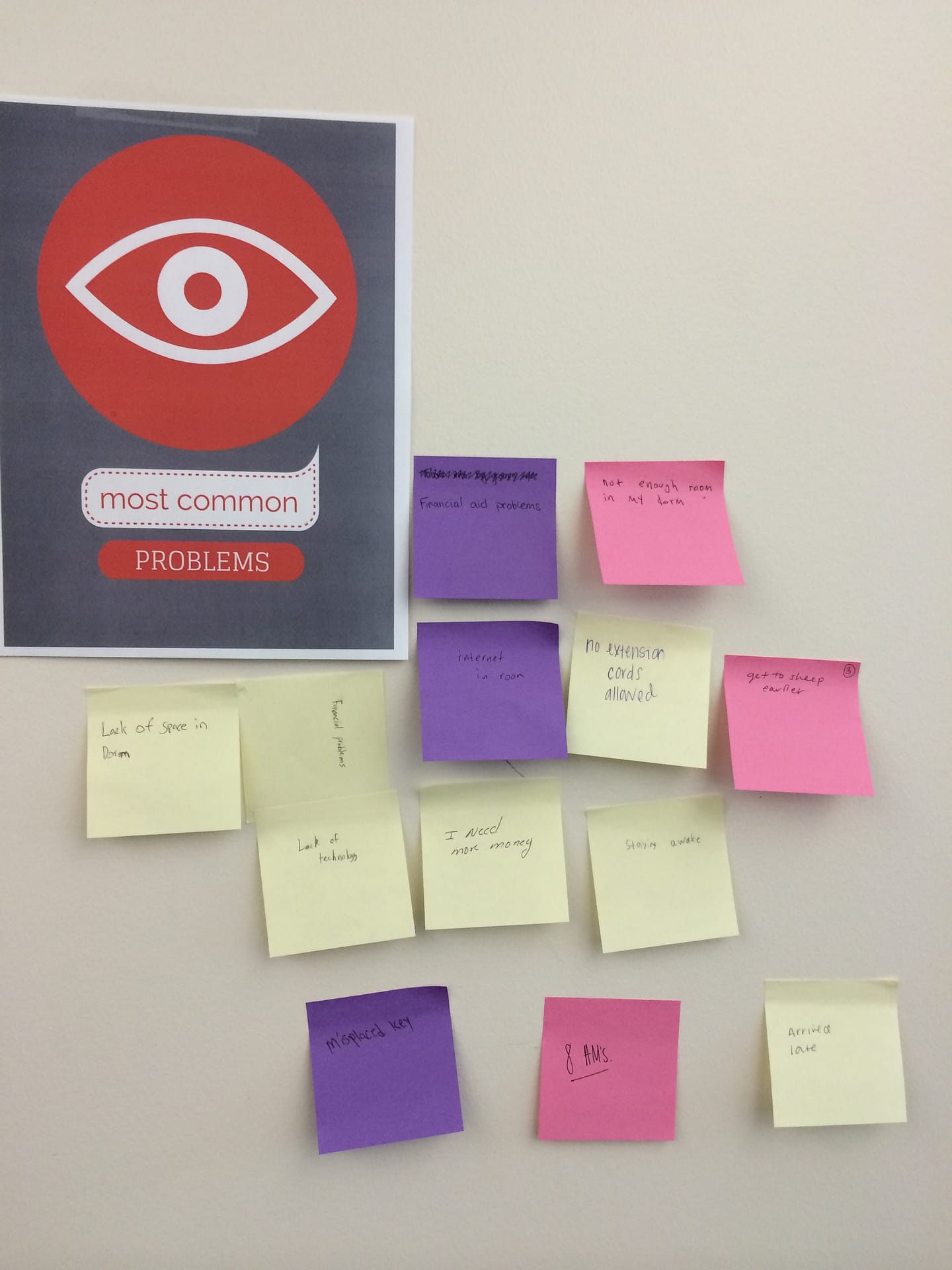
mostcommon-sticky
Sticky note exercise: Signs were created using the easy-to-use graphics editor called Canva.com

I'm teaching three sections of Introduction to Business, in addition to one marketing elective. I've taught Introduction to Business over twenty times, previously, just not three times in the same semester.

We started out with an exercise designed to help them get to know each other and start to think about how entrepreneurs come up with ideas.

I shared how many business ideas are the result of attempts to solve problems.

There was recently a story from Wired Magazine about the invention of a gadget that helps solve the problem of doctors not washing their hands thoroughly enough. Another example came from college students looking to reduce date rape incidents through their creation of nail polish that changes color when exposed to date rape drugs.

[Read more…] about Sticky notes as a teaching tool

Filed Under: Teaching Tagged With: teaching

Stop yourself from becoming a digital hoarder

By Bonni Stachowiak | August 26, 2014 | | XFacebookLinkedInEmail

How do we know when we have truly gained the trust of a colleague in academia? For some of you, it may be when you are asked for advice. For others, perhaps it is when your help is requested. For me, it seems to be when people are willing to confess that they have become digital hoarders.

Digital hoarder

This first happened about four years ago. My friend admitted that she had been letting people down and not following through with her commitments. Let's call her Laura. I'll admit to having been sometimes frustrated that she didn't get back to me on stuff, since we were on committees together and our paths crossed regularly in our work. It was easy to forgive her, though, because I know Laura cared so much and had so much on her plate. What I didn't realize at the time was her big secret as to why she was getting increasingly worse at managing her life as a professor.

We were in my office and she finally broke down and cried one day. Laura had forgotten about a meeting she was supposed to attend and had no idea how on earth she was going to get things together for an end-of-the-year event. She said she just couldn't keep up with it all, particularly the email. We talked around the issue for a few minutes, but then got to the heart of the matter. She had more than 7,000 emails in her inbox, much of which she associated with unfinished business.

The costs of having a lot of digital clutter aren't immediately evident. Storage costs for data have come down so much that IT departments keep raising the storage they make available to us and it is easy for us to buy another hard drive or sign up for another cloud service. The costs come when we think about how much time we spend trying to find what we need, or having to start over again with something. There's also the stress of having a system we don't trust.

Here are four steps to stop yourself from becoming a digital hoarder:

[Read more…] about Stop yourself from becoming a digital hoarder

Filed Under: Personal knowledge mastery Tagged With: pkm

Cultivating character

By Bonni Stachowiak | August 19, 2014 | | XFacebookLinkedInEmail

It isn't just about getting students not to cheat. It's about them cultivating character and developing into people who can make good decisions in a complex world.

cultivating character

The headline reads like something from the online satirical news site, The Onion.

Professor plagiarized plagiarism definition in textbook, co-author says

However, as the headlines started to spread, none of the sources were from anything but actual news organizations. As more stories about this co-author's accusation emerge, the defense from the accused (or at least those who are speaking for him) seems to be that he neglected to cite the quote correctly, not that he intended to do anything dishonest. Let's keep in mind that the guy we are talking about here is a person who wrote a book about plagiarism, who supposedly should be among the leading sources on how to cite correctly. The university has conducted an investigation and suggests that the problem happened on the publisher's end, with citations being removed from the work. While they have concluded their focus on the matter, questions still exist as to the root causes.

This story was revealed after we recently learned that Senator John Walsh had plagiarized large portions of his thesis, while at the Army War College. While there are some plagiarism charges that are less clear cut and sometimes used as a means to launch an attack on an opponent, the kind of dishonesty I am writing about for this article is the type that is easily identified.

As the news cycle seems to have hit on another supposed pattern of academic dishonesty, it is easy to focus on the individuals that the media has made take center stage. While I do want those who chose to take that route to be held accountable, I also hope that those of us in academia can be thinking about ways that we contribute to these incidents occurring.

The profession of accounting has a model that can help us conceptualize how we might better cultivate character in our students. Criminologist Donald R. Cressey articulates how fraud is perpetuated by three forces working together in what he calls the fraud triangle: opportunity, motivation, and rationalization. Let's consider the three ways we avoid cultivating character in our students:

We give them opportunity

More than half of the time, the students I catch plagiarizing have been in college or graduate school for some time. This is not their first class. I typically discover that this is the first time a professor has ever used any type of plagiarism detection service with their work. When I first started teaching in higher ed and such services were not available to me, I used to be able to determine (or so I thought) pretty easily when students' writing was not their own. However, the vast majority of the time when issues arise today, I would never have caught it on my own, without the support of TurnItIn.com.

We don't take away their motivation

I've written previously about what my students have taught me about plagiarism. I'm still struck by one of the young women telling me that it was clear to her that when plagiarism happens in my classes, the consequences are severe. She couldn't imagine it would be worth it to anyone to take the risk. I loved her transparency. We can use the disincentive that holding students accountable for their actions can provide us.

We let them rationalize their choices

A natural response to being confronted with our unethical behavior can be to try to excuse it as something that isn't really them. “You have to understand. I'm just not like that.” When I have heard that response, I attempt to get the student to a place where he or she can begin to name the choice they made. The next step I hope they can take is to see that when we do “a thing” – we are the kind of person who does “that thing.” When we behave a particular way, we are the kind of person who behaves that way. When we don't attribute other people's words and ideas to them, we are the kind who steals other people's words and ideas. The final place I work to influence toward is where students can build a foundation of values that are in alignment with the choices they make. This important aspect of cultivating character is to help people identify, name, and acknowledge what it is they have done.

[reminder]How to you work to cultivate character in your students? Where are we allowing for more opportunity, motivation, and rationalizations to contribute to an environment where cheating flourishes? [/reminder]

Filed Under: Teaching Tagged With: character, cheating, plagiarism

  • « Go to Previous Page
  • Page 1
  • Interim pages omitted …
  • Page 51
  • Page 52
  • Page 53
  • Page 54
  • Page 55
  • Interim pages omitted …
  • Page 70
  • Go to Next Page »

TOOLS

  • Blog
  • Podcast
  • Community
  • Weekly Update

RESOURCES

  • Recommendations
  • EdTech Essentials Guide
  • The Productive Online Professor
  • How to Listen to Podcasts

Subscribe to Podcast

Apple PodcastsSpotifyAndroidby EmailRSSMore Subscribe Options

ABOUT

  • Bonni Stachowiak
  • Speaking + Workshops
  • Podcast FAQs
  • Media Kit
  • Lilly Conferences Partnership

CONTACT

  • Get in Touch
  • Support the Podcast
  • Sponsorship
  • Privacy Policy

CONNECT

  • LinkedIn
  • Instagram
  • RSS

CC BY-NC-SA 4.0 Teaching in Higher Ed | Designed by Anchored Design