• Skip to primary navigation
  • Skip to main content
  • Skip to footer

Teaching in Higher Ed

  • Podcast
  • Blog
  • SPEAKING
  • Media
  • Recommendations
  • About
  • Contact

Guest on Luminaris Podcast

By Bonni Stachowiak | June 30, 2015 | | XFacebookLinkedInEmail

Click to access the podcast on the Luminaris site.

I was honored to be asked to be a guest on episode 07 of the Luminaris Podcast, hosted by Mark Hofer.

We spoke about the opportunities for “Connecting with others around teaching and learning,” through 50 podcast interviews on Teaching in Higher Ed.

markThe Luminaris Podcast host, Mark Hofer, is an Associate Professor of Education at William and Mary. We both listen to each others' podcasts, so it felt like we already knew each other as we had our dialog. Mark is a great interviewer, though I'm also looking forward to switching roles in the future. He's already agreed to be on an upcoming episode of Teaching in Higher Ed.

If you haven't been listening to the Teaching in Higher Ed podcast for too long, I speak with Mark about some of my favorite episodes on his podcast. He includes links in his post for the episode, in case you want to go back and catch some of the older shows.

Mark is also active on Twitter and worth following.

Filed Under: Resources Tagged With: podcast, teaching

Choose your own adventure learning (part 2)

By Bonni Stachowiak | June 16, 2015 | | XFacebookLinkedInEmail

choose-your-own-adventure-learning

I wrote a post about how I provided some Choose your own adventure-style learning for my students last semester. In the comments, Doug McKee indicated that it sounded like it would wind up being much harder than a “normal class” and asked if that was a fair assumption to make.

The question seemed worthy of a follow up post to my prior blog entry about Choose your own learning.

The inherent challenges of course design

I will say upfront that it is challenging to assess what additional time was required, since it was my first time teaching the course at the undergraduate level. Whenever I do that, I spend an enormous amount of time crafting learning outcomes, developing rubrics for each assignment, and on instructional design.

Someone who had taught a class previously, but just wanted to add the component of choose your own adventure would have a lot less work to do than I did last semester.

Questions to address before adopting this approach

Here are some of the areas I've identified that would require additional planning and thinking for a choose your own adventure type approach:

How will you handle exams, when not all students in the class will take them?

  • I taught the course in a three-hour block, so it was easy to schedule the exams as the last activity for the night. Those not taking the exam just left after the first two hours of instruction.

How strict will you be about the class policies you set up for this approach?

  • I had a form that students completed with their points designation, which states that changes could not be made after the fact. I wound up making changes on a number of fronts and would probably figure out other wording to use in the future to reflect what are likely to be my true actions when changes are warranted.

How can you structure the potential options for earning points to be sure that all learning outcomes are assessed?

  • My course had four modules and one comprehensive exam or assignments. I required that students take at least three of the five exams and earn points for some assignment related to the fourth module they potentially wouldn't be taking an exam on.

How will you structure your grade book to show progress toward total points in the class?

  • I was transparent with the students that the way the grade book was set up, they would have to do figuring on their own of how they were progressing toward a desired grade in the class. I didn't have a way to set up individual reports for students, based on the ways they selected to earn points during the semester.
  • This didn't wind up to be too problematic. Half of the class was comprised of accounting majors, who were all quite comfortable with projecting their own grades, individually. The remainder of the students were highly mature and also either kept a close eye on their points, or weren't as concerned about their grade in the class.

How will you track students' selected assignments?

  • I used a form that the students filled our during the second night of class (after hearing about it and receiving the dome during the first session). Then, I made a photocopy for me and handed the originals back to the students. This became problematic when I scanned the documents and recycled the copies.
  • I didn't notice until too late that the items each student had checked did not show up on the scanned copy, except in a few cases. Even then, the documents were difficult to sort through and manage. Some students also lost their originals throughout the semester and had to rely on memory for what they had chosen.
  • Next time I use some kind of choose your own adventure style, I will use a Google form for collecting the students' point selections. I'll have each student include their email address on the form and will set up a mail merge to send each student their selections.

Yes, using a choose your own adventure state of teaching took some additional time, versus having a standard set of assignments. However, I can refine my processes over time and probably carve that down to something almost negligible in the long run.


Filed Under: Teaching Tagged With: teaching

New tools page added

By Bonni Stachowiak | June 2, 2015 | | XFacebookLinkedInEmail

I added a new page to the Teaching in Higher Ed site. My hope is that the tools page is constantly changing, as I have new productivity or educational technology tools that I add into the mix.

In the meantime, check out the newly-added tools page.

[reminder]What are some of the essential tools that you use in your teaching or personal productivity?[/reminder]

Filed Under: Resources Tagged With: edtech, productivity, tools

Turbo-charge your summer

By Bonni Stachowiak | May 26, 2015 | | XFacebookLinkedInEmail

summer

It's official. I'm on summer break. I'm also healthy enough to be back to exercising and hanging out with the kids.

My mind is full of all the things I would like to do during the break to make the 2015-2016 academic year better than this past one. I had a good time teaching, but just felt like I was running to keep up the entire time. People say that's normal with two small children at home, but I yearn for a bit more preparation to occur before diving back in again.

In the meantime, I do want to recharge my batteries and capitalize on the opportunities to try and learn new things. Here are a few actions I've taken in the past to try to turbo-charge my summer that have worked well:

Share a meal with someone in a different discipline

One of the many things I'm grateful for about getting to do the Teaching in Higher Ed podcast is all of the experts I get to talk to in such different disciplines than mine. At first, I was incredibly intimidated to speak with some who I only had the most  shallow understanding of what they teach. However, I'm glad I pressed on, as I've found I'm learning far more than I bargained for when the podcast began.

If you're not able to get together for lunch or dinner, perhaps try the next best thing.

Listen to a podcast in an entirely different discipline than yours

Doug McKee recommended the Very Bad Wizards podcast to me a few months ago. It is a dialog between Tamler Sommers (a philosopher) and David Pizarro (a psychologist). They describe themselves as people who “share a love for ethics, pop culture, and cognitive science.” They also are quite funny and crass (in the best way possible).

I've enjoyed being challenged by the few episodes I've listened to so far. One recommendation I would have for those of you who really want to maximize your learning is to review the show notes for an episode before you listen to it and read the articles they post before listening.

Watch something purely for the fun of it

As I mentioned on episode #049, I spent another week in May with a cold. There's something seriously wrong when you can't keep yourself healthier than the people who stick things they find on the ground in their mouths on a regular basis. One upside to being ill was the excuse to binge watch House of Cards, a Netflix original series.

Now I'm going to want to listen to some of Slate's podcasts about House of Cards, as I understand they have some experts come and and compare real-world politics with the fictitious politics in House of Cards.

[reminder]How will you be maximizing any time off you have to turbo-charge your summer? [/reminder]

Filed Under: Resources

Choose your own adventure learning

By Bonni Stachowiak | May 5, 2015 | | XFacebookLinkedInEmail

choose-your-own-adventure-learning

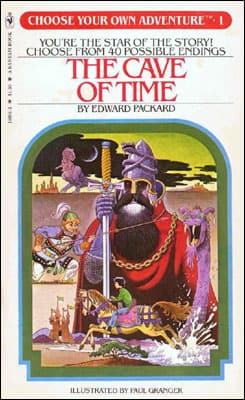
When I was a kid, one of my favorite forms of story telling was the Choose Your Own Adventure series. The books were written in a non-linear way, allowing me to grapple with how I would handle a particular situation.

Cave_of_timeEvery couple of pages brought forth a dilemma with two or three possible routes to take. If I wanted to choose option A, I was directed to turn to a specific page. Option B took me to an entirely different part of the book. You could read the book repeatedly and get a different story each time.

Edward Packer created the series of books out of an exchange he had with his daughters. He used to tell them stories each night about a character named Pete. One day, he ran out of adventures to send Pete on and he asked his children what they thought Pete should encounter that night.

When he saw how engaged his daughters became, he decided to extend the idea into written form. The Choose Your Own Adventure series was quite successful, selling 250 million copies between 1979 and 1999.

Choose Your Own Adventure Learning

The idea for using a choose your own adventure style of instruction for my business ethics course came, initially, from my desire to incorporate some type of undergraduate research into the class. Bethany Usher was on episode 27 of Teaching in Higher Ed and was such an inspiration to me to begin to engage in the messy work of leading undergraduate research.

I wound up failing in my ability to get traction with any kind of formal research projects, but I did start to think more about approaching the class in a more flexible manner than my typical syllabi afford students.

Goals

As I started to put together a framework for the assessment for the learning, I kept a few goals in mind.

1) Offer varied methods for demonstrating learning

I wanted to be sure that students were assessed on each, main, learning outcome for the class. However, I also wanted students to be given choices as to how they might demonstrate their learning.

2) Help students discover their strengths

Instead of having students focus on improving their weak areas, my desire was that this course would help them identify and amplify their strengths.

3) Ask students to take responsibility for their learning

I also hoped that students would be more autonomous in their learning and have some of their childlike curiosity sparked.

Structure

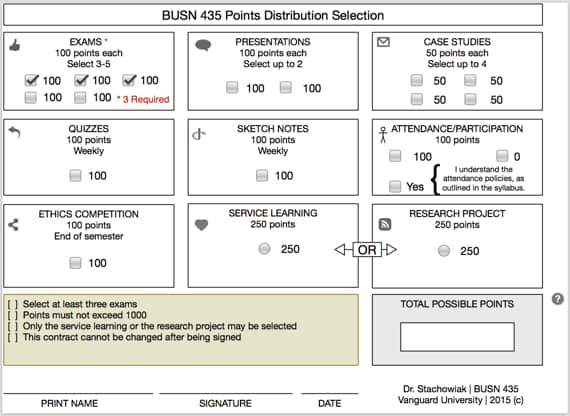
I started by putting together a graphic that showed the students the various ways they had to demonstrate their learning throughout the semester and the associated potential point values.

busn435-pointsdistribution

In order to ensure that students demonstrated learning in each of the four primary learning outcomes, they were required to take at least three exams (out of a possible five).

Each student chose a combination of points that added up to 1000 and only contained one project worth 250 points (the service learning or research project).

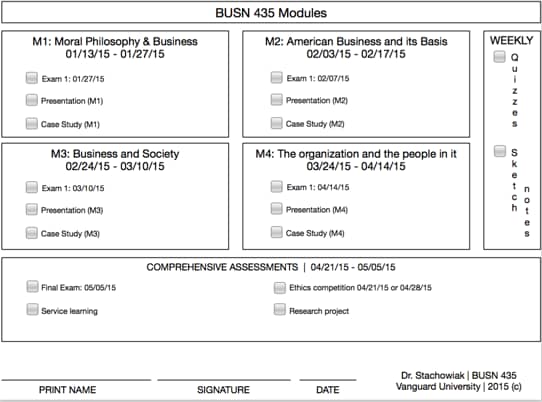
Then, I showed them how the various assignments were timed throughout the semester.

module-timing

Some assignments were based on the four modules, each around 3-4 weeks apart. I had students use the scheduling service, Doodle, to sign up to give their in class presentations.

The timing of the exams was not flexible, as they occurred in class and were only offered on a single night of class. The timing of the weekly assignments was also not flexible, as they were designed to be reinforcement for before the class sessions were held.

There were a series of comprehensive assignments, which were assessed in the last few weeks of the semester. Some of our graduating accounting majors put together this video on how to create more ethical business practices through internal controls, as their service learning project.

The intent was that it could help people with limited business experience reduce their risk of fraud. One area that I know I need to improve on the next time I teach this class is to have more measurable outcomes surrounding what “done” looks like for these projects. While I was incredibly impressed with the video, I had hoped that they would have a particular group of individuals who could be helped by it.

I'm disappointed that I didn't outline my expectations more effectively, but am also reminded of what my friend, Doug McKee, says:

If you aren't failing at teaching, you aren't trying hard enough.

Results

On the final week of our class, I asked the students to give input as to what worked and what didn't about the way the class was structured. I had been candid with them in the beginning about my experimentation with this format and we had made some tweaks along the way as we discovered problems with my initial design.

The students were excited to share their feedback with me on how much they liked the class structure.

Here are some of the notes I took that relate directly to the Choose Your Own Adventure learning approach:

We got to play to our strengths.

I could schedule the assignments around my other classes' exam and assignment dates.

It shifted the responsibility for learning from you, as the professor, to us, as the students.

I liked being able to decide whether or not attendance was going to be a factor in my grade for this class.

The flexibility of this structure was great.

Planning out which assignments I would do when also helped me do a little thinking about my learning, in advance of right around when the assignment was due, like I do in so many of my other classes.

It was rewarding to discover that the goals I had set out for this experiment were achieved. I also found other aspects to the approach that I hadn't even anticipated as a potential benefit.

Other ideas

I wasn't surprised when I discovered that I'm not the only person to have had the idea to make a class in to a Choose Your Own Adventure format. Here are 20 ideas for ways you might use a similar format in your classes.

[reminder]Let us know what ways you have given your students more control over their own learning. [/reminder]


Filed Under: Teaching Tagged With: instructional_design, teaching

  • « Go to Previous Page
  • Page 1
  • Interim pages omitted …
  • Page 44
  • Page 45
  • Page 46
  • Page 47
  • Page 48
  • Interim pages omitted …
  • Page 70
  • Go to Next Page »

TOOLS

  • Blog
  • Podcast
  • Community
  • Weekly Update

RESOURCES

  • Recommendations
  • EdTech Essentials Guide
  • The Productive Online Professor
  • How to Listen to Podcasts

Subscribe to Podcast

Apple PodcastsSpotifyAndroidby EmailRSSMore Subscribe Options

ABOUT

  • Bonni Stachowiak
  • Speaking + Workshops
  • Podcast FAQs
  • Media Kit
  • Lilly Conferences Partnership

CONTACT

  • Get in Touch
  • Support the Podcast
  • Sponsorship
  • Privacy Policy

CONNECT

  • LinkedIn
  • Instagram
  • RSS

CC BY-NC-SA 4.0 Teaching in Higher Ed | Designed by Anchored Design