• Skip to primary navigation
  • Skip to main content
  • Skip to footer

Teaching in Higher Ed

  • Podcast
  • Blog
  • SPEAKING
  • Media
  • Recommendations
  • About
  • Contact

Personal knowledge mastery

Curated Episodes that Have Most Impacted My Teaching

By Bonni Stachowiak | October 12, 2016 | | XFacebookLinkedInEmail

NetworkLinked In used to provide a way for us to visualize our network connections in a graphical format. After talking with Bonnie Stewart, recently, about networked pedagogy, I keep wondering how my map has changed since I first wrote this reflection on my network visualization more than five years ago.

Certainly, more of my connections initiate from social media now. I have found more of what Seth Godin calls a tribe through virtual connections, than I ever do in my local community.

When I want to lament about race relations in the United States, I'm just as likely to reach out to my Egyptian friend, Maha Bali, than I am to people I see face-to-face. I find far more challenging and creative teaching ideas through the blogs I subscribe to, than I do in hallway conversations.

I was honored to be interviewed by Lina Gomez for a forthcoming episode of Utopistica a couple of weeks ago. She asked me one question that was incredibly difficult to answer. She wanted to know which Teaching in Higher Ed interview has impacted me the most, in terms of it being challenging and encouraging. I wanted to go with the safe answer and say that I just couldn't narrow it down.

Instead, I shared that it was probably the episode with Ken Bain, since I'm still thinking about how to capture the essence of my courses through a compelling question. His precise challenge to us was to think of the following as we design (and redesign) each of our courses:

Ask engaging questions that spark people’s curiosity and fascination that people find intriguing… – Ken Bain

Also, I made a complete idiot out of myself on the episode, when I read, verbatim, the autocorrected version of The Minerva Prize as “The Manure Prize.”

I decided to create an actual Manure Award that we award annually, to professors who share their failures with the community. The first Manure Award was presented to Maha Bali on episode #100 of the podcast. Others shared their failure stories that encourage us to continue to take risks in our teaching and never settle for safe.

There are so many other episodes that continue to “speak” to me daily in my work. If I would have thought it was appropriate during the Utopistica interview, I probably would have tried to squeeze at least ten episodes into the conversation, that continue to shape me and challenge me today.

Ten Episodes that Shape My Teaching Daily

  1. Episode 19: Cheating Lessons, with James Lang
  2. Episode 30: Teaching Naked, with Jose Bowen
  3. Episode 23: Teaching with Twitter with Jesse Stommel (and more so from what he says about kindness on the episode than even the other magnificent things he had to say about Twitter)
  4. Episode 71: Flipping Out with Derek Bruff (he competely changed my thinking about the best approach for the flipped classroom / blended learning)
  5. Episode 72: How to Use Cognitive Psychology to Enhance Learning with Robert Bjork (the most observable differences in my teaching from before learning about retrieval practice to after come from this conversation with Robert Bjork, when I was first introduced to the approach)
  6. Episode 92: Small Teaching, with James Lang (currently, the most listened to episode)
  7. Episode 87: What the Best Digital Teachers Do, with Sean Michael Morris
  8. Episode 118: Teacher Becomes Student Through LIFE101, with Mike Wesch (even though it is a recent one, I already know this conversation is going to continue to shape my teaching for years to come)
  9. Episode 112: Radical Hope: A Teaching Manifesto, with Kevin Gannon
  10. Episode 107: Engaging Learners, with Gardner Campbell

The list, above, is not in any particular order. Let's just say I had about 10-15 other tabs open in my browser for consideration. I tried to keep this list as episodes that have observably changed my teaching, versus ones that I think are full of tremendous ideas that I haven't been able to act on just yet.

I am so thankful for all the people who have accepted the invitation to be on the podcast. It is humbling to get to talk to such phenomenal teachers each week.

How about you? What episode(s) has most shaped your teaching?
 

Filed Under: Personal knowledge mastery

Practicing curation

By Bonni Stachowiak | March 8, 2016 | | XFacebookLinkedInEmail

CURATION

I shared with my doctoral students this past weekend about the power of personal knowledge management (PKM). Specifically, I attempted to address the benefits of having a trusted curation process that is built for the present and the future.

The value of having information available to you when you need it is difficult to articulate until people get to experience it for themselves. Part of being overwhelmed by things flying at us seems to be the shutting down anything that isn't immediately demonstrating a pressing need.

I came across two articles this week that were of immediate value to me:

1) An Apple Pencil-drawn review of the Apple Pencil

I've had an Apple Pencil for a little over a month now and really enjoyed seeing the device through Serenity Caldwell‘s eyes.

2) What's really to blame for the failures of our learning management systems?

Our institution is currently evaluating a potential change in our learning management system, or at least a substantial upgrade to our existing one. The article cracked me up, since some of the events described in the piece are happening to us as I write this.

At least you've got to be able to laugh at yourself in this life…

The couple other articles I discovered this week aren't ones I am instantly going to do something with, but will no doubt be of value down the road:

1) Small changes in teaching: The last five minutes of class

James Lang is such a wonderful author and gives fabulous advice in this piece. However, this week is primarily made up of exams in my classes and next week is our Spring break. I have captured his ideas in my bookmarking system (Pinboard.in) and will follow up at such a time as when I have an opportunity to try some new approaches in my teaching.

I will get more out of his article if I review it, again, when I am able to start experimenting with his suggestions. In the meantime, it has been saved under my teaching bookmarks.

2) This website simulates what dyslexia is really like

I saw this tool on Twitter and was instantly captivated by the idea that we might be able to have more empathy for those with dyslexia by seeing through their eyes…

The article has been saved under my disability bookmarks and no doubt will prove to be useful when I am working with faculty to have a better sense of why certain accommodations are made for our students.

[reminder] What have you come across this week that either had immediate or future benefit to you? [/reminder]


Filed Under: Personal knowledge mastery Tagged With: curation, pkm

15 lessons from 2015's podcasts (part 3)

By Bonni Stachowiak | January 19, 2016 | | XFacebookLinkedInEmail

This is a multi-part post in which I practice my curation skills and share what I'll be taking in to 2016 from the past year's podcasting efforts.

You may want to start with part 1 and part 2, if you want to get all 15 lessons.

Lesson #11

Create regular opportunities for retrieval.

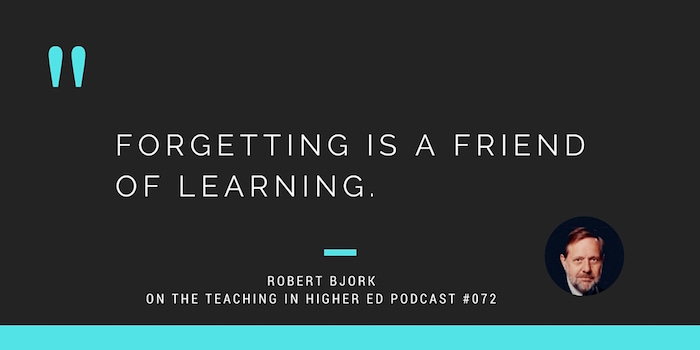
Robert Bjork described the strength of attempting to retrieve information out of our brains as we are learning. Even if my students wind up not being able to come up with an answer, their brains will still be making new connections when they are reminded of the missing data.

That's why Bjork says that “forgetting is a friend of learning.”

bjork-tihe-quote1

https://teachinginhighered.com/72

Lesson #12

We like to pick people who are like us and that's not a good thing when choosing groups for projects.

Jim Sibley has been in my head since the episode he was a guest on, as I contemplate whether I should change the way groups are formed for projects in my various classes. This is still something I am reflecting on and I haven't made any firm changes as I write this. However, it still seems like  “lesson” from 2015 since it is still challenging my thinking in this way.

https://teachinginhighered.com/73

Lesson #13

Something amazing happens when we go public in our scholarship.

Kris Shafer inspired me greatly on episode 74, as he spoke about his public scholarship efforts. As he has introduced this idea to his students, he helps them navigate the online world in all of its complexity and discover news ways to influence.

https://teachinginhighered.com/74

Lesson #14

Keep getting better by “teaching out loud.”

Doug McKee has been on the show now a couple of times (and I hope we're just getting started!). He also is a co-host of the Teach Better podcast and regularly blogs about his quest for continually improving his teaching skills. He inspires me to never let up in my pursuit of excellence in facilitating learning.

https://teachinginhighered.com/76

Lesson #15

There are many advantages to teaching what you don't know.

This seems like the secret no one wants to talk about. We sometimes are scheduled to teach classes outside of our content expertise.

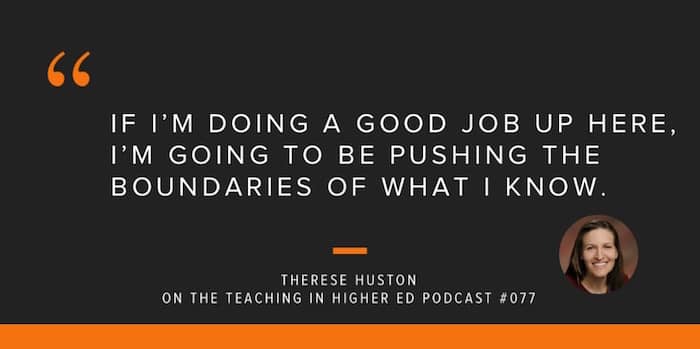
Therese Huston helped me see that I'm not alone in this reality – – and that there are a number of strategies I can take in order to provide higher quality learning experiences for my students when I wind up teaching what I don't know…

theresehuston

https://teachinginhighered.com/77

[reminder]What is a lesson you're taking from the Teaching in Higher Ed podcast into 2016? [/reminder]

Filed Under: Personal knowledge mastery Tagged With: curation, pkm, teaching

15 lessons from 2015’s podcasts (part 3)

By Bonni Stachowiak | January 19, 2016 | | XFacebookLinkedInEmail

This is a multi-part post in which I practice my curation skills and share what I'll be taking in to 2016 from the past year's podcasting efforts.

You may want to start with part 1 and part 2, if you want to get all 15 lessons.

Lesson #11

Create regular opportunities for retrieval.

Robert Bjork described the strength of attempting to retrieve information out of our brains as we are learning. Even if my students wind up not being able to come up with an answer, their brains will still be making new connections when they are reminded of the missing data.

That's why Bjork says that “forgetting is a friend of learning.”

bjork-tihe-quote1

https://teachinginhighered.com/72

Lesson #12

We like to pick people who are like us and that's not a good thing when choosing groups for projects.

Jim Sibley has been in my head since the episode he was a guest on, as I contemplate whether I should change the way groups are formed for projects in my various classes. This is still something I am reflecting on and I haven't made any firm changes as I write this. However, it still seems like  “lesson” from 2015 since it is still challenging my thinking in this way.

https://teachinginhighered.com/73

Lesson #13

Something amazing happens when we go public in our scholarship.

Kris Shafer inspired me greatly on episode 74, as he spoke about his public scholarship efforts. As he has introduced this idea to his students, he helps them navigate the online world in all of its complexity and discover news ways to influence.

https://teachinginhighered.com/74

Lesson #14

Keep getting better by “teaching out loud.”

Doug McKee has been on the show now a couple of times (and I hope we're just getting started!). He also is a co-host of the Teach Better podcast and regularly blogs about his quest for continually improving his teaching skills. He inspires me to never let up in my pursuit of excellence in facilitating learning.

https://teachinginhighered.com/76

Lesson #15

There are many advantages to teaching what you don't know.

This seems like the secret no one wants to talk about. We sometimes are scheduled to teach classes outside of our content expertise.

Therese Huston helped me see that I'm not alone in this reality – – and that there are a number of strategies I can take in order to provide higher quality learning experiences for my students when I wind up teaching what I don't know…

theresehuston

https://teachinginhighered.com/77

[reminder]What is a lesson you're taking from the Teaching in Higher Ed podcast into 2016? [/reminder]

Filed Under: Personal knowledge mastery Tagged With: curation, pkm, teaching

15 lessons from 2015's podcasts (part 2)

By Bonni Stachowiak | January 12, 2016 | | XFacebookLinkedInEmail

This is a multi-part post in which I practice my curation skills and share what I'll be taking in to 2016 from the past year's podcasting efforts.

You may want to start with part 1, if you want to get all 15 lessons.

Lesson #6

It takes daily discipline to demonstrate the respect our students deserve.

While I have always cringed when colleagues at my institution have gone on a social media rampage to vent about their students, I will admit to having chuckled at some learners' version of historical events.

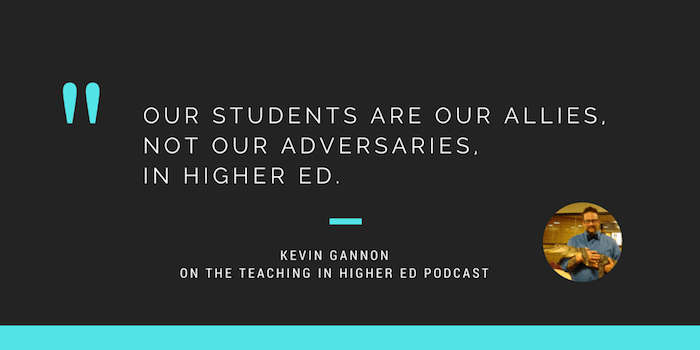
Kevin Gannon has been the “voice in my head” that ensures I only poke fun of myself on social media, instead of my students. There's plenty of material to draw from there.

kevin-gannon-quote

https://teachinginhighered.com/52

Lesson #7

People who are not like me are crucial to my lifelong learning.

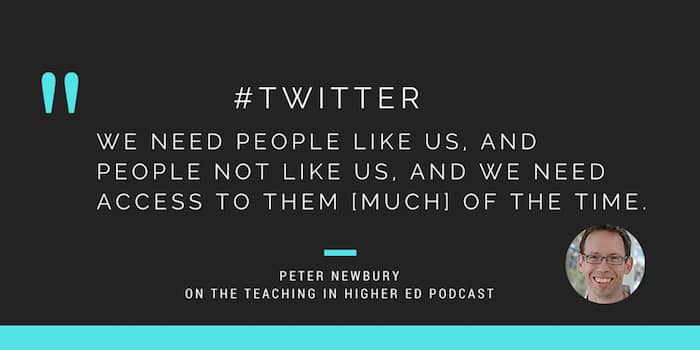
On episode #053 Peter Newbury stressed the importance of having people who aren't like us in our personal learning network (PLN). I've thought, often, about the need to strengthen that aspect of my network and have benefitted from those times when I attempted to integrate someone who is unlike me into my personal knowledge management system.

peter-newbury-quote71

https://teachinginhighered.com/53

Lesson #8

Kindness matters

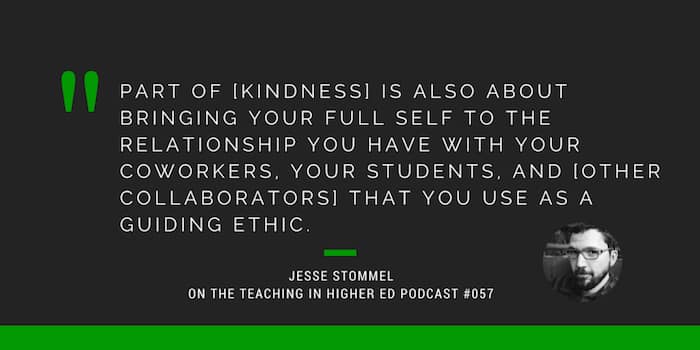
While I like to think that I have worked at not being rude to my students in the past, I certainly didn't contemplate ways I could be more kind. Jesse Stommel stated that kindness is a centerpiece of his teaching. He has challenged me to think more about what that might look like if it were the case with me, too.

jesse-stommel-quote31

https://teachinginhighered.com/57

Lesson #9

It's gonna get messy

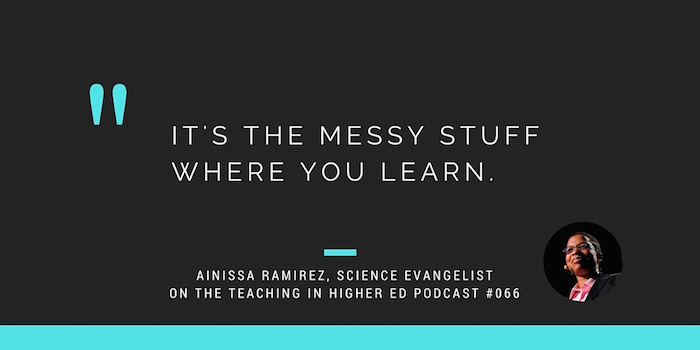
I've been surprised at how much messiness comes up on the podcast. Ainissa Ramirez spoke about learning happening after things get messy.

ainissa-tihe66-quote5

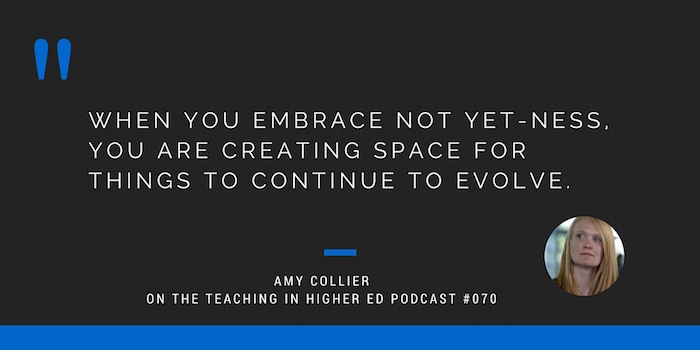
Amy Collier also introduced the term ‘not yet-ness' to me and helped me be more willing to take risks in my teaching.

amy-colliertihe70-quote11

https://teachinginhighered.com/70

Lesson #10

Creating “times for telling” is more important than adhering to a consistent schedule/format in hybrid classes

Derek Bruff shared about his flipped learning model, which is quite different from how I've been approaching hybrid classes. He has continued to challenge me as I consider ways that I can create more “times for telling” in my classes and not stick so rigidly to my schedule/format of introducing concepts online before bringing them into the classroom.

https://teachinginhighered.com/71

Part 3 – coming soon

Stay tuned for next week's post with part 3 of lessons learned from podcasting in 2015.

[reminder]What is a lesson you're taking from the Teaching in Higher Ed podcast into 2016? [/reminder]

Filed Under: Personal knowledge mastery

  • « Go to Previous Page
  • Page 1
  • Interim pages omitted …
  • Page 7
  • Page 8
  • Page 9
  • Page 10
  • Page 11
  • Interim pages omitted …
  • Page 13
  • Go to Next Page »

TOOLS

  • Blog
  • Podcast
  • Community
  • Weekly Update

RESOURCES

  • Recommendations
  • EdTech Essentials Guide
  • The Productive Online Professor
  • How to Listen to Podcasts

Subscribe to Podcast

Apple PodcastsSpotifyAndroidby EmailRSSMore Subscribe Options

ABOUT

  • Bonni Stachowiak
  • Speaking + Workshops
  • Podcast FAQs
  • Media Kit
  • Lilly Conferences Partnership

CONTACT

  • Get in Touch
  • Support the Podcast
  • Sponsorship
  • Privacy Policy

CONNECT

  • LinkedIn
  • Instagram
  • RSS

CC BY-NC-SA 4.0 Teaching in Higher Ed | Designed by Anchored Design