• Skip to primary navigation
  • Skip to main content
  • Skip to footer

Teaching in Higher Ed

  • Podcast
  • Blog
  • SPEAKING
  • Media
  • Recommendations
  • About
  • Contact

Personal knowledge mastery

15 lessons from 2015's podcasts (part 2)

By Bonni Stachowiak | January 12, 2016 | | XFacebookLinkedInEmail

This is a multi-part post in which I practice my curation skills and share what I'll be taking in to 2016 from the past year's podcasting efforts.

You may want to start with part 1, if you want to get all 15 lessons.

Lesson #6

It takes daily discipline to demonstrate the respect our students deserve.

While I have always cringed when colleagues at my institution have gone on a social media rampage to vent about their students, I will admit to having chuckled at some learners' version of historical events.

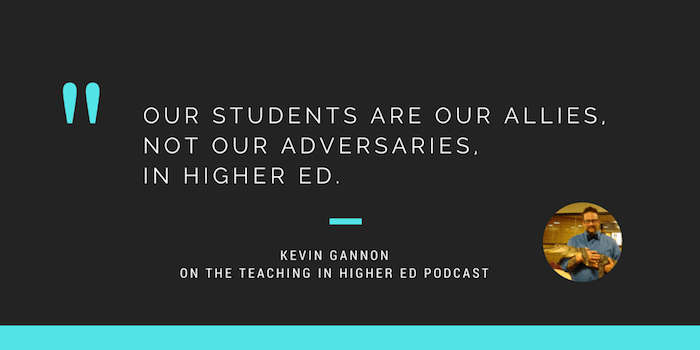
Kevin Gannon has been the “voice in my head” that ensures I only poke fun of myself on social media, instead of my students. There's plenty of material to draw from there.

kevin-gannon-quote

https://teachinginhighered.com/52

Lesson #7

People who are not like me are crucial to my lifelong learning.

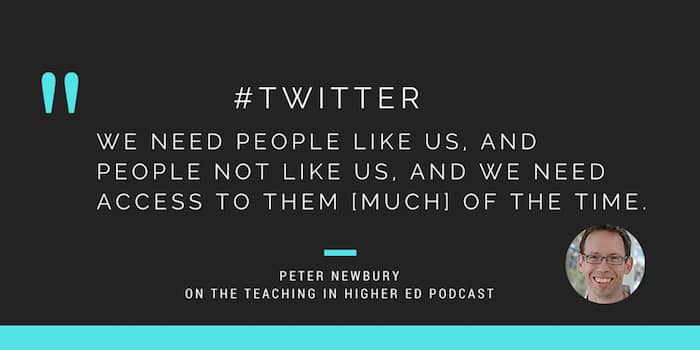
On episode #053 Peter Newbury stressed the importance of having people who aren't like us in our personal learning network (PLN). I've thought, often, about the need to strengthen that aspect of my network and have benefitted from those times when I attempted to integrate someone who is unlike me into my personal knowledge management system.

peter-newbury-quote71

https://teachinginhighered.com/53

Lesson #8

Kindness matters

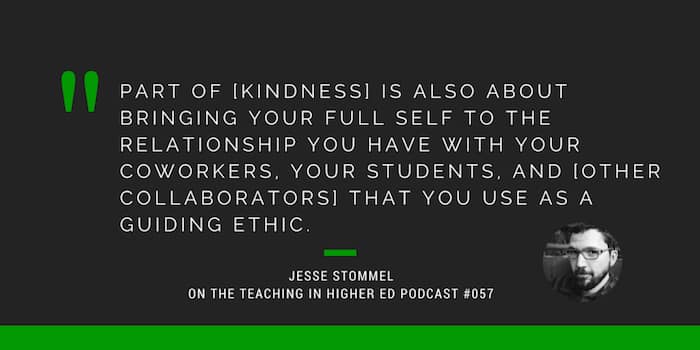
While I like to think that I have worked at not being rude to my students in the past, I certainly didn't contemplate ways I could be more kind. Jesse Stommel stated that kindness is a centerpiece of his teaching. He has challenged me to think more about what that might look like if it were the case with me, too.

jesse-stommel-quote31

https://teachinginhighered.com/57

Lesson #9

It's gonna get messy

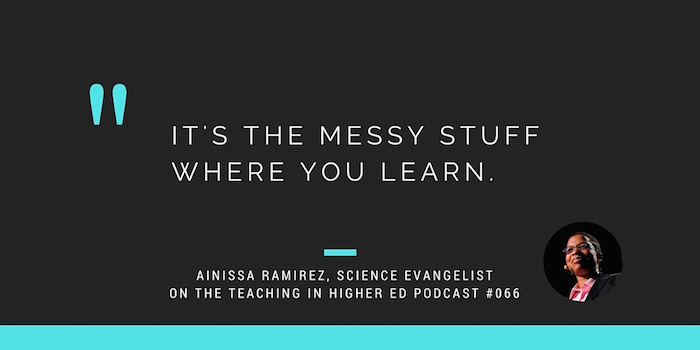
I've been surprised at how much messiness comes up on the podcast. Ainissa Ramirez spoke about learning happening after things get messy.

ainissa-tihe66-quote5

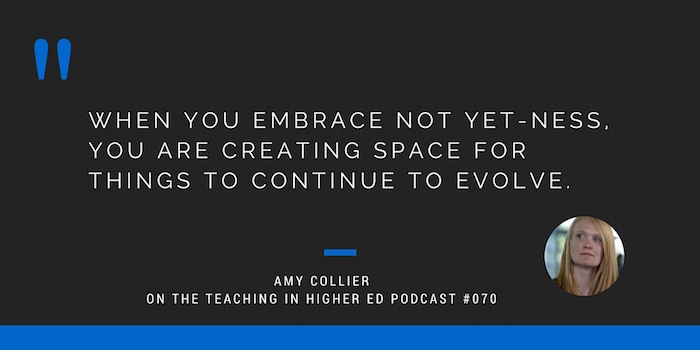
Amy Collier also introduced the term ‘not yet-ness' to me and helped me be more willing to take risks in my teaching.

amy-colliertihe70-quote11

https://teachinginhighered.com/70

Lesson #10

Creating “times for telling” is more important than adhering to a consistent schedule/format in hybrid classes

Derek Bruff shared about his flipped learning model, which is quite different from how I've been approaching hybrid classes. He has continued to challenge me as I consider ways that I can create more “times for telling” in my classes and not stick so rigidly to my schedule/format of introducing concepts online before bringing them into the classroom.

https://teachinginhighered.com/71

Part 3 – coming soon

Stay tuned for next week's post with part 3 of lessons learned from podcasting in 2015.

[reminder]What is a lesson you're taking from the Teaching in Higher Ed podcast into 2016? [/reminder]
Filed Under: Personal knowledge mastery

15 lessons from 2015’s podcasts (part 2)

By Bonni Stachowiak | January 12, 2016 | | XFacebookLinkedInEmail

This is a multi-part post in which I practice my curation skills and share what I'll be taking in to 2016 from the past year's podcasting efforts.

You may want to start with part 1, if you want to get all 15 lessons.

Lesson #6

It takes daily discipline to demonstrate the respect our students deserve.

While I have always cringed when colleagues at my institution have gone on a social media rampage to vent about their students, I will admit to having chuckled at some learners' version of historical events.

Kevin Gannon has been the “voice in my head” that ensures I only poke fun of myself on social media, instead of my students. There's plenty of material to draw from there.

kevin-gannon-quote

https://teachinginhighered.com/52

Lesson #7

People who are not like me are crucial to my lifelong learning.

On episode #053 Peter Newbury stressed the importance of having people who aren't like us in our personal learning network (PLN). I've thought, often, about the need to strengthen that aspect of my network and have benefitted from those times when I attempted to integrate someone who is unlike me into my personal knowledge management system.

peter-newbury-quote71

https://teachinginhighered.com/53

Lesson #8

Kindness matters

While I like to think that I have worked at not being rude to my students in the past, I certainly didn't contemplate ways I could be more kind. Jesse Stommel stated that kindness is a centerpiece of his teaching. He has challenged me to think more about what that might look like if it were the case with me, too.

jesse-stommel-quote31

https://teachinginhighered.com/57

Lesson #9

It's gonna get messy

I've been surprised at how much messiness comes up on the podcast. Ainissa Ramirez spoke about learning happening after things get messy.

ainissa-tihe66-quote5

Amy Collier also introduced the term ‘not yet-ness' to me and helped me be more willing to take risks in my teaching.

amy-colliertihe70-quote11

https://teachinginhighered.com/70

Lesson #10

Creating “times for telling” is more important than adhering to a consistent schedule/format in hybrid classes

Derek Bruff shared about his flipped learning model, which is quite different from how I've been approaching hybrid classes. He has continued to challenge me as I consider ways that I can create more “times for telling” in my classes and not stick so rigidly to my schedule/format of introducing concepts online before bringing them into the classroom.

https://teachinginhighered.com/71

Part 3 – coming soon

Stay tuned for next week's post with part 3 of lessons learned from podcasting in 2015.

[reminder]What is a lesson you're taking from the Teaching in Higher Ed podcast into 2016? [/reminder]
Filed Under: Personal knowledge mastery

15 lessons from 2015's podcasts (part 1)

By Bonni Stachowiak | January 5, 2016 | | XFacebookLinkedInEmail

In the interest of practicing the curation piece of my PKM system, I'm investing some time in reflecting back on a year of podcasting in 2015.

I'm grateful to each guest who accepted the invitation to be on the show.

As I consider what I want to take with me into 2016, I'm focusing on key lessons for me from 2015's Teaching in Higher Ed podcasts.

This is part one of a three-part series on lessons from the podcast. I'll share five lessons in each post, for a total of 15.

Lesson #1

Things are going to be messy and that's ok.

I shared with Jose Bowen about one of my bigger teaching failures. Instead of shaming me, he celebrated it and told me to keep it up.

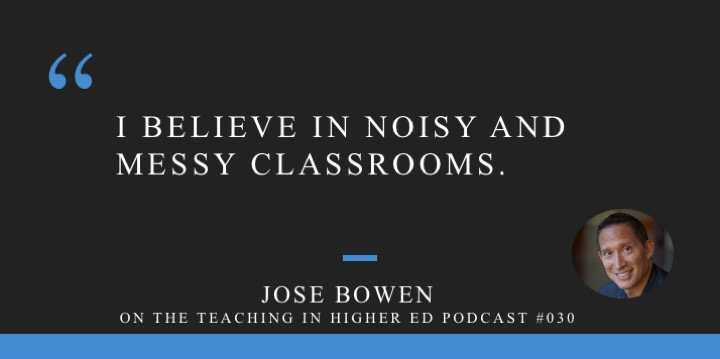
I believe in noisy and messy classrooms. – Jose Bowen

josebowen-quote

https://teachinginhighered.com/30

Lesson #2

There's a lot one can do with a timer.

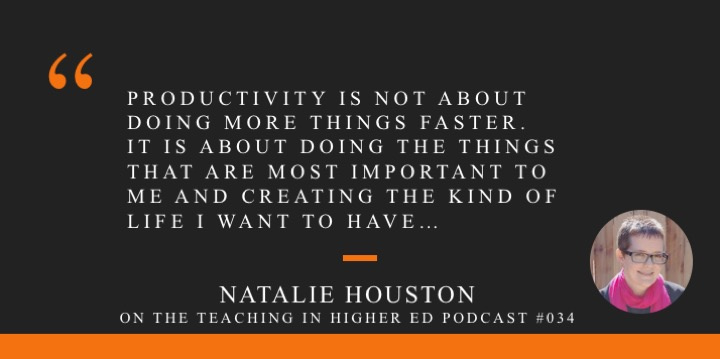
Natalie Houston introduced me to the idea of using timers more in my teaching and productivity. When I'm meeting with students, I'll now set a timer on my Apple Watch. When it goes off, the student doesn't realize it, but I know to start to wrap things up to move on to my next commitment.

I am able to be more present for others in my life using timers. Plus, I can make sure I don't get too caught up in something solitary and miss out on other priorities.

nataliehoustonquote

https://teachinginhighered.com/34

Lesson #3

If you're I'm not having my students solve problems or the problems I'm having them solve lack interest to them, I'm missing the boat in my teaching.

2015 meant that I had the opportunity to speak with someone who I have admired from afar since I started teaching in higher ed more than a decade ago.

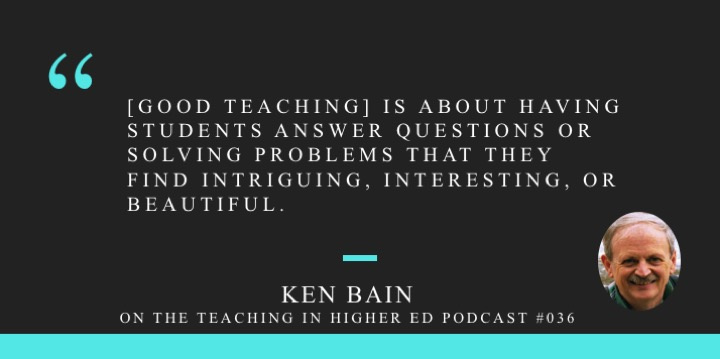
Ken Bain's voice has been in my head, ever since, encouraging me to create opportunities for students to solve problems that they find interesting or beautiful.

[Good teaching] is about having students answer questions or solving problems that they find intriguing, interesting, or beautiful. -Ken Bain

kenbainquote

https://teachinginhighered.com/36

Lesson #4

Digital literacy is less about generations and more about context.

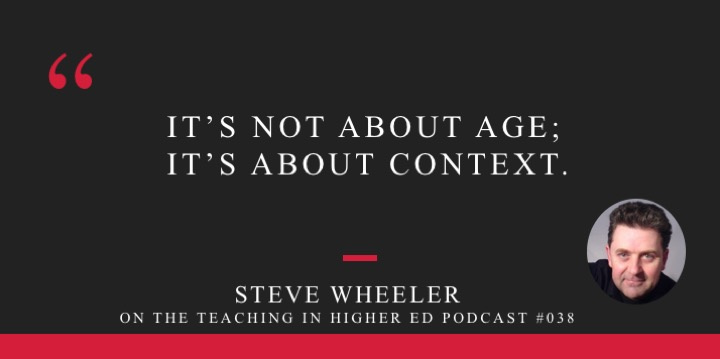
Steve Wheeler challenged the notion of digital natives on episode #38 and has had me thinking so much more about context ever since.

It’s not about age; it’s about context. -Steve Wheeler

contextquote

https://teachinginhighered.com/38

Lesson #5

Keep content independent from an LMS and therefore more portable into whatever system comes my way.

Scott Self helped me see a whole new potential for using Evernote (or any cloud-based notebook system) in my teaching. He stressed keeping content out of LMSs, for the most part, since at any point, a university could decide to make a change to the system that they use, leaving all our course shell creations useless.

https://teachinginhighered.com/48

Part 2 – coming soon

Stay tuned for next week's post with part 2 of lessons learned from podcasting in 2015.

[reminder]What is a lesson you're taking from the Teaching in Higher Ed podcast into 2016? [/reminder]
Filed Under: Personal knowledge mastery Tagged With: curation, pkm, teaching

15 lessons from 2015’s podcasts (part 1)

By Bonni Stachowiak | January 5, 2016 | | XFacebookLinkedInEmail

In the interest of practicing the curation piece of my PKM system, I'm investing some time in reflecting back on a year of podcasting in 2015.

I'm grateful to each guest who accepted the invitation to be on the show.

As I consider what I want to take with me into 2016, I'm focusing on key lessons for me from 2015's Teaching in Higher Ed podcasts.

This is part one of a three-part series on lessons from the podcast. I'll share five lessons in each post, for a total of 15.

Lesson #1

Things are going to be messy and that's ok.

I shared with Jose Bowen about one of my bigger teaching failures. Instead of shaming me, he celebrated it and told me to keep it up.

I believe in noisy and messy classrooms. – Jose Bowen

josebowen-quote

https://teachinginhighered.com/30

Lesson #2

There's a lot one can do with a timer.

Natalie Houston introduced me to the idea of using timers more in my teaching and productivity. When I'm meeting with students, I'll now set a timer on my Apple Watch. When it goes off, the student doesn't realize it, but I know to start to wrap things up to move on to my next commitment.

I am able to be more present for others in my life using timers. Plus, I can make sure I don't get too caught up in something solitary and miss out on other priorities.

nataliehoustonquote

https://teachinginhighered.com/34

Lesson #3

If you're I'm not having my students solve problems or the problems I'm having them solve lack interest to them, I'm missing the boat in my teaching.

2015 meant that I had the opportunity to speak with someone who I have admired from afar since I started teaching in higher ed more than a decade ago.

Ken Bain's voice has been in my head, ever since, encouraging me to create opportunities for students to solve problems that they find interesting or beautiful.

[Good teaching] is about having students answer questions or solving problems that they find intriguing, interesting, or beautiful. -Ken Bain

kenbainquote

https://teachinginhighered.com/36

Lesson #4

Digital literacy is less about generations and more about context.

Steve Wheeler challenged the notion of digital natives on episode #38 and has had me thinking so much more about context ever since.

It’s not about age; it’s about context. -Steve Wheeler

contextquote

https://teachinginhighered.com/38

Lesson #5

Keep content independent from an LMS and therefore more portable into whatever system comes my way.

Scott Self helped me see a whole new potential for using Evernote (or any cloud-based notebook system) in my teaching. He stressed keeping content out of LMSs, for the most part, since at any point, a university could decide to make a change to the system that they use, leaving all our course shell creations useless.

https://teachinginhighered.com/48

Part 2 – coming soon

Stay tuned for next week's post with part 2 of lessons learned from podcasting in 2015.

[reminder]What is a lesson you're taking from the Teaching in Higher Ed podcast into 2016? [/reminder]
Filed Under: Personal knowledge mastery Tagged With: curation, pkm, teaching

Cataloging course resources using PKM

By Bonni Stachowiak | August 3, 2015 | | XFacebookLinkedInEmail

Cataloging course resources

One of the compliments that students regularly give me is that I use current examples in my classes.

Generally speaking, they quickly follow the compliment with an example of another professor who shows dated videos in his class with regularity. I suspect that when others get it wrong, I get to look that much better than I actually am…

kodak

Of course, I always remember the time I showed a video in class about Kodak's marketing approach and one of my beloved students texted me from the back of the room.

He shared that on that very day, Kodak had filed for bankruptcy. We got to have a good laugh about it and fortunately, the event didn't take a toll on my credibility with him.

How I use my Personal Knowledge Management (PKM) system to catalog course resources

I have a defined personal knowledge management system (PKM) that I've been using for years now. It helps me not have to think very hard to bring current examples into a class. I'm also fortunate to have many current and former students who know I have an interest in a particular topic or company and who will send articles and videos my way.

Here are a few other ways I work to use PKM to bring current examples into my classes:

Use tags in Pinboard.in to make retrieval easier

I always include any course numbers that are related to the topic of the resource, as well as whether the asset being saved is an audio or video clip.

For example, I recently bookmarked this episode of NPR's Planet Money called “Free Parking.”

It is about a guy who decided to attempt to solve a problem of scarce resources in his neighborhood: parking spaces. He created an app that attempted to make life easier for residents, but he wound up in all sorts of trouble.

I used the following tags on Pinboard.in for the episode: busn114 (the course number for my introduction to business course), audio (so I can search for audio clips on a particular topic or course number), and economics.

Here's how it looks on Pinboard:

pinboard-tags

Streamline your PKM process to make saving resources easy

I use Feedly as the service where I subscribe to various blogs and other web resources via RSS. Then, I review the information that comes in using Newsify on the iPad. There are plenty of great RSS readers out there. I like Newsify for its dark mode, when I am reading at night, as well as for the way it displays the headlines, so I can quickly skim through them.

Regardless of which service you us, it is imperative that it has a quick method for saving articles to whatever bookmarking service you use. Pinboard.in has worked great for me these past couple of years. It even easily imported my bookmarks from Delicious, once I decided I had enough of getting frequent error messages when I tried to save to Delicious from within Newsify.

Automate bookmarking using Pinboard.in or IFTTT

While my RSS reader does much of the heavy lifting of finding and saving resources, Twitter also is finding its way into my process. I used to go through the laborious process of finding an article on Twitter that I wanted to save, opening it in my browser, and then saving it using the Pinboard.in Chrome extension.

Now, I've set up Pinboard.in to automatically save any Tweets that I favorite into Pinboard.in. I don't have to do anything except click the star to set a Tweet as a favorite. Pinboard does the rest.

pinboard-meet-twitterHashtags are automatically created as Pinboard tags, though I often find myself needing to do some refining for the resource to fit into my tagging methodology. I have a task in my weekly review that reminds me to check items that have been added to Pinboard for Twitter and to add the necessary tags at that time.

If whatever service you use doesn't have a setup like the one that Pinboard does, check out IFTTT to see if there's a channel that can add the bookmarks for you. If this is the first time you've heard about IFTTT, it is worth checking out the Introduction to IFTTT from ProfHacker.

Getting Started

If this post is all new to you and it is starting to seem overwhelming, start small.

1) Sign up for a bookmarking service. I recommend Pinboard, but Diigo is also good if annotation is important to you.

2) Install the Pinboard (or Diigo) browser extension into whatever program it is you use to browse the internet. That way, you'll have a little button you can press to save an article, without having to navigate to the Pinboard or Diigo website each time.

Here's what my Pinboard browser button looks like on my Google Chrome browser:

pinboard-button

3) Bookmark articles, blogs, videos, etc. to use in your courses. When you come across an article or video that might be good for one of your classes, click the Pinboard/Diigo button on your browser and enter the associated tags and any other information you want saved. Here's an article from the Chronicle I saved today about what if the Harry Potter novels had taken place in a historically black college or university.savingbookmarkIt took me less than a minute to see the link to this article on Twitter, skim it to note that it was of interest, and to save it to my: race, diversity, and higher ed tags on Pinboard.

[reminder] What approach do you use for cataloging your course resources? [/reminder]


Filed Under: Personal knowledge mastery Tagged With: pkm, rss

  • « Go to Previous Page
  • Page 1
  • Interim pages omitted …
  • Page 8
  • Page 9
  • Page 10
  • Page 11
  • Page 12
  • Page 13
  • Go to Next Page »

TOOLS

  • Blog
  • Podcast
  • Community
  • Weekly Update

RESOURCES

  • Recommendations
  • EdTech Essentials Guide
  • The Productive Online Professor
  • How to Listen to Podcasts

Subscribe to Podcast

Apple PodcastsSpotifyAndroidby EmailRSSMore Subscribe Options

ABOUT

  • Bonni Stachowiak
  • Speaking + Workshops
  • Podcast FAQs
  • Media Kit
  • Lilly Conferences Partnership

CONTACT

  • Get in Touch
  • Support the Podcast
  • Sponsorship
  • Privacy Policy

CONNECT

  • LinkedIn
  • Instagram
  • RSS

CC BY-NC-SA 4.0 Teaching in Higher Ed | Designed by Anchored Design