Follow the Teaching in Higher Ed Podcast
About this Episode
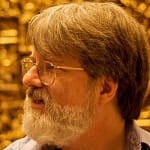
Gardner Campbell talks about engaging learners on episode 107 of Teaching in Higher Ed.
Learning is an enormously powerful and eventful kind of experience.
Gardner Campbell
On episode 107 of Teaching in Higher Ed
Voices on this Episode

Show Notes + Resources
- Seymour A. Papert’s books
- APGAR for class meetings by Gardner Campbell
- Derek Bruff reflects on Gardner Campbell’s APGAR test for class meetings
- Book: Smart Mobs* by Howard Rheingold
- Video: Mr. Hand from “Fast Times at Ridgemont High”
- Song: Peter Gabriel’s Solsbury Hill
- PHPBB Discussion Forum
- Book: Where Good Ideas Come From* by Steven Johnson
- Hacking the Academy
Recommendations from this Episode

Transcript
Bonni: [00:00:00] Gardner Campbell joins me to talk about engaging learners on today’s episode of Teaching in Higher Ed number 107.
Production Credit: [00:00:10] Produced by Innovate Learning, maximizing human potential.
Bonni: [00:00:20] Welcome to this episode of Teaching in Higher Ed. This is Bonni Stachowiak and this is the space where we explore the art and science of being more effective at facilitating learning. We also share ways to increase our personal productivity approaches so we can have more peace in our lives and be even more present for our students.
Bonni: [00:00:47] If you have not heard the name. Gardner Campbell before, allow me to introduce you to an absolutely phenomenal educator. He is an Associate Professor of English and the Special Assistant to the Provost at Virginia Commonwealth University. He’s also served there previously as the Vice Provost for learning innovation and student success as well as the Dean of the innovative innovative University College. Before coming to VCU, Gardner was Senior Director for networked innovation in the division of technology enhanced learning and online strategies at Virginia Tech. He also served as Associate Professor and prior to that he was the Founding Director of the Academy for Teaching and Learning at Baylor University as well as Associate Professor of literature media and learning in the Honors College. I am so pleased to be welcoming him to the show to talk about engaging learners. Gardner Campbell, welcome to Teaching in Higher Ed.
Gardner: [00:01:53] Hi Bonni thanks. Good to be here.
Bonni: [00:01:55] Thanks so much for spending time with me today. We’re going to start out the episode by going back in time and we’re going to go back to when e-learning was first invented or at least the term was first coined and we used to say that that those online courses were interactive If we clicked our mouse on a little arrow. You remember those days.
Gardner: [00:02:18] Yes I do remember them well.
Bonni: [00:02:21] Well today we do a lot of talk. There’s a lot of talk in the media there’s a lot of talk amongst faculty about engaging our students what part of the talk about engaging our students is the equivalent to saying that clicking on a course is interactive.
Gardner: [00:02:36] Oh dear I’m afraid this is going to elicit a little bit of sarcasm from me, so everybody just kind of hold on. Well we’re doing so well with interactivity Bonni, for example, Not only can you click on links but you can watch a movie of somebody speaking in a large room. Now that’s a real advance.
Gardner: [00:02:54] Not only that you can have a separate window with bullet laden PowerPoint slides accompanying the video of somebody talking in a room a big room. And not only that you can pause it and take a multiple choice test. So you know what lovely interactivity it’s all kind of a part of the same clicking on links idea. And I think it’s because interactivity for most people simply means there’s something to do to follow along which is not exactly what I would think of as an activity.
Bonni: [00:03:29] And what are the ways in which we talk about engaging our students and our teaching that are actually not real demonstrations of engagement?
Gardner: [00:03:41] I think there’s a thought that if we are getting responses from students of any kind that there is engagement that’s happening and I guess in a way you could say that I mean it is probably more interesting to click on multiple choice test every 10 minutes than it is simply to watch a lecture that goes on for an hour even if you can play it back at double speed.
Gardner: [00:04:07] But I think that there’s far too much focus on simply what I would call a stimulus response kind of paradigm. And in the meantime our students are sitting there with thoughts and dreams and distractions and hopes and what they just ate for lunch which has made them sleepy or made their stomach rumble or whatever.
Gardner: [00:04:30] I mean there’s there’s a rich context of lived experience in many ways a very high bandwidth context that we could draw on as we’re together to be able to empower and strengthen interaction which doesn’t always mean that everybody’s talking at once. I think listening can be a very active process and that following along can be very active or even interactive without the person who’s listening. Never you know and necessarily responding in any way other than kind of bearing down on the listening. But for me the stimulus response paradigm governs most of what we think of as interaction in an electronic format. And that’s just a very impoverished view how people are in rich communication contexts when they’re online or face to face.
Bonni: [00:05:22] Would you share a memory of me from your teaching that you just think so fondly upon because you just think now that that was true engagement?
Gardner: [00:05:33] That’s that’s a very interesting question. So I’ll I’ll give you one example that’s an extreme example because it’s certainly not possible on a daily basis. It was a very special experience in which I was leading a group of students in a study abroad and back in the UK in 2003 we had been on this five week summer course together.
Gardner: [00:06:03] It was called rock solid progressive transatlantic crossings and popular music 1950 to the present and we started with Patti Page and the Tennessee Waltz and ended up with U2 and beyond. And I can’t remember that the most recent of the Radiohead was in the mix there and you know we went right up to the present and we had lived through five weeks together and each of the classes was interactive. And I think at least it felt to me that there was a high degree of engagement and not just because everybody listened to popular music but because we had read things together we were in a fairly small and contained and exotic setting.
Gardner: [00:06:44] We were analyzing music and in ways that I think were wouldn’t new for most people. And we were learning from each other just by paying attention to the way each of us experienced music in the context in which we experienced music and how we would even talk about what it was we were hearing. So that was very interesting and we did that for five weeks.
Gardner: [00:07:07] There were field trips including a great weekend in London where we went to the townhouse studios and one of my students sat down at Sir Elton John’s favorite piano and played some Fiona Apple that she had memorized from her own piano lessons and then going to Brighton and going on a tour that retrace the steps in the movie Quadrophenia featuring the music of The Who and on and on.
Gardner: [00:07:35] So all of that was highly engaging but the highest moment of engagement was in the moment where we all walked up on top of Solsbury Hill the last day of class Solsburry Hill is celebrated in a famous song by Peter Gabriel on his first album. And it’s a song about an eagle flying down to take him home when he had come to a crossroads in his own career and was now prepared to go out as a solo artist.
Gardner: [00:08:06] So we were at a crossroads too. We were in a physical setting that was new to most of us where we might not ever be together again in that way. We’d been through all of these lives experiences together in an unusually intense fashion and that moment of peak engagement was a moment of reading and silence. We had all brought books with us from the course and read aloud to each other bits of the books that had meant something in particular to each of us. And then I turned to them and I said that’s your life down there because we were overlooking the city of Bath. That’s where we lived together for the last five weeks. Let’s look at that now and reflect on it together in silence on this windy hill. And I never had a more engaged moment myself.
Gardner: [00:09:02] And from what the students recorded it was pretty magical for them as well. So that’s an edge case as I say. You know you can’t make those memories every day. Except. I think within that experience there are certain kinds of principles I would say that you could isolate or identify to begin to get to deeper kinds of engagement. And I’m not the first one to have thought of these things by any means.
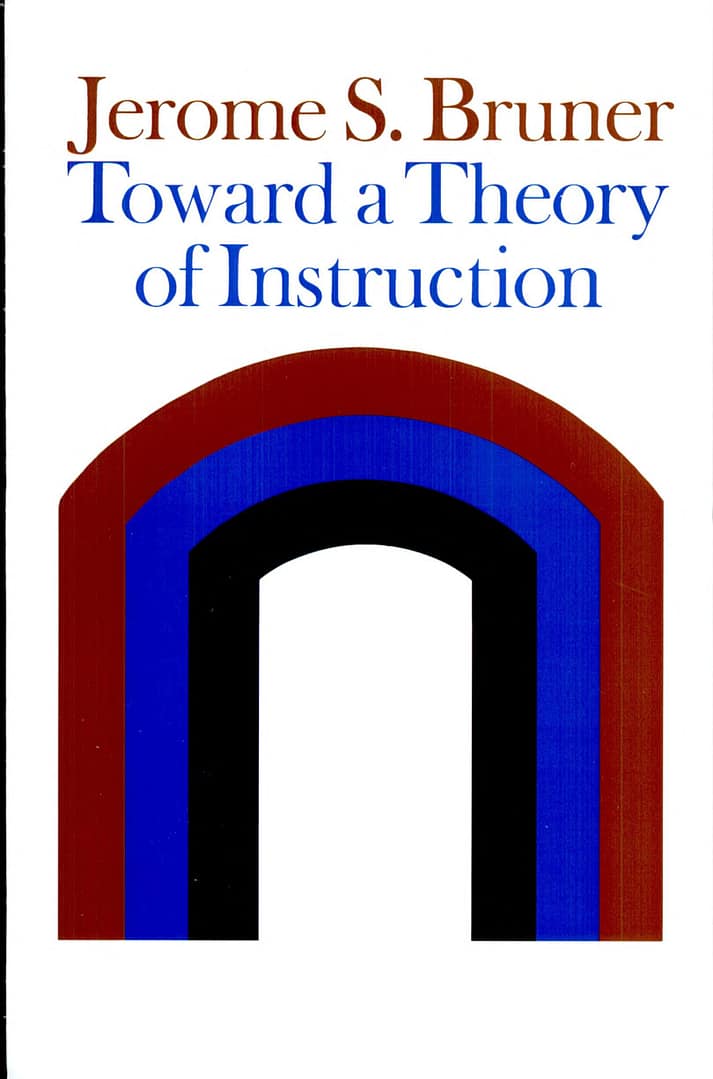
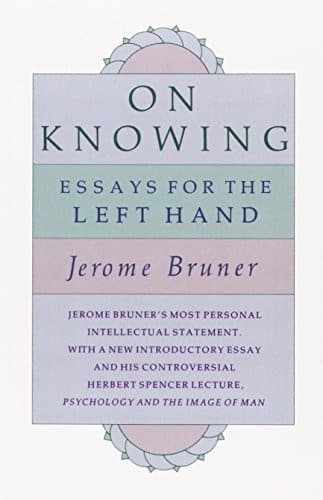
Gardner: [00:09:30] One of my favorite education writers who sadly passed away a couple of weeks ago, a fellow named Jerome Bruner, talks about these kinds of things pretty consistently throughout all of his writing and they have to do with paying very close attention to context. Keying off of preexisting interests and bringing them together into wider spheres of inquiry that have to do with the power and the power of really attentive listening. They have to do with a deep kind of. Personal communion and caring about each other which can never be manufactured but it can certainly be encouraged and modeled within the instructional setting. It has to do with a kind of daring and imagination to go beyond a transactional relationship either with the content or with each other.
Gardner: [00:10:23] It has to do with a heightened sense of occasion and an awareness that for me brings a kind of humility with it that at any moment is something you learn could change your mind about a lot of things. It could fill your life with meaning a new direction or it could send you back into a really dark period of soul searching. That learning is an enormously powerful and eventful kind of experience and that we need to be prepared for that we need to be humble in the face of that we need to be excited and be answerable to that occasion and to the extent that’s possible.
Gardner: [00:11:08] And I think it’s almost always possible to a substantial extent whether or not you’re sitting on Solsbury Hill. Those are the things that I always prized about my own learning experience as a students and try to encourage and support and empower within the classes that I teach now that I’m an adult and I’m a teacher.
Bonni: [00:11:30] One of the things I think many perhaps all of us do is these rituals when we are in a classroom many of us will play music and I have had such delightful times discovering what musical history students sometimes share one of my favorite memories was plain build me up buttercup and realizing that 99 percent of the class could sing that song every word and did that day. That’s really fun. Before class and then there’s one guy who was not from the United States who’s going what is this song and where are you all singing. It was great fun together.
Bonni: [00:12:05] But even if people don’t play music before class there’s some kind of a ritual there. I was just reading yesterday about someone who makes sure that they greet everyone as they come in. Some people like to sit in the back of the class. There’s all these rituals that we do. And of course there’s rituals that students do talk sometimes about you know why did you come in and sit in these rows of seats instead of coming up and sitting in this nice comfy chair in the front of the class.
Bonni: [00:12:28] We talk about those social norms and that sort of thing but on line I don’t see as many of those rituals or at least I don’t know that we collectively have had as many conversations about rituals that might as you said tie in to these key interests and help people pay this close attention to contacts and have that deep power of an attentive listening what comes to your mind when you think about effective rituals or that we might create or recreate in an online environment to do some of these things.
Gardner: [00:13:03] That’s such a great question and I agree with you that those rituals can have just enormous power. They bring what Seymour Papert calls a kind of an intentional micro culture into the particular learning community that you’re engaging with at any given moment. And it can be anything from everybody gets a nickname to exactly the kinds of things that you’re describing with playing music. It’s a great story about that Foundation’s track by the way. That’s just a great great story for the people who knew it and for the person who didn’t. Those are both opportunities right.
Gardner: [00:13:38] But just as there are many things in face to face classrooms that are just kind of soul sucking and transactional there are just exactly the same kinds of encounters seen in online learning. And I think that if anything that the fact that we can get kind of numb in the online medium because it just looks like a picture on a flat thing that we’re looking at. We need to be even more mindful in that distributed environment of rituals that that might bring us together.
Gardner: [00:14:10] And one example that I can talk about along those lines which is a ritual that was actually actually a couple of rituals that I did in those new media seminars for many years and they had to do with one what I call that embedded librarian. Who was on the Twitter backchannel during the class but was not located in the class she was over to work in the library and just paying attention to the hashtags for the class.
Gardner: [00:14:39] And the other was the apple cart test that I would give my students at the beginning of every class meeting. So first the embedded librarian Her name is Ellen Filgo. I did another version of that with a librarian called Rebecca Miller at Virginia Tech. But, Ellen seemed to have a particular knack for it. Probably because she had a lot of sensitivity to music. Ellen seemed to get the vibe real real fast. What would happen is we would come into the class and we were using a Twitter backchannel that the students would use I wouldn’t see it. I didn’t display it.
Gardner: [00:15:15] For me the display of the back channel can be a little distracting if it’s up in the middle of the room but if it’s on everyone’s laptops not so much. And so because I wanted them to use that back channel creatively among themselves and in a way that was also interacting with our embedded librarian who was in another building but following the channel I would do a little thing at the beginning of class with that inevitable moment where everyone has to turn on their laptops to get on the net and is the wireless working today and all the rest of that and I would do all of that in a ritual that I would simply say OK everybody boot up log on and say good morning to our guardian librarian.
Gardner: [00:15:59] And it became this a way of kind of like a little seance in a way. We were all kind of get our computers on and figuratively speaking kind of all link hands and do our little you know greeting that would bring the presence of this ghostly librarian into our midst. And it was great because she would be ready and she would always say good morning and it would be a little interchange there and sometimes she would do very clever librarian things like saying, “Oh you know Alexis I read your blog it was very interesting and blah blah blah.” And that would get us started. It would be a little kind of: Now we’re on the net. Now that part of our class is fully present.
Gardner: [00:16:40] And the other ritual I would do is this look Apgar test that I devised because I was so inspired by the story of Virginia Apgar and her test for newborns her checklist really that would score them on the scale of one to 10 around various aspects of their physical condition to be able to see very quickly which infants would need interventions to be able to wake up and live and thrive. And which ones were already in pretty good shape and you could just say OK on the go.
Gardner: [00:17:11] I was so impressed by that story and so taken with her personality that I thought well I wonder what that would be like if I wanted to encourage healthy classes. And I wasn’t so interested in each individual response though I was asking them to fill things out individually as I was interested in what does this say about the class as a whole. On this day.
Gardner: [00:17:34] So in many ways it was the same kind of thing with the impended library and I wanted to go but a ritual that would also have some electronic affordances that would give them the opportunity to bring their minds into the sphere of mindfulness we wanted for this class and I would deliver the test and they would put it out on paper and score themselves and then hand it all in anonymously and I do this big thing up at the front of the room enter the scores into the a Google doc and do a mean median and mode and then be very theatrical about whether it is going to be a good day or a bad day but it was interesting because while it wasn’t fully online it was something that I think is also a nice thing to do online which is to try to do things that are not simply about one to many or one to one but many to many.
Gardner: [00:18:27] Thinking of this moment when we’re doing something in a synchronous fashion, understanding that it really is a web we’re encountering not just a television station set to a particular channel I think that’s really the thing that gets missed most often is a very deliberate intentional mindful use of what to me is one of the great strengths of any kind of online experience which is this weird kind of any time anything that happens where you feel that you are in a network with multiple possible interconnections and that they can if you’re if you’re good at it be mutually reinforcing and really really make the experience a lot richer.
Bonni: [00:19:14] One of the challenges that I see a lot of faculty having sometimes when they try to introduce even the most simplistic kind of collaboration. All right let’s work in a group project and let’s put a Google doc together and we can you can collaborate together is to make this assumption that today’s traditional undergraduate students are 18 to 22 year olds just come to college knowing about these many to many relationships and that they’re predominantly about knowing the technology versus knowing the relationships and how they might flourish in such a work together.
Bonni: [00:19:52] How do you respond I guess to faculty who think this is some generational thing or or some – Once I know the technology if only I could know what buttons click and I would suddenly miraculously be this great networked learner?
Gardner: [00:20:07] Yeah. What a great question. I think that lots of times because people are are not quite getting at exactly the depth of the kind of question you’re asking. They’re pretty much sitting ducks for vendors who will say well now it’s it’s like watching lectures but in 3-D with bigger Technicolor PowerPoint and so minute that this this is what Scott McCloud calls the McLuhan mistake which always happens when you shift into a new medium. The classic example is well gee now we have movies so we’ll put the movie camera in the middle of the auditorium and film the play.
Gardner: [00:20:46] Well. You can do that but it gets really a lot more interesting when you add it which doesn’t have any equivalent really in a theatrical production. I guess you can think of scene changes that way but it’s not the thing you do after the fact. And you can move the camera. Oh that’s really interesting.
Gardner: [00:21:04] That would be like people getting up and walking around during a performance so they could see you know Hamilton from different seats and that would be kind of chaotic although people do that at the Grand Ole Opry which adds another kind of many to many dimensions of that experience.
Gardner: [00:21:21] So I think for me the answer is that no one really has a deep understanding of network literacies in this telecommunications environment we live in now because it’s too new. I think that many times young people have better approximations of things that we can’t because their experience is so heavily mediated in these networks that we can draw on to help make them more mindful of the networks they’re in. But again they’re not necessarily thinking of it in those terms.
Gardner: [00:22:00] And even though it’s something that is maybe more foreign to older people who are faculty and staff I think we’re world more of a level playing field than we think because this idea of network literacy which is something Howard Rheingold talks about really beautifully and I’ll come up with a mini recommendation right now for a major book that’s called Smart Mobs where Howard explores some of the ideas of networked literacy and he does it in lots of videos as well that are really worth seeking out online.
Gardner: [00:22:34] You know I don’t think we really do know what that’s like yet. I don’t think we really have great ways to think about it just as I don’t think we had great ways of thinking about print culture where many many people would be literate who were never literate before. And the circulation of tax would take on such profusion and intensity.
Gardner: [00:22:54] I don’t think we really knew what to think about that for about 200 years. So kind of early days I think that. Younger people who are in that environment even if they’re not aware of it may be able to come to certain kinds of realizations a little faster but they’re not inevitable and most schooling is sad to say it doesn’t really encourage those kinds of questions or take advantage of the performances. And I think we had better I hope we will.
Bonni: [00:23:21] You talked a bit about our customary one to many kinds of engagements that we attempt as faculty. What are some of the ways we should be stretching ourselves to develop more skills around many to many.
Gardner: [00:23:38] One of my favorite things to do is to have an absolutely unprompted discussion forum in a congenial environment by which I do not mean the way discussion forums are set up in most of the learning management systems I’m familiar with because they are ugly and they don’t look anything like the internet and no one would ever voluntarily do that if they were a scientist.
Gardner: [00:24:02] So I think this is probably just my own experience. But there’s and there’s enough discussion forums on the web that I think I’m pretty safe in saying that it is a very powerful way of thinking about many too many. So I’ll give you a couple of examples. I used to use discussion forums on my film studies class because I really did want people to have the opportunity to kind of hang out and talk about movies outside of class and I never or rarely ever started a discussion thread. What I would do is say you’ll actually reinforce your learning and have more fun if you talk about movies and what we’re learning on this discussion forum. I’d like you to post twice a week. Go.
Gardner: [00:24:47] And then I would kind of remind people and sometimes I would do it you know with various impressions of crazy teachers from various movies including Mr. Hand in Fast Times at Ridgemont High who was a personal model for me. Oh you know I mean he’s the immortal Mr. Hand.
Gardner: [00:25:02] So you know I would do that and everything you know because it was movies and people wanted to talk about that kind of stuff anyway so it kind of was a natural plug into their interests. They would just take off and you know I would notice that if I came in very strongly or sometimes at all on a discussion thread that it would tend to chill the discussion a little bit because people had a certain idea of the kinds of ways you behave when you know teachers here and I’m a pretty congenial teacher.
Gardner: [00:25:33] But you can’t help being that authority figure and that can be a good thing. It can also be a conversation stopper. I also noticed that when they were talking about things on their own they said very interesting things. And I would learn stuff which I know is love. So I was like huh that’s interesting. Then I switched from the LNS discussion forum to one that is a very widely open source discussion forum on the Internet called PHPBB and I was able to do that because that was some kind of a long bit here but I was able to do that because I got tired of using the LNS which I thought was a very ugly and harmful thing. Still do.
Gardner: [00:26:12] And found out that for six dollars a month I could buy space on a web hosting service and had access to all these amazing web things that I could install with one click. This is kind of old news now but in 2005 I bought or 2004 I thought wow this is kind of an amazing thing. So I clicked and install PHPBB which is kind of a bear to administer but I’m current handy with it so I figured it out.
Gardner: [00:26:41] And then the first day that the forum went online a student wrote me and said Oh could you please put the Solaris skin on this because I really like that one. So I said sure I had no idea what he was talking about and only a vague idea. But I googled it. Found out what it was. Got the instructions to install it and you know snick or snack. I had actually responded to a student’s request to customize the way the learning environment looked to him. I thought Oh that’s very nice. And then I set off and just let them do their discussion forum thing the rate of participation doubled. That is they were twice as number twice the number of posts in those sections as there ever than in any of the learning management system forums because they looked kind of like e-mail inboxes.
Gardner: [00:27:27] They don’t really look like many to many. And the other thing that happened was that people’s creativity was unleashed. So some people would actually put avatars up. That would be little animated just one student I remember doing this. We had a very eerie way with the face of James Dean which would you know you’d be looking at him and then suddenly his eyes would shift to the right. Very spooky.
Gardner: [00:27:52] And I didn’t say it. I didn’t say oh everybody please find an animated gif – you know don’t say anything. I just said I want you to have an avatar if you don’t I had to have an avatar. Here are the instructions. And if you’re if you’re puzzled ask somebody in the class and I want you to post twice a week.
Gardner: [00:28:08] Then I found out that this particular forum of adults let people create space for each other. This is very standard stuff but it was not that way in Blackboard. You know why would you want to have pretty things have avatars and make it look like many to many? I mean there’s this idea that in the end it’s all about the teacher asking a question and grading the answers that he gets back.
Gardner: [00:28:32] But in PHPBB the students could poll each other and so that the moment where I said ha ha ha this is a brave new world I’m glad to be in it was when one student created a poll.
Gardner: [00:28:47] After we’d watched Citizen Kane and the poll was when in the movie did you first realize what Rosebud was and then constructed like six or seven different possible answers. And it was great for everybody just you know piled in and gave their answers and it was just you know a little Citizen Kane party which I’m all fine with.
Gardner: [00:29:09] And then I thought now what if I just witnessed and witnessed a many to many interaction around a prompt in the form of a fund but actually quite regulatory quiz created by a student Oh I guess that’s what they mean by learner centered education. I would like some more of that please. That was just a very powerful experience for me. Great great fun to see but also really set me off on a quest to be able to do more of those kinds of things. And a number of those experiences have been inside that idea of a discussion forum.
Gardner: [00:29:49] The other example was a few years after that when I had a discussion forum for an introduction to literary studies. And again same technique. I did not start the threads except in rare instances and I would participate every now and then but typically not very much very sparingly but I would constantly remind the students that this was not busy work it would reinforce their learning they should get in there and they should do some of that muddly many many stuff.
Gardner: [00:30:17] And one student started a thread called a little place to sit and the purpose of the thread according to the student was to ask the question do the things we’re learning in class ever connect with what’s happening in your life outside of class. Well you can imagine that’s just like catnip to a teacher. Oh yeah.
Gardner: [00:30:37] And of course if I had asked a question like that they would have been thinking well I don’t know. Well Dr. Campbell like my answer is it’s a good answer. Maybe he’ll think this is too trivial or I don’t want to tell him what’s going on in my business or whatever. But instead this thing just took off. The first answer was Oh hell yes. And it just went on from there.
Gardner: [00:30:56] And the thing about that thread was that it ran with some of the participants not all but a few for about five months after the class was over. And and you have to puts it. But ok then. And of course I was still in a forum and so could see these things happening and then every now and then they might ask me something and I might respond. But it was just so beautiful.
Gardner: [00:31:24] And I’ve always thought that that’s just an extraordinary thing when a class gels like that and in a perfect example of the kinds of network effects and many many experiences that we could be seeking out and refining and inventing and celebrating in the way we think about online learning. But typically we do not because we we just can’t imagine it I guess or maybe most of my colleagues don’t hang out on discussion forums but might be worth it.
Bonni: [00:31:57] I think sometimes what I observe too is the discomfort with the lack of control. And for many of us that’s invigorating or you think oh my goodness I didn’t even imagine that you could think about it this way or I hadn’t thought about the pull for Citizen Kane what a wonderful way. But but that is scary when what if what we were taught about teaching means teaching equals control and predictability and structure.
Gardner: [00:32:25] No I think it’s a good point. I think that control can mean several things. It can mean that I’m not being responsible as a teacher unless I grade and evaluate every single thing that the students are doing in response to the learning. I certainly understand that I had a colleague once who really was I think sincerely afraid that if she let students in her biology class just talk amongst themselves they would simply perpetuate error.
Gardner: [00:32:53] Now I think that if you set the environment up in a good way and intervene sparingly when you think you really need to do it that there are ways in which the environment can become self-correcting and actually start to boost the collective intelligence not just the people leave themselves out of ignorance and even more error but she didn’t think so. And so she never even tried.
Gardner: [00:33:16] And that to me is the real shame. I mean at least give it one or two tries. I do know some colleagues who tried it but they feel like they need to start every thread because otherwise the topics will be trivial. But I’ve never found that to be the case. And the other thing I would say is you know I’m not really giving up control. I still put the syllabus together the discussion forum is by no means the only thing we’re doing in the class. I said tests like grade papers I steer discussions and fruitful ways when we’re face to face.
Gardner: [00:33:50] But it is a place where the many to many and unscripted aspect of the students interacting let live experience breathe and brings things out that would otherwise be lost and I found that the freedom to learn as Carl Rogers has called it that students find when they’re in that kind of carefully prepared but unscripted learning environment one that I control because I did do be careful preparation but do not control all the minute to minute basis in terms of specifying what they’re supposed to be doing or saying that kind of freedom in enriches everything in life and everything that happens in the whole class. So I think it’s very valuable and I think it really is about exploring other ways of influencing or shaping or focusing the learning experience.
Gardner: [00:34:49] Besides a kind of you know minute granular kind of control over every aspect of what goes on which is an illusion anyway because we know when they leave class are going to talk to each other and you’re not changing their minds to the desk and so you don’t want to want to turn some of the human spirit to good use and leave it at that. Fresh air in as well as the things that I do agree need to be more tightly controlled and scripted.
Bonni: [00:35:20] If it was possible to actually know all of one’s discipline which I can’t fathom but that’s what set up that hypothesis there at the beginning you still wouldn’t know everything about your students and how they’re experiencing the learning or are what they’re curious about or how your attempts at teaching this discipline that you’ve truly mastered because it is for me I’m just always thinking that collectively there’s no way that any group of individuals would bring them together.
Bonni: [00:35:48] There’s no way I could possibly know more than them so it’s that fun thing. Let it be free and say there’s going to be things that I don’t know about but still having the confidence that as you say I’m where my value here is coming up with these ways of shaping the learning experience and building of that community of learning together.
Gardner: [00:36:10] No I think that’s exactly right. And most people who have done work in the history of ideas or the history of thought I think about Steven Johnson’s really interesting book called Where Great Ideas Come From recognized that great ideas of all kinds come from all kinds of people at all stages of their knowledge. There are some great ideas that are easier for an expert to have. There are some great ideas that are forever closed off from the expert because he or she is simply too conditioned by prior learning and even more than that. There’s the idea that a great idea can come by putting two things that are apparently unrelated next to each other.
Gardner: [00:36:51] So if somebody is making a connection between you know Milton and you know Patti Smith which actually happened in my Milton class last time that’s great. You know suddenly the field of Milton’s studies has expanded in significant ways and all of us may be able to have better more interesting and fresher ideas than we would have if that if that combination hadn’t emerged in our conversation.
Gardner: [00:37:21] And it is true that the connection between Patti Smith and John Milton may not be as important for Milton studies as the connection between John Milton and oh let’s say the philosopher Nicholas of Cusa or the way Shakespeare influenced him or any of those things.
Gardner: [00:37:40] But you know there’s time for lots of different things. And if the connection feels lively and inspiring to somebody they’re going to naturally want to know more. And I think it’s a mistake for teachers to say or sometimes we all will. Oh that’s very interesting. But we don’t have time for that now because as soon as you do that the message you send is I don’t care how creative and interesting your remark is. It’s not what I think is most important right now. Therefore I’ll kindly ask you not to say it. And that’s just it’s so disappointing and it does make people think that Milton is about sitting up straight and looking at the teacher at all times which I can assure you it is not.
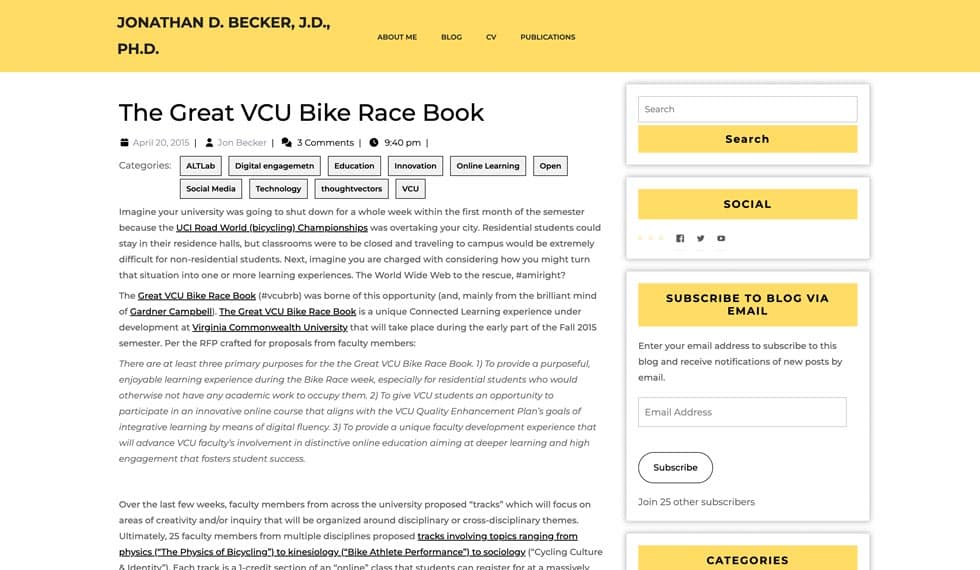
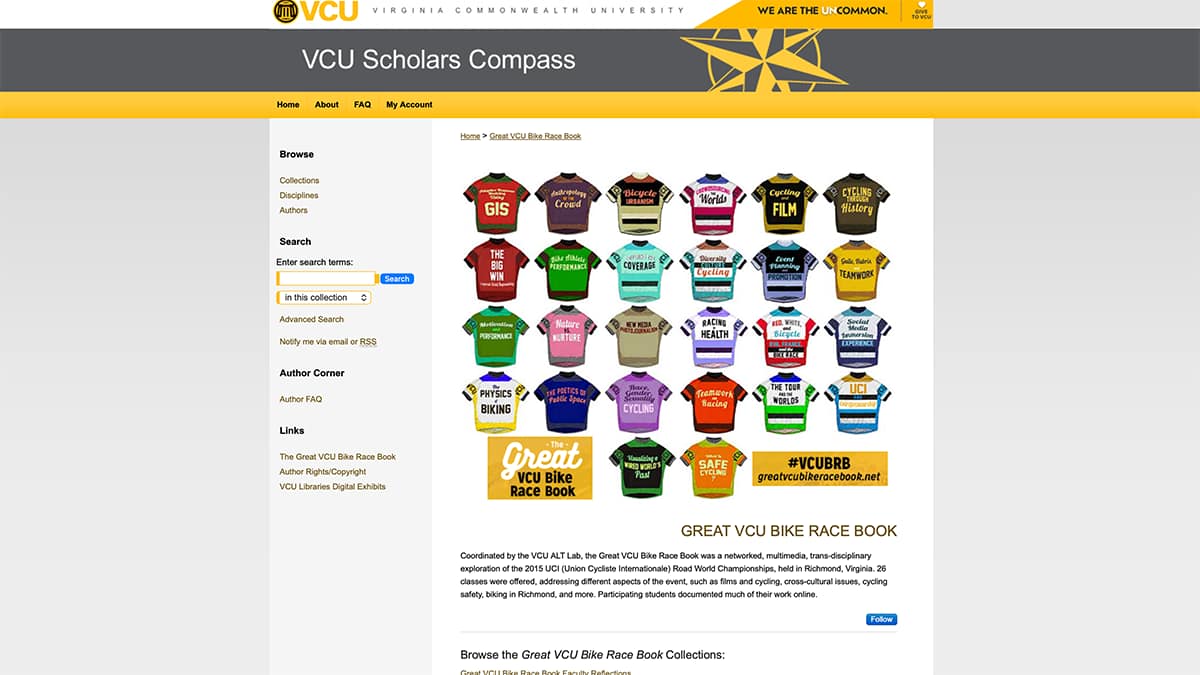
Bonni: [00:38:24] This is the time in the show where we each give a recommendation and mine is going to be for people to go look at the links I will post in the show notes on The Great VCU Bike Race Book and I will quickly read with an inflection I might add in the description and then ask you to share.
Bonni: [00:38:45] It is a network to multimedia trance disciplinary exploration of the event. But is the 2015 UCI That’s the union cyclist international road World Championships. VCU faculty have focused their energy enthusiasm and unique expertise on this event to create an array of energising learning opportunities. What can you tell us about The Great VCU Bike Race Book and why we should all go look at it.
Gardner: [00:39:14] Well I do you read that description extremely well.
Bonni: [00:39:20] Why thank you. I even have a podcast.
Gardner: [00:39:21] Very well. Yes. There you go. I see I’m speaking with a professional.
Bonni: [00:39:26] Yes.
Gardner: [00:39:27] That’s that’s that’s it. That’s great. No those are not words that were chosen idly that kind of opportunity has long been one of my kind of dreams about what a school might do. And I’ve had various ways of dreaming about it. But this particular one it really did involve luck or preparation and ambition. It was luck because it just so happened that the bicycle race the course of it was going right by the main Arts and Sciences campus of VCU.
Gardner: [00:40:02] So it was right next to us preparation because the folks who were involved in this project which included my colleague the vice provost for community engagement Catherine Howard it involved people from Student Affairs. It involved a crackerjack team of what you might loosely call learning technologists I would call an awesome learning experience designers in what we called the academic learning transformation laboratory.
Gardner: [00:40:27] And of course the faculty who were game all came together with what I might add was a superb project manager named Amy Adkins. It was a biology psychology post-doc to say you know we’re ready we can do this given the opportunity and then the aspiration was how can we make this a striking thing as possible. And so I came up with the idea of calling it The Great VCU Bike Race book.
Gardner: [00:40:55] First of all because I like things that are great as opposed to good. And I always like titles like The Great Gatsby The Great McGinty the great this great that assumes it comes out you feel like it’s the greatest show on earth in this moment of a real promise and that you’re going to have a good time.
Gardner: [00:41:13] That was part of it also the idea that it would be a book that would be crowdsourced across many different writers meaning primarily the students themselves was very appealing to me in part because I had long admired this book called hacking the academy that was in its first iteration was compiled in about a week that was made in all the history right off the top of my head that there was a conference and they all got together and they said hey what if we wrote a book like really fast right now.
Gardner: [00:41:48] And so everybody just started writing stuff or recommending things they thought would be good to include and at the end of the week. They had this crowdsourced book which was marvelously appropriate to this idea of hacking the Academy and then over stages they would carry it to try to get the best of the best.
Gardner: [00:42:07] So I was really interested in this idea of an aggregate crowdsourced kind of documents across many disciplines of that which in many disciplines was really kind of Cathy Howard’s idea which I thought was exactly right I was very grateful to her for her for pitching that in there and then having all of those things be published to the web as they were happening. He curated during the event in a kind of an ongoing news magazine which was part of the project I worked on as an individual and then have that content. Presence in an aggregate way and then curated through successive stages until we would get it into our form that we would say OK this is the best of the best and we’re going to put it in the library’s scholarly repository as a kind of book that we all wrote together.
Gardner: [00:43:05] We didn’t quite get all the way to the scholarly repository but we did get to the curation part and we did get some really extraordinary moments along the way in which students really did feel like the work they did was something that could matter on a potentially global scale.
Gardner: [00:43:23] And that was part of the co-creation of knowledge. Of course this institution of higher education. So it was great. It really kind of inverted knowledge creation relationship. And it was about a cool event and lots of surprising things happened. And it was all up on the web to be shared with the world and it was across many disciplines. And the faculty loved the experience and the results we got back from the Student Assessment were very very positive in ways that were just very affirming and a faith that I think the experiment could be generalized into other contexts as well. And I’m eager to try again sometime. So we’ll see if that opportunity emerges.
Bonni: [00:44:06] What do you have to share with people today.
Gardner: [00:44:10] So many recommendations. I don’t know I just got a really lovely quadraphonic set of Chicago’s albums from its first to the 10th when they did and it’s kind of fun to hear old music and new ways and hear things you’ve never heard before but I don’t suppose that’s true. Perfectly related to student engagement so I would say that my recommendation today would be for people to feast themselves upon really any of the writing that is nearby or they can get to by the late Jerome Bruner.
Gardner: [00:44:44] I would recommend in particular a book called “Essays at the Left Hand” which is just full of wonderful stuff including an essay called The act of discovery that’s just marvelous. There’s another one called “Toward a Theory of Instruction” that’s also been just an extremely strengthening and nourishing book for me for many years. And my recommendation today is it yourself to some Jerome Bruner. B R U N E R and prepare yourself for a wonderful experience.
Bonni: [00:45:19] And of course I have the introduction to one of my favorite Chicago songs stuck in my head which will be there for the next four hours. But it’s a much better soundtrack to have than say the Paw Patrol soundtrack that my kids love to listen to or my son is now in love with the first song of the Star Wars soundtrack so it’s going to work for me here. I like it.
Bonni: [00:45:41] Well thank you so much for your time today and just your time in building this community for engaging our students and really challenging ourselves to do better and to take those risks that we need to in order to create real engagement.
Gardner: [00:45:57] Well it’s my pleasure and I have to say as the credits roll but none of this you know I try to carry on the same kind of intensity and transformative qualities that I felt with my best teachers. Sometimes folks are criticized for trying to teach the way they were taught. In my case I should be so lucky to be able to teach the way my best teachers taught me. They taught me so much at work. We’re just amazing influencers. So thanks for the opportunity to talk about it it’s been great.
Bonni: [00:46:28] What a pleasure it was to speak with Gardner Campbell today. And just as a heads up we actually recorded two episodes today as I record this and the next episode with him will be airing on July 28. And so you can look forward to hearing that episode and discovering more from this great thinker in higher ed and thanks to all of you for listening. I just have grown to appreciate this community of individuals who come together and we’re just always seeking to facilitate learning better through a lot of different creative lenses today was just one example of that.
Bonni: [00:47:08] Again to access the show notes from today’s show you can go to teachinginhighered.com/107. And if you want to expand the community even more and get to have the opportunity to engage with even more people. The best way to do that is to write a review or give the podcast a rating on whatever show it is you use to listen to the show. I always appreciate those and they really are through the algorithmic magical wonders of iTunes the best way to get the word out about the show. Thanks so much for listening. I’ll see you next time.
Teaching in Higher Ed transcripts are created using a combination of an automated transcription service and human beings. This text likely will not represent the precise, word-for-word conversation that was had. The accuracy of the transcripts will vary. The authoritative record of the Teaching in Higher Ed podcasts is contained in the audio file.