• Skip to primary navigation
  • Skip to main content
  • Skip to footer

Teaching in Higher Ed

  • Podcast
  • Blog
  • SPEAKING
  • Media
  • Recommendations
  • About
  • Contact

Resources

My learning from the OLC Innovate 2016 conference

By Bonni Stachowiak | April 22, 2016 | | XFacebookLinkedInEmail

Untitled design

This week, I've been experiencing the OLC Innovate 2016 conference in New Orleans.

Back in January, I was contacted by someone from MERLOT, to let me know that the Teaching in Higher Ed podcast had been included in their collection and had then won a MERLOT Classics award. They invited me to come have the award conferred at the OLC Innovate conference and to give a presentation.

That's how I got here.

Discoveries

Here are just a few things I discovered this week:

GooseChase is a great way to build mobile phone scavenger hunt for your classes. The service is free to educators using it in our classrooms. The presenter of this session built a game, using our input, in less than five minutes.

Dr. Katie Linder gave me a pair of Research in Action earbuds, having no idea that one of my trusty pairs of earbuds had broken right before I took off for the airport.

The new Research in Action podcast is fabulous and is a great complement to Teaching in Higher Ed. It focuses on topics that aren't addressed on Teaching in Higher Ed, while still making their content accessible to diverse listeners.

I had to privilege to talk with Dr. Carl Moore after my session. We covered all the bases: race, religion, politics, teaching, social justice, productivity, iPhone apps, and music. I'm not kidding. As you might imagine, I invited him to come on the podcast and look forward to having him share with us about proactive inclusion.

Carl shared with me about a professor who has taught him so much by always having two rules for his classes: That you be yourself and that you are present. 

Universities are experimenting with hyflex models of course delivery. Dr. Brian Beatty put together a great panel of  presenters, discussing the various ways they are giving their students flexibility, while ensuring that they still maintain the following four hyflex principles: Alternatives, equivalence, reuse, and accessibility.

Travis Thurston shared about the creative ways they are developing learning paths within the Canvas LMS. He's doing what seems to be a combination of choose your own adventure learning, as well as choose your own adventure assessment.

The presenters from UCSF shared about how to create screen lessons for our students and provided a link to their online resources. They gave four ideas for creating more engaging videos:

  1. Provide a virtual demo in a screencast format
  2. Ask questions (can even do video-based questions in a quiz)
  3. Annotate with ink using a stylus
  4. Use props to illustrate your point

They also suggested keeping videos less than 10 minutes, in most cases even as short as 3-5 minutes. They make use of Screenflow and Camtasia in creating their videos.

Finally, I started coveting the Swivl robot, once again.

You hold a small remote in your hand while you're presenting and the robot “follows” you to keep your image on camera. Also, you indicate using the remote whether you want to be recording your image, or whatever you're projecting on to the screen.

Given that our university is switching over to Canvas this summer, something tells me it isn't the right time to make a purchase of an entirely new type of device… But, that's probably just because I'm tired and I'll be back to wanting one, again, tomorrow.

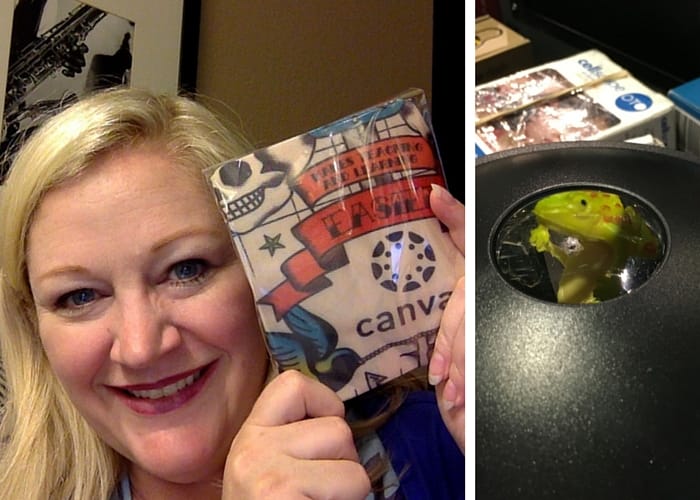
I didn't do any sketchnotes, like I usually do at conferences. The tip of my Apple Pencil had fallen off and I didn't notice until I took it out to start my first note. Fortunately, I located it in the bottom of the tote bag they gave us and order was restored in my iUniverse.

You can view the slides and resources from my session online.
Filed Under: Resources Tagged With: conference, OLC

Help me help you

By Bonni Stachowiak | March 22, 2016 | | XFacebookLinkedInEmail

My apologies to those of you who prefer a bit more sophisticated reference to the movie Jerry Maguire… I'm coming off of more than a week with a nasty virus and may not be able to manage much more than this.

At 1:15 in the clip, Jerry says, “Help me, help you.”

That's what I'm asking you for today…

I've been airing Teaching in Higher Ed podcasts weekly since June 2014.

As I start thinking about summer of 2016, I wonder if I should keep going with the same pattern that I have been on, or perhaps modify my approach a bit during those months.

Help me, help you

Please consider getting in touch through the comments section, below, or if you receive this via email, you can just reply with answers to any of the following questions:

  1. How could Teaching in Higher Ed best support your professional development over the summer?
  2. How regularly will you be listening to podcasts over the summer?
  3. What have been 1-2 of the episodes that we have aired so far that have changed your teaching in some way and how did they impact that change?
  4. What's one area in your teaching or personal productivity that you are struggling with right now?

[reminder]Thank you for considering providing input as I consider how to approach summertime with Teaching in Higher Ed. [/reminder]

I know that many of you teach year round and appreciate hearing from you, as well, about your listening habits and episodes that have transformed  your teaching… 

Filed Under: Resources

A rewarding week…

By Bonni Stachowiak | September 15, 2015 | | XFacebookLinkedInEmail

A rewarding week...

This past week was definitely rewarding.

  • James Lang wrote an article for The Chronicle of Higher Education about the Teaching in Higher Ed podcast that was edifying.
  • Josh Eyler came back on the show to talk about teaching lessons from Pixar movies (episode #065). I think it was my 3 1/2 year-old son's favorite episode yet. [Disclosure: Our son only wanted to listen to the movie clips, though.]
  • I got to speak to Ainissa Ramirez, a science evangelist who I had learned about on NPR's All Things Considered. The episode with her will air on Thursday, September 17.
  • The Teaching in Higher Ed podcast was listed among the top 10 higher ed podcasts on itunes throughout the week.

It is so energizing to get to connect with people who are so committed to teaching and learning. I'm excited to think about what this next year in podcasting will bring.

If you have gotten something out of Teaching in Higher Ed, would you consider helping others discover the show by:

  1. Forwarding James Lang's article about Teaching in Higher Ed to others who have a passion for teaching
  2. Commenting on the article James Lang wrote with what has been your favorite episode of Teaching in Higher Ed, so that it might get additional exposure with those who read The Chronicle
  3. Rating or ranking the show (https://teachinginhighered.com/itunes – it will take you into iTunes, where you can rate/rank it, or via whatever app/service you usually use to listen)

Thanks for being a part of the Teaching in Higher Ed community.


Filed Under: Resources

My back-to-school purchase

By Bonni Stachowiak | August 11, 2015 | | XFacebookLinkedInEmail

back-to-school-purchase

I was one of those kids: So excited for the start to school, especially the purchase of all the school supplies.

I don't go quite as crazy for the start of school these days, but every year does tend to bring with it one fun new thing to add to my collection of teaching tools.

The problem

Let me start by sharing one of my biggest challenges to finishing a class.

There's often a line of about ten students waiting to ask me something. There's another professor waiting to set up his/her class, which starts in 10 minutes. I need to get to a different classroom and setup and test my laptop. And the clock keeps ticking…

More times than I care to admit, something gets lost in the shuffle. In the past, I've left behind my cell phone, my laptop power cord, a water bottle, or the cord I use to connect my laptop to the projector.

These are not inexpensive things to replace, as you can imagine.

The potential solution

I'm hoping that the back-to-school purchase that I made is going to make a difference.

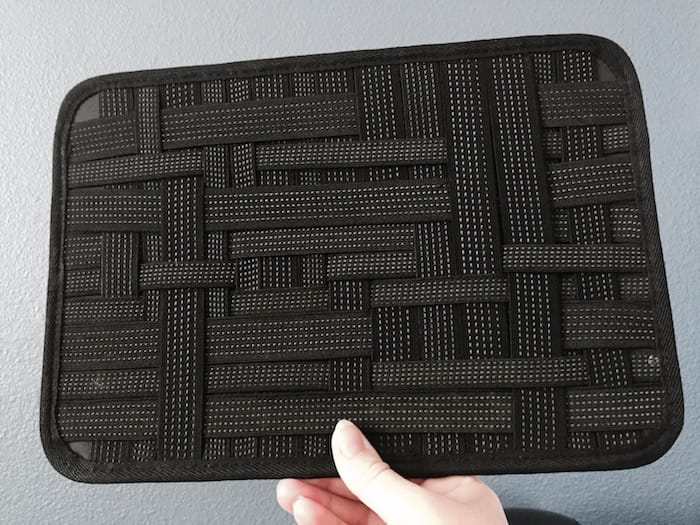
gridit

I purchased a Grid It bag organizer, in the hopes that I'll stop leaving things behind in the classroom.

This organizer is extremely flexible and allows you to find the perfect spot to store key essentials for your teaching (electronics, or otherwise).

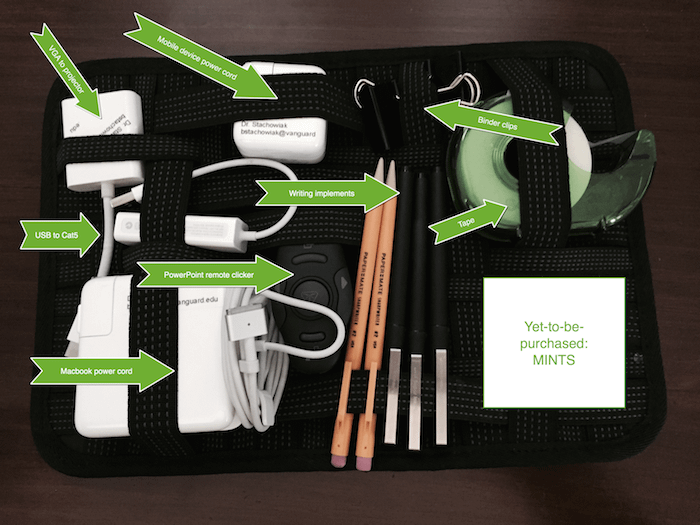
griditwithtxt 3

I've got my Grid It mostly packed now, with:

  • VGA to projector cord
  • Mobile device power cord
  • Binder clips
  • Tape
  • Writing implements
  • Powerpoint remote clicker
  • Macbook power cord
  • USB to Cat5 cord

The final essential item to be packed is a container of mints. When I was searching on Amazon, they seemed awfully expensive, but perhaps it has just been a while since I purchased mints.

The plan

My plan is to remove this Grid It from my bag as I'm setting up for class. Then, when I'm done teaching, I'll put any items that I removed back into the Grid It and will place it back in my teaching bag.

My hope is that I'll notice an empty spot in the grid, if something is missing, which will prompt me to look around and replace the item. This won't help me if I leave my phone behind, since I tend to keep my phone in my purse and not in my teaching bag.

I use my phone a lot when I'm teaching, especially for the Attendance2 app. That's the app that helps me call on students randomly, or place them into random groups. I use it at least a few times during each and every class.

I suspect that if I could just get in the habit of only placing the phone down on the same table where my laptop is, I wouldn't have as much of an issue. However, I'm not as confident in that “fix” as I am in the Grid It's potential for helping me not leave other stuff behind.

[reminder]Do you have any back-to-school purchases that you've made to help your year of teaching go better?[/reminder]


Filed Under: Resources Tagged With: tools

Guest on Luminaris Podcast

By Bonni Stachowiak | June 30, 2015 | | XFacebookLinkedInEmail

Click to access the podcast on the Luminaris site.

I was honored to be asked to be a guest on episode 07 of the Luminaris Podcast, hosted by Mark Hofer.

We spoke about the opportunities for “Connecting with others around teaching and learning,” through 50 podcast interviews on Teaching in Higher Ed.

markThe Luminaris Podcast host, Mark Hofer, is an Associate Professor of Education at William and Mary. We both listen to each others' podcasts, so it felt like we already knew each other as we had our dialog. Mark is a great interviewer, though I'm also looking forward to switching roles in the future. He's already agreed to be on an upcoming episode of Teaching in Higher Ed.

If you haven't been listening to the Teaching in Higher Ed podcast for too long, I speak with Mark about some of my favorite episodes on his podcast. He includes links in his post for the episode, in case you want to go back and catch some of the older shows.

Mark is also active on Twitter and worth following.

Filed Under: Resources Tagged With: podcast, teaching

  • « Go to Previous Page
  • Page 1
  • Interim pages omitted …
  • Page 11
  • Page 12
  • Page 13
  • Page 14
  • Page 15
  • Interim pages omitted …
  • Page 17
  • Go to Next Page »

TOOLS

  • Blog
  • Podcast
  • Community
  • Weekly Update

RESOURCES

  • Recommendations
  • EdTech Essentials Guide
  • The Productive Online Professor
  • How to Listen to Podcasts

Subscribe to Podcast

Apple PodcastsSpotifyAndroidby EmailRSSMore Subscribe Options

ABOUT

  • Bonni Stachowiak
  • Speaking + Workshops
  • Podcast FAQs
  • Media Kit
  • Lilly Conferences Partnership

CONTACT

  • Get in Touch
  • Support the Podcast
  • Sponsorship
  • Privacy Policy

CONNECT

  • LinkedIn
  • Instagram
  • RSS

CC BY-NC-SA 4.0 Teaching in Higher Ed | Designed by Anchored Design