• Skip to primary navigation
  • Skip to main content
  • Skip to footer

Teaching in Higher Ed

  • Podcast
  • Blog
  • SPEAKING
  • Media
  • Recommendations
  • About
  • Contact

Personal knowledge mastery

Can You Keep a Secret?

By Bonni Stachowiak | October 21, 2025 | | XFacebookLinkedInEmail

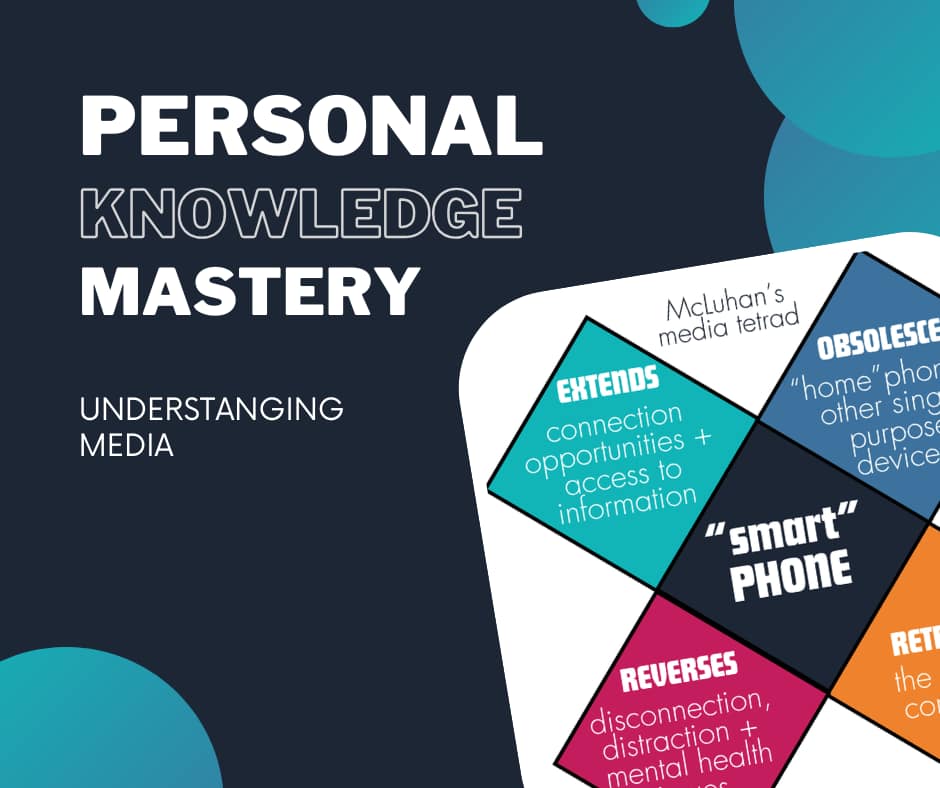
A graphic with the title “Personal Knowledge Mastery” and subtitle “Understanding Media.” On the right side, it shows McLuhan’s media tetrad applied to the “smart” phone. The tetrad diagram includes four diamonds around a center labeled “smart phone.”

This post is one of many, related to my participation in Harold Jarche's Personal Knowledge Mastery Workshop.

The Medium: The “Smart” Phone

Shhhh… Don't tell anyone, but our 13 year-old son will likely be getting his first “smart” phone for Christmas this year. I don't think he has ever read my blog, so we should be good until December. As long as you cooperate with this secret surprise.

I remember reading a few years back that the average child in the United States gets a phone at the age of 11. That seemed really early to me then. By the time Christmas rolls around, he will be about a month away from turning 14, which seems awfully late.

Our son would agree.

He tells us that he and one other guy in school are the only kids without a phone at this point. This may sound like a stereotypical story of woe that young people tell their parents to let them have something. But when we discuss the subject, there's a common theme:

What he really wants is a camera, disguised as a phone.

A primary driver for his wanting the camera and messaging functionality is his upcoming middle school Washington DC trip in the Spring. When I tossed the idea around of getting him a camera, instead, he had no interest in that, though. Dave and I have talked a lot about it and figure this is a good time for him to get a phone and we've started our discussions about how we want to handle that, as parents.

Dave and I talk more about these tensions in the second half of the video we recorded of us unboxing and playing with Justin Shaffer's Alignment: A Course Design Deck.

We also link in the video's notes to the parent resources from The Social Institute, which are recommended by the academic leadership at our kids' school. Now, on to why I'm bringing up smart phones in this particular post.

McLuhan's Media Tetrad

Jarche introduces those of us participating in his Personal Knowledge Mastery Workshop to McLuhan's Media Tetrad this week. I've seen the diagram on Jarche's blog, before, but never slowed myself down enough to spend time soaked in it, like I have today.

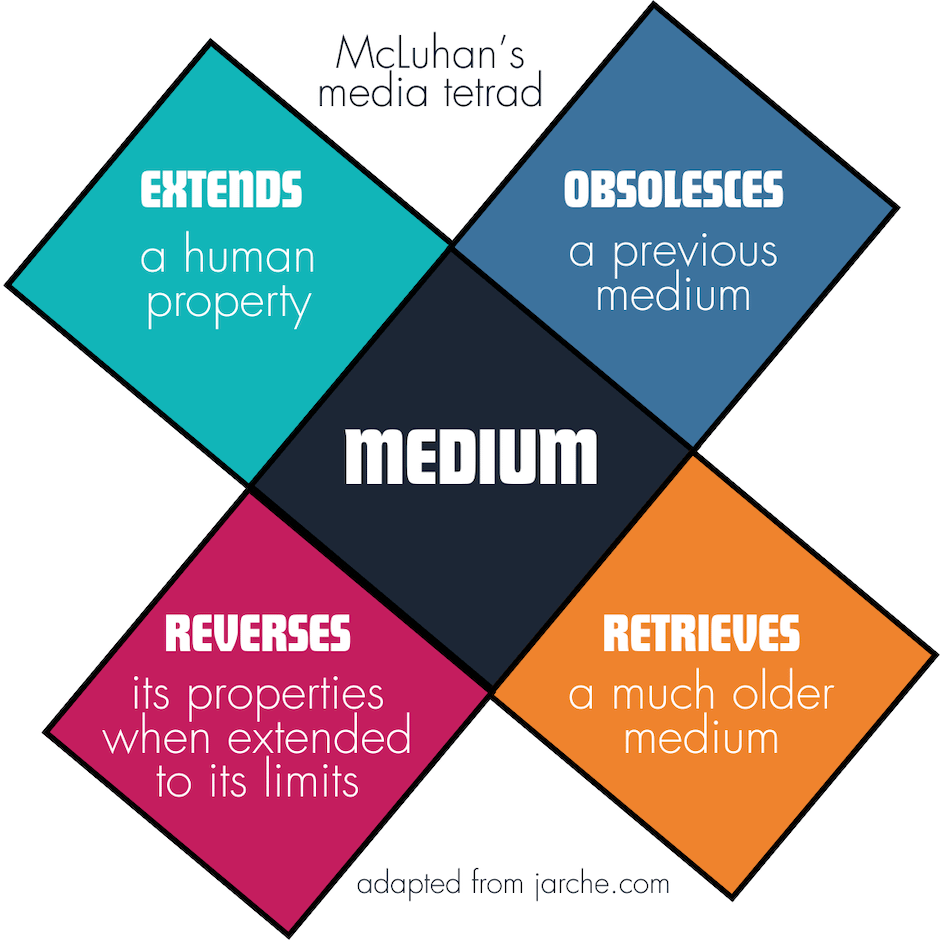
A diamond-shaped diagram illustrating McLuhan’s media tetrad. The center diamond is labeled “Medium.” Four surrounding diamonds describe its effects: the top says “Obsolesces — a previous medium,” the right says “Retrieves — a much older medium,” the bottom says “Reverses — its properties when extended to its limits,” and the left says “Extends — a human property.” The image is adapted from jarche.com


Here's my best, novice's understanding of the framework:

It starts with a new medium.

McLuhan posits through his Laws of Media that every new medium results in four effects. Jarche explains that under McLuhan's laws, each new medium:

Extends a human property,

Obsolesces the previous medium (& makes it a luxury good)

Retrieves a much older medium &

Reverses its properties when pushed to its limits

When we take time to understand what happens with new media, we can put in place steps to negate or minimize the negative effects. Ample examples exist of ways that social media extends humans' voices, while ultimately making healthy, human-to-human conversation obsolete. Then, our more tribal affiliations can kick in (Twitter, anyone?) and we reverse into “populism and demagoguery,” according to Jarche's example.

Jarche writes:

The reversals are already evident — corporate surveillance, online orthodoxy, life as reality TV, constant outrage to sell advertising. The tetrads give us a common framework to start addressing the effects of social media pushed to their limits. Once you see these effects, you cannot un-see them.

My Example

As I mentioned earlier, I've selected the “smart” phone as the medium to analyze.

Here's my attempt at the tetrad:

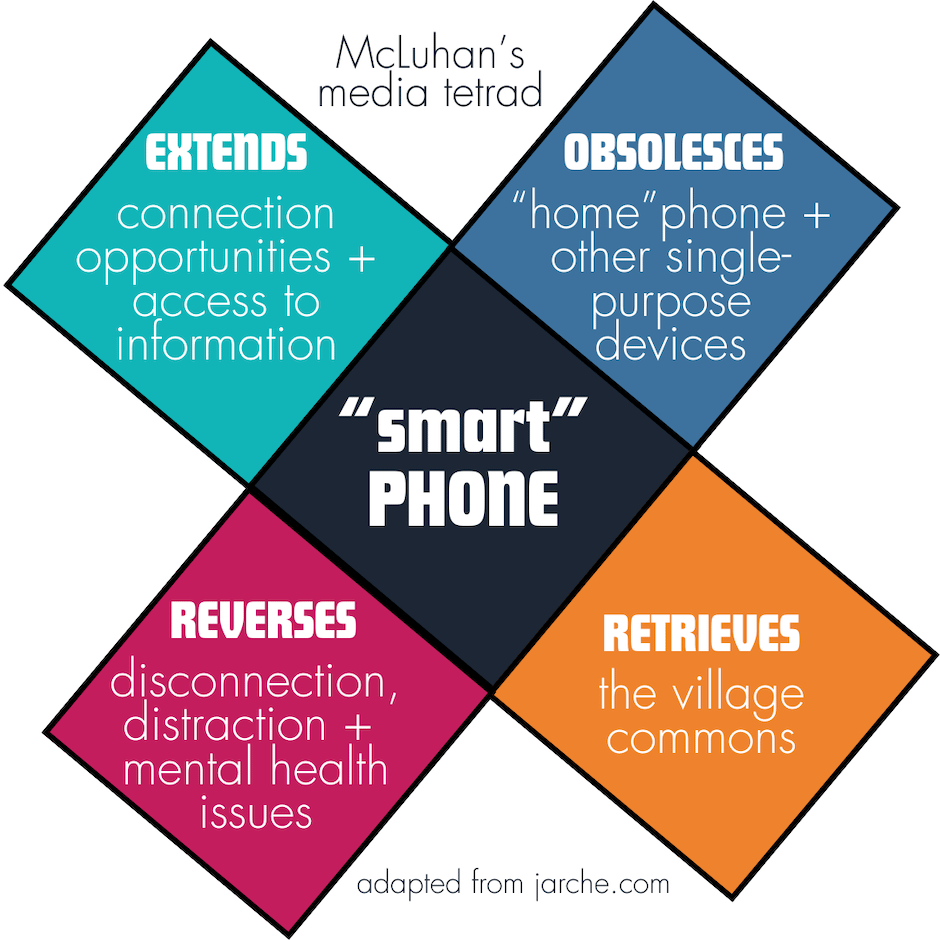
A diamond-shaped diagram showing McLuhan’s media tetrad applied to the “smart” phone. The center diamond says “smart phone.” The four surrounding diamonds explain its effects: top—“Obsolesces: ‘home’ phone and other single-purpose devices”; right—“Retrieves: the village commons”; bottom—“Reverses: disconnection, distraction, and mental health issues”; left—“Extends: connection opportunities and access to information.” The image is labeled “adapted from jarche.com.”

Jarche suggested that we first explore what the technology enhances and then what it obsolesces. That felt easy and hard, simultaneously. Today's “smart” phones contain so many features that the definition of what this technology is can be blurred. Our son, for example, has understandably brought up that when adults raise concerns about phones, they can often be actually talking about social media (which he presently has zero interest in).

The “smart” phone:

  • Extends: connection opportunities and access to information
  • Obsolesces: “home” phone + other single-purpose devices

As Jarche predicted, these two elements of the tetrad were fairly easy to identify (though I could have chosen to go in a bunch of different directions). I can still recall what it felt like to go with my brother to a convenience store that was about two miles from our house and involved climbing down a super steep, dirt hill. The idea that I could have called my Mom to ask her to pick us up, so we could have avoided the steep hill on the way home would not have occurred to me at the time.

That's despite the fact that we watched Star Trek as a family and they had these transporter beams that would transmit the characters in the show from the starship and a planet's surface.


Leonard Nimoy William Shatner Star Trek 1968

The idea of extending our home phone to one that could be carried around in my pocket (if women's pants had pockets, that is…) would have been a welcome idea to me. Then, there are all the other single-purpose devices that the “smart” phone can take the place of, such as:

  • 📞 Landline phone
  • 📷 Camera
  • 🎧 MP3 player
  • 🗺️ GPS
  • ⏰ Alarm clock
  • 📺 Video player
  • 💾 Disk or hard drive
  • 📝 Notepad
  • 🧮 Calculator
  • 💡 Flashlight
  • 💳 Wallet
  • 🧭 Compass
  • ✉️ Mail service

I could have kept going with that list for a long time and just be getting started.

Productive Struggle

Cognitive psychologists talk about how helpful productive struggle can be in the learning process. As Jarche thought we might, I had trouble with what the smart phone might retrieve a much older medium, in terms of the way I had anchored the framework with the other two components (extends and obsolesces). I then moved my focus over to the reverses portion of the tetrad and thought how it was the polar opposite (disconnection) of what it promises to extend (connection).

For the retrieves part, I kept getting stuck between two, broad ideas: the pubic square or the commons.

I considered how the promise of today's phones as the device to connect us with others and with information winds up making loneliness more likely and seeding a potential decline in mental health. I also fixated on how the “extends, obsolesces, and reverses” descriptions I had come up with were more geared toward individuals, yet the promise of the common good is only possible when we come together in community.

I would like to learn more about the history of the public square, as well as regarding the commons in medieval and early modern Europe. I'm also intrigued to keep my learning going regarding “the commons” in digital contexts (Wikipedia, Wikis, Creative Commons, etc.). There are also a lot of places I continue to want to explore about the attention economy and surveillance capitalism.

Until next time, when I share my reflections from Jarche's Fake News lesson. That should be fun, ehh? Nothing going on there in the world, right? 🫠 

Filed Under: Personal knowledge mastery

Why Isn’t RSS More Popular By Now?

By Bonni Stachowiak | October 17, 2025 | | XFacebookLinkedInEmail

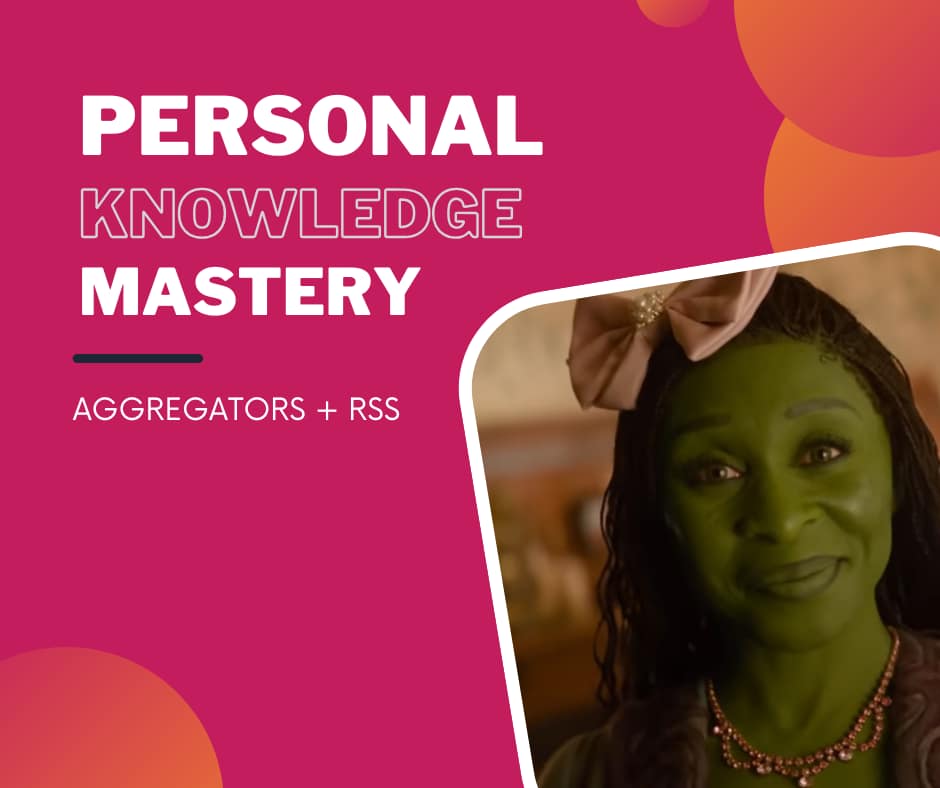
Personal Knowledge Mastery - Aggregators and RSS Screenshot from the Wicked movie of Elphaba dressed up with a bow on her head

It was a bit of a relief to have well-traveled terrain as the today's topic in Harold Jarche's Personal Knowledge Mastery workshop: Aggregators and RSS.

While I still want to drop everything going on in my life right now and dive deep into the topic from two days ago (the Cynefin Framework), that just isn't realistic. This PKMastery workshop has been a wonderful blend of ideas that challenge me, coupled with topics that I always enjoy learning more about, but am not starting from scratch with…

RSS – Not-So-Popular

It seems RSS could really have used some help from Galinda in the musical, Wicked, in terms of getting popular. I wish aggregators and RSS were something that the vast majority of people knew about and had incorporated into their lifelong learning and sense-making. It's strange to me that RSS has been around such a long time, yet still isn't very common in organizations at all.

In case the terms (RSS and aggregators) are new to you, Common Craft's RSS in Plain English from 18 years ago still checks out:

The Good, the Bad, and the Ugly

I've got some good news for you, some bad news, and some real ugly news.

The good: There's a ton of information on the internet, which has the potential to be transformative for us, as sense-making human beings.

The bad: We can't keep up and the quantity of information just keeps on growing, yet not enough of us know ways to harness the possibilities.

The ugly: Some of us give up on thinking we'll never be able to have a way of seeking, sensing, and sharing, so we resolve to just search for things at the exact moment we realize we have a specific question about something (a gap in our knowledge that we are aware of in that moment).

What gets missed here in “the ugly” (among other things) are the questions we don't even realize we have… The unknown unknowns… Not to mention misinformation/disinformation, etc.

Getting to Know RSS

Here are some RSS-related articles that I've saved on my digital bookmarking tool of choice: Raindrop:

  • Curate your own newspaper with RSS, by Molly White
  •  How I Use my RSS Feed for Bluesky and Mastodon: Keep up with anyone, no social media account required, Justin Pot for LifeHacker
  • Real Simple Syndication, by Harold Jarche
  • The Indispensable Digital Research Tool I can Say, Without Lying, Saves Time, by Alan Levine

Next, let's take a look at how I've set things up to be a tap away from a world of possibilities for sense-making…

My RSS + Aggregation Tools

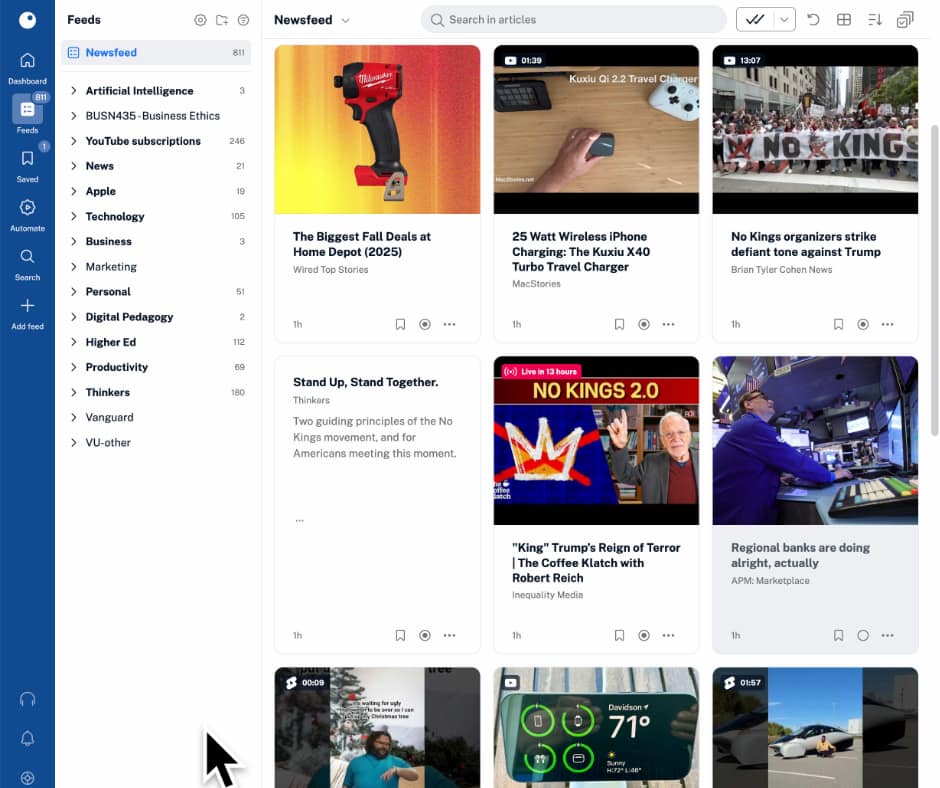
I use Inoreader as my RSS aggregator. That means that when I discover a source (news site, blog, newsletter, YouTube channel, etc.) that I discern will serve me up potentially useful information, I add it to Inoreader inside my existing folders (e.g. News, Technology, Business, Digital Pedagogy, Higher Ed, Thinkers). Each time one of those sources (called feeds in RSS nomenclature) posts something new, it automatically shows up as an unread item on Inoreader.

Screenshot of the Inoreader RSS website with folders on the left (AI, YouTube, News, Personal, etc.) and images/headlines on the right.

Thats where some people stop.

They download Inoreader's app(s) and read their feeds on their computers or smart phones and they're off to the races. Inoreader is both an RSS aggregator (keeping track of what feeds the user subscribes to, as well as which stories they have read/not read) and a reader (actually reading/watching/listening to the items in the feeds you've subscribed to).

However, I'm picky about my reading experience and have gotten particular about being able to read via my iPad and navigate everything with just one thumb.


"Who has two thumgs and can operate Unread with just one of them? this guy (and me)" Guy wearing a medical coat and a stethoscope puts both his thumbs up, which then point back at him.


This is where you insert a joke about “who has two thumbs and can set up RSS aggregators and tools? ME.” Except that in my case, it actually only takes one thumb, using my preferred RSS reader.

Unread = The Best RSS Reader I've Ever Experienced

Those who read on iPads would be hard pressed to find a better RSS reader than Unread, especially if you want to be able to skim and scroll through headlines (you can set up Unread to automatically mark the items as read, as you scroll through them, making the navigation even easier).

Inoreader does the work behind the scenes of keeping track of all my subscriptions and what is read/unread. The Unread app then presents me with a “window” into all that “stuff” Inoreader is keeping track of in the background. Unread “syncs” with Inoreader. I don't have much use of an RSS reader on my Mac, preferring to do most of my RSS consumption via my iPad, but I wanted to mention that even if you had a different app/service you preferred to use on your computer, Inoreader (and other RSS aggregators) are able to keep track across different RSS readers what you've read/unread.

Something Very Cool

Harold Jarche suggested that those of us who already have an aggregator / RSS workflow to share tips. I've kind of done that, already, above. But I will say that through his materials, I was delighted to discover that I can set up feeds for Mastodon #hashtags.

From Harold:

You can also subscribe to any Mastodon feed by adding .rss to the address, e.g. mastodon.social/@harold.rss

You can subscribe to #hashtags by appending .rss — e.g. https://mastodon.social/tags/pkmastery.rss

The PKMastery workshop is the gift that just keeps on giving. I'm looking forward to giving that a try this weekend. So cool.

Filed Under: Personal knowledge mastery

Scooping Up Adulting and the Benefits of Being Curious

By Bonni Stachowiak | October 14, 2025 | | XFacebookLinkedInEmail

Navigating complexity

My first year or two after graduating from college, I kept wanting there to be some instruction book that would teach you how to do all the lessons you somehow had missed in life thus far that it seemed like people should know. Today, young people would refer to this body of knowledge and skills as “adulting,” I think. I'm still wishing I had the magical powers that I witness only on the internet of those people who are able to meal plan effectively and sustainably (as in do it week in and week out). I'll do it like once and then will be so exhausted by the process that I won't try again until three years later.

It still amuses me how this yet-to-be-discovered curriculum evades me. When you think you have something figured out, change emerges, and you're right back in a liminal space. Jarche writes:

The Cynefin framework can help us connect work and learning, especially for emergent and novel practices, for which we do not have good or best practices known in advance.

Speaking of instructions: Will I ever live to see the day when I don't need to look up the pronunciation of Cynefin each time I run across it, yet again? I've been in the field of learning my whole life, though started getting paid for it at the age of 14 and a half, when I first started working and was quickly asked to train other people how to scoop ice cream, decorate cakes, clean the store, and so on at the local Baskin Robbins. It wasn't that complicated. Sweeping the floors looked the same day-to-day, Even when someone requested a new cake design, it was essentially tracing on plastic wrap and didn't require new ways of thinking.

Instead of step-by-step actions, many of the challenges I navigate today at work are complex. I was once selected to be the scholar in residence for the University of Michigan Dearborn specifically because I wasn't an “expert” (nor did I claim to be one). The role was to explore artificial intelligence in higher education. The team who hired me said it was specifically my curiosity that was what made them think I would be an effective person to help them explore the various perspectives people hold without acting as if there was some easy way to step-by-step figure out exactly what needed to happen.

Jarche writes:

In a crisis it is important to act but even more important to learn as we take action.

This “as we are going” learning is only possible with intentionality. It's otherwise all too easy to succumb to the tyranny of the urgent and neglect the humility required to continuously learn from what is emerging. We are invited to think of an example of each of the following, which I will attempt to do:

  1. formal community – at my work, we have our Academic Leadership Council (ALC)
  2. informal community – a group of friends have a text chat, where we share each others joys and sorrows, as well as recommend podcasts, articles, tv shows, books, and so on with each other
  3. open knowledge network – I'm thinking about communities that arise from clever (intentional) hashtag use, such as ones related to the disability movement, or Black lives matter, etc.
  4. formal knowledge hub – so many universities have resources to share with faculty related to teaching + learning, like the University of Virginia Teaching Hub

Filed Under: Personal knowledge mastery

Engaging with Intentionality and Curiosity

By Bonni Stachowiak | October 14, 2025 | | XFacebookLinkedInEmail

Intentionality - harold Jarche's Mastodon Profile picture.

Thus begins week two of Harold Jarche's Personal Knowledge Mastery workshop. This week's schedule already feels overly crowded, when my brain may best begin to be described as “fuzzy”… Hardly an opportunity for much sense-making. Still, I noted something as I considered some of the ways that Jarche says are the practices that PKM is built upon. He gives the following examples:

– narrating our work
– adding value before sharing information
– helping make our networks smarter and more resilient
– network weaving and closing triangles
– seeking diverse perspectives
– sharing half-baked ideas

I instantly thought of the tension between wanting to “add value before sharing information” and “sharing half-baked ideas”. I've almost always found incredible things happening in those times when I feel most vulnerable in sharing the unfinished work, while simultaneously wanting the exchange to be worth someone's time/attention.

My favorite LinkedIn thread of all time (as least as of October 13, 2025) started with me saying that I had needed to get these custom card decks printed before creating the game structure that they would be played on. As in I needed to create a game after having ordered the cards that the game would be made up of… It was then in my sense-making (and writing on LinkedIn) that I realized I wasn't even sure that I knew what a game was. And then, the beauty of the waterfall of goodness that commenced was amazing.

Harold suggested we look at who he follows on Mastodon, as we reflect on what our purpose and aims might be there. I noticed:

  1. More than a handful of computer programers. While not a programmer, myself, I do enjoy learning from geeky people.
  2. Primarily individuals and not as many organizations or group entities
  3. Many use what appear to be their “real” names
  4. A few have “request to follow” and I'm wondering what the etiquette is with that.
  5. Found a number of people I recognized from elsewhere, but hadn't yet “found” on Mastodon
  6. Lots of varieties in profile picture approaches. Some regular photos; others more sketch-drawings; others not people at all)
  7. I try not to be about the numbers, but it depresses me to have gone from 8k on Twitter to 259 on Mastodon. Yes, I know it is quality, not quantity. Still… I won't try to pretend it doesn't bum me out a bit.
  8. Lots of personality comes out on these profiles… sense of humor… believe in something that matters to them… good trouble…
  9. Lots of environmental people/professions, which reminds me of a post Harold wrote about wanting differing opinions, but not “both-sides-isms”… I just looked to see if I could find this post in my bookmarks and have come up empty. It's a bummer, too, because he wanted to hear from people who generally agreed with the 97% of the world's scientists who agree that climate change is occurring and is an issue, but to hear from people who think differently about what to then do about it.
  10. Wait. Robin DeRosa is actively posting on Mastodon. My goodness, have I missed her on social media.


Filed Under: Personal knowledge mastery

Connecting Birds, Grief, and Communities

By Bonni Stachowiak | October 11, 2025 | | XFacebookLinkedInEmail

Personal Knowledge Mastery: Communities Canary sitting on a branch

This week, I got to welcome Clarissa (Rissa) Sorensen-Unrue back to Teaching in Higher Ed. She's been on a few times in the past, exploring critical pedagogy; intersectionality, power, and pedagogy; and about the wonderful learning made possible through the MYFest community. This time, Rissa was joined by her sister, Christy Albright. They both shared about their unique (and some shared) experiences with grief and how it has shaped and formed them.

Why write about grief, when discussing communities, as part of this week's Personal Knowledge Mastery Workshop, led by Harold Jarche?

Grief can be such a lonely experience. Yet there are opportunities to feel less alone through the power of community. I've witnessed the ways that networks have helped people with disabilities navigating difficulties with access or inclusion, grieving parents who have lost a child, and connecting those who are looking to advocate for chance in higher education. Harold Jarche quotes Ronald Burt, author of Neighbor Networks: Competitive Advantage Local and Personal, in this week's reading:

It is not being in the know, but rather having to translate between different groups so that you develop gifts of analogy, metaphor, and communicating between people who have difficulty communicating to each other.

Getting Started with Mastodon

Jarche then invites us to set up and share our Mastodon profile, which we will be using throughout the workshop. I already had one set up on Mastodon.Social (a larger instance of Mastodon): bonni208, as usual, so this was relatively easy for me. Originally, Dave had set us up on a unique Mastodon instance. Ultimately, we decided that it wasn't worth the expense for us to do so and now we're both on a larger instance.

If my description of instances are getting confusing, Jarche suggests: Dear Friend: Let's Talk About Mastodon.

I'm still mourning the loss of community I used to experience on Twitter. First, I went radio silent and ultimately decided to delete my entire account. When discussing communities, that's one of the things we're warned against. If we put our metaphorical eggs in one basket and something happens to that basket, there's no putting Humpty Dumpty back together again. I was able to move some the people I followed over to other platforms, but it isn't at all the same as it once was.

Many people find themselves on newsletter and social media platforms that are misaligned with their values. Then, there's all the work with how to navigate that cognitive dissonance. This is messy business. I would advocate holding yourself to high standards as you're making decisions about where to farm and nurture your communities, but to be gentle with others who are in the process of making their own decisions about where to engage.

I know Harold and plenty of others aren't a fan of Bluesky, for reasons of replicating the issues many of us faced when investing so much on Twitter back in the day. However, that's been the closest experience I've had to some aspects of community I used to get to enjoy. I like that they have starter kits (thank you for all the bird starter kits, people of the internet) and that my feed has a mix of hard-to-read-yet-important stories, satire and humorous posts, and then there are the birds. Many, many birds.

Note: As I gather a few more links for this piece from my Raindrop.io bookmarks, I see that there is a way to: Roll Your Own Mastodon Starter Kits, thanks to Alan Levine's ongoing contributions to my learning over many years now.

Fact Checking Bird-Related Claims

Speaking of birds, when I was talking with Rissa and Christy, I mentioned something about not having fact checked an Instagram post, but enjoying the idea of when we listen to bird song, that the experience can be associated with positive health benefits. Before finishing the show notes for that episode, I figured I had better do my due diligence and assess the veracity of that claim. Using Mike Caulfield's Deep Background: Fact Checks and Context GPT,

In the first round of fact checking, the GPT stated that a fact checker might say that this statement is “mostly true.”

Strong evidence shows short-term relaxation and mood benefits from hearing birdsong, including reduced anxiety/paranoia versus urban noise. Broader or lasting “health benefits” (physiological and clinical) are plausible but less well established for birdsong specifically and should be qualified.

Another Round

When I followed Caulfield's advice and typed: “another round” in the text box, more nuance emerged. Note the parentheses in the following text, which indicates what is new in this follow up query:

What’s new here is marked (NEW).

What changed / what we learned this round

  • We found a credible conflicting lab study (Hedblom 2019) reporting no significant physiological stress-recovery benefit from bird-song masking in a traffic-noise context—suggesting that some of the stronger “health” claims (physiology) don’t always replicate when visuals and context are controlled. 
  • Two different angles refine the claim: (1) not all birds are equal—e.g., crow calls lower restorativeness scores relative to other species; (2) the mix with urban noise matters—bird/stream sounds may reduce annoyance only when traffic noise isn’t perceptually dominant. These both caution against blanket statements and point to designable soundscapes (what species? what mix?). 
  • Net effect: support for short-term mood/annoyance relief remains strong (Urban Mind; Stobbe; Buxton), but broad physiological or long-term clinical benefits from listening to birdsong alone remain unproven or context-dependent, and species/mixture effects are meaningful. 

Pattern to note

  • Higher-quality, controlled lab studies split: some show physiological recovery with general nature sounds (often water + birds), while others show null effects for birdsong specifically—especially when traffic noise is present or visuals drive recovery. Reviews also warn about conflating “birdsong” with “being in nature.” This pattern suggests the moderate claim is well supported, while the strong claim needs tighter, preregistered trials parsing species, diversity, and noise context.

Context Report

Finally, I followed Caulfield's guidance to type “context report” for a summary and can share the following results.

Core Context

  • The claim is often presented as “listening to birdsong relaxes people and produces other health benefits,” which can imply broad, causal, even physiological effects; reviews caution that many studies are short, context-dependent, or conflate “birdsong” with being in nature generally. 

  • In real-time diary research using the Urban Mind app, moments when participants reported seeing or hearing birds were associated with higher mental wellbeing, with benefits persisting to the next check-in; this is strong evidence of association but not proof of causation. 

  • A randomized online experiment (~6 minutes of audio) found that birdsong reduced anxiety and paranoia relative to traffic noise; depression decreased only with a higher-diversity birdsong track, and there were no cognitive gains—supporting short-term mood benefits rather than sweeping health effects. 

  • Evidence syntheses indicate natural sounds overall improve affect and reduce stress/annoyance, with birdsong showing particularly strong links to stress/annoyance relief; these findings speak to psychological states more than durable clinical outcomes. 

  • Not all studies find physiological benefits from birdsong: in a controlled lab study, masking traffic with birdsong did not improve physiological stress recovery versus traffic or silence, suggesting context and modalities matter. 

  • Species and soundscape context shape effects: crow calls score low on perceived restorativeness, and the ability of birdsong to temper annoyance depends on how dominant traffic noise is in the mix—underscoring that “birdsong” is not a single, uniform stimulus.

I felt that note about crow calls hard. Real hard. 😅

Back to the Birds

Finally, I could hardly do all this writing and thinking about birds without brining up my colleague Ludmila Praslova's book: The Canary Code: A Guide to Neurodiversity, Dignity, and Intersectional Belonging at Work. The community Ludmila has fostered on LinkedIn to help organizations “transform toxic cultures into thriving ones-reducing moral injusry, unlocking neurodivergent brilliance, and turning inclusion into innovation and belonging into business success,” is a great example of the power of networks.

Ludmila holds a copy of her book: The Canary Code
Dr. Ludmila Praslova holds a copy of her book: The Canary Code

Until next time…

…and here's a long list of sources, which I thought seemed appropriate, given what we're fact checking in this post.

Bibliography

  • Alvarsson, J. J., Wiens, S., & Nilsson, M. E. (2010). Stress recovery during exposure to nature sound and environmental noise. International Journal of Environmental Research and Public Health, 7(3), 1036–1046. https://doi.org/10.3390/ijerph7031036
  • Annerstedt, M., Jönsson, P., Wallergård, M., Johansson, G., Karlson, B., Grahn, P., Hansen, Å. M., & Währborg, P. (2013). Inducing physiological stress recovery with sounds of nature in a virtual reality forest—Results from a pilot study. Physiology & Behavior, 118, 240–250. https://doi.org/10.1016/j.physbeh.2013.05.023
  • Buxton, R. T., Pearson, A. L., Allou, C., Fristrup, K., & Wittemyer, G. (2021). A synthesis of health benefits of natural sounds and their distribution in national parks. Proceedings of the National Academy of Sciences, 118(14), e2013097118. https://doi.org/10.1073/pnas.2013097118
  • Hammoud, R., Tognin, S., Burgess, L., Bergou, N., Smythe, M., Gibbons, J., Davidson, N., Afifi, A., Bakolis, I., & Mechelli, A. (2022). Smartphone-based ecological momentary assessment reveals mental health benefits of birdlife. Scientific Reports, 12, 17589. https://doi.org/10.1038/s41598-022-20207-6
  • Hedblom, M., Gunnarsson, B., Schaefer, M., Knez, I., Thorsson, P., & Lundström, J. N. (2019). Sounds of nature in the city: No evidence of bird song improving stress recovery. International Journal of Environmental Research and Public Health, 16(8), 1390. https://doi.org/10.3390/ijerph16081390
  • Methorst, J., Rehdanz, K., Mueller, T., Hansjürgens, B., Bonn, A., & Böhning-Gaese, K. (2021). The importance of species diversity for human well-being in Europe. Ecological Economics, 181, 106917. https://doi.org/10.1016/j.ecolecon.2020.106917
  • National Geographic. (2025, May 14). Listening to birds sing really does soothe your brain. Here’s how. National Geographic. https://www.nationalgeographic.com/health/article/birds-sing-brain-mental-health
  • Praslova, L. N. (2024). The canary code: A guide to neurodiversity, dignity, and intersectional belonging at work (1st ed.). Berrett-Koehler Publishers. https://www.oreilly.com/library/view/-/9781523005864/
  • Ratcliffe, E. (2021). Sound and soundscape in restorative natural environments: A narrative literature review. Frontiers in Psychology, 12, 570563. https://doi.org/10.3389/fpsyg.2021.570563
  • Stobbe, E., Sundermann, J. M., Ascone, L., & Kühn, S. (2022). Birdsongs alleviate anxiety and paranoia in healthy participants. Scientific Reports, 12. https://doi.org/10.1038/s41598-022-20841-0
  • Zhao, W., Li, H., Zhu, X., & Ge, T. (2020). Effect of birdsong soundscape on perceived restorativeness in an urban park. International Journal of Environmental Research and Public Health, 17(16), 5659. https://doi.org/10.3390/ijerph17165659

Filed Under: Personal knowledge mastery

  • « Go to Previous Page
  • Page 1
  • Page 2
  • Page 3
  • Page 4
  • Page 5
  • Page 6
  • Interim pages omitted …
  • Page 13
  • Go to Next Page »

TOOLS

  • Blog
  • Podcast
  • Community
  • Weekly Update

RESOURCES

  • Recommendations
  • EdTech Essentials Guide
  • The Productive Online Professor
  • How to Listen to Podcasts

Subscribe to Podcast

Apple PodcastsSpotifyAndroidby EmailRSSMore Subscribe Options

ABOUT

  • Bonni Stachowiak
  • Speaking + Workshops
  • Podcast FAQs
  • Media Kit
  • Lilly Conferences Partnership

CONTACT

  • Get in Touch
  • Support the Podcast
  • Sponsorship
  • Privacy Policy

CONNECT

  • LinkedIn
  • Instagram
  • RSS

CC BY-NC-SA 4.0 Teaching in Higher Ed | Designed by Anchored Design