• Skip to primary navigation
  • Skip to main content
  • Skip to footer

Teaching in Higher Ed

  • Podcast
  • Blog
  • SPEAKING
  • Media
  • Recommendations
  • About
  • Contact

Teaching

Quick teaching

By Bonni Stachowiak | September 8, 2015 | | XFacebookLinkedInEmail

quick-teaching

I've often been frustrated at the 50-minute time block for courses.

At our university, morning classes on Monday/Wednesday/Friday are held [typically] in 50 minute blocks, while afternoon classes and those held on Tuesday/Thursday are conducted in an hour and 15 minutes.

Generally speaking, I tend to reserve the first five minutes for an introduction and welcome, while the last five minutes is left open for questions (or more likely because something took longer than I predicted).

That leaves really 40 minutes to facilitate learning.

Let's say I use five minutes to introduce the topic and some key terms and up to ten minutes to show some kind of video.

Now we are down to just 25 minutes to facilitate learning.

I might give instructions on an exercise for five minutes, let them come up with ideas on their own for ten minutes and then work in groups for another ten minutes.

Class is now over.

No feedback has been given on their group work.

There are all sorts of ways to change the time estimates up that I've reflected above.

Students can watch the video before they come to class and answer a few questions on their own. I could combine the giving instructions with the welcome.

However, the fact remains that it is very challenging to invite active learning in a 50 minute class session.

One technique I do is to follow up with some written or spoken feedback after the class session has ended.

My Introduction to Business students did an exercise recently about corporate social responsibility and stakeholders.

Introductory Pre-work

Before coming to class, the students watched a pencast and took a quiz to gain the basic vocabulary.

Activation in Class

In class, we listened to part of an interview with John MacKey (Whole Foods' CEO and founder) about conscious capitalism, in which he discussed some of ways in which he responds to stakeholders' needs. As they listened, I asked them to group the approaches he described under a list of the five, main stakeholders: investors, community members, employees, the environment, and customers.

We then scrolled through Apple's supplier responsibility site and discussed how challenging it can actually be to live out your company's values when you have a complex supply chain.

Application

Finally, I hung up signs around the room with the names of the various stakeholders. I made the signs on Canva, which is a terrific resource for quickly making gorgeously-designed graphics, without being a graphic designer, yourself.

The students met in groups and had to come up with three ways that Toyota might address each of the stakeholder groups.

Here is one of the class section's stickies.

Reinforcement after class

There wasn't time for me to review their responses in class. However, I was able to quickly capture their ideas via Evernote's iPhone app. Then, I wrote an email to them and discussed areas of strength in their responses and what they will want to improve upon by the time their first exam arrives in a couple of weeks.

Interleaving practice in weeks to come

Even though I would much prefer not to teach in 50-minute sessions, it does keep me from neglecting opportunities for interleaving practice.

Here's Robert Bjork describing the benefits of interleaving practice and how it is superior to blocked practice (even though it doesn't initially appear to be so).

Now that students have had an introduction to corporate social responsibility and they have been able to practice applying their new vocabulary in different contexts, they are ready for unexpected and low-stakes practice in the weeks to come.

I am getting a lot of leverage out of Remind this semester, as I send short messages no more than 2-3 times a day, asking students follow up questions about subjects we have explored in class.  They are not required to respond, but if they do, I will reply to them and let them know if they're on the right track.

[reminder]What approaches do you use when dealing with a short time frame in which to teach?[/reminder]

Filed Under: Teaching Tagged With: teaching

Calm teaching

By Bonni Stachowiak | September 1, 2015 | | XFacebookLinkedInEmail

calm-teaching

My former students often tease me, saying that having kids changed me as a teacher.

They reflect on how much calmer I am, in terms of when students aren't necessarily “following the rules” I set in the classroom. [I'll leave the discussion for how creating a culture of compliance may or may not be the best goal for education for another day…]

Both of our children were conceived as a result of many medical adventures. When I was pregnant both times, I worked hard to keep my stress levels low.

It was actually easier than I thought it was going to be…

I vacillated between being somewhat tired to being completely exhausted throughout the experiences. There just wasn't enough energy for getting angry at students.

When something would happen that would normally have frustrated me to the point of stress, I instead just took a deep breath and addressed whatever it was that happened in a patient way.

Despite the fact that we are done having children now and I get 8 hours of sleep most nights, the sense of calm in my teaching has remained.

Behavior does not equal intent

I used to be so incredibly good at ascribing bad intent to a behavior that a student would exhibit in a class.

If they were texting on their cell phone, I made that action somehow about me, specifically. They weren't just being rude, but were specifically choosing to be rude to me.

Now, while I still have times during my classes when the cell phones get put away and we focus on being fully present for one another, my feelings have changed during those times when the cell phones somehow sneak back into the foreground.

I still will ask a student to put their cell phone away, but I'll just mention that we aren't going to be needing them for what we are working on and that I know they don't want to miss what we're experiencing.

I frame my request more like I might an invitation and less like I might an indictment .

Students will often mirror our level of anxiety

Calm teaching certainly creates a better experience for me, but it also creates a calmer learning environment for my students.

Family systems theory is based on the idea that, in psychotherapy, you need to think about the individual you're treating as a part of their overall family system.

Organizational psychology draws from family systems theory and attempts to show the ways that the same dynamics from family systems theory emerge in the workplace.

If you would like to hear a robotic voice explain how this works, check out this video on family systems theory in the classroom.

We can model for students how to keep their anxiety low and reduce it for others by remaining calm when facing a potentially challenging situation with a student.

I have found that taking a deep breath (during which I remind myself that there's a lot that I don't know about this student) and formulating either a question I can ask, or an invitation to that student to engage works well for me.

We've been encouraged by Jose Bowen to Teach Naked… and I'm so looking forward to discovering from James Lang in 2016 more about Small Teaching.

I'm thinking calm teaching is another aim we can cultivate as educators…


Filed Under: Teaching Tagged With: teaching

Choose your own adventure learning (part 2)

By Bonni Stachowiak | June 16, 2015 | | XFacebookLinkedInEmail

choose-your-own-adventure-learning

I wrote a post about how I provided some Choose your own adventure-style learning for my students last semester. In the comments, Doug McKee indicated that it sounded like it would wind up being much harder than a “normal class” and asked if that was a fair assumption to make.

The question seemed worthy of a follow up post to my prior blog entry about Choose your own learning.

The inherent challenges of course design

I will say upfront that it is challenging to assess what additional time was required, since it was my first time teaching the course at the undergraduate level. Whenever I do that, I spend an enormous amount of time crafting learning outcomes, developing rubrics for each assignment, and on instructional design.

Someone who had taught a class previously, but just wanted to add the component of choose your own adventure would have a lot less work to do than I did last semester.

Questions to address before adopting this approach

Here are some of the areas I've identified that would require additional planning and thinking for a choose your own adventure type approach:

How will you handle exams, when not all students in the class will take them?

  • I taught the course in a three-hour block, so it was easy to schedule the exams as the last activity for the night. Those not taking the exam just left after the first two hours of instruction.

How strict will you be about the class policies you set up for this approach?

  • I had a form that students completed with their points designation, which states that changes could not be made after the fact. I wound up making changes on a number of fronts and would probably figure out other wording to use in the future to reflect what are likely to be my true actions when changes are warranted.

How can you structure the potential options for earning points to be sure that all learning outcomes are assessed?

  • My course had four modules and one comprehensive exam or assignments. I required that students take at least three of the five exams and earn points for some assignment related to the fourth module they potentially wouldn't be taking an exam on.

How will you structure your grade book to show progress toward total points in the class?

  • I was transparent with the students that the way the grade book was set up, they would have to do figuring on their own of how they were progressing toward a desired grade in the class. I didn't have a way to set up individual reports for students, based on the ways they selected to earn points during the semester.
  • This didn't wind up to be too problematic. Half of the class was comprised of accounting majors, who were all quite comfortable with projecting their own grades, individually. The remainder of the students were highly mature and also either kept a close eye on their points, or weren't as concerned about their grade in the class.

How will you track students' selected assignments?

  • I used a form that the students filled our during the second night of class (after hearing about it and receiving the dome during the first session). Then, I made a photocopy for me and handed the originals back to the students. This became problematic when I scanned the documents and recycled the copies.
  • I didn't notice until too late that the items each student had checked did not show up on the scanned copy, except in a few cases. Even then, the documents were difficult to sort through and manage. Some students also lost their originals throughout the semester and had to rely on memory for what they had chosen.
  • Next time I use some kind of choose your own adventure style, I will use a Google form for collecting the students' point selections. I'll have each student include their email address on the form and will set up a mail merge to send each student their selections.

Yes, using a choose your own adventure state of teaching took some additional time, versus having a standard set of assignments. However, I can refine my processes over time and probably carve that down to something almost negligible in the long run.


Filed Under: Teaching Tagged With: teaching

Choose your own adventure learning

By Bonni Stachowiak | May 5, 2015 | | XFacebookLinkedInEmail

choose-your-own-adventure-learning

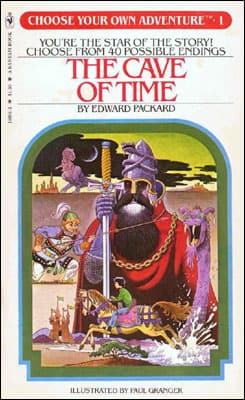
When I was a kid, one of my favorite forms of story telling was the Choose Your Own Adventure series. The books were written in a non-linear way, allowing me to grapple with how I would handle a particular situation.

Cave_of_timeEvery couple of pages brought forth a dilemma with two or three possible routes to take. If I wanted to choose option A, I was directed to turn to a specific page. Option B took me to an entirely different part of the book. You could read the book repeatedly and get a different story each time.

Edward Packer created the series of books out of an exchange he had with his daughters. He used to tell them stories each night about a character named Pete. One day, he ran out of adventures to send Pete on and he asked his children what they thought Pete should encounter that night.

When he saw how engaged his daughters became, he decided to extend the idea into written form. The Choose Your Own Adventure series was quite successful, selling 250 million copies between 1979 and 1999.

Choose Your Own Adventure Learning

The idea for using a choose your own adventure style of instruction for my business ethics course came, initially, from my desire to incorporate some type of undergraduate research into the class. Bethany Usher was on episode 27 of Teaching in Higher Ed and was such an inspiration to me to begin to engage in the messy work of leading undergraduate research.

I wound up failing in my ability to get traction with any kind of formal research projects, but I did start to think more about approaching the class in a more flexible manner than my typical syllabi afford students.

Goals

As I started to put together a framework for the assessment for the learning, I kept a few goals in mind.

1) Offer varied methods for demonstrating learning

I wanted to be sure that students were assessed on each, main, learning outcome for the class. However, I also wanted students to be given choices as to how they might demonstrate their learning.

2) Help students discover their strengths

Instead of having students focus on improving their weak areas, my desire was that this course would help them identify and amplify their strengths.

3) Ask students to take responsibility for their learning

I also hoped that students would be more autonomous in their learning and have some of their childlike curiosity sparked.

Structure

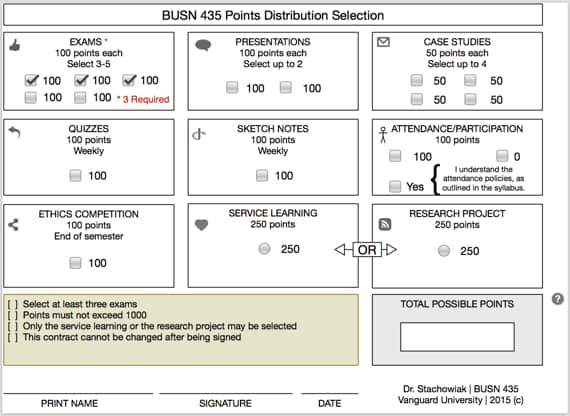
I started by putting together a graphic that showed the students the various ways they had to demonstrate their learning throughout the semester and the associated potential point values.

busn435-pointsdistribution

In order to ensure that students demonstrated learning in each of the four primary learning outcomes, they were required to take at least three exams (out of a possible five).

Each student chose a combination of points that added up to 1000 and only contained one project worth 250 points (the service learning or research project).

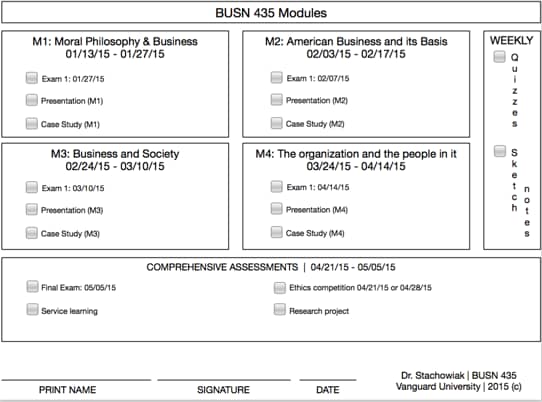
Then, I showed them how the various assignments were timed throughout the semester.

module-timing

Some assignments were based on the four modules, each around 3-4 weeks apart. I had students use the scheduling service, Doodle, to sign up to give their in class presentations.

The timing of the exams was not flexible, as they occurred in class and were only offered on a single night of class. The timing of the weekly assignments was also not flexible, as they were designed to be reinforcement for before the class sessions were held.

There were a series of comprehensive assignments, which were assessed in the last few weeks of the semester. Some of our graduating accounting majors put together this video on how to create more ethical business practices through internal controls, as their service learning project.

The intent was that it could help people with limited business experience reduce their risk of fraud. One area that I know I need to improve on the next time I teach this class is to have more measurable outcomes surrounding what “done” looks like for these projects. While I was incredibly impressed with the video, I had hoped that they would have a particular group of individuals who could be helped by it.

I'm disappointed that I didn't outline my expectations more effectively, but am also reminded of what my friend, Doug McKee, says:

If you aren't failing at teaching, you aren't trying hard enough.

Results

On the final week of our class, I asked the students to give input as to what worked and what didn't about the way the class was structured. I had been candid with them in the beginning about my experimentation with this format and we had made some tweaks along the way as we discovered problems with my initial design.

The students were excited to share their feedback with me on how much they liked the class structure.

Here are some of the notes I took that relate directly to the Choose Your Own Adventure learning approach:

We got to play to our strengths.

I could schedule the assignments around my other classes' exam and assignment dates.

It shifted the responsibility for learning from you, as the professor, to us, as the students.

I liked being able to decide whether or not attendance was going to be a factor in my grade for this class.

The flexibility of this structure was great.

Planning out which assignments I would do when also helped me do a little thinking about my learning, in advance of right around when the assignment was due, like I do in so many of my other classes.

It was rewarding to discover that the goals I had set out for this experiment were achieved. I also found other aspects to the approach that I hadn't even anticipated as a potential benefit.

Other ideas

I wasn't surprised when I discovered that I'm not the only person to have had the idea to make a class in to a Choose Your Own Adventure format. Here are 20 ideas for ways you might use a similar format in your classes.

[reminder]Let us know what ways you have given your students more control over their own learning. [/reminder]


Filed Under: Teaching Tagged With: instructional_design, teaching

The treasures of a teacher

By Bonni Stachowiak | April 28, 2015 | | XFacebookLinkedInEmail

The treasures of a teacher

I took our kids to the beach the other evening. Our 3 year-old, Luke, found a penny while we were walking toward the pier. He was thrilled with his find and wanted to put it in one of the parking meters we kept passing.

It was difficult to try to explain to him the errors in his logic.

First off, paying for parking at the beach is only required until 5 pm and we were there after that time. Second, I tried to explain to him that there really wasn't much that a penny would do for him these days. A penny wouldn't even be accepted in the meter, let alone result in any minutes of parking time.

After I told him these things, this was his response to me:

Mommy, this penny is my treasure.

It was one of those “in the eyes of the beholder” moments. I loved that he took such delight in something so seemingly insignificant.

It got me to thinking about the things I treasure the most in my teaching.

For me, its the letters and emails I receive from former students. They remind me of the ways in which I've been some small part in helping another person grow. They remind me that even though students will likely be challenged beyond what they would choose for themselves in the short term, that they have the potential to reap rewards that extend well beyond that final week of classes.

During the stressful final days of the semester, I like to read former students' words of encouragement that remind me of the longer arc of learning we are striving for…

My most treasured letter came from a student who failed her first class with me. She was devastated. At the time, she suspected that she was going to be unable to return to the university the following year.

I listened to her and had her talk through the possibility of not coming back. She was prepared to accept that outcome, though of course she was saddened that it would set her back so much in her life.

The following year, she was able to return. She took the class, again, and this time earned a C. Each class she took with me, she told me she worked harder than she ever had in college.

I would sometimes stay late in the evenings to study with her and others in the classes. It was rewarding to watch her put forth such effort, despite the fact that she wasn't able to accomplish the specific grades I know she wanted.

As is so often the case, her graduation seemed to come so quickly. She dropped a letter off for me in my office as the last week of classes was ending.

In it, she wrote about how much I had meant to her as a professor. She said she appreciated that not only did I challenge her to do more than she ever thought she was capable of, but that I believed in her more than anyone else ever had.

Most of the letters that students write wind up getting scanned and put in to a folder on my computer for my post-tenure review or future promotion portfolio. While I have scanned hers, just in case something were to happen to it, the physical copy of it has remained in my desk hutch all this time.

I can see the lines of the back of the piece of paper paper all the time when I'm sitting at my computer, knowing the precious treasure of words that sits inside those folds.

Yes, Luke, I understand what unexpected treasures we might find on our journeys. Thank you for reminding me of that with your penny the other night.

Speaking of which, I don't think I took the penny out of my pocket. By now, it has probably gone through the wash. Sigh. 

[reminder]What is a treasure in your teaching that you've collected?[/reminder]

Filed Under: Teaching Tagged With: evaluation, teaching

  • « Go to Previous Page
  • Page 1
  • Interim pages omitted …
  • Page 10
  • Page 11
  • Page 12
  • Page 13
  • Page 14
  • Interim pages omitted …
  • Page 23
  • Go to Next Page »

TOOLS

  • Blog
  • Podcast
  • Community
  • Weekly Update

RESOURCES

  • Recommendations
  • EdTech Essentials Guide
  • The Productive Online Professor
  • How to Listen to Podcasts

Subscribe to Podcast

Apple PodcastsSpotifyAndroidby EmailRSSMore Subscribe Options

ABOUT

  • Bonni Stachowiak
  • Speaking + Workshops
  • Podcast FAQs
  • Media Kit
  • Lilly Conferences Partnership

CONTACT

  • Get in Touch
  • Support the Podcast
  • Sponsorship
  • Privacy Policy

CONNECT

  • LinkedIn
  • Instagram
  • RSS

CC BY-NC-SA 4.0 Teaching in Higher Ed | Designed by Anchored Design