Follow the Teaching in Higher Ed Podcast
About this Episode
EPISODE SPONSORS: Courtney Plotts discusses culturally-responsive online teaching on episode 314 of the Teaching in Higher Ed podcast.
How well are we really reaching our students? How is that authenticity coming through?
Courtney Plotts
On episode 314 of Teaching in Higher Ed
Voices on this Episode


Show Notes + Resources
- On the Folly of Rewarding A While Hoping for B, by Steven Kerr
- Teaching Connectedness Webinar
- The Space Between – Identifying Cultural Canyons in Online Spaces and the Use of LatinX Culture to Bridge the Divide, by Dr. Courtney Plotts
- What Do Our Most Vulnerable Students Need This Fall? To Be on Campus, by James M. Lang
- TextExpander
- SaneBox
Recommendations from this Episode
Resource
CASEPS Community Series: Teaching Connectedness
Article
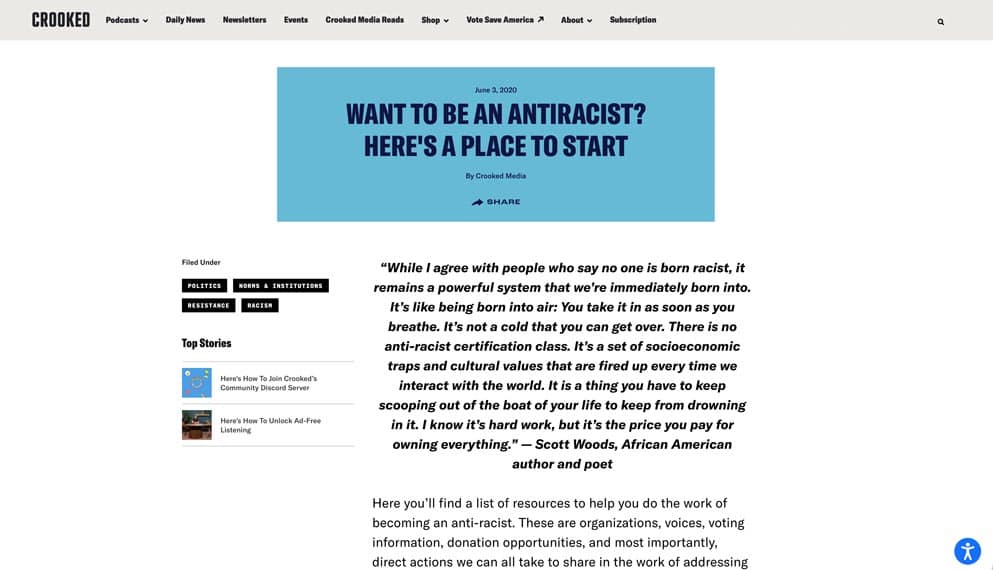
How to Be an Anti-Racist

Idea
Listen
Transcript
[00:00:00] Bonni Stachowiak: Today on episode number 314 of the Teaching in Higher Ed podcast, Dr. Courtney Plotts joins me to talk about culturally responsive online teaching.
[00:00:13] Production Credit: Produced by Innovate Learning, maximizing human potential.
[music]
[00:00:22] Bonni: Hello, and welcome to this episode of Teaching in Higher Ed. I’m Bonni Stachowiak, and this is the space where we explore the art and science of being more effective at facilitating learning. We also share ways to improve our personal productivity approaches so we can have more peace in our lives and be even more present for our students.
[00:00:50] Bonni: Before I introduce today’s guest, I wanted to thank today’s sponsors, and that is SaneBox and TextExpander. To start, I’m going to share a little bit about SaneBox. It is an email filter system that is absolutely a wonderful way to make email work for us. This has been a time for me in my personal career that I’ve received more email than ever. It’s difficult to keep up with, but it is a lot easier with SaneBox. What it does is it allows my email to filter out into things I don’t want to look at until later, or their newsletters, or if it’s something that I suspect could be spam, but I also don’t want to attract additional spam by unsubscribing or attempting to unsubscribe.
There’s the Sane BlackHole that I can just drag an email into there and never hear from that entity again. I can ask the inbox to remind me if this person hasn’t replied to me in a certain amount of time. I can snooze emails. There’s all kinds of ways that I can really make email work for me. I’m going to suggest that you head on over to the link that’s in the show notes for the SaneBox service and get started right away, and have your inbox cleaned up in minutes. It works with all the major email providers. It really is an essential part for me at trying to serve the people that I serve in terms of all the things that we’re dealing with in this time.
Dr. Courtney Plotts is a dynamic keynote speaker, author, and professor. As the national chair of the Council for At Risk Student Education and Professional Standards and a school psychologist, her primary focus is on online teaching and learning best practices. Dr. Plotts is highly sought after for educational and leadership conferences for her ability to connect with audiences, and share common sense practices that can be easily integrated.
Dr. Plotts was recognized in 2017 by the California State Legislature for her bold commitment to change in education. In 2019, she was recognized by Magna Publishing as one of the ‘Best of’ speakers at the Educational Leadership Conference. Dr. Plotts has contributed her subject matter expertise to a variety of book publications, most recently noted in Small Teaching Online by Flower Darby with James M. Lang. Published in June 2019, Dr. Plotts’ book entitled, The Space Between, Identifying Cultural Canyons and Online Spaces and Use of Latin X Culture to Bridge the Divide will be available in August of 2020. Courtney, welcome to Teaching in Higher Ed.
[00:03:37] Courtney Plotts: Thanks Bonni. It’s good to be here. Thanks for having me.
[00:03:40] Bonni: We talk a lot on this podcast about pervasive myths, about teaching, and one of them I know you’re very well familiar with is just this idea that good teaching is just good teaching. Everything’s the same and it’s going to land on all our students regardless of their backgrounds, regardless of their culture in the same way, and it’s up to them to get with the program or not. Would you discuss a little bit of that myth and maybe where you’ve seen it in your work?
[00:04:11] Courtney: Sure. Age-wise, I’m the benefit of higher education focusing on non-traditional students. I’ve had the benefit of instructors who were on that first and second wave of interacting with their students and really setting them up for success. As for myself, I was a K12 public school teacher. I taught in higher education. I was also the director of the Community and Human Services Department at Eastern University, Esperanza College which is primarily a Latino school in Philadelphia.
When we look at these practices for teaching, it comes through a filter. That filter is there are certain values that go with higher education and expert teaching and learning. That lens is filtered through. There are certain values such as independence, and self-efficacy, and self-motivated. When you look at the literature, you look at the research on who makes a good online learner, or what are the characteristics. It falls in this one value center.
What I’ve been looking at is other cultural values that can translate those same opportunities, that same power that can come from teaching and learning. What we’re talking about is we’re not talking about shifting all best practices to a cultural lens. What we’re talking about is, “Let’s take a look at what we’re doing and add some features that will allow what we’re doing to flow through other cultural lenses.”
[00:05:47] Bonni: Courtney, so much of learning, teaching, whatever it is we can use to describe what’s been happening, a lot has been moved online. You really started to allude to some of this, that’s on our learners, self-efficacies, got some troubles with it if we take that a little bit too far. This independence isn’t going to work well for all different types of learners. Talk a little bit now of what you’re seeing. In recent months, so many people have moved online, and so many people weren’t really equipped to do so, and what you saw in terms of maybe this myth and how it became maybe even amplified.
[00:06:30] Courtney: Sure. Just a little bit of context. About four years ago, the organization that I work for, we started looking at standards for how to work with non-traditional student populations, and face-to-face, and online learning environments. There are some pieces that have to be in place before we did this mass ‘throw everyone online’. I have the opportunity to work with Aluma Therapy to build pieces of policy to keep people safe in these environments, so a couple of points. We have a lot of instructors who rely heavily on Student Services for their students.
In a face-to-face environment, maybe their student is having an issue, maybe their student needs the support of the counseling services, or they need the support of an academic advisor. When we put everyone online, we didn’t equip our faculty to know what that process was in an online space. For instance, there’s been a lot of research looking at people in recovery, students who are maybe living with an abuser. We have an outline for our faculty what that looks like in an online space. For instance, right now, Bonni, if you and I were doing a webinar, you wouldn’t even know where I am.
If something was going on, you could call 911, but most 911s are not connected through interstate communication. What I’ve seen is a lot of faculty have really stepped up to the challenge. Some of them have taken it as an opportunity to be creative. Some of them have taken it as an opportunity just to learn. Some of them are really overwhelmed and just need a place to start. The way I look at it is I want every faculty member and every student, regardless of circumstance, to feel connected in the online space, whether it was– It didn’t take us a pandemic to realize that this was important.
We’ve been working on this for about four or five years. Really, commending the faculty that have moved from point A to point B, and some of them have done it seamlessly, because they’re open to the process, and some people just have timing. It took a minute for faculty to get their bearings, but overall, it’s now time for part B, which is, how well are we really reaching our students? How is that authenticity coming through? Bonni, if you and I know each other face-to-face and then we go online, it’s a way different experience than for our new students coming in who don’t know us, who haven’t been on campus, who haven’t spent that time face-to-face.
Those are big challenges that we’re looking at. Overall, I think most faculty have done the best that they can do for the circumstance. We can always all do better, but I think it was just that initial change, was point A to point B. It wasn’t like, “Oh, we’re going to do this. Great,” because nobody was prepared. Now that everyone’s got their bearings and maybe they can get a little summer respite, hopefully, for themselves to really reflect for themselves and really do some self-care, and come back in the fall. Again, that difference in coming back in the fall is, our new students don’t know us face-to-face. We really need to make a concerted effort to make sure we’re doing everything we can to connect with them in the online spaces.
[00:09:50] Bonni: I keep thinking about that not only will some of them not know us, that this would be a fresh new experience for them, but also that we’ll be wearing masks. Side note, totally in support of masks, let’s stay safe people. I’m not at all advocating that we shouldn’t. I’m advocating the fact that in so much of my work, I hope that I’m some influence and getting people to remove some of those barriers of power between themselves that hold them back from really being able to be in true relationship, and true connection with our students.
Now I go, “oh God, people are talking”–I was listening to some congressional testimony this morning that institutions of higher education are talking about and, Oh God, I forgot the institution so I don’t want to get it wrong but one of the larger institutions has bought over a mile of plexiglass. I was like, “If this isn’t taking some of the figurative things that so many of us have been fighting against and then literally building up barriers,” whether that be a mask again, which I support.
I’m trying to picture this for myself as a teacher. I’m wearing a mask. I don’t leave the house very often, but occasionally when I do, I wear a mask, but not for that long and not with people I’m really trying to connect with.
[00:10:58] Courtney: Sure. The other piece of it is it’s a pick and choose thing as well, because my director is Muslim. You’re telling people on one hand, they can’t wear a full burka, but then we have to have masks. When you’re thinking culturally competent, the reasons are different, but if you’re working in a place like Michigan that has a large Muslim population, maybe they already have those policies in place. If not, how are you considering all students and all people?
[00:11:31] Bonni: Your book which I am so excited to read is called The Space Between. I will read the full title, Identifying Cultural Canyons and Online Spaces and The Use of Latin X Culture to Bridge the Divide. Would you tell us about the Space Between?
[00:11:48] Courtney: Sure, The Space Between is just the gap between myself as an instructor and my students. It usually happens because of a couple of reasons. It’s because maybe I’m not as genuine or not as real as I could be to my students, or maybe something in my video or podcasts and my facial expressions is falling short. One of the best pieces of advice I ever got, I was listening to a psychologist and she said, “If you’re going to be a psychologist in online spaces, your personality has to be three times what it is in person to bridge that gap.
I thought about that clinically and I thought, “Okay, I get that if we’re talking counseling or really making the connection.” Over time, that got a little bit more real to me, which was, “Yes.” I think the same thing applies to teaching, is that we want to be as real as we can be, as genuine as we can be, and The Space Between is just the gap between how well we’re reaching our students and how well we think we’re reaching our students, especially in this climate and announcement isn’t enough. A discussion post isn’t enough.
We really have to work on those online soft skills that bridge that cultural canyon between online culture, learning culture, and other cultures, whether that’s Latin X, African-American, LGBTQA, whatever that is. We need to work on those soft skills to enhance what we’re already doing.
[00:13:18] Bonni: I believe it was yesterday James M. Lang came out with a article on the Chronicle. I’ve never seen him do this before. This is on Twitter where he was sharing. I think he had a link to this in the show notes. I think he had about five tweets where he’s like, “All right, I’m about to post this thing, but I want to explain to you why I’m doing this first so that I don’t get myself into too much trouble.” I’m never going to be able to encapsulate his beautiful poignant writing in my own clumsy words, but I will attempt to do so now.
It sounded to me like he was saying that in moving online, if they end up needing to be online in the fall again, just as we have been that he feels a disproportionate greater difficulty connecting with his students of color. He used the example of email, and you just mentioned announcements. One of the things that I was thinking about is that, first of all, email, difficult in my mind to connect with all students in terms of, “Oh God”– there were so many problems that he brought up, you could have written entire books on.
The quantity of emails the institution send, and every email then gets shown up on their screen with equal importance and et cetera, et cetera. I was thinking about what you would have to share in terms of, if we either need to be online or imagine this Courtney. You want to be online beside email, besides announcements, which really are just another form of email, what are the ways in which you see us really actually being able to really leverage it in ways to make these connections?
[00:14:59] Courtney: Yes, that’s a great question. There’s a couple of things that are coming to mind. It’s interesting. When Flower Darby was writing her book and she contacted me, it was interesting to hear her point of view because she said, “This book just needs something else. Tell me about non-traditional student populations. Tell me about what is the deal.” I’d shared some information with her and you guys can see that in the book.
The second part is, in my own research, working with African American men, I found it fascinating that I asked them, “If you’re working shift work”— because the majority of people that I had interviewed for that research were working shift work. I said, “Well, where’s your computer access?” They said, “At work.” I said, “Okay, so on your break if you’re allowed to use that computer, is that when you respond to your instructor?”
And they said, “No.” I said, “Well, how come?” They said, “Well, what would you think if I wrote an email at three o’clock in the morning to you?” A lot of them said, “Nothing good happens after 11 o’clock.” That can span cultures. I’ve heard people of all races say that, but in the black community, it’s understood that there’s a stereotype that’s going with that timestamp. They said they’d just rather not do it. They’d rather pick up the phone when it’s more convenient, or in the morning, or in the– There are these nuances to it.
A lot of the clinical research shows that especially for African American men, online telehealth groups are very beneficial. If we’re talking about, what can the faculty do or what can leaders do, be prepared to listen. It’s really basic human stuff. We have to listen to people regardless of race, color, or creed. We have to get back or we have to get to where I can hear you and I understand. I might agree, I might disagree and I’m not suggesting that with George Floyd. I’m just saying in general spaces. We have to get to a place where people can hear each other, and sharing a little bit about my own personal life.
It’s interesting to me because my mom is white and my dad is black, and my brother looks like George Floyd. My mom looks like you, Bonni. I hear people and I hear their concerns, and it’s always hard for me to articulate to one side of my family where the other side is coming from. Personally, I totally understand where the divide is and I totally get it. Higher education has a responsibility to shepherd people to the next level. That’s what we have to do.
We have to be the beacons of hope, we have to be the beacons of enlightenment and we have to help people move to the next level. Whether that is holding listening circles for our students, whether that’s really making sure as higher Ed leaders that we’re reaching out to the faculty who are comfortable with the stuff like our sociologists, our psychologists. If that’s where we start, then that’s where we start. They have to know those important pieces and they have to be allowed to be available.
When we’re talking online, that means that there’s a link to a chat group. That chat group is solely talking about X, Y, Z issues. Some of them might be for the students at large, some of them might be for different groups. I trust higher Ed leaders to know their campus, and I trust them to know their climate, and they can make those decisions. Again, as far as online goes, there’s a lot of support that shows that African American men in particular benefit a lot from online conversations.
[00:18:21] Bonni: You talked earlier about the desire to be real, the desire to be genuine. Another thing that you shared earlier is that so much of online predisposes us to value, perhaps even overvalue, independence and self-efficacy, especially that independence to me really is a representative for me of ways in which I have needed to change my teaching approaches to better reflect the students I serve. Would you share some things that come to mind around what is a more of a collectivist approach look like in an online class versus in individualistic?
I used the example earlier of announcements. I am telling you something. Email, I am telling you something and you can reply back, and then it’s just me. As the professor, I’m telling you as the student, can you help us see a little bit of a different lens around what collectivism looks like?
[00:19:18] Courtney: Sure. One of the biggest pieces, again, it comes back to that prevention piece is really sitting down. What we’ve done is we’ve made online learning transactional. That’s what we’ve done. I do this, you do this, I do this, you do this, I’m going to grade this, you’re going to reflect on it then you’re going to do better next time.
Psychologically, if we really want learners to be interdependent and we want them engaged, if we want them to do everything that we say we want them to do like read the syllabus, and participate three times a week, and do peer reviews, we have to set the climate for them to do that.
One of the easiest things that helps do that is outlined in your announcement, what your sense of community is, because sense of community is in the literature, all over the place, is something that’s important but no one’s talking about building it and defining it. Just like you’d post an announcement to say, “Hey, everything’s due here.” Before you even post that, you should say, “This is how you should feel when you enter. This is what my values are for this learning community. This is what it’s not, and I’m going to grade it.”
If it’s important, we should be grading it, we should be assessing it. Working with other people and feeling included is a big part of your workforce. It’s working with people who are different than you, who come from different places, and you’re working on projects together. In online spaces, we reduce that to transaction. We say, “Oh, well, sense of community is so important.” All the literature, says that, right? Everything about online learning, sense of community, we want people to feel engaged, we want them to feel empowered, but yet nobody is defining that in the space.
One of the easiest things you can do is identify values to your sense of community. If I’m a student coming in and I’ve never been on online learning, don’t … with an orientation. Show-me community and I’ll participate. Show me that I’m safe. Show me you understand my concerns that if I’m an African-American male, show me that you will respond if someone is saying something that’s inappropriate. What is the value of the community?
Instead, we do this individualistic thing, and now we wonder why we’re losing Latin-American and Latino students all over the place in online learning. What it comes down to is, we can absolutely look at a sense of community and grade it. People always say, “Well, Courtney, what does that look like? What is this grading a sense of community look like?” It looks like you outline some values, just some examples off the top of my head, whether it’s something like civility.
Whether it’s something like appreciation for diversity, whatever those constructs are that you want to look at. You post that each week in the announcements section, and you grade them as a group to show that it’s not just about you, it’s about the interaction, it’s about these other pieces. Hopefully, that was helpful.
[00:22:13] Bonni: Oh, it really, really was. One of the best articles I ever read in my entire master’s, entire doctorate is called On the Folly of Rewarding A, While Hoping for B. It was in the Academy Management, something back. I’m trying to think of when it was first published, but a gazillion years ago. [laughs]. That’s a precise term, but you’re reminding me of that in the classic example, it was written so long ago but it literally could have been just written today in terms of these examples come up all the time.
We say in workplaces how essential teamwork is, but then we give individual performance reviews and bonuses. If it’s a salesperson, for example, teamwork except for in sales, except that you’re the best at whatever this individualistic thing was. This comes up all the time.
[00:23:04] Courtney: It’s also just a value. Psychologically, people want to know that it’s not lip service. The way that we’re doing it right now is like, “Well, you care about the community, but you don’t know how to pronounce my name.” It’s a disconnect. I know that faculty want it too, they want to feel as close to their students in person as they do online– they want that. That’s not something they don’t want. It’s why they’re educators [laughs]. They want to be with the students. I’m just trying to point out conduits that can help them get there.
[00:23:33] Bonni: I struggle so much with the transactional thing that you talked about. As soon as we do assign points to something, grades and, of course, there’s lots of conversations happening about the challenges with grading even just as a concept. As soon as we do that then and we say– respond three times. We’ve instantly made it transactional. I think what I’m hearing you say though is, “If you’re going to grade this stuff over here then you better grade this stuff over here.” [laughs]
[00:24:02] Courtney: Yes, and that grading looks different. It’s just saying, “Hey, we’re doing excellent here, we’re doing good here. This is something that we’re developing as a group, as a group.” All of our students each semester, each class, we have different students. Even if we have students that are repeating, the students that they’re interacting with are different, so each class that we’re doing is an opportunity to really connect with our students. I think that psychologically showing a value to the community, of the community, for the community is just essential for that.
[00:24:34] Bonni: You also talked about your intentions for when people enter that space. One of the things that just gripped us that you used was wanting people to be safe. What are some ways we can help people be more safe when they come into online spaces?
[00:24:50] Courtney: Yes, again for the past four or five years, we’ve actually been training online diversity officers, and so giving them the tools to scan discussion threads, to know where to support people, prop people up, maybe support their point of view, or add something extra. That can be helpful. We’ve actually worked with colleges to design courses that actually have a safe space that people can click on, because psychologically, that helps.
If I’m in a home with an abuser and I can’t get away, and for some places, we’ve done it where it’s just a YouTube video, and it’s the electronic fish tank, and you’re taking five minutes to watch the fish float around. In other places, its resources, it just depends, but we really have to do the intentionality that’s required. If I am an online student, I should have access to everything that’s on the campus. It’s bringing in those features and making people feel safe.
It’s an instructor pledge that says, “To the best of my ability when I’m not posting and I’m not grading, I am combing this class to look for examples of civility that I want to highlight. I’m looking for examples of really open-mindedness, all of those soft skills.” That’s … training that we do, but that’s really just looking at all of those skills and showing instructors how to build those skills in online spaces. All of this is supplemental to some other things that we’re doing.
For some instructors, it’s going to be brand new stuff, but if you’re a teacher’s teacher, if you’re an educator’s educator, this is the pieces that you’re missing. One of the questions that I love to pose is, how many educators have had a conversation like this? If they would just read the syllabus, or it was like, “Hey, so and so was doing so good. What happened?” “I don’t know what happened. They were doing fine and then all of a sudden they stopped participating.” A lot of those answers to both of those questions lie in what we’re talking about.
[00:26:45] Bonni: Yes, the whole, it’s in the syllabus. I don’t find those jokes funny, I don’t. I don’t find them funny.
[laughter]
Whenever I come across where something is confusing, I assume it’s on me. Part of it is the ways in which learning management systems are designed, and some of the things that you’re not able to tweak to help people navigate. For the most part, I’m like, “If they have a question about something,” then I’m like, “Oh, how could I have done that better?” I think that’s a wonderful approach to take.
We’re going to be wrong sometimes when we start out by asking what could we have done differently. There is a possibility that the person isn’t doing the work, but my goodness. I think that’s actually one of the ways in which this pandemic and all this ‘move to online’ may help some people who are in teaching positions is just to have a little bit of a greater sense of empathy for. It’s not at all a perfect comparison, but anytime I think we can expand our empathy. I think that’s probably a good thing.
[00:27:53] Courtney: I think it’s just an intentionality thing. The semester comes around and we’ve either been on for teaching in the summer, we’ve gone to a conference, we’ve got some good ideas we’re going to implement, right? It’s really more about what is it that I really want to convey in this space? We’re the academic leaders in the online space. What is it that we’re really trying to do here? Are we really just trying to have people regurgitate information? Are we really trying to create a space where genuine investigatory type of learning is happening? That’s very hard to do when you’re not sure with the rules of the game.
It’s very hard to do when the game literally is spelled out in another culture’s favor. This isn’t even a black and white thing. This is an academic culture versus online culture, versus home culture, versus ethnic culture. That doesn’t mean that every culture has to adjust and change and that there’s good and bad. It just means if I really want to connect with you, I need to learn more about you and really define this space for you.
You wouldn’t invite me to your house for dinner and not tell me the address. It’s like, “Well, I know that you live wherever it is that you live. You live in XYZ State but that doesn’t help if you really want me to come over. If you really want me to come over you give me your address.” It’s that same concept.
[00:29:13] Bonni: We’ve had past guests talk to about even the writing styles and such– How important is it to meeting the learning outcomes that you write in formal APA style versus giving you a place where you can take your words, and the way that you would construct them normally, just as I will, expect to do in the way that I construct my words normally is not APA by the way.
Just inviting people to show up, yet at the same time, we also want to be equipping people for being able to speak in a way that will gain them access to academic spaces. It’s not like we can ignore our academic standards, but I think we can ignore them in a lot of discussion forums. I think if you really want to have a discussion forum actually represent anything like a discussion, then you might really purposefully set that stuff aside.
[00:30:02] Courtney: Yes, absolutely. Even for myself, and I’ve shared this in other interviews and podcasts too. For myself, I have a processing disorder that’s worse than less than 1% of the population, but my verbal skills fall in the superior range. If you really want to know what I know, you would ask me. Writing is extremely difficult for me not because I don’t know, not because I don’t understand, not because I didn’t go to a good school. It’s because my brain literally doesn’t function that way.
I was presenting one time and we were talking about online learning and discussions, and one of the things that I had brought up was, if I were in a car accident, God forbid, and I was in a wheelchair, you wouldn’t ask me to get up and run and judge my academic ability based on that. For a lot of our non-traditional students, they had not had the pathway to even get accommodations for a lot of the things that they would need accommodations for.
Not only are they coming in especially when we’re talking about students who’ve experienced physical abuse, students who may have an undiagnosed learning disability, they don’t have an access pathway. Yes, some colleges provide that type of testing and they can get accommodations, but if their whole life, they’ve gone under the radar because they haven’t been a behavior problem and they’re okay at school, that’s a huge curve.
I’m 41, and I told people that I said, “Look, if that’s what you’re going to judge me on, academically, I understand that.” As a writer, I am a very interdependent writer. It’s not that I can’t write on my own but I really need someone who has the skill to look over it, to say, “What are you trying to say here? Are you trying to say this or are you trying to say that?” Does that make me any less of an academic? No, I love education, I love fixing it and I love contributing to it. I love what you said about.
This is not saying then, “Oh, well, then we’re just going to get rid of all the academic standards.” No, we have to all understand as faculty that we are in the business of developing students. We’re in the development business. Part of education is human development. It’s me learning more things, doing more things, gaining more skills. Not all students come packaged the way that we’d like them to, and so really just having a heart for that.
Again, I love what you said. It’s not about losing academic rigor and focusing solely on students’ feelings. It’s about really coming down to, “How am I conveying this information? How can I keep this academic rigor with making sure that my students are really getting the support that they require?”
[00:32:40] Bonni: Is there anything else you want to tell us about teaching online before we go to the recommendation segment?
[00:32:45] Courtney: No, if you’re out there, hang in there. I know it’s been crazy and online learning is a great thing, and it’s not for everyone, and it’s not for every teacher but I think it is here to stay. Just give yourself time, be gracious to develop your skills and just hang in there.
[00:33:06] Bonni: Before we get to the recommendations segment, I just wanted to thank our second sponsor for today’s episode and that is TextExpander. You’ve heard me share about them many times in the past if you’re a longtime listener. TextExpander is one of the first things that I install on a new computer. What it lets me do is basically save a ton of time in typing. I can type in what they call a snippet.
It’s just a few characters that are easy for me to remember, and when I press my spacebar, it automatically expands into a longer section of text, or some a text that I find difficult to remember like my work phone number. Definitely not a phone number I ever remember, but I definitely remember my snippet that I type in and press the spacebar and it gets going.
You also can actually use TextExpander in a team. If you wanted to have consistent responses coming from people, you could have a centralized place of keeping those responses and keep everyone on the same page. Sometimes that starts to seem a little bit artificial to people that you’re making the robot do to the work. I find quite the opposite actually, because I can, for example, have a TextExpander snippet for a recommendation letter.
What it allows me to do, is have all the common things I need to have in a letter like that, who is it to, who’s it from, et cetera, but then fill in the gaps with fill ins so I can type in the things that I really want to invest the time and making sure I have the wording just right to recommend that person for whatever it is I’m sending that letter for.
I would highly suggest that you go over to textexpander.com/podcast, let them know that you heard about TextExpander from Teaching in Higher Ed, and get ready to automate the things that deserve to be automated to free you up to have the time to invest in the more meaningful and significant work. Thanks TextExpander for sponsoring this episode of Teaching in Higher Ed.
This is the time in the show where we each get to give our recommendations. I have one that is just a general one. I suspect that it probably doesn’t even need to be said, but I wouldn’t want to make that assumption. There are, in my experience, still too many white people who are coming into scene, some of what’s been happening in our country and around the world and saying, “Oh God, this is so surprising for me. What can I do?”
I think maybe don’t ask that question. That maybe use Google, Google’s your friend, and so this podcast is your friend to so I’m going to link to a ‘how to be an anti-racist’. I’m just reading a lot, hearing from people of color that are being asked during this time to not only go through the emotional, physical, spiritual labor that they’re being burdened with now and always but in addition to that, to educate those of us are not people of color.
I will link to a ‘how to be an anti-racist’. I’m also going to recommend that we just don’t need to talk. We could just stop and listen, and there’s a lot that can emerge in that space. I’m going to pass it over to you Courtney for your recommendations.
[00:36:15] Courtney: That is awesome. Four times a year, the organization that I’m affiliated with, they do series, webinar series. They’re free. They’re called Community Series. The next one is in September, it’s on September 9th, and it’s called Teaching Connectedness. It’s just about how to connect in online spaces. It’s just about really being authentic and genuine, and regardless of race, color, how we can convey that we care about one another, and how we can convey that to our students and our colleagues in online spaces. That is my share.
[00:36:51] Bonni: Wonderful, I’ll put a link to that in the show notes and hopefully if people are downloading this before then, they’ll have a chance to register and sounds like a wonderful resource.
[00:37:00] Courtney: Awesome.
[00:37:00] Bonni: Courtney, I’m so glad to have had this chance to connect with you and to become aware of your work, and can’t wait to read that book and add it to the show notes when it comes out. Congratulations in advance. That is a really big deal. As I said to you, when we first started speaking today, I sadly have never heard of a book about online teaching specific toward a Latin X community, and so I’m just excited. I know you have more books to come on different groups.
[00:37:26] Courtney: Yes, thank you so much, Bonni, I appreciate your time. This has been so fun. I’m just really grateful for the time. Thank you.
[music]
[00:37:35] Bonni: Dr. Courtney Potts, thank you so much for joining me for today’s episode of Teaching In Higher Ed. This was episode number 314. If you’d like to reference the show notes, you can head on over to teachinginhighered.com/314. You’re also welcome to subscribe over there @teachinginhighered.com/subscribe or right there on the homepage and you’ll receive, I was going to say a weekly update. Let’s just say it hasn’t really been weekly lately, but semi regular updates that have the most current episodes of show notes in them as well as a blog post about teaching or productivity written by me. Thanks so much for listening. I’ll see you next time on Teaching in Higher Ed.
[music]
[00:38:29] [END OF AUDIO]
The transcript of this episode has been made possible through a financial contribution by the Association of College and University Educators (ACUE). ACUE is on a mission to ensure student success through quality instruction. In partnership with institutions of higher education nationwide, ACUE supports and credentials faculty members in the use of evidence-based teaching practices that drive student engagement, retention, and learning.
Teaching in Higher Ed transcripts are created using a combination of an automated transcription service and human beings. This text likely will not represent the precise, word-for-word conversation that was had. The accuracy of the transcripts will vary. The authoritative record of the Teaching in Higher Ed podcasts is contained in the audio file.