• Skip to primary navigation
  • Skip to main content
  • Skip to footer

Teaching in Higher Ed

  • Podcast
  • Blog
  • SPEAKING
  • Media
  • Recommendations
  • About
  • Contact
EPISODE 622

Why Mattering Matters with Jennifer Wallace

with Jennifer Wallace

| May 14, 2026 | XFacebookLinkedInEmail

https://media.blubrry.com/teaching_in_higher_ed_faculty/content.blubrry.com/teaching_in_higher_ed_faculty/TIHE622.mp3

Podcast (tihe_podcast):

Play in new window | Download | Transcript

Subscribe: Apple Podcasts | Spotify | RSS | How do I listen to a podcast?

Jennifer Wallace shares about her book, Mattering: The Secret to a Life of Deep Connection and Purpose on episode 622 of the Teaching in Higher Ed podcast.

Quotes from the episode
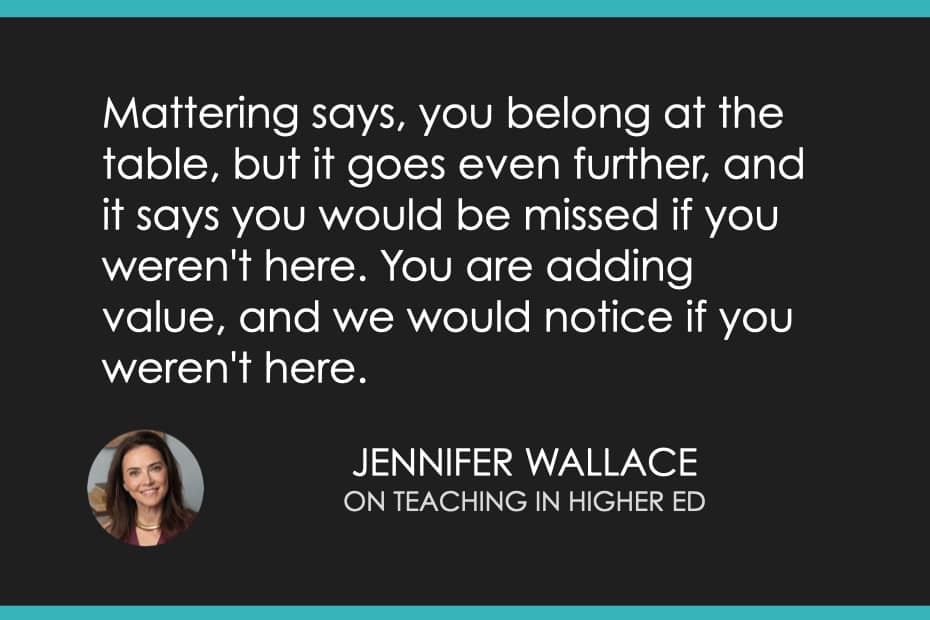
Mattering says you belong at the table, but it goes even further, and it says you would be missed if you weren't here.

Mattering says you belong at the table, but it goes even further, and it says you would be missed if you weren't here. You are adding value, and we would notice if you weren't here.
-Jennifer Wallace

We have so much input and so much output being demanded of us today that often we go through life on autopilot.
-Jennifer Wallace

Mattering is not another thing to add to your to-do list. Mattering is a way of looking at your to-do list.
-Jennifer Wallace

When you look at the data on what drives performance, it is engagement. And what drives engagement is mattering.
-Jennifer Wallace

Resources

  • Mattering: The Secret to a Life of Deep Connection and Purpose, by Jennifer Wallace
  • Never Enough: When Achievement Culture Becomes Toxic—and What We Can Do About It, by Jennifer Wallace
  • Bowling Alone: The Collapse and Revival of American Community, by Robert D. Putnam
  • Jennifer Wallace's Website
  • Mattering Movement
  • Gallup-Purdue Index Report
  • Nancy Schlossberg’s Transition Theory
  • World Spins Madly On
  • WeRateDogs – This is Sadie.
  • Sign up to be a Mattering Ambassador

ARE YOU ENJOYING THE SHOW?

REVIEW THE SHOW
SEND FEEDBACK

ON THIS EPISODE

woman smiles with bookshelves in the background

Jennifer Wallace

Journalist and author

Jennifer Wallace is an award-winning journalist and author of the New York Times bestselling book Never Enough: When Achievement Culture Becomes Toxic—and What We Can Do About It, which was named an Amazon Best Book of the Year. Wallace began her journalism career at CBS's 60 Minutes and is a contributor to The Wall Street Journal and The Washington Post. She lives in New York City.

Bonni Stachowiak

Bonni Stachowiak is dean of teaching and learning and professor of business and management at Vanguard University. She hosts Teaching in Higher Ed, a weekly podcast on the art and science of teaching with over five million downloads. Bonni holds a doctorate in Organizational Leadership and speaks widely on teaching, curiosity, digital pedagogy, and leadership. She often joins her husband, Dave, on his Coaching for Leaders podcast.

RECOMMENDATIONS

World Spins Madly On

World Spins Madly On

RECOMMENDED BY:Bonni Stachowiak
WeRateDogs - This is Sadie

WeRateDogs - This is Sadie

RECOMMENDED BY:Bonni Stachowiak
Sign up to be a Mattering Ambassador

Sign up to be a Mattering Ambassador

RECOMMENDED BY:Jennifer Wallace
Woman sits at a desk, holding a sign that reads: "Show up for the work."

GET CONNECTED

JOIN OVER 4,000 EDUCATORS

Subscribe to the weekly email update and receive the most recent episode's show notes, as well as some other bonus resources.

Please enter your name.
Please enter a valid email address.
JOIN
Something went wrong. Please check your entries and try again.

Related Episodes

  • EPISODE 413How Mattering Matters
    Heidi Weston square

    with , Heidi Weston, Peter Felten

  • EPISODE 391Learning That Matters
    Caralyn Zehnder

    with , Caralyn Zehnder, Cynthia Alby, JuliA Metzker, Karynne Kleine

  • EPISODE 383Implicit Bias in Our Teaching
    Jennifer Imazeki square

    with Jennifer Imazeki

  • EPISODE 341Multidisciplinary Teaching

    with , Susan Roll, Jennifer Wilking


EPISODE 622

Why Mattering Matters with Jennifer Wallace

DOWNLOAD TRANSCRIPT

EPISODE 622: Why Mattering Matters in Teaching and Learning, with Jennifer Wallace 

Bonni Stachowiak [00:00:00]:

Today on episode number 622 of the Teaching in Higher Ed podcast, Mattering, Teaching and Learning with Deep Connection and Purpose, with Jennifer Wallace. 

Bonni Stachowiak [00:00:13]:

Production Credit: Produced by Innovate Learning, Maximizing Human Potential. 

Bonni Stachowiak [00:00:22]:

Welcome to this episode of Teaching in Higher Ed. I’m Bonni Stachowiak, and this is the space where we explore the art and science of being more effective at facilitating learning. We also share ways to improve our productivity approaches, so we can have more peace in our lives and be even more present for our students. Jennifer Wallace is an award-winning journalist and author of Mattering: The Secret to a Life of Deep Connection and Purpose, an instant New York Times bestseller. She’s also the author of Never Enough: When Achievement Culture Becomes Toxic and What We Can Do About It, named Amazon Best Book of the Year. Her work appears in the Wall Street Journal and the Washington Post, and she began her career as a producer at CBS’s 60 Minutes. In this episode, Jenny and I talk about the research on mattering, what it means to truly feel valued and to add value to others, and how educators can use this lens to support students through transitions, reduce disengagement, and build learning communities where people genuinely feel like they belong and are needed.

Bonni Stachowiak [00:01:44]:

Jennifer Wallace, welcome to Teaching in Higher Ed.

Jennifer Wallace [00:01:47]:

Oh, I’m so happy to be here.

Bonni Stachowiak [00:01:49]:

I love reading books, which is a good thing as a podcaster, but I also especially love the dedication and yours sparked such curiosity for me. You write: To my husband Peter, our family and friends, my truest teachers of mattering. Jenny, I feel like with this first question, we could talk a day, and just be getting started. So I’m going to cheat a little bit, and since you mentioned him first, tell us a little bit about one surprising way that Peter has taught you about mattering.

Jennifer Wallace [00:02:22]:

What Peter? I mean, there’s so many things. Peter and I have been together for 25 years, but one of the things that’s really come out in our 25 years together is that we, he and I, and it’s true of everybody, feel like we matter in different ways. So what might make me feel like I matter when he is investing in me, in fixing my printer, in getting me my flights, all of those things, that makes me feel like I matter. When I appreciate him, when I give him, you know, words of affirmation, that’s what makes him feel like he matters. So, our mattering languages are different.

Bonni Stachowiak [00:03:03]:

Oh, I could imagine in 25 years that that took some while to get that, you know, those, those appreciations to be more present, you know, for each other, to be able to show that kind of mattering. Well, I’m fascinated by mattering, and so are past podcast guests, I should mention. So we’ve had lots of conversations over the more than a decade of doing this podcast, about belonging. We’ve had lots of conversations about purpose, and we’ve had exactly two about mattering. And I understand it as an emerging area of research. Tell us a little bit about what’s going on, where belonging doesn’t quite get us, quite where we want to be all the way, where a sense of purpose doesn’t quite get us there. What does mattering do that those other bodies of research may not do?

Jennifer Wallace [00:03:54]:

So, mattering is defined by researchers as feeling valued for who you are by your family, your friends, your colleagues, your community, and having an opportunity to add value back across those domains. Mattering is also defined by researchers as a meta need, or an umbrella term, meaning it’s a need that sits above other needs and encompasses them, like belonging, like connection, like mastery, like agency, self determination. But as you mentioned, mattering goes deeper. So you can belong to a department or a classroom, or a neighborhood, or even a family, and not feel like you really matter to the people there. So mattering says you belong at the table, but it goes even further, and it says you would be missed if you weren’t here. You are adding value, and we would notice if you weren’t here.

Bonni Stachowiak [00:04:55]:

And I know you help us break it down even further by telling us that there are three components to your framework. Recognition, reliance, and importance. Help us understand those three components of mattering.

Jennifer Wallace [00:05:09]:

So actually, what might be easier, I think, verbally for people, what seems to really help people understand mattering and the ingredients-

Bonni Stachowiak [00:05:18]:

Are we cooking something, Jenny?

Jennifer Wallace [00:05:20]:

Yeah, I know we’re cooking mattering, is I’ve put these ingredients. So researchers, as I mentioned, have been studying it since the 1980s. And so there are key ingredients that I’ve put under a framework I call SAID, S A I D. That means I feel significant, I feel appreciated, I feel invested in, and I feel depended on. So I can go through each of those quickly if you want me to.

Bonni Stachowiak [00:05:51]:

I love it. And you’ve made it so much easier for me to remember it in the future, too. I love that, especially as it’s great.

Jennifer Wallace [00:05:56]:

Yeah, that came out of talking about it for the past two and a half months and realizing I need something sticky that people can just put in their heads and recall at a moment’s notice.

Bonni Stachowiak [00:06:07]:

So good.

Jennifer Wallace [00:06:07]:

So that’s what SAID is for me. So let’s just quickly go through them, SAID: Significance. So for this book, I interviewed hundreds of people around the world, and each person, I would say, tell me a time when you felt like you mattered. And it was never life’s big moments, a promotion or a big toast. It was this sense of feeling significant in life’s little details. It was a neighbor coming by with a pot of soup when they were sick. It was a colleague calling to check in after a particularly rough week at work. So we crave as humans, to matter, as I put it, in the mundane, in the details of our lives.

Jennifer Wallace [00:06:46]:

So that’s Significance. Feeling Appreciated is, I’ve come to think of it, as appreciating the doer behind the deed. So let’s say you have a colleague who’s great at getting the department together for lunch or happy hours instead of thanking them for another fun get-together, a way of feeding a sense of mattering is saying, ” You know, you are really the glue that keeps this department together. Because of you, we are so much more cohesive as a group”. So again, it’s appreciating the doer behind the deed. Feeling Invested in, is having people in our lives who are invested in our goals and well-being, and having people that we are invested in their goals and well-being.

Jennifer Wallace [00:07:29]:

Researchers call this idea ego extension, or the idea that you can extend your ego to include the egos of others, so that their successes begin to feel like your successes. And Dependent on, the last element, is knowing there are people in this world that you can depend on and rely on, and knowing that there are people who rely and depend on you, that the world would be less good if you weren’t here, that you are not going through this world alone.

Bonni Stachowiak [00:08:00]:

As you’re sharing those examples, and this way that you’ve started to make it more sticky, as you said, how important has it been in either your research, or in the subsequent reflection you’ve been doing through all this, this, these more recent conversations, to ask people what it looked like when they didn’t matter?

Jennifer Wallace [00:08:21]:

Yeah. So I also conducted a survey with the help of researchers in the UK and asked people to name a time that they felt like they mattered, and another time they felt like they didn’t matter. And this was specifically asking about the workplace. You know, there were moments that were obvious; rudeness, incivility, being ignored in a meeting, being talked over, being left off of a work email that was, had something to do with the work you were doing on a daily basis. But it was also in small moments. What I’ve come to realize, particularly with leaders and coworkers, is that we have so much input and so much output being demanded of us today that often we go through life on autopilot. We just put our heads down. We try to get through our to do lists.

Jennifer Wallace [00:09:12]:

And those are, when we do that, we miss the signals that people are sending us that we matter, and we miss the signals to others that they matter to us. So often, the feelings of feeling like you don’t matter were not necessarily, you know, the big moments of incivility. Rather, they were the small moments of being left out, of someone, you know, not making eye contact when we’re in the elevator with them. Those small moments add. They add up to a feeling of a culture that makes you feel like you don’t matter.

Bonni Stachowiak [00:09:49]:

That analogy, or the phrase just putting our heads down, is certainly one I’ve heard said across many contexts. And also, the, sticking our necks out, so not wanting to, like, just put your head down, don’t stick your neck out. It’s interesting that those are kind of historically maybe more vulnerable parts of the human body and interesting metaphors for us to use. Well, you talked about how these things can add up. What can you tell us about the modern mattering crisis?

Jennifer Wallace [00:10:19]:

Yeah, well, you know, there- There were times in our lives, certainly when I was growing up in the 70s, where mattering was baked into everyday life. So we knew our neighbors, we were more likely to know our neighbors, we relied on them. I know when we would go on family vacations, one of our neighbors would feed my goldfish, or, you know, if the newspapers were piling up, another neighbor would take them so as not to attract a burglar. And my father worked for 50 years at Exxon. There used to be this lifetime employment contract, this social contract, that if you stayed loyal to your company, they would stay loyal to you with a pension that no longer exists.

Jennifer Wallace [00:11:00]:

We used to be more religious as a society, and I’m not saying religion is a panacea, but it was a place every weekend where we were expected to show up, where people noticed if we weren’t there, where we heard about messages of unconditional worth and value. We are religious society. So mattering is no longer baked into everyday life, and that is what has eroded it. I mean, Robert Putnam has done a wonderful job of tracking this in his book Bowling Alone, how we used to all belong to bowling leagues and, you know, civic organizations. We had community baked in, and we no longer do.

Jennifer Wallace [00:11:41]:

And what community gave to us were signals that we mattered.

Bonni Stachowiak [00:11:45]:

That example you gave of a religious community, of someone noticing when you’re not there, is making me hearken back to a story from maybe even 10 or more years ago, with just the difference in terms of attendance policies. More punitive attendance policies, you miss and you know, in some institutions, that’s going to really jeopardize a grade, in contrast to a story I can so vividly remember, even though it was so long ago, of just noticing that someone wasn’t there. And in this, I mean, it’s a unique culture where they could actually go and make sure that the person was okay on a smaller campus, you know, it just, it was a different time, like you said, and more opportunities to let people know that they matter. And instead we’re, we’re replacing that with other things that, that can really get in the way from that. Anything specific around how burnout, loneliness, disengagement, or even quiet quitting are linking to this crisis?

Jennifer Wallace [00:12:47]:

Yeah. So Gallup has reported 70% of employees self-report that they are disengaged right now in the workplace. When looked at through the mattering lens, disengagement is, in my mind, a coping strategy. So when you feel like your voice, your work, you don’t matter, it’s very painful to keep pouring yourself and your efforts, and your energy into a place that isn’t recognizing it. And so what can you do if you don’t feel like you have agency? You pull back because that is, it’s a less painful way of coping with feeling like you don’t matter. So I think they are very much aligned. And when you look at the data on what drives performance, it is engagement.

Jennifer Wallace [00:13:35]:

And what drives engagement is mattering. So mattering is this deep human motivation that we all have.

Bonni Stachowiak [00:13:44]:

You, one of the things you said a little bit ago is that, the example you gave was around just someone bringing by some soup when a neighbor was ill. In having produced this podcast for as long as I have, we just hear the ways that people get burned out because it feels like one more thing. One more thing. I think back to the conversations we had as COVID came upon us, or more recently, the continued dumping on already burned-out, and hardened faculty. Hey, this AI thing is coming, we’re not going to look at it institutionally, but this is one more thing you need to redesign all of your assessments, etcetera, etcetera. One thing I think can be helpful is when we can shrink these things down in our head, that it’s not one more thing. We’re not going to say, ” Hey, now it’s your job to make sure every student that’s enrolled in your classes knows that they matter”.

Bonni Stachowiak [00:14:40]:

How can we shrink mattering down in our minds so that it feels like something that is more possible for us to do?

Jennifer Wallace [00:14:48]:

So you are absolutely right. Mattering is not another thing to add to your to-do list. Mattering is a way of looking at your to-do list. It’s a lens that you can put on your to-do list. So let’s talk about, you know, office hours. All professors, all faculty members have office hours. We can, and I’ve seen this in higher ed communities that I have visited, both for my research and also in the consulting that I’m doing now.

Jennifer Wallace [00:15:18]:

There are some professors that have renamed it as student hours, that these are hours for you. There are conversations that professors have that encourage people. I heard one professor say,”You know, well, my favorite part of my job, the reason I do this job, is because I like to connect to individual students. So when you come, and you come during my office hours to connect with me, I want you to know it’s not a burden. It’s actually the best part of my job”. So it is inviting students, it is saying to them, “I value you. I value this connection”.

Jennifer Wallace [00:15:52]:

So again, I’m not telling you to put more office hours out. I’m simply saying, recast the way you talk about office hours. There was a pilot study done at the University of Michigan, and what I would call a mattering nudge, and that is, that researchers had, so they have these huge freshman seminar classes, and they had professors in these big classes send out notes to students at peak times of stress in the semester. So these were written notes by a researcher, just a few sentences saying, “I hope you’re enjoying this class. Would love any feedback that you have for it. We’re entering into a stressful time of the semester. You have an exam or a big paper coming up.

Jennifer Wallace [00:16:37]:

If you are, if you, if your mental health is taking a hit, if you’re, if you’re not coping as well with the stress as you’d hoped, you know, let me know. I’d love to connect you with a mental health coach, or I’d love to connect you to resources here”. And so it was this, it was this simple way of targeting students at a time when they would most need resources. And to say, here are the resources available to you. What was so interesting is that when they followed up with the students, first of all, they sent these out, again by the professor’s name, and they had students fill them out in the last three minutes of class. So it was like a 98% response rate.

Jennifer Wallace [00:17:18]:

When researchers followed up, the students that took professors up on being connected to a mental fitness coach were predominantly, it was about 5% of the class, and they were predominantly first-gen students, which are the exact students that would be most at risk of dropping out during stressful points in the semester. Number one, they were able to target and connect with the students that they most thought were at risk. And secondly, the students after the survey, they sent another survey, and 95 or so percent of the students said that they felt a greater sense of belonging and connection, and overall well-being because the teacher, the professor, had reached out to them personally. So while it captured the most at-risk students, all students benefited from this simple mattering nudge that took 10 seconds to send.

Bonni Stachowiak [00:18:20]:

I love these two examples. You’ve helped us with two things I think here. One is you’ve helped really do, instead of putting more on the individual faculty, who often can have more of a sense of relationship with students, is to help normalize those help-seeking behaviors, which so many of the mental health professionals that we’ve had on the show before have just talked about how that’s a vital role we can play. And as you have illustrated here, doesn’t take that long to do. The second thing I’m really getting curious about, though as you shared the story, especially about the professor letting the students know, being transparent about, you know, this is what brings me the joy, it’s the best part of my job. I was starting to notice that, that seems like it would then help that person experience more of a sense of mattering. Are there other aspects to this lens? I love this idea.

Bonni Stachowiak [00:19:19]:

As somebody who tends to over-commit and the to-do list is long, I’m going to be thinking about after today’s conversation. Oh no, this is a lens to look at that to-do list. Are there other strategies we can use here?

Jennifer Wallace [00:19:31]:

Well, I like to think about, when I go and I work with universities, I think about the cadence of a student coming into a class. So you could use what’s known as Nancy Schlossberg’s transition theory, to think about a student moving into the classroom, moving through the class, and moving on. Those are three transition points. And what we know from the research is that mattering is most fragile and vulnerable during moments of transition. So if you were going to just target a few moments throughout the semester, the move-in is a big one. Is getting to know students as more than just a number that goes such a long way. What is your name? Ask them, I don’t know, depending on the class size, do they have a hidden talent? Something that humanizes them. And then when it’s moving through, it’s noticing these moments, you know, it’s sending signals out there, that I would love you to take me up on my office hours. I want to help you during these stressful times.

Jennifer Wallace [00:20:40]:

And then, the moving on aspect is, as the students are leaving, saying, “I’d love to stay in touch with you. I hope you learned something. If you have feedback, I’d really love to hear it”. Letting them know that you care about them again, as more than just a student, as more than just a number.

Bonni Stachowiak [00:20:57]:

This is a wonderful way for us to take this lens and put it on our to-do list. I would be remiss, though, if I didn’t invite you to also share things that you wish we could be thinking about at the institutional level. Are there key ways where we could make this not about individuals trying to solve the mattering crisis, and bring it more to the systemic level?

Jennifer Wallace [00:21:20]:

Oh, absolutely. So again, when I think about transition theory, it’s students moving in. It’s students moving onto the campus, freshman year, educating them, giving them the language of mattering. I mean, what’s so rich about mattering is that it gives students a language for expressing what they may be missing about mattering so much at the high school level, and now coming. And what I love about it, is that it allows people to be vulnerable, but in a way that might be more palatable. Like I mattered so much in my high school. I was the president of the debate team, whatever it was. And now I come to this big campus, and normalizing how difficult, and how our sense of mattering can really collapse during these transitions, making it normal that every student is going through this.

Jennifer Wallace [00:22:15]:

This is a normal process of moving in and here’s the language. And if you are feeling like you don’t matter, here are ways to cope with that feeling. Often, the fastest way to feel like you matter is to remind others why they do. So maybe it is, you know, complimenting a peer, or appreciating a professor, or the woman in the cafeteria who always serves you your lunch with a smile. So what is amazing about mattering is how actionable and practical it is in its application, and that it gives a language to students, to parents, to campuses. I mean, another way of looking at mattering on the college campus is to look at the Gallup Purdue Index study, which is the largest study ever done of college graduates. And they looked at, what are the key experiences on a college campus that have an outsized impact to later life outcomes? Well-being, career success, financial success?

Jennifer Wallace [00:23:22]:

And they found six key experiences: Did you know a professor who took an interest in you as more than just their student? Did you have an opportunity to use what you were learning about in the classroom, out into a multi-semester project, or an internship? Were you involved in activities where you felt valued and had a chance to add value to the campus? Even through entertainment and humor, or the newspaper? So, in other words, it was mattering, even though they didn’t use this word, it was mattering on the college campus that had an outsized impact, both in their experience on the campus and afterwards, teaching students. We talk so much, I say this all the time, I had this great conversation with the former Surgeon General when he was having his college campus tour, and really amplifying the idea that there is a loneliness crisis on the college campus is that we talk so much about where a student goes to college. We need to start talking about how to go to college. There are practical ways that we can help our first-year students make this transition to mattering on that college campus. Mattering is a wonderful protective factor.

Jennifer Wallace [00:24:49]:

It is a buffer against loneliness. It’s a buffer against disengagement, and burnout, and you know, just pointing out to young people how you can matter on this campus. And maybe even doing it before they get to campus, so they can start thinking about it, and then educating the faculty so they have those, that language and that framework. Educating the parents so that when their students inevitably call them, you know, later on in the freshman year, when the shine has come off, and the reality has set in, of being away from home, and the loneliness, that they can have a laugh language and they can be constructive in their advice to the young person.

Bonni Stachowiak [00:25:29]:

You’ve talked so much and in such helpful ways today about these transition points, and I certainly don’t want to miss getting the opportunity to talk with you more about the transition points that are the not good ones that you talk about. In mattering the life changes, whether it is someone moving on to retirement, or a death in the family, a diagnosis. What should we know about those most vulnerable, painful times in our life?

Jennifer Wallace [00:26:01]:

Yeah, I wish I had known… I thought, you know, in the times that I’ve gone through big transitions, moving out of the country with my husband, leaving my job, I wish I had known that I wasn’t just uniquely ill-equipped to cope with them, that transitions are hard for everyone. By their very nature; they destabilize us. But a way of thinking about them, a way, a helpful way of getting through them, is noticing the impact they have on our sense of mattering. So our sense of mattering isn’t- We don’t matter in a vacuum. We matter to specific people, in specific roles, in specific ways. So, when we, let’s take, retirement, so when we leave a workplace where we felt valued and knew where we added value, it could feel like almost overnight, our sense of mattering collapses. And so I looked at, what are the healthy ways? What do people who do well through transitions, what do they do? The first thing they do is, they look for role models.

Jennifer Wallace [00:27:09]:

They look for people who have gone through something similar. They ask to take them out for coffee, or if they don’t know people, individual people, they might listen to podcasts, or read a memoir, or read an article about someone who’s gone through something similar, so that you can get a kind of blueprint on a way that you might approach this transition. The other thing, after you’ve looked for role models, is to harness the power of invitation, both accepting invitations, but also issuing them. So we often think that when we’re going through a painful transition and we feel a little messy inside, that we need to get our act together before we can really accept invitations. But there’s research called the beautiful mess effect, which turns this idea upside down. It finds that we often overestimate how much we need to have our lives in order and estimate how much our vulnerability, admitting to the difficulties that we’re going through, actually draw people closer to us. That vulnerability signals that we are authentic, and it signals that we might be a good friend, a good relationship partner. So don’t feel like you have to get your life in order to accept invitations.

Jennifer Wallace [00:28:27]:

Let’s say that you’re not getting invitations. I interviewed a woman who went through a very painful divorce, and was complaining to her therapist that her social life had just totally disintegrated. And the therapist said, ” You know, you have agency here. You can start inviting people to your kitchen, invite people into your house for dinner”. And she did exactly that. She started issuing invitations, people accepted them, and that’s how she built back her sense of mattering. So anybody here who’s going through a painful life transition, to know that you are not alone, that others have gone through it, and to lean on your people to get you through. Our resilience rests on our relationships.

Bonni Stachowiak [00:29:14]:

Before we get to the recommendation segment, I would just like to ask you- Well, first I’d like to share a little bit of my experience having read the book, and then just ask you to close us this part of the show, talking a little bit about resilience. And it’s hard for me to say this to you, but I’ll only get this one shot. I think it really meant a lot to me, and it was weird to get this book in my hands at such a pivotal time in my life. And it’s so weird to be talking to, my friends are going to be listening to this, going like, did she script this? Because it’s, it’s, it’s so much like you’re speaking to me. But as you said, it’s so much just a universal experience. And having gone through some really difficult times, I was able to take this new set of lenses that you give us so well, and to really shrink it down, because it’s tough when you’re, when you are just experiencing something so difficult.

Bonni Stachowiak [00:30:05]:

But then just to, I mean exactly what you’re saying, accepting the invitations. And I had that very same experience of just, being vulnerable when I did not want to be vulnerable. And then it just really does endear you to people, because it is a universal experience. Even if no one knows exactly how you feel, they certainly feel, “Gosh, this is such a difficult time”. But then, I just wanted to say too that, I have been spending more time with family, because of some of the stuff that’s been going on, and I just, I like to go with my mom to, to her Jazzercise class, and it’s a low-impact. So it’s just people, I feel like the youngest, the youngest person in the room, because I quite literally probably am much of the time.

Bonni Stachowiak [00:30:47]:

And then just to look for little, little things, like in that way, I’m taking care of my own body and building up some resilience, but also to care for her well, and her well-being. But then even I would just notice more, the other people in the class, there was a woman who just was not getting around as well as she normally does. And so I was able to help her make sure she got to her car ride service, you know, and got to the place safely. So I just, I wanted to again, because I won’t probably have a chance like this, just to say thank you, thank you, thank you. I want to encourage people who are listening, before I actually stop talking and let you close this part of the episode. But there’s a wonderful self-assessment at the end that I can’t recommend enough. I mean, it’s just a beautiful book.

Bonni Stachowiak [00:31:28]:

I’m so grateful for you for writing it, for all the research, all the work I could only imagine went into it, and just it really has been a transformative book for me. So I’ll stop gushing on you now and getting emotional, and I’ll pass it to you for talking a little bit more meta in terms of like what mattering has to do with our overall resilience as human beings.

Jennifer Wallace [00:31:50]:

Well, I, it’s so meaningful to hear you speak about that, and I’m so, so grateful that mattering helps to boost your resilience. It has certainly changed my life, researching this and learning about it. And I was someone who was more of a help-giver than a help-seeker in my circle. And what I’ve come to realize is that when I don’t reach out to my friends for help, wisdom, support, not only am I denying myself the support I need and deserve, I am also denying my friends the chance of being a helper, to feeling like they matter to me, that they are dependent on. So in this way, it’s really an act of generosity to be reaching out for support. We often, in our hyper-individualistic culture, believe we have to self-care our way to resilience. That isolating, listening to the right things, drinking the right drink, soaking in a bubble bath. These are wonderful stress reducers.

Jennifer Wallace [00:32:58]:

I am not here to take those away from you, but they do not give you the resilience you need to get through life’s hard times. There’s a favorite study that I have in the book, one of my favorite studies, researchers were looking at people and asking them to estimate the incline of a hill. They had them measure it alone, and then standing next to someone who was supporting them, and the incline did not look as steep when they were there with someone else as it did when they were standing there alone. So, social support, we are wired, wired to crave and need social support to give us resilience.

Bonni Stachowiak [00:33:41]:

Before I get to the recommendations segment, I wanted to take just a moment to thank the partner that I have in, Poll Everywhere. Thank you for your support of Teaching in Higher Ed, and I get the joy of sharing tips. Either something that I’ve done in my own teaching, or I’m hoping that many of you will write in and share about ideas that you have for using polling services like Poll Everywhere in your teaching. Recently, someone on social media shared about wanting to go back and reread the book Quiet by Susan Cain, and I thought, what an important thing for us to be remembering, those quieter voices in our classroom. And especially as we’re thinking today, we’re having this conversation about the scholarship of teaching and learning, and as good researchers, we of course, would want to think about who’s going to get left out of being included in our observations of learning, or challenges, and our really deeper listening to what is occurring in that learning process. We can use the Q&A feature in Poll Everywhere to surface quieter voices. Those students who won’t normally speak up in class, they they’re much more likely to type a question. And then the nice thing with that Q&A feature, if you’ve not used it before, is others can share their resonance with particular questions that are bumping up.

Bonni Stachowiak [00:35:07]:

You don’t even have to use it for questions, it can just be a list of responses, and then people can upvote those responses that are resonating most. As we think about wanting to ensure that we’re inclusive in our teaching, not leaving any learners out. A great way to do that for people who are more introverted is to use Poll Everywhere. Consider that Q&A feature as a way to surface those quieter voices. Thanks once again to Poll Everywhere for your partnership with Teaching in Higher Ed. And if you’re not familiar with Poll Everywhere, I hope you’ll head over to polleverywhere.com and sign up for an account, and start to experiment how polling might be able to help you in your teaching. This is the time in the show where we each get to share our recommendations, and I feel like my first one goes so perfectly with what we were just talking about. Someone in an email the other day had been expressing solidarity with me on some things, and he wrote something in his email like, oh well, this, you know, this happened, this happened, but the world keeps on spinning.

Bonni Stachowiak [00:36:12]:

And it reminded me of this song from, I think you and I grew up about the same time, so maybe you might know this song too. It’s from a band called The Weepies, and the song is called, The World Spins Madly On. And I just want to recommend for people if you have listened to that, it’s worth a re-listen. And if you haven’t, it’s a beautiful song. And secondarily, I want my second recommendation, is from an account that I enjoy a lot. Some of you may have seen it on Instagram or other social media. It’s called We Rate Dogs. And so as soon as I saw this, this was actually a repost where someone else had quoted it.

Bonni Stachowiak [00:36:50]:

So this is from We Rate Dogs. I’m going to encourage you to click the link, because what you’re going to see is a video, and I’ll describe what’s on the video using the We Rate Dogs post. They say: This is Sadie, she was finally reunited with her human astronaut, Christina Cook, after her mom’s voyage around the moon took her the furthest any human being has ever been from their dog. She can’t wait to hear all about the universe. And then it’s, We Rate Dog, so, of course, they rate it, a 14 out of 10. And you absolutely now need to go watch this video with his adorable dog.

Bonni Stachowiak [00:37:34]:

So excited to see Christina Cook returning from that trip. It’s the cutest, cutest thing you will see all day if you do click on it. And just the chef’s kiss, so I mentioned this was a repost of a We Rate Dogs. Here’s what Emily Ferris says in her repost: That dog is truly loved to the moon and back, and I just thought “Chef’s kiss, Emily Ferris, there we go.

Bonni Stachowiak [00:38:00]:

So those are my recommendations. And Jenny, I get to pass it over to you to clear or to close us out.

Jennifer Wallace [00:38:07]:

Oh, that’s amazing. So I would love to give two recommendations. One is this idea. I’m a terrible journaler, but I know how important journaling is. So anyone out there who’s been reluctant or inconsistent about journaling, I’ve come up with a 32nd practice that I am now doing almost every night. As I close my eyes, I think “How today, in some small way, did I add value to the world, and when today, in some small way, did I feel valued?” And I do this because we are all primed by evolution with a negativity bias, meaning the negative things of life stick to us, and the good things don’t. And so what I found is that 30-second prompt, you don’t even have to write it down, it helps to override that tendency. 

Jennifer Wallace [00:38:57]:

So if you’re someone that’s, that’s looking for a little more gratitude and mattering in their lives, try that 30-second prompt in your head. And then the other thing I would love to invite anybody listening, I’ve had so many wonderful people reaching out to me, having read the book and asking for more resources and asking for more tips, and how to bring mattering to their own little communities, or neighborhoods, or workplaces. And so I’ve started this free program called the Mattering Ambassador Program, and you can sign up for it. You can go up on my, on my website, jenniferbwallace.com, and click up on the top, you’ll see it, and you could sign up, you could sign up for my newsletter and get more tips for how to bring more mattering to your life and to the people around you.

Jennifer Wallace [00:39:44]:

So thank you so much for having me, Bonni. This was such a great conversation.

Bonni Stachowiak [00:39:48]:

Oh, same with you. Such a joy to get to read the book and then get to talk to you about it. I really appreciate your time, and I’m sure so many who are listening do as well. Thanks once again to Jennifer Wallace for joining me on today’s episode. Today’s episode was produced by me, Bonni Stachowiak. It was edited by the ever-talented Andrew Kroeger. If you’ve yet to sign up for the weekly Teaching in Higher Ed update, now is your moment. Head over to teachinginhighered.com/subscribe.

Bonni Stachowiak [00:40:24]:

You’ll receive the most recent episode’s show notes ,as well as some other resources and benefits that go above and beyond, having to remember to go find those notes. Thank you so much for listening, and I’ll see you next time on Teaching in Higher Ed.

Expand Transcript Text

TOOLS

  • Blog
  • Podcast
  • Community
  • Weekly Update

RESOURCES

  • Recommendations
  • EdTech Essentials Guide
  • The Productive Online Professor
  • How to Listen to Podcasts

Subscribe to Podcast

Apple PodcastsSpotifyAndroidby EmailRSSMore Subscribe Options

ABOUT

  • Bonni Stachowiak
  • Speaking + Workshops
  • Podcast FAQs
  • Media Kit
  • Lilly Conferences Partnership

CONTACT

  • Get in Touch
  • Support the Podcast
  • Sponsorship
  • Privacy Policy

CONNECT

  • LinkedIn
  • Instagram
  • RSS

CC BY-NC-SA 4.0 Teaching in Higher Ed | Designed by Anchored Design