Follow the Teaching in Higher Ed Podcast
About this Episode
Caralyn Zehnder, Cynthia Alby, JuliA Metzker, Karynne Kleine talk about their book, Learning That Matters, on episode 391 of the Teaching in Higher Ed podcast.
I ask myself, what matters to me and why? And am I living that in my teaching?
JuliA Metzker
On episode 391 of Teaching in Higher Ed
Voices on this Episode

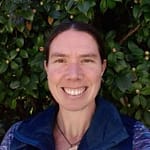
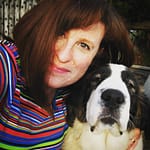


Show Notes + Resources
Recommendations from this Episode
Book
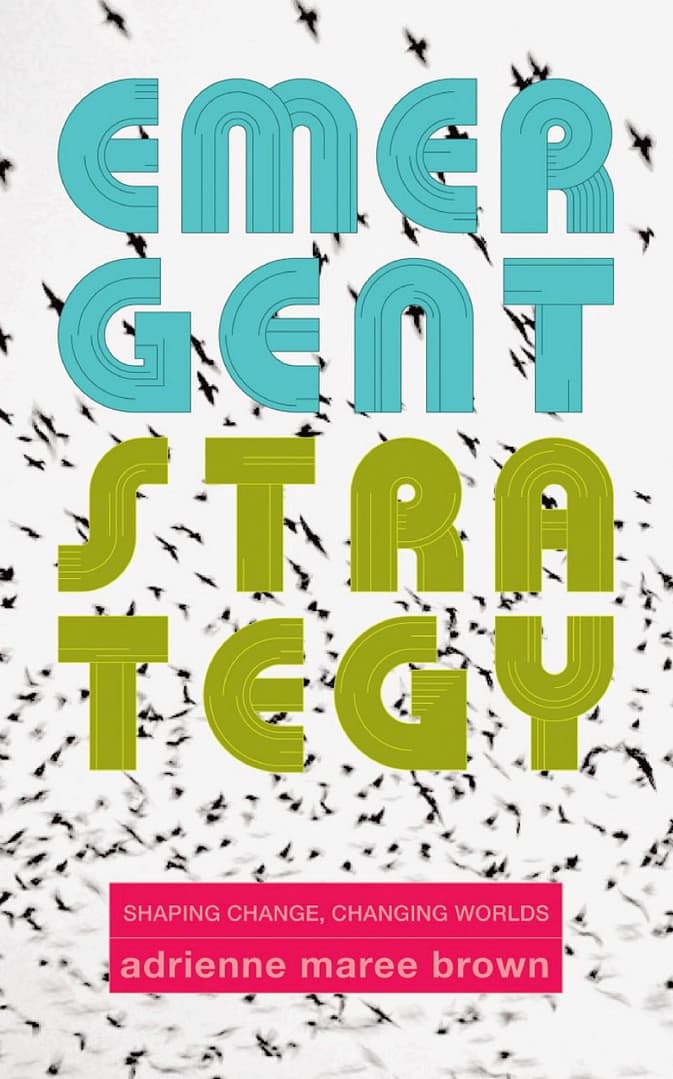
Emergent Strategy: Shaping Change, Changing Worlds by adrienne maree brown

Idea
Walking
Book
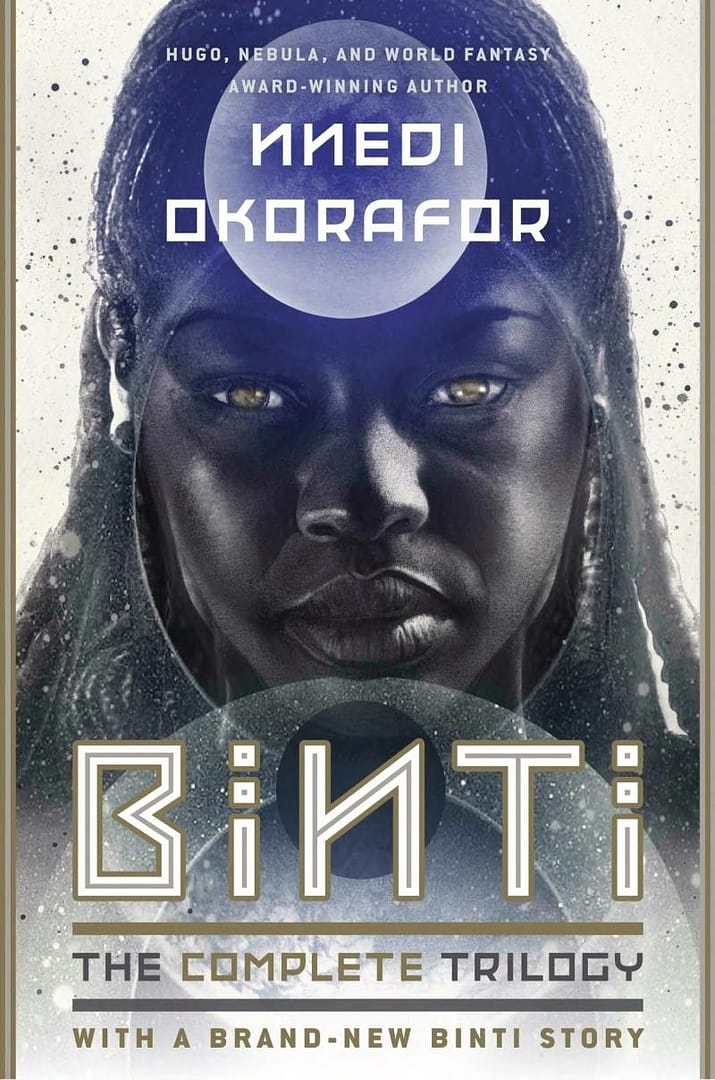
Binti: The Complete Trilogy by Nnedi Okorafor
Book
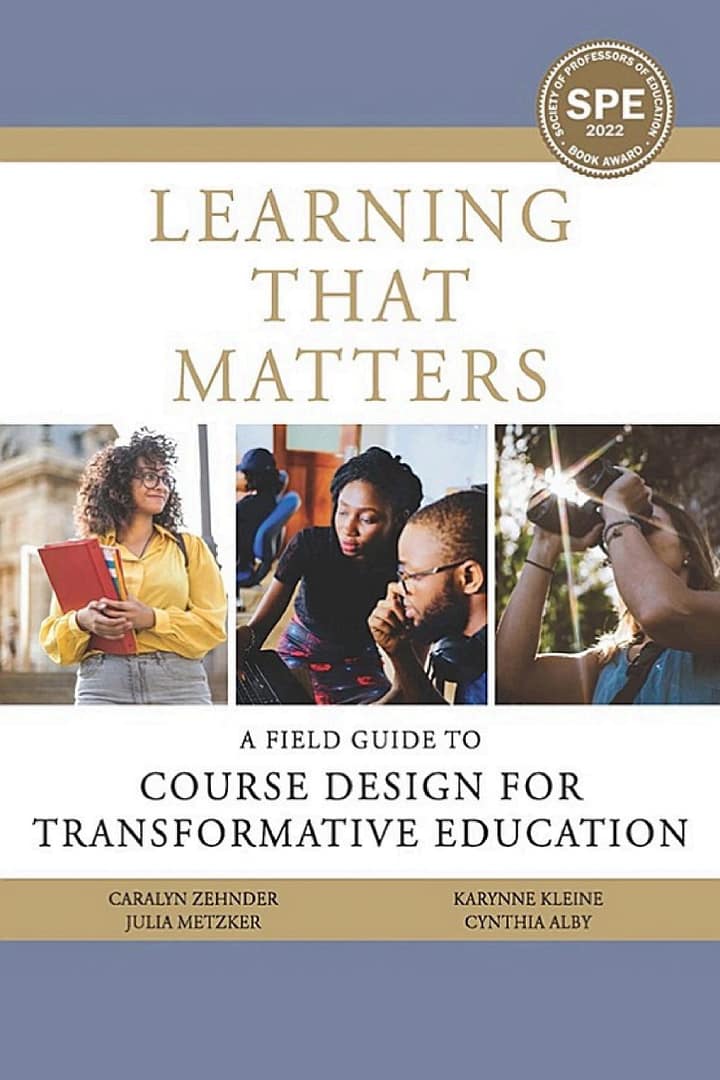
Learning That Matters by Caralyn Zehnder, Cynthia Alby, Karynne Kleine, and Julia Metzker
Resource
Abolition Science Radio
Resource
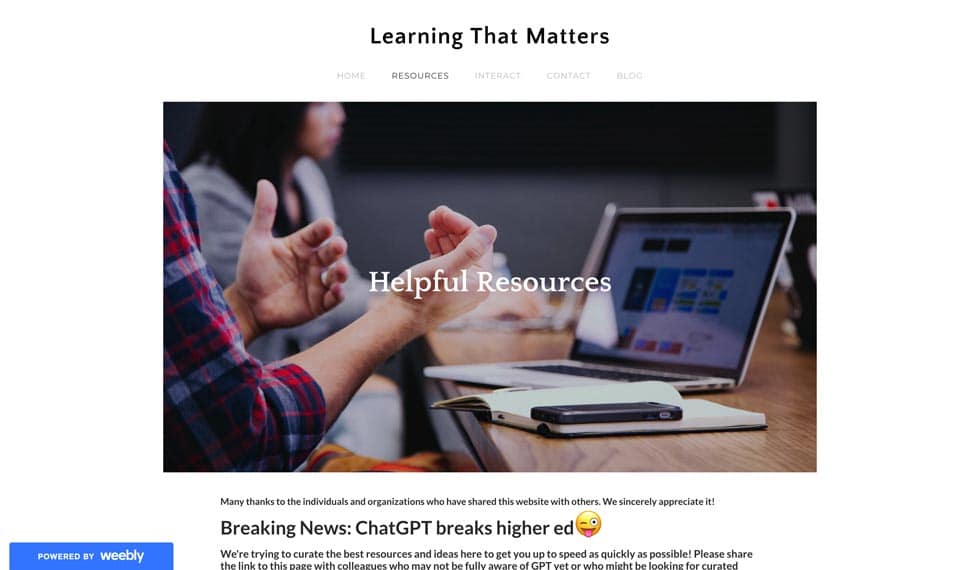
Learning That Matters Resources
Transcript
[00:00:00] Bonni Stachowiak: Today on episode number 391 of the Teaching in Higher Ed podcast, authors Caralyn Zehnder, Cynthia Alby, JuliA Metzker, and Karynne Kleine, join me to talk about their book, Learning That Matters.
[00:00:18] Production Credit: Produced by Innovate Learning. Maximizing human potential.
[music]
[00:00:27] Bonni: Welcome to this episode of Teaching in Higher Ed. I’m Bonni Stachowiak, and this is the space where we explore the art and science of being more effective at facilitating learning. We also share ways to improve our productivity approaches so we can have more peace in our lives and be even more present for our students.
[music]
[00:00:55] Bonni: Karynne, Caralyn, Cynthia, and JuliA, welcome to Teaching in Higher Ed.
[00:01:01] JuliA Metzker: Thank you. Happy to be here.
[00:01:03] Caralyn Zehnder: Thank you so much.
[00:01:05] Bonni: We’re doing something a little bit different this time. Rather than me going through your bios, we think it’ll be a little bit more interesting to have you introduce yourselves. We’re also going to have each of you share a little bit about why it’s been important to you to align your teaching with your values. Let’s begin with Cynthia. What can you tell us about yourself, Cynthia?
[00:01:28] Cynthia Alby: Well, I am a professor of Teacher Education at Georgia College. I also have worked for the past 20 years with the state of Georgia’s Governor’s Teaching Fellows Program, which has been one of the highlights of my life. I have a sheep farm where I … endangered breed of sheep.
[00:01:48] Bonni: There are going to be some animal surprises in today’s episode. I don’t want to spoil anything [laughs] but it has been one of the delights of getting to know you all. Cynthia, tell us a little bit about why it has been important to you to align your values with your teaching.
[00:02:05] Cynthia: I think that what it’s really done for me is it’s helped me better see the meaning in what I’m doing and helped me discover better my own purpose. Because of those two things, it has brought so much more joy to my work to feel like my work is aligned with my values. I certainly have friends whose work is not aligned with their values, and my heart just breaks for them.
[00:02:32] Bonni: Karynne, tell us a little bit about you.
[00:02:35] Karynne Kleine: I’m going to sound like I’m copying Cynthia, except I have nothing to do with sheep other than visit hers on occasion. I also am a professor of Teacher Education. My background mostly is in STEM disciplines sorts of things. We’ve both been at the same institution now for decades.
[00:02:59] Bonni: What’s been something that you’ve done to align your teaching with your values over these years?
[00:03:05] Karynne: Something that I have done is to really take stock of what is important to me. I’ll give you an example of something that I’ve changed often because I realized how important family is to me. I am always in my teaching, trying to bring the cohort not to make a family, but to make a collective. I just know how important that is to me that I believe that others benefit from that as well. I don’t try to teach to individuals. I try to teach to we are a group, we are a collective.
[00:03:52] Bonni: Tell me your distinction between– some people use that phrase, we’re like a family. Just candidly, I’m sure it’s partially because I have a lot of baggage here. I’m like, “No, this is not a family.” Tell me a little bit about that distinction.
[00:04:09] Karynne: Well, because I think a family, there’s a certain reverence to having a family, and I don’t want to force that on people. On the other hand, I do think that we can consider others in their humanity and how important they are to our development. That is the focus on trying to get in there. Not that we need to- I don’t know, spend our time reminiscing, but rather that we can put ourselves in other’s shoes and really make things better for them by how we live our lives.
[00:04:47] Bonni: Thank you so much. Caralyn, tell us a little bit about yourself.
[00:04:51] Caralyn: I am a senior lecturer in Biology at the University of Massachusetts Amherst, though my roots go back to Georgia College where our collaborations began many years ago, and yet my animal connection is on the birdwatcher of the group. That is in terms of my animal connection.
[00:05:16] Bonni: Do you ever participate in those birdwatching? I forgot what they’re called, but they’ve talked about it before on the show where you go and participate in a survey and counting birds.
[00:05:29] Caralyn: Like the Christmas bird count?
[00:05:30] Bonni: Counting birds, yes. That’s what it is.
[laughter]
[00:05:34] Caralyn: Yes. I married into a family of birders and so we’ve actually done that over the holidays as a family event.
[00:05:41] Bonni: Oh, that sounds lovely, Caralyn. Tell us a little bit for you about how you have approached connecting your values with your teaching.
[00:05:49] Caralyn: When you asked that question, I thought a lot about my change as an educator in my identity, thinking about bringing more compassion into the classroom, which I think when I started out, and maybe it’s my science background and it’s something we’ve all talked about, that we were almost schooled in. You had to be strict and you had to be really deadlines and guidelines were really important, and to be flexible would be showing weakness.
Now recognizing that if I want to bring my whole self to the classroom and ask students to take risks and learn, then I need to really bring my– If I value that compassion value, that idea of treating everybody with dignity and respect, then I need to over the years had to look really hard at some of those preconceived notions I had about teaching and change those to better align with my values.
[00:06:47] Bonni: Thank you so much. JuliA, how about you? Tell us a little bit about you and also tell us about your unique spelling of your first name, too.
[00:06:56] JuliA: I currently am the director of the Washington Center for Improving Undergraduate Education which is a national resource center for two and four-year colleges. What we do is we help teams orchestrate change initiatives at their institutions. The unique spelling of my name really comes from the fact that I’m a little particular about the fact that I’m a JuliA and not a Julie. I started putting that capital A on the end of it, [chuckles] and then I just really grew to like the way it looks. This is a symmetry that makes me really happy. [laughs]
I was going to say in terms of my career shift which is related to the values question, so I, like all the others here, started teaching at Georgia College. My disciplinary background is in chemistry and was so fortunate to find this group of faculty. We started this grassroots faculty development network that we called the innovative course building group.
Through that process of challenging a lot of what I just adopted assumptions of being a scientist that Caralyn mentioned, which the idea of objectivity being something that one could achieve and should demonstrate all of the time and trying to reconcile that with my own undergraduate degree which was at Evergreen State College, which is an integrated, holistic curriculum, I was always finding a tension between the objectivity and the integration.
It was constantly a little bit of a value for me or a problem for me. I think the values orientation really helped me navigate those two things and find my own space in that world, which is at just asking myself what matters to me and why and am I my living that in my teaching.
[00:09:00] Bonni: You also have some animal connections, too. Would you like to share those before we go on? [laughs]
[00:09:05] JuliA: Yes, I do. It’s funny because I’m looking at some chickens out the window right now. [laughs] We raise both bees and chickens, and we recently moved across the country from Florida to Washington. Now we have a whole new group of bees and chickens in our little mini homestead.
[00:09:25] Bonni: Oh, my goodness, this is just great. I love all of your connections, both the values that you share, the connections that you’ve made over these years, and the occasional animal connection is fun, too. Let’s start out with JuliA. I’d like to begin by asking you, when you’ve gone through a process of determining who your students are that you’ll be designing a course for, what have been either some of the surprises or some of the challenges that have arisen in that endeavor?
[00:09:57] JuliA: I really love this question because I think that it’s such an important starting point for thinking about what are the choices that you’re going to make when you’re designing a course. I think for me, the thing that surprises me and challenges me the most is trying to reconcile the biases that I hold or even bring those to the surface so that I know what it is that I am thinking about who these students are and correlate that with whatever data and evidence that we have available to us.
One of the things that I really try to do in my own teaching and also when I work with faculty is to pull as much data about the students at their institution, and that’s where I find a lot of surprises. For example, I’ve worked with faculty who are surprised to learn that most of their students transferred into the institution and didn’t start there from start as freshmen. I think that that’s where I see a lot of the surprise and it’s a lot of challenge, but it’s really fun also to think about, well, now that I know that most of my students are transfers and they’re commuting, what can I do to design for students in that kind of a context?
[00:11:16] Bonni: You just described this so well and, to me, it’s been another tension where I yearn to continue to know more about the learners that I may find myself privileged to be able to walk alongside, and yet you talked about recognizing the biases that may be there. This is probably an overly simplistic thing, but if I knew that it’s more likely that I would have transfer students, that’s helpful information to know. It’s also helpful to recognize I could be wrong. [laughs]
The data could bring along with it some assumptions I may make that either may not be true for a particular learner or may not, in fact, be true even if someone does check the box and that they’re a transfer student. I really appreciate what you said about important information to have, and yet also important to know and become continuing and to continue to be aware of the biases that we hold.
All right, Cynthia, you are up next. We’ve looked a little bit about designing for the learners that we might be working with and designing courses for. Let’s talk then about syllabi. You’ve talked a little bit about ways that we might be able to express our aspirations for a class and also to be invitational in our syllabus. Would you talk about some examples of how that might work?
[00:12:44] Cynthia: Over the years, it’s really changed for me. There was a time, a decade or two ago, where I was able to do a lot with my syllabus, and then over the years, more and more, we were just told cut and paste this verbiage right into your syllabus. I do make some real strong attempts to change some of the language of my syllabus. For example, using the term student hours as opposed to office hours, things like that, but I’ve also gotten into the habit of providing a syllabus letter that goes along with the syllabus because that’s where I feel like I can really say what I need to say just right upfront.
I can send some subtle messages. I want students to know that I care about them as a person and as a learner. I like for them to know that I know my subject well, and I’m passionate about it, and I’m good at helping people learn it because I think that helps students feel a little more safe. I like to send the message, you belong in this course. I love having the opportunity through a letter to say, “Let me tell you about how I hope you will be different as a result of taking this course and what I hope you’ll be able to do with what you learn here years from now.”
Of course, I just really want them to know why I love to teach that particular course. Then, of course, there are things I do that aren’t somewhat unconventional and so I like to also have the opportunity to introduce those. For example, something I learned on this very podcast was about ungrading. I’m now passionate about ungrading. Again, a syllabus letter gives me a place to begin to introduce that.
[00:14:30] Bonni: I’ve also changed my mind a lot about syllabi. In fact, I think I’m probably never going to stop changing my mind about it, but I don’t like to talk very often about it. I used to be in corporate training and it feels like a thing you shouldn’t admit to thousands of people. [laughs] Corporate training, one of the things that we used to talk a lot about is just-in-time training. That can sound cheesy, but I think about that a lot when it comes to the syllabus and how many times we said, “Go back and read the syllabus and get mad at people.” Well, how many of you can hang onto things in your brain?
All of that up there until just the moment you need them and then to send people back to some document that they haven’t seen in weeks. I do try to break it down and I now try to think of it more as that invitation, yet also recognizing that understandably, there are some constraints that need to be made in an institution in order to maintain one’s accreditation and things like that that they can’t expect those people who are evaluating those things to dig all the way down. Trying to find a happy medium and also to have some happy surprises. I really do appreciate your use of word invitation as opposed to all of these rules and regulations, and dos and don’ts, and all of that.
[00:15:50] Karynne: I just wanted to chime in there and say, one, I just wrote my first letter to students this semester, precisely because that’s what Cynthia does and it’s so helpful. Then when you were just talking about syllabus, for me, what’s so constraining about a syllabus is having to say 14 weeks in advance, I know exactly where we are going to be and what we are going to need to be doing, and that is so annoying.
Also in the letter, I’m able to put, and this is pretty tentative. I won’t do anything that I think will harm you, but on the other hand, I might change a due date if I think we are not there yet or whatever. I just wanted to add that I’ve learned from all of my colleagues here and also from your podcast, but specifically, I feel empowered because of them to make these changes.
[00:16:57] Bonni: Thanks, Karynne, and actually, this next question is for you. What has been some of the most important work that you’ve done around reflection as an educator?
[00:17:08] Karynne: Probably, I think if I have to say that there is one thing I want to have people come out of a course with learners to come out, it is a greater capacity for reflection, because I do not think that is a something that you just use in your courses, I think it is a way of being. Probably for me, it was recognizing– Going back to Dewey and always going back to John Dewey and seeing like, “Oh my gosh, this is at the heart of being human reflection is to me.” I’m grateful that I have that capacity.
Probably for me, it’s not one occasion, it’s every occasion where I’m interacting with because I’m a teacher educator saying if you only have one tool as a teacher, this is the one you need because all the others fall around it. I would just say it’s for me every time I work with learners, trying to get them to embrace how valuable it will be and when they can reflect on things they never thought were important.
[00:18:35] Bonni: Oh, thanks. Cynthia, how about you?
[00:18:38] Cynthia: Well, I’m just thinking about when we were writing the book, how incredibly important the concept of reflection was for us so much so that every chapter we ask people to do a preflection and at the end, we have ways for them to reflect on what they just read and that the whole book, we were trying the whole time to convince people to read this book with someone else so that the two of you can reflect together because there is such a joy in sharing reflections.
[00:19:11] Bonni: I’m so reminded as you’re both sharing these examples of way back when. I’m teaching a class I’ve taught many times now. It’s called Personal Leadership and Productivity. I remember so vividly some six or seven years ago, having a guest speaker come in and one of the students in the class asking, “Hey, what does it take to be successful?” The guest speaker said, “Well, what is success to you?” There was the longest most glorious pause and he said, “I don’t know.” He said, “Well, it’s pretty hard to be successful if you don’t know what it looks like.”
He wasn’t making fun of him at all, it was such a powerful moment and one that I know that student remembered for many years to come, and I just find that to be just such a powerful thing and so just like you’ve talked about, weaving that in, and maybe trying to anticipate the kinds of questions that people might have. Even, we talk about things like exam wrappers of, “How did that go for you? What kind of studying did you do? Do you see any opportunities?” and that kind of thing.
That, to me has been incredibly- as an educator, incredibly revealing just to go– First of all, not to take myself too seriously. Maybe they didn’t do well on a test because they don’t care and maybe that’s okay. Just all of this, but to find out then where there are disconnects of like, “Wow, I really worked hard at this, I suspected, I predicted that this was going to go well,” versus, “No, I didn’t do well. There was other stuff going on in my life.”
Just that and to try and to be open and transparent about that being okay. I don’t take myself that seriously, or my classes that seriously, and try to be very transparent about I know you have a whole life that’s out there. [chuckles] Also part of that for me is helping them do that reflection because then it doesn’t put too great of a burden on me. I’ve somehow failed if it’s– I think these kinds of activities they’ve never really go to waste, do they? JuliA, you’ve got something to add?
[00:21:13] JuliA: Yes. Just really quickly, I wanted to add that I think that for me, the really critical thing is carving out the time to do reflective writing as a practice. Noticing that when I’m not spending time doing that, I’m getting into a place where I’m not being intentional about the things that I want to do. Also, I think it’s really important to help students create that practice of reflective writing as well.
[00:21:39] Bonni: Yes. Caralyn, my next question is going to be for you, but before we do that, I just wanted to say, JuliA, that sometimes I feel guilty that I don’t do enough of that. I’ve had people on prior episodes talk about journaling after every class and having some sort of a scale that they use to capture those reflections. I haven’t always made time for doing that, but what I do is I’ve always got it in my task manager. When things didn’t go well and I want to tweak them, now is not the time to tweak them. I’ll just make a quick note and I’ll have the number of the assignment. Is that an M 2.3, or whatever?
Then here’s what I wanted to change. Any notations about what needed additional clarification, or what, I need to update the rubric. Occasionally, I’ll miss, I change the number of points that the assignment had, but the rubric didn’t reflect that. Obviously, it’ll calculate that but ideally, the things would match, things like that. To me, I want to be more forgiving of myself and gentle with myself and say, “That is a form of reflection that you are doing, and no, you’re not writing it all out.” Sometimes it can be really good to do that. You’re capturing those little nuggets that will help continue to be able to serve people’s needs better. All right, Caralyn, tell us. This is actually a perfect segue into this question. [laughs] How do you approach change in your teaching?
[00:23:05] Caralyn: Wow, I think so many of us have had so much change in our teaching over the past two years. Wow. Ideally, and I think and I’ve gotten definitely better at this over the years, as I think working with my wonderful friends here and learning more about– I have a habit of sometimes making a change, making decisions a little too quickly, replying to that email maybe a little too soon when I should’ve let things simmer.
Now when I think about changes to my teaching, really thinking about, “Okay, what’s the purpose of this change? How does it align with what I’m hoping to do in this course, what I hope to help students become, and then how will I know it worked?” I think in the beginning of my teaching career, I didn’t do as much of figuring out, okay, how do I know if this activity, if this assessment, if this whatever was doing what I thought it did? Now, I’m really thinking about, I’m changing something and how do I know it works? It works.
Also, I think when you were asking that question, the change we’ve all gone through and trying to recognize that, and now I’m thinking about even the teaching I’m doing right now, this semester, that even though I might know in the abstract what– Pandemic still going on. I know that students are readjusting back to face-to-face, that I really I’m not experiencing that change in the same way that my students are, and to really have a lot more empathy and care because that change that may be to me felt like a little blip could have been a huge earthquake for someone else.
[00:24:50] Bonni: All right. Karynne, could you tell us what are connected and authentic assessments?
[00:24:59] Karynne: When I think about that, the first thing I think about is having a goal in a course. Maybe goal is a little bit too formal, but having a strong sense of what I hope people will come away from the course with. For me, this idea of connected means in the assessment, I am assessing that goal, that is what I want. It’s opportunities to see learner success, my success, or lack thereof, or things like that. Connected to me means I can trace it all the way through. Even a formative assessment, I can see how is this connected to what you were aiming for, Karynne, but connected to that is authentic.
I’m always wanting to know, and I’m wanting learners to be aware that they are moving toward being more and more capable. In my case, again, it’s teachers. An authentic connected assessment is, in what ways does this assessment reveal things that you know or are able to do that will help you be a more, I’ll just say, successful teacher? I shy away from that word effective now, because I’m like, “I don’t know. It just doesn’t ring true for me.” Successful, I feel like that’s something you can feel. That’s something you can feel.
An example of this week, something that students that I am working with, and these are teachers who are already placed in the field. They are in there, they will next year be the teacher there, but this year, they are still learning, and they have a partner teacher they work with. This week it was to, as part of partnering with families, ask the families what would they need? What would they like to know about? What would help them connect to the school? What would do that? The assessment is them really talking with families about what would be useful that the pre-service teacher could offer, could bring to them. That’s the assessment, is, did you talk to the family?
I can tell, and it’s connected because they’re learning how to build partnerships. That is something I want them to be able to do. Yet, I don’t have to grade that or anything like that for both of us to sit down and talk about, “What did you learn from doing that?” “I learned maybe it’s not as scary as I thought it was going to be.” Or, “I learned they really do not understand the young adolescents that are their children. I can provide them with some information.” To me, connected and authentic, they would be one and the same and they would be assessments that will inform me and the learners about where they are and what they’ve accomplished that is so valuable.
[00:28:23] Bonni: So much of what you’re talking about the challenge that I see comes in for so many is just that we tend to collectively just really veer toward the knowledge. Yet, if we’re heavily weighted toward the knowledge, it’s hard to have people understand the relevance for them in their lives. What if they’re not planning on going to grad school and writing a whole bunch of esoteric papers no one’s going to read? Sorry, everyone. I just find myself so much now, what is it I really want them to be able to do? What is it I really, really want them to be able to do? Then once I have that, that’s very often not a knowledge-based thing. It’s often a skills thing in some way, or shape, or form.
Now, oftentimes, I have to back into the knowledge because to do this skill, you would need to know how to do this. Then when it comes to the knowledge, I try to make it a little bit fun. I know some of you have some stories to share after my quick example is one of the things I had them recently been able to do is a whole bunch of little pieces that added up to something big. They need to have a Getting Things Done system from the book that we’re reading, and then they need to have what’s called a weekly review, which is something tied to you review your Getting Things Done system or whatever.
You could only imagine, it takes an entire book to get to that endpoint. Sometimes, there’s things along the way which is just a quick spot check. Do they know? Do they have a calendar? Is it synced back and forth between the device that they have with them all the time and then the one that they’re in front of when they’re just working on school stuff often, most often? I had them send me a meeting invite, a fictitious meeting invite of somewhere that they’d like to have us go together that we’re not really going to go to. I had an invitation to pet someone’s pet unicorn, or meet someone’s pet unicorn. I had an invitation to go to the moon.
There were a lot of Halloween-oriented things, and it was funny because [chuckles] someone I worked with who has access to my calendar thought I had been hacked, because she saw that I’d been invited to a bike ride. She’s like, “Bonni does not ride bikes.” [laughs] If we’re going to have to learn stuff and demonstrate a skill, why not make it fun if not practical? Obviously, practical to me is number one, but they appreciate every once in a while something a little bit playful, and we can continue to get to know each other a little bit. I know, Caralyn, you had something to add to this one, too.
[00:30:53] Caralyn: No. Just when you started to tell that story, it just made me think of something. I think it was in one of the initial meetings I had with Julia and Karynne. They did one of the new faculty orientation workshops when I first started at Georgia college, oh, many years ago, I won’t give the exact year. It was, what do you want students to remember about your course 5 or 10 years from now?
I remember sitting there thinking, and I was about to like start teaching for the first time in a week. I thought I knew what I was going to be doing. It was like, wait, there’s all this biology knowledge, but that’s not the real important stuff. Thinking about like you just said, those skills and just developing as human beings is way more important than the steps of cellular respiration.
[00:31:44] Bonni: The other thing I think is worth making a note about all of this is that when our assignments are more authentic, when our assignments are more connected, it also reduces the likelihood of issues around academic integrity. I’m going to get the email with the invite to pet the pet unicorn. That’d be really hard [laughs] to be dishonest about. I know who it’s coming from. I know who it’s to, that kind of thing. I do a lot of quick screencast recordings of them.
It’s their face, it’s their voice. That would be really hard. That’s not my intention. Speaking of aligning my values with my teaching, I don’t go into it of like how to make sure no one ever cheats ever. It is a nice side benefit that when we have done this, it just doesn’t happen as often. I’m not saying it could never happen, but it’s just going to be a little bit less likely, which I feel really good about. All right, Cynthia, talk to us a bit about how we might create opportunities for learners to engage when oftentimes there can be, especially when we’re first meeting them, this natural and normal resistance to that engagement that so many of us want to have.
[00:33:00] Cynthia: I think one of the most important things is ensuring that students understand why you’re doing something, why you’re doing anything, why you’re doing everything. The example that springs first to mind, probably because I was teaching about it today, is flipping the classroom. That is something that students tend to frequently resist. Why is it, why am I doing all the work? Isn’t my professor supposed to be doing the work?
For something like that, what I would really recommend is that people start by asking their students like, “Here’s what we’re thinking about doing. Why do you think this might be good for your learning?” and let them brainstorm some ideas and talk one another into thinking about why it might be valuable. Then I can follow that up with– I may seem obsessed with letters, but if I do have a letter that I send, I give them with the first module that has a list of here’s what I think is great about flipping. Here’s why I’m doing it. Here’s how it’s helpful for individuals.
I think that just really makes a big difference when students know you’ve really thought through it and are willing to talk with them about your why. I heard an amazing episode of Hidden Brain recently, that podcast, and it was called The Obstacles You Can’t See. It was such an interesting podcast that had a lot to do with resistance and how what we tend to want to do when students are resistant.
He wasn’t talking about students, but when people are resistant is to add more what he would call fuel. Meaning we’ll try to make it sound more palatable, more likable. We’ll talk about what’s great about it. That is good. Then we also need to address the friction. How can we make it so that a flipped classroom works easily, logistically for students? How can we take obstacles out of their way when we’re asking them to do, especially when we’re asking them to do something new and different? How do we remove the obstacles, and how do we make sure we’re asking them what they’re seeing as obstacles? Often, we are not very accurate at guessing what those obstacles might be.
[00:35:27] Bonni: All right. Well, before we get to the recommendations segment of today’s episode, I want to take just a minute to think today’s sponsor. That is TextExpander. I have been using TextExpander for more than a decade now. It is really just a part of my computing life and a part of my productivity. I don’t even really think about it that much in the sense of it just feels so integrated with everything I do on my computer. What happens with TextExpander is it’s a text expansion service.
I can type a few characters that I predefine, and automatically, they expand into things that are either hard to remember or are lengthy and wouldn’t make sense to type over and over again. TextExpander allows me to type less and say more, wherever it is I am typing, whatever the application it is, whether it’s a short sentence or a longer, more complicated, even a form. I can expand what they call shortcuts or snippets with a few keystrokes.
It’s all the information that I need at my fingertips. As I’m typing something as simple as when I type in L-I-N-K-T-I-H-E, it automatically expands into the link to the Teaching in Higher Ed website, all kinds of ways that TextExpander allows us to save time and say more without doing as much work. This can come in with things that have common sets of language in common, like a letter of recommendation or even just my work phone number, I keep in TextExpander, and I’m continually refining it to be able to help me save time and save the time, by the way, so that I can invest it in those kinds of writing endeavors that really do require a very customized and thoughtful approach.
Thanks to TextExpander for sponsoring today’s episode. If you head on over to textexpander.com/podcast, you can find out about a special offer for our listeners, which is 20% off. Please let them know that you heard about TextExpander on Teaching in Higher Ed. All right, well, this is the time in the show that we all get to give our recommendations. Mine probably isn’t that much of a surprise. I want to recommend your book. I had the opportunity to read it such a long time ago. I got to read it before it was even listed anywhere out there. [laughs]
It was really fun for me. The thing that I love the most about the book– There are so many things that I do, but the thing that I love the most is just how you really do help us, every page, step between our values and our intentions, and then really in very practical ways have us live up to those. I think sometimes we think that’s simple to do. I’m going to be giving a talk tomorrow. One of the things I’ll be talking about is a mental health, and it’s just a small part. It can feel so overwhelming.
You mentioned earlier, Caralyn, I think it was, we’re not out of this pandemic yet. We’re just exposed to so many students that are going through such difficult things. It can feel just this weight on our shoulders, our values. We care, we want to do so well, but it feels like, but then how do I do that? One of the past guests on the podcast said, “Don’t set assignments to be due at midnight, set them at five or six or seven or eight.
Then what you do so well throughout the whole book is taking our ideals, our values, things that we care so much, but also things that can feel like a burden. Then it’s, okay, have you thought about this? Then here’s some really practical, tangible steps that you can take. It’s really a brilliant balance between those things. That’s my recommendation, is that people get themselves a copy of Learning That Matters, the book we’ve been talking about all this time. Caralyn, I’m going to pass it over to you for your recommendation.
[00:39:25] Caralyn: Well, thank you. Thank you for those wonderfully kind words. I have two short recommendations. The first is the Binti trilogy by Nnedi Okorafor. It’s a sci-fi fantasy, Afrofuturism. The reason I’m recommending it for folks interested in higher ed is because the premise of the first book is that the main character, Binti, is leaving to go away to university on another planet. I really loved the story of thinking about how much some of our– sometimes, our students are making such big changes and giving up so much when we invite them to campus. This putting it in outer space and thinking about it worlds apart literally was really cool.
Now that I too am commuting back and forth to work and picking up my daughter sometimes, I’ve been listening to podcasts a lot more. Another podcast in addition to this one, of course, is that I’ve been listening to is Abolition Science Radio. It’s a podcast by LaToya Strong and Atasi Das. They explore some of the inequities associated with science and STEM fields and interrogate those fields and look at ways to creatively really reimagine better futures for us all.
[00:40:43] Bonni: Thank you so much. Next up, we have Cynthia. What do you have to recommend today?
[00:40:48] Cynthia: I am going to recommend the website that goes along with our book. Probably the part that people are going to like the most is the tab that’s called resources, because I know it can be very hard to find fantastic resources. The four of us, that’s our passion. We really try hard to keep up with what’s happening and so we’re able to curate for people. I think we’ve done an excellent job curating around some great resources around equity. We talked earlier about the syllabus letter. For example, if you want to see examples of syllabus letters, they’re there, ultra practical. People who are in the mood for ultra-practical, come to the website. You don’t even need to buy the book to enjoy the website.
[00:41:37] Bonni: Oh, thank you so much, Cynthia. JuliA, how about you? What do you have to recommend?
[00:41:41] JuliA: I am actually going to recommend a book and it is, I think, fitting because in our book, we actually close each chapter with a set of recommendations. This is the final recommendation in the final chapter, and it’s an Emergent Strategy by Adrienne Maree Brown. Coincidentally, it is also the common read on our campus this year. The reason I’m recommending it though is because it has been, for me, a real lifesaver in moving through the pandemic and a time when plans were upset and changed and put on the cutting room floor.
The concept that she has around trying to find strategies that are emergent in the moment and really value-laden, it’s just been a lifesaver for me. It’s really helped me stay hopeful and positive and not dwell in the mourning of lost futures. In addition to that, I also really love to listen to things. When I was reading this book, there wasn’t an audiobook, but I did stumble across an unofficial audiobook that is on YouTube. It is so great because it is collectively read by a group of people that came together over a weekend.
They read sections of it, and then discuss it and then read sections of it and discuss it. It was just a really lovely way to hear the book. I wanted to just take a minute to read the 10 core principles that Adrienne Maree Brown puts in her book as the core of it and they’re short. Small is good. Small is all. The large is a reflection of the small. Change is constant. Be like water. There is always enough time for the right work. There is a conversation in the room that only these people at this moment can have, find it.
Never a failure, always a lesson. Trust the people. If you trust the people, they become trustworthy. Move at the speed of trust. Focus on critical connections more than critical mass. Build the resilience by building the relationships. Less prep, more presence. What you pay attention to grows. I feel like it’s an exact encapsulation of what we were trying to do with the book.
[00:44:14] Bonni: Oh, that is just amazing. Thank you so much. [laughs] I’m pressing buy as we speak. Wait, I’m going to press pause. No, just kidding. All right, Karynne, what would you like to recommend for us? Thank you, JuliA, so much for yours.
[00:44:28] Karynne: I know. JuliA, that was fabulous to be reminded of those again. My recommendation is probably going to seem a little odd, but I am recommending walking. I looked back over this time of the pandemic and I think that that has helped me so so much. Besides the walking and getting out in the air and the beauty and all of that that you’re able to observe, it’s also the time when I listen to podcasts, including this one. I don’t know. It’s really changed my life, the doing the two together. Old school, I know. Lots of people have said it for decades, eons maybe, but that’s my recommendation.
[00:45:19] Bonni: Oh, I love that recommendation. Earlier today, I was feeling the crunch of just trying to fit too many things in the day and I’m not where I need to be for tomorrow, et cetera, et cetera. I thought there’s nothing more important I could do today than take a walk, so I’m happy to report that I already did that. Look, I’m already taking you up on your recommendation. It’s everything. It can completely change a mindset for sure. Love it.
All right. Thank you to the four of you for writing such a important work. Thank you for all of your collaboration and your generosity and sharing it with us. I’m walking away from this conversation even more hopeful than when I finished reading your book. Just thank you for this, and I hope people will go and find out more and follow up. The Binti trilogy looks good. You’ve given us so much to consider. Just thank you again for your time today.
[00:46:15] Cynthia: Thanks for having us.
[00:46:16] Caralyn: Thank you.
[00:46:17] JuliA: Thank you. It’s been delightful.
[00:46:19] Karynne: We really appreciate it.
[music]
[00:46:24] Bonni: Thank you once again to Caralyn, Cynthia, JuliA, and Karynne for joining me on today’s episode of Teaching in Higher Ed, and thanks to all of you for listening to today’s episode. If you’d like to check out the show notes for today’s episode, they’re are over at teachinginhighered.com/391. If you don’t want to have to remember to go look at them or look at them in your podcast catcher app, you can just subscribe to the weekly update at teachinginhighered.com/subscribe. Those show notes will come into your email once a week along with some other recommendations that don’t show up on the show in addition to the ones that do. Head on over to teachinginhighered.com/subscribe to subscribe today. Thanks for being a part of the Teaching in Higher Ed Community.
[music]
[00:47:25] [END OF AUDIO]
The transcript of this episode has been made possible through a financial contribution by the Association of College and University Educators (ACUE). ACUE is on a mission to ensure student success through quality instruction. In partnership with institutions of higher education nationwide, ACUE supports and credentials faculty members in the use of evidence-based teaching practices that drive student engagement, retention, and learning.
Teaching in Higher Ed transcripts are created using a combination of an automated transcription service and human beings. This text likely will not represent the precise, word-for-word conversation that was had. The accuracy of the transcripts will vary. The authoritative record of the Teaching in Higher Ed podcasts is contained in the audio file.