• Skip to primary navigation
  • Skip to main content
  • Skip to footer

Teaching in Higher Ed

  • Podcast
  • Blog
  • SPEAKING
  • Media
  • Recommendations
  • About
  • Contact
EPISODE 620

The Joyful Online Teacher with Flower Darby

with Flower Darby

| April 30, 2026 | XFacebookLinkedInEmail

https://media.blubrry.com/teaching_in_higher_ed_faculty/content.blubrry.com/teaching_in_higher_ed_faculty/TIHE620.mp3

Podcast (tihe_podcast):

Play in new window | Download | Transcript

Subscribe: Apple Podcasts | Spotify | RSS | How do I listen to a podcast?

Flower Darby shares about being a joyful online teacher on episode 620 of the Teaching in Higher Ed podcast.

Quotes from the episode
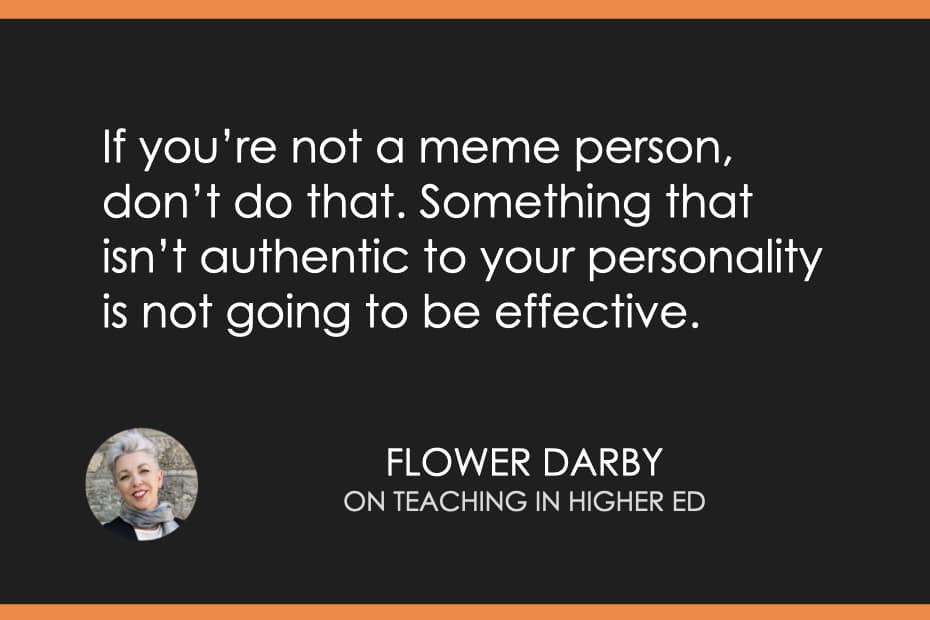
If you’re not a meme person, don’t do that. Something that isn’t authentic to your personality is not going to be effective.

Higher education doesn't do a great job of preparing faculty to teach, generally speaking, that's not new, but especially online teaching.
-Flower Darby

If you’re not a meme person, don’t do that. Something that isn’t authentic to your personality is not going to be effective.
-Flower Darby

Sometimes you don't need all the latest bells and whistles; you don't need the latest iPhone. We can be effective with simpler tools.
-Flower Darby

We can’t be joyful if we’re always working.
-Flower Darby

Resources

  • The Joyful Online Teacher: Finding Our Fizz in Asynchronous Classes by Flower Darby
  • Michelle Pacansky-Brock
  • The Spark of Learning: Energizing the College Classroom with the Science of Emotion, by Sarah Rose Cavanagh
  • Dave Ghidiu
  • Denise Maduli-Williams
  • TextExpander
  • Thor: God of Thunder gets a library card
  • A Starting Point for Seth Godin’s Blog
  • Feel Good Inc., by Gorillaz
  • Muddiest Point Handout from Purdue
  • Revitalizing the Muddiest Point for Formative Assessment and Student Engagement in a Large Class, by Amy Mackos, Kelly Casler, Joni Tornwall, and Tara O'Brien
  • Poll Everywhere

ARE YOU ENJOYING THE SHOW?

REVIEW THE SHOW
SEND FEEDBACK

ON THIS EPISODE

woman wearing a scarf smiles warmly

Flower Darby

Flower Darby celebrates and promotes effective teaching in all modalities to advance equitable learning outcomes for all students. She's an Associate Director of the Teaching for Learning Center at the University of Missouri and has taught in person and online for 30 years in a range of subjects including Psychology, English, Technology, Education, Dance, and Pilates. In her current work and publications, Darby empowers faculty to teach inclusive and equity-focused classes in all modalities. Her new book is The Joyful Online Teacher: Finding Our Fizz in Asynchronous Classes (2026). Previous books include The Norton Guide to Equity-Minded Teaching (2023) and Small Teaching Online: Applying Learning Science in Online Classes (2019).

Bonni Stachowiak

Bonni Stachowiak is dean of teaching and learning and professor of business and management at Vanguard University. She hosts Teaching in Higher Ed, a weekly podcast on the art and science of teaching with over five million downloads. Bonni holds a doctorate in Organizational Leadership and speaks widely on teaching, curiosity, digital pedagogy, and leadership. She often joins her husband, Dave, on his Coaching for Leaders podcast.

RECOMMENDATIONS

Thor_-God-of-Thunder-gets-a-library-card

Thor: God of Thunder gets a library card

RECOMMENDED BY:Bonni Stachowiak
A-Starting-Point-for-Seth-Godins-Blog-and-consider-one-of-your-own-in-your-work

A Starting Point for Seth Godin’s Blog (and consider one of your own in your work)

RECOMMENDED BY:Bonni Stachowiak
Feel-Good-Inc.-Gorillaz

Feel Good Inc. Gorillaz

RECOMMENDED BY:Flower Darby
Woman sits at a desk, holding a sign that reads: "Show up for the work."

GET CONNECTED

JOIN OVER 4,000 EDUCATORS

Subscribe to the weekly email update and receive the most recent episode's show notes, as well as some other bonus resources.

Please enter your name.
Please enter a valid email address.
JOIN
Something went wrong. Please check your entries and try again.

Related Episodes

  • EPISODE 240Small Teaching Online
    woman wearing a scarf smiles warmly

    with Flower Darby

  • EPISODE 239Becoming an Authentic Online Teacher

    with Michelle Pacansky-Brock

  • EPISODE 347Online Culture
    courtney-plotts

    with Courtney Plotts

  • EPISODE 581Joyful Justice

    with Alexandra Kogl


EPISODE 620

The Joyful Online Teacher with Flower Darby

DOWNLOAD TRANSCRIPT

EPISODE 620: The Joyful Online Teacher, with Flower Darby

Bonni Stachowiak [00:00:00]:

Today, on episode number 620 of the Teaching in Higher Ed podcast, The Joyful Online Teacher, Finding Our Fizz in Asynchronous Classes, with Flower Darby, 

Bonni Stachowiak [00:00:13]:

Production Credit: Produced by Innovate Learning, Maximizing Human Potential. 

Bonni Stachowiak [00:00:23]:

Welcome to this episode of Teaching in Higher Ed. I’m Bonni Stachowiak, and this is the space where we explore the art and science of being more effective at facilitating learning. We also share ways to improve our productivity approaches, so we can have more peace in our lives and be even more present for our students. It is joyful for me to be welcoming back to the show Flower Darby. She celebrates and promotes effective teaching in all modalities to advance equitable learning outcomes for all students. She’s an Associate Director of the Teaching for Learning Center at the University of Missouri, and has taught in person and online for 30 years in a range of subjects, including psychology, English, technology, education, dance, and Pilates.

Bonni Stachowiak [00:01:22]:

In her current work and publications, Darby empowers faculty to teach inclusive and equity-focused classes in all modalities. Her new book, which we’ll be talking about today, The Joyful Online Teacher: Finding Our Fizz in Asynchronous Classes, is a joy to read, and I’m so excited to talk with her today. Her previous books include The Norton Guide to Equity-Minded Teaching and Small Teaching Online: Applying Learning Science in Online Classes. Flower Darby, welcome back to Teaching in Higher Ed.

Flower Darby [00:01:58]:

Bonni, thank you so much for having me. It is always my true delight to hang out with you.

Bonni Stachowiak [00:02:03]:

I love book dedications, and yours was no different. May I read it to you?

Flower Darby [00:02:09]:

Absolutely.

Bonni Stachowiak [00:02:10]:

For Tim, with fierce gratitude for the strength, depth, and fizzy harmony of our mind meld. You know, I couldn’t do this work without you. And for you, my often unseen, underappreciated online teaching colleagues, my heroes in this work. You and your students are the reason I do what I do. Flower, I feel like our entire conversation is going to be about that book dedication, but I have to start with the subtitle of your book, Finding our Fizz in Asynchronous Classes. Tell me about the origins of your love for Fizz. What is Fizz? Who are you? Who are we without Fizz? Tell me about the Fizz.

Flower Darby [00:02:57]:

Yes, thank you, Bonni. This is fun. It’s excitement, it’s enjoyment, it’s the buzz of interaction. It’s giddy, just enjoyment, eager anticipation. It’s just all the feels, the positive feel-good feels. And you know, we know when we experience this in various life domains, when we’re maybe we’re driving a particularly fun road in a fast car, or whatever it might be that experience that fills us with that kind of giddy excitement.

Flower Darby [00:03:26]:

My proposal here is that we don’t naturally necessarily experience that fizz in asynchronous classes, but I think we can, and we should. And so that’s the fizz to me is just literally sort of a giddy excitement. A lot of fun, really enjoying ourselves.

Bonni Stachowiak [00:03:44]:

And you’ve already anticipated what I thought we might chat about next, which is, you have a true confession. You have a true confession about how you feel. Even still sounded present tense as of the writing of the book about the contrast between teaching online and teaching in person. Tell us about that.

Flower Darby [00:04:04]:

It’s true. I’ve made this confession in the book for the first time sort of publicly in writing. I don’t really love teaching online. What? It’s not as fun to me. I love being in person. I’m a former jazz dance teacher and choreographer, and I can bring that palpable fun energy into any college classroom. It’s much harder to generate in online classes.

Flower Darby [00:04:28]:

And that was what my confession was. I don’t enjoy learning management systems like Canvas. They’re ugly, unpleasant places to be. Yeah, I’m just being honest about the fact that I have experienced times in my own teaching where teaching online felt like drudgery. And that’s not who I want to be as a teacher.

Bonni Stachowiak [00:04:46]:

I so appreciated that it made me feel less alone. When I have difficulty with the fizz in my own online teaching, I sometimes get invited by our admissions department to give a sample class. They used to actually have them come sit in our classes, but just for logistical reasons that became problematic. And the idea of getting in front of a hundred prospective students and feeling that rush of what it’s like to engage and experience those micro connections with people. I mean, there, it’s definitely takes a lot more intentionality.

Bonni Stachowiak [00:05:22]:

And I would love to have you share now a little bit because I think sometimes for myself, I’ll put a lot of these factors, of why it’s hard to bring that joy into an online context on my own shoulder. Would you talk some about some of the factors, some of the contributors to our joy being sapped, some of which maybe we don’t want to rest directly on our own shoulders, and are more systemic in nature? I think it’s a combination, right?

Flower Darby [00:05:49]:

Oh, absolutely. I learned from a mentor several years ago that we never blame or shame any individual instructor who is trying to do their best to support student engagement and learning. And that has really stuck with me. I still believe, even though people like you and me have been saying this for literal years now, I still believe that higher education doesn’t do a great job of preparing faculty to teach. Generally speaking, that’s not new, but especially online teaching. You know, the first time I came on your podcast, Bonni, I think it was 2019. And I said, ” Gosh, we’re just not really, ee’re not experiencing good online learning”.

Flower Darby [00:06:26]:

And unfortunately, I still kind of think that’s true. So to your point, it’s not about what individuals necessarily know to do, because sometimes we don’t know what we don’t know. Sometimes we haven’t experienced a good online class. I know there are institutions, colleges, universities, that are doing a great job of preparing faculty to teach online. They’re really doing wonderful work. But there’s a lot of other places that are just not there yet. So, lack of preparation, lack of experiential learning about what a good asynchronous class feels like, how it can feel invigorating, and deep, and meaningful. And then last but not least, I would just add the category of sort of the conditions that we work in. Classes that are too large, too many classes that we’re trying to teach, unreasonable expectations on us and our time.

Flower Darby [00:07:13]:

These are all reasons that can contribute to a lack of joy in online, or I would say, any teaching.

Bonni Stachowiak [00:07:20]:

You mentioned an episode when you first joined, and I’m thinking back even years prior to that, my first having a name for something, “civil attention”. And this contrast between when we do stand in front of groups in a classroom setting, feeling like learning is happening, when in fact it is a student’s ability to perform. Civil attention is often the best we can get, unless we more intentionally go in and structure it. And as I was reading your words, I was thinking about your comments about some of the regulations that many of us experience, and how the attempt to recreate, you know, how would we know if they’re learning? And some of the misguided things that happen in a classroom also happen around what either rules get instituted by a regulatory body, or perhaps even at the institution, and oftentimes with the best of intentions. How does that kind of muck things up when we start to put some rules or rubrics without really having a sense of the importance of joy, the importance of engagement, and what that could look like in an online context?

Flower Darby [00:08:35]:

Yeah, I’ve just thought a lot about external impositions of expectations, really is the way to put that. And this is a very nuanced topic for me because I also recommend that we use things like course design rubrics, and that I personally, when I teach online, I still require my students to post once, reply twice. But I think it’s important to acknowledge that that can feel forced or stilted or inauthentic. Something I like to invite folks to think about is just imagine the next department meeting or, I don’t know, book club meeting that you go to, and before people can leave the room, everybody has to say one original thing, and then everybody has to- it’s sort of forced and false. We also know that again, different bodies, different regulatory bodies, the government institutions might be requiring certain number of clicks, for example, and that is not very motivating. And yet it’s the conditions that we work in, they, to some extent, some of those expectations can serve a purpose.

Flower Darby [00:09:37]:

But what I’ve found is that when we center the people in our online classes, including ourselves, and try to truly foster those meaningful connections, that’s when we experience more interest in connecting with our students beyond a minimum number of clicks.

Bonni Stachowiak [00:09:53]:

Oh, that’s a beautiful sentiment that you just had; centering the people as opposed to the clicks. What a powerful reminder for me to hear today, and I’m sure so many others. I’m going to do something that, that for some feels rather rebellious. I’m going to ask us to skip to the very end now because you end with the idea of finishing strong. And would you tell us why is thinking about persistence so key when we bring our fizz to online environments?

Flower Darby [00:10:26]:

Yeah, thank you. And it’s okay, we can be a little bit rebellious. That’s what, that’s what makes it fun. That’s where we can have a little fizz here today. So, we know for a fact that attrition rates in asynchronous classes especially are higher than they are for in person classes. Students fail to complete, they drift away, or they are not successfully completing their courses, earning lower grades in online classes. And that has been a persistent challenge for literal years.

Flower Darby [00:10:57]:

We also know when we disaggregate those data that some students are faring worse than others in completing the class. But for me, it’s about recognizing that asynchronous education, first of all, serves a really important purpose. That it enables people to achieve a degree or a credential that they would not otherwise be able to achieve. And it’s about recognizing the increase in autonomy, and self-regulation, and executive function that is naturally required in this modality. So really what I talk about in terms of finishing strong is tapping into motivational theory, is applying recommendations from Universal Design for Learning, just to recognize that the very act of persistence in online classes is in itself a challenge that we can address, and then to plan accordingly and build in those structures that support and promote that persistence and completion.

Bonni Stachowiak [00:11:53]:

As we think about where some misguided attempts to measure, whether it’s measure our effectiveness, measure the learning, whatever it is, can in some cases be reduced down to clicks or time spent. I just kept resonating with that, and then I thought about your advice about our endings. When we conclude classes, you tell us that we should be thinking about a little shorter endings, a little like- and in case other people need to hear that advice, could you say it louder so the people in the back could hear you? Tell us about the importance of short endings.

Flower Darby [00:12:30]:

You know, just to go ahead and be transparent for people who have not gotten the book. My last chapter in the book is a combination of a finishing chapter and conclusion. I kind of condensed what originally might have been a separate standalone chapter and then a conclusion. It is called Finish Strong, that’s the name of the chapter. And it really is about recognizing that by the time we get to the end or those last few weeks of a class or a semester, that we’re just tired. And so again, I feel this, especially in asynchronous classes, but I think this principle applies to individual class meetings or to semester or term-long experiences. Just planning in advance for a lower ebb of energy that can, you know, naturally happen toward those final minutes, those final weeks, and being proactive to kind of maybe, for example, requiring that the final project, the major assessment is actually due maybe two weeks prior to the end of class.

Flower Darby [00:13:24]:

And then that gives instructors some breathing room to grade and process it. It allows for any communication with students. But maybe you have an opportunity to build in some metacognitive reflection during those last two weeks when you sort of, I won’t say front load, that’s not accurate, but sort of move up that final kind of major assessment to not the last week of class. I just feel like a little bit of breathing room benefits all of us, and it acknowledges the reality that we’re tired at that point, so are our students. And so let’s plan in advance for that.

Bonni Stachowiak [00:13:55]:

Yeah, you give the advice about even, and you mentioned this with metacognition, but just three key takeaways. What have you found when that’s one of your final assignments in a class? What’s been a surprise or a delight from a seemingly simple prompt, but I’m sure you found some joy in it.

Flower Darby [00:14:12]:

I love that you said what has been a surprise or delight, because that’s exactly how I think we should create assignments and activities. If we think about what we will enjoy grading, right? I know I’m not the first person to say this, or what we’ll enjoy reading or reviewing, that can be a really key sort of factor. So, Three Key Takeaways is an assignment that I have oftentimes, and specifically, I’m thinking of a graduate course called Technological Fluency and Leadership. No matter what work we do, how can we use tech well to benefit ourselves, our coworkers, to do the work more effectively? And what I love about Three Key Takeaways is, and partly because I’m sure it’s a very practical and applied course, people can tailor it to their own context, their workplace settings.

Flower Darby [00:14:57]:

But I love the, sort of, the authenticity of those takeaways. It’s not just like, I learned that this leader’s theory can be really effective. It’s about, hey, I learned that asking my team what kind of process would benefit their use of, you know, this particular platform, or what kind of software would help them do their work easier. Like, it can be really simple like that. And then of course, sometimes it’s, it’s even more at a personal level. Like, I learned that, you know, sometimes you don’t need all the latest bells and whistles, you don’t need the latest iPhone. We can, we can be effective with simpler tools. I just love the individual application, the authenticity that we see in students responses, that it prompts them to think about their lives and their learning.

Flower Darby [00:15:42]:

And it is kind of an endless source of inspiration for me, to keep trying to engage our students in meaningful and relevant ways.

Bonni Stachowiak [00:15:50]:

You introduce us to so many incredible educators throughout this work, and just one is Dave Ghidiu, from Finger Lakes Community College. He teaches computer science. I’m going to read the way you quote him in the book: There’s this dissonance between my previous life as a camp counselor, where every day was novel and memorable, and you find the greatest joys in the smallest things, and the rigidity of institution life, like with inflexible, predetermined online course structures for example. I try to break up that rigidity with my quirky camp counselor self, and I get a lot of unsolicited feedback from learners that my class feels very personal. That’s not something you need camp experience for. You just need to be comfortable letting your learners see who you really are.

Bonni Stachowiak [00:16:47]:

Flower, what are some practical tips that you have for us for navigating bringing what makes sense for us with our unique intersectional identities, ourselves, into an online class?

Flower Darby [00:17:00]:

Yeah. Critically important to recognize that there are different backgrounds and experiences that we have all had, that there are different comfort zones, right? Dave is a phenomenal instructor who really got the bit between his teeth after he and I talked for this book. And he recorded all kinds of fabulous little short 30-second, 60-second videos that took the place of syllabus, policy statements, and he had all kinds of characters and costumes, it was really phenomenal what he did. But it’s not likely that everybody’s going to do that, right? 

Flower Darby [00:17:31]:

So, to your point, what are things that feel authentic to each of us individually? For example, maybe you’re the kind of person who really enjoys memes. The research shows on online teaching and learning, including memes and your announcements from time to time, sparks some energy and enthusiasm in your students. But I would say if you’re not a meme person, don’t do that. Right? Something that isn’t authentic to your personality is not going to be effective. Same thing with the use of emojis. It’s very easy to overdo those, but I would say they bring a little bit of warmth and color into these otherwise unappealing learning environments that we find ourselves in online. So it’s about being willing to record your videos and not be perfectly polished when you record a quick announcement or a clarification.

Flower Darby [00:18:17]:

Another of the folks in the book who I talk to is Denise Maduli-Williams, and she has sometimes posted on LinkedIn about how funny the thumbnail looks, right? The video still, and how it isn’t great, but it’s her, and her students love that. So just be willing to be yourself, connect with your students as a real person. That’s a key recommendation for me.

Bonni Stachowiak [00:18:38]:

I’m going to read her words that you quote her in one of the chapters, and, spoiler alert to listeners. Actually, I’m not sure how the episodes are going to all stack up together. You will have already heard from Denise in an earlier episode or one in the future because she’s agreed to come on the show. So thank you for this introduction to her and her work. Actually, I think I first learned about her on LinkedIn, and then was so glad to see her quoted in your book. So I’m reading Denise’s words, and it’s in your chapter about connecting with students: Cultivate rapport and relationships with and among students. I’m quoting her here:

Bonni Stachowiak [00:19:15]:

“I feel like I know my online students better than my in-person students. I have more interactions with them, they get to know more about me through the types of activities we do, and I’m able to individualize content, links, and resources for different students’ needs”. Any ideas for us, Flower, as far as how to capitalize on these opportunities to get to know these unique parts of our students’ lives, without maybe overwhelming ourselves as much? And specifically here, do we feel like for every assignment, every interaction, we have to customize it for every single student, or how might we think about some of the psychological principles you bring in? It doesn’t have to be an all-or-nothing thing, right? What are some practical ways we can still capitalize on those rich relationship opportunities without exhausting ourselves?

Flower Darby [00:20:11]:

Yeah. You know, I also think it’s important to add the context that if I’m not mistaken, I think Denise teaches a smaller enrollment class, and that’s important to remind ourselves, right? If individually working with students and tailoring content or support, that does depend on a luxury that not everybody enjoys, right? I see you’re nodding your head, you’re with me on that point.

Bonni Stachowiak [00:20:32]:

Absolutely. Although I mean I’m nodding, but with hesitation, because I can exhaust myself sometimes thinking that it all has to- it all has to be with excellence in every interaction. Which is why I so found your word so comforting.

Flower Darby [00:20:46]:

Thank you. I’ll just say two things about this. First of all, and you know this because you have had an opportunity to read the book, I’m all about structuring ways to see each other as real people. So, maybe there is a social discussion forum that happens every week, and it is not anything related to the class content. It’s post a photo of something that was fun about your weekend, or post, you know, tell me a little bit about a series that you’re binging on Netflix right now. Or, right? Just kind of a very social and interactive opportunity to build those relationships that, because I would argue, and I think you would agree based on your experience, it just doesn’t happen by an accident in online classes.

Flower Darby [00:21:27]:

And people like Denise, you know, have found a lot of joy and inspiration to pour that energy when we more meaningfully connect with our students and create ways for us all to connect with each other. The other thing that I would say, recognizing that not everybody is a big fan of using AI in teaching and learning. However, I will share this recommendation from Jose Bowen, author with Eddie Watson of Teaching with AI, that actually you could put those tools to work in order to sort of, tailor in a very efficient way, different discussion prompts, or quiz questions or, right? So, English teachers like my former self, we’re pretty accustomed to saying, all right, here’s three essay topics, pick one, whichever one is more interesting or right, that you want to write about. 

Flower Darby [00:22:15]:

But Jose Bowen and Eddie Watson talk about, maybe you collect through a survey, for example, students general interests. Are you more interested in sports, or music, or movies, or what is it? Right? And then maybe you just say to AI okay, create five versions of this scenario that students in small groups can address based on this category of interest. So I think that can be an effective way to deploy the tools that we have available to help students experience a more customized experience- learning environment without, you know, adding too much to our own time. That’s important too, we can’t be joyful if we’re always working.

Bonni Stachowiak [00:22:48]:

Another piece of advice you give us or remind us of is that for every single week, every single assignment, we don’t have to be sharing every single student’s work, but we could pick one or two that were particularly surprising and might be intriguing to other students. Of course, assuming that you’ve already gotten permission with students to share their work, you’d want to be cautious of that. But that really brings in a sense that there is someone there, you know, you talk a lot about, you know, having that. And I think presence is another one of those words that can mean a lot of different things to a lot of different people. But truly to be able to not just bring our presence in, but to be able to bring the presence of these students’ lives, and the things that they’re pursuing, things that they’re getting curious about. And that can be rather infectious, even if it’s not directed toward that specific student every single time, they’re seeing you acknowledge other students’ work, and it’s kind of infectious and starts to build that community.

Flower Darby [00:23:47]:

Absolutely, I’m very much building on the work that I first learned about through Sarah Rose Cavanagh, I know a previous guest of yours. Her book The Spark of Learning Energizing the College Classroom with the Science of Emotion is a direct inspiration for this book, because as soon as I read about that research and application, I thought, ” This has so much potential in online classes”. It is infectious when we generate energy and enthusiasm, and highlight the work of an individual student here or there, everybody in the class can experience that upsurge of motivation and enjoyment of the process.

Flower Darby [00:24:24]:

One thing, you know, again, it’s really important to me to continually emphasize, to maintain a balance between how much we’re putting into our teaching, and how much we’re protecting our own downtime, something that I have struggled with in the past. But one thing that I have done is to maintain, and I know again, I know I’m not alone, but maybe I maintain a list, and I make sure to highlight or directly respond to in discussions, each student at some point in the semester, I just keep a little checklist, right? So that every student gets some attention at least once. And I like it that it should be in a public space so that the other students go, “Oh, Flower really is a real person, and is interacting with us as a person”. So yeah, I would agree, these are important ways that, when we are strategic with how we do them, and I know you’re all about strategic productivity, that they can create a big effect in our classes.

Bonni Stachowiak [00:25:16]:

You’re reminding me of another tip, which I have shared, but it’s been such a long time, and it’s been helping me so much recently. I want to share it. I do a lot of noticing and wondering, inviting students to do that. I’ve been, I’ve drawn from so much inspiration from past guests on that. And I use a text expansion app. There are many of them out there. The one I use is called Text Expander, but I’ve set up these various prompts in there, so you noticed, colon. And then whatever’s in my clipboard gets pasted, and so I can quickly take their work.

Bonni Stachowiak [00:25:51]:

So imagine I’m in a learning management system and I’ve just, instead of highlighted, I’ve just just highlighted and then copied something that they noticed, or copied something that they wondered, or copied something that they asked, or copied something that they wrote. So it’s all that like I do wrote, notice, wonder, all the things. And as soon as I do that, that goes into the assignment comments, so they see reflected back on them their own words, and then something is sparked in me, whether I wanted to wonder along with them, or did they ask something and I want to provide my thought on whatever it is they asked. But that text expander to me just creates the least amount of friction I could possibly imagine. It’s such a time saver, but it really does give that personal touch.

Bonni Stachowiak [00:26:40]:

I do get a lot of feedback from students saying that I give them such helpful feedback, but it lets them know that I’m there, there’s another person there, and all the things that they don’t necessarily always get in other contexts. It is a huge time saver. But still, my yearning to make those connections is time investor, because I suppose we could just leave the no-assignment comments at all. But I just really think they deserve that. They deserve to see the spark you mentioned Sarah’s work, to see that not just the spark of their learning, but what they’ve sparked in me too.

Flower Darby [00:27:12]:

Absolutely. And based on your advice, I also use Text Expander. And you just shared, again, a very practical thing that I have not tried yet, but reflecting students back, you know, their words back to them, and commenting or responding to, so powerful! You know, I like to go to panels of students on their online student experience as often as I can. And the most recent one I attended was just over a year ago. And this particular student said, ” You know, like, when it feels like the instructor reads what I wrote and kind of cares a little bit, that really helps me feel like I’m like, I matter in that class”. And I’m like, right?

Flower Darby [00:27:49]:

My takeaway is that very often our online students do not feel that we’re reading what they wrote and that we care a little bit. And the strategy, the technique that you just mentioned, allows us to convey that in a meaningful and authentic way, but also efficiently. I love it.

Bonni Stachowiak [00:28:05]:

Before we get to the recommendation segment, I’d love for you to share you have a tip about emoji that is a time saver for you, but also you have a caution for us regarding emoji as well.

Flower Darby [00:28:15]:

Let’s see if I remember what you’re thinking of, but I’ll tell you what comes to mind in this moment. Yeah, I do actually, I do use TextExpander. I’ve loaded several emojis in there, some of my favorites. But given that my name is Flower, I like to use the little pink tulip one. And oftentimes, I’ll just put something in the assignment comments itself to indicate to students that a real person was there, that I did look, that I acknowledged what they did. And it takes, I mean, it doesn’t even take a second, right? It takes a nanosecond to pop in a quick emoji that it helps students again; it’s a little tiny pop of color and warmth in these otherwise unappealing pages.

Flower Darby [00:28:52]:

The caution that comes to my mind right now, I don’t know if this is what you’re thinking, but there is research that shows that it’s really easy to overdo that. And sometimes that just gets annoying, and in fact, if we’re thinking about digital accessibility, emojis can really trip up a screen reader where it might say, sobbing face, sobbing face, sobbing face, right? So I’m a fan of strategic and intentional little use of emojis.

Bonni Stachowiak [00:29:16]:

I’m laughing so hard at the sobbing face, sobbing face, sobbing face, because, yes, that would be overwhelming, but it might actually be something you’re referring to that is also overwhelming. Oh, gosh! Yeah, you did, you did mention Text Expander, and then you also mentioned the, just not getting too carried away with it.

Bonni Stachowiak [00:29:33]:

Sometimes it can seem as if your words are potentially being written by artificial intelligence instead of by you as well if they’re overused. And, you know, that can just take a little bit of getting to know you and your personality. Like, for you, if I saw, I love sort of imagining, you know, what that emoji would look like, and then that I would associate that with you and it becomes very personal and unique to you. I thought that was such a great thing. All right.

Flower Darby [00:29:57]:

And I would really quick, before we go on, I would also just remind us again that if you’re not an emoji person, don’t do that. My brother hates them.

Bonni Stachowiak [00:30:03]:

Yes.

Flower Darby [00:30:04]:

I’ve learned not to communicate with him in emojis. And so if that’s you don’t, don’t use them. But find little ways to infuse your personality so that students see that you’re a real person.

Bonni Stachowiak [00:30:13]:

I love the way you give us advice to adapt it for who we really are. And if that’s not you, that’s not you. And you just do that throughout all of your work, not just this book itself. Before Flower and I get to our recommendations, I want to thank the partnership that I have with Poll Everywhere, all the people there, and for this wonderful opportunity that it is, to share a tip about how to use Poll Everywhere in our teaching, and I’m excited about this one. You may have heard of Muddiest Point, and if you haven’t, I will have a link in the show notes to a one-page handout from Purdue, where you can go and learn more. But it’s an opportunity, it’s a classroom assessment technique.

Bonni Stachowiak [00:30:59]:

A very small, low prep time needed, small amount of class time needed, and a very, very low lift as far as the time required to analyze the data. And we can create some kind of a prompt in Poll Everywhere, like what is the muddiest point in, and then fill in the blank. And you want to think about how to collect your data. I’ve certainly done this with sticky notes before, but I can tell you the nice thing about using a poll service like Poll Everywhere is that then, where it’s just easier to retain it’s either to gather and then retain, and then be able to see those results over time. And so Muddiest Point, I’m going to link you over to that one-pager so you can learn more about it. And the thing I wanted to mention here about using Poll Everywhere in this is we can do it with large classes, which is fabulous. You also can do it in asynchronous classes or some combination. So it could be that most of your class is there, but you want to gather some of the data for people who weren’t able to join.

Bonni Stachowiak [00:32:07]:

Maybe you have some sort of a flexible format. And I’ll also be putting in the show notes a link over to an article entitled Revitalizing the Muddiest Point for Formative Assessment and Student Engagement in a Large Class. And this article by Amy Mackos, Kelly Casier, Joni Tornwall, and Tara O’ Brien helps us look at how we can ascertain student understanding in either large enrollments, and or hybrid, or asynchronous courses. What I really appreciate about Poll Everywhere is I have the flexibility to be able to, yes, do things right there in a classroom, or I can do it after the fact asynchronously, or any combination of those things. So check out the article, check out the Muddiest Point, and use Poll Everywhere to help you do that. And if you have any ideas for ways that you’re creatively using Poll Everywhere or another polling service in your teaching, would love to hear from you, email me at feedback@teachinginhighered.com. Thanks once again to Poll Everywhere. Head over to polleverywhere.com to find out more about what’s possible through Poll Everywhere.

Bonni Stachowiak [00:33:26]:

Well, this is the time in the show where we each get to share our recommendations. And I have two today. The first one comes from my colleague and friend Jim, who leads our library. And it took me right back to the Muppets. It is an old, old Muppets clip, and it is Thor, God of Thunder Gets a Library Card. And it is just delightful, and just brought back so many memories of both the humor of the Muppets, I did see, I can’t recommend it yet, Flower, because I haven’t watched it, but I did see that there is a new Muppets television show, Flowers nodding her head. And so I’m kind of curious if that’s going to be any good.

Bonni Stachowiak [00:34:07]:

But I’ll watch it. I will do my due diligence and then if I like it, I’ll recommend it in the future.

Flower Darby [00:34:12]:

Reviews are sounding very positive, very true to old school Muppets.

Bonni Stachowiak [00:34:15]:

Don’t we need that? Don’t we need that in this world? We need that. So I’m, I’m glad to hear that the, the reports are out. That’s good to know. All right, and then the second thing I wanted to recommend, I have shared across, gosh, a very long time in this podcast, pieces from Seth Godin. And I came across a post that he wrote in February of 2026 called A Starting Point for Seth Godin’s blog. And so, I guess this is one recommendation, but it kind of comes in two parts. So if you’re interested in his work, this would be an interesting post to you.

Bonni Stachowiak [00:34:53]:

And I’m going to read from his words here: The challenge of the library is the card catalog. If you don’t know what you’re looking for, it’s hard to find much of anything. The challenge of the web is the search box for the same reason. It’s efficient once you’re on a mission, but it requires you to go first. And the chat interface of Claude and ChatGPT is more of the same. Faced with infinite choice, what we really need is a guide. By request, then, 10 places to start on this blog.

Bonni Stachowiak [00:35:31]:

And he goes on to share, yes, you guessed it, 10 places to start on his blog. Everything from notes to myself, 65 principles distilled from 10,000 posts, energy and systems complexity. Systems thinking that connects beans to bureaucracies to solar panels. The AI effort gap, six sentences that reframe the entire AI conversation. You get the idea. 

Bonni Stachowiak [00:35:56]:

And I just- so I guess that this is a recommendation in two parts, go check out his post. It would be a great starting point for you, or a returning point for you of his work. But I’d also suggest that we, and I include myself very much in this, that we consider a starting point for some of our own work. So I kind of thought, “gosh, what if I created a starting point for my blog?” And that I’ve been doing more blogging in the last three months, really, than I’ve maybe even ever done. It started with taking a online class from Harold Jarche on Personal Knowledge Mastery, and that was, I was blogging twice or three times a week. So that was quite a, quite an endeavor.

Bonni Stachowiak [00:36:37]:

I did not keep that up to date, but I have been writing more. And so I thought, well, that would be kind of interesting for me to, what would be a starting point for my blog? Or, you know, perhaps more specific to my work and my streak would be a starting point to the podcast, that would be kind of a fun challenge to take. So I’d encourage people, and if you, if you take the challenge, I’d love it if you’d send me a note, tell me what’s a starting point for your work and I’ll, I’ll see Flower if I get to a starting point for my work anytime soon. The good thing is that this episode is going to be airing in April. So as of this conversation, I have some time to actually, I’ll put it in the show notes if I get to it before then. 

Flower Darby [00:37:15]:

With over 600 episodes to date, yes, I would benefit from a starting point to your podcast.

Bonni Stachowiak [00:37:21]:

Yeah, well, now I get to pass it to you. Flower, what would you like to recommend?

Flower Darby [00:37:24]:

You know, the book reflects a new life philosophy that I really am trying to embrace and emulate, and that is to literally enjoy our life more and do things that we enjoy, and just revel in feeling good. So I have kind of a new theme song in my life, and my work, and that’s my recommendation. The band is called Gorillaz, it’s spelled with a Z at the end. And the song is Feel Good Inc. It is from 2005, you’ll probably be able to find a link, I can provide that to you as well.

Flower Darby [00:38:00]:

But it’s just a feel-good song about feeling good, and that’s where I’m going with the joyful online teacher and with enjoying our teaching more broadly is let’s, let’s create experiences that feel good because the research is clear that actually promotes student motivation, engagement, and deepens learning, predicts academic performance and achievement. Let’s feel good. Let’s enjoy that. That’s my recommendation for today.

Bonni Stachowiak [00:38:25]:

You know what I’m going to be doing as soon as we get offline with each other, we’ll be going for a walk around the neighborhood and finding that song for the show notes, but also for my soul.

Flower Darby [00:38:35]:

I hope you find it as catchy and fun as I do. I know you, and I share a love of dancing, and so I love the beat. I find it very, very fun.

Bonni Stachowiak [00:38:45]:

Thank you so much for this book. Thank you for your last one. Thank you for your next one. Thank you for your contributions to especially in this work, those who may feel more alone in our work for celebrating that incredible aspect of our education. And thanks for coming on the show again.

Flower Darby [00:39:03]:

Bonni, it is always a humbling pleasure, and thank you for the work that you do, so many important contributions as well. It’s just really a delight to be among your circle of acquaintances. And again, it’s I would say it’s very humbling to try to bring materials and ideas and research that hopefully supports all of our flourishing. That’s what it’s all about.

Bonni Stachowiak [00:39:24]:

Thanks once again to Flower Darby for joining me on today’s episode. Today’s episode was produced by me, Bonni Stachowiak. It was edited by the ever-talented Andrew Kroeger. If you’ve been listening for a while and have yet to sign up for the weekly Teaching in Higher Ed update, I encourage you to head over to teachinginhighered.com/subscribe. You’ll receive the most recent episodes’ show notes, as well as some other recent resources that go above and beyond those. Thank you so much for listening, and I’ll see you next time on Teaching in Higher Ed.

Expand Transcript Text

TOOLS

  • Blog
  • Podcast
  • Community
  • Weekly Update

RESOURCES

  • Recommendations
  • EdTech Essentials Guide
  • The Productive Online Professor
  • How to Listen to Podcasts

Subscribe to Podcast

Apple PodcastsSpotifyAndroidby EmailRSSMore Subscribe Options

ABOUT

  • Bonni Stachowiak
  • Speaking + Workshops
  • Podcast FAQs
  • Media Kit
  • Lilly Conferences Partnership

CONTACT

  • Get in Touch
  • Support the Podcast
  • Sponsorship
  • Privacy Policy

CONNECT

  • LinkedIn
  • Instagram
  • RSS

CC BY-NC-SA 4.0 Teaching in Higher Ed | Designed by Anchored Design