• Skip to primary navigation
  • Skip to main content
  • Skip to footer

Teaching in Higher Ed

  • Podcast
  • Blog
  • SPEAKING
  • Media
  • Recommendations
  • About
  • Contact

Personal knowledge mastery

with Dave Stachowiak

| July 24, 2014 | XFacebookLinkedInEmail

Personal knowledge management and mastery. How to capture information, curate it, and create new knowledge from it. It can be so challenging to keep up with everything we have on our plates, let alone to what’s happening in the world and in areas that are most important to us.

Podcast notes

Guest: Dave Stachowiak

This episode introduces the terms personal knowledge mastery and management.

Discipline of finding information, making meaning of it, and sharing it with others.
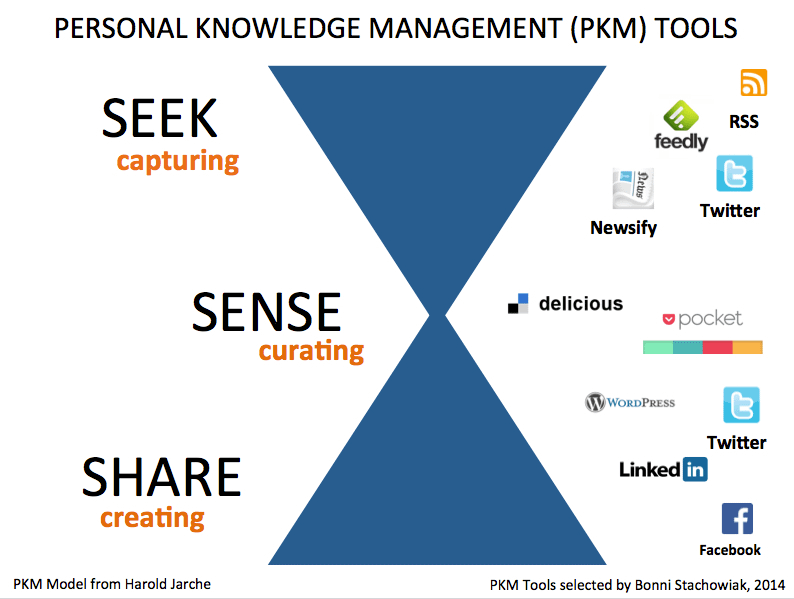
pkmtools

Personal mastery

“Personal mastery is a discipline of continually clarifying and deepening our personal vision, of focusing our energies, of developing patience, and of seeing reality objectively.” -Peter Senge

Personal knowledge management

Harold Jarche’s PKM resources

Harold Jarche’s introductory video

Personal knowledge mastery

Skills for 2020

KickStarter campaigns

StorkStand

Potato salad

Framework

Seek – capture

Sense – curate

Share – create

Definition

“Discipline of seeking from diverse sources of knowledge, actively making sense through action and experimentation and sharing through narration of your work and learning out loud.” – Harold Jarche

Key posts on PKM from Harold Jarche

Bonni’s online PKM modules: 

1. Introduction to PKM

2. PKM demo (the actual tools I use in my PKM process)

3. PKM for academics

Recommendations

Practical Typography by Butterick (Dave)

Dave Pell’s NextDraft – The day’s most fascinating news (Bonni)

Feedback

On this episode: https://teachinginhighered.com/7

Comments, questions, or feedback:  https://teachinginhighered.com/feedback

Tagged With: pkm, podcast

Eight seconds that will transform your teaching

with Dave Stachowiak

| July 17, 2014 | XFacebookLinkedInEmail

How can we use silence to condition our students to answer the questions we pose?

Podcast notes: Eight seconds of silence that will transform your teaching

It is counter-intuitive. We want students to engage with us, so we pose questions. Then, they just look at us, or down at their desks, with a pained or bored expression. We decide this whole question-asking thing is for the birds… or, at least, for a different kind of class/discipline than the one in which we teach.

Guest: Dave Stachowiak

How we condition ourselves not to ask questions and condition our students not to answer them.

We try to get our students to engage by asking a question. They stare back at us, blankly. It’s awkward.

Thinking in terms of what to cover in class, versus where the needs actually are.

What has to happen before a student will answer a question.

  1. Process what’s been asked.
  2. See if they can formulate an answer to the question.
  3. Formulate an answer in their head (how they will convey their answer).
  4. Decide if it is safe to answer.
  5. Raise their hand, or speak (depending on the cultural rules in the classroom).

The 8 second rule takes this time I to account. It used the power of silence to pressure students to take to risk of engaging.

EdTech Finds

Broadening the definition of EdTech for the purpose of sharing a couple things that have captured our attention:

Evernote water bottle (Bonni) After recording the show, I saw that not only is this a great water bottle, but it is also associated with a great cause: WaterAid.

Turning off email on phone (Dave); Essentialism book

Tagged With: engaging_students, podcast, questions, silence

What this Trader Joe’s sign teaches us about professional development

with Dave Stachowiak

| July 10, 2014 | XFacebookLinkedInEmail

Overcome the excuses we make that stop us from pursuing more professional development opportunities in this episode of Teaching in Higher Ed.

There’s a sign posted in our local (and beloved) grocery store: Trader Joe’s. “Please do not use this machine if you have not been trained,” it reads. The machine in question is a drink dispenser. As absurd as this is, in some cases, there’s more training required to dispense raspberry lemonade than there is to teach a college class.

traderjoesdrink


Guest: Dave Stachowiak

There are abundant resources out there for professional development, but we can sometimes be held back by our own excuses.

Professional development excuses and opportunities

Here are the most common excuses for not pursuing more training on how to teach and how to overcome each of them:

Not enough time

  • Podcasts (Bonni’s podcast recommendations)
  • Audio books (Dave listens via Audible.com)
    • A couple of audio books that Dave particularly enjoyed listening to lately on Audible:
      1. Adam Grant’s Give and Take
      2. Essentialism by Greg McKeown
  • When you’re waiting (Pocket)

Too hard to keep up

  • Subscribing to blogs (feedly)
  • Twitter
  • Bonni’s professional development Twitter lists:
    1. Teaching in Higher Ed
    2. EdTech
    3. Teaching and learning centers
    4. ProfHacker

My discipline is unique

  • Coursera
  • EdEx

Nothing I’ve tried before works

  • Filming or recording yourself teaching

My university doesn’t dedicate resources for professional development

  • Faculty development centers at other universities
  • USC’s Center for Teaching Excellence videos
  • Grass roots efforts
  • EdTech group at Vanguard

EdTech tools

JotPro stylus (Dave)

iAnnotate (Bonni)

Tagged With: podcast, professional_development, teaching

Your teaching philosophy: The what, why, and how

with Dave Stachowiak

| July 5, 2014 | XFacebookLinkedInEmail

How to formulate, refine, and articulate your teaching philosophy.

Podcast notes

The academic portfolio: A practical guide to documenting teaching, research, and service by J. Elizabeth Miller

Miller provides examples of the narrative from actual promotion and tenure portfolios.

What is a teaching philosophy?

  • Why we teach. Why teaching matters.
  • Not just a formula for teaching structure, but the rationale behind the structure.

Why is having a teaching philosophy important?

Helps guide our teaching methods. Needed in the job hunting process. Typically part of the promotion/tenure process at most universities.

How to identify, articulate, & refine it?

Questions from The Academic Portfolio (p. 13):

  • What do I believe about the role of a teacher, the role of a student?
  • Why do I teach the way I do?
  • What doesn’t learning look like when it happens?
  • Why do I choose the teaching strategies and the methods that I use?
  • How do I assess my students learning?

Questions of my own that  I have found useful in articulating my teaching philosophy:

  • Who are my students? How I describe them says a lot about how I approach my teaching.
  • Who am I, as an educator? How I describe myself says a lot about my teaching, too.
  • What is teaching? Is the purpose to convey information, or to facilitate learning (or something else altogether)?

Planet Money episode about young woman becoming a business owner in North Korea.

  • What are the artifacts of my teaching? Observable things.
  • What would I see/hear/experience that would be evidence of those beliefs, if I was in your class?
  • Espoused beliefs vs theories in use. Chris Argyris / Edgar Schein

Podcast updates

Thanks to Suzie RN for giving us our first iTunes review. We appreciate iTunes or Stitcher reviews from listeners, as it helps us get the word out about the show. Also, if you haven’t done the listener survey yet, please do. That will help us continue to make the show better meet your needs.

Tagged With: portfolio, teaching, tenure

Lessons in teaching from The Princess Bride

with Dave Stachowiak

| June 30, 2014 | XFacebookLinkedInEmail

This is the space where we explore the art and science of being more effective at facilitating learning. We also share ways to increase our personal productivity approaches, so we can have more peace in our lives and be even more present for our students.

Lessons in Teaching from The Princess Bride

The Princess Bride on Facebook – official site

Store (selling magnets… if only today’s fridges were magnetic)

Princess Bride party game

 IMDB: The Princess Bride

 Test your knowledge: The Princess Bride quiz

From: “Who played the grandson?” (Fred Savage) to “What town is Inigo Montoya from?” (huh?)

The Wonder Years

You keep using that word. I do not think it means what you think it means.

Help students break things down. visualization. pencasts.

As you wish.

Pay attention to wishes… dreams… going to take a lot to get there. grit. resilience.

From Psychology Today:

“Resilience is that ineffable quality that allows some people to be knocked down by life and come back stronger than ever. Rather than letting failure overcome them and drain their resolve, they find a way to rise from the ashes. Psychologists have identified some of the factors that make someone resilient, among them a positive attitude, optimism, the ability to regulate emotions, and the ability to see failure as a form of helpful feedback.”

Beware of ROUSs (rodents of unusual size)

Politics in higher ed. power. French and Raven’s five bases of power.

From MindTools:

“One of the most notable studies on power was conducted by social psychologists John French and Bertram Raven, in 1959.” They identified five bases of power:

  1. Legitimate – This comes from the belief that a person has the formal right to make demands, and to expect compliance and obedience from others.
  2. Reward – This results from one person’s ability to compensate another for compliance.
  3. Expert – This is based on a person’s superior skill and knowledge.
  4. Referent – This is the result of a person’s perceived attractiveness, worthiness, and right to respect from others.
  5. Coercive – This comes from the belief that a person can punish others for noncompliance.

EdTech Tools

HaikuDeck (Bonni)

Pinboard (Dave)

Tagged With: grit, organizationalpolitics, podcast, politics, resilience, teaching

  • « Go to Previous Page
  • Page 1
  • Interim pages omitted …
  • Page 125
  • Page 126
  • Page 127
  • Page 128
  • Go to Next Page »

TOOLS

  • Blog
  • Podcast
  • Community
  • Weekly Update

RESOURCES

  • Recommendations
  • EdTech Essentials Guide
  • The Productive Online Professor
  • How to Listen to Podcasts

Subscribe to Podcast

Apple PodcastsSpotifyAndroidby EmailRSSMore Subscribe Options

ABOUT

  • Bonni Stachowiak
  • Speaking + Workshops
  • Podcast FAQs
  • Media Kit
  • Lilly Conferences Partnership

CONTACT

  • Get in Touch
  • Support the Podcast
  • Sponsorship
  • Privacy Policy

CONNECT

  • LinkedIn
  • Instagram
  • RSS

CC BY-NC-SA 4.0 Teaching in Higher Ed | Designed by Anchored Design