• Skip to primary navigation
  • Skip to main content
  • Skip to footer

Teaching in Higher Ed

  • Podcast
  • Blog
  • SPEAKING
  • Media
  • Recommendations
  • About
  • Contact
EPISODE 614

Keeping Your PKM Real Simple with RSS

| March 19, 2026 | XFacebookLinkedInEmail

https://media.blubrry.com/teaching_in_higher_ed_faculty/content.blubrry.com/teaching_in_higher_ed_faculty/TIHE614.mp3

Podcast (tihe_podcast):

Play in new window | Download | Transcript

Subscribe: Apple Podcasts | Spotify | RSS | How do I listen to a podcast?

Bonni Stachowiak shares how to keep your Personal Knowledge Mastery (PKM) real simple with RSS on episode 614 of the Teaching in Higher Ed podcast.

Quotes from the episode
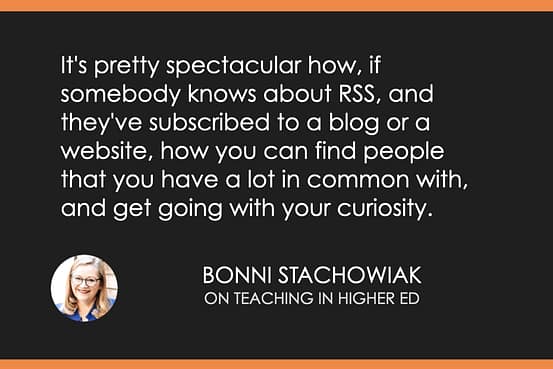
It's pretty spectacular how, if somebody knows about RSS, and they've subscribed to a blog or a website, how you can find people that you have a lot in common with, and get going with your curiosity.

Rather than get that overwhelmed feeling of how hard it's going to be to keep up, I don't have to, and neither do you. Enter RSS, Real Simple Syndication.
-Bonni Stachowiak

It's pretty spectacular how, if somebody knows about RSS, and they've subscribed to a blog or a website, how you can find people that you have a lot in common with, and get going with your curiosity.
-Bonni Stachowiak

It's amazing what happens when, before we start trying to lecture or share information,  we ask people to predict something. Even if they end up predicting incorrectly, there still is that connection where we've piqued their curiosity.
-Bonni Stachowiak

Resources

  • Why Isn’t RSS More Popular By Now, by Bonni Stachowiak
  • Real Simple Syndication, by Harold Jarche
  • Inoreader
  • Unread App
  • The Indispensable Digital Research Tool I can Say, Without Lying, Saves Time, by Alan Levine (aka CogDog)
  • RSS in Plain English, by Common Craft
  • MiniRoll
  • This Cozy Reading Life with Katie Linder
  • The Transformers: Imagining the Future of the Teaching of Writing
  • NASA Image of the Day
  • McSweeney's Internet Tendency
  • Poll Everywhere

ARE YOU ENJOYING THE SHOW?

REVIEW THE SHOW
SEND FEEDBACK

ON THIS EPISODE

Bonni Stachowiak

Bonni Stachowiak is dean of teaching and learning and professor of business and management at Vanguard University. She hosts Teaching in Higher Ed, a weekly podcast on the art and science of teaching with over five million downloads. Bonni holds a doctorate in Organizational Leadership and speaks widely on teaching, curiosity, digital pedagogy, and leadership. She often joins her husband, Dave, on his Coaching for Leaders podcast.

RECOMMENDATIONS

You’ve Got This

You’ve Got This

RECOMMENDED BY:Bonni Stachowiak
Woman sits at a desk, holding a sign that reads: "Show up for the work."

GET CONNECTED

JOIN OVER 4,000 EDUCATORS

Subscribe to the weekly email update and receive the most recent episode's show notes, as well as some other bonus resources.

Please enter your name.
Please enter a valid email address.
JOIN
Something went wrong. Please check your entries and try again.

Related Episodes

  • EPISODE 445Personal Knowledge Mastery (PKM) Reboot
    Man wearing glasses and a sports coat smiles warmly

    with Dave Stachowiak

  • EPISODE 143Keeping Evergreen As Professors and Educators
    Teresa Sörö

    with Teresa Sörö

  • EPISODE 007Personal knowledge mastery
    Man wearing glasses and a sports coat smiles warmly

    with Dave Stachowiak

  • EPISODE 001Three things my children have taught me about teaching
    Man wearing glasses and a sports coat smiles warmly

    with Dave Stachowiak


EPISODE 614

Keeping Your PKM Real Simple with RSS

DOWNLOAD TRANSCRIPT

EPISODE 614: Keeping Your PKM Real Simple with RSS

Bonni Stachowiak [00:00:00]:

Today, on episode number 614 of the Teaching in Higher Ed podcast: Keeping your PKM real simple with RSS. 

Bonni Stachowiak [00:00:13]:

Production Credit: Produced by Innovate Learning, Maximizing Human Potential. 

Bonni Stachowiak [00:00:21]:

Welcome to this episode of Teaching in Higher Ed. I’m Bonni Stachowiak, and this is the space where we explore the art and science of being more effective at facilitating learning. We also share ways to improve our productivity approaches, so we can have more peace in our lives and be even more present for our students. I got to catch up with Katie Linder in the last couple of months, and I hadn’t talked to her, at least not directly, in a couple of years, although I get to hear from her pretty regularly. It’s just normally a one-way conversation. If you’re not familiar with her work, she helps academics and higher education professionals create more ease in their work and their lives through one-on-one and group coaching, online tools and resources, and practical strategies shared through her podcast episodes and blog posts.

Bonni Stachowiak [00:01:22]:

And I’m mentioning this one-way conversation that we’ve been able to have for longer and more frequently than our direct one-on-one chats, through her podcast. She also has a YouTube channel, actually, I think she might even have more than one, I don’t know. But she’s got This Cozy Reading Life with Katie Linder. And I mentioned she’s got a blog, and she’s got a podcast I really enjoy listening to as well. Why am I mentioning this? Well, one of the things that can happen is we can really want to keep up with people’s work like that, want to hear about when they write a new post, or I find so many of her podcast episodes so perfect for where I’m at in my life, and in my career.

Bonni Stachowiak [00:02:08]:

And that can be hard to do. It can be hard to keep up with it all. And RSS, which stands for Real Simple Syndication, is something that makes that entirely easy to do. I’ll give you another quick example. When Mark Watkins was on episode 613, he talked about this new group where a group of them— Anna Mills, Jon Ippolito, Maha Bali, Jeremy Douglas, Mark Marino, Annette Vee, and Mark Watkins— are all getting together to talk about the future of the teaching of writing, and particularly the impacts of AI there. And I got so fascinated by what they’re doing- I suspect you can relate to this. I’m going, I’m going down to visit the Transformers website, which is what he originally linked to, but then I’m realizing, “oh, there’s actually another”— actually was the electronic book review website, but then I realized there’s a whole nother website here, and I started getting overwhelmed in a good way.

Bonni Stachowiak [00:03:14]:

Like, “Oh my gosh, look at these conversations that they’ve had, and it’s so relevant and such rich conversation”. But rather than get that overwhelmed feeling of how hard it’s going to be to keep up, I don’t have to, and neither do you. Enter RSS, Real Simple Syndication. Let me contrast my 22-year-old self with myself today, and how I live today. So when I was 22, I used to live in a much more walkable place than we do now, and I would— every Sunday morning, I would walk to a local bagel shop. I would have my printed newspaper with me, and I would always take it with me, and start to immediately take it apart and sort of sort it between the things that I highly valued and wanted to be sure to read the sections of it. The things that maybe if I time, and then the things that I would immediately just go and set on a little cart that they had set out there that I was not interested at all in reading, and I would leave those sections to other people. And with Real Simple Syndication, we don’t have to leave things on a cart and sort through them every week. That can happen for us, and we’re able to have every time a new post gets added.

Bonni Stachowiak [00:04:35]:

It’s actually how originally podcasts were made available through Real Simple Syndication, where it gets sent out to you, and can keep track of whether you’ve listened to it or not. That was the original technology, and we can really make this easy. And I want to mention that I’m going to be putting a link to a blog post where I link out to things, like the reader that I use, and I talk a little bit more about it. So I’m hoping you’ll just soak in this episode, and listen for the big ideas around Real Simple Syndication, and truly how simple and customized it can be for you. And then know that you’ll be able to go to those show notes and easily be able to follow there, and go through the links. And there are a couple of things where sometimes people get held back and thinking, you know what, I just— why would I want to set up another thing? I got enough things, I don’t need another thing. This RSS thing sounds complicated.

Bonni Stachowiak [00:05:34]:

Side note, it is not. But sometimes people think that it is, and they think just, well, why wouldn’t I just search for what I’m looking for when I have a question? And the problem comes in that we don’t know what to look for. A lot of the time, we don’t know what we don’t know. And then sometimes we might think that there could be— we could just subscribe to something that somebody else curates. An example of that might be Apple News. Maybe you have a device that is Apple and it comes with the news app, and you just figure, I’ll do that. I do read Apple News probably, I’m going to say, every 3 to 4 days, but it’s not my primary way to get the news, because I have it so dialed in and so customized for exactly what I want to keep up with in a much more controlled way, and a more customizable way. Let’s look a little bit more about what RSS is.

Bonni Stachowiak [00:06:35]:

It’s a way that websites can package up their new content and be able to hand it over to you. You’re not subject to algorithms, you’re not subject to advertisements -unless of course the advertisements are within those particular feeds-, but you’re not being served up that by Real Simple Syndication the way that you would with other news sources. And you subscribe to the exact feeds that you want using what’s called an aggregator. An aggregator is one of those things that probably sounds a lot fancier, I mean, it’s really cool technology, but I don’t want it to intimidate you. It’s essentially just collecting those things that you have indicated are going to be important to you, and then if you want to, generally speaking, an aggregator also can be your reader for you, to keep track of what you’ve read and what you haven’t read before, and that sort of thing.

Bonni Stachowiak [00:07:39]:

I like to use a different aggregator than I do the reader, because I have particular needs around what I would like to see. But before I start talking about what I use and giving you suggestions, let me share a few examples that might help expand your imagination for the kinds of things that you might be able to subscribe to on an RSS feed. One of the things that I do is subscribe to journals in my field and in my discipline. What happens is every time they’ll come out with new issues of the journal, new articles, they come out, and I’m able to see what stories, what new content is being posted. It’s an easier way for me to keep up on the scholarship within my field, within my discipline, than it would be to try to do it some other way. Now, oftentimes I would have to go- if I wanted to go and read one of those articles, maybe it’s behind a paywall of some kind, maybe it is, I would need to log into our library’s database. But just to have those feeds coming in, it’s giving me a good sense of what the discourse is like. We also, many of us might be interested in blogs about teaching, ed tech resources, and discipline-specific news, and that’s the same deal there.

Bonni Stachowiak [00:09:04]:

Rather than just the doom scrolling that some of us can do, we can get that information coming directly to us. And people that we follow will tend to really treat that well in terms of being respectful of keeping within the kind of content that we come to expect from them. And then, if they don’t, we can always just easily unsubscribe from any feeds that aren’t producing the consistent kind of content for us. One of the things I should mention, I was talking about a paywall. Many of these aggregators or these readers can actually store your account information for you. Perhaps you pay for a news publication, one example for me would be Wired magazine is something that I pay for, and I can set up my login there so that my RSS reader automatically knows that I pay for that, and it all just flows in there seamlessly. It’s really nice.

Bonni Stachowiak [00:10:02]:

And another thing that I do quite a bit— there are so many different email newsletters today, so much- rich things are being shared there, but they’re shared across different newsletter platforms. You’ve probably heard of Substack, there are others that, that I see as a little bit less popular, but they’re coming across these different services. And all my email newsletters can come in to my RSS aggregator, instead of setting up a whole separate account or a whole separate app for Substack. I can just have those newsletters coming in automatically, that’s set up within my RSS aggregator. It, as I mentioned, is very easy to get started, you can download a free RSS reader or aggregator. So I’ll mention the aggregator that I use is called Inoreader.

Bonni Stachowiak [00:11:01]:

There are others you may have heard of, such as NetNewsWire, or Feedly, or Readwise today is getting into that business as well. InoReader I like a lot, it’s relatively cost-effective, and really lets me customize things, but it’s pretty simple, you just set it and forget it. And my RSS reader is called Unread, and I have mentioned it before on the podcast, I— this is my joke, okay? Are you sitting down? Because I got a joke for you. So who has two thumbs? And can use her RSS reader with a single thumb. Well, I can literally be laying down, have my iPad in front of me, and be navigating through the stories.

Bonni Stachowiak [00:11:47]:

I might scroll through. I want you to picture me with just one thumb that’s scrolling through, looking at headlines. Maybe it’s in a category of higher ed, maybe it’s in a category of artificial intelligence, or technology. I’m scrolling through all of those headlines, and then when I want to— it’s a pic— you got to picture me here with the thumb, doing the thumb, flipping through, sliding through, and then I get to a headline that’s of interest. I just tap with my thumb on that story, and it goes to the story. I can read through it, I can scroll through it, and then when I’m ready to come back out of it, I swipe to the right, and I’m back in that list of headlines. It is muscle memory for me. It is this most seamless environment, and I really, really like it.

Bonni Stachowiak [00:12:36]:

Even though I mentioned it is easy to get up to speed, I appreciate that the people who run InoReader are spectacularly good at aggregating those feeds, and allowing me to customize them, set up custom email addresses, so I can subscribe to those newsletters that I enjoy on a custom email that’s going to go into my RSS feeds and not clutter up my inbox. But I so appreciate Unread, from Golden Hill software as far as what it allows me to do, and just the, I mean, the user interface is spectacular. It gets a little bit confusing sometimes to try to describe, since a lot of these applications, a lot of these services can do both things that I’m mentioning. As an example, Unread does let you even subscribe to RSS feeds within it, and they kind of keep improving over time, which is great, but then it makes the distinctions between them be less, less pronounced than they might otherwise be. But as of today, I can tell you I really still think both of those are kind of the best of their respective features, and I really appreciate that RSS gives us that feeling that we’re in charge of our information diet, and we’re not we’re not leaving that to algorithms, to feeds, we’re not having it be infected by advertising. As I mentioned, there could be advertising in the RSS feeds that we subscribe to, but otherwise, we’re in full control of those things. Here are just a few teaching, or higher ed feeds that you could subscribe to. Perhaps you read the Chronicle of Higher Education, Inside Higher Ed, Times Higher Education.

Bonni Stachowiak [00:14:28]:

Those are all going to have RSS feeds that you can subscribe to. Perhaps you have a love of space, and you want to be able to have the NASA image of the day. That’s available in an RSS feed. There are humorous ones, I know many of you are familiar with and love McSweeney’s Internet Tendency. Those are satirical essays, and many of them are written by academics and are about academic life, and that’s a great RSS feed to sign up for. The Onion is another satirical site, also has an RSS feed, and another one that you may be familiar with is lettersofnote.com.

Bonni Stachowiak [00:15:16]:

These are remarkable letters from history, famous people, unknown people, funny, devastating, weird, and each of these letters is a tiny, complete world. And one of those, kind of, “did you know” sorts of fodder, and you can of course visit lettersofnote.com, but you also can have an RSS feed that each time a new Letter of Note gets posted, it comes to you. That’s just a little taste of RSS. I wanted to mention one that, every time I see something come through, brings me so much joy and enhances my curiosity that comes from Alan Levine, who often in his username goes by CogDog. He’s been on the podcast many times before. He has a cool tools RSS feed. Each time he bookmarks something, that automatically flows through on an RSS feed to people like me who have subscribed to it, and each time he does that, it’ll send me another nugget of goodness, something I’ll get curious about. I have to actually be careful not to, not to go down too many rabbit trails because he does such a phenomenal job of curating these resources.

Bonni Stachowiak [00:16:34]:

And recently he— his CogDog Cool Tools pointed out to Miniroll.app. And this is another way, if you want to look for more RSS feeds, more blogs that you might want to subscribe to, you can create your own blog roll. A blog roll would just be, hey, here’s a collection of blogs I think are worth you checking out. Or you can go explore existing ones that other people have shared. And I did this when I saw that Alan had posted this. I went over here, and as soon as I saw a blog that I recognized on somebody’s blog roll, I would click through and go, my gosh, there are so many new ones I could discover there, and also other ones I had in common. It’s pretty spectacular how if somebody knows about RSS, and they’ve subscribed to a blog or a website, how you can really find people that you have a lot in common with, and get going with your curiosity in terms of making sure that you’ve set yourself up to regularly be contributing to your own personal knowledge mastery, and to ensure that you’re being connected with other people who share interests, and perhaps even values in common with, such that this is going to be an ongoing way of nourishing yourself, your mind, your heart, and ultimately what your hands do in terms of being of use in the world. And as I mentioned, I do have a blog post where I share more about this with you, and I have a lot of links out to more information, other people’s explanation of RSS, how to get set up.

Bonni Stachowiak [00:18:28]:

So I encourage you to look at the show notes for this episode and get set up. And if you have any questions, I’d love to hear from you. You can email me at feedback@teachinginhighered.com. Let me know if you’re running into any questions, or if you actually take it upon yourself and you do set up RSS. I would love to hear from you. It would bring me so much joy to know that you are now rocking and rolling with RSS, and you’ve set up this ability to not have to succumb to knowing what you’re searching for, which so often we don’t, or to, you know, succumbing to the algorithm, and what it decides to feed you instead of having more control over the knowledge that comes and then, ultimately what you decide to do with it. Before I get to the recommendations segment, I wanted to share about the new partner that I have in: Poll Everywhere.

Bonni Stachowiak [00:19:25]:

On a recent episode, I mentioned that about a couple of times a month, you’ll be hearing me share tips on how to successfully use a polling service, specifically in this case Poll Everywhere, but this would work in others too, to really enhance the learning that happens in your teaching. And in this case, I want to talk about something that comes out in a number of places, but one that you’d be very familiar with is James Lang’s Small Teaching. One of the practices that he talks about there that is small, hence the name Small Teaching, is to do prediction, and I use this all the time. It’s amazing what happens when, before we start with trying to lecture or share information, if we ask people to predict something, that even if they end up predicting incorrectly, there still is that connection where we’ve piqued their curiosity, and we have given an opportunity, what is referred to as a time for teaching, meaning we’ve— even if they get something wrong, if they predict wrong, we’ve gained their attention and we’ve also gotten them curious this, and now there’s just— it’s almost like we’ve set the table then and people are ready to learn. Let’s say, for example, that you’re teaching about confirmation bias, and you might ask, using Poll Everywhere, or polling service, which of the following is most likely to reduce confirmation bias? And then have students vote anonymously via their mobile devices, and then, I always keep the right answer hidden, and actually keep their answers hidden from each other. There’s an option to do that within Poll Everywhere. I’ll wait a little while, and then I’ll reveal the answers, so not even the right answer yet, but just the answers.

Bonni Stachowiak [00:21:29]:

And one technique you can do, you don’t have to do this every time, but one technique you can do, this comes from the work of Eric Mazur, among others. Eric Mazur coined the phrase, the term peer instruction, and so, if you decide you want to take a little bit more time, you can pause, and then have students talk about their answer, and what they’re seeing on- displayed there with each other. Talk about it with somebody sitting near them, and then run the poll again, and then show the correct answer. And that really can have those results really pay off and see them shift dramatically. I mentioned shifting the results dramatically. Sometimes even just asking a question gets those results to shift dramatically. It’s interesting, and you really find out a lot more nuance behind how people are thinking about something when you take the time to do it. As I mentioned, this is just the second of, or third of, many, many opportunities to see tips, and I really want to thank Poll Everywhere for your partnership.

Bonni Stachowiak [00:22:40]:

I’m having a blast just thinking about more tips. By the way, if you have any ideas that you’d like to share about ways that you’ve used polling creatively in your own teaching, I would love to hear from you; feedback@teachinginhighered.com. Polling is such a powerful way for us to engage learners, and I’d love to hear about anything creative that you are doing. And finally, in terms of recommendations, I mentioned Katie Linder, that I really enjoy her podcast, and it was so fun to catch up with her interpersonally in recent months. Her podcast: You’ve Got This. And You’ve Got This is a podcast where Katie helps academics and higher education professionals, and I’m quoting from her description, seek self-knowledge, playfully experiment, and live core values with intention. She always has examples, very practical advice, and topics such as meaningful productivity, boosting our creativity, and a lot more.

Bonni Stachowiak [00:23:44]:

And as I mentioned, it is just, it always feels like a chance to reconnect, even if I’m just, you know, it’s a one-way in this case, but I feel like she’s talking right to me. And I get lots of practical reminders of things to keep doing on my end, to bring more of a sense of ease into my work and my life. And I get some things that maybe I’m not doing, that I want to start trying and playfully experimenting with. So I do strongly recommend Dr. Katie Linder’s You’ve Got This podcast. 

Bonni Stachowiak [00:24:15]:

I want to thank you so much for listening to today’s episode of Teaching in Higher Ed. Today’s episode was produced by me, Bonni Stachowiak. It was edited by the ever-talented Andrew Kroeger. If you’ve been listening for a while, I want to encourage you to sign up for the Teaching in Higher Ed Weekly Update. Maybe you do that via RSS, via one of those email addresses I told you was so easy to set up, or maybe you do it the old-fashioned way. Head over to teachinginhighered.com/subscribe, and you’ll receive the most recent episodes, show notes, right there in your inbox. You don’t have to remember to go find it somewhere else, and you’ll also receive some resources that go above and beyond. Thank you so much for listening, and I’ll see you next time on Teaching in Higher Ed.

Expand Transcript Text

TOOLS

  • Blog
  • Podcast
  • Community
  • Weekly Update

RESOURCES

  • Recommendations
  • EdTech Essentials Guide
  • The Productive Online Professor
  • How to Listen to Podcasts

Subscribe to Podcast

Apple PodcastsSpotifyAndroidby EmailRSSMore Subscribe Options

ABOUT

  • Bonni Stachowiak
  • Speaking + Workshops
  • Podcast FAQs
  • Media Kit
  • Lilly Conferences Partnership

CONTACT

  • Get in Touch
  • Support the Podcast
  • Sponsorship
  • Privacy Policy

CONNECT

  • LinkedIn
  • Instagram
  • RSS

CC BY-NC-SA 4.0 Teaching in Higher Ed | Designed by Anchored Design