Follow the Teaching in Higher Ed Podcast
About this Episode
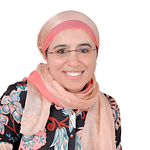
Maha Bali talks about intercultural learning on episode 124 of the Teaching in Higher Ed podcast.
By spending a lot of time with people who are different than yourself, you get to know yourself even better.
Maha Bali
On episode 124 of Teaching in Higher Ed
Voices on this Episode

Show Notes + Resources
- Maha’s PhD Thesis: Critical Thinking in Context: Practice at an American Liberal Arts University in Egypt
- Developing Intercultural Competence in Practice* by Michael Byram, Adam Nichols, and David Stevens
- The Outer Word and Inner Speech: Bakhtin, Vygotsky, and the Internalization of Language by Caryl Emerson
- Developmental Model of Intercultural Sensitivity by Milton J. Bennett
- Hannah and the Talking Tree by Elke Weiss
- The Lion Guard song: We Are the Same
- Homi K. Bhabha’s Third Space Theory
- Edward Said
Recommendations from this Episode

Transcript
Bonni: [00:00:00] Today on episode 124 of Teaching in Higher Ed, Maha Bali talks about intercultural learning.
Production Credit: [00:00:10] Produced by Innovate Learning, learning maximizing human potential.
Bonni: [00:00:18] Welcome to this episode of Teaching in Higher Ed. I am Bonni Stachowiak and this is the space where we explore the art and science of being more effective at facilitating learning. We also share ways to increase our personal productivity so we can have more peace in our lives which allows us to be even more present for our students.
Bonni: [00:00:47] I’m thrilled to be welcoming back to the show today Dr. Maha Bali. She Was on Episode 108 talking about collaboration. And today she’s going to be joining me talking about intercultural learning. She is an Associate Professor of Practice at the Center for Learning and Teaching at the American University in Cairo. She’s a full time faculty developer and she also teaches creative educational game design to undergrads. She is co-founder of virtuallyconnecting.org, cofounder and co-facilitator of Edcontexts, an editor at her favorite journal, Hybrid Pedagogy and blogger at Prof Hacker. She’s also International Director of Digital Pedagogy Lab. In a nutshell: she is a self-described learnaholic, writeaholic, and passionate open and connected educator. Welcome back to the show, Maha.
Maha: [00:01:49] Thank you. I’m so happy to be back talking to you.
Bonni: [00:01:52] You and I are funny on Twitter because I never calculate what time it is in Egypt, bit I do know that you’re known for late nights and early mornings and everything in between. But we got into some good Twitter conversation around the issue of intercultural learning. And I’m so glad that you were willing to come back on and talk a little bit about this.
Maha: [00:02:16] I’m really happy to be back. And this is one of my favorite topics. And like I was just telling you this morning, it’s been one of those- not this morning, like starting this morning until now, it’s 11:00 p.m. now- this has been the topic of the day so I’m really, really ready for it.
Bonni: [00:02:29] Oh good. Well you were so gracious to send me your thesis. And I was sharing with you that things have been a little busy in our household here. And so I literally could have just not just read the section of your thesis, but I wanted to read the whole entire thing. It’s fascinating. Would you just share a little bit about the broad thesis topic? And then the topic that we’re going to be sharing about today.
Maha: [00:02:55] Right. So my thesis in general is about the development of critical thinking for students at my institution. And what I did is I interviewed students who had some level of critical thinking based on what I knew from teaching them. And then whatever themes came out of there, I developed further by interviewing faculty and staff and reflecting on my own experiences and doing all kinds of other kinds of research.
Maha: [00:03:17] And I just came up with like four broad areas that developed critical thinking in the context of AUC, which is where I am. And one of the chapters is about intercultural learning. And that’s actually the last one I talk about because the institution I’m at is already bicultural, it’s an American institution in Egypt. So that’s already a bicultural institution just in its own identity.
Maha: [00:03:38] But there’s also a lot of opportunities for intercultural learning that students identified as helping them learn. And I just got really into it as I was doing part of my thesis, researching intercultural learning in a lot of depth.
Maha: [00:03:52] In itself, it’s very connected to critical thinking, but it’s also a thing on its own. And so I’m still fascinated by it until now. So I’m really happy to be talking about it with someone.
Bonni: [00:04:04] I have read a couple of books about critical thinking before, but by no means am an expert after the two books. I will say though- and actually we had a guest come on and talk about critical thinking. And it’s been one of the most popular episodes, so I know it’s something that a lot of us in higher ed want to help develop in our students. And, of course, we’ve had lots of conversations about diversity and about cultural competence.
Bonni: [00:04:30] But this is the first time it’s coming together. And for you it sounds like that was more second nature, but for me I thought “well of course these things do go together…” And that is some of the problem is when we have less maturity in our cultural competence, some of that is of course due to a lack of critical thinking but I hadn’t put it together like that so I’m so excited about today’s conversation.
Maha: [00:04:54] It’s a chicken and egg thing.
Bonni: [00:04:55] Yeah.
Maha: [00:04:56] As I was just telling you before, it’s like the more you’re exposed, the more critical you are. But then you need to be a little bit critical to allow yourself to be properly exposed, to be open to listening to different viewpoints and so on. We’ll talk about this a little bit more as we go.
Bonni: [00:05:11] Yeah I was mentioning to you how accessible the writing style was to me and how much I just dove right in. I thought it was going to have a harder time with it and started to get nervous. Like oh no, am I going to have enough time to prepare to make best use of your expertise on this. And I was excited just with how rich it is, but also how your writing just makes it accessible for all different types. You’re not trying to high brow it with making it inaccessible to people. I really appreciated that. And there were things that really stood out to me. I have it all printed out with all these highlights and stars and everything and I wanted to read just one quote.
Maha: [00:05:53] Oh! I got stars? Gold stars?
Bonni: [00:05:54] Well I only had a blue pen, so they are blue. Blue stars. I’m going to read this quote and then I know there’s one that really meant a lot to you as well. And this is from a 2001 source, Byram. And just so people know we’ll have all of the references that we refer to in the show notes so that people can access them and learn even more. And also of course to your thesis as well, if you’re open to that.
Maha: [00:06:24] Oh sure. It’s open access.
Bonni: [00:06:26] I thought so.
Bonni: [00:06:27] So here’s the quote: “It is not the purpose of teaching to try to change learners values, but to make them explicit and conscious in any evaluative response to others. There is none the less a fundamental values physician which acknowledges respect for human dignity and equality of human rights as the Democratic basis for social interaction.”
Bonni: [00:06:58] I love that it reminds me of when they talk about making sure there’s a diversity statement in your syllabus of some kind. And I think that’s my diversity statement that we can all express different points of views and I’m not going to try to tie you to your values. But there is just this whole idea of it does come down to human dignity and equality of human rights as the democratic basis for social interaction. I love that one. Thank you so much.
Maha: [00:07:24] And we were just talking earlier. For you, this is one of your favorite quotes. And I was saying my favorite quote is just one in the page before it. But I also get what you’re saying about the part about emphasizing sort of the purpose of why you’re doing it, the respect for human dignity equality and human rights as the purpose of why you’re doing it. But you don’t do it by trying to changing learner’s values, but by making them explicit.
Maha: [00:07:48] The one that I like more is a quote by Bakhtin, who’s a Russian scholar. It’s a 1961 quote. I have one of his books but I’ve never gotten around to reading it because it’s so hard to read. But the quote which I love is he says, “I am conscious of myself and become myself only while revealing myself for another, through another, and with the help of another.”
Maha: [00:08:13] And so if that one is maybe a more personal one and it talks about how you get to know yourself better as you interact with other people and as you interact with people- probably, it doesn’t say that- but I think also different from yourself who help you question, not necessarily by directly questioning you, but just by being different and by spending a lot of time with people who are different than yourself you start to sort of get to know yourself even better.
Maha: [00:08:40] And I was just talking to you just before we went on air about when you leave your culture and go to live somewhere else and how that helps you question your own values and what you have been taking for granted in your assumptions.
Maha: [00:08:54] It can be a very- obviously a stage of disequilibrium and it can be very disturbing, but it can also be very enriching and a great time for growth and development.
Bonni: [00:09:04] Talk a little bit more about that. What opportunities our students have to learn as they are exposed to a theory? And then some of the limitations of theory as it comes to our own innercultural learning.
Maha: [00:09:20] Right. The problem with being exposed to theory is that you have this distance from whatever it is you’re really about. And it’s so abstract that- or you get what it means in theory, but you don’t really get what it means to actually live it in practice, or to see it happening, or to interact with someone who has to deal with it.
Maha: [00:09:39] I mean thinking indignities I think of a certain kind. So for example, just today Paul Prinsloo shared on Twitter an article about what it means to travel with an African passport. And what happens to you in the airport. And the indignities of asking for a visa. And being refused entry to certain countries. And being placed in a certain place where- I think the guy called us, Africans he said “passport undesirables..?” I think something like that.
Bonni: [00:10:07] Yeah. Yeah.
Maha: [00:10:07] And yeah if you’re American or European, it’s very easy for you to get anywhere. And if you are Arab or African, it’s actually pretty difficult for you to get pretty much anywhere even nearby countries. Like people are just… And the thing is that I’ve heard Americans laugh or joke about maybe not being able to get into Egypt because they’re American. And it really makes me angry because it’s not funny.
Maha: [00:10:32] You really don’t have problems getting to this country. You know what I mean? But if you’ve seen the way someone like me gets randomly checked 50 percent of the time at an airport. If you’ve traveled with me often enough and you saw how often I get chosen a random check and you saw how the people… You know I mean if you see that, if you have a close enough relationship with someone who is like that. And you see it, it’s completely different than hearing about it. And it’s thinking like it just happens like every now and then. Or maybe it’s just that one person’s experience. You know what I mean?
Bonni: [00:11:04] Yeah. And of course, even if I did travel often with you and I was able to observe that happening to you it still is not the same thing as it happening to me.
Maha: [00:11:14] Right. Right. And I was thinking of people who are very very close relationships to someone of a different culture, like they’re married to someone from a different culture, for example. They’re obviously- well there are two things. They had to be originally culturally sensitive in some way to be open to having that kind of relationship with someone so different from them. Right.
Maha: [00:11:32] But also, they develop it more by their interaction with that person and their family and so on. And then when they have children, then it becomes even a bigger issue. And they’re still who they are. They’re still not that person, but they have a better experience of that different culture than they had been just themselves marrying someone of a very similar culture.
Maha: [00:11:52] And I think maybe that what I’m going to say now is probably not necessarily in the part you were reading but, there’s this thing about people who immigrate to a new country and whether they assimilate or integrate or do something different.
Maha: [00:12:06] And so whether they assimilate and just become like the new culture, or whether they separate and remain like try to hold onto their own culture and whether they try to find something something in between where they can maintain elements of their own identity, but still be able to interact well with others.
Maha: [00:12:23] And that’s talking about people who are immigrants going into another place. But also it’s really important to think about us and how we welcome new people into our own culture. Whether it’s even your company or your department, not necessarily your entire country. And whether we’re asking them to be more exactly like us if they want to fit in. Do they have to have whatever kind of values we have to be able to interact with us? Or do we encourage them to remain their own selves? Or do we give them away to stay with them themselves, but still integrate with us.
Bonni: [00:12:59] Yeah. One of the things you talk about is the impact of intercultural experiences on student’s critical thinking. And through some of the interviews that you did how it helped them recognize and understand different world views. And then the next thing you said was recognize their own personal biases. One of the things I think can be a challenge is when- if we’re doing this ourselves, reading about other people’s experiences or, as you said, sharing the theory with our students that so often it can just sound like we’re talking about somebody else.
Bonni: [00:13:38] “Oh those people that have those biases, well shame on them. If only we’d stop having those biases.” And maybe this actually starts to put us on the part of the conversation about this being a continuum because I first have to recognize that I have biases that it is not just those other people that do, but that they are in me. And that I can probably never rid myself of them completely. And in fact, some of our biases actually help us stay safe. I mean that’s how we’ve been able to survive through generations. But that that is a part of the process is to recognize “oh I have these biases.” And I thought that was a nice way. Do you want to talk a little bit now about the continuum that it’s not just binary?
Maha: [00:14:24] I mean the first one of just thinking between the difference between theory and practice. I was thinking that maybe the King and Baxter Magolda model – it’s called the Developmental Model of Intercultural Maturity. And what I like about it is that it’s not just a spectrum, but it’s also multi-dimensional. So it talks about a cognitive aspect, an intrapersonal (so a metacognitive aspect), and an interpersonal aspect.
Maha: [00:14:44] And the thing is if you just read about the theory, then maybe you’re developing your cognitive aspect of it. Like just sort of knowing that there are different world views out there and understanding the history of them or whatever. But just knowing them doesn’t mean that when you come to interact with someone who’s different from yourself that you’re necessarily going to be able to do it well. Just knowing something doesn’t mean that you’re not going to say something stupid to someone or something insensitive when you’re dealing with them.
Maha: [00:15:13] And then there’s also the metacognitive dimension which is questioning yourself. And I think again learning theory doesn’t necessarily make you question your biases in the same way that engaging with another other person may challenge your viewpoint.
Bonni: [00:15:27] Yeah.
Maha: [00:15:28] Because you have a lot of choice over how deeply to question yourself if there isn’t a person in front of you who’s really urgently asking you to do that or making you do that. Or that you need to change your behavior like right now if you need to and go back and think about why you’re doing it. But even within each of these there’s a spectrum of how far you can be in each of these.
Maha: [00:15:50] So for example, sometimes when you’re first exposed to something- I can’t remember which model does that- But they say sometimes when you’re first exposed to something, you get this exoticism of something else can make you at first either really really impressed or really really resistant to learning the other thing.
Maha: [00:16:06] And eventually you start to sort of see the different dimensions of it. So for example, there was a student of mine who did an internship in the US for maybe a month or two. And she came back so impressed that everything in the state is well. And they’re so nice. And they’re so open. And they’re so open to diversity and so on.
Maha: [00:16:24] And I lived in the States for a whole year and I didn’t face a lot of discrimination in Houston. I was just talking to someone about this today that in Houston Texas everyone told me to expect a lot of discrimination. And there wasn’t a lot of it, but there was a little bit of it. And to say that “oh everything was well,” it’s just because you had a short experience there.
Maha: [00:16:43] But then you need to be really really trying to look a lot more closely and engage a lot more deeply with another culture to start seeing it in all of from different angles and not just see the part that’s really impressive or just see the part that’s really making you resistant.
Maha: [00:16:59] So just a very quick one about the resistance. For example, the first time- I only had this once actually- but the first time I had a student come to my class who had her face covered. It used to be not allowed on my campus, but for some reason they allowed it. And so I had a student whose face was covered, I couldn’t see her face at all.
Maha: [00:17:17] And my first impression was like “oh my God how am I going to deal with this person? And how am I going to know what she’s thinking? And how is she going to respond to my class?” I was very resistant to it.
Maha: [00:17:26] But then with interacting with her over a long period of time, I just started to see her as a full person, the whole person with all the different angles to her. I learned how to deal with her even though I could not see her face and to sort of know what she’s feeling and thinking.
Maha: [00:17:41] And you think this is not really possible, but it is. You can tell a lot by just a person’s eyes and their posture and all that. And so I think the point is though that you need deep, sustained interaction with the person or a group of people to be able to understand that culture. It’s not something that just getting exposed to for a very short period of time when you’re traveling on a trip that you could do that. I mean you can be on a trip and do all the touristy things and not learn anything. Or you can try to engage deeply with people in public transportation or you could try to engage deeply with even the people at your hotel because you can see them every day. It’s not going to be just like on a bus trip.
Maha: [00:18:22] But you can also try to maintain relationships with people different from yourself online and even though you’re not living their lives, you get to know a lot about them. And I know a lot about a lot of other people but I only met online just by this sustained interaction. They know when it’s Ramadan here and they know why my sleep was like that for that month.
Bonni: [00:18:43] I was familiar with Ramadan before, but there was another holiday that recently happened that you made me familiar with. Of course now I can’t think what it was, but I looked it up to have a better appreciation for your culture. Yeah that’s always helpful. It’s amazing what we can find out about each other.
Bonni: [00:19:01] I was going to mention a children’s book. I bought a book called Hannah and the Taking Tree. It’s about a young girl who has a really really big ears and they all make fun of her. And she is very lonely. And she goes out into nature and feels alone and she meets a tree. And the tree is also very lonely because the tree’s friends have all been chopped down. And so the tree starts to tell her the stories of- and because she has such large ears, she’s able to hear the tree’s voice and stories.
Bonni: [00:19:40] And the tree says because you understand me and you have heard my stories, you can be the one to go back into the city and tell the other people what’s happening so they can help rescue me. And bring friends. And she goes back and tells the story to the mayor and the different townspeople. And as they listen, their ears get bigger too.
Bonni: [00:20:02] As you were talking, it sort of reminded me of that because you sort of think like “oh either they’ll start making fun of her for having big ears and everyone will live happily ever after or…” You know. But I didn’t expect that the end of that story would be that everyone else also got those same large ears. They’re better able to hear. Better to empathize.
Maha: [00:20:18] You know what I like about that story is that is a reversal of standards. It makes big ears a good thing.
Bonni: [00:20:25] Yes.
Maha: [00:20:26] Right. Oh I love that story.
Bonni: [00:20:28] And I only found it because our daughter’s name is Hannah. And so I had been on Amazon just looking at books that have the word Hannah in the title and I happened upon it. It’s a really great book. Yeah.
Bonni: [00:20:40] Talk a little bit about these stages- you started to wind us through them- but one of them is the issue of minimizing and trivializing the others. You talk a little bit about that phase.
Maha: [00:20:53] So so this is the [Dr. Milton Bennett] Model right? And it’s called the Developmental Model of Intercultural Sensitivity. And so this is similar to what I was saying earlier which is there’s the part where there’s a reversal where you’re very impressed or whenever. There’s a part where you’re defensive about your own culture versus others.
Maha: [00:21:11] And then there’s this part where you minimize the differences between different cultures and just romanticize the other as “we’re all human” and all of that. Which is a good stage to be. I mean it’s better than looking at the other person as an alien, right.
Bonni: [00:21:23] Yeah.
Maha: [00:21:24] That’s why we’re saying it’s a spectrum and there is a stage where that’s the case, and it’s not bad. I mean there’s a song in The Lion Guard, it’s called Sisi Ni Sawa. I’m not sure what language that is, some African language that they’re tokenizing, I guess. But it means we’re the same.
Maha: [00:21:42] And it’s about lions and hyenas saying they’re the same. Even though lions and hyenas are known in nature not to really be good friends, but that they’re actually the same in a lot of things. And they are, but they are also different in a lot of things.
Maha: [00:21:53] And so this model has ethnocentric stages and ethnorelative stages. And as you move into the ethnorelative stages you start to accept that there are multiple viable world views. And that’s the point. It’s just not to know that there are different world views and that’s it, but to respect that these are all viable. That there are these different ways of seeing something. And then possibly incorporating some of these different world views in your own thinking and behavior.
Maha: [00:22:20] And then finally integration, where you become able to move between different cultures and worldviews. And two people who are really good at representing that is someone called Homi Bhabha who writes about the notion of Cultural Hybridity in Third Space. And he talks about how in a lot of colonial cultures that they’re thinking about the “pure” pre-colonial Egyptian or Indian or whatever. But actually none of us are pure in that way. And we’re all cultural hybrids. And then when I interact with you, we’re meeting somewhere in between my culture and yours that we sort of meet somewhere in between that we can both use.
Maha: [00:22:57] So I have to speak in English for you to understand me. And when I speak in English, I express myself in a certain way. But you’re also coming one step, maybe I’m taking 10 steps to get to you and you’re taking one step towards me, but we’re still meeting somewhere. That’s not your culture or mine, but somewhere in between them. And so he says each of us is a hybrid, but also we meet in between our cultures.
Maha: [00:23:18] And Edward Said is someone who, I don’t know if he’s very- I mean he’s most known for his work on Orientalism, but he’s done a lot more than just that. But he talks about the notion of world travelers and about if you’re educated well enough and exposed well enough to different cultures, you’re able to act as a free agent in all these different cultures and be that different person.
Maha: [00:23:43] And he himself, he’s a Palestinian, a Christian Palestinian, who grew up in Egypt and then went to the U.S. And he has all these different dimensions to his own identity. And he belongs in all of them. He doesn’t belong to one. Because when you’re that kind of very hybrid person, you don’t actually belong to any of them in any pure sense.
Maha: [00:24:03] And being that, I think a lot of definitely people who intermarry or people who live for a long time in a culture different than their own become like that. And they’re a third culture or a fourth culture or whatever. Not necessarily something to aspire to if you’re not in a situation where you can develop it.
Maha: [00:24:20] But I think definitely helpful to be able to sort of try to at least incorporate some different worldviews. I find it very interesting when a Western person has very very- I don’t know, Buddhist values or something that you would normally expect to find in a Western person. Like just today I was pretty angry at something and I wrote a blog post. And someone responded to that blog post. And I think she’s just English. She looks just English. I mean I don’t know her very well, but she’s English. And she shared with me something writte by a Vietnamese woman whose name I don’t know how to pronounce properly, but I’ll put that in show notes as one of the recommendations.
Maha: [00:25:04] And she’s a Vietnamese woman and she has a book called Woman Native Other. And she’s trying to describe herself that way. And the thing is that the person who wrote that read her book and she’s influenced by her and everything, but she’s just a white English woman. I was not expecting that person to give me that reference. And that reference represented how I was feeling about myself. As you know Egyptian, Muslim, other. That was how I was feeling in that post and she felt that. And she made that connection and she gave it to me. And so that sort of made me feel like she has a lot of intercultural sensitivity in doing that. And that she got from reading. So that was interesting.
Bonni: [00:25:49] It’s so nice when we can find someone else that can give something a voice that we have been feeling. Let’s talk a little bit more about the classroom because of course it sounds like both you and I are in full agreement how rich it can be for our students to get a deep dive into intercultural experiences where they actually travel to another place and have that sense of loneliness, but also the opportunity for learning that that they can embrace.
Bonni: [00:26:17] What about right here in our classrooms? Because we’re not traveling too far to get to them. How do we increase those opportunities and think about moving people along this continuum from wherever they are, just moving them along a little bit?
Maha: [00:26:34] So the first question is of course not all campuses are the same. So some campuses will have more diversity in the classroom than others. In my campus, for example, you’re not going to find international students in your mechanical engineering class. And also not a professor who wants to talk about that kind of thing.
Maha: [00:26:52] But you find a few in other contexts. But in some campuses you’ll find people look like they’re all the same, but they might have different histories or come from- you know in America especially you have a lot of people who are immigrants from wherever. But even in Egypt, you’ll find people who have lived somewhere else.
Maha: [00:27:10] Like trying to bring out whatever elements of difference we have in the class and trying to see if people are willing to talk about that and bring that up and make it part of our identity. Like one of the things I do in my classes is ask my students to do an alternative CV at the beginning with class. This is an activity we developed for digital writing month. And it’s about presenting yourself, not with what degrees you have or whatever that you do for regular CV, but how you want people to know you. And I don’t specify what students need to say. And some of them say a lot of really interesting things about themselves and reveal those things about themselves and it makes a difference in the class.
Maha: [00:27:49] But the thing is what if your students don’t reveal a lot about themselves personally? Or they’re not willing to? They’re not racially diverse, they’re not culturally very diverse, that happens sometimes. And then the thing to do then is to figure out ways of going outside beyond the classroom even when you’re in that class. So I have my students do some things on Twitter. Now how deeply you can engage will depend on what kind of course you have and how much time you can get into it.
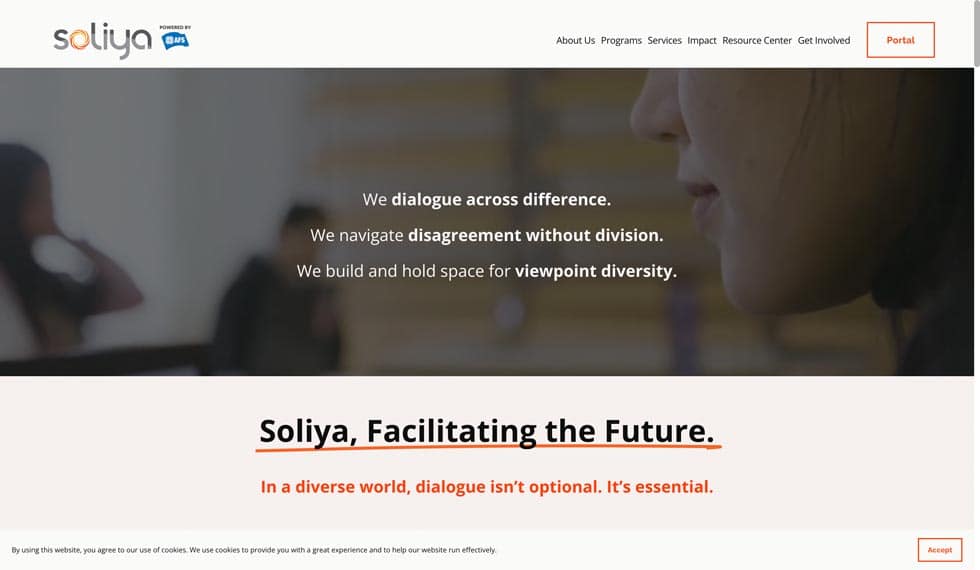
Maha: [00:28:15] There is a program called Soliya, which I first volunteered with, I facilitated, I coached facilitators. And it’s pretty simple to sort of integrate it into your class if you’re interested. And that’s one of the things I’ll put in the show notes as well.
Maha: [00:28:29] What they do is that they bring a group of eight students four of them from Western countries and four of them from Arab Muslim countries. And they bring them into intercultural dialogue about that relationship between East and West, or Arab/Muslim and West America. And they problematize all of that.
Maha: [00:28:50] They have facilitators from both sides of the world to sort of balance that out and they recognize that there are power differences that connect in that context. They recognize that there is differences in technology and infrastructure between people from both sides. So if there are people in rural areas of the Arab world, their internet connection is going to be weaker. They recgonize that the use of English is always going to privilege some people over others. But they still try to bring that explicitly and talk about it and bring students and help them over a period of several weeks understand their own biases and understand “the other” slowly. And this can be integrated into any course.
Maha: [00:29:26] And I’m mentioning this specifically because this is something that if other people are interested in they can go ahead and contact Soliya and try to have their own courses. If it fits their learning outcomes, you could do it with political science or international relations course but you could do it with a mass comm journalism type of course because they discuss media. You can do all kinds of things with this.
Maha: [00:29:44] So I just want to share something else which is culturally relevant pedagogy. I’m not sure if this is a familiar term to a lot of people and I’ll share again some resources at the end of the podcast. It’s all about how do you ensure that whatever group of students you have in the class that what you do in the class is culturally relevant to them.
Maha: [00:30:05] And it usually comes from race theory and that kind of thing. But also, it applies to a lot of intercultural learning too. Because if you’re in a classroom and there is diversity in the classroom, then just simply by addressing all the different cultures in the classroom in your readings, in your pedagogy, and in your choice of topics, rather than having them all Eurocentric or right western centric type of thing.
Maha: [00:30:31] How aware people are how diverse they’re syallbi are. Are all your students finding themselves as possible scholars in that field if they choose to be? And this is what I’m remembering by Annemarie Perez just before we were talking, is that she was talking about the experience of being the only lonely. Or something like that. In a conference where being the only person of a certain culture or color in a certain location that makes you feel. You don’t want your students to feel that way. Right.
Maha: [00:31:04] So you don’t want your students in your classroom to feel like they’re studying chemistry. Even if it’s chemistry. So this is like not a very cultural type of thing. But I always feel like if we’re studying chemistry in an introduction classroom, everything we talk about in chemistry comes from the west. We never mentioned any Arab or Muslim or Egyptian contribution to the field at all.
Maha: [00:31:31] That makes the students feel alienated from that field in some ways. If we discuss biology and we discuss issues of things like stem cell research, which isn’t really done over here. We don’t discuss things like organ transplants, which is a big ethical issue here. You know what I mean? It’s just like how you choose all of the content and the authors and everything you choose your class.
Maha: [00:31:58] And the way to do this culturally relevant pedagogy if you yourself are very culturally different from your students I think is to ask the students, ask the parents, ask other faculty in your institution who are of different cultures to help you.
Bonni: [00:32:11] Yeah.
Maha: [00:32:11] Don’t Assume that you are on your own, you’re not. Like no matter who you are, no matter how many different cultures you belong to, those are the only cultures you belong to. Right. Like if someone is American and they’re married to an Indian, sure they know about these two cultures. They don’t know anything about Swedish culture. They don’t know anything about Mexican culture.
Bonni: [00:32:29] Yeah.
Maha: [00:32:30] And your material is just going to keep getting richer if you just keep adding and opening yourself to allowing all of that to come. And everyone I think benefits in some way. It’s not easy, it’s hard. And it might be difficult for you as the teacher to incorporate because it is going to be unfamiliar stuff. And it might feel like it’s irrelevant, but I really think it makes a big difference to students.
Maha: [00:32:51] Like when I teach educational game design, I make sure that my students read stuff by Egyptian people who write about educational game design. And I make sure that they find Arab created games. That really makes a difference to them because it makes them feel like maybe someday I could be a game designer. Even though we don’t have the major. It’s just one part of one course that I teach. But it’s just sort of to bring that a little bit closer which is a little bit away from intercultural learning but it’s also I think important.
Bonni: [00:33:22] You and I knew that we would before we even pressed record, we honed in but we knew that we would get off track in the best ways possible. This is the time in this show where we normally each get to share recommendations.
Bonni: [00:33:36] But since I shared with you that I hadn’t come up with what mine was going to be yet you volunteered to take my recommendation segment. And so you’re going to give us a double hitter. The floor is yours.
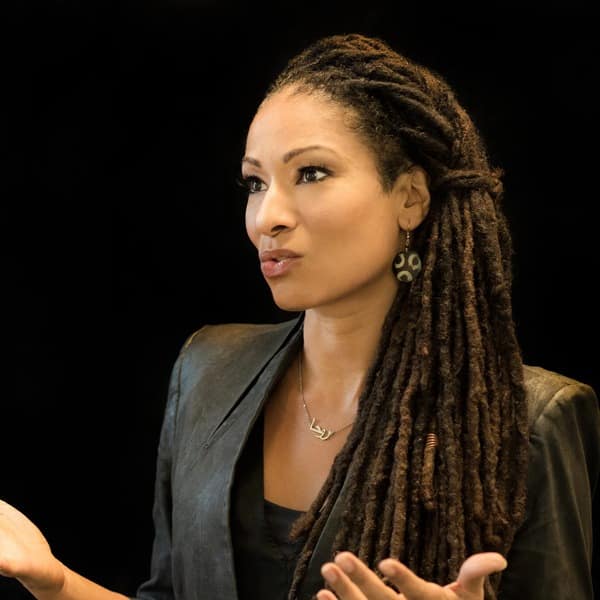
Maha: [00:33:46] Yes. So one is something that we’ve been talking about. I fell in love with this professor, I guess she’s an assistant professor, Ruha Benjamin at Princeton who gave the keynote at the ISTE conference this year and she’s phenomenal. And in that one hour keynote she talks about maybe 20 really, really, really strong points. She’s a great presenter. And one of the things that really stood out for me was how she talked about discriminatory design. She’s got a Ted Talk about that as well. But I like her her hour long keynote a lot more. And it made me think a lot. And everyone I think who’s listened to it has been really really affected by it. I think I’ve listened to it like two or three times now. And I pause and it makes me think. It’s definitely worth thinking about and listening to. And you’ll really thank me for this one.
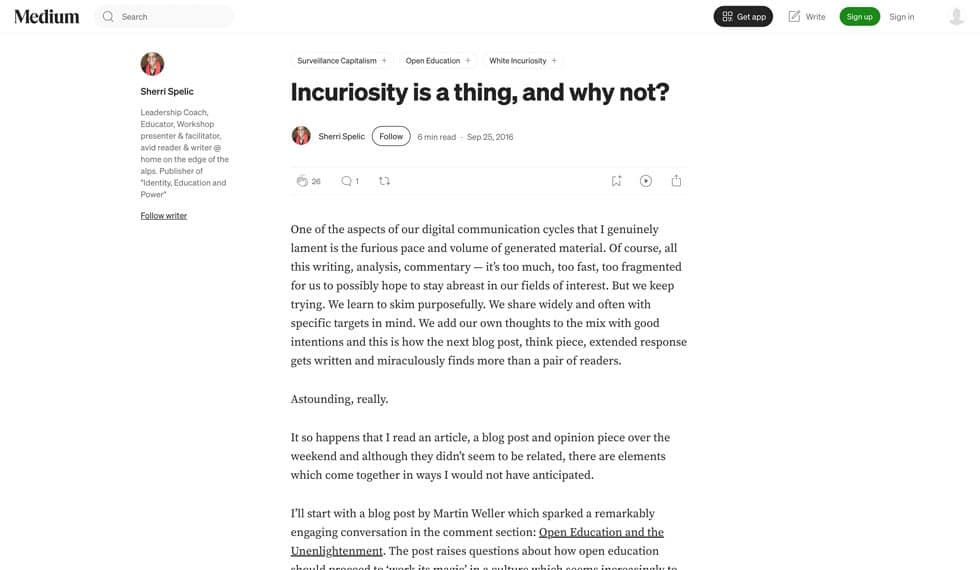
Maha: [00:34:36] There’s also a blog post by Sherri Spelic. It’s called Incuriosity is a thing, and why not? Again it’s relevant to what we were talking about today about intercultural learning and whether a we are sort of raised not to be curious about things to just to let them be and how that affects our interaction with each other. And thus that’s worth reading.
Maha: [00:35:07] And then the third thing I wanted to recommend is Soliya, which is the program I’ve been talking about. There’s a lot of kinds of intercultural exchange programs, but I know for example that it’s quite difficult for students to- you know, you can have every single student do an exchange program.
Maha: [00:35:23] And so this thing is a low risk, low cost way to start building intercultural maturity that will I think help a lot of people if they later trouble somewhere else. But even if they never do, they can build relationships with people from different parts of the world and just start doing something about it and make use of the Internet that we’ve already got.
Maha: [00:35:45] And then the very last thing is just I would recommend reading about culturally relevant pedagogy and I’ll provide resources on that as well as about morals of intercultural maturity.
Bonni: [00:35:56] You are so generous with your time both for this podcast community, but also to me personally. I just treasure when we get a chance to go back and forth. You continue to challenge me and challenge others in such a positive encouraging way.
Bonni: [00:36:11] It’s interesting thinking of you as a teacher that you challenge your students and I consider myself one of them and say “you can do better,” but yet you’re also encouraging us all the way along and giving us resources and support to continue our own development. So thank you so much for today and for always.
Maha: [00:36:29] And you do this for a lot of us too, Bonni. So thank you for your- I love having these conversations with you. And I learn a lot by just being with you. So thank you.
Bonni: [00:36:41] Thanks to all of you for listening to today’s conversation. As always if you have feedback on the show get potential guests or topics you can do that at teachinginhighered.com/feedback.
Bonni: [00:36:54] And if you have yet to subscribe to the weekly e-mail, that’ll come into your inbox and it’ll give you the show notes of all of the great resources, especially this week, it’s going to be packed. It’s going to be a packed set of show notes. You’re definitely going to want to get.
Bonni: [00:37:07] And also an article about teaching or productivity written by me. You can subscribe at teachinginhighered.com/subscribe. And I so appreciate all the conversation that’s happening in the Teaching in Higher Ed Slack channel. And if any of you are on Slack or want to try it out, it’s a great place just to have a little bit more privacy for asking questions that you don’t want in a public space. And it’s a great community. So thanks for listening and I’ll see you next time.
Teaching in Higher Ed transcripts are created using a combination of an automated transcription service and human beings. This text likely will not represent the precise, word-for-word conversation that was had. The accuracy of the transcripts will vary. The authoritative record of the Teaching in Higher Ed podcasts is contained in the audio file.