Follow the Teaching in Higher Ed Podcast
About this Episode
David Rhoads and Bonni Stachowiak revisit the topic of hyflex learning on episode 478 of the Teaching in Higher Ed podcast.
Hyflex in general is a choice between in person and synchronous, or in person and asynchronous, or a choice of all three of those things.
David Rhoads
On episode 478 of Teaching in Higher Ed
Voices on this Episode


Show Notes + Resources
Recommendations from this Episode

Idea
Provide structure; Leave room for emergence
Article
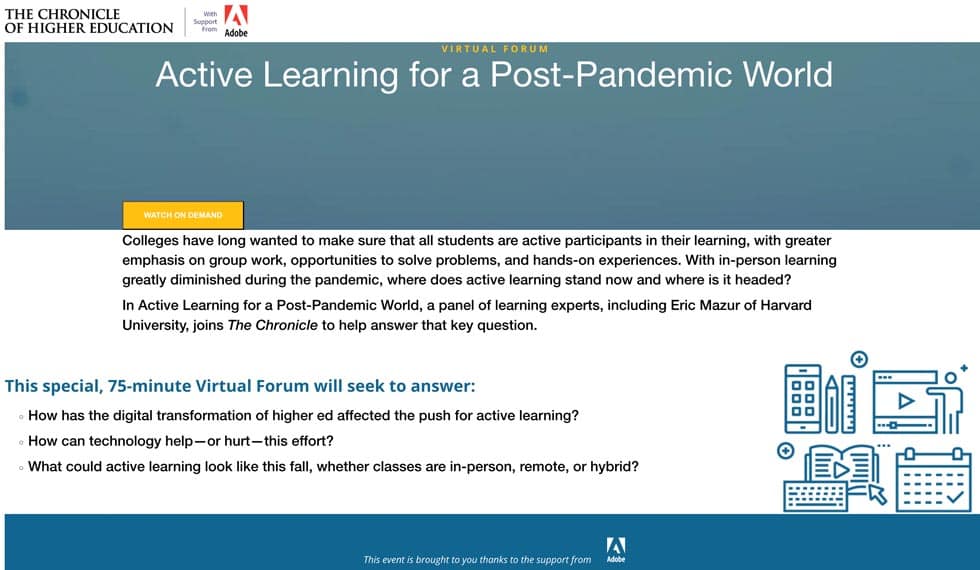
Active Learning for a Post-Pandemic World
Resource
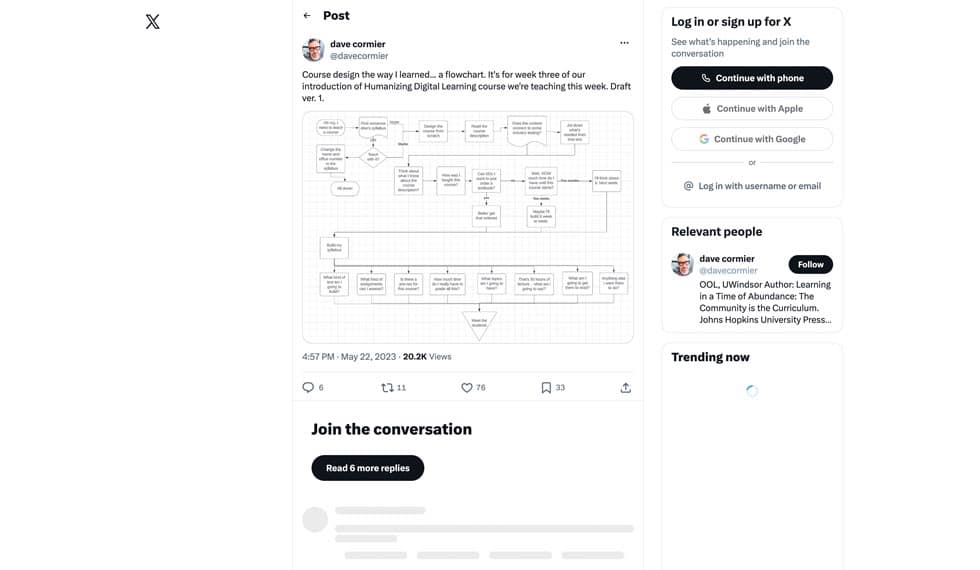
Dave Cormier’s Flowchart Tweet
Resource
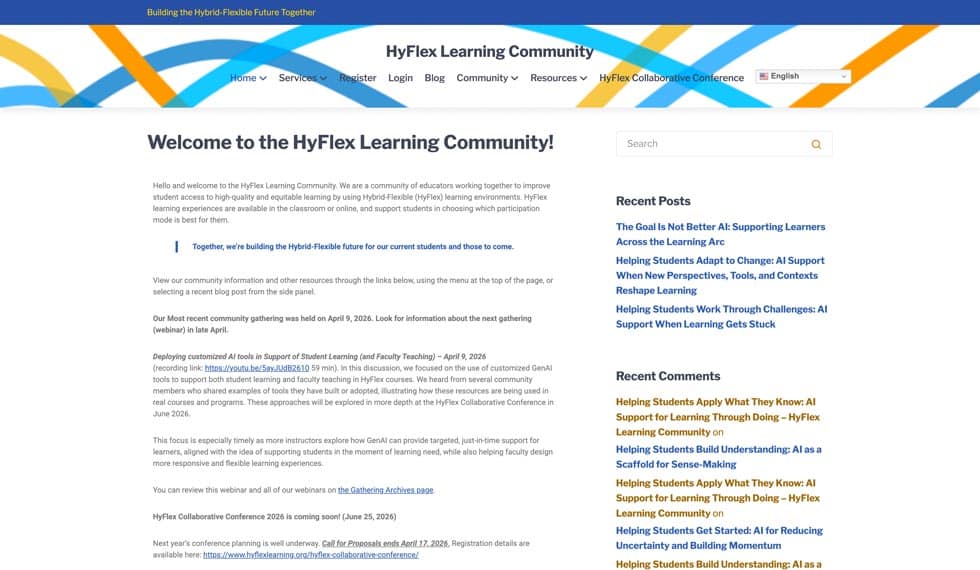
HyFlex Learning

Movie/TV
Happy Valley
Transcript
Bonni Stachowiak [00:00:00]:
Today, on episode number 478 of the Teaching in Higher Ed podcast, Hyflex revisited with David Rhodes. Welcome to this episode of Teaching in Higher Ed. I’m Bonnie Stachowiak, and this is the space where we explore the art and science of being more effective at facilitating learning. We also share ways to improve our productivity approaches so we can have more peace in our lives and be even more present for our students. David Rhodes has been teaching in the areas of leadership and educational technology for over a decade. He enjoys helping faculty do what they do best, by equipping them with solutions and effective practices for their classroom. David has extensive experience in the areas of online pedagogy and program development, Bonni traditional enrollment and support, instructional design, and educational technology. David’s background prior to working in higher education includes teaching at the high school level as well as 12 years of youth and young adult ministry. David is passionate about helping faculty maximize face to face and online learning opportunities so their students can gain the most benefit from their instruction. He believes that our goal as educators should be to facilitate learning in such a way that encourages and equips students to be passionate, lifelong learners. And you might want to know before the interview begins that David Rhodes and I, our colleagues, And it’s great to have these opportunities to collaborate and learn and teach together.
David Rhoads [00:01:50]:
David, welcome back to Teaching in Higher Ed. Thanks for having me. I’m excited to have this conversation.
Bonni Stachowiak [00:01:56]:
As of yesterday in this recording, which we won’t even mention when that was, The episode that was your first time on Teaching in Higher Ed about Hyflex learning is the 2nd most listened to of all time. So, David, talk a little bit about what was. Take us back to you. You were on the podcast in May of 2020. And again, in September of 2020, these, were obviously conversations of great import
David Rhoads [00:02:24]:
to people what was going on back then in terms of why this was such an important thing for us to be talking about? I think that if anyone has forgotten already, what was actually happening during that time, then we may need to be speaking to someone or trying to figure out that type of trauma that was happening to all of us across the world was making us go to the drawing board and trying to figure out what to do to reach students in that particular case. So it was the very long time debate of does online education work well to have students be learning but it was it was actually forced upon faculty in general in the sense of the pandemic putting us in a situation where we had to reach out to students in different ways that we weren’t unable to do well before. And that kinda threw through us kinda in front of let’s let’s look at the research. Let’s look at how we can Rhoads students that are not right in front of us inside of a classroom. So professors were looking to podcasts, and they were looking to the literature. I’m trying to figure out how can I reach my students in in different ways that maybe they have not done before. And for myself, that was it wasn’t a pandemic. The reason that I went to Hyflex, but it was a I I needed to figure out how to combine programs together in online program in a in a in person face to face program together to make it more efficient to fill seats for enrollment for that purpose, but the pandemic wasn’t it was a whole different prompting where faculty looked to just find more tools, and then it was like a just in time type of training and looking and researching,
Bonni Stachowiak [00:04:03]:
and that was kind of kind of the pressure was on to be able to find solutions to reach our students. I still think it is absolutely remarkable that you picked a topic like that for your dissertation and then what that speaks to today. you and I met when you were actually a student in a class that I taught technology and leadership and systems thinking and it was so fun to know you back then and then who would have ever they even thought we would ever work together, let alone, be in this adventure. And you might in trauma. I mean, I think that’s a really, really big thing that’s important for us to be talking about individual and collective traumas that we’re adding up to certainly not the best learning environment to completely demolish and destroy what for many people was not only a set of skills, but also an identity, a deeply rooted identity of what it means to teach and to learn and to attempt to make meaning out of either one of those things real and do that in a very, experiencing such a a lot of trauma like we talked about. I think that’s an important word to have in there. So now we get to fast forward a little bit more to current days. So we looked at what was. Let’s look now, David, at what is what is Hyflex and how has the discourse about it changed in these few years that have taken place since then?
David Rhoads [00:05:27]:
So Hyflex in general is a combination of terms, hybrid and flexible, and we’re all familiar with what a hybrid class is. We’ve heard blended and hybrid but in the case of hybrid flexible, it is defined as giving students choice of how they are to participate in the learning in multiple ways, and it would have to be at least two ways. So high flex in general is a choice between in person and synchronous or in person and asynchronous or a choice of all three of those things. So going into the pandemic, the in person choice was taken away, but the definition still remains the same. You have to have student choice. You have to have flexibility And students definitely needed flexibility then and need flexibility now.
Bonni Stachowiak [00:06:17]:
You, as I mentioned, came on the podcast 2 times. You talked about Hyflex, and then you about some of the myths and misconceptions around Hyflex for the second episode that you were on. I also aired an episode because we were starting to see as colleagues, the ways in which really the weakest point for a lot of people really turned out to be designing engaging and effective asynchronous options for people. And so I talked all about, you know, I was teaching a a online synchronous attendance option. I had designed it that way, but really the backbone of the course were these asynchronous things. And so you I I use this expression of backing into the synchronous because that has always been the easiest one for me. And the harder one to design well is highly engaging vibrant asynchronous activities And so somebody wrote to me, oh, it’s not my most pleasant favorite email I ever got. And this guy’s like, who are you? You don’t get to side what Hyflex learning is. By the way, I’m putting a tone of voice in an email that I read. He did not include an audio file of himself, but it was like, you don’t get to define what Hyflex is because I was explaining of these 3 options that you just listed, David, synchronous, in a classroom Bonni campus, synchronous online via something like a zoom, and then asynchronous. Those are 3 different choices how someone might participate in the attendance component of a class that we have recommended and and executed on in our own course designs, trying to do 2 of those 3 things well. versus trying to do 3 of those things. And this individual who wrote to me did not think that I was allowed to decide that Hyflex learning means me doing 2 of those. So that that would be something else entirely. So does the definition of Hyflex learning allow for me It’s an educator. Sorry. I’m being a little sarcastic here. if you’re still listening, listener, thank you for listening and for your provoking email. So I’ll I’ll stop talking now and let David answer the question about how flexible is this definition of Hyflex learning?
David Rhoads [00:08:37]:
I guess it really just depends on the standard by which we’re where we’re going back to for myself and for the majority of research on HiFlex. from about 2006 is Doctor Brian Beatty from San Francisco State, and his definition included the in person the synchronous and the asynchronous, but he was a little bit more flexible on the asynchronous at the beginning of his research because, of course, We know that we want to build that asynchronous out, but it’s not always possible. So you have that in person and you have that synchronous. But as he went further in his own classes, he saw hate synchronous as a really integral part of of what Hyflex is. And at at no point was it defined as you must have 3 choices, but it is it has been defined as choice from week to week session to session. So that’s one of the non negotiables is if you take away the choice, In any way, if you build your class out and you say your students must be there in residence, in person, or lock them into a synchronous session at a certain time, on a certain date, then that that wouldn’t be Hyflex. Hyflex is that choice of at least 2 choices. and it could be up to 3 choices in the cases of synchronous in person and asynchronous. Yeah. It just really just really depends on what definition we’re going back to. and some people would call the 2 choice, the co modal or bimodal or things like that, but it is still a hybrid flexible class if students a choice each session. Each time you offer them that in person or that synchronous session. So it’s it it it just really depends on and what word setting as the standard of what Hyflex is. Some would actually say that it’s not Hyflex unless it’s inside of a Hyflex classroom. where you have cameras in it, there’s not only a simulcast, but there’s interaction. And they call Hyflex classes sometimes just streaming to a student and then having an in person session, and that wouldn’t even be Hyflex. That’s not really a choice. It’s more like I’m watching learning happening. I’m watching a learning experience in the company. So there could be different little versions that would go outside of the definition of pipelines, but most certainly, an asynchronous online class with an in person or asynchronous session is still to be defined as Hyflex. What we get into, though, is through the pandemic, there has been much discussion if we take the in person away. and you have a choice between synchronous and asynchronous is that Hyflex. From the beginning of the definition when Brian Beatty’s work, That was not Hyflex until the pandemic happened. And we, as a group of researchers, as a group of practitioners, have discussed this over the last 2 years and have come to the conclusion, this 2 choice, even if you don’t have the in person, could also be called Hyflex. And at our institution, we just defined it a little bit differently. We have we have Flexview Campus and Flexview Virtual which kinda distinguishes between the 2 and doesn’t even use the word high flex. So if you’d kinda change the name of it, and it’s like, it was not Hyflex. Well, it’s kind of our version of Hyflex at our institution. So there’s multiple ways that people have approached that, and some people have just renamed it. just as long as you’re very clear to the student of what choices they have. The if if you take away choice, it’s not Hyflex or highly flexible.
Bonni Stachowiak [00:12:09]:
And to elevate this beyond our institution in a recent publication from EduCause, which I’ll post a link to in the show notes, This lack of a consistent definition is certainly emblematic of Hyflex learning. You’re seeing a lot of different institutions define it in I don’t wanna say a lot of different ways, but but there is not as precise of a definition for it as there are other things that have existed in the ways in which we teach and learn in institutions for higher learning, So we’ve looked at maybe some of how the definitions have differences depending Bonni, and and you mentioned how those definitions got significantly different with the dawning of a global pandemic. Talk a bit about how the definition for you has changed. So we look at some of the researchers that you collaborate with. What have you seen as growing in importance, or maybe you you think differently about it today than you did back when we first spoke in about this publicly in, May September of 2020.
David Rhoads [00:13:19]:
I think the big thing for me in my own practice, both this my institution and at institutions that I consult with and talk with and kinda help plan with is the difference between designing for flexibility and teaching for flexibility? Hyflex is always it it’s gonna remain the same just like I was talking about. You made that transition to, I believe, but it is Hyflex. If you have a choice between asynchronous, and synchronous now, and we, as a group, did not believe that before, but the situation has has changed. But how I’ve approached faculty in discussing designing of a class does not necessarily mean that does that you have you have designed this class, it has to be taught with 100% flexibility. If it’s not taught with 100% flexibility, then I wouldn’t consider it Hyflex, but innately within the class itself, if you design with that 100% flexibility in mind, that then you have the choice as a professor, as an administrator as what whatever the case may be as a chair to go. You know what? We are this class is totally appropriate for 100% flexibility, and you can make that choice if it’s designed in such a way. So it’s not really a definition. It’s more like it’s more approach. of actually speaking to faculty, encouraging them to build it with the most flexibility they can the very beginning, even if they think they’re going to deliver it with some residency requirements. And then they would then have the choice to to move toward more flexibility for their students, and it actually gets them to be thinking about how would I reach certain learning outcomes, learning objectives, in such a way through even in in the majority of cases, the most challenging for professors is this asynchronous environment. And they designed those class kind of participation, attendance, activities to be asynchronous, and then go, okay. Now now that we’ve met learning objectives this way, would I do it inside the classroom? And even for for your work inside the classroom that you kind of have spoken to me about is just the fact that that’s built gives you an opportunity to look at that and go, you know what? We’re gonna use this exactly like it’s designed, or I’m gonna I’m gonna point to this while I’m inside the classroom. I I really appreciate your approach. And the only reason that you’re able to do that is because you had that time. It took that time to be able to design in an asynchronous
Bonni Stachowiak [00:15:47]:
activity and then offer your synchronous in person or zoom in in this case. I’d like us to speak a little bit about some of the ways in which this need for flexibility has continued to rear its head. So I mentioned this global pandemic. You talked about that as in, obviously, something that we all are both experiencing still the effects of now. The policies around mitigating risk have changed certainly, but we’re all still dealing with it. And and as you mentioned, the trauma and the effects of it as well. But there are other things. Our university is in the process of embarking on a new type of athletic Designation and competing at a different level of utterance. This is a non athlete trying to playing to people from all around the world that would use different words to describe these things. Anyway, there’s different there’s different attendance requirements. You are allowed to you know, when people go to compete at a game to have them be absent from classes, but there is an expectation that that absence isn’t just, I guess, you missed the class. So we’re we’re going through that as a university trying to think about, okay. Well, the there will be athletes who need to miss class and just missing class. You can’t just Well, I’ll see you next week. There has to be something, again, with these these increased requirements for us. Another thing that just happened at our university was a new policy just got past, which those of you that have had this for a long time, I might be wondering. Seems like a a late to the game, but, hey, we have a new policy. If you’d join a class late, You can’t be penalized for the absences that have already occurred. You have to be provided with some kind of an on ramp into that class that doesn’t involve, oh, you can’t now possibly earn such and such a grade because you’ve missed so many classes when you weren’t even enrolled in that class, and there’s all sorts of reasons. And so those are just two examples people get sick still. Believe it or not, David. people have other other sorts of reasons why they they might need to miss And I’m even thinking about it. You and I do most of our work in terms of faculty development that you you and I will constantly most of the time it’s me, where I think, okay, well, it’s really, really important that this particular thing be on campus. And a lot of times, it really is important. We are not saying that an on campus experience is exactly the same thing as joining on zoom different affordances Zamora sure. But when we try to start thinking, oh, then there’s only going to be one of those 3 possibilities. We fall short 100% of the time because of all of those reasons. So I’m I guess I just want us to be a little bit in a mindset of some of the reasons why that flexibility may need to be there. Before we start talking about some of the real practical approaches that people can put into place, David, I’d love to hear you share a little bit about your theory as to why Hyflex for for some people, for a lot of people, really, is showing up as what in past, shows has been called the pandemic dirty words And people are asked, like, what’s a dirty word that has showed up? And and for some, it is Hyflex. Hyflex being a dirty word, a word we should not say, what are some of the reasons that it is showing up in more negative ways in people’s experiences and higher education.
David Rhoads [00:19:17]:
I think the majority of reason that it it’s started out as a dirty word is because administration scrambled to solve the problem and force Hyflex as a solution on faculty as opposed to even having enough time to collectively collaboratively come together and say, what are these solutions that are available? That thrown on them and said, you’re gonna you’re gonna do Hyflex. And then they just started describing things as you’re gonna use the Hyflex modality. And Hyflex in and of itself is not a modality. It is a combination of choice between modalities. And when you threw it on faculty, And I know that as faculty are listening, they’re going like, yes. Yes. I have totally experienced this getting thrown on me, and they’re saying, you must they had a misdefinition and a misunderstanding of what Hyflex was, you must do all 3 of these things. Or it could be even the choice between you you need to do your in person And before the pandemic, you needed this in person had a synchronous and just forced that amount of faculty. It became a bad word that way. But then it was you must also now do asynchronous, and it was a lot more work, a lot more time with the same contracting, with the same compensation, some real valid frustrations. And and then just coming in to say, okay, you have a faculty member deciding that, okay, I will experiment with this. I do see this choice, this flexibility as necessary for students, and then being frustrated with the technology, being frustrated with not being trained, but not even necessarily just being not trained and and have enough that the skills and the tools to be able do things with the technology, but not to be able to trust the technology and be able to trust departments to be able to support that. So it’s not only the professional development, but it’s the ability to trust that if you if a faculty member went inside the it went inside the classroom and we’re testing and trying to use this equipment and it fails once, it fails twice, most likely for myself, I would then revert to a different way of teaching because I wanna make sure it’s a good experience for students across the board. So I think the the time, the extra time that it takes to design, a really good Hyflex classes, some of this, the lack of increase of compensation or adjusting of contracting or things like that, that faculty in general don’t have the power over, but you can be able to speak into that. and we try to speak it into that for our institution as well. It just became Hyflex equals more work. Hyflex equals more expectations that I had before. Hyflex equals impossible. There’s no way that I can do this. If you came into Hyflex and it got thrown on you and you said, and somebody sent to you, you must do this stem class in the Hyflex modality undergoing. I have all these hands on all these hands on activities I can do. How do I do that? So I think it just became a bad word because it was thrust upon faculty. What I do think is happening though is after a a a time of recuperation in the sense of both health and pandemic wise, but also being able to have more time of practice people reverting more to the classroom was this pendulum swing back to the classroom, but now they’re seeing, okay, the work I put in and I I see the reason why. And then the kind of the persuasion happened after the fact happened through this being thrown into the fire, and then slowly people are becoming persuaded. You know what? Students really do need this flexibility, and it’s not just because of the pandemic. I think it was, like, because Hyflex is a choice for students and that choice of how to offer your class was taken away from faculty. That’s the big reason why it became a bad word. And it’s like, I don’t wanna I don’t need more to deal with this anymore. Don’t don’t use the word Hyflex anymore with me because that’s like a a one man band with all these things all over them trying to play all the instruments at once and try to play them all really, really well, which of course, as a as a faculty, as a teacher, as an instructor, we wanna do things in the best way possible. And when it makes it look like, we can’t do our jobs well, then that then that even affects the ego. It affects it affects everything about us trying to do things well for students.
Bonni Stachowiak [00:23:22]:
I would encourage anyone listening who has it on their list of pandemic dirty Rhoads, first of all, I would just say totally get it. Mhmm. Totally get it. End of story. Podcast is over. Yep. Enjoy whatever’s next on your queue. I have found I resisted it at first. And part of why I resisted it is because it’s really, really hard to do a little bit. Now what’s not hard to do is what is known as by Tom Tobin and others, this plus one. So I could decide to just sprinkle a little bit in and maybe, okay. If they’re gonna have to miss this, miss this, what what would that look like as an alternative for that? But if I just when I say doing it a little bit, it’s like, oh, this student has to miss on this day. This student has to miss on this day. this student over here has to miss on these 2 week like, that that is you talk about impossibility. That is impossible. And that is what is sometimes the misnomer that that’s what Hyflex is is making flexibility for each and every single instance that someone may have to miss versus having their design rooted from the beginning. of this underpinning of the course. And the other thing that I’ve noticed too is that speaking of missing terms, is not a modality. And by that, David, means it is not synchronous online. It is not asynchronous. It is none of those things. It is a combination that adds up to flexibility and designed from the ground up on that flexibility being available on a week by week or entire classes or entire programs. So the other thing I wanted to say is that speaking of misnomers, we act as if we’re comparing the same thing of how things looked before and how the expectations are now when we still haven’t come out of the woods on some faculty still thinking that good teaching means a entirely lecture based, a midterm, a final, and maybe a pay a paper thrown in there for good measure. And so that’s what we’re comparing it to. And I I wanted to mention when Viji and Sathy and Kelly Hogan were on talking about inclusive teaching, they’ve really emphasized high structure classes. Mia Zamora, when she was on, she also talked about high structure facilitation And that that’s where she puts more of her emphasis is on high structure facilitation, but she leaves lots of breathing room for what might emerge through the particular set of learners that are gathered together for that class. So leaving room for emerging ideas, emerging whatever it is you’re teaching, innovations, news, and whatever particular unique learning that people are bringing to that community. So If we were comparing high structure classes like Viji Sathy and Kelly talk about or high structure facilitation like Mia really emphasizes, or any one of the other number of people that have talked about excellent teaching on this show since it first began, were to a closer apples to apples comparison of what it takes to do a really good Hyflex class. And that’s what I think it’s lost just because sometimes people don’t know what that would even look like. Let alone if you then said, oh, but then you could choose whether or not you were there. So I don’t know if you have anything you wanna add about that whole collection of misnomers
David Rhoads [00:26:59]:
or, I guess, the hard slash easy part of Hyflex. Yeah. I I think what one of the things I was thinking about, it is tangentially related, is this idea of Excused when you were speaking to students that were missing this excused you’re excused from the class from attending. and just we were just thought about that for a second. What does that mean? We’re excusing people from learning, from the learning opportunities that they have. Okay. You’re an athlete. You’re excused. And you’re sick. You’re excused. You’re excused from learning is basically what it means if They just miss and you go, it’s alright that you missed, but then they are missing what you have presented as a value add. as an excellent opportunity, you’re thinking, okay, but you you are that type of student. So therefore, it’s alright for you, but it’s not alright for the rest of these people. and it then becomes this disadvantaged, vanished equity issue where we are not providing equitable equivalent learning experiences for students in these various modalities, and that is a lot more work to be able to design from to design from the beginning. but it is necessary to have these this high structure, both facilitation, and design in classes so that you can maneuver and flex as a professor in a way that meets this needs of your students right then and it gives you the opportunity to people to to say, you know what? I have designed this class intentionally for you. If you have to miss what you most likely have to, at some point, miss, because of sickness, because of family obligation, it is this atmosphere of caring, showing that you’re caring for the student just telling them that out loud and showing them that it’s available to them, just that without them taking advantage of it is huge. to remove cognitive load, to remove stress, and to add the fact that we all want to be seen as a caring professor. So I don’t know if that’s specifically answered your specific question, but I think it it totally relates to this this idea of of of a, I mean, faculty feeling as if they Bonni revert back to an old way of teaching in the sense of lecture maybe a scantron, if you remember those, or there’s a test. There’s a midterm, and there’s a final. And start date, there’s faculty that I have interacted with and or even myself I’ve seen research over time showing that this active learning, this active participation, these these choices, these different ways of showing and assessing learning, Those are all necessary for good pedagogy, for good teaching, and that happens to fall within synchronous asynchronous, in person that needs and and within Hyflex in this multiple modalities, this is not uniquely a Hyflex challenge. This is a good teaching across the board. If you are going to do it one way, really well, it is gonna be harder to do three ways really well. And that’s why we and recommend when developing faculty is the plus one idea, start as simply as you can in in our case, We believe that asynchronous, a asynchronous backbone to a course being built that way, and then adding in person element and not adding that streaming in person interaction onto it is the easiest simple way to be able to start and make steps you don’t even necessarily have to deal with that all at once. You don’t have time when is it within the summer. If you have your teaching somebody classes, you don’t you don’t know when you can fit that in. You can build this slowly over time, increase choice of, attendance and participation, but it also increased choice how you’re to be assessed through video or through written form or whatever the case may be and utilizes good universal design for learning and equitable, equitable, inclusive practices.
Bonni Stachowiak [00:30:49]:
When you talk about doing it a little bit at a time, what does that look like? What would be an example of what that might look like? As a as many professors
David Rhoads [00:30:58]:
enter semesters, they have a class that they would like to increase flexibility. They’d like to add more activity choice to for for students they can’t do it from week to week, start adding choices and term over term if especially if you are a a professor that has the same class they teach over and over and over again from term to term. Why don’t you just add one more choice of how to be so not as far as, like, attendant choice, but in in a case of activity choice, activity choice, it was a written paper that you’re asking them to do. Also, why don’t we add a a video opportunity for them to produce a video that’s gonna answer the same questions and fulfill the same learning objectives or learning outcomes? So that would be like an activity example. And for an attendance example, just pick 1 of your assignments at one particular week and and create an asynchronous equivalent assignment for a learning experience that you’re having inside the classroom. Just build 1 test it out, see how students are doing and with the different choices. You’re coming up on a holiday. It’s coming up on a Thanksgiving holiday or whatever the case may be, or coming up on a Christmas holiday or coming up on a a winter break, whatever the whatever the reason for these breaks are, experiment, and try it yourself to see what what how students are gonna react and use this. and see if the learning actually needs to be improved over time, which you every time that I create an assignment, they’ll they’ll the students will take an assignment then I go, I I I forgot a new way and a better way to to fix it. Not not good enough instructions, and I wasn’t clear enough. That’s kind of the plus one idea that I’m talking about. Just do gentle slow improvements, but to actually start giving that flexibility rather than shutting it out completely and saying online is not worth it. I believe in the majority of cases, you can build really good quality asynchronous online activities for students that will assess their learning and give them the flexibility that they need, but not to think of have to do this all at once. And of course, I wanna encourage faculty to build their whole course at the end of time. If they have time to build, it’s gonna be gonna be helpful to you. But if they have to throughout the semester, build it. And then the next semester, they have a a a more robust course to then do that plus one again on top of so that it can be coming better, better, more and more flexible. And you get to a point, your whole class is 100% flexible in the sense that it can be delivered in multiple modalities, and students could have the choice if you gave them to it. I was gonna say one other time you didn’t mention is the 1st 2 or 3 weeks of the class. Whatever is before the date. by which people have to have added a class
Bonni Stachowiak [00:33:36]:
that sometimes they’re called the drop date and add date by that deadline. because every institution I’m aware of, you might have people adding. They couldn’t be there the 1st class session. Maybe not the second. Maybe not the third. Those are some really good times to have that little cushion. And even though it can be harder to design Hyflex courses, I just always wanna careful because it both is and isn’t all at the same time. It is an equal measure easier once it’s done. Because now once did I used to stress me out so bad, David, when students would add late. And then it was coupled with did I miss anything? You know, and they don’t mean to be rude. truly, truly don’t, but that’s a little discouraging. You know, all the effort to put into those 1st couple weeks of classes versus today. I’m just like, Welcome. The water’s fine. Come on in. Like, we’re we’re having fun and and just to have that. I mean, literally, just like, I’m so glad that you’re here. And here you go. And I love too the combination of and again, this goes back to me Zamora just leaving room for flexibility and have system set up that have a lot of ease. You know, I’m a huge fan of whatever video screencasting it is where I press re press record. And I say, hi. So now I got your email. I’m so glad that you’re here. Yeah. So here’s the class. And then just go through these things. I can’t wait to get to know you some more. And that that takes me. less than 45 seconds, including actually getting it into the email and pressing send. I mean, that and that that’s a plus plus too. I mean, you don’t even have to do that. It could just be that it’s all waiting for you, but there’s a welcome video in there for everyone, which I want all all students to watch. There is a navigation video. how do we navigate through these courses? And by the way, in case people listening, don’t know this, that’s because of you and your leadership, David, to have that kind of consistency that our courses would have these elements and familiarize and welcome. And then I wanna learn about you. So fill out this who’s in class survey because that’s gonna be really important. But all that can happen, not during a synchronous session. And then if I have something, maybe they fill out something to begin to build some community expectations, hopes for the class, that kind of thing, then people who come in afterward asynchronously can add to whatever that shared document creation graphic, whatever that is. That’s emerging. That’s really cool. So it’s so fun to hear you talk about this stuff. Alright. Well, this is the time in the show where we each get to share our recommendations, David. I know there’s so much more we could say on all of this stuff. To that end, my recommendation is uncharacteristically related to today’s topic. It is a tweet that came from Dave Cormier, who’s been on the podcast previously. It’s a flowchart, but I will express the flowchart as best I can. His tweet says course design the way I learned, a flowchart. It’s for week 3 of our introduction of the humanizing digital learning course we’re teaching this week. Draft version 1. And I’m not Bonni read through all of these, but it’s this will start to sound familiar to all the listeners. Oh my. I need to teach a course. And then we move to the next box on the flowchart. Find someone else’s syllabus. And then if the answer is yes, then you teach it, teach with it, use the syllabus. And then if the answer to that is yes, change the name and office number in the syllabus all done. That’s a very short part of this particular flowchart. And then we go to the answer to what if you couldn’t find someone else’s syllabus. And then we go to design the course from scratch. Read the course description. I’m going along his flowchart here. Rhoads the content connect to some industry learning jot down what’s needed from that test? Think about what I know. about the course description. How was I taught this course? Can I, do I want to just order a textbook? If yes, Better get that ordered if no. Wait. How much time do I have before this course starts? 2 months. I’ll think about it next week. 2 weeks, maybe I’ll build it next week. And then we skip down to the whole bottom portion of this particular flowchart, build my syllabus, And then we go down a next one. What kind of test am I going to build? What kind of assignments can I assess? Is there a prereq for this Cormier? How much time do I really have to grade all of this? What topics am I gonna have? That’s 30 hours of lecture. What am I going to say? What am I going to get them to read? Anything else I want them to do? And then at the very, very, very bottom, of this flowchart meet the students. And so the reason I am recommending this is, I mean, we could we could literally just have multiple discussions on this and barely be getting started. Dave later in the thread says that one aspect of him presenting this flowchart is that his point, I’m quoting him here, my point is going to be that deciding everything before meeting the humans as in the students might be an issue. So to me, the recommendation I mean, this this is kind of funny and not funny all at the same time is to provide structure structure is good, but loose enough structure that things that emerge, new learning, insights, that learners bring into these learning communities, just how vital that that is. But I don’t think flexibility means not that you actually have to build it so that there’s a place for things to live, even if those places aren’t fully shaped informed yet. Because otherwise, what we end up doing is over designing. That was another thing, of course, David, that’s happened throughout this time is We’re gonna get more precise, create more structured learning, and then you cascade that all over their classes, and it’s just too much. too high of expectations. So simplify, simplify, simplify, and part of that can be leaving room for assessing learning, providing feedback. And maybe that’s a little lighter work for the students because that’s the week that I’m gonna need to do that. And, anyway, that’s just what I’m thinking about. But go check out Dave’s tweet. The the whole comments throughout in that discourse are a lot of really, really good things about flexibility. And in this particular instance, David, flexibility of just you don’t know who’s gonna show up, leave room for it. Leave room for all the amazing learning that can emerge when we when we leave ourselves a little bit of room like that. So That was a little bit of a messy recommendation. I hope you got something tighter than me, David, turns off. Oh, something maybe we can I guess I I guess can link to that. Alright. I can’t wait to hear what you’re gonna recommend. What do you wanna share today, David? Well, while you were speaking, I kinda added a recommendation.
David Rhoads [00:40:43]:
It is both an article and a webinar that happened this last year with Eric Mazur. He’s a physics teacher at Harvard. and one of the the the most surprising and impactful quotes that he says is I almost think it is Zamora to go back to the classroom in the same way that I went back to that I I did before. So he’s he’s basically saying he saw the power of online learning so powerfully that he was able to teach and to reach these learning objectives in physics in such a way he could do that primarily online and he reserved his in person face to face student carrying time to community building and practice and application, and those things that most of the theory and even pre practice can be done in the online environment, and then also providing opportunities for them just to get together and learn about one another and to build the relationships. And most of the surveys that he refers to and that we have seen over time this this wanting this in person experience we’re misinterpreting it in a lot of cases. They really want face to face experiences and relationship building time, they wouldn’t say, I sure would like that to happen inside of a classroom. That’s a 2 a half hour session. They’re saying they want connection. They want real human connection. And that the this webinar, this article really speaks overall in the whole thing, not just this one quote, to meeting students where they’re at, and then adjusting to what you’re seeing as best for the student as opposed to what’s best for you as a faculty member. Maybe hard, but you can make those plus one changes. So that’s one recommendation. Another recommendation just very quickly is the highflexlearning.org website that myself, Doctor Brian Beatty, and some of my other colleagues contributed toward as well as some practitioners of Hyflex throughout the United States and the world. Be checking that out for the forums and stuff that are available if you wanna ask questions and we have webinars every month to be able to discuss this at more length in each individual challenge and an opportunity that we have within Hyflex. and then something completely unrelated to this topic. It is a television show that I’m watching now that I’m now on the 3rd season of. It’s called Happy Valley. Now B. Valley is about a police officer in England and not so great town in in England. It’s in modern day. It is not something that you wanna watch too much in a row if you wanna be uplifted, but it is excellent acting, excellent texture, and visual And just to I’m I’m always excited to to to watch anything from the United Kingdom. Any any usually murder mystery or things like that, to get my mind off of more academic and more work related things. I go to shows like Happy Valley. And I have not seen Happy Valley, but I can attest to David’s ability to recommend
Bonni Stachowiak [00:43:36]:
incredible, not just television, but also music. David and I have we are I think our birthdays are within 2 weeks of each other. and our music tastes are they don’t completely overlap, but if I ever think about a song, David usually knows the song, I’m thinking I’m thinking help me find it track it down if I can’t remember the lyrics or I can just have a bar and he’ll be like, that’s this one that showed up for us. So well, David, it feels like interesting to record a podcast because it just feels like we’re having a regular conversation that we have every day. But I am so glad to have you back on the show. Grateful for your friendship. and collaboration and what a joy it is to get to work with someone as amazing as you. Thanks for coming back on the show. Thanks for having me. As always, it was wonderful talking with my colleague and friend David Rhodes about Hyflex and all other sorts of things about teaching and learning. Thanks to each one of you for listening. Today’s episode was produced by me, Bonni Stachowiak. It was edited by the ever talented Andrew Kroeger. podcast production support was provided by the amazing Sierra Smith. If you have been listening for a while and haven’t yet signed up for the weekly updates that come out, you guessed it, weekly, from Teaching in Higher Ed, head over to teachinginhigheed.com/subscribe, you’ll receive an email that has the most recent show notes in it, and it also will contain other resources that go beyond what’s available. in the show notes for that given episode. Thanks for listening, and I’ll see you next time.
Teaching in Higher Ed transcripts are created using a combination of an automated transcription service and human beings. This text likely will not represent the precise, word-for-word conversation that was had. The accuracy of the transcripts will vary. The authoritative record of the Teaching in Higher Ed podcasts is contained in the audio file.