Follow the Teaching in Higher Ed Podcast
About this Episode
Zhaoshuo Jiang shares ways to connect with students inside and outside the classroom on episode 238 of the Teaching in Higher Ed podcast.
The main goal is to not only help the student inside the classroom, but also outside the classroom.
Zhaoshuo Jiang
On episode 238 of Teaching in Higher Ed
Voices on this Episode


Show Notes + Resources
Recommendations from this Episode
Transcript
Bonni [00:00:00] Today on episode number 238 – Zhaoshuo Jiang talks about connecting with students inside and outside the classroom.
Production Credit [00:00:10] Produced by Innovate Learning, maximizing human potential.
Bonni [00:00:20] Hello and welcome to this episode of Teaching in Higher Ed. I’m Bonni Stachowiak and this is the space where we explore the art and science of being more effective at facilitating and learning. We also share ways to improve our productivity approaches so we can have more peace in our lives and be even more present for our students.
Bonni [00:00:48] If you’ve been listening to Teaching in Higher Ed for a while, you notice that I have a partnership now with the Cal State University system where I’ve been profiling some of their innovation and teaching award winners. And today’s episode does the same. And we are today getting the opportunity to learn about the teaching of Zhaoshyo Jiang. And he practices to improve students success and degree completion using technologies that students use daily. And he redesigned a course that had low success rates, and also as you’ll hear, low attendance by developing strategies using mobile technology. He also reinvented the way he thinks and holds office hours which we will discuss in the interview and developed an app and a whole series of videos and curriculum that students can use outside the classroom. He wants to really think about how to facilitate laboratory experiments, and as you’ll hear in the interview, he does that by allowing the students to connect and use those labs through mobile technology. I’ll let him share more about that in the interview. He cares about his students, he wants to prepare them for the work force and provide them with top quality training and professional networks to help them transition from school into professional engineering careers. Zhaoshuo, welcome to Teaching in Higher Ed.
Zhaoshuo [00:02:19] I’m glad to be here.
Bonni [00:02:20] I am honored to have you on the show. I’m getting to talk to so many of these award winners from the Cal State University system and you are just like the rest, completely inspiring to me. I don’t even know where to begin, but I’ll try to focus myself as an interviewer. But first off, thank you so much for being there on the show.
Zhaoshuo [00:02:38] Thank you for inviting me.
Bonni [00:02:40] Let’s start a little bit with how you noticed that you wanted to see some changes happening in your own teaching and how you approach teaching.
Zhaoshuo [00:02:50] Before, I try to answer your question, first maybe I provide some background.
Bonni [00:02:53] Yeah.
Zhaoshuo [00:02:55] I typically do not take attendance in class. The idea behind that is if I forced a student to come to class because of attendance they might not enjoy it and they might not learn a lot from it. And with that background, going back to your question, the first time I noticed that my students struggle is through the attendance. And I remembered that was my first time teaching a course called Mechanics of Solids. That was in 2014. I had just started. And the class was full and had around 40 students at the beginning of the semester. However with the semester moving along, the student attendance tend to drop gradually.
Bonni [00:03:37] You started right out with just that was your attendance policy from the very beginning of teaching?
Zhaoshuo [00:03:42] Right. And I was very curious. What did I do wrong? Or anything that happened during that time. So I asked the students, I talked to them and said, “hey what happened there? Could you tell me, explain to me why you’re not coming to class anymore?” And from the conversation that I had with the students, the main cause for that was that this course covered a wide range of materials and it is difficult for them to see the connection between the various concepts and as well as the global picture of the course. And also because of these large number of topics that are been covered in the course, I didn’t have enough time to give an example on each of those topics.
Zhaoshuo [00:04:26] And with that said, the students just felt lost when those knowledge is being accumulated. Another factor for that is students come with a different prerequisite knowledge and some knowledge that I assume is known by everyone but actually it is not. And with those factors adding up though some students starting to to say “Hey, no. I’m not going to understand it, therefore I’m not going to go to class then.” And that was the first time I felt there’s something that has to be done in there.
Bonni [00:04:57] And how is that different from your own experience in school? Because I’m thinking that maybe if you were more open about your attendance policy maybe you just made the assumption of well of course people are going to come. Did you always go to class when you were in school? Was that something always very important to you to get there?
Zhaoshuo [00:05:13] Myself, yes. Attending the class is a very important factor to myself in my own experience because I can learn by reading a book. But I think there’s a lot of knowledge that the faculty will deliver outside the textbooks and that is something that I would like to learn in there. So typically what I did when I was in school was I first read the textbooks and then I go to the class to see what else can I learn. But it seems that is a different learning style to everyone so I wouldn’t expect everyone would do the same as what I did.
Bonni [00:05:44] So let’s talk a little bit then about how you started to make some changes, so you’ve noticed that the attendance isn’t quite there and a lot of it’s coming from there’s so much here and I’m feeling lost and almost it sounds like a little bit fatalistic like whether I go or whether I don’t go, I’m not going to be able to get the stuff. So how did you start to make some changes?
Zhaoshuo [00:06:03] Right. And at a time, I was kind of scratching my head saying “hey what can I do?” And one thing that comes to my mind is why not use the technology that is available to the students now a days? So if you look at young students on the bus or walking on the road, a lot of them are carrying their cellphones. They are kind of doing what they are doing without noticing every everything else around them.
Zhaoshuo [00:06:31] So my idea that I have with them was if they’re so dependent on those devicess in addition to using them to gain information, to play, why not use them for study? So I’m trying to incorporate all those knowledge, all those necessary materials into a mobile platform for my students so that it’s making them more accessible to them, making them more engaged in the classroom.
Bonni [00:07:00] And did you start out right away with something big that you tackled or did you start just trying little interventions or little experiments to see what worked and what didn’t work?
Zhaoshuo [00:07:10] I was lucky because I was funded by the chancellor’s office on a course with a side grant. At that time therefore I just started what a bunch of strategies that I planned on using the mobile device to deliver for example to give you some idea.
Bonni [00:07:27] Oh yeah. Tell us tell us more about that…
Zhaoshuo [00:07:29] Several strategies are planned on that. One is that we pre-recorded knowedge videos – which I recorded those knowledge that I think the students should know and to help them to review the prerequisite concepts. The second strategies I use was to develop some interactive mobile apps so that the student can use those app to create a limited number of example they can use to practice the knowledge that they learn in class because I never got enough time in classroom to to show them all. And the third thing is the virtual office hours. So that provided student a timely and easily accessible guidance and feedbacks and this didn’t always complained to me as a hey I don’t have time to come to your office either because I have some time conflict or something like that but. Providing this opportunity that can take those away.
Bonni [00:08:20] What was your main goal in making these changes? Because I know I know that you really thought about how to measure your success.
Zhaoshuo [00:08:28] Right. The main goal Is trying to help the student not only in the classroom but also outside in the classroom. We chose to provide them all those materials more successful so that they. For example if they take a bus they can take the phone allowed to take out a tablet out and they can just review the material as they need it. I don’t know you but some time when I walking as a whole I remember my professor talking aboutthis, right. I really don’t remember exactly what is it so I don’t have my textbook around with me. What can I do?
Bonni [00:09:02] I am cracking up at your example just because it was something that came up for me fairly recently. I was asked to give a talk at our faculty gathering and I really started to just to get this sense that I don’t really want to be the only one giving this talk. I want to have the students voice there too. And so I invited some of them to share where the most unique place was that they ever checked our learning management system on their phones because there’s a mobile app for it.
Bonni [00:09:29] [laughing] Oh my gosh. I just got the funniest answers but it not only were they funny but they also were insightful just because I don’t think sometimes we realize that you know they’re talking about we live near a Disneyland and so they’re oh I’m in line at Disneyland and I’m there you know working on stuff. I mean just that you could get inside the head of your students and realize you know as you said you know they’re walking down the street you know sometimes not even watching for their… I should include myself in that too because I certainly…
Zhaoshuo [00:09:57] You actually – I think you gave a perfect example on using the way that the new generation try to learn. For them to learn… Just to fit their learning style better than some textbook. I think that was the time that that at least I learned.
Bonni [00:10:16] Yeah.
Zhaoshuo [00:10:16] But now they kind of change if not dramatically but gradually.
Bonni [00:10:21] And in this process of redesign, you’re trying different things which ones really stood out to you as wow this is really working and what were the students telling you at that time?
Zhaoshuo [00:10:34] In addition to those strategies to which we just talk about one thing that we’ve done now is a mobile laboratory that I developed that is. Trying to utilize the best mobile technology and Internet all things to provide the student an opportunity to conduct / performed real physical experiments in the lab through their cell phones and tablets. So they don’t need to come to the school anymore or could do an experiment. They just need to take out their cell phone their tablet and they get remote controlled equipment in real time in my lab and those data is being feed back to their mobile device in real time.
Bonni [00:11:16] This isn’t really such an incredible thing to me because it really just stretches my imagination. I have very little background in terms of anything involving stem but it’s so fun to just to hear how things are happening today because it did used to be and still is in many cases where you really did need to be there to do those labs. And what was that like for your students when you completely freed them and I’m also curious to what extent you know when people are engaged. Because if we you know if you were leading a lab or having a TA you know lead a lab or what have you – you’ll see them come into the room. So what sorts of indications do you get that people are engaging in? I’m sure you probably have. If you do get that data it’s pretty some wild times sometimes.
Zhaoshuo [00:11:58] Right. Right. We performs direct and indirect measurements. The indirect measurements was to use pre and post survey and trying to evaluate how the students performs on those critical concepts of the day on those particular course before and after using those mobile learning module and the response from them. Or the results from that was very promising.
Zhaoshuo [00:12:20] And in addition to that you can see the students actually taking that for all time say hey I tried this. It’s not working let’s try it again. And it’s funny because the original thought was to ask the student to research a 30 minute time slot to do the experiments. But at the end of the day you can see the student was searched multiple times and try to do those experiment again and again. And that to me is indication. It’s funny for them to play with and is is kind of engaging to them.
Bonni [00:12:49] What’s great about this example is that a lot of times we think that if they’re not with us in the classroom or in the lab in this case then we’re not going to get to see when they need extra help. But what I think so many of us forget is that there are so many times cultural barriers.
[00:13:09] Or even just beyond culture just developmental barriers that would prevent someone from saying raising their hand. I’m stuck. I need help. Back with my very first job out of college I used to teach computer classes and then after that I started training other people how to teach those classes to the one of the biggest rookie mistakes would be that someone would start teaching a class and they’re standing at the very front of a computer lab. There’s 24 people in the computer classroom with them. The monitors are faced away from them right because they’re up at the front.
Bonni [00:13:43] So they would say Are you all with me? Did you all get that done? I’m you know I’m the person teaching them and coaching them how to teach. I’m sitting in the back of the classroom. I can clearly see that 20 percent of the people are not with them. But you know that’s part of our ego our sense of identity we don’t want to say hey I’m clueless here clueless because it seems like everybody else is caught up you know.
Bonni [00:14:06] And so what you’ve done with these mobile labs is you have given them a little bit more of an opportunity to experiment and what sounds like a more playful way or or you know a way that perhaps brings out a little bit more of their persistence. I don’t I don’t know if this is making sense.
Zhaoshuo [00:14:24] It does. It does.
Zhaoshuo [00:14:25] Also in addition to allowing them to fool to freely explore those different idea without being embarrassed we also provide a opportunity for them to directly talk to the person in the lab. So we have something called our mobile remote robots and that the student can use that to actually drive around the room. They can control the robot and can set up an experiment but even they can talk to the student actually in the laboratory. Also they can talk to theT.A. if they have any questions and that is side by side and on the control apps to add that they used to control the equipments.
Bonni [00:15:01] I think I may have seen one of these devices if it’s the same thing you’re talking about we have someone who teaches for us who is paraplegic and I’m fairly sure the last six months they bought one for him to use and he actually is able to drive around the classroom and engage is that sound like the same thing. It’s an iPad does that.
Zhaoshuo [00:15:18] It’s exactly it’s the iPad on a on a movable robot that is called a double.
Bonni [00:15:23] OK.
Zhaoshuo [00:15:24] It’s from Double Robotics. It is a startup company but that is very fun and actually a used out for my virtual office were a small student and if they wanted to see me I could write a robot in my office. And as funny I touch I tell them hey don’t don’t try to hit me or using the robot.
Bonni [00:15:43] They must love that so much.
Zhaoshuo [00:15:45] Yeah they do. They do.
Bonni [00:15:47] Well I want to talk more about your office hours.
Bonni [00:15:49] But before we do let’s actually bring in a couple to three of your students. We’ve got a video that you shared with us although obviously it’s a pod cast and they’re not going to see the video. But let’s let’s have your student share a little bit about what this mobile laboratory was like for them.
Video [00:16:11] My experience with old traditional labs you would actually have to be inside the lab and do the labs. It’s kind of catered to the new age we’re able to use it on a mobile app.
Video [00:16:19] What it does is allows the user to be at the location while not physically being there. Now we’re using instruments such as our smartphone or iPad. Use that everyday. What you don’t know the capability that it has in terms of learning as well as terms of how it’s implemented in academia.
Video [00:16:37] The first step to using this mobile app is you want it to go ahead and make an appointment time after that you need to go ahead and solve a couple of modular questions.
Video [00:16:45] We had to figure out things like the actual frequency of our buildings and stiffness and the mass of our buildings.
Video [00:16:53] So with these apps it helped us identify how we would do it as well as provide helpful input if we didn’t know how to do it.
Video [00:17:01] The thing with this lab is that you’re not allowed to move forward if you don’t solve these questions. And so it kind of forces you to learn this material because it’s something familiar like an app. It makes it more an enjoyable learning experience.
Video [00:17:13] I would recommend this to other students because it’s interactive and it’s through a mobile app so something that we’re all familiar with that’s using our phones.
Bonni [00:17:26] Oh what a great testament to the tremendous changes you were able to make in your teaching.
Zhaoshuo [00:17:31] Yeah I’m very happy with where the feedback from the students.
Bonni [00:17:35] So I’m curious before we get to the office hours part. Did you see attendance change after putting some of these in place. Because I mentioned in some cases it would be “wow I can engage so much even when I’m not there.”
Zhaoshuo [00:17:46] I did. I see gradually more attendance to my class. And one thing that I did after that was hey let’s trying to place some apps doing the classroom so that I could show them how to create those example how to track their answer using the hand counts and things like that. So it’s closer to what they used to daily. I think that is attractive to them as well.
Bonni [00:18:10] Well and with the videos that you made, too, then you’re doing more of what would traditionally be thought of as lecture outside the class so that inside the class can be more of this problem solving and helping them to achieve the goals they have in the class to right.
Zhaoshuo [00:18:24] Yeah that’s that’s kind of like a [take] on the flipped classroom approach. But this is a laboratory approach. Also you can see data with the material that provide them in a matter of time that would have been more meaningful questions in the classroom which is driving the whole classroom more or engage in more active.
Bonni [00:18:44] So tell us about how you have rethought office hours.
Zhaoshuo [00:18:48] OK so for the office hours at the beginning when I first starting I set up quite a bit of office hours intentionally saying “hey if you have any question if I do the explaining it correctly or clearly come to me we can talk through it.” But, after a while [I] found not so many students actually coming to my office hours, except if you have a quiz exam. And they’re just lining up in front of my office to say “hey I have this question; I have asked that question.” I think it might be more beneficial for them to actually asking those questions along the semester instead of just coming to the office were right before the exam. So I asked him, “Hey what prevented you from coming to my office?” The most frequently answer that I got was this just taking them too long to come to their campus or just for that office visit. San Franscisco State is within the city. It’s very hard to find parking and there’s a lot of trouble for them to just come to ask question if they are on campus. Also they are saying hey I have some class conflicts on this time I cannot come. That’s why I’m saying I’m trying to provide a more accessible way for them to come to talk to me if they can.
Bonni [00:20:07] And how do you have them sign up for a time to meet with you or do you have more of an open unscheduled approach or some combination.
Zhaoshuo [00:20:15] Right. I’m using some similar approach as you set up your – booking system is called You can book me dot com. Yeah. And with that booking a directly come to my calendars and also it would send them a link to reserve a time to book the double. If they want it to or they can choose if they would use the Remote [robot], or if they would use Zoom or if they would like to call me.
Bonni [00:20:40] So let’s talk through those options because I know that they’re familiar to you. First let’s actually back up a minute. The service You Can Book Me and the one that I use is called Acuity Scheduling – although I actually think You Can Book Me is better for professors to use for a number of reasons I won’t go into here. But it’s more and more it just better easier to get set up I think. And those are game changers. I mean for anyone listening who does not have the ability for students to be able to sign up that way it is so much more convenient for them but also saves you a lot of time and it has a lot of built in automation like you can customize it to say send a confirmation message the day before or two hours before or whatever whatever I think is most helpful. And I found that it would go from no shows being I’m guessing maybe 30 percent years ago to never just because if they get a reminder and something’s come up then they’re going to tell you before you’ve gone completely out of your way to meet them, right?
Zhaoshuo [00:21:38] Yes. I agree with you. And also they provide you with a link saying “hey if you want to reschedule or cancel, just click here. So you don’t need to call. You don’t need to send an e-mail. And that just makes the student’s life much easier to confirm.
Bonni [00:21:51] And then they make it so easy because you can connect them with your calendar so if you schedule a dentist appointment doctor’s appointment and you forget like a lot of times people have it maybe in their learning management system which many of them offer that feature there, too, but it’s not linked to your calendar. “Oh shoot I forgot I was going to the dentist that day.” It’s it’s really time intensive to try to then reschedule so these link with your calendar and they automatically won’t offer that time that you’re going to be a dentis to the students – it makes a huge difference.
Zhaoshuo [00:22:20] Exactly. And I also link the booking system to the mobile apps that we have. So the student just click on that to – tap on the mobile app. They can already book a time with me. And also that was linked to the Learning Management System as well. So the student if they do the coursework on this thing called iLearn on our [system] and they can also if they have any question they can directly make a reservation with me.
Bonni [00:22:45] So once they’ve booked with you or they’re getting ready to book you said they have three options. Are you seeing that “double” is one of them? So it’s like a body double? Is that the…
Zhaoshuo [00:22:54] The Double is the robot that we do we just talked about. It’s just the student can just drive around that robot and they can see me see through the camera on the robot. I can see them through the camera as well.
Bonni [00:23:07] And what are they using on their end of things? Is it on their phones?
Zhaoshuo [00:23:10] Yeah. They can use their phone.
Bonni [00:23:12] So tell me the student who signs up for that versus zoom. Just I’m curious what the personality types are for the various options.
Zhaoshuo [00:23:20] Right. At the beginning most students were actually using zoom. But after some students start using the robot more and more student trying to use the robot because they know that now I can drive a robot. They can drive it around.
Zhaoshuo [00:23:34] Yes. I kind of decorate the robot with a T-shirt and things like that so it looks like like a human being. And I showed them some picture in the class goes hey – So here is the picture that I’m talking with some of you in my office. And the rate of using the double has increased dramatically after that.
Bonni [00:23:56] Oh I’m so curious about this. I mean just fascinated by the whole process. And so you’re finding a lot of Zoom – a lot of the robot. And then how about in person? Has that changed?
Zhaoshuo [00:24:07] Actually the in person meeting actually dropped dramatically. Because they just don’t need to even walk to the other building to talk to me. They just tap on one apps and launched either Zune or the Double apps and they can directly talk to me at that time.
Bonni [00:24:23] One of the things I want to be sure that we touch on before we get to the recommendations segment is to ask you to share a little bit more… We talked about these videos that you received – part of your grant was to create these videos – and I’m not sure I asked very good questions because there’s a big element of them that I left out of my question asking. And that is to make the materials for the class more accessible – as in specifically more affordable. Could you talk a little bit about those changes too?
Zhaoshuo [00:24:50] Yes sure. Maybe I can start with the story that I got. And that was also in Fall 2014 – when I first starting teaching that mechanics of [?] Class that we were talking about. And I remember there was there was one student. He always asked very good question in the classroom. And one day after the class it came to me and say “hey sorry professor I wasn’t able to attend your class last time.” I originally thought that was because hey it’s just some emergency. You know, everyone has an emergency. That’s fine. But later on, I found that that was not the case. He wasn’t able to come to the class because his car when out of gas and he didn’t have money to fill the tank. And that was the moment that I felt – education could be a luxury thing to a lot of students. And that’s why I started to look into a more affordable option to provide education to students.
Zhaoshuo [00:25:53] And part of my efforts is I converted all that material into a digital format. And then I put it into my mobile apps. So the student can actually open up the apps. That can have all the material on their phone or tablets anywhere from anytime.
Bonni [00:26:11] So what would a textbook in this particular type of a class had cost before or did cost for your students prior to this. And then what to the materials cost now for the class?
Zhaoshuo [00:26:20] The class the textbook was costing two hundred sixty two dollars per persons. And now I converted all in digital format so now they don’t get any textbook anymore. So it’s zero for now.
Bonni [00:26:33] One of the things that has been shared in talking about this kind of a radical change in textbooks is that it isn’t only when textbooks are expensive that its a “I’m going to buy it or I’m not going to buy it.” But sometimes it’s a “yeah I’m going to buy it, but after my next two paychecks. When Eddie Watson came on the podcast he talked about some of their research in open educational resources and one of the things I recall from that episode was just that so many of the students they’d have to save and save and get really creative and maybe they didn’t get the textbooks until week three or week four. So even if they did find the money to invest in the textbook they’re already so far behind in the class and with a solution like you’re describing here that you’ve created – from day one it’s a level playing field. Whether you are a person who is food insecure or whether you’re a person who is completely affluent – everyone starting out the same in your class because because money is not the barrier to the learning.
Zhaoshuo [00:27:38] Exactly. And also even after the class – you have those materials as a reference if they would like to refer to later on. Through their work or through the other higher level of classes they are taking.
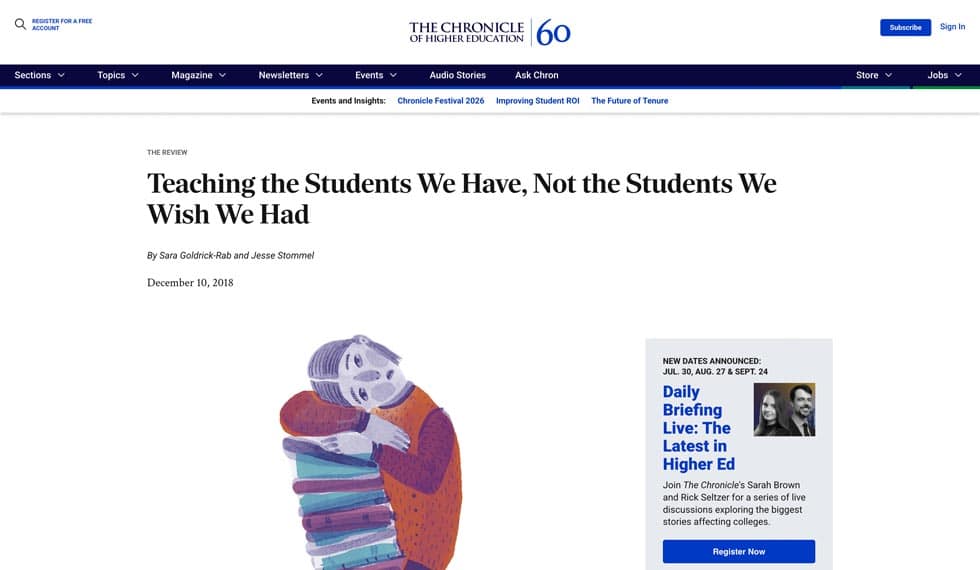
Bonni [00:27:52] Well this is the point in the show where we each get to share some recommendations and I have just a couple. First off there was an article in The Chronicle by Sara Goldrick-Rab and Jesse Stommel. It was entitled Teaching the Students We Have, Not the Students We Wish We Had. And it was just in fact so many of the stories that you have shared today, your student who the car was at a gas and couldn’t find the money to fill it up again. It’s really, it was just a good stark reminder Sara Goldrick-Rab particularly is so good at giving us those reminders to her work. And it’s just a reminder to be real and identify the real concerns that today’s students have.
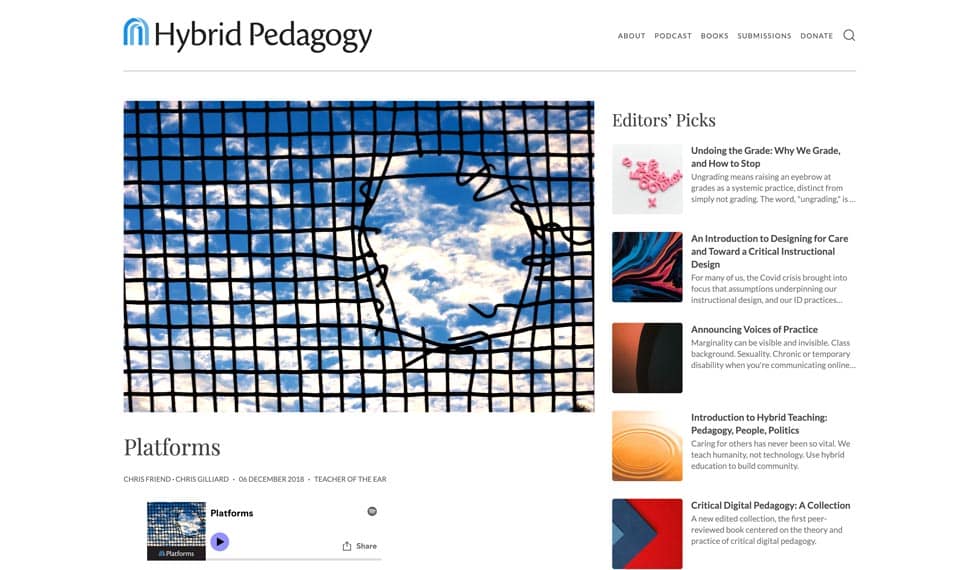
Bonni [00:28:33] And then the second recommendation I have is that Chris Gilliard was on HybridPod, which is the podcast associated with the Digital Pedagogy Lab. And it was a wonderful look at some of the concerns he has around privacy, online surveillance, the Internet of Things, and some of the expansion that is in that kind of technology and how some of us are exposing ourselves to things we may not recognize that we do. And it’s a great interview. He does wonderful work in this area as well as in something called digital redlining. Chris Guillard has been on Teaching in Higher Ed previously, and I just love any chance I get to hear him talk and give us these cautions and educate us about. So I am going to recommend people listen to that episode of Hyprid Pod, it’s called Platforms. And thanks to Chris Friend for a another wonderful Hybrid Pod episode. And this is where I get to pass it over to you to make your recommendation.
[00:29:33] Awesome. I definitely would check those out. My only recommendation here is an app called Canvas. And nowadays, everything has an app for it. Previously, I don’t know if you would like to buy new furniture. The thing that you typically would like to do is first go to your room, measure the dimensions. And then you go to the place selling the furniture and look at that the dimension and try to see if that fits. And after you bring the furniture back home, you put it up and oops, the color doesn’t match. So there’s a lot of uncertainty in there. So this app, the Canvas app is an app that works with a smart sensor called the structure sensor and you’ll be able to take the 3D images, 3D scanning of the whole room in seconds. And with that, now you can have the model of the room. You can put your furniture model inside that room using the V.R. Now you can see how it would look before you go out and find it. And I think that’s a fantastic technology now that we can do using your mobile phone, using all those apps that are available.
Bonni [00:30:46] It’s truly remarkable to me, I keep wondering when I’m going to stop being surprised. We bought one for my son the other day that is similar to this where it’s augmented reality and instead of helping us place furniture in the room, it actually placed dinosaurs and also a giant some sort of creature that was really had a lot of spikes on it. My daughter was really not happy she says “Mommy I never want you to use that app again.” It is pretty remarkable what’s possible. I’m going to have to check this one out. I have zero spatial intelligence, so things like this are very helpful to me.
Zhaoshuo [00:31:19] Yeah and there are a lot of opportunities of using this kind of technology not only for fun but in the classroom for our future students. And I am very much looking forward to what we can do using this technology in the classroom.
Bonni [00:31:36] Zhaoshuo, thank you so much for coming on Teaching in Higher Ed and for igniting our imagination in this way.
Zhaoshuo [00:31:42] You’re welcome. Thank you so much for having me.
Bonni [00:31:47] Thank you once again to Zhaoshuo you for inspiring us on this episode. I had a hard time coming back to press record because I’m going to the double Robotics website and looking at their telepresence robot and thinking that there’s got to be some reason why we need to have one of these at home. I’m sure that my son who loves all things robots would have no problem getting onboard for that but you know probably I should start by actually using it for grander things.
Bonni [00:32:18] But anyway, thank you so much for igniting our imagination, helping us rethink how we might connect with our students on their mobile devices outside the classroom, reducing the costs of their textbooks, I could go on and on but this has been a great conversation. We really appreciate your time today and congratulations on winning the award for your teaching.
Bonni [00:32:38] Thanks to everyone for listening. We’ll see you next time.
Teaching in Higher Ed transcripts are created using a combination of an automated transcription service and human beings. This text likely will not represent the precise, word-for-word conversation that was had. The accuracy of the transcripts will vary. The authoritative record of the Teaching in Higher Ed podcasts is contained in the audio file.