Reflections on Mark Watkins' Keynote at a Recent Conference
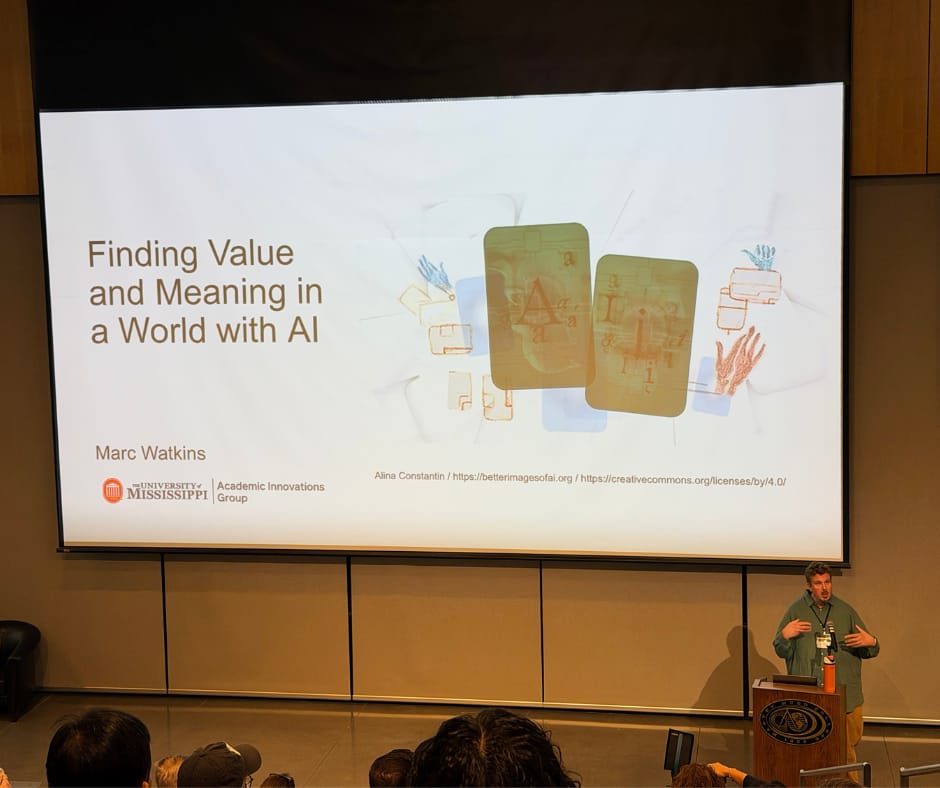
It was such a pleasure to get to see Marc Watkins' keynote at Harvey Mudd's (Re)Imagining Liberal Arts & STEM Education in the Age of GenAI Conference. Marc's talk was titled Finding Value and Meaning in a World with AI. I have had him on Teaching in Higher Ed before (Episode 613: Skepticism and Curiosity in the Age of AI), and that was such an enriching experience. This opportunity to see him speak gave me even more time than the podcast episodes typically allow, and I also got the pleasure of seeing the visuals that Marc had put together for his slides.
The conference as a whole, as I continue to think back on the experience of participating, was so full of nuance. Marc's presentation was no different. Early in his talk, he talked about the importance of creating space for conversation and quoted Molly Roberts from The Washington Post, who had written a story about the place where Marc works. She writes:
There is no better place to see the promise and the peril of generative artificial intelligence playing out than in academia. And there's no better place to see how academia is handling the explosion in ChatGPT and its ilk than at Ole Miss.
Though Marc spoke with maturity and wisdom, he also had his fair share of warnings. One such cautionary note was involving the extensive use of the free versions of artificial intelligence tools. TechCrunch revealed OpenAI's announcement that ChatGPT use reached 900 million weekly active users in a February 2026 story. Other players are growing as well, such as Google and even Claude, though Marc did point out that users of Claude are still in the minority.
Marc spoke about the opportunities that some companies have given students to use the premium versions of AI. Google has done that. So has OpenAI. That said, this isn't guaranteed to continue. In fact, quite the opposite. And the disparities in qualities of tools, perhaps often without the person even realizing it, are an ethical consideration we should all reflect on.
The instructional scales and traffic lights for use in articulating when artificial intelligence is allowable from an academic integrity standpoint was a key section of Marc's talk. He pointed to the AI assessment scale from Perkins, Furze, Roe, and MacVaugh, and also from the University of Sydney, the two-lane approach. Marc doesn't believe we can ban generative AI, and neither do the individuals who came up with this two-lane approach.
Testing centers can have a more locked-down assessment environment. These centers ask students to remove every gadget and also examine their glasses to ensure that they do not contain cameras. This is a very expensive way to do assessment, and it has a heavy lift, not accommodating for those students who require online learning to pursue their educational goals, nor is it particularly accessible.
Another ethical concern brought up by Marc is around the need that faculty have for support and training. We cannot, in higher education, expect faculty to implement these kinds of large-scale course redesigns on their own without funding and communities of practice being available in addition to faculty AI guides.
One thing I enjoyed about how Marc approached his keynote is that, in addition to speaking with such nuance, he provided a tremendous overview of not just the ethical concerns that get raised with artificial intelligence, but also how things have been changing within the last year or so. He quoted a piece from Liza Long, On Becoming a Cyborg, which explored the ways in which agents can perform tasks and change how we work.
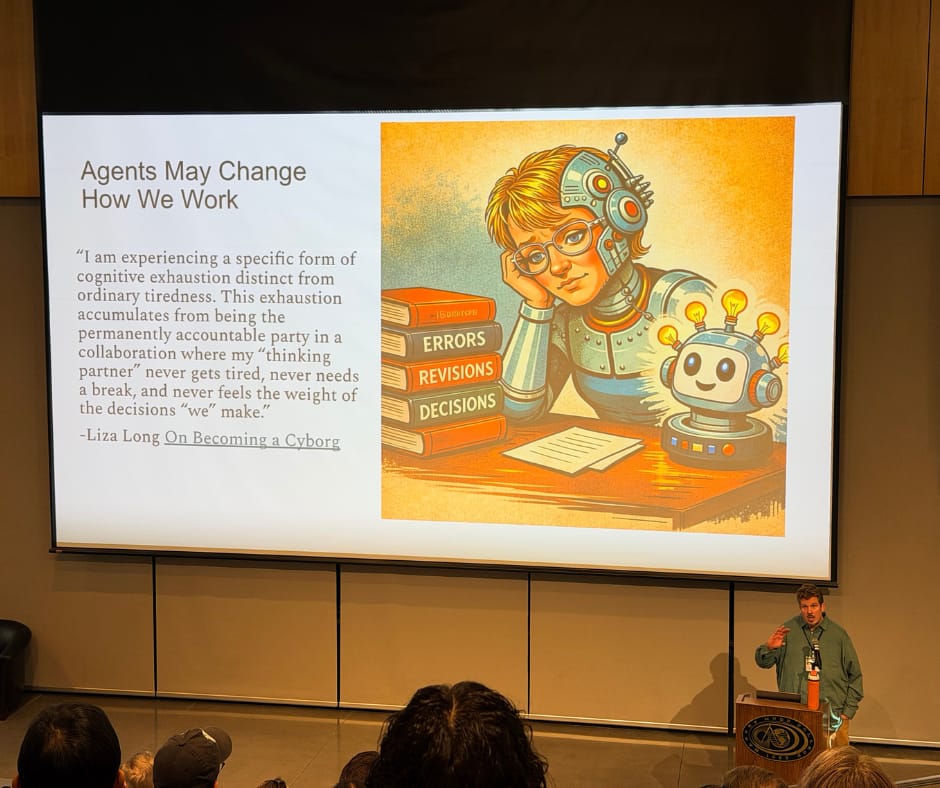
Yet Liza points out how the inexhaustible nature of artificial intelligence raises some issues related to the nature of work. She writes, “I am experiencing a specific form of cognitive exhaustion distinct from ordinary tiredness. This exhaustion accumulates from being the permanently accountable party in a collaboration where my ‘thinking partner' never gets tired, never needs a break, and never feels the weight of the decisions ‘we' make.”
Marc explored the issues around integrity having to do with students' use of AI in addition to faculty members' use of AI. He referenced Jeff Young's podcast, Learning Curve: Is My Professor Using AI to Teach? from October 2025. Students are often unhappy with their professors using artificial intelligence to create courses. From the New York Times, “College Professors Are Using ChatGPT. Some Students Aren't Happy,” outlines the story of Ella Stapleton at Northeastern, who discovered that her professor had been using AI in a way that got her wondering what her tuition dollars were meant to be for if it wasn't to be taught by an actual human being.
This brought up the importance of disclosure, which is something that Marc is a big advocate of. At the bottom of his slides, whenever he had an image that had been generated by artificial intelligence, he included detailed information about his approach. On this “Modeling Discernment and Responsible Use” slide, he said it used to be plain bullets. And then in the disclosure label, he explained that he used Google's Nano Banana in Google Slides to beautify this slide.
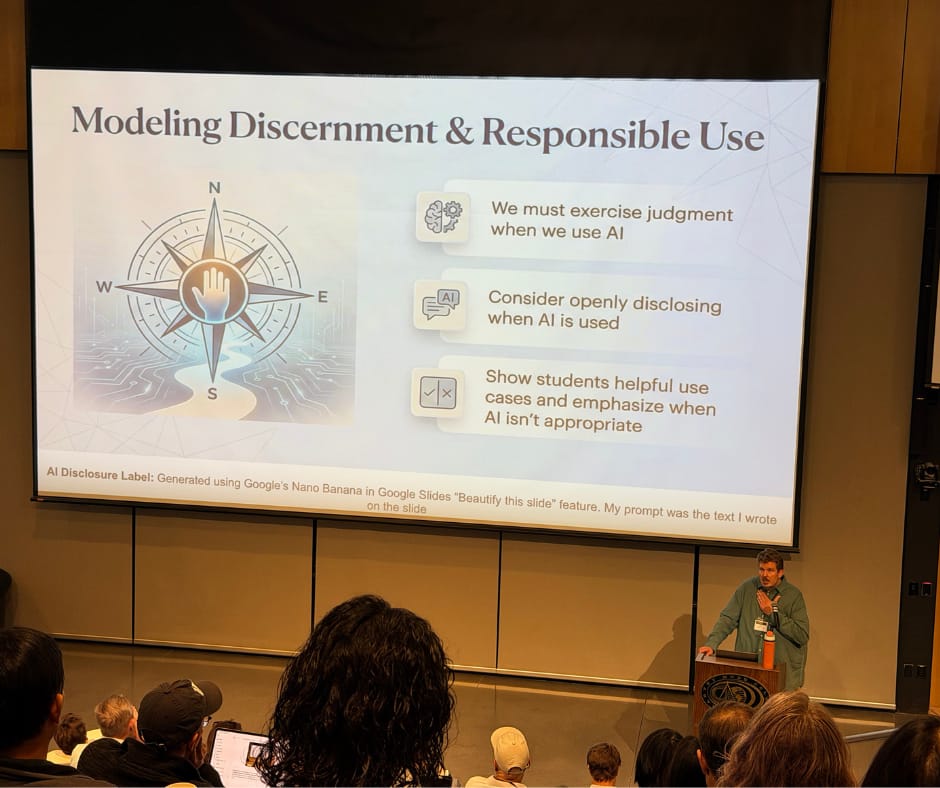
I am not sure I've admitted this in too many places publicly, but I'm a bit of a slide deck design snob. I would like to push back a bit on the idea that this particular slide is at all what I would call beautiful. My concerns are geared toward Google themselves and do not mean to imply this is a critique of Marc, who gave a wonderful keynote talk. Whenever I see these supposedly beautified slides, I tend to think that those of us who enjoy creating slide decks are safe from having that role be usurped by AI anytime soon.
If you would like to learn more about Marc Watkins and his wisdom around what he and colleagues called AI-aware teaching, there are a plethora of resources available. The Norton Guide to AI-Aware Teaching by Annette Vee, Marc Watkins, and Derek Bruff is now available. Marc wrote a post about it that will give you a good overview. Additionally, he published a post called “We Shouldn't Destroy Ourselves Fighting About AI” that is well worth a read.
I especially like the reflection about a third of the way through the post where he talks about how good work gets lost when we shout–when we have shouting matches over the machines. He's so good about pointing to other people's work and then reflecting in public about the ways that they have shaped his responses to artificial intelligence. He encourages us to be aware of changes as they come and be prepared to move forward. He doesn't specify where we should go, but he does stress that we not stay in the same place.
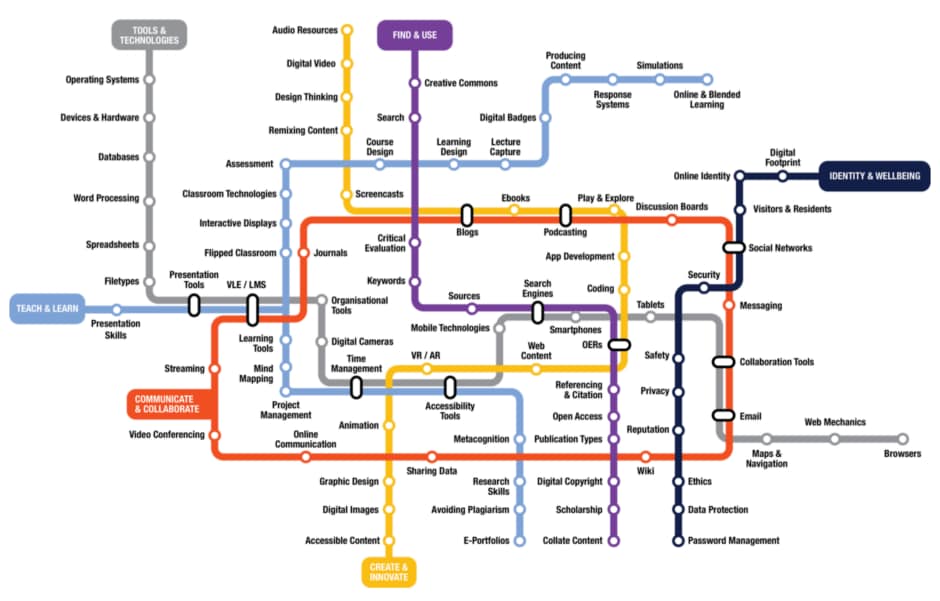
That has always been what I've advocated when offering a Go Somewhere keynote, or playing the Go Somewhere card game as part of a workshop. Let's move, even if none of us know exactly where we're going… I still hold that Ireland's All Aboard: Digital Skills in Higher Education Map offers a good starting point for thinking about where AI intersects with the various “stations,” even though it came out well before the release of ChatGPT got so many more people using AI than ever before.
If you're looking for more ways to have conversations about AI, Marc offers some questions to spark dialog at the bottom of this post: The Norton Guide to AI-Aware Teaching and Using AIs as Provocative Pedagogy. That, plus subscribe to Marc's newsletter and follow him on LinkedIn.