Follow the Teaching in Higher Ed Podcast
About this Episode
Christian Friedrich shares about privacy and safety in online learning on episode 185 of the Teaching in Higher Ed podcast.
Privacy and safety are not the same thing.
Christian Friedrich
On episode 185 of Teaching in Higher Ed
Voices on this Episode


Show Notes + Resources
- OER17: Safety in Open Online Learning
- OEB16: Can we be safe in online learning?
- 16 Days of Activism against Gender Based Violence: protecting your online privacy in 16 steps
- Sean Michael Morris – Not Enough Voices keynote
- I Know Who You Are and I Saw What You Did: Social Networks and the Death of Privacy by Lori Andrews *
- Guardian article – I asked Tinder for my data. It sent me 800 pages of my deepest, darkest secrets by Judith Duportail
- So You’ve Been Publicly Shamed Paperback by Jon Ronson *
- Episode 18 of the ReplyAll podcast: Silence and Respect
Recommendations from this Episode

Technology
1Password

Article
Speak Up & Stay Safe(r): A Guide to Protecting Yourself From Online Harassment by Jaclyn Friedman, Anita Sarkeesian, and Renee Bracey Sherman
Music
The Three E.P.’s
Technology
Brain.fm: Music for the Brain
Technology
1Password for Families
Resource
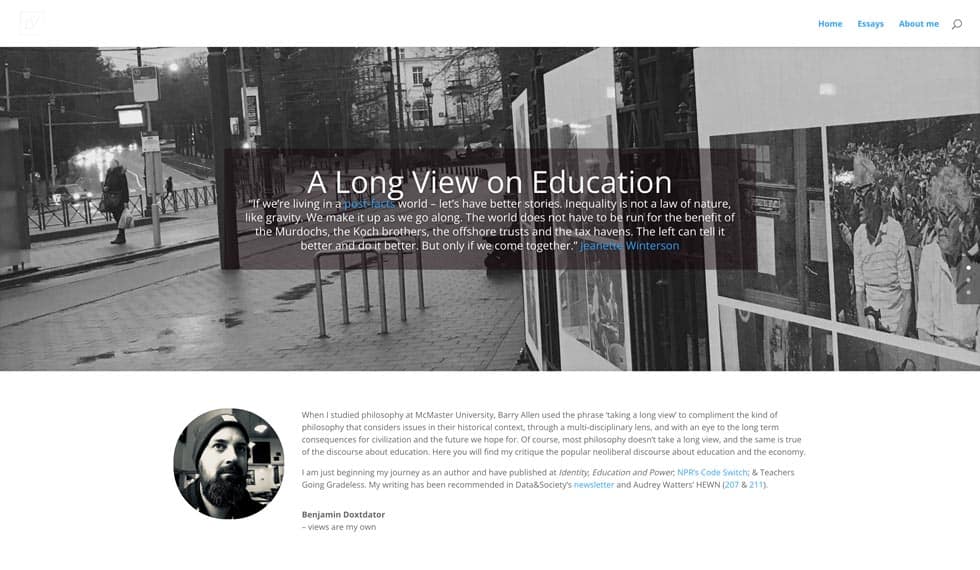
Long view of education blog by Benjamin Doxtdator
Transcript
Bonni: [00:00:00] Today on episode number 185 of the Teaching in Higher Ed podcast, Christian Friedrich shares about privacy and safety in online learning.
Production Credit: [00:00:12] Produced by Innovate Learning, maximizing human potential.
Bonni: [00:00:20] Welcome to this episode of Teaching in Higher Ed. I’m Bonni Stachowiak and this is the space where we explore the art and science of being more effective at facilitating and learning. We also share ways to improve our personal productivity so we can have more peace in our lives and be even more present for our students.
Bonni: [00:00:49] Today I’m thrilled to be welcoming back to the show Christian Freidrich. If you have been listening for at least a month or so, you’ll remember that he was a guest back on episode number 182. Today he’s back to talk about a topic that’s near and dear to both of our hearts and that is privacy and safety in online learning.
Bonni: [00:01:10] Christian was the co-developer of the Leuphana Digital School. And that school has really done such a tremendous job of implementing connected learning formats for learners worldwide. Over the last few years his work has focused more on openness, safety, and inclusively in education. Christian is the cohost of a German podcast on open education and a freelance consultant in online learning. He’s a member of the #TowardsOpenness where he and many others aim to provoke conversations around open and connected learning. He is also a member of Virtually Connecting, which I’m so happy to report I’ve been on a number of sessions with Christian and really have enjoyed engaging him in that community. Virtually connecting provides a space for virtual participation and representation at conferences. Christian, welcome back to Teaching in Higher Ed.
Christian: [00:02:05] Well thank you Bonni. Glad to be back.
Bonni: [00:02:07] It’s so nice to be having this second conversation with you as a follow up to ours on equity and learning design. I imagine we’ll probably have some crossover from that episode because these two things definitely intertwine.
Bonni: [00:02:21] What do you remember about the first time or an early time where you really recognized perhaps your own lack of knowledge or awareness of just some of the privacy and safety risks in online learning?
Christian: [00:02:37] I think it was actually at the very beginning of my experience with online learning when we designed and managed and worked on our first course where a colleague of mine mentioned that he had been working in journalism before that and he engaged the wrong people who responded to an online story that he worked on.
Christian: [00:03:06] And they basically took his comments out of context- and basically whenever you could look up his name, that is still what you will find about him and not the other work that he has done. So he has been really exposed to harassment online. And it has to some extent also affected his choices in his professional life.
Christian: [00:03:28] So it’s not directly intertwined with online learning but with online behavior. And it was interesting for me to talk to him about that when we designed our first larger-scale online course because we at least were then made aware by “one of ours” so to speak. One from within our team. What the dangers and risks are when you engage in online spaces.
Bonni: [00:03:58] I have not been exposed to any type of harassment online and I’m happy to report that. But there’s a couple things with that. One would be I do have that feeling of when is it coming? Because it seems like it is so prevalent today.
Bonni: [00:04:13] So I just wonder like what day is it going happen? That kind of thing. Or perhaps I just don’t happen to stumble upon it because of the things that I write about and the things that I share about in online spaces. I’m not entirely sure, but I do have that feeling of that we are all at risk without really being cognizant of the risk that we take when we go online.
Bonni: [00:04:38] You clearly have decided that the risks are worth it. And of course we have described that as a white male in your mid 30s, a straight man, that you aren’t in as much risk as others are but you ultimately have decided that it’s worth it to you still to engage about controversial topics and to participate online. But of course we can’t make those decisions for others.
Bonni: [00:05:04] What are some of the ways that you try to help people think about their privacy and safety in online where you’re helping them contemplate the ways in which they want to engage without trying to prescribe for them how they should engage?
Christian: [00:05:21] Yeah that’s complicated, isn’t it?
Bonni: [00:05:24] Yeah. And we could talk for four hours and not even be halfway done yet. It’s very complicated. Yeah.
Christian: [00:05:29] It is. So for me, as you pointed out, the same goes for me. I don’t think I’ve ever been truly harassed. So everybody who has an online identity of some sort will have a not so pleasant comment every once in a while, or find a tweet about them that doesn’t really overlap with their own perception or something like that, but that’s not what we’re talking about here.
Christian: [00:05:58] So I think on the one hand, especially someone like me- and I think it’s off the top of my head, I think it was Sean Michael Morris who last year in a key note called Not Enough Voices stressed that really I think if I’m correct, if not, I apologize- but I think he spoke about him at least being perceived pretty much the same way I am. So a white male and he is like a middle aged white male.
Christian: [00:06:36] And we are not approached in ways that others are. And we are valued differently by others when they engage with us. And our role pretty much should be not what I’m doing right here. But to listen and to engage with people who make different experiences and try and take that up and see what we then can do to work against that.
Christian: [00:07:05] And that’s basically what I’m trying to do and I do think it’s one of the important issues that we have to face and tackle if we engage in online and in the digital and when we speak about education and teaching and learning because lots of the narratives that form around online education and that have formed around online education and- Audrey Watters among many others that she is kind of at the forefront of this exposes those narratives really well.
Christian: [00:07:38] When people talk about democratizing education by using this or that technology. But that’s not what really happens. So not for everybody, the same access has the same effects. And that is also due to a lack of safety and lack of care, I would say. We have to- like especially people like me should work against that or towards a more safe environment in online learning.
Bonni: [00:08:10] I read this really interesting book a number of years ago it’s called I Know Who You Are and I Saw What You Did: Social Networks and The Death of Privacy, and I couldn’t do it justice even if this is all we talked about was this book. But one of the many aspects that I took away from reading this book is that so much of our concern and so much of our attention goes toward privacy as it relates to the government and the government spying on our phone calls and now hacking into our phones, etc.
Bonni: [00:08:43] And that that’s causing a great deal of trepidation but that while that is a concern to her, what she thinks we should be more conscious of and paying even more attention are the privacy implications of what businesses are collecting on us, the data that businesses are. She has a funny yet terrifying all at the same time example of the company called Fitbit that tracks our exercise.
Bonni: [00:09:08] And one of the things that it tracks for burning calories has to do with one’s sexual endeavors. And so that was apparently hacked and available online for anyone to go view. People that had chosen to track their activities of that nature using their Fitbits. So those are the kinds of things that she says we should be worried about but that we’re often not.
Bonni: [00:09:31] What comes to mind for you when we start talking about privacy and safety of things that people should be more concerned about, but that you notice actually that they’re not, that there’s other things that really catch our attention but some stay more behind the scenes?
Christian: [00:09:47] So I think the first thing I would want to say, I try to stress this when I first engage with people about this and I think Kate Green for example does a great job at addressing that is that privacy and safety are not the same thing. And like as we talked about in the episode on equity before this, safety and privacy usually are contextual.
Christian: [00:10:17] And to be aware of that is certainly the first step and to be aware of what some call their their “digital footprint” is certainly one thing. There was this other article I think and the Guardian a couple of weeks ago where a reporter requested her data from Tinder and she kind of wished afterwards that that she had not.
Christian: [00:10:41] And I think also this this kind of discussion kind of relates to your let’s call it a threat model. So for some people in some countries, a government will be the number one threat model and they would be happy to provide information to Fitbit. And then others it’s not. And also that question then is contextual. So I don’t think there’s- regardless of context, the one thing that people should always be concerned about- but of course when you engage in online communities, there are some basic rules that you can follow.
Christian: [00:11:23] And I mean we’ve all seen those be more safe online in five or ten steps kind of tutorial blog posts by sometimes content marketing companies but also by experts in the field. And I think all of those or many of those are valuable but it really depends on- how do you say that- on what kind of level of literacy you get to start with when you engage people.
Christian: [00:11:48] So when I do workshops with faculty, it might happen that people try to figure out combinations to copy and paste. And if we’re at that level of literacy then something like online safety and privacy might come like a little later down the road.
Christian: [00:12:05] And if people think about, for example, doing work or doing teaching online, then of course issues around safety, around privacy, around security should be incorporated in that thinking and in that design process from the very start.
Bonni: [00:12:25] You shared with me some provocations that Nishant Shah shared with you. And I wonder if you would talk about the distinctions that he made about making safe versus feeling safe?
Christian: [00:12:39] Yeah, so when I first started to design this workshop with Nishant and Kate for- I think this one was for the online education in Berlin where Kate Green and I co-facilitated this workshop. She was online and I was on site in Berlin. And we collect provocations for these workshops that we do together under the umbrella, so to speak, of Towards Openness.
Christian: [00:13:12] And Nishant, who I’ve had the pleasure of working with for a couple of years, recorded a provocation that kind of still gets me. And I want to introduce it here because every time I listen to it and in preparation for tonight I went back to it and listen to it again. It still gets me because I always find something new.
Christian: [00:13:31] So I’m probably not going to do it justice at all but Nishant introduced basically five let’s call them categories of safety in online learning. And he starts with Making Safe. And Making Safe, if I recall correctly, is this category where we identify others as being “other” and we try to come up with a technological or a solution of categorization to make them safe in a, for example, a learning environment.
Christian: [00:14:12] So the example might be really skewed but you have one student with impaired vision and he’s going to sit right in the front row of your lecture hall, for example. And you will be demonstrativly handing them notes or whatever it is. So that might be something for you to address that problem that she or he has. And that’s what I understand as Making Safe. So you point someone out and you try and make them safe. And you might probably and you will probably have the best of all intentions doing that. And quite often there’s nothing wrong with that.
Christian: [00:14:54] But he then goes on and talks about Keeping Safe and Being Safe and Safeguarding. And it’s quite a dense talk of eight minutes and I highly recommend listening to it of course, but me trying to condense it to like podcasts digestible length is not going to work.
Christian: [00:15:13] But the fifth dimension that he introduces is about Feeling Safe. And what he introduces there instead of the first four dimensions or categories where he talks about technological solutions mostly or working within the let’s call it the known design process of for example a learning environment. With Feeling Safe something else is added and that’s the agency and negotiation of learners and with learners.
Christian: [00:15:44] So making someone a stakeholder in the design of something and not making guys like me stake holder off that. But those who are at stake, those who are at risk of being marginalized, those who are unsafe in quite a lot of places and give them agency and engage in negotiating processes with them when it comes to the design of learning or learning environments.
Christian: [00:16:12] And I really like that because he himself if I get that right introduces the idea that none of these categories by definition is right or wrong but that you yourself, as an educator would want to use different approaches to approach and identify different problems.
Bonni: [00:16:38] One of the things- this is the first time I’ve heard about this model is from you- but one of the things that it seems like it would help us perhaps do is have a greater appreciation for why people are concerned. We can talk about- in the last episode, we had a conversation about context and you brought up that so many times we’ll take our own reasons for doing things or our own experiences and assume that they apply to others. I’m sure I do that with regards to privacy and safety online.
Bonni: [00:17:11] So it seems like thinking about feeling safe, having these conversations where it’s a co-creation of what helps us feel safe that we might have a greater ability to contextualize where the concerns are where the fears are and that many times they might be fears that we were not yet aware of. “Oh gosh, I shared that and didn’t really think that it would be of concern to someone else.” But that some times we might actually find that people are fearful about something that comes from a lack of information.
Christian: [00:17:53] I think it’s quite often- and I can only talk about this from my own position basically- quite often it’s a lack of information and knowledge and that comes from a lack of awareness for different contexts quite often. And I’m as guilty of that as anybody else is. And what I like about this, as you said much more eloquently than I could have, is by engaging those who are at risk into those design processes and even giving them the agency is the wrong terminology probably but having those people have agency and work with you on eye to eye level who are at risk will make you aware of the next the next thing that makes people unsafe.
Christian: [00:18:43] So it’s very much related to what we talked about in the last episode because there is no safety, there is no privacy, there is no security, at least not to 100 percent. But there’s always only the next step that you can take towards that and identifying those next steps is crucial and not engaging with those who are at risk seems weird somehow.
Bonni: [00:19:09] There was a fascinating episode of the podcast called Reply All. Reply All is a podcast that looks at technology and how it intersects with different parts of our lives. And I’m going to go back and find it and put it in the show notes and like you shared, we don’t always have time on the podcast to describe these things too thoroughly. But it was an episode having to do with companies that help people repair their digital identities.
Bonni: [00:19:39] And there was a rather extreme example, but it certainly happened to someone who she had worked in public relations on a very well-known political campaign and had a habit of taking inappropriate but joking I mean juvenile fun pictures of her and her friend in front of signs that tell you not to do something and then they would do it anyway.
Bonni: [00:20:04] And one of the photos that they took was not great and wound up being perceived as disparaging of people who had served in our military. And she had flown somewhere across the world. And by the time she got off the plane, her whole world has blown up. So they end up hiring an organization, the podcast does, to help her repair her identity in order to share what these companies do. And the short version is that instead of trying to remove what’s there, because that’s nearly impossible. They couldn’t get rid of the 12 bajillian things going around of this photo that she had taken.
Bonni: [00:20:47] They tried to have good things that wind up showing up higher in the search results. That’s how they repair someone’s digital identity. And it makes for just some good conversation when thinking about one’s digital identity. Not that it has easy answers. It’s not like when I asked you in the beginning, I have a three point process to fix this but I just find it fascinating.
Bonni: [00:21:08] I’ve thought about this episode so many times since listening and I’ll definitely post that and the show notes of people want to think a little bit and learn about what some of these companies do to help improve or repair our digital identities.
Christian: [00:21:21] It’s great that you mention the podcast because it was on my short list of recommendations as well and got scratched then.
Bonni: [00:21:27] Oh that’s so good.
Christian: [00:21:29] It’s really. And they have an interesting humor I would say. And I really do like that podcast and actually what you just talked about I think it was her name was Justine Sacco is that…
Bonni: [00:21:44] I don’t know. I’ll type it in but I can’t… Can you spell it for me?
Christian: [00:21:48] It’s Justine Sacco and I’m pretty sure it’s her because I’ve read a book by Jon Ronson recently which was on my shortlist as well. That’s called So You’ve Been Publicly Shamed. And there’s plenty of stuff wrong with that book from my perception in terms of how he justifies the things that those people do in that moment. But we’ve all been there and like deleted that tweet before we pressed send right or deleted that e-mail before it was sent because we had that feeling “OK this might come off the wrong way. This joke might not land.” Or something like that.
Christian: [00:22:27] But he basically speaks about people quote on quote “like that” who like like Justine Sacco have been destroyed publicly on the Internet for like a year or two and couldn’t leave their houses because of that one tweet or that one e-mail. It’s an interesting book.
Bonni: [00:22:46] Christian, I know that we have just skimmed the surface on this important conversation, so I guess this just means you have to come back some day and talk more about it. But before we get to the recommendations portion of the show, would you just share anything that comes to mind that we haven’t talked about that’s essential before we close this portion of the show?
Christian: [00:23:06] I think what strikes me always when I think about this and then work on this with different people from different contexts as we have stressed a couple of times on this episode and in the previous one is the contectuaility of these things. And how the context that you work in really influences and should influence your way of approaching this.
Christian: [00:23:35] I remember when we did this this workshop on safety in online learning at this year’s OER17 in London, we had those different provocations and we were really lucky to have different people engage with us and engage with that topic. So people who were not allowed or chose not to travel to the US for conferences because they were not sure if they would be admitted. People who thought about- like Chris Gilliard talk about digital redlining or Ahmed Kharrufa about his experiences.
Christian: [00:24:07] But also what I found really interesting and where I always still come back to and what might be interesting for others as well is the way that workshop participants then onsite were able to take those ideas and those limitations that those people were talking about and transfer them into their own creative thinking process.
Christian: [00:24:37] And to make it less abstract, basically workshop participants took that and worked out their own sometimes quite fantastical and sometimes very down to earth solutions and concepts to engage with safety for online learning. And topics like security and privacy very often seem to be at least- how would you say that- one dimensional of sort. I think this human experience of safety makes it much more contextual and worth thinking about.
Christian: [00:25:09] And this really comes out in those results that they produced. And I am mentioning this because I think in my everyday work it really helps to every once in a while take a second and go back to those experiences and to those ideas and to see to basically ask yourself everyday, “Am I doing this right now?” But am I approaching- am I incorporating these experiences in my work? And this one workshop really resonated with me. And so I thought I’d plug it in here as well.
Bonni: [00:25:51] Oh that’s wonderful. And for people listening, the show notes will have a lot of links in it and they’re at teachinginhighered.com/185, including some of the provocations that Christian just shared about. And there’s lots of video posts and audio posts. I think definitely this is a very browseable set of show notes that’s for sure.
Bonni: [00:26:14] I was thinking about in the 2008 election, many people know this already but in case people aren’t aware anyone in the United States who gives more than 200 dollars to a political campaign, it automatically becomes publicly available information.
Bonni: [00:26:31] And that used to mean that you had to go down to the courthouse if you wanted to browse these kinds of records. But of course with technology today, it’s available to anyone and everyone. And way back then I had given more than 200 dollars to one of the political candidates at the time and the Huffington Post created what’s called a mash up.
Bonni: [00:26:53] And this was a mashing together of two large databases, one of these databases was the MLS database. That’s the real estate listings. So essentially that’s people’s addresses, their home addresses. And it mashed that together with these political campaigns.
Bonni: [00:27:10] And so at the time, if you Googled me- it doesn’t happen anymore, but if you googled me back then, you would not only have a map to our home but you would also have an image of a donkey or a elephant on top of it to represent the two political parties and all the houses around us who had also donated more than 200 dollar campaigns had one of those political parties mascots on top of them that symbolize them. So you could just see in your neighborhood who leans which way politically. And then you also could search someone’s work place, if you searched where I worked.
Bonni: [00:27:48] Yeah anyone who had given… I mean i was just so frustrating. But I remember it actually because I told you I hadn’t really been ever harassed online but that was the closest I ever got because there was a student at the time who was really having some mental health challenges.
Bonni: [00:28:07] And I won’t go into a lot of detail, but there was some concern for me obviously having my home address be available to someone who again it never got that dramatic, but it certainly did enter my mind especially because my husband at the time was teaching often at night and I was home alone. And it just you know it’s one of those things where it can be really scary.
Bonni: [00:28:30] And yet there are certainly steps we can take. And So You’ve Been Publicly Shamed book that you talked about and the podcast episode 18 of the Reply All podcast that we spoke about it does come down to I had to wait a little bit of time to see that move down in the search results and then lots of other things that move their ways up.
Bonni: [00:28:51] But yeah there are no easy answers in all of this. And it can certainly feel really scary when something like this is going on. And I know you and I have linked to a lot of resources that can help people thinking about how to stay safe online too.
Christian: [00:29:07] Yeah we have. And let me let me just add that I find those stories that like you just shared especially from a non U.S. perspective or a Central European perspective interesting because the way that you- and I only know chunks of it- but the way the U.S. society goes about this data sharing and public availability of this kind of sensitive data does strike me as odd coming from a society where we are in many ways more public and open, but in many other ways keep those things more to ourselves. So there is again context. So this really does add to the whole mix of things.
Bonni: [00:29:54] Yeah our laws certainly have not kept up with the prevalence of technology. Those laws were designed again when you used to have to go down to the local courthouse in order to get that. And of course I don’t know enough about it historically to even know if it was a good idea at the time or what the rationale behind it was to have that information available at the courthouse. But my goodness thinking today just how easily someone can access that kind of information is just- yeah, we have much work to do as a society to think through these things more critically.
Christian: [00:30:23] We do.
Bonni: [00:30:25] This is the point in the show where we each get to give some recommendations. And shocker alert mine are actually going to relate to what we talked about today. Horray! I Never do that. The first one is a storify that I put together. A storify is a way of collecting tweets and other things from social media and putting it in the timeline that is more chronological. Sometimes it can be hard on twitter to follow conversation.
Bonni: [00:30:50] So there was a great conversation that happened around safety and our digital identities, a question from one of my doctoral students a couple of years ago and many answers for a person who is new to blogging. And on that Storify there’s a link to a wonderful resource called Speak Up and Stay Safe: a Guide to Protecting Yourself From Online Harassment that I highly encourage people go look at.
Bonni: [00:31:15] And then the last thing I’d like to recommend is an application called 1Password. This is a password manager. And when I think about how people are putting themselves at risk oftentimes without having any understanding of how dangerous it is for example to use the same password on every single website and just what that could mean for- there was a famous reporter who lost all of his pictures of his kids growing up because someone hacked into his- and he was not using the same password for all of his sites but it was just someone was preying on him and did it to “prove a point.”
Bonni: [00:31:55] But just how vulnerable we are with our digital information, credit card information, our log ins and passwords to sites that really are vital to keeping out of other people’s hands.
Bonni: [00:32:07] 1Password is our go to as a family. And it’s really evolved over time. It’s always been a wonderful password manager. But even today you can have different vaults. So we have 1Password for families. And I can have passwords that just show up on my vault, but I can also put them in the vault that my husband Dave and I share.
Bonni: [00:32:29] So that if it’s a site that we both need to get into, we both have access to that information. And it’s all done so conveniently so I’m able to be more safe but also able to have the convenience of this living right in my browser bar so I want to log in my 1Password is right there. When I want to create a safe and secure password, it’s right there to do that for me.
Bonni: [00:32:50] And I mean it’s just I couldn’t say enough good things about it. That’s definitely worth exploring if you are a person who uses the same password for all your Web sites. That’s just a danger I think we need to not take these days with the critical information on our lives. Christian, what do you have to recommend today?
Christian: [00:33:08] So the one recommendation I have doesn’t directly relate to this topic but then again it does. And I’m not even sure if you’ve had him on your show yet. It’s Benjamin Doxdator’s blog Long view on education.
Bonni: [00:33:22] I recognize the name from Twitter. But no he has not been on the show.
Christian: [00:33:26] I’m not even sure if I’m pronouncing it right. But I looked it up and I hope it did it justice. But what he does really really well and we’ve talked about Audrey Waters and her work. Like at least we touched on it. He does really well at looking at certain narratives around technology and education and learning and teaching. And their deployment and what sometimes lies behind that. And he does really well at researching it, describing it, and exposing it.
Christian: [00:33:57] So I wanted to have people have a look at his blog and he writes at a frequency that I find hard to keep up with at times. But what he does what he writes really quite often has blown me away. So that’s really an interesting resource I think.
Christian: [00:34:18] And the other one relates more to productivity because I think in the end the last episode I hinted that I’m not the- how would you say that- the most academic person I know. So I really have to create the right environment for me to be able to write in, for example. And what I do in order to do that I work with sound as I’m sure many people do. So I started with white noise and sometimes I go to an app called Brain.fm where certain frequencies are basically delivered to you to enhance your concentration. And it might just be the placebo effect but it works for me at least and it gets you into that tunnel that you can work in and concentrate in.
Christian: [00:35:06] And if you’re not into white noise or brain.fm, my favorite album to listen to when I have to write is from The Beta Band called The Three E.P.’s Which I’d also recommend if you’d rather have something playing in the background for your writing.
Bonni: [00:35:22] Wonderful you’re giving me so much to look at you want to go look at all three of your recommendations right now at the same time. But I have to settle down.
Bonni: [00:35:28] Christian, it’s been so glad to have you back on the show for a second time. You’ve really given us much to think about. You’ve given us a lot of ways we can extend the learning from you being a guest on this episode and I just really appreciate your contribution to the Teaching in Higher Ed community.
Christian: [00:35:47] Well thank you for having me on. It’s been an honor to be here.
Bonni: [00:35:51] Thanks Christian for coming back on Teaching in Higher Ed and for joining me for this episode number 185. If you’d like to access the show notes for this episode and see some of the links that we talked about, you can do that at teachinginhighered.com/185.
Bonni: [00:36:09] You also can receive those shown notes in your inbox automatically so you don’t have to remember to go locate them. And you can do that at teachinginhighered.com/subscribe. You’ll only receive one email a week, at the top of it will be a blog about productivity or teaching written by me, and underneath that each week’s most recent episodes podcast notes.
Bonni: [00:36:34] Thanks for listening and I look forward to seeing you next time. We’ve got lots of great guests coming back on and I’m so appreciative to you for listening and recommending the show to others when you have an opportunity. I’ll see you next time.
Teaching in Higher Ed transcripts are created using a combination of an automated transcription service and human beings. This text likely will not represent the precise, word-for-word conversation that was had. The accuracy of the transcripts will vary. The authoritative record of the Teaching in Higher Ed podcasts is contained in the audio file.