• Skip to primary navigation
  • Skip to main content
  • Skip to footer

Teaching in Higher Ed

  • Podcast
  • Blog
  • SPEAKING
  • Media
  • Recommendations
  • About
  • Contact
EPISODE 630

Feedback, Voice, and AI in the Writing Classroom with Anna Mills

with Anna Mills

| July 9, 2026 | XFacebookLinkedInEmail

https://media.blubrry.com/teaching_in_higher_ed_faculty/content.blubrry.com/teaching_in_higher_ed_faculty/TIHE630.mp3

Podcast (tihe_podcast):

Play in new window | Download | Transcript

Subscribe: Apple Podcasts | Spotify | RSS | How do I listen to a podcast?

Anna Mills shares Peer and AI Review and Reflection, plus a layered approach to writing feedback on episode 630 of the Teaching in Higher Ed podcast.

Quotes from the episode

AI companies should be designing so that their agents don't go in and say, "I'm a student taking a quiz."

My sense of the value of feedback has not changed. It’s more important than ever, more meaningful than ever, when we do have that connection through words.
-Anna Mills

I think overall I’ve advocated for more sort of technical support for transparency about what is AI and what is not.
-Anna Mills

Students preferred both the peer and the AI feedback. They did not want one or the other.
-Anna Mills

AI companies should be designing so that their agents don’t go in and say, “I’m a student taking a quiz.”
-Anna Mills

Resources

  • Poll Everywhere
  • AXL 2026 Keynote with Alex Vasquez
  • Statement on Educational Technologies and AI Agents, Modern Language Association
  • Peer & AI Review + Reflection (PAIRR), UC Davis Writing Program
  • Contradictory Feedback Chatbot on PlayLab
  • Anna Mills on Amazon vs. Perplexity and Distinguishing Agentic AI Bots from Humans (LinkedIn)
  • Anna Mills on Judge Orders Perplexity to Stop AI Agents (LinkedIn)
  • More Than Words: How to Think About Writing in the Age of AI by John Warner
  • Jellyboard
  • Bad Ideas about AI and Writing: Generative Practices for Teaching, Learning, and Communication
  • MyEssayFeedback.ai
  • AI and College Writing: An Orientation

ARE YOU ENJOYING THE SHOW?

REVIEW THE SHOW
SEND FEEDBACK

ON THIS EPISODE

Anna Mills

Anna Mills is a leading voice on AI in higher education across platforms like LinkedIn, Substack, and BlueSky. She has taught writing in California community colleges for 20 years and is author of the OER textbooks AI and College Writing: An Orientation and How Arguments Work: A Guide to Writing and Analyzing Texts in College. Her writing appears in The Chronicle of Higher Education, Inside Higher Ed, Computers and Composition, and AIPedagogy.org. She serves on the Modern Language Association Task Force on AI in Research and Teaching. As a volunteer advisor, she has helped shape MyEssayFeedback.ai, and she serves as co-Principal Investigator for the Peer & AI Review + Reflection (PAIRR) project funded by the California Education Learning Lab.

Bonni Stachowiak

Bonni Stachowiak is dean of teaching and learning and professor of business and management at Vanguard University. She hosts Teaching in Higher Ed, a weekly podcast on the art and science of teaching with over five million downloads. Bonni holds a doctorate in Organizational Leadership and speaks widely on teaching, curiosity, digital pedagogy, and leadership. She often joins her husband, Dave, on his Coaching for Leaders podcast.

RECOMMENDATIONS

Jellyboard

Jellyboard

RECOMMENDED BY:Bonni Stachowiak
Bad Ideas about AI and Writing: Generative Practices for Teaching, Learning, and Communication

Bad Ideas about AI and Writing: Generative Practices for Teaching, Learning, and Communication

RECOMMENDED BY:Anna Mills
MyEssayFeedback.ai

MyEssayFeedback.ai

RECOMMENDED BY:Anna Mills
AI and College Writing: An Orientation

AI and College Writing: An Orientation

RECOMMENDED BY:Anna Mills
Woman sits at a desk, holding a sign that reads: "Show up for the work."

GET CONNECTED

JOIN OVER 4,000 EDUCATORS

Subscribe to the weekly email update and receive the most recent episode's show notes, as well as some other bonus resources.

Please enter your name.
Please enter a valid email address.
JOIN
Something went wrong. Please check your entries and try again.

Related Episodes

  • EPISODE 554Classroom Assessment Techniques
    Todd Zakrajsek smiling

    with Todd Zakrajsek

  • EPISODE 423A Classroom Observation Story
    1
  • EPISODE 209Antiracist Writing Assessment Ecologies
    Asao Inoue

    with Asao Inoue

  • EPISODE 433The New College Classroom

    with , Cathy Davidson, Christina Katopodis


EPISODE 630

Feedback, Voice, and AI in the Writing Classroom with Anna Mills

DOWNLOAD TRANSCRIPT

EPISODE 630:  Feedback, Voice, and AI in the Writing Classroom with Anna Mills

Bonni Stachowiak [00:00:00]:

Today on episode number 630 of the Teaching in Higher Ed podcast, Feedback, Voice and AI in the Writing Classroom, with Anna Mills. 

Bonni Stachowiak [00:00:13]:

Production Credit: Produced by Innovate Learning, Maximizing Human Potential. 

Bonni Stachowiak [00:00:21]:

Welcome to this episode of Teaching in Higher Ed. I’m Bonni Stachowiak, and this is the space where we explore the art and science of being more effective at facilitating learning. We also share ways to improve our productivity approaches so we can have more peace in our lives and be even more present for our students. Anna Mills is a leading voice on AI in higher education across platforms like LinkedIn, Substack, and Blue Sky. She’s taught writing in California community colleges for 20 years and is the author of the OER textbooks AI and College Writing: An Orientation, and How Arguments Work: A Guide to Writing and Analyzing Texts in College. Her writing appears in the Chronicle of Higher Education, Inside Higher Ed, Computers and Composition, and aipedagogy.org. She serves on the Modern Language Association Task Force on AI in Research and Teaching. As a volunteer advisor, Anna has helped shape my essay Feedback AI, and she serves as co-principal investigator for the Peer and AI Review and Reflection Project, also known as PEAR, funded by the California Education Learning Lab.

Bonni Stachowiak [00:01:52]:

As you’re going to hear in this conversation, Anna and I talk about how feedback shapes a writer’s sense of voice and even possibility, and what’s at stake when generative AI enters the picture. She shares the approach she and her colleagues developed called the Peer and AI Review and Reflection, or PEAR. We talk about skeptical AI literacy, why layered responses to academic integrity work better than relying on detection alone, and what it looks like to invite students into a more critical agentic stance with the tools showing up in their writing lives. Anna Mills, welcome to Teaching in Higher Ed.

Anna Mills [00:02:34]:

Thank you. I’m so excited to be on your podcast. I love it so much.

Bonni Stachowiak [00:02:39]:

I am delighted to have you here, and I think about all the things that I already know we share in common, and what a joy it is to talk to you. One of those things has to do with us both valuing feedback and the role that it plays in the learning process. Would you take us back to a time in your life when feedback was particularly important in your own learning?

Anna Mills [00:03:03]:

Well, I think in college I was an English major, and I was in a fiction class, and I remember going in the day my short story was going to be workshopped, and I just had this nervousness but excitement that was, I was so primed for this intense, important experience, and I realized it felt a little bit like going to a date. And it wasn’t that I was looking exactly for them to tell me I was brilliant or anything. It was more that I knew they were going to witness me. They were going to mirror me in this really deep way. They were going to be discussing what it was they got from my story and what they thought was going on. And that feeling of I’m going to be witnessed in a way that almost never happens in life was so profound that my whole body was like, awakened to this.

Bonni Stachowiak [00:03:59]:

Do you have any artifacts today that are still around from the times in your college experience you were getting feedback on your written work?

Anna Mills [00:04:08]:

I think I saved all of the single-spaced typed letters that my professor wrote me. And he would write everybody a page-and-a-half response to each story. And he also put check marks in the margin when something resonated with him. And that meant so much to me, that he was in relationship with me, writing me a letter, and that he was getting so much out of what he was reading. It wasn’t just evaluative.

Bonni Stachowiak [00:04:35]:

Oh, that’s so powerful. I know I’ve shared this on the podcast previously, but in case anybody missed it, my son was helping me go through- I have these big lateral files, and I had kept all the handwritten feedback. It meant so much to me. But that is, that is a precious real estate for storing things. So I have been digitizing those things slowly. But I, man, I go back, and I look at that feedback, and it still, today, brings, it can really evoke a lot of emotion in me, in a good way, of just how…

Bonni Stachowiak [00:05:07]:

And when you were talking about those check marks. The power that something so small can translate to you, that there is a human being on the other side of whether it be, I think you said typewriter, handwritten, whatever, whatever mechanism, whatever channel is being used to communicate. That’s really powerful stuff. Well, we started with experiences of joy. We’re going to get to maybe some experiences that are a little less joyful here. Talk broadly about some of the problems that you and your close collaborators have identified with this just continued enduring emergence of generative artificial intelligence. So we know lots of challenges, of course, but specific to feedback. What kinds of challenges have you noticed there?

Anna Mills [00:05:59]:

Well, I think there’s the fear that there’s not a human connection, like the fear on the part of the instructor as we’re reading. Is this really the student, or is my life energy being demanded for something that is not coming from a human? Is my desire to nurture, and connect, and mentor not being met by the student’s presence? I think we throw everything at it in terms of intrinsic motivation and helping students see what we’re trying to do and how we’re trying to be in relationship and why this will benefit them and how they can connect to it and to each other. And it’s also not always enough. In fact, every semester there’s a case where a student is not showing up, is still using generative AI at a time when I’ve asked them to do the work. I think it’s demoralizing, and there’s so much uncertainty for the instructor. There’s a lot of gray area and just not knowing. So it’s been a case where you have to, for me, embrace like, we’re going to have to deal with compromise and contradiction here, and build in some forms of accountability and know that they won’t always work.

Anna Mills [00:07:21]:

And there have been amazing moments of connection through feedback. And I think my sense of the value of feedback has not changed. It’s more important than ever, more meaningful than ever, when we do have that connection through words.

Bonni Stachowiak [00:07:35]:

I recently had the great privilege of getting to attend a conference at Harvey Med College. The title of it was Reimagining Liberal Arts and STEM Education in the Age of Gen AI. And if anyone’s curious about it, I did write a blog post, so I’ll put it in the show notes if anyone wants to go take a peek at the experience. The keynote, well, one of the many keynotes, the only one as of this date I’ve gotten to catch up on my reflection about, was Alex Hartermink. And again, I’ll encourage people to read that blog post if you want to learn more. But one thing I want to share with you, Anna, is he, he’s a computer science guy, so very quant guy. This guy is deep, deep quant.

Bonni Stachowiak [00:08:16]:

And so he, he was poking a little fun at himself, and he had a very quantitative-looking chart, but it was a timeline. And then, so he admitted, I’m attempting to chart enthusiasm here. And it was- He was admitting to it not being a very scientific measure. And I’m going to ask you to do the same thing. But given that you’re not a super, super quant person, I think you could probably handle it a little, a little bit better than others might be able to. Could you kind of chart your emotional reactions to when you don’t feel like there’s a human being on the other side, since, let me pick a date, November of 2022, which, if people aren’t familiar with that date, of course Anna is. 

Bonni Stachowiak [00:08:56]:

But for those listening who may not be, the release of ChatGPT, not the first large language model, of course, but the first chat based ones that was regularly available to people. So I guess we’re in now in 2026, so over those years, what’s changed? What, where have you seen kind of the gosh, maybe I have a handle on this, you know, emotional response to their not seeming like sometimes there is or isn’t a person on the other side? Chart that for us a little bit, your emotional feelings about the person who is or isn’t on the other side of this feedback loop.

Anna Mills [00:09:33]:

Well, I think there’s definitely a feeling of sort of disappointment, ennui, disgust, anger, frustration, overwhelm. A sense of, like, well, I think this is what’s going on, I’m having this emotional reaction, but what if it’s not? What if this actually is the student and constant self-reminding that I don’t know as much as I think, you know, I might have these various narratives in my head, and they might be wrong. And so those are some of the feelings. And then there’s also an impulse to let me bring that student in, let’s actually connect. This is a missed opportunity, and I need to be assertive about seeking that connection with the students, seeking their voice, and saying, this is really about your learning, and that’s what needs to happen. And so that, that is energizing to me. And then, and then the conferences that follow, sometimes, are energizing in that way where I feel like there’s, there’s a healing of that disconnect or, you know, there’s a meeting, there’s a moving forward, there’s more of the student’s voice, there’s more of their growth and sense of, “Oh, I can learn from this.

Anna Mills [00:10:47]:

I really can’t just turn in AI slop”. So that’s the hopeful part. I guess I’ve been doing this layered approach, Swiss cheese mosaic, Phil Dawson, Chris Ostrow, call it different things, but where I sort of throw all of the strategies at it and recognize it won’t be 100%. But we can have more learning, less AI misuse with all of these strategies layered. And depending on the semester, it works; I’m pretty satisfied with it, or I’m- this is just- it’s not working well enough. I need some more layers, or I need to shift this, or I really wish we had, you know, more, more kinds of technical support as teachers.

Anna Mills [00:11:35]:

And that’s a little bit where I am this semester because most of the students I’M very confident it’s their work. A couple of students, I’m still not sure. And I’ve had to give them the benefit of the doubt. And I wish that I could feel more sure that it was their work. And I want to feel more sure next semester. So, yeah, that’s where I am.

Bonni Stachowiak [00:11:56]:

For listeners who may not be as familiar with Anna’s work, I’ve gotten to the delight of being able to see her offer a number of workshops and talks, and I read her voraciously. She and I interact most often on LinkedIn. And I just want to mention, before we kind of get into, start to talk about a specific strategy that you listeners might want to use, how grateful I am for you for advocating… You mentioned wishing you had more support. And I think listeners might assume, perhaps, you meant about your own teaching context. You might have meant that, but I also want listeners to know that, in addition to whatever commentary you might have wanted to make about your individual context, that you also are advocating to some of these large companies that create the learning management system. So why don’t I let you share a little bit about what you’ve been advocating for?

Bonni Stachowiak [00:12:47]:

And shall we? I don’t want to spoil it for people. Let’s just say we’re not quite getting to the hopeful part yet in the show. Cause we haven’t- Despite the invitations that you’ve made to us to join you in your advocacy, things haven’t turned out so well. But let me let you share a little bit about what you’ve been advocating for. Oh, good, good.

Anna Mills [00:13:07]:

Well, I think overall I’ve advocated for more sort of technical support for transparency about what is AI and what is not. When we want that, when we want to know that something is human, whether it’s text or other media, or actions that could be an AI agent or a human. And so, I’ve tried to navigate this line where I’m not interested in punishment. I don’t want to do privacy invasion, surveillance vibe. But I do think that when we’re left on our own without support for knowing what’s human and what’s not, we kind of founder, and we could design systems to help us know. To help us say, look, this is really me speaking right now. And I want you to trust that because here’s a little bit of accountability I’m offering you so that you have more trust in that. I’ve actually said there are uses for things like process tracking and even AI detection in education that are not punitive, that are not relying on them. Or trusting them absolutely, but can help with accountability.

Anna Mills [00:14:21]:

And more recently, with the rise of these agentic browsers that can autocomplete learning activities, I’ve really just been saying agents need to identify themselves as human. AI companies should be designing so that their agents don’t go in and say, I’m a student taking a quiz. And learning management systems need to support teachers to say, this is a learning space. This is not for bots to do these learning activities. So educators need technical support from the companies to make that possible. And we put out a statement in the Modern Language Association really advocating for that, for lawmakers and AI companies and learning management system companies and ed tech, to build in that support and those boundaries so we can have human learning online. And I’m still hoping that that can happen in various forms. I think it has to, because there are many, many reasons.

Anna Mills [00:15:21]:

Amazon, just for the moment, has won a lawsuit to say they shouldn’t have to allow bots onto their site if they don’t want them. So, if Amazon can win a lawsuit saying they don’t want bots, why not online learning spaces? Why can’t Ed Tech keep the bots out? There are these societal conversations that we’re slowly starting to have because we absolutely have to, about knowing what’s going on and what’s AI, and regulating it, and making space for the human. And I just want educators to feel more empowered to be assertive about this and to say this is in society’s interest, and it’s not all inevitable. We are shaping the future of AI. We are shaping how these systems work now. And let’s talk about what’s best.

Bonni Stachowiak [00:16:12]:

You and I both use artificial intelligence for some of our teaching and learning efforts. And I love what you’re saying about us being able to advocate, because I think those of us who might choose to use it for different purposes, and by the way, the vast majority of us are using some aspect of artificial intelligence, whether we realize it or not. And I don’t want to sound like I am entirely dismissing people who choose to actively attempt to avoid it. I do not mean that at all. But I love that you brought up the Amazon lawsuit because, when you contacted these companies to advocate for them to be able to identify that it’s an agent and not a human being, I believe that they mostly just said, “We can’t do that”, or some version of ” We won’t do that”. But I think the number of times that I am asked to click on something, the CAPTCHA stuff, to try to prove that I am indeed not a bot, I think. I can’t tell you which of these are curtains or sidewalks. I have a very hard time with it, actually.

Bonni Stachowiak [00:17:13]:

I get this wrong on a regular basis. Or the other ones where I’m supposed to type in the characters. I’m turning my head on the side. So I just want to, I want to definitely continue to celebrate the work you’re doing and the invitations you’re making to the rest of us to join others in solidarity. Well, there is some good news as we look to the other half of this part of our conversation. Tell us what some of you and your colleagues have been working with to think about how feedback could incorporate humans, giving feedback to other humans, but with some artificial intelligence involved as well.

Anna Mills [00:17:53]:

Yeah, so the Peer and AI Review Plus Reflection project was started at UC Davis. And I was, sort of, doing something parallel with a not-for-profit app called My Essay Feedback as a volunteer advisor. And then we kind of joined forces. And I just think this is such a solid approach, because it is building on and complementary to what we’re already doing in writing pedagogy. Everything we know is meaningful and works well, and it’s bringing AI in, but not to change everything or take over, but as a complement in its place alongside peer review and instructor feedback. And the idea is that it can support writers to be more reflective, to be thinking about their human audiences, their human readers. So we actually prompt the feedback to talk about.

Anna Mills [00:18:52]:

“Your readers might be curious about this, or readers might wonder this, or the way you’ve structured this really helps readers connect to this idea”. So even if it’s wrong, it’s at least nudging them to think about that human purpose of writing. We’ve also built in steps for reflection on the AI and the peer feedback and some AI literacy readings so that we are helping students build, kind of, a skeptical AI literacy in the process, even as they’re getting help with their writing. So it’s both at once. It’s encouraging them to chat back in ways that are assertive, that push the AI to sort of give them more of what they’re looking for, that question what the AI is focusing on, that recognize that it might sound authoritative but not be aligned with what their purpose is. So we’re asking them questions about what they get out of the AI feedback that encourages that sense of agency and empowerment. And we’re asking them to chat back at least twice. And we’re sort of scaffolding that with multiple kinds of suggestions for ways you could chat back. And students seem to really appreciate that guidance and structure and that set of options and the context for what are they dealing with here with AI in the literacy readings and the ethics readings.

Anna Mills [00:20:14]:

They also appreciate that there’s an opt-out where they can opt out of engaging with AI if they want. And they often appreciate that this is an alternate way to think about their relationship with AI and its place in the learning process. And it’s very clear, it’s very structured, it’s the same all semester. AI is for feedback; it’s your draft, and here’s where AI comes in, is for feedback. So it’s something that really is relatively seamless to adopt in classrooms that use writing across the curriculum as a complement, and it’s a very clear line. So I think for instructors and students, that’s a little easier to get our heads around and adjust to than kind of the sometimes overwhelming barrage of possible applications and different policy structures around AI.

Anna Mills [00:21:05]:

So it’s been cool to see instructors who are very anti-AI and those who are very excited come together and try this out through the grant we have with the California Education Learning Lab at Public Colleges and Universities in California at eight institutions. And just to collaborate with these researchers who’ve been publishing on… One of the biggest findings is that students preferred both the peer and the AI feedback. They did not want one or the other. They mostly preferred to have both. And I think that supports the vision that we can have a complementary relationship between the human focus and the AI in education, with some clear boundaries and limits.

Bonni Stachowiak [00:21:51]:

If somebody listening wanted to try PEAR, what kinds of resources might be available to them?

Anna Mills [00:21:57]:

So we publish everything as open educational resources. If you go to our website hosted at UC Davis, you’ll find our packet, which has our prompts that we’ve tested intensively and refined. So you can just plug those into any chatbot. We also have the reflection questions we use, the scaffolding suggestions we use for chatting back. All of the AI literacy readings we assign, as well as sample feedback, are in the packet, which is a big Google Doc, and we’ve had tons of people adapting it. I think University of Georgia has their own peer program and website up now, where they’ve adapted our materials. And so it’s exciting to see how the OER allows it to spread beyond the grant that’s limited to certain institutions.

Bonni Stachowiak [00:22:46]:

It can be so hard when, I’m thinking about myself, I mentioned this conference that I got to attend recently. I’m such a learner, and I come out just going, oh my gosh, there’s so much to learn in this world. It also can be overwhelming for people. If you had to think about just, just shrinking things down to a tiny step, what would be a tiny step? That, I mean, I realize people’s contexts are so different or anything, but is anything coming to mind where, gosh, you thought, if you could just try this one small thing, it actually has an outside difference?

Anna Mills [00:23:19]:

Well, it’s really easy to just plug in an assignment that you give and your rubric. And we even made a little sample essay generator and put in a sample student essay or an AI-generated sample, and just see what kind of feedback you get with our feedback prompt. So we have a chatbot up where you can just plug that all in and see, what do you think of this feedback? Would it be useful to your students? And it’s really as simple as telling the students, this is an option. It’s out there, right? You can start by just looking at that quality of that feedback and offering it as an extra credit assignment to students. And I think it’s fun to look at the feedback and play with it. One direction that I just gave a workshop, and this was what instructors were most excited about, was the idea of contradictory feedback as an AI literacy-building measure. So we’re just piloting this, but we have our PEAR prompt, and then we tell it, okay, but give two versions of the feedback that are mutually incompatible, but both reasonable, so that the student actually has to recognize that sometimes AI will sound really great, but both of those things can’t be true. They have to decide what is their priority? What is their purpose? Which is which feedback matches what they actually believe?

Anna Mills [00:24:46]:

And so I think it’s a lot of fun to kind of play with looking at what it gives in terms of feedback and critiquing that. And I think that’s a place to start for anyone who teaches with writing.

Bonni Stachowiak [00:24:57]:

When you think about your own writing, what sorts of very concrete yeses or nos do you have for AI, and where are there more gray areas as you continue to experiment just with your own voice, your own self as a writer? It’s part of, part of who you are.

Anna Mills [00:25:17]:

That’s such a great question. Well, I think when I’m writing publicly so far, I want that to be my words, my ideas. And I find that mostly in the early stages that AI would get in the way, except for transcription and sort of organizing of a transcript into bullet points of ideas that I have. I think that the gray areas are where I think I’m going to use AI for translating from one format to another. So I have the ideas in this slide deck or in this article, and I want them translated into a different format. But in that process, I just generated a slide deck the other day, and I thought, this is going to represent my ideas because it’s starting with my material. But when I looked at the slide deck, it was like, wait a minute, no, this is not quite. I’m not even sure what it means there, if it means anything.

Anna Mills [00:26:15]:

And I don’t know how I would talk through that. And I realized I couldn’t use that. I had to build my own slide deck because that was the process where I was going to think out what I was going to say and why, and what my framing was, and which quote to pull out, and what to emphasize in the title versus the body of the slide. So I think there is a gray area where it’s not clear if it’s format or ideas that we’re working with. And there are a lot of times when I have to back up and say, no, set it aside for now. I think where I really struggle is where I see colleagues who are being transparent and acknowledging that their newsletter is hybrid, or that I love that Lance Eaton will say, I had AI interview me about this topic. And then this is a hybrid blog post based on that. So the transparency helps.

Anna Mills [00:27:07]:

But I do start to feel a little wistful about those moments, then when, I don’t know, as I read, like, did they come up with that wording? Is that coming organically from what they’re trying to communicate? Or was that an AI framing that then later seemed reasonable to them? How much should I connect to it as theirs? And so that’s where I’m uneasy and unsure how much I will use it in future, in those kinds of hybrid ways in my own Substack. And I’d like us to have more structures for labeling degrees of AI use and types of AI use so we can disclose more precisely.

Bonni Stachowiak [00:27:47]:

John Warner, in his book More Than Words, he talks about writing as being messy and spiky. And I loved his description of it. I’ve thought about it so often, and I miss reading more words that are messy and spiky. I miss that a lot. And yet at some, I mean, I certainly do a ton of transcription. I have an Apple Watch, and I have this complication, just basically meaning a watch button I can tap on, and I can start talking. And that’s a way for me to reduce my stress levels, just to get it out of my head and be able to capture my thoughts and ideas that way.

Bonni Stachowiak [00:28:26]:

It’s both a creative thing but it’s also a stressful thing, too. If something’s going on, then that’s just a great way to capture it for me. But I have learned, and I’m sure you already know this, but for listeners who might not, I literally have to always have, in the prompt, do not change any of my words ever, for any reason, and to always have them at a bottom of a note, even if I do ask it to make sense of it. As an example, I have mentioned having an extended family member be in the hospital. It’s a very stressful time, and I would just quickly watch, say something and, and let it do its thing. But I was also, I was sort of cracking up because this family member started telling all these stories, and they’re not a particularly lovey person. So I was like, who are you? Apparently, this is common when coming off of life support, that you kind of turn into someone who you might not… You know, I had friends who were like, this person’s probably not going to keep being that way.

Bonni Stachowiak [00:29:24]:

Just so you don’t think they’re going to turn into a different person. But I wanted to capture these funny stories from such a long time ago, and it actually changed that. And, and so part of it was helpful because it’s like, yeah, I want to remember what the hospital room was, and I remember the medication, all the things. But no, I want to remember the exact movie quote that he said so I could talk to my brother about it later. I mean, it was, it was just like, what are you doing? So now, it’s always has to be very precise. Always, always, always. When you’re transcribing, keep at the bottom, my exact words, don’t… 

Bonni Stachowiak [00:29:55]:

But then, yes, sometimes I do need that organization because, for my own ability to deal with the stress for listeners, by the way, things are much better now. But that was just, I needed that organizational prowess, but I also wanted to retain those memories and the messiness and the spikiness of it all. So, yeah, that’s really. That’s really, really helpful.

Bonni Stachowiak [00:30:20]:

Anything else that’s coming to mind before we go to the recommendation segment?

Anna Mills [00:30:24]:

Well, I just love what you said, and I think that at least now that AI can browse and use tools, we can hold it more accountable for going back and checking if it’s changed any words and fixing that, or showing us the history and staying true to our instructions. We’ve got to push it. We’ve got to keep doing that. Keep using all of its capacities to keep it more honest.

Bonni Stachowiak [00:30:51]:

Yeah, yeah. While still getting to really make use of some particularly incredible things that it can do. I will also say, for the transcripts we do for the podcast, we purchased some deal some time ago. So whatever lifetime membership means in this day and age to a transcription tool. But there is a human in the loop on the transcripts. It isn’t me. I don’t have the time to be able to do that myself. But we find that important that there’s a human in that loop, but it’s a human.

Bonni Stachowiak [00:31:18]:

So between the AI and the human, we’re getting them as best as we absolutely can, so that this podcast remains accessible and available to support as many people as I can. But yeah, and that… And that is another use of AI that we do. You know, we do make use of that. It just would not be feasible to have an individual person pressing pause every time. There’s just not like- And again, I want to really listen to the people who are very critical of AI and don’t want any part of their life.

Bonni Stachowiak [00:31:48]:

But I also want to be transparent about the parts of my life that it is definitely assisting me being able to spread news about the podcast, so… Before Anna and I get to the recommendations segment, I wanted to take a moment and thank Poll Everywhere for your partnership with Teaching in Higher Ed. And I have a tip to share. And today I want to make it related to what we’ve been broadly discussing today, and that is around people’s feelings about and use of artificial intelligence. But really, it could work with any sort of ethical dilemma or broad area of discussion. And I’m going to suggest that you use two types of poll questions in succession. So you start with a multiple choice that asks them to share how they would handle a particular situation. In this case, it might be how would you handle it regarding deciding whether or not to use artificial intelligence for a particular task or use, and then the second one after that is to ask them to explain their reasoning.

Bonni Stachowiak [00:33:03]:

And that’s going to open up a lot of possible conversation around thinking through why we choose the things that we do. I’d also suggest that if you don’t normally use Poll Everywhere in an anonymous way, I suggest that you do that in this case. That allows for there to be a sense that they can answer more candidly than they might otherwise. I tend to use Poll Everywhere almost always anonymously, but it kind of depends on my own context, that kind of a thing. But I just wanted to call attention of what can happen when you make that choice to have people’s responses be anonymous. Thanks once again to Poll Everywhere, and I’m so looking forward to the next time when I get to share a tip about how to use it to facilitate learning more effectively. Well, this is the time in the show where we each get to share our recommendations, and I actually added one to Anna’s list, so I’m gonna share mine quickly so we can get over to hers. I wanna recommend, for anybody that misses the web service that used to be called Jamboard.

Bonni Stachowiak [00:34:17]:

That was where you could put up a collaborative board of sticky notes. And if you wanted to do some kind of an activity, it was just a great way; I used the time in my teaching. Well, someone speaking of using artificial intelligence, someone from our Canadian friends, Darcy Norman, vibe-coded, I don’t know if that’s the word he would use. He used Claude code to build a similar service called Jellyboard, and you can go there and use it. Jellyboard is a free browser-based collaborative whiteboard. It’s got sticky notes, you can group things, multi page support. If you use Jamboard, it will act and look a lot like that, so you can feel right at home there.

Bonni Stachowiak [00:35:01]:

And just like so many of these services, the nice part about it is there’s not a lot of friction. No accounts are required. Students can join via a QR code or join via a five letter four digit pin. Just a nice way to get in there and start engaging and not have the expense or a lot of friction to do that. And I do want to mention I had a whole show that was dedicated to RSS reading and how we can curate our information. And Alan Levine’s cool tech RSS feed is the gift that keeps on giving. Every time anything pops up on my RSS, I go, okay, this is going to be good. I have to be careful not to read it too close to bed, or I’ll get overly stimulated.

Bonni Stachowiak [00:35:45]:

So I have to, like, save it for when I want to get excited about whatever he shared. So this is one of many, many gifts that I’ve received from that, from that resource. So I get to pass it over to you now for whatever you’d like to recommend.

Anna Mills [00:35:58]:

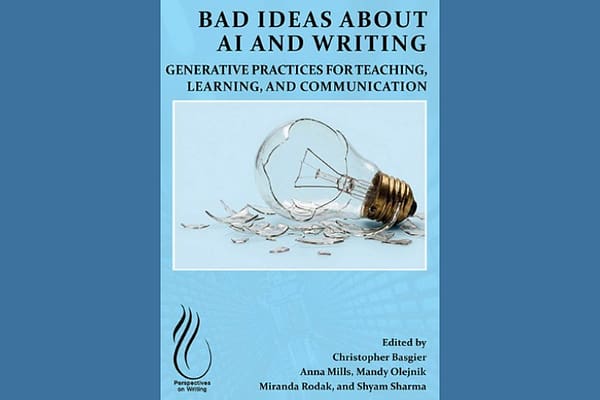
Yeah, well, I wanted to share a book that I’m one of four editors for, which is Bad Ideas About AI and Writing, from the Writing across the Curriculum Clearinghouse. It’s a collection of really short essays that start with a sort of a misconception and then transform that into what we call a generative idea about AI and writing, and writing instruction in higher ed. So it’s really grounded in writing studies, but very practical, very hopeful, and sort of, you know, there’s that tension, that contrarian, like here’s why this is not right, but here’s how we could transform it. And it’s really wide-ranging, and kind of in that critical slash pragmatic middle ground, I would say, where there are different kinds of voices. And so I’m just really excited because I learned so much editing some of those pieces, and I’ve been like, when can I cite this? When, when is it going to be up? And it’s open access, so it’s published now. And Chris Basgier, and Mandy Olejnik, and Miranda Rodak, and Shyam Sharma are my co-editors. And so I’m really excited that that’s out there.

Anna Mills [00:37:10]:

I also am really excited about faculty-led, not-for-profit ed tech. And I do believe in this app that I sort of consulted on, advised on as a volunteer, My Essay Feedback. I’ve been using it for three years now, and it really reduces the instructor labor of overseeing student reflections on AI feedback. So it’s giving automatic credit in the learning management system for participation for the students chatting back, reflecting. And then I get to go in and just see, like, what are they interested in? What kind of feedback did they get? Do I agree with that? Do I want to weigh in? It’s very easy, it’s very user-friendly, and I just love that it’s been shaped by writing instructors and by this ed tech developer, who was a math and music professor at Western Washington University, Eric Keen. So it’s really just like there’s no big slick sales pitch. It’s just, this is a great tool if you want to try it, it works well to reduce instructor labor.

Anna Mills [00:38:15]:

And lastly, I want to share my OER textbook, which is an AI orientation, aiorientation.org. This is really a letter to students about what I think makes sense with AI right now, what I would advise them, where I’m coming from in terms of ethical concerns, kinds of guidelines they can use, what kinds of strategies, how to explore their own ambivalence, how to explore the absurdity of AI, to have kind of a skeptical relationship to it that relishes that absurdity, sometimes. And I feel like it was an intimate project, a vulnerable project. And I think that’s what’s kind of precious to me about it is that, you know, I’ve opened myself up to criticism in many places in it, and I’ve just sort of spoken frankly to them, and I’m waiting to see, like, well, what do you think? What are you going to do now? Is this useful? What would you say back? And I got a lot of great feedback from other educators as I was building it, kind of, publicly, and you know, there was no budget for marketing. So it’s just kind of, it’s living out there. It’s free, it’s available, and I would love it if anyone wants to engage with it, or build on it, or adapt it.

Bonni Stachowiak [00:39:29]:

Oh, thank you so much. Well, it has been an absolute joy getting to have this conversation with you today. And I know I say this a lot, but I really mean it. I feel like it’s just the beginning. So look forward to the next time that we get to talk on or off the air. What a joy it was to get to talk to you today.

Anna Mills [00:39:44]:

Oh my gosh, such an honor. Such an honor and a joy to be in conversation with you. Thank you, Bonni.

Bonni Stachowiak [00:39:53]:

Thank you so much to Anna Mills for joining me on today’s show. This episode was produced by me, Bonni Stachowiak. It was edited by the ever-talented Andrew Kroeger. If you want to go even deeper between the episodes, I encourage you to subscribe to the still somewhat new Field Journal. I’m sending it out each week and sharing what I wondered, what I noted, what I listened to, what I read. And I’m also getting some feedback from you. It’s been a delightful new format for that weekly communication. Head over to teachinginhighered.com/subscribe to start receiving the Field Journal today.

Bonni Stachowiak [00:40:40]:

Thanks for listening, and I’ll see you next time on Teaching in Higher Ed.

Expand Transcript Text

TOOLS

  • Blog
  • Podcast
  • Community
  • Weekly Update

RESOURCES

  • Recommendations
  • EdTech Essentials Guide
  • The Productive Online Professor
  • How to Listen to Podcasts

Subscribe to Podcast

Apple PodcastsSpotifyAndroidby EmailRSSMore Subscribe Options

ABOUT

  • Bonni Stachowiak
  • Speaking + Workshops
  • Podcast FAQs
  • Media Kit
  • Lilly Conferences Partnership

CONTACT

  • Get in Touch
  • Support the Podcast
  • Sponsorship
  • Privacy Policy

CONNECT

  • LinkedIn
  • Instagram
  • RSS

CC BY-NC-SA 4.0 Teaching in Higher Ed | Designed by Anchored Design