Christopher Schaberg talks about his book, Pedagogy of the Depressed, on episode 398 of the Teaching in Higher Ed podcast.
Quotes from the episode
Just talking to students once or twice a week is so important.
-Christopher Schaberg
Christopher Schaberg talks about his book, Pedagogy of the Depressed, on episode 398 of the Teaching in Higher Ed podcast.
Just talking to students once or twice a week is so important.
-Christopher Schaberg
Audrey Watters shares about her book, Teaching Machines, on episode 397 of the Teaching in Higher Ed podcast.
When people try to erase history, they do that to foreclose hope.
-Audrey Watters
If we have a better understanding of the history of educational technology, there is hope.
-Audrey Watters
I do not think that the future is already written.
-Audrey Watters
Amy Lynch-Biniek discusses the ways in which contingency can impact pedagogy on episode 396 of the Teaching in Higher Ed podcast.
To be a teacher in the 21st century, you also have to be a bit of an activist.
-Amy Lynch-Biniek
As teachers we have to find ways to advocate for ourselves, for our students, for our campuses, and for our classrooms.
-Amy Lynch-Biniek
We have to remind ourselves to speak with, not for, others.
-Amy Lynch-Biniek
Begin advocacy by listening.
-Amy Lynch-Biniek
Alex Venet was on Episode 372, talking about Equity-Centered Trauma-Informed Education
Episode 272: Inclusified Teaching Evaluation with Viji Sathy and Kelly Hogan
Episode 89: The Research on Course Evaluations with Betsy Barre
Twitter Thread: Contingent faculty
Conference on College Composition
Jonathan Malesic shares about his book, The End of Burnout, on episode 395 of the Teaching in Higher Ed podcast.
The data seems to suggest that around half of workers are somewhere on the burnout spectrum.
-Jonathan Malesic
In our culture we put a lot of expectations on work to fufill us.
-Jonathan Malesic
We need to see work as the support to whatever is at the center of our lives.
-Jonathan Malesic
Tracie Addy talks about what inclusive instructors do on episode 394 of the Teaching in Higher Ed podcast.
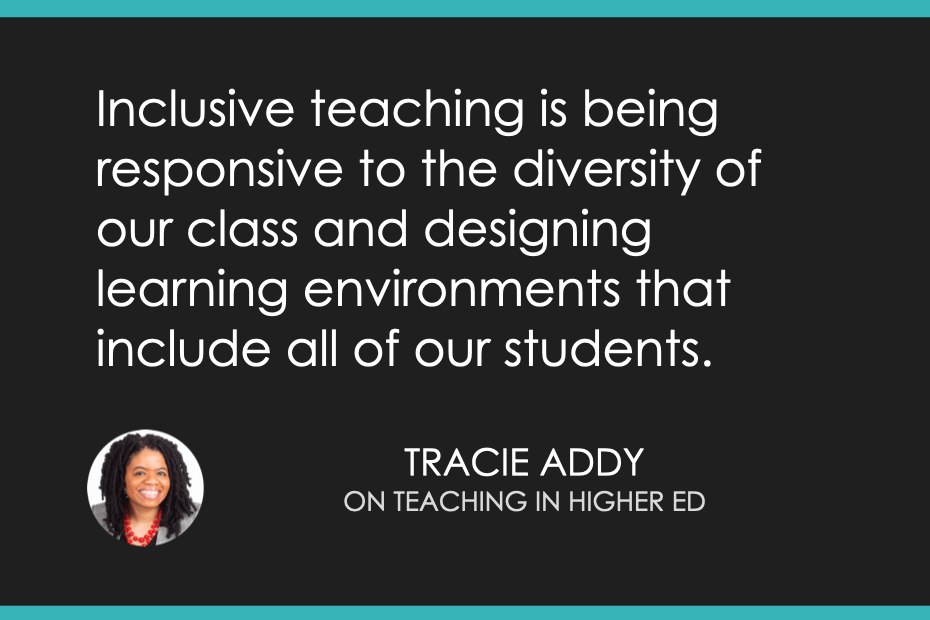
Inclusive teaching is being responsive to the diversity of our class and designing learning environments that include all of our students.
-Tracie Addy
Inclusive teaching allows students to be engaged in an equitable learning environment and feel a sense of belonging.
-Tracie Addy
We can think about our students in terms of the different strengths they bring to the classroom.
-Tracie Addy
I had a lot of experiences as a black female that had a profound impact on me.
-Tracie Addy