• Skip to primary navigation
  • Skip to main content
  • Skip to footer

Teaching in Higher Ed

  • Podcast
  • Blog
  • SPEAKING
  • Media
  • Recommendations
  • About
  • Contact
EPISODE 624

How to Engage Learners in Online Courses with Denise Maduli-Williams

with Denise Maduli-Williams

| May 28, 2026 | XFacebookLinkedInEmail

https://media.blubrry.com/teaching_in_higher_ed_faculty/content.blubrry.com/teaching_in_higher_ed_faculty/TIHE624.mp3

Podcast (tihe_podcast):

Play in new window | Download | Transcript

Subscribe: Apple Podcasts | Spotify | RSS | How do I listen to a podcast?

Denise Maduli-Williams shares how to engage learners in online courses on episode 624 of the Teaching in Higher Ed podcast.

Quotes from the episode
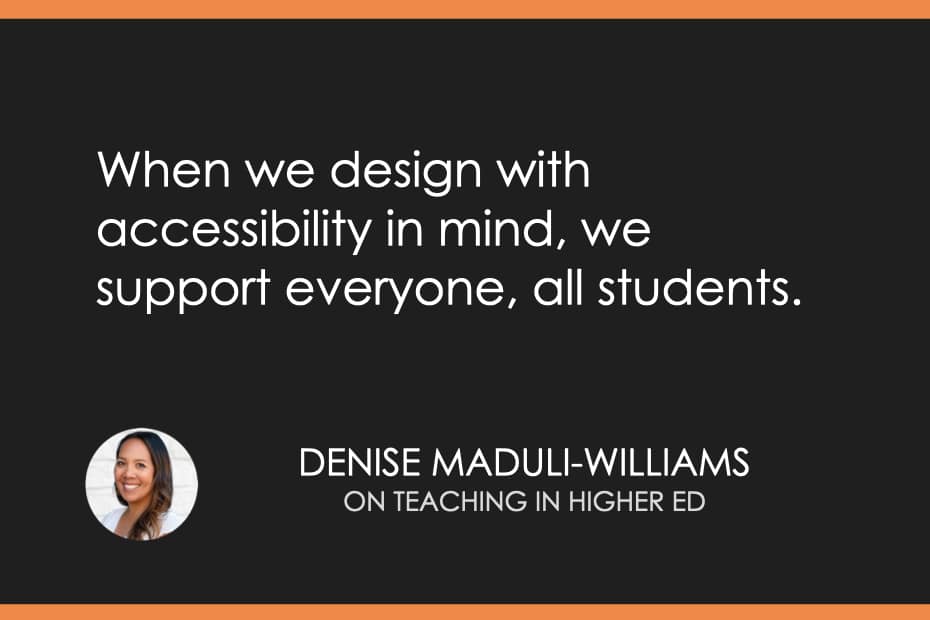

When we design with accessibility in mind, we support everyone, all students.

The very first thing I saw was the online instructor posting this video where she was roller skating in this roller Derby rink and welcoming us online, and that just changed everything for me.
-Denise Maduli-Williams

When we design with accessibility in mind, we support everyone, all students.
-Denise Maduli-Williams

Students who are quieter, whether it's synchronous on Zoom or synchronous in person, they have the opportunity to participate when they're ready and to prepare.
-Denise Maduli-Williams

Resources

  • Denise Maduli-Williams at San Diego Miramar College
  • Denise Maduli-Williams on LinkedIn
  • Supporting ADHD Learners, With Karen Costa (Teaching in Higher Ed Episode 384)
  • Reach Everyone, Teach Everyone: Universal Design for Learning in Higher Education, by Thomas J. Tobin and Kirsten T. Behling
  • The Joyful Online Teacher: Finding Our Fizz in Asynchronous Classes, by Flower Darby
  • Rutgers Online Learning Conference (RUOnlineCon)
  • California Community Colleges Online Network of Educators (@ONE)
  • Universal Design for Learning (UDL) Guidelines
  • Zero Textbook Cost (ZTC) Program
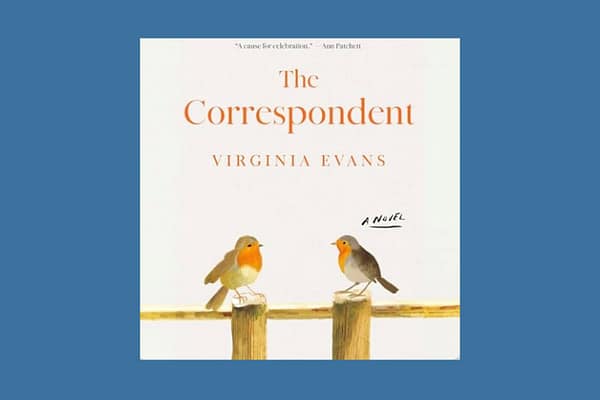
  • The Correspondent: A Novel, by Virginia Evans
  • The Passion Planner
  • Poll Everywhere

ARE YOU ENJOYING THE SHOW?

REVIEW THE SHOW
SEND FEEDBACK

ON THIS EPISODE

Denise Maduli-Williams

Professor

Denise Maduli-Williams is a Professor of English and ELAC (English Language Acquisition) at San Diego Miramar College. She began her teaching journey as a Peace Corps Volunteer in Botswana and has since taught in a range of settings, including a California prison and New York City public schools, before finding her professional home in the community college classroom. Her work focuses on creating human, connected, and accessible online learning experiences for students navigating complex, real lives. She presents nationally and internationally on inclusive teaching, academic writing, and thoughtful, equity-centered uses of AI in education.

Bonni Stachowiak

Bonni Stachowiak is dean of teaching and learning and professor of business and management at Vanguard University. She hosts Teaching in Higher Ed, a weekly podcast on the art and science of teaching with over five million downloads. Bonni holds a doctorate in Organizational Leadership and speaks widely on teaching, curiosity, digital pedagogy, and leadership. She often joins her husband, Dave, on his Coaching for Leaders podcast.

RECOMMENDATIONS

The Correspondent: A Novel, by Virginia Evans

The Correspondent: A Novel, by Virginia Evans

RECOMMENDED BY:Bonni Stachowiak
The Passion Planner

The Passion Planner

RECOMMENDED BY:Denise Maduli-Williams
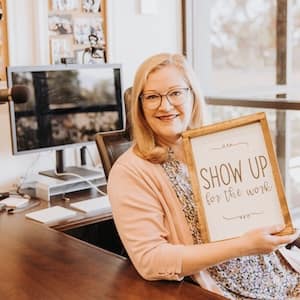
Woman sits at a desk, holding a sign that reads: "Show up for the work."

GET CONNECTED

JOIN OVER 4,000 EDUCATORS

Subscribe to the weekly email update and receive the most recent episode's show notes, as well as some other bonus resources.

Please enter your name.
Please enter a valid email address.
JOIN
Something went wrong. Please check your entries and try again.

Related Episodes

  • EPISODE 189Designing Online Experiences for Learners

    with Judith Boettcher

  • EPISODE 417Liberated Learners
    Terry Greene Square

    with Terry Greene

  • EPISODE 023How to engage students in the classroom and online

    with Jay Howard

  • EPISODE 347Online Culture
    courtney-plotts

    with Courtney Plotts


EPISODE 624

How to Engage Learners in Online Courses with Denise Maduli-Williams

DOWNLOAD TRANSCRIPT

EPISODE 624: How to Engage Learners in Online Courses with Denise Maduli-Williams

Bonni Stachowiak [00:00:00]:

Today on episode number 624 of the Teaching in Higher Ed podcast, How to Engage Learners in Online Courses with Denise Maduli-Williams.

Bonni Stachowiak [00:00:14]:

Production Credit: Produced by Innovate Learning, Maximizing Human Potential. 

Bonni Stachowiak [00:00:23]:

Welcome to this episode of Teaching in Higher Ed. I’m Bonni Stachowiak, and this is the space where we explore the art and science of being more effective at facilitating learning. We also share ways to improve our productivity approaches so we can have more peace in our lives and be even more present for our students. In today’s episode, I’m joined by Denise Maduli-Williams, professor of English and ELAC at San Diego Miramar College. Denise’s teaching journey, as you’ll hear in the interview, spans from the Peace Corps in Botswana to classrooms in prisons and public schools, all of which inform her deeply human and relational approach to teaching in general and online learning specifically. We look at how to design engaging, inclusive online courses that really meet students where they are, both in their own learning and also in their unique contexts. And Denise shares practical strategies grounded in universal design for learning, accessibility, and connection.

Bonni Stachowiak [00:01:42]:

Denise Maduli-Williams, welcome to Teaching in Higher Ed.

Denise Maduli-Williams [00:01:46]:

Thank you so much. I’m so excited to have this conversation.

Bonni Stachowiak [00:01:50]:

And I’m so excited to have this conversation, too. And I would love us to start at the very beginning. Would you tell us about the first time that you taught?

Denise Maduli-Williams [00:01:59]:

Sure. So my first teaching experience was actually a student teaching experience, and it was at- It was on the medium security side of a California prison. And at that time, I was an undergrad, and you kind of just stumble into things. I had been volunteering at a shelter, and then somebody there was volunteering at the prison, the local prison. So then I started volunteering there, and then I found out that there were actual classes and an education side, and I was doing a TESOL certificate at the time. So I don’t even remember how it happened, I kind of forged some way into a student teaching position at the prison, and it was one of the best teaching experiences I’ve ever had. I learned so much there about connecting with students.

Denise Maduli-Williams [00:02:49]:

I had a great mentor teacher there who was the main teacher at the, at that educational facility. And the students were amazing. And I just remember one of my funniest memories was at the end of our certificate, we had to do a teaching practicum, and everyone else was kind of finding something at the local elementary school, or a volunteer at the library. And I remember going to my professor and saying, ” Oh, I’m already, I have one, at the California Men’s colony”. And he’s like, hang on, what are we doing? What’s happening? And we went through a lot of hoops to have him come in and observe me there. And thinking back on that, it really affected how I learned about the importance of human connection in the classroom.

Denise Maduli-Williams [00:03:35]:

And it was really one of the best teaching experiences I ever had. And a part of it was that I had a great mentor teacher who was teaching there.

Bonni Stachowiak [00:03:43]:

There might be some people listening who could not be familiar with TESOL. Tell us just briefly about what TESOL is, and then I have tons of questions. But for anybody who may not be familiar with the acronym. 

Denise Maduli-Williams [00:03:53]:

Of course, I hate acronyms. It’s teaching English to speakers of other languages. So that has been most of my career is teaching English to students who are multilingual, whether those are new immigrants, refugees, international students, students abroad.

Bonni Stachowiak [00:04:10]:

And is that the discipline that you were teaching in that context?

Denise Maduli-Williams [00:04:13]:

It was. It actually was, yeah. So, English language learners in that setting.

Bonni Stachowiak [00:04:20]:

And what’s fascinating to me is thinking about, since this was your first time, did you still have to fight against thinking of students as a monolith, as if they’re all the same? Or did, did you actually maybe get to skip some of the lessons the rest of us maybe had to learn? Do you think that, that, that that habit wasn’t a habit you had to break, or was it still something that that became, or still maybe still is a challenge today?

Denise Maduli-Williams [00:04:45]:

I think it’s a good question, because in a setting like that, it is, in a sense, more monolithic. You’re walking into a setting where people are dressed the same, and they’ve gone through all of the situational things they need to to be able to pursue education inside. And the classroom, obviously, is very regimented with access and things. So in that sense, it’s very structured. But, yeah, learning more about people and doing group work and having people share their stories, it’s one of those things where you start to realize everyone has a different story and different ways of learning and different motivations. So thinking back on, that’s really interesting.

Bonni Stachowiak [00:05:25]:

And tell us more about your mentor and the lessons that still stick with you today that you learned from them.

Denise Maduli-Williams [00:05:31]:

Sure. I think the most important thing was that connection. I mean, we would walk into the setting, and she knew everyone’s name, and she’s asking them about who visited them. And we’re doing really fun activities where people get to bring in their backgrounds and their stories. The motivation is always high in this English language learner classroom, which is nice. I think that’s one of the benefits of being a TESOL instructor. I don’t have to force anyone to understand why this content is so important. You leave English to survive in these settings and are highly motivated. So that motivation, inner motivation, is always there.

Denise Maduli-Williams [00:06:07]:

But she also really found a way to make things fun. I remember doing things, this is decades ago, Bonni, decades ago. But we were doing things with comics and drawing and stories, and it really was very different from the kind of educational setting that I grew up in, which was kind of testing and sitting in rows and this kind of situation. So it really did open my eyes, and that impacted all my future teaching situations for sure.

Bonni Stachowiak [00:06:37]:

The, so for the listeners that are new to learning about you today, what you and I share in common, that we teach predominantly online these days, obviously, that could change on a dime. But as of this, and that’s another area where I see people who maybe don’t do it as much, can really get caught in these traps of thinking of learners in more of transactional ways. You know, complete incomplete scores, that sort of thing. Did you, when you started to learn to teach online, did you have things you needed to unlearn there, or were you able to bring more fluently over some of those things from those early lessons in teaching?

Denise Maduli-Williams [00:07:15]:

I think it was a very big learning curve. After that situation, then I taught overseas in the Peace Corps, and I was in a very small village. And then after that, I taught in New York City public high schools. So these were very hands-on teaching situations and all very different. And being a Gen Xer, we didn’t have online classes. I never had taken an online class. So I think it’s really challenging to understand how online learning can be interactive and community-driven. And you can know your instructor if you’ve never had that experience as a student.

Denise Maduli-Williams [00:07:48]:

So luckily for me, when I started getting interested in teaching online or just learning about online education years ago, I was taking- facilitated online classes, and that was through that, let’s see, what does that acronym stand for? CVC: California Virtual Campus Online Network of Educators, we call it @One, and I actually wrote about this recently. I logged on to my very first class to learn about how to teach online. And I was like, I know nothing about this, I’m trying to find the password, and I’m logging in, and I’m just like, is this going to be like some kind of correspondence course? What’s happening? And I logged in. The very first thing I saw was the online instructor posting this video where she was roller skating in this Roller derby rink and telling us, you know, welcoming us online, and that just changed everything for me. I had never thought that’s what it would be like online, and I had no frame of reference.

Denise Maduli-Williams [00:08:42]:

If we haven’t been in an online class that’s facilitated and community-driven, there’s just no way to know. So I had a lot of learning to do. But it was really fun to see the connections are the same and that can still be built online. But I think if I hadn’t had that experience, I just wouldn’t have known how to build that.

Bonni Stachowiak [00:09:02]:

When I think about my background in instructional design, which again is also dated back a number of decades, but there’s a guy, David Merrill, who really taught me this, this stays to me very much still to this day, that when you’re teaching someone how to do something, yes, show them what it looks like when it’s done, when it’s complete, if it’s something that’s a process oriented things going through the steps or whatever. But also equally important, is to show them what it doesn’t look like or when they’re, when problems incurred so that we could learn how to troubleshoot things. I’m totally oversimplifying his lessons here, but when I think about online learning, sometimes it’s a problem because people haven’t experienced it. But now, today that the age that we’re living in now, probably people have experienced something resembling it, but not really. And so it’s like they learned a lot of what not to do, but not even realizing that that’s not what to do, but just thinking that’s all that’s there. What are some sources for you that you think might help people be able to expand their imagination for what’s possible? Any stories you want to share with us, where I think you mentioned it earlier, just like, how do I make the connections when it seems like so hard to do? Especially because people have had such bad experiences in past online classes so many times.

Denise Maduli-Williams [00:10:20]:

It’s a good question. This is a real tangent, Bonni, but let me just say this. During COVID I just remember taking group fitness classes online and it was just so interesting because at that time in higher education I had been teaching online before, so I, and many of us that have, I’m sure you had the same experience, were really tasked with helping our colleagues shift 100% online. Colleagues who were previously not interested in it. And that shift happened literally in a heartbeat. In a week, we were 100% online. People who had never gotten on Zoom or been on canvas were tasked with trying to figure this out. So there was a lot of just build as you go, and an enormous lift for everyone, students, parents, faculty.

Denise Maduli-Williams [00:11:07]:

But I remember, I had been going to the gym, taking different classes, and then I remember just, this is again going to date me, Stepper Robin’s class. And I remember following this one person on YouTube, and he was like,” all right, we’re just going to do it”. And he just had his phone up, and suddenly we were doing it, and then he couldn’t see us. And I remember this was one of the things where people felt like, well, if I’m just looking at black boxes or students are logging and I don’t see them, I don’t feel the community. But that instructor was so excited, and we were like putting hearts in the chat, and he’s like shouting us out. And I just remember thinking, this is a great model.

Denise Maduli-Williams [00:11:45]:

Group fitness online for me was just that flip. There was no kind of, I don’t know if we should do it, or we don’t have the tech, or I can’t see my, the people in the fitness class. Everyone just did it. And I remember still feeling that connection. And I felt the way that that person was interacting. He felt connected with us as well. So I think that we have to find ways that might not be a typical education class, but find a way to experience other kinds of learning because it gives us more empathy and understanding of how those, those connections can still be formed.

Bonni Stachowiak [00:12:18]:

I’m hearing illustrated in your story that yes, he brought energy, passion, but also a belief that what he was about to embark on, you were with him, that sort of thing. What sorts of mind shifts have you found really important, either for you and your teaching or as you work with other colleagues to- when we shift to not having the benefit of that synchronous connection like we might in a group fitness class, but to, gosh, what, what, what advice do you have for, okay, we’re not all there at 2 pm or what have you, anything come to mind for ideas for how to, how to really think that through?

Denise Maduli-Williams [00:12:59]:

Yeah, I think this has a little bit to do, my thoughts on this, is my own experience. I was particularly shy in classes when I was growing up, and I was kind of quiet. And I mean, even now, when I went back and was working on my graduate work, we’d be in a discussion with people I all knew. You know, doctoral classes are kind of small, and you have a cohort, but I would still be like, my heart beating when I wanted to say something, and super nervous and not speak up. Right? So I think that we can remember that in an online asynchronous class, that students who are quieter in that synchronous, whether it’s synchronous on Zoom or synchronous in person, they have the opportunity to participate when they’re ready, and to prepare for that. So I, I am less worried about being online at the same time as my students, actually prefer asynchronous to synchronous.

Denise Maduli-Williams [00:13:55]:

So for me, being on with 30 students on Zoom for an hour is less interactive. I know it sounds weird. No, I know, like stay with me, is less interactive for me than having a community-driven discussion board for a week, in one week module, and everyone can post when is best for them. And especially for English language learners, they have prepared what they want to say, whether it’s text or video and audio, and they feel confident in saying it when they’re ready. And then people have the time to respond. And in the end, we have 30-something beautiful voices and interaction. I don’t get that same interaction sometimes in a synchronous setting or even in person.

Denise Maduli-Williams [00:14:39]:

Even though we all have so much experience with active learning and groups and all of these things, we still can end up in a classroom where the loudest, quickest, extroverted students are the most present. I really feel online that I get a more equitable experience with my students’ voices, which is one of the reasons why I like it so much.

Bonni Stachowiak [00:15:01]:

This doesn’t happen to me that often, but I’ll admit, just to you, I mean no one else is listening, right? Just to you.

Denise Maduli-Williams [00:15:06]:

Just us. Why?

Bonni Stachowiak [00:15:08]:

Sometimes I get a little spicy because I think when, when people say, oh, you just can’t build the relationships online. And I go, okay, how many pets can you name of the students in your class? Because I know all their pets, and every single one of them, and not only can I name them, but I’ve seen multiple pictures of them, that kind of stuff. So I really- that, what you said resonates with me as far as that goes. I will say that I do, I prefer myself, if I were to get to pick, I like having the option where they can join synchronously, because, back to your group exercise class. I’m a lot… I’ve actually been bonding a lot with my, my, my mom lately.

Bonni Stachowiak [00:15:51]:

Listeners, if you listen regularly, will have heard that there’s been some health struggles going on in my extended family, and so she and I get to spend a lot of time together, and a lot of that time is at Jazzercise down in Oceanside. And it’s literally, because it has been such a stressful season for me this so far this year, that is the time in my life where it’s, it’s really the only time where I’m fully present, because I’ve been working out so hard. There’s nowhere else for my brain to worry or stress. It’s just like, if you’re gonna keep up, this is what you know, you’re gonna need to be present for this. And I just love it too, cause there’s mostly people that are older than me.

Bonni Stachowiak [00:16:28]:

There’s a woman who takes that class, she’s 96 years old, and she’s in the front row every single time. And she’s just going- and I gotta tell you, if you’re not 96, and you’re listening and, and you go to an exercise class where that woman… I mean, it’s going to push you that much harder. And I do find students who, despite the fact that they know that I’m going to read their assignments, watch those screencasts.

Bonni Stachowiak [00:16:55]:

I’m very invested in individualized feedback to them. I get such- I get enriched by it, and they can tell that. They still, they don’t feel it. They don’t have the same sense of connection if the synchronicity isn’t there. So my preference is always just that, be that, that connection.

Bonni Stachowiak [00:17:14]:

Even though I totally know what you’re saying. And it’s not about what my preferences are. How about what the students want and need? You know, but some of them really do. Some of them really do, really want that. And I think especially because they, a lot of them didn’t have that during the peak Covid times. They just didn’t get to have those experiences.

Bonni Stachowiak [00:17:33]:

So when they realize what’s possible, then it kind of makes them hunger for that. What they might perceive more as mentoring. Even though, I mean, it’s really hard to build the trust that you’re actually there and that you’re actually getting to witness their learning in ways that they may just not realize. And that actually brings me to, I don’t want to miss out talking to you or getting people to benefit from your expertise when it comes to accessibility. Your role, part of your role, is helping many of us do this better. 

Bonni Stachowiak [00:18:01]:

What are, I’m going to- I am asking you so many broad questions. I’ve been so excited about this conversation since you booked the time. But I don’t know, should we pick three? What are your top three things, Denise, that if you’re like, if I could tell faculty, here’s, you know, really thinking about accessibility, here’s three things I’d really, really want you to be thinking about?

Denise Maduli-Williams [00:18:21]:

My gosh, this is a big topic. Accessibility is something that I have just come into, really learning about and being dedicated to within the last handful of years. And now it’s really upon us in higher education to make sure that all of our digital content is accessible. And especially if we’re teaching online, we would be concerned with that. I think for me, the number one thing, and this is broad, not a specific topic, is knowing that when we design with accessibility in mind, we support everyone, all students. I very mistakenly thought, unless somebody sent me an accommodation letter, and then I have one student who has one need that I don’t really need to worry about that. And we know now that, I think it’s one in four Americans has some sort of disability, that students underreport their disabilities. That, a lot of the work that I have learned about universal design for learning, I just listened to Karen Costa’s episode with you on ADHD, that all of these things support all students.

Denise Maduli-Williams [00:19:21]:

And we also don’t know who really needs the support. So for me, the change has been to embed it from the beginning, because it is a little scary to have someone come in and say, ” Hey, you need to make your course accessible”, after the fact and try to fix all these things. So I would say, just start with knowing this helps everyone, and then, starting with some of the universal design principles of adding choice for students. Right? So that everything isn’t, especially online, can be very heavy text-based reading and writing. So, is there a choice for audio? Is there a choice for video? Do we have flexible deadlines in ways that students can follow structure during your module in your course? That also catch up or complete at their own time? Those kind of very practical, hard, kind of accessibility things are not as hard as they sound. I do a lot of workshops on these very basic things, like captions, alt text, heading structure, lists, and links, all in color contrast. So they can be overwhelming.

Denise Maduli-Williams [00:20:23]:

But what I would say is that when you learn about them, and there’s lots of people out there doing great workshops. I know that Thomas Tobin has been doing a lot around UDL and those very specific accessibility things like alt text and color contrast. What I realized about myself, I was making it a lot harder for myself by doing a lot of weird things to make things fancy. Like, I was adding highlighting and colors and doing, click here, click here, like all these weird things. Adding emojis for the bulleted lists, right? And so much now is actually formatted for accessibility if you use the tools properly in Canvas, which is what we use at the California Community colleges for our LMS in Word and PowerPoint, you know, the bulleted formats are there, the headings are there.

Denise Maduli-Williams [00:21:10]:

Instead of doing like, I would be highlighting in pink and then, add purple because I like purple, green for go, and then it’s like color contrast, it’s out the window. Just use black and white, it’s better for everyone. And you can do small little things. So I would say learn what you can.

Denise Maduli-Williams [00:21:25]:

Small steps make a difference, and I think that less is more. I found that I was, once I learned about each accessibility topic, I was able to undo the extra work that I was doing to make it fun, and then not accessible in the end.

Bonni Stachowiak [00:21:41]:

Yeah, that thinking about the making it fun, you remind me a bit of, I’m gonna date myself here, but people were really, really into animations and PowerPoint when you heard, wow, things can spin in. And it’s that, that sort of thing, that less is more can be such a powerful thing, and then actually make it that much more accessible, like you said. I mean, it just really makes it simpler for us. You mentioned audio and video. One of the things that I celebrate about the California Community Colleges is just the deep commitment to open educational resources. And in what ways have you found that commitment, and therefore, maybe greater access to people that are teaching in that big system, to be able to have things like audio and video, and text space to make those choices more profound? 

Bonni Stachowiak [00:22:32]:

As in, I’m inviting you to share anything that you would like to, about open educational resources as an avenue for making UDL a bit easier. What have you found there?

Denise Maduli-Williams [00:22:40]:

Yeah, it’s one of those things that just, it makes it accessible for all students. Right? One of the goals we have in, in my district, and I think our entire system is, is OER, and actually we have ZTC, which is zero textbook, I don’t know what the C is for… 

Bonni Stachowiak [00:22:58]:

Cost. Cost!

Denise Maduli-Williams [00:22:59]:

Thank you.

Bonni Stachowiak [00:23:00]:

I love that I knew it! I win the prize! 

Denise Maduli-Williams [00:23:03]:

Oh my gosh. Yes. So, it’ll actually be on the online course schedule when students go to register. If your course is only OER materials, it’ll have a little ZTC icon, and students are searching for this course, for these courses where they know they don’t have to pay extra. So, there are so many resources for open educational resources. What I love about it is that, for example, in my Writing classes, just kind of general comp classes that I teach online, I don’t need to find a textbook. Students buy the textbook. Students are waiting for the textbook.

Denise Maduli-Williams [00:23:39]:

I can go in, there’s so many resources that I can find online. I can link to it. Students can open on their device. I can use the chapters and the pieces that I need that just pertain to me. And it is… Then it’s also accessible in that if students need to listen to it, the screen reader is going to say it for them.

Denise Maduli-Williams [00:23:59]:

If there’s a video attached that’s already built in, there’s going to be captions. So, all of these things I do want to say, there is always a list- a lift for faculty that we can’t ignore that. So, in order for me to embed these resources, I have to go and do the work to research and find the ones that are going to fit my class and fit my curriculum. So I don’t think we should ignore that. Any of these things requires a lift from faculty to do this, I guess, extra work. But then it’s also one of those things, once I find the pieces that fit my curriculum, I can roll those over and to kind of stay in the loop and update them as needed. But it has been an immense source of equity and accessibility for my students.

Denise Maduli-Williams [00:24:39]:

They are so happy to have a course where they don’t have to worry about it. And I know just from my personal experience, the courses that have that ZTC icon are the ones that fill first.

Bonni Stachowiak [00:24:48]:

What does the icon look like?

Denise Maduli-Williams [00:24:50]:

I think it- Well, I don’t know if it’s new, but I remember early on it was like a, it was like a dollar sign with a cross through it. It used to be, and I’m not sure if that’s still it, but they are heavily highlighted in this course schedule for students to know.

Bonni Stachowiak [00:25:04]:

I can still remember a session from faculty from Santa Ana College, and up here in Orange County, and there were students who came to and talked about that. So I’m sure I’m actually picturing this. I don’t know if I’m picturing it because you just made me imagine it, or if that actually was it. But just the power of that. I mean, these students telling such incredible stories about the difference that that made and that. I love that you didn’t know the acronym just because it’s so embedded. That’s just like, that’s how it is.

Bonni Stachowiak [00:25:29]:

And that’s, that’s what we go for. I got to read about you in Flower Darby’s book about online teaching. So I’m going to read your words. This is very meta, your words to you, out to the people. She, you wrote, and she includes in her book. Quote: I feel like I know my online students better than my in-person students. I have more interactions with them. They get to know more about me through the types of activities we do, and I’m able to individualize content, links, and resources for different students’ needs. 

Bonni Stachowiak [00:26:02]:

And, before we get to the recommendations segment, I’m wondering if there’s anything else you want to advise us on, on the how do you get to know things about them? How do they get to know things about you? Such that it’s more embedded, though, in the class and doesn’t seem like something that’s getting added on, because sometimes I think students then see that as fake or artificial ways to embed those interactions, those opportunities to get to know each other into the class.

Denise Maduli-Williams [00:26:27]:

Sure. Because I feel like sometimes we learn about something and we’re like, we’ll tack it on at the very beginning, and then maybe at the end, right? But how do we continue that? And I think it may be easier for someone who’s teaching writing or English to kind of embed these things into the course content. I talk to my fellow colleagues in STEM a lot, and sometimes they’re like, how are you going to build this in chemistry? You know, and that’s something that can be a challenge. But I think that are small ways. When I give weekly announcements out, a lot of times I can see announcements that come out for students. I’m talking about online.

Denise Maduli-Williams [00:27:02]:

So, in my online course, I want to give weekly announcements to greet them to the new week and then reminders throughout the week of what’s due. Right? So those can become very formal and structured if you’re not careful. Just like, welcome to week one, here’s your list of activities: do these readings, complete these assignments. As opposed to starting with how’s it going? It’s raining outside, and I was just walking my dog, Bella. Everyone in my class knows my dog, Bella, and now I have to wipe her muddy feet.

Denise Maduli-Williams [00:27:28]:

Okay, and now we’re going to work on, talk about this: to share an announcement, and highlight a couple of the cool things that students mentioned in the discussion board. Right? So, trying to embed my own personal experiences and messages to them the same way you would do in an in-person class. I think that’s the difference when you, when I walk into my in-person class, I don’t just walk in, put my thing down, and then list what we’re going to do. I’m like, “hey, how’s it going? Oh, you do have a coffee too. Oh, I just saw you outside. Oh my gosh, I can’t believe the parking was so crazy.”

Denise Maduli-Williams [00:28:00]:

Like, all of that can come across in the online class as well. And I think I’ve been doing, kind of, these small things to personalize some of the assignments and activities that used to be very structured before. So, I have always had in the comp classes things like a research paper or rhetorical analysis essay, or how is writing embedded in your life? And lately I’ve been having students do small interviews for each of these things so that they can bring in, you know, how? Please interview someone that you know, and anyone can be an expert. Your grandmother is an expert; you don’t have to go find a doctor about how they use writing and reading in their life. And then you’re going to add that into the essay we were already doing, based on the academic readings we’re already doing. For me, I believe that academic writing can be an extension of personal writing.

Denise Maduli-Williams [00:28:51]:

It’s not separate, so bringing that in. And I’ve also been doing this fun thing at the end of quizzes and just kind of comprehension things that I sometimes do in my classes. For example, English language learners sometimes will do a grammar or like a sentence thing, you know, because they’re practicing language learning. But at the end of that, I’ll just have the question, tell me something positive that’s going on with you this week, or what’s something that’s bringing you joy? And I just think it’s funny because I’m sure they’re, you know, I could picture them going through this thing online, and then all of a sudden they’re doing sentence structure and fragments. And then at the very end, it’s like, what’s something good happening out of the blue? But everyone always writes the most amazing things. And we’re still doing the academic work, but we’re learning and finding ways to connect with each other that way. Again, same thing as I would do in an in-person class.

Denise Maduli-Williams [00:29:38]:

In person, we’re talking about reading strategies. But as the class ends, everyone have a great weekend. Anyone doing anything fun? What’s happening? So I think we just need to find ways to remember what we do in person and know that we can bring that to our online settings.

Bonni Stachowiak [00:29:51]:

I took a class, an online class from Sean Michael Morris, ages ago, and one of the first activities that he had us do was take a picture, or some people did a video of wherever we were. And it’s just that, that reminder of it, and somebody did it. She rode a motorcycle, and she literally recorded a video of herself.

Denise Maduli-Williams [00:30:09]:

Oh my gosh. So cool!

Bonni Stachowiak [00:30:11]:

I was, mine was relatively boring because it was a picture of where I was at my home office or whatever. But yeah, whatever, whatever you can do to create that sense of context. I so enjoyed getting to watch a video online of you and your colleague Dayamudra, and you exchanging all these ideas about how in your respective disciplines, you are building such richness for that engaged kind of learning. I do have to tell you, before we get to the recommendation segment, I found out something we share in common through that video. We both wore blue mascara in high school.

Denise Maduli-Williams [00:30:47]:

Yes, absolutely.

Bonni Stachowiak [00:30:49]:

I was listening to the video in my car, and I just laughed and laughed and laughed when I heard that. Oh so perfect!

Denise Maduli-Williams [00:30:58]:

It was a staple in high school.

Bonni Stachowiak [00:31:00]:

It really was. It really, really was. It’s too funny. Before we get to the recommendations segment, I wanted to take a moment and say thank you to Poll Everywhere and share a tip. And is something that I do a couple of times a month to thank them for their partnership, and it is so easy to do. I have an entire list of all these ideas of ways that we can use Poll everywhere, and if you have ideas, by the way, send me an email at feedback@teachinginhired.com, because I’d love to share some ideas from listeners as well. This sounds simple, what I’m about to share, and it is simple.

Bonni Stachowiak [00:31:39]:

That’s the beauty of it. You can embed polls directly into your slides, whether that’s PowerPoint, Google Slides. I embed mine in my beautiful dot AI slide decks, and pretty much if an embed code is feasible in whatever tool it is that you’re using, it is going to work. And I really enjoy that seamless way of not having to stop sharing my screen, if I’m on Zoom, for example, or online in some other way, or in a setting where I might be presenting on campus, then having to get out of that and then go over to the other thing, it just makes it so much easier where it is seamless and it pops right up. The other trick that, again is easy once you learn how to do it, but it depends if you have this equipment, I really enjoy using an iPad alongside my computer, and I learned about a lot of this sort of behind-the-scenes, what does it look like, from Tolu Noah. 

Bonni Stachowiak [00:32:40]:

She’s been on the show many times before, and she’s shown her setup, where she’ll have the iPad there, and she’ll also have it on her big screen monitor. So what I enjoy doing is sharing the screen of the iPad as what the participants see. And then, that frees up my big screen monitor for things like the chat, for things like another window of Poll Everywhere, where I can be activating and deactivating the polls very easily and seamlessly. And that just makes it completely, that much more smooth sailing. But if you’ve not done this sort of thing before, I would say just start with embedding poles that embed, embed, embed, Poll Everywhere, polls is a great technique to use. Get yourself comfortable with that.

Bonni Stachowiak [00:33:34]:

And then if you do have a tablet or another kind of device, and you want to start practicing with that. is a lovely add-on as well. So thanks again to Poll Everywhere again, and we’ll see in a couple, two, three weeks for the next tip. All right, Denise and all the listeners, of course, have I ever got a recommendation? It is the audiobook of The Correspondent, by Virginia Evans. I have been hearing about this from people on Teaching in Higher Ed. I’ve been hearing about this from all the top book lists out there. And it’s, this book’s been intriguing to me, but I just hadn’t picked it up until recently. And I want to strongly urge people to listen to the audiobook.

Bonni Stachowiak [00:34:20]:

I have a hard time sometimes listening to audiobooks because I’ll space out and not really be able to come back to the plot. I’ll start to wrestle with some problem and just, just have to rewind, you know, 20 or 30 minutes, which is really not great when you’re listening to an audiobook. In this case, I’m completely captivated because The Correspondent is a fictional work, and it’s about a woman who writes a lot of letters. Her life is built around letters, and then people writing her back, and the voices change depending on who the author of the letter is. And I am finding myself, it’s been a while, where I just can’t wait until I either get in the car or go for a walk, do some laundry, to be able to get back into this main character’s world. All the letters that she’s writing, and then all the people that are writing, writing back to her. I cannot recommend it enough.

Bonni Stachowiak [00:35:13]:

The Correspondent, the audiobook version, highly, highly, highly recommend. And now I get to pass it over to you, Denise, for whatever you’d like to recommend.

Denise Maduli-Williams [00:35:23]:

Sure. Just quickly, I have been hearing a lot about that book, and I actually, this wasn’t my recommendation, but on, I used the Libby app to hear and listen to books, and I had put in, I had reserved it both under audio and paper, which is what I do. Not paper, but-

Bonni Stachowiak [00:35:39]:

Yeah, digital.

Denise Maduli-Williams [00:35:40]:

Yeah, digital to see, like, just to see whatever comes in first. But now I’m going to make sure I do the audio. I’m excited.

Bonni Stachowiak [00:35:45]:

It is. We talked off-air. Denise likes audiobooks like I do, but the narrator’s voice makes such a difference to both of us. And it, I mean, I’m telling you, they, it is so good. So good.

Denise Maduli-Williams [00:35:56]:

I love it. I love it. Okay, well, my recommendation, it’s here on my desk is, and I know people have done different analog planners and things, but this is The Passion Planner. So the Passion Planner is available now, I sound like a commercial; it’s not meant to sound like a commercial. I’ve just been using them for a long time.

Denise Maduli-Williams [00:36:14]:

You can get like, you know, paper copy, but also they have digital ones, and they also have lots of free digital downloads. And everyone’s planner experiences are different. But the one thing, the one reason why I like the Passion Planner is that they have a section for pretty extensive monthly reflections between the months, as well as a passion roadmap in the beginning. And I just really love that aspect. I sometimes pull some of the questions from the reflections for my students for the end-of-month and end-of-module reflections. But it’s just, it’s a great planner. I sometimes come and go from it. But I really like those, those monthly reflections that are in there. So I highly recommend it.

Bonni Stachowiak [00:36:49]:

I love it. Well, it has been so delightful to not only get to have this conversation with you today, but I encourage people to follow you on LinkedIn because it’s always fun to get these behind-the-scenes glimpses of your teaching and things that you’re curious about. And then so fun to see your colleagues on that video. Certainly, if video is available still publicly, I’ll put a link to it because people, it, it’s totally worth watching. What we didn’t even get a chance to talk about today, which I guess is just an excuse to have Denise back, but they talk a lot in the video about how they’re handling artificial intelligence. And I thought there was a lot of wisdom there. Really good things to be thinking about. So until the next time, thank you so much for your generosity and for coming on the show.

Denise Maduli-Williams [00:37:27]:

Thank you so much for having me. Bonni, it’s been a pleasure.

Bonni Stachowiak [00:37:32]:

Thanks once again to Denise Maduli-Williams for joining me on episode, episode 624 of the Teaching and Higher Ed Podcast. Thanks also to Poll Everywhere for being such a great partner and letting me share all these terrific tips on how to use Poll Everywhere and polls in general more effectively in our teaching and learning. Thanks to each of you for listening. Today’s episode was produced by me, Bonni Stachowiak. It was edited by the ever-talented Andrew Kroeger. And if you have yet to rate or review this show on whatever service it is you use to listen, I highly encourage you to do that so that more people can find out about Teaching in Higher Ed. I’ll see you next time on Teaching in Higher Ed.

Expand Transcript Text

TOOLS

  • Blog
  • Podcast
  • Community
  • Weekly Update

RESOURCES

  • Recommendations
  • EdTech Essentials Guide
  • The Productive Online Professor
  • How to Listen to Podcasts

Subscribe to Podcast

Apple PodcastsSpotifyAndroidby EmailRSSMore Subscribe Options

ABOUT

  • Bonni Stachowiak
  • Speaking + Workshops
  • Podcast FAQs
  • Media Kit
  • Lilly Conferences Partnership

CONTACT

  • Get in Touch
  • Support the Podcast
  • Sponsorship
  • Privacy Policy

CONNECT

  • LinkedIn
  • Instagram
  • RSS

CC BY-NC-SA 4.0 Teaching in Higher Ed | Designed by Anchored Design