• Skip to primary navigation
  • Skip to main content
  • Skip to footer

Teaching in Higher Ed

  • Podcast
  • Blog
  • SPEAKING
  • Media
  • Recommendations
  • About
  • Contact
EPISODE 606

An Educator’s Guide to ADHD with Karen Costa

with Karen Costa

| January 22, 2026 | XFacebookLinkedInEmail

https://media.blubrry.com/teaching_in_higher_ed_faculty/content.blubrry.com/teaching_in_higher_ed_faculty/TIHE606.mp3

Podcast (tihe_podcast):

Play in new window | Download | Transcript

Subscribe: Apple Podcasts | Spotify | RSS | How do I listen to a podcast?

Karen Costa shares about An Educator’s Guide to ADHD on Episode 606 of the Teaching in Higher Ed podcast.

Quotes from the episode
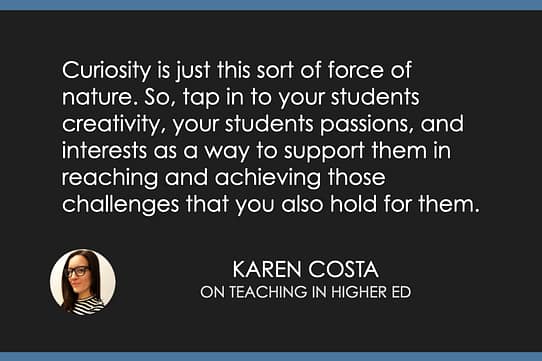
Curiosity is just this sort of force of nature. So tap in to your students creativity, your students passions and interests as a way to support them in reaching and achieving those challenges that you also hold for them.

Curiosity is just this sort of force of nature. So tap in to your students creativity, your students passions and interests as a way to support them in reaching and achieving those challenges that you also hold for them.
-Karen Costa

That's a heavy thing for folks with ADHD to carry, that we are a burden on the other students in the classroom, that we are a burden on our teachers. And that is simply not true.
-Karen Costa

What we know now is that many times those are what are called stims in neurodivergent and ADHD and autistic communities. And those are actually a way that a lot of folks help themselves to stay present and regulated in their bodies so that they can direct their attention to the teacher or to the task at hand.
-Karen Costa

The best thing we can do to make the course real is as an instructor to be present in that online course.
-Karen Costa

Resources

  • An Educator's Guide to ADHD: Designing and Teaching for Student Success, by Karen Costa
  • 99 Tips for Creating Simple and Sustainable Educational Videos: A Guide for Online Teachers and Flipped Classes, by Karen Costa
  • Episode 577: Teaching and Learning When Things Go Wrong in the Classroom with Jessamyn Neuhaus
  • Snafu Edu: Teaching and Learning When Things Go Wrong in the College Classroom, by Jessamyn Neuhaus
  • Episode 578: Learning to Teach, Design, and Rest from Nature with Karen Costa
  • Community of Inquiry Checklist, from Karen Costa
  • Belmont University
  • The Canary Code, by Ludmila Praslova
  • Blackbird – The Harvard Opportunes
  • AP 100 Photos of 2025 The Defined the Year
  • Hard Core Literature

ARE YOU ENJOYING THE SHOW?

REVIEW THE SHOW
SEND FEEDBACK

ON THIS EPISODE

Karen Costa square

Karen Costa

Faculty Development Facilitator, Adjunct Faculty, Author

Karen Costa is a faculty development facilitator specializing in online pedagogy and trauma-aware higher education. Karen loves leading faculty learners through fun, interactive, and supportive professional development experiences. Karen’s first book, 99 Tips for Creating Simple and Sustainable Educational Videos (Stylus, April 2020), focuses on helping faculty and teachers to make creative use of videos in their classrooms. Karen is involved in various faculty development initiatives including as a facilitator for the Online Learning Consortium, Online Learning Toolkit, and Lumen Learning. She spent four years as a regular writer for Women in Higher Education. Her writing has also appeared in Inside Higher Education, The Philadelphia Inquirer, On Being, and Faculty Focus. Karen graduated from Syracuse University with a B.A. in sociology. She holds an M.Ed. in higher education from the University of Massachusetts-Amherst and a CAGS in educational leadership from Northeastern University. Karen has a Professional Certification in Trauma and Resilience (Levels 1 and 2) from Florida State University, a Trauma-Informed Organizations Certificate from the University of Buffalo's School of Social Work, and a Certificate in Neuroscience, Learning, and Online Instruction from Drexel University. ​Karen is a certified yoga teacher and Level 1 Yoga for Arthritis teacher. She lives in Massachusetts with her family.

Bonni Stachowiak

Bonni Stachowiak is dean of teaching and learning and professor of business and management at Vanguard University. She hosts Teaching in Higher Ed, a weekly podcast on the art and science of teaching with over five million downloads. Bonni holds a doctorate in Organizational Leadership and speaks widely on teaching, curiosity, digital pedagogy, and leadership. She often joins her husband, Dave, on his Coaching for Leaders podcast.

RECOMMENDATIONS

Blackbird - The Harvard Opportunes

Blackbird - The Harvard Opportunes

RECOMMENDED BY:Bonni Stachowiak
AP 100 Photos of 2025 The Defined the Year

AP 100 Photos of 2025 The Defined the Year

RECOMMENDED BY:Bonni Stachowiak
Hard Core Literature

Hard Core Literature

RECOMMENDED BY:Karen Costa
Community of Inquiry Checklist

Community of Inquiry Checklist

RECOMMENDED BY:Karen Costa
Woman sits at a desk, holding a sign that reads: "Show up for the work."

GET CONNECTED

JOIN OVER 4,000 EDUCATORS

Subscribe to the weekly email update and receive the most recent episode's show notes, as well as some other bonus resources.

Please enter your name.
Please enter a valid email address.
JOIN
Something went wrong. Please check your entries and try again.

Related Episodes

  • EPISODE 384Supporting ADHD Learners
    Karen Costa square

    with Karen Costa

  • EPISODE 488Climate Action Pedagogy
    Karen Costa square

    with Karen Costa

  • EPISODE 547Teaching in Higher Ed 2024 Gift Guide
    1
  • EPISODE 438Learning Out Loud
    Karen Caldwell square

    with Karen Caldwell


EPISODE 606

An Educator’s Guide to ADHD with Karen Costa

DOWNLOAD TRANSCRIPT

EPISODE 606: An Educator’s Guide to ADHD with Karen Costa

Bonni Stachowiak [00:00:00]:

Today on episode 606 of the Teaching in Higher Ed podcast, An Educator’s Guide to ADHD: Designing and Teaching for Student Success with author Karen Costa.

Bonni Stachowiak [00:00:15]:

Produced by Innovate Learning: Maximizing Human Potential. 

Bonni Stachowiak [00:00:18]:

Welcome to this episode of Teaching in Higher Ed, I’m Bonnie Stachowiak, and this is the space where we explore the art and science of being more effective at facilitating learning.

Bonni Stachowiak [00:00:36]:

We also share ways to improve our productivity approaches, so we can have more peace in our lives, and be even more present for our students. 

Bonni Stachowiak [00:00:45]:

Today, I’m joined once again by educator, author, and faculty development facilitator Karen Costa, for a conversation that invites us to rethink what we believe about ADHD, and about attention itself. Karen and I explore excerpts from her new book on ADHD, beginning with a metaphor that threads throughout the work. We examine some of the most persistent misconceptions about ADHD, including the deficit-based narratives that educators may unintentionally reinforce, as well as the equally unhelpful framing of ADHD as a superpower. Karen helps us navigate a more humanizing middle path, one that recognizes both the strengths and the struggles of ADHD learners while honoring their creativity, complexity, and capacity. Karen is a faculty development facilitator with 100 FACULTY, an adjunct professor, and the author of 99 Tips for Creating Simple and Sustainable Educational Videos. Her work centers on creating more inclusive, compassionate, and neurologically expansive learning environments.

Bonni Stachowiak [00:02:10]:

And I am so excited to share this conversation with you.

Bonni Stachowiak [00:02:14]:

Karen Costa, welcome back to Teaching in Higher Ed.

Karen Costa [00:02:19]:

Hi Bonnie, I wanted to tell you before we get started, I was thinking of this before we met today, of what a great listener you are. And I wanted to tell you that you sit and listen to all us, higher educators, yap about the work that we are doing, and you are so patient, and you have such a grounding presence. That is not a skill or gift that I received in life, patient listening, and you are, you’ve got to be in like the top 0.1% of world listeners. So I hope you get a sticker, and a pin, and a cookie for that. But I just, I just really appreciate that skill that you have and all the work that you do. So, very glad to be back again.

Bonni Stachowiak [00:03:02]:

Thank you so much, I will receive those words. And we just hired someone new at our work, and I tend to, people tend to stay a long time, so it’s not often that we hire someone, and I was talking about you, and my work style is not, I don’t have a normal schedule, you know, all the things, and I was telling her about our conversation, however many months ago, that was where you told me I might be a shark. And so I was explaining to her, Karen Costa told me I might be a shark, you know. And for listeners who didn’t hear that episode, you definitely should go back and listen. But to loosely paraphrase what Karen shared with me, it was about something she taught me about called biomimicry, and that sharks are always moving, right?

Bonni Stachowiak [00:03:45]:

And that’s okay, I don’t have to feel guilt and shame about always moving, you know, that, but I also still can rest as a shark. 

Karen Costa [00:03:53]:

Yep, absolutely. I am glad that you reminded me of that. We’re going to talk about ADHD today. I have ADHD and I, I don’t remember telling you that, but it sounds like something I would say, and I’m really glad that I shared it with you. And sharks are awesome, they’re terrifying, but also awesome.

Bonni Stachowiak [00:04:10]:

Well, it’s such a perfect way to start our conversation, because as it relates to ADHD, broadly speaking, but specifically in a learning context, so many can view that as a negative thing. And we can have these deficit-based narratives about it. What are some of the things that come to mind for you as misconceptions about ADHD that lend themselves more toward deficit-based narratives?

Karen Costa [00:04:40]:

I think the biggest one is that our learners with ADHD are a burden. And even just saying that, I felt a little emotion bubble back, bubble up in the back of my throat. That’s, that’s a heavy thing for folks with ADHD to carry, that we are a burden on the other students in the classroom, that we are a burden on our teachers. And that is simply not true. I think the, it is the sort of deficit-based mindset that has been sold to all of us, myself included, that is the real burden on all of us. It blocks us from seeing people with ADHD for who they are, and for the amazing gifts that they bring into our classrooms. I talk about ADHDers as these little sparks of engagement. And one of the biggest things I hear from educators that they want for their teaching and for their pedagogy is to engage their students.

Karen Costa [00:05:36]:

ADHDers are so enthusiastic and excited and weird and creative, and if we can just see them for who they are, part of the vast variety of life, part of the vast variety of ways of being and knowing and thinking and feeling, and celebrate their many strengths while also supporting them with their challenges, our ADHD students are just an incredible asset not only to our classrooms, but to our world. I talk a lot in the book about climate action and social change that is happening and that needs to happen. And we have these creative geniuses in our ADHD years, who are ready and willing and able to design new and better worlds for all of us. And we just need to be seen for who we are, for our strengths and our challenges. And getting rid of that deficit-based mindset is step one to opening up all of those possibilities for students in the classroom and out of the classroom.

Bonni Stachowiak [00:06:38]:

In a number of her books, Jessamyn Neuhaus talks about the myth of the superhero educator and pushes back against that. And you want us to be cautious that we don’t flip the, the deficit mindset into an unrealistic, unhelpful metaphor. You push back against thinking of it as a superpower, like there’s some questionable metaphors there. Tell me more about those concerns.

Karen Costa [00:07:07]:

Yeah, a lot of this probably has to do with, during the pandemic, during the early lockdown days, my husband and son, and I watched, every Marvel movie in order. And that’ll leave a mark on you. Superheroes are not generally happy people. They are people who are deeply, deeply struggling with their identities, and with their relationships, and with the, speaking of burden, that burden of carrying sort of the weight of the world on their shoulders. I don’t, I don’t want to be, you know, I don’t want to be Spider Man. Spider Man, there are many memes of various actors who’ve played Spider-Man crying I just, I want to be a human being.

Karen Costa [00:07:51]:

So, it’s very reasonable, I think, and for this has been driven, I think, sometimes from within the ADHD community to go to that. Well, it’s not a deficit, it’s a superpower. The pendulum swings in the opposite direction, but I think that can be equally dehumanizing. I don’t want to be a superhero; I want to be a person in the world. I want to be seen for my strengths and my challenges. I want to be supported and celebrated in those strengths and challenges. I don’t want to be sort of idealized in any way or to have that sort of pressure on me that comes with this superpower or superhero idea.

Karen Costa [00:08:29]:

If that works for you, if you’re somebody with ADHD and that’s working for you, I think that’s fantastic, obviously. Keep doing what works for you. But my invitation to folks is to think about who superheroes really are. Maybe watch a few superhero movies to educate yourself on that, and then really to come back to this idea of strengths-based, challenge aware, and part of the VA ADHD being part of the vast variety of life and of neurotypes human beings. So we really want to be careful about anything that has the potential to further dehumanize ADHDers more than they already are.

Bonni Stachowiak [00:09:04]:

One of the paradigms that you share, or the frameworks that you share, contains high support, high structure, and high challenge. Tell us about these various components and where the, not the superpower, but the super … powerful things that can happen when we, when we consider that triad.

Karen Costa [00:09:31]:

Yeah, absolutely. So we know this is true for all students. We know that teacher expectations are, you know, have this incredible power to influence student learning outcomes. This is true for ADHDers, this is true for disabled students, but this is true for all students. Students really will react to and live up to whatever those expectations are that their teachers have for them. And if those are low expectations, students will meet educators there. And if there are high expectations, students will meet educators there. So, the sort of vision I want people to present to their students is “I have these high expectations for you,

Karen Costa [00:10:15]:

I am in this with you, and I will help you to meet those expectations. I know that you are capable of this, you can do hard things, and I’m going to be here to support you every step of the way”. Another model that might help people to think about this is a tree with flexible structure. So within those high expectations, we of course are going to flex as needed. We are of course going to adapt as needed. Students are going to have bad days, students are going to have bad weeks, students are going to need extra support on certain tasks and assignments. So these expectations are not meant to be rigid, they are meant to be like trees. And if you look at a tree, it’s real strong, it’s very structured, and it sways in the wind. So we’ve got to be willing to practice that model of flexible structure in every aspect of our courses, including the expectations that we have for our students.

Karen Costa [00:11:08]:

And again, I want to bring up that sort of creative genius of our ADHDers. If you help ADHDers follow that interest-based nervous system, their fascination and curiosity, that is sort of an output of our open minds and our sort of open nervous systems. If you help them to follow those interests, the expectations, and the hard work, and the challenge and the rigor, that’s all going to follow along with that, because curiosity is just this sort of force of nature. So tap in to your students creativity, your students passions and interests as a way to support them in reaching and achieving those challenges that you also hold for them, and also be like a tree. So, no toxic rigor here. We want to be flexible in everything that we do and meet students where they are in that moment, that day, that course, to best support their needs.

Bonni Stachowiak [00:12:06]:

You mentioned toxic rigor, and in the book more broadly, you have many critiques about the ableist roots of what we might call traditional pedagogy. What are some ableist practices that might just be so normalized by some faculty that we don’t even see them as ableist? We can’t see it because we’re swimming in the water.

Karen Costa [00:12:31]:

Yeah. I think a big one is about our relationship to attention, and how we understand attention. I talk about this a lot in the book. It’s a fascinating, it could be an entire book in and of itself. The very words “pay attention” gives us a lot of clues about how many of us view attention. It is very much tied into capitalism, productivity, toxic masculinity, white supremacist thinking. There’s a lot going on there.

Karen Costa [00:13:03]:

Another version of that we can think of is that many people view attention as sitting still in the seat, eyes on teacher, no fidgeting, not looking down, not wiggling in your seat, not twirling your hair, not drumming your fingers. All of those things would be signs of a student who’s not paying attention. What we know now is that many times those are what are called stims in neurodivergent, and ADHD, and autistic communities. And those are actually a way that a lot of folks help themselves to stay present and regulated in their bodies so that they can direct their attention to the teacher or to the task at hand. So we have a lot of misconceptions about attention. Another thing I talk about in the book is this idea of open focus attention, which is when you are present to everything in your environment rather than a single-pointed, eyes on teacher, quiet type of attention. There are other ways of being and experiencing the world where you are present with every sound, every smell, every person, every color in your environment.

Karen Costa [00:14:13]:

And ADHDers really are very adept at that type of attention. So there’s not one way to pay attention. And when we teach our students and ourselves that there’s only one way to pay attention, and it is the single-pointed type of attention, we really just cut out so many people, and so many opportunities from the learning experience. And then we pile, of course, shame onto that. So if you’re not, if you’re not practicing attention, if you’re not paying your toll, you are less than. You’re then less deserving of resources, whether it’s in the classroom or out of the classroom. You are less deserving of your peers compassion or,

Karen Costa [00:14:51]:

Or your teacher’s compassion. So really just taking a minute and naming what attention means to you and then saying, well, that’s one way to express attention in the world. And there’s lots of different ways, and what that might those be? Another little fun homework assignment for people is to. I’m studying French later in life because, of course I am, and we have,

Karen Costa [00:15:12]:

we use different, a different phrase to talk about attention. It’s actually “faire attention”, which is to, sort of to DO attention. So just a very slight difference, right? There’s no, French have a word for pay and we don’t. They don’t use that when talking about attention.

Karen Costa [00:15:27]:

So look at translations from different languages and how they translate and talk about attention, and you’ll start to see the cultural nuances and that will ignite some curiosity in you. That there’s a lot of ways to express attention in the world.

Bonni Stachowiak [00:15:41]:

There’s another key metaphor in your work and in your writing, and I’d love to have you take us there now. So take us on a visit to the open-windowed house.

Karen Costa [00:15:54]:

Sure. So this is how the book starts. And it is probably born of my desk where I’m sitting now as we record this, is next to a window that looks out onto a street. Most of the time I keep the shades open. I used to have an office in the house without a window. And you would think that would work better for somebody. It was quieter, less interruptions,

Karen Costa [00:16:17]:

I couldn’t focus there. I am now in the kitchen in sort of the heart of the house, where I get interrupted a lot more, and I have a window, and I am able to focus better here. So I talk about this idea of ADHD as a house with windows thrown wide open. And there are so many gifts to that. Last time you and I talked, Bonni, we talked about our gardens and our yards. And we have dragonflies here where I live, we have butterflies.

Karen Costa [00:16:45]:

We have praying mantises, lots of red robins in the spring, all kinds of birds, chipmunks. I mean, it’s a nature sanctuary. I’m very lucky, I live in, on a road, but there’s a wooded area. So we have like a little woodland, a cozy woodland forest in our backyard. And I invite people to imagine”if your windows were thrown open, that you could sort of live a bit like Snow White. That these little animals would be sort of crawling in and in and out of your house.

Karen Costa [00:17:14]:

You would hear birdsong, which is one of the most peaceful, regulating sounds in the world. So easily all day long, you hear bird sound. Your neighbor is walking by with their dog, they might come up to the window. You could pet, reach out, and pet their dog. My neighbor Sue, I mentioned her in the book, and her dog Tucker, I could reach out the window and pet Tucker. So there would be all these wonderful gifts, great breezes blowing through the house, fresh air, never getting stuffy. Those are the many gifts of ADHD.

Karen Costa [00:17:44]:

But those open windows would also bring some challenges. So I don’t want yellow jackets in my head, who seem to love me, in my house. I don’t want mosquitoes in here. It would certainly get cold or hot, depending on the season, wet or snowy, or icy. So there would certainly be challenges to having the windows thrown wide open as well. So the ADHD brain or the ADHD nervous system, we’ve got this growing body of data that the brain is more open and flexible, and less rigid or less mature in ADHDers than in folks without ADHD. And that sort of flow between networks, and systems, and structures in the brain is likely our best thinking on this right now, the root of all of that creativity, of all of that passion, of that what the French would call “joie de vivre”, joy in life that ADHDers bring.

Karen Costa [00:18:38]:

And it’s also why I carry a toothbrush in my car, because half the time I leave the house, I have forgotten to brush my teeth. So there are gifts and challenges to this openness in our nervous system and brains. Not better, not worse than folks without ADHD or neurotypical people, but just something that we can use that metaphor to think about ADHD in a different way. To think about it as a combination of strengths and challenges and part of the vast variety of life and neurotypes on this planet that make life joyful, and interesting, and worth living.

Bonni Stachowiak [00:19:17]:

I’d like you to take us on at least one, although you get to choose if you’d like to take us on two, slightly more depressing, or actually, I should say depressing, visits. Would you take us to, and I hate to use the word traditional because, but less, less inclusive, shall we say, that less inclusive learning environment? So could you take us maybe to on campus experience, and take us on a tour what that might be like for students with ADHD to go into a more traditionally oriented learning environment? And then if you’d like to, also maybe take us on a tour of some online experiences that ADHD learners may have that are not conducive to their learning contexts.

Karen Costa [00:20:01]:

Sure. I think the last time I was, one of the last times I was in a traditional classroom was in my master’s program. It was a few years ago, and I can remember having a visceral physical discomfort in being in the classroom. I’m picturing the law in higher education course lecture, traditional lecture style classroom, rows and rows of chairs, all kinds. The chairs don’t move, right? It’s like the auditorium seating. So I sit down, my chair can’t move. Sitting in a chair is a rather, it’s an experience for folks with ADHD and many other diagnoses and types of neurodivergence.

Karen Costa [00:20:43]:

I don’t do well in chairs. I don’t do well in chairs, particularly that don’t move. So, right out of the gate, I’m having a very physical experience of significant discomfort where I am from the moment I sit down in the class, before the teacher or professor has even opened their mouth. I’m uncomfortable, I’m dysregulated. I’m extremely distracted by my internal experience of discomfort sitting in that chair, being expected to be still. So I would fidget, I would do, you know, all of those things I needed to do to regulate, fidget, doodle, talk to the person next to me. Yes, we did have cell phones back then. I’m not aging myself too much here, so pull out the cell phone, get up and go to the bathroom.

Karen Costa [00:21:27]:

All of these things that I need to do just to stay physically, sort of in my body, that don’t even have anything, I haven’t even mentioned any of the pedagogy yet, right? So sometimes the physical environments of our classroom are extremely limiting and dysregulating for, for learners with ADHD. And then the lecture style classroom, where I am basically asked to again sit and listen quietly to a professor, or lecturer, or educator standing in the front of the room talking for an hour. There’s no opportunity for me to inject my interests, or my engagement, or my passions, or my comments in that classroom. It is simply sit still and be quiet, which is on, on the list of my skills, it’s very low.

Karen Costa [00:22:12]:

Sit still and be quiet is very low. And then, of course, high-stakes tests that are now based on those lectures that I had a very difficult time sitting through, and to be honest, was not paying attention to. So disengagement, not providing students choice, lots of high stakes assessments, and then sort of the physical experience of the classroom is really important to think about. When we’re designing for ADHD learners in the online classroom, right out of the gate, we have a benefit in that our students can move and wiggle and stim and fidget to their heart’s content, without having to be seen or perceived or criticized or shamed for any of that. We can learn in our kitchen, we can learn on our bed, we can learn in the library, in the coffee shop. So that is certainly one of the affordances of online. I think the biggest thing that I would say about online classes that are not designed for ADHD learner success is a lack of presence by the educator. 

Karen Costa [00:23:14]:

I’ve been teaching online for probably, almost 20 years. When you are not, when the student and the educator are not present regularly in the online class, it goes away. So we have, and what I mean by that, is ADHDers have something called object impermanence. So if something is not sort of visible, visible or tangible in front of us, it ceases to exist. So if we are not sitting down regularly and have built in structures and systems to make our online courses visible and tangible to us, whatever that looks like for us, depending on our learning needs, the course just won’t exist. And then the student won’t log in, they won’t do their work. And then it just sort of is like, this course wasn’t even real in my life. The best thing we can do to make the course real is as an instructor to be present in that online course.

Karen Costa [00:24:05]:

So that looks like a lot of things that are probably beyond our scope. But you know, logging in regularly, emails, announcements. I obviously wrote a book about videos, so I make a ton of videos. And then working with students to help them design systems for engaging and being present in the online course so that it doesn’t vanish from their mind. Putting in task lists and printable calendars so that they can print out tangible things to work with. Just anything we can do to boost the presence that we have in our class. Bonni, I actually have a checklist called the Community of Inquiry Checklist, that maybe we can pop in the show notes. It talks about that teaching presence, in addition to cognitive presence and social presence.

Karen Costa [00:24:45]:

But it also talks about a concept that I proposed whenever I wrote that checklist called self-regulation presence. And that is guiding students toward things like their time management, their decision making, their calendars, how often they’re logging into the course, and that we can be guides to our students in that work. I think that would be really relevant to all, again, all students, but certainly to ADHDers. And maybe we can pop that in the show notes link for folks.

Bonni Stachowiak [00:25:14]:

Absolutely, I would love to do that. You began touching on the external brain or externalizing things, would you share some other things that might be helpful to people until they get their hands on your book? Which they absolutely should, but until they do, what’s some advice about externalizing everything? Tell us more about that.

Karen Costa [00:25:35]:

Yeah, so the chapter is quite literally entitled Externalize Everything. So you know, look at your course and look at sort of, what is abstract or intangible or trans, like I do ceramics, so like the difference between opaque and transparent glazes is coming to mind, right? Like we want things that people, we don’t want things that are sort of light. We want things that people can see, and touch, and work with.

Karen Costa [00:26:03]:

So one of the biggest things in online course, true for all courses, but I teach online calendars and task lists, are one of the best things that we can do. This is why I make, you know, I just mentioned the COI checklist, I have a biomimicry checklist, I have a trauma-aware teaching checklist. There’s a reason I’m doing these checklists. Having something that folks can print out or download to their device and work with.

Karen Costa [00:26:30]:

Check off the checkbox, cross out the item on the to-do list, is incredibly important. Another thing we can do is we can normalize using notes for things. So for example, I wrote this book. Obviously, I spent a lot of time on it. Multiple edits, multiple rounds. I have next to me, I’ll hold this up so Bonni can see it, I have the table of contents for my book with highlights of the chapters.

Karen Costa [00:26:57]:

Because no, I do not remember every single detail of my book, because once I put it to bed, a lot of those details because I have that porous working memory sort of float away. So normalizing that people need notes and need that external brain, I think is something that we can do. We sort of valorize working without notes as a culture. And I talk about this quite a bit in the book, and it’s, it’s really just silly. Like what, what’s wrong with looking at notes? I teach people presentation skills in higher ed and in sort of corporate world. I always say to them, like, have your notes have your index cards, have your post it notes, hold them up, say that you’re using them.

Karen Costa [00:27:37]:

Be transparent, who cares, right? If that helps you to be more confident and to be more helpful, to your audience, why is going without those some, some mark of distinction? So, really just sort of, bringing in this idea of externalizing everything, including time. The last thing I’ll say is, there’s a lot more in the book, but writing down, if you are in a class, in person, on-site setting. If you’re giving students 15 minutes, write the time that you’re going to start on the board, or whatever folks use, whiteboard, chalkboard, robot, I don’t know what people are using anymore.

Karen Costa [00:28:12]:

Right? Write the time you’re starting, and write the time that you’re going to end. Or sharing the agenda. I talk about sharing the agenda for a meeting, or a workshop, in the book. You’re externalizing time, you’re assigning times to something so that people have a visual, tangible, something that they can look at rather than holding, you know, we’re going to talk about this for five minutes, in their head. That goes in one ear and out the other, and then, we enter into this sort of state of dysregulation and anxiety because how long are we going to talk about this? Am I still going to have time to talk about this? Am I behind? Am I ahead? If we can anytime we can externalize time with and for our students that will benefit them as well. So externalize and make visible and tangible anything that you can, is the short answer.

Bonni Stachowiak [00:29:01]:

You stress that we tend to put a lot of blame on individuals, and we ignore those systemic barriers. I know that you discuss this at length, but what’s an example to give people an idea of one structural practice you wish you could change to better support ADHD learners at that level?

Karen Costa [00:29:24]:

This one’s easy. It’s the current accommodations model of higher education. I have a section in the book where I imagine what a student who has arrived at college and is starting to struggle, and is starting to wonder if they have ADHD, and reaches out and seeks help for that. I have a section in the book where I list out all of the steps that student would go through, need to go through within the current accommodations model of higher education. And I think it came to 18 steps. And as I wrote that, I was just, you know, I felt just such a mix of strong emotions. But you know, one of them was like embarrassment, right? Like this is my, this is my field and industry, and career that I’ve dedicated so much of my life to, and we call ourselves higher education, and we have an 18-step process for disabled students to access quality teaching and learning.

Karen Costa [00:30:25]:

Like, that just cannot be true. It just can’t be true, and yet it is. So I’m always sort of like, I like to take a twofold approach. So, let’s work to change that. The accommodations model of higher education needs massive reconsideration and redesign. And if you are somebody listening to this who might not have access to do that work overnight, there are things that you can do to create a more accessible classroom, and to eliminate those. You can eliminate those 18 steps for students.

Karen Costa [00:31:02]:

One of the things I measure myself by, when I have a student who sends me their accommodations letter, I thank them for it. I say, I’m really glad that you are connected with this resource, and here’s how I run my classroom. And if I am already meeting all of the things that their accommodations letter is asking for for all students, I feel like that is a sign that I’m doing something right. And I always close by saying, this is going to shift as you get into the course and start experiencing things. If there’s something that you need that I can offer you, let’s have a conversation, because I’m not a mind reader. But more and more, that wasn’t always true in my teaching.

Karen Costa [00:31:41]:

I’ve been teaching, I think, for 20 years. That was certainly not true in the early days of my teaching. I would have had to make specific changes for that individual student to accommodate them. It is true now that I have built those things into my classroom. So things like flexible deadlines within structure, for all assignments, providing opportunities to meet with me to discuss course concepts, providing things like task lists with due dates that students can easily print and follow. Those are some of the things that we see on accommodations letters, and they’re built into my course. So, yeah, the accommodations model, it shouldn’t require 18 steps, and who knows how long and how much that would cost for a student to go through, for a student to access learning. That’s not just bad for that student, that’s bad for,

Karen Costa [00:32:28]:

it’s so bad for everyone. It’s bad for student success, faculty success, and institutional success. Like, how many of those students are on our attrition lists who are not coming back from term to term or semester to semester and not graduating? So anything that we can do to work on the structure,and then in the meantime, we’re going to do what we can as individuals. We’ll change that mind-boggling system that we have in place.

Bonni Stachowiak [00:32:56]:

I absolutely love book dedications, and you’ve given me permission in advance to read a portion of yours, before we get to the recommendations segment. It comes toward the end of the dedication and I’ll share your words now: To artists and writers who keep creating despite it all: Your words and creations give us things to look forward to. They excite and inspire us, they help us to stay our most human. You teach us how to imagine something that doesn’t exist, and then to take the small, incremental, courageous steps to build this new thing. That’s how we make art, but it’s also how we can and will create a better world. To my fellow ADHDers, I love you and your beautiful brains just as you are.

Bonni Stachowiak [00:33:54]:

Thank you. I don’t know how that felt for you to hear me read it, but oh gosh! Thank you for that.

Karen Costa [00:34:03]:

Yeah, it’s emotional. Again, one of the, it’s a blessing and a curse of ADHD, or a strength and a challenge, that I forget things. So I know that I wrote that, I looked over it many times and yeah, it wasn’t something held in my brain. So it was really lovely to, I asked Bonni to read it. I don’t love reading things that I’ve written, but it was really lovely to hear somebody I trust read it back to me. And a good reminder, I think, for the times that we live in and how to move forward through each day. I really, really want to emphasize to folks with ADHD listening and to anybody who’s got kids.

Karen Costa [00:34:47]:

I hear a lot from parents of kids with ADHD, and I always say, please tell your children that they are awesome for me, and tell them that I love them and their beautiful brains. So. one of the biggest, most important things we can do is reduce shame. It’s why I wrote this book, it’s why I talk about having ADHD. And I really mean it, I love y’ all and keep creating and being awesome.

Bonni Stachowiak [00:35:12]:

This is the time in the show where we each get to share our recommendations, and mine is a musical piece, but I’d like to give a little background before I share it. It’s one of those music means so much to me, and I have such vivid memories and associations, that I just thought in this case I’d share a couple of reasons why this song is special to me. First, I had an opportunity to get invited to speak at Belmont University, which is in Nashville, a few years back. And our family, I hadn’t experienced Covid for the three and a half years, you can already tell where this story is going, sadly, but our whole entire family had not gotten it. And then we all got it, all four of us, but it was spread out across I think eight weeks. I mean goodness gracious! But it started with me, and so my husband and children were not sick at that point.

Bonni Stachowiak [00:36:05]:

So they, because was a lot of this was non refundable, so they went and had a lovely time in Nashville. And I didn’t get to show up for that, for that keynote. I was invited back the following year. So I’m happy to say I got to spend time in community with them that following year. But I loved that part of my prep for that particular speaking engagement, was getting to know a little bit about their campus and their culture, and they are very music oriented university, for what’s probably obvious reasons for those of you that know Nashville. And so they have wonderful acapella groups, and I would just get to go on YouTube and watch all of their acapella stuff. And so YouTube’s algorithm knows that I like acapella music.

Bonni Stachowiak [00:36:49]:

So that’s kind of stored in the memory. I also love birds and you were talking about birds earlier, Karen. I recently read, I don’t know, six months ago, a social media post that was like, you know you’re getting old when you have a sudden fondness for birds. I was like, all right, I’ll take that one. So Carrie Mandelak’s the one who told me about this app called the Merlin app where we can, it’s Shazam but for birds and stuff, so I’m so much more aware of how the bird song changes.

Bonni Stachowiak [00:37:19]:

I think we talked about this maybe last time that we spoke and stuff. So just love, love, love the birds. And then I have a colleague, Ludmila Praslova, who wrote a book called The Canary Code, which is both research informed but also talks about her own experience as someone with autism and ADHD, and of course the canaries, and dwhat they did I will definitely get her on the the show at some point so she can stare share more about the story behind that. But all this to say what showed up for me is a beautiful acapella group that is the Harvard Opportunes. And it is a Beatles cover of the song Blackbird and ever since I listened to it, it keeps playing on the soundtrack of my mind. And I love harmonies and I don’t want to take anything away from The Beatles of course, but I will tell you it is beautiful to see these more so sophisticated harmonies and what they do with it as an acapella group.

Bonni Stachowiak [00:38:15]:

It’s just such a rich, rich, rich, rich song, so beautiful. And this is where I get to pass it over to you for. Oh, oh sorry, I have one more! How could I forget? So I go from song to photography. I just wanted to quickly share, there’s a beautiful post from the Associated Press, 100 photos of 2025.

Bonni Stachowiak [00:38:36]:

AP Photos that defined the years, the year of 2025. Some of these are depressing, because there was a lot of awful, awful, terrible things that happened in 2025. I still do like to look at the work of photographers because sometimes they can tell a story in a way that words cannot convey. And I do suggest going to look at those photos as well, and I get to pass it over to you for whatever you’d like to recommend.

Karen Costa [00:39:02]:

Thank you, Bonni. I am recommending something that I’m really looking forward to for my 2026. It’s called the Hardcore Book Club. So it relates back to, sort of that dedication from my book that you read about artists and creatives giving us things to look forward to. So I stumbled on this guy’s book club on YouTube, I’m quite a fan of YouTube. YouTube is a wonderful place for us ADHDers to follow our interests, and it’s a book club reading some challenging books and a lot of classics. So I am a voracious reader, but lately I’ve been feeling like, I don’t know, a little stuck in my reading and like I’m too much pulled into, like, what the latest book recommendations are.

Karen Costa [00:39:47]:

This is my fiction reading, and not reading what I really want to be reading, that’s going to be like, meaningful for my life and to influence me on sort of a deeper level. I’m just kind of like, this got posted on Instagram and everybody’s talking about it. I kind of felt like I was more following the crowd. And the guy who runs this Hardcore Book Club is an Oxford grad, and he does these lectures on the books that he recommends on a monthly basis. A lot of them are classics, but some of them are more modern classics. So, we’re going to be reading in January, Lonesome Dove, which is very much out of my wheelhouse, it’s a Western,

Karen Costa [00:40:23]:

not sure how that’s going to go, along with some Greek plays. Like, how do these fit together? He’s going to help us understand that. I’m going to aim to read some Shakespeare this year, haven’t read Shakespeare since college. And an author who I’ve really wanted to check out, she’s a Brazilian author, Clarice Lispector, and she’s quite like, train of thought, style of writing, a little less plot driven. But I feel like in the support of this book club, I’m going to be able to accomplish that goal of reading some of her work. So Hardcore Book Club, he’s got a website, it’s on YouTube.

Karen Costa [00:40:57]:

It’s a great blend of structure and flexibility which we ADHDers love. And yeah, I’m excited to read a little bit out of my comfort zone this year and see where that takes me.

Bonni Stachowiak [00:41:07]:

Thank you so much, Karen. It’s been delightful to get to read and then talk with you about an Educator’s Guide to ADHD: Designing and Teaching for Student Success. And, and as I read every word felt like you were talking to me. It was just really, really beautifully written.

Karen Costa [00:41:26]:

That means a lot to me. I don’t write like an academic, I don’t think of myself as an academic, and I don’t, my writing style is very intentionally plain language and I feel like I am having a conversation with my readers. And I really do visualize all of you in the room with me when I’m writing, so that is the highest compliment that you can give me. So I love that, thank you so much.

Bonni Stachowiak [00:41:49]:

I am so glad and it definitely felt like that, and I’m looking forward to continuing to follow your work, read your words, and to the next time we get to talk, either on air or off air. It’s just always a delight to connect with you. 

Bonni Stachowiak [00:42:06]:

Thanks once again to Karen Costa for joining me for today’s episode. Today’s episode was produced by me, Bonni Stachowiak. It was was edited by the ever talented Andrew Kroeger. If you’ve been listening for a while and you’ve not signed up for the email, it is time. Now is your moment. Head over to teachinginhighered.com/subscribe. You’ll receive the Teaching in Higher Ed weekly update, that means the most recent episodes, show notes will come your way, as well as some resources that extend beyond those show notes.

Bonni Stachowiak [00:42:41]:

Thank you so much for listening, and I’ll see you next time on Teaching in Higher Ed.

Expand Transcript Text

TOOLS

  • Blog
  • Podcast
  • Community
  • Weekly Update

RESOURCES

  • Recommendations
  • EdTech Essentials Guide
  • The Productive Online Professor
  • How to Listen to Podcasts

Subscribe to Podcast

Apple PodcastsSpotifyAndroidby EmailRSSMore Subscribe Options

ABOUT

  • Bonni Stachowiak
  • Speaking + Workshops
  • Podcast FAQs
  • Media Kit
  • Lilly Conferences Partnership

CONTACT

  • Get in Touch
  • Support the Podcast
  • Sponsorship
  • Privacy Policy

CONNECT

  • LinkedIn
  • Instagram
  • RSS

CC BY-NC-SA 4.0 Teaching in Higher Ed | Designed by Anchored Design