• Skip to primary navigation
  • Skip to main content
  • Skip to footer

Teaching in Higher Ed

  • Podcast
  • Blog
  • SPEAKING
  • Media
  • Recommendations
  • About
  • Contact
EPISODE 603

Active Learning That Engages All Learners with Matthew Mahavongtrakul

with Matthew Mahavongtrakul

| January 2, 2026 | XFacebookLinkedInEmail

https://media.blubrry.com/teaching_in_higher_ed_faculty/content.blubrry.com/teaching_in_higher_ed_faculty/TIHE603.mp3

Podcast (tihe_podcast):

Play in new window | Download | Transcript

Subscribe: Apple Podcasts | Spotify | RSS | How do I listen to a podcast?

Matthew Mahavongtrakul shares about active learning that engages all learners on episode 603 of the Teaching in Higher Ed podcast.

Quotes from the episode
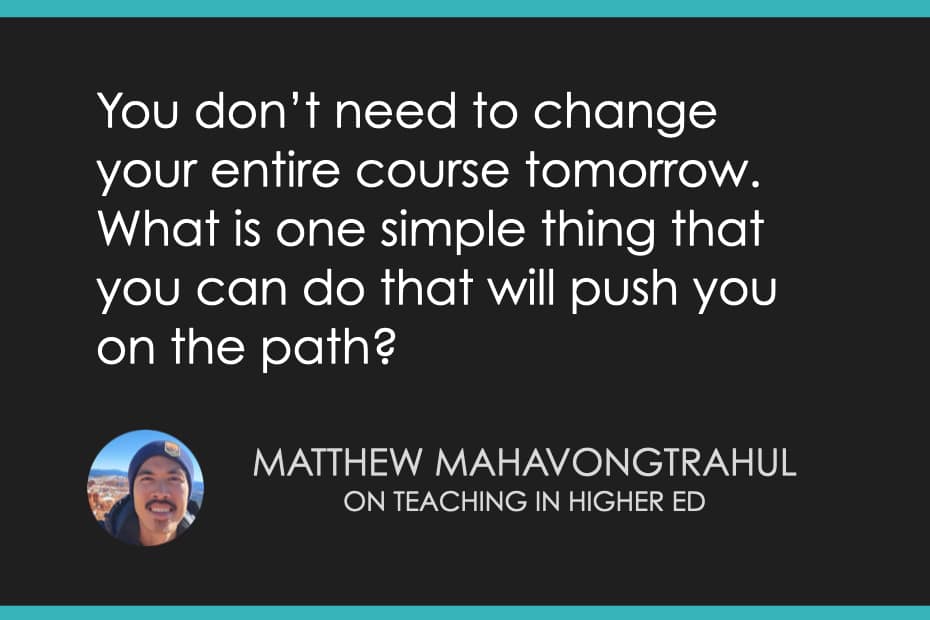
You don't need to change your entire course tomorrow. What is one simple thing that you can do that will push you on the path?

You don't need to change your entire course tomorrow. What is one simple thing that you can do that will push you on the path?
– Matthew Mahavongtrakul

“The number one kind of piece of pushback that I get from faculty is I just simply cannot cover everything.”
– Matthew Mahavongtrakul

“I think at the crux of it, it is the shift in mentality between us as being, as we say, the sage on the stage to being a facilitator in the classroom.”
– Matthew Mahavongtrakul

Resources

  • UC Irvine Division of Teaching Excellence & Innovation’s Active Learning Institute
  • Stephen Brookfield
  • Todd Zakrajsek
  • You Care About It, Do It in Class: Why faculty members need to shift the balance of class time from first exposure to skills practice
  • Why Students Resist Learning with Anton Tolman on Episode 171
  • Notsu Notes
  • Lily Abadal’s workbook, outlining her process of having students write a research paper throughout her entire class
  • Bluesky post of Andrea Kaston Tange sharing about her reading scenario experimentation
  • POD Network Conference

ARE YOU ENJOYING THE SHOW?

REVIEW THE SHOW
SEND FEEDBACK

ON THIS EPISODE

Matthew Mahavongtrakul

Program Director of Faculty Educational Development

Matt is a first-generation multilingual lifelong learner who earned his PhD at UC Irvine in the Department of Neurobiology and Behavior studying epigenetics and cognitive impairment. In his role as the Program Director of Faculty Educational Development, he leads numerous workshops and faculty professional development offerings such as the Active Learning Institute. He enjoys teaching very much and continues to facilitate the undergraduate Bio Sci 99 course at UC Irvine. In addition to his academic appointment, he continues to be involved in STEM as a freelance science writer for Biofluent Communications. In his spare time, he loves teaching and performing Thai classical music, shooting film photography, traveling, and developing healthy baking recipes. He also has 2 rambunctious boys who keep him very busy!

Bonni Stachowiak

Bonni Stachowiak is dean of teaching and learning and professor of business and management at Vanguard University. She hosts Teaching in Higher Ed, a weekly podcast on the art and science of teaching with over five million downloads. Bonni holds a doctorate in Organizational Leadership and speaks widely on teaching, curiosity, digital pedagogy, and leadership. She often joins her husband, Dave, on his Coaching for Leaders podcast.

Woman sits at a desk, holding a sign that reads: "Show up for the work."

GET CONNECTED

JOIN OVER 4,000 EDUCATORS

Subscribe to the weekly email update and receive the most recent episode's show notes, as well as some other bonus resources.

Please enter your name.
Please enter a valid email address.
JOIN
Something went wrong. Please check your entries and try again.

Related Episodes

  • EPISODE 509How to Teach in Active Learning Spaces
    Kem Saichaie square

    with Kem Saichaie

  • EPISODE 179Active Learning in STEM Courses
    Paul-Blowers

    with Paul Blowers

  • EPISODE 417Liberated Learners
    Terry Greene Square

    with Terry Greene

  • EPISODE 486Design for Learning
    Jenae Cohn

    with Jenae Cohn


EPISODE 603

Active Learning That Engages All Learners with Matthew Mahavongtrakul

DOWNLOAD TRANSCRIPT

Bonni Stachowiak [00:00:00]:
Today on episode number 603 of the Teaching in Higher Ed podcast, Active Learning that Engages All Learners with Matt Mahavongtrakul

Production Credit:Produced by Innovate Learning, Maximizing Human Potential.

Welcome to this episode of Teaching in Higher Ed. I’m Bonni Stachowiak and this is the space where we explore the art and science of being more effective at facilitating learning. We also share ways to improve our productivity approaches so we can have more peace in our lives and be even more present for our students. Today on Teaching in Higher Ed, I’m joined by Matthew Mahavongtrakul, a first generation multilingual lifelong learner whose work bridges neuroscience, faculty development, and the deeply human side of teaching. Matt earned his PhD at UC Irvine studying epigenetics and cognitive impairment, and now he serves as Program Director of Faculty Educational Development, where he leads initiatives like the Active Learning Institute and supports faculty across disciplines in designing more engaging learning experiences. Matt is also a practicing educator facilitating large undergraduate courses at UC Irvine, and he’s a freelance science writer with Biofluent Communications. In our conversation, we explore what active learning really looks like in practice, especially when it goes unexpectedly right or wrong.

Bonni Stachowiak [00:01:49]:
From Snowball fights with 200 students, from snowball fights in 200 student classrooms to flexible engagement systems that honor students complex lives. Matt shares stories, research, and design principles that invite us to rethink what we do with our precious class time. Matthew Mahavongtrakul, welcome to Teaching in Higher Ed.

Matthew Mahavongtrakul [00:02:14]:
Thank you for having me. It’s such a pleasure to be here.

Bonni Stachowiak [00:02:17]:
We’re going to start with story time, but you get to pick the kind of story. It could be a good story, it could be a bad story, and at the end I’ll guess which kind you told us. Although I say wink, wink, I probably will. The listeners will be like yelling at their at their car radio video. They know the answer. Tell us either a story that’s emblematic of what it looks like when active learning is vibrant and working the way it ought to, or a story in which it’s gone oh so wrong and.

Matthew Mahavongtrakul [00:02:52]:
There’s a lot to pick from here. But just for a little bit of context, I do run a faculty development program. And faculty a lot of the times they come up to me and they ask, well, this is all great active learning in the classroom, but I have a large class and how can I do active learning in a large classroom? It’s just not possible. And so one year I decided, well, it’s very difficult, but why don’t you come to my class? So my class sometimes enrolls about 200 to 250 students. And see. And I will do an active learning activity that we had talked about in our institute. And it so happens that the one that I chose was the snowball fight. And for people who are not familiar with a snowball fight, you pose a question, Students will write down their answer, not their name, but just their answer on a little piece of paper.

Matthew Mahavongtrakul [00:03:38]:
They get up, they crumple up their little snowball, toss it around the room, and then everybody grabs the snowball. My rule is you have to toss it at least three times just to increase the chance of randomness. And then afterwards, you open it up, and then I just read the prompt, and then the students will read their answers. If you do this in a small class, it is really good and it’s very easy to maintain, but you can imagine that in a class of 200 that it gets a little bit hectic. And so, you know, me and my TAs, we were trying to facilitate, and these snowballs were flying around everywhere. And I did give my students one extra credit point. If there were no snowballs on the ground at the end of our class session, and it was a lot of fun, lots of throwing, lots of laughter, several people getting smacked with snowballs, which was fun. And then it was just really lively.

Matthew Mahavongtrakul [00:04:32]:
And at the end, we had trash bins at the top of the stairs. People dropped them off on their way out, and there were no snowballs on the ground by the end. I was so proud of my students, and I did give them a shout out. But that was a really interesting, and for me, kind of almost anxiety inducing because I had never done it in a class that size. But also, it proved to the faculty who showed up that, yes, you can actually scale some of these learning activities to a large classroom and do it in a way that is really fun and also not too messy.

Bonni Stachowiak [00:05:01]:
What I love about your story is, first of all, I thought I’d be able to tell if this was a good or a bad story. But I’m sensing it’s a more nuanced story than that. But I’m hearing a couple things. One is, I’m hearing that context matters, that when we are considering our own pedagogical approaches or whether we might be giving some guidance or suggestions to other people, what a difference that context makes. I’m also thinking you mentioned the word scale, the sense of chaos. I kind of like think about what chaos is particularly helpful for generating curiosity and all that. And then at what point does curiosity become or, sorry, not curiosity, but does it, the chaos actually then hinder the learning? And I don’t know if you have any thoughts about the experience. Did you think of this as a good example or as a bad or nuanced example to try to trick me into not having a binary answer to this question?

Matthew Mahavongtrakul [00:05:58]:
I think it is a. It ended up being a good experience for the faculty because the faculty at the end, the feedback that I got back was that it was so cool to see everybody kind of moving around and doing these things. It was chaotic. And maybe a story for another time is that I did also do a jigsaw in this class. And you can imagine that with a jigsaw of 200 at the time, it was 210 people. Was very difficult to coordinate. But again, trying to show faculty that we could do this and scale things, it was chaotic. It required a lot of planning.

Matthew Mahavongtrakul [00:06:29]:
But in the end, I think that when people see what can come of it, it’s very inspiring to see that, yes, you can actually do it. You just need to think about it a little bit more.

Bonni Stachowiak [00:06:38]:
I remember someone hearing, actually listening to this podcast and who actually teaches at your same institution who had gotten really excited about using a polling service in her class. And so hearing me talk about the great experience I had had. Well, speaking of context, I probably had 30 students at TOPS, you know, there. And then she goes into a lecture that I think had 200 ish students, if my memory serves here. And then she. What? One of the things I hadn’t mentioned is if, you know, if you’re going to do a open prompt kind of a poll, open answer. Well, to me, I like, that’s happening. And then we stop that from happening and then we go on to something else.

Bonni Stachowiak [00:07:21]:
She had left it running behind her and I’d kept lecturing so you could imagine the total distraction. And, you know, I mean, sometimes people are just having fun. So for me, I sort of, when that has happened to me, it’s relatively tame. I remember this time I was actually playing a podcast and they. They were interacting. I was using some techniques from Stephen Brookfield and his work on discussions and so having a back channel. And this is one of my finest. I mean, I will never forget this.

Bonni Stachowiak [00:07:52]:
This is probably close to 10 years ago, drawing from the work of Steven Brookfield and his work on discussion. And it was so great because they actually took on characters from the podcast as if they were them and then started interacting. So, I mean, sometimes the chaos is just precious. But I do know that, I mean, it’s just so such a great area sometimes where, especially for people maybe not as confident in their teaching, to kind of go off in their unexpected direction. So this brings me actually to my next question here, and I, I’m going to sound like all I’m going to do is ask you binary questions, and life is so much more complicated than that. But just, just, just share a little your reflections on how much of active learning and us being effective at it involves instructional design and how much of it requires being able to adapt and leverage what’s happening right in that moment.

Matthew Mahavongtrakul [00:08:52]:
That’s a great question. I think at the crux of it, it is the shift in mentality between us as being, as we say, the sage on the stage to being a facilitator in the classroom. But I think it kind of goes beyond that, where even now in my own classes, and then also when I interact with faculty, I encourage them to not call their classes lectures. And so when they say, oh, in lecture one, we talked about this. In lecture two, we talked about this. That as a student, I think that would kind of give the impression that, oh, I’m going to be lectured at. And instead if we talk about, oh, this class session or, you know, during this open discussion time or some other sort of categorization, that it invites a lot more conversation into the classroom. And I think it begins with course design.

Matthew Mahavongtrakul [00:09:35]:
And then it goes into, as you were talking about adaptability in the classroom, really pushing some of that control to the students. And also to your earlier point about chaos, leaning into it a little bit while having some contingencies in the classroom. And so when I think about active learning, I think about when I was an undergraduate student and I was sitting in a class that actually was 650. It was a. It was an introductory chemistry course. And just lecture the entire time. It wasn’t a good lecture. It was just.

Matthew Mahavongtrakul [00:10:05]:
It was just talking. And then I had a class where it was more experimental. The entire class was out of four points. And he said, you know, we are going to try something new and we’re going to have a lot of discussion. I thought, okay, sure. And it ended up being one of the most memorable classes that I had. It was on the evolution of human nature. And then kind of in the middle, I had an instructor who was very good at storytelling, had zero active learning, but could tell a story so well that I came out of that class just being just so inspired because of the way that he was telling these stories.

Matthew Mahavongtrakul [00:10:37]:
And I thought, well, if we, if we can kind of Lean into the strengths of lecture and we can lean into the strengths of active learning, then how great would it be that of a learning experience for our students? And so that kind of led me into my graduate studies, which was in neuroscience. But there I was, part of a pedagogical fellowship that really introduced me to active learning for the first time and how to implement the concepts about cooperative and collaborative education. And then from there, being able to learn more about it. Reading a lot of, for example, Todd Kreisk’s dynamic lecturing and a lot of his other books about kind of the nuance with active learning really helped form my opinions and also the implementation of active learning. And then the other thing I’ll say from there is that I inherited and have since tweaked a program called the Active Learning Institute at UC Irvine, where I will talk with faculty. And now it’s actually faculty not only from UC Irvine, but also from local community colleges, speaking about context and how important that is about the importance of active learning and showcasing as them being the participants in our institute, the different techniques. What did they think of them having a lot of debriefing methods. And that has really shape active learning and also the implementation.

Matthew Mahavongtrakul [00:11:57]:
A couple of things that I’ll mention is that one, I think it allows for more authentic assessment in the classroom. And if you do it right in terms of the course structure and building in the language and the time and the contingencies into the content, then you don’t need to worry too much about, oh, I need to cover X amount of content in this short period of time, because all of that is already built into the course. And so all of that kind of, if you, if you design it correctly and you design it with intention, then I think that it could be a very engaging process for both the students as well as the instructor as well, because I learned so much from the students as well. When I listen to their conversations and I hear what they’re talking about, what they’re struggling with, but also what do they understand and how do they explain it to each other? I actually tend to steal a lot of their explanations and then use that in terms of a whole class debrief.

Bonni Stachowiak [00:12:49]:
James Lang wrote a piece for the Chronicle of Higher Education which is titled if you care about it, do it in class. Why faculty members need to shift the balance of time from first exposure to skills practice. And Matt, he makes three arguments here, and I want to share them with you and of course with the listeners and then get your reaction to his assertion. So his first argument, I’m reading from his words now. Whatever you care about most, whatever you care most about students learning from your course, do it in class. If you don’t use class time for skills practice, start doing so now. And his final argument, if you already do it, do it more. What resonates or doesn’t from his three arguments and his overall framing?

Matthew Mahavongtrakul [00:13:41]:
These are really great arguments and I’m a huge fan of his work. I think the things that come to mind when I hear about these three points is that again, going back to authentic assessment, a lot of times, especially in STEM courses, a lot of the faculty will do a multiple choice exam. And I understand why. And there are certainly ways to tweak multiple choice exams to be more authentic. But for the most part, students aren’t really going to use that unless they’re doing an MCAT or they’re taking some sort of a credential, program, certifications, something like that. But if we think about authentic assessment, when are they going to learn those skills? It’s never too early to learn these skills. And so if you’re going to have the students, if, for example, in the class they need to, they need to analyze an article, give them the practice in class, have them talk about it in class, and then you can walk around and listen in and eavesdrop on their conversations if that is important to them. In the future, if they’re going to need to experience in discourse, set up some time in class for that in a healthy way and lay out some ground rules and say it’s going to be very important for you to know how to argue a point and we’re going to practice that in class.

Matthew Mahavongtrakul [00:14:48]:
When I consult with faculty and they come to me with their syllabus, I oftentimes will tell them, if you take a look at your course goals, maybe one of these goals should be or could be a transferable goal. So one possible goal here could be students will be able to analyze, discuss and critique a specific article with their peers. Something like that might work. Or if they’re going to need to do some sort of a creative brochure or something, then allow for times to do that in class so that they can not only gain the content, but also gain the skills that they’re going to need to be successful in whatever field they decide to go into after they leave your class. I oftentimes think about the class as one little snapshot in a student’s educational career. And if we just take it as a snapshot, that is only that’s all that it’s going to be, it’s just one picture. But if we think about a movie and we can think about our students educational experience as a movie, it’s continuous. And one frame will influence the next frame, which will influence the next frame.

Matthew Mahavongtrakul [00:15:50]:
And so the skills that we’re teaching them can help them not only in future classes, but also in their future endeavors. And I think this kind of gets to the point where I don’t think we’re going to go down this rabbit hole today, but about curricular design across a major and trying to really align different classes together. The other thing that comes to mind is the last point about if you already do, do it more. And at first I thought, yeah, this is awesome. And then I thought about a faculty member who I saw at our institution where she had asked me to come to observer class. And I came in and she told me where to sit and she sat down and said, I kid you not, no more than two sentences the entire class, because she just had the students come in. Each student group had a lesson plan prepared and they just did the entire lesson. They engaged with the students in that class.

Matthew Mahavongtrakul [00:16:41]:
And at the end the instructor just kind of gave some closing remarks. And then I just said, okay, then I’ll see you on Thursday. And I was thinking and kind of having a little chuckle to myself that I don’t know if she could have done it anymore because she literally only said one or two sentences. And so I do want to acknowledge that there are faculty out there who are doing so much already in their classrooms that perhaps they can maybe do a little bit more or a little bit better, but the efforts that they’re already putting in and also the time and the intention is already there. So I do want to acknowledge them there.

Bonni Stachowiak [00:17:16]:
I want you to think about because you, you. I feel like both you and I are kind of a little spoiled because we get to teach, but we also get to work with so many amazing educators. So we start to see some patterns. I’d like you to think about what tends to be everyone’s different, but what tends to be a real struggle that people might have as they begin to make this kind of a shift from more of a lecture only type of a structure to wanting to adopt more active learning.

Matthew Mahavongtrakul [00:17:44]:
Yeah, so for the hardest thing about adopting active learning, I hesitate a little bit because I think a lot of the arguments surround content. Right? I have so much content that I need to deliver and I only have so much time to deliver it. That’s the number one kind of piece of pushback that I get from faculty is I just simply cannot cover everything. And one of the things that I really liked, one of your previous guests, I forget who it was now, but they talked about not covering content, but uncovering content. And I really like that mental shift in thinking about it because I think that our role as facilitators in the classroom has evolved over the years, and we probably won’t get into how AI has influenced this as well. But I think that when we think about our role as facilitators in the classroom, I think about us as sparking curiosity in our students. How can we get our students to think about our content more deeper and maybe develop some sort of an intrinsic motivation to then explore further on their own with a critical eye and with an eye towards. Towards not just the healthy discourse, but also towards generation of content in our classrooms.

Matthew Mahavongtrakul [00:19:00]:
And so when I, when I think about the content portion, I think about how can we redesign our course structure? Do you really need to cover 40 different topics in a day? You know, what are the key things that you think your students need to cover every single day or by the end of this course and then kind of work backward from there using the principles of backward design? The other thing that faculty often will tell me is, I just don’t have the time to do these major changes in the course. And to that I’ll say two things, which is, one, yes, it does require time, but the payoff in the long run is that you will actually be saving yourself so much time and you’ll have such an enjoyable experience in the classroom if you do it intentionally and do it right and come to class with the right attitude about it. And the second thing that I tell them is, you don’t need to change your entire course tomorrow. What is one simple thing that you can do that will push you on the path? Right. And another one of your guests has said something about, we are not trying to get them to the finish line, we are just trying to get them to the starting line. And I really like that as well, because we are not expecting perfection here, but we just want our faculty to try it out, to see the benefits and perhaps to consult with them to frame things appropriately in the classroom. But I think that as if you don’t try it, then you’re not going to be able to realize the benefits that can come with effectively implementing active learning in the classroom.

Bonni Stachowiak [00:20:26]:
I so appreciate that you. Thank you, by the way, for these wonderful examples of what can be a barrier. And then you ended with okay, then once you start to try, because I. I was sort of assuming we were already trying. So, like, there. There is a lot for all of us. All of us can have these mental blocks that prevent us from even starting on a different path and that. That could apply to a lot of areas of our life, not just our teaching.

Bonni Stachowiak [00:20:51]:
And that I wonder for myself, how much do I hold myself back because of these mental models that I might hold in certain areas and just don’t even recognize them because I’m swimming in the water. In this particular case, I am thinking about once someone starts trying to facilitate active learning and it’s just not yet comfortable. A big pattern that I see is resistance. And I have had people talk about. And I’ll put a link to if this is kind of a new part of the scholarship of teaching and learning for people, I’ll link to an episode, which also an associated book about resistance, but that’s from an episode a long time ago. I think it might have been eight or so years ago. I mean, so this has not gone away. In fact, some might argue that it continues to persist, perhaps even more amplified because we had the years of people with COVID and not us coming together in classrooms, the vibrant active learning classroom that you’re describing at the University of California, Irvine, where you teach and lead.

Bonni Stachowiak [00:21:57]:
So, yeah, so I’m thinking about this resistance and I’m excited to hear you share a little bit about how you approach engagement in your own teaching.

Matthew Mahavongtrakul [00:22:06]:
Yeah, thanks. And I won’t share kind of everything that I do, but one thing that has really been a game changer in my own class, and I’ve seen this in feedback and also just from conversations with my students, in addition to active engagements and collaborative exercises in the classroom is I’ve recently implemented, and by recently, I mean three or four years ago, and then have tweaked it since then. A token system. And what this token system is, it is a way for students to engage with the course and the course content in a way that is maybe not a traditional way that they would be asked to in traditional classes. And it’s actually a way for me to put in some pilots that I want to test and then eventually we’ll adopt them into the course policy. So to give kind of the goal of the token system first, and then I’ll talk to you about how it works. The goal of it is really to make the classroom a not so stressful of a place to be, but just stressful enough that they are motivated and want to do better. And so, but they don’t need to worry about, you know, if I’m five minutes late for this, what do I do? Or if I have to miss a class, what do I do? And I also don’t want them to need to disclose to me anything that they don’t want to.

Matthew Mahavongtrakul [00:23:22]:
And so this token system allows me to get around that. And the way it works is I give the students multiple ways to earn these tokens in the classroom. It could either be through posting questions or answers on a discussion board, kind of at the simplest level, to answering or asking questions in the classroom. Doesn’t have to be, you know, in front of 200 people, but, you know, even in their small groups, with us kind of walking around and engaging with the smaller groups, they can engage with us there. But I also put in some experimental things, like, for example, take a recent research study that we talked about in class, and if you’re really interested in it, follow the work of the principal investigator or maybe the first author. Reach out to them, ask them a question about, you know, either the study that you read or maybe their path to being a scientist or anything like that. Engage with them at that level, and then cc me on it if you’d like, and you can earn a couple of tokens there. Or, you know, if you want, I will hold an informal set of walk and talks and, you know, just come and join me.

Matthew Mahavongtrakul [00:24:22]:
We’ll walk around. You know, we have a really beautiful Aldrich park that kind of goes in the center of our campus. Come and join us. There’s going to be a group of us who are just going to walk for a couple of laps around there, and we can talk about anything. It doesn’t even need to be about the class. It could be about a trip to a national park. It could be about anything that you want to talk about. Also, there could be other ways to earn tokens as well.

Matthew Mahavongtrakul [00:24:47]:
By, for example, creating something new in the classroom that contributes to the field of study, which lends itself to another assessment that I have in the classroom called the choose your own adventure assignment, where they literally will choose how they want to demonstrate their knowledge. But through all of this interaction, they can. And by the way, all of this is optional. They can earn these tokens, and at the end of the quarter, they can redeem them. Just like, you know, if you were at an arcade and you had all of these little tickets and you go up and you point at the wall and say, I want that stuffed animal or this game or whatever, you know, they can do the same thing there. They have a menu that they can choose from and they can redeem things, for example, a 3% overall grade bump. Or they can. They can redeem it for a dropped assignment.

Matthew Mahavongtrakul [00:25:32]:
Or at the very high end, they could redeem it for a letter of recommendation. And this is really great because you can imagine that with a large class, I oftentimes will get a lot of students coming to me and say, hey, could you write me a letter? I took your class like seven years ago, and I said, I don’t know who you are. Let me go through my emails. And there’s no correspondence with them. But if they’ve earned enough tokens to get to that letter of recommendation, then I will have a documented way to talk about them in a meaningful way way in their letter. Or if they want me to look at job application materials, or if they want a coffee chat to talk about their future careers or things like that, then they could use these in either ways that will help them in the classroom or ways outside of the classroom. And I’ll share kind of two very quick anecdotes, which is one, this actually allowed one of my students to miss class for her own wedding. And to give you context, I teach over the summer, which is over the course of five weeks, and she needed to miss a week for her wedding.

Matthew Mahavongtrakul [00:26:30]:
And she came back and she said, you know, I just wanted to say that I take this class very seriously. And I am so grateful for the token system because I could work at my own pace. I could go to my wedding and enjoy it and not have to worry about, oh, am I going to get an F in this class? Because this system was there to catch me and I could live my life and do well in this classroom as well. And she was showing me pictures and talking to me about that. And she actually really knew her stuff as well. And she did put in the effort to earn those tokens, which she really appreciated because she could do it on her own time. And then the other quick anecdote is, I had a group of four, and one of the students there was very shy, didn’t want to speak up at all, ended up not earning a lot of tokens, even though there were other ways to do it. Like, you don’t have to speak in class, you can email, you can do a lot of other things.

Matthew Mahavongtrakul [00:27:18]:
But the student, for whatever reason, did not do any of those. And he was on the cusp of a grade bump. And so the three other group members came up to me and said, our teammate here. He doesn’t know that we’re here, but he’s been helping us out so much, and he’s so close to getting this great bump. And if you’re using the analogy of an arcade, could we give our tokens to him? And he then used that to redeem it for whatever he needs, in this case, a great bump. But we are willing to just give all of our tokens to him so that he could have enough to do that. And I just thought that was such a touching moment. And when I approved it, they went back to the.

Matthew Mahavongtrakul [00:27:57]:
To the group or to their table, and they told him, and he literally broke down, you know, in tears, thanking them. And they formed such a tight bond. I followed up with them a few years later, and they’re still taking classes together, and they’re still really good friends. So it really allows the students to engage in different ways for me to signal that my class is not their life and their life is not my class. And it also allows them. And I know you’ll talk to one of my other colleagues, Theresa, later, about pedagogical wellness, but really to infuse that into the classroom so that we can support and enhance learning without needing for our students to disclose every single thing to us and to give them that space to grow in whatever way that they need to for the course.

Bonni Stachowiak [00:28:41]:
I entirely love this idea, and I’m so energized right now. But I know myself, and I know my weaknesses. I have such a hard time organizing things. Do you have suggestions for ways of tracking this? That for people that are a little.

Matthew Mahavongtrakul [00:28:54]:
Scatterbrained like me, that was one of my biggest challenges, was how to keep track of all of this. And what I would do is I would take a. So there. There’s two. There’s two ways. I’ll answer that. The first is kind of the. The spreadsheet way, where you have a spreadsheet of the students, and then you have the dates kind of as columns, and then you can go through, and then you can mark the tokens there, and then you can sync that with, like, a sheet or something like that.

Matthew Mahavongtrakul [00:29:22]:
The other way, which I’ve been playing around with, I haven’t done it yet, but you could actually buy custom tokens online and customize them however you want. So you could put your name, the title of your course, a weird picture, something that’s not easily reproducible, and pass out physical tokens just like at an arcade. And that is. That’s something that’s kind of marinating in my brain that I haven’t tried yet. But it’s something that I’m also very excited to try because it just seems like so much fun.

Bonni Stachowiak [00:29:50]:
Well, if you do try it, I can tell you, years and years ago, I’m going back almost 20 years. I did. There were. There was such a thing as Bonni Bucks. I actually still have a Bonni Buck up on my cork board. I can tell you. Unfortunately, people lose their wallets or have things go missing, and so you would always want some sort of a backup for the currency, because otherwise you want to talk about really disappointed students. That’s.

Bonni Stachowiak [00:30:12]:
Yeah, I have. I have recollections of that. Although your story is so great about that group of four coming around each other. Because when I do recall a student who’s Bonni Bucks went missing, she did have other students who would contribute, and that back then, it was not a token system. This sounds like such a wonderful approach. This was just a drawing, like to get a gift card or something like that, like prizes and things like that. But that’s so fun. So are there any other examples you want to share of the kinds of things people might get tokens for or advice that you’ve kind of been wrestling through? What really works well for a token and what maybe didn’t work as well?

Matthew Mahavongtrakul [00:30:48]:
I think the important thing to think about with the tokens system, and this is something that I’ve tweaked over the years, I’ll mention kind of two things. The first is you need to have a. You need to calculate the tokens appropriately. If you set 20 tokens, for example, to be a letter of recommendation, but the amount of tokens somebody can earn is like 100, then you are going to get several hundred people wanting to get a letter of recommendation for you. So I would have people kind of think about how much they realistically want to offer and have that scale with the actual prizes that they can get. Otherwise, you’re creating a lot for yourself. So the second thing that I’ll mention is the concept of putting in flexible design into your token system. And what I mean by that is, if you have all of the opportunities to earn tokens, our verbal communication, we are going to be exacerbating gaps that already exist in the classroom.

Matthew Mahavongtrakul [00:31:45]:
If we can think about our neurodivergent learners, our multilingual students, and people who want to engage with the content in different ways, I encourage you to think about multiple ways of earning these tokens, be it verbal writing, emails, setting up office hours, maybe creating something and have it Tiered appropriately so that you’re not having. Because the other thing that we don’t want to do is to assume that our students have infinite time. That those students who are, you know, I want to get 100% of the tokens, and I have the resources to dedicate all of my time to earn these tokens, they’re going to get those tokens because, again, that’s going to exacerbate gaps that already exist in the classroom. And so I think it’s important to have a lot of these really easy ways to earn tokens and also to provide the students the opportunity to earn them in the classroom. Much like when we design collaborative exercises, we want to give our students time in class to work together for tokens. I think the same thing applies where the students should not have to put in so much extra outside work to do it. You know, a little bit, I think is okay, but not a. Not like, not so much that it would actually exacerbate any gaps that we already have in the classroom.

Matthew Mahavongtrakul [00:32:57]:
So those are two sort of tips that I have for anybody who wants to implement a token system in their own classroom.

Bonni Stachowiak [00:33:02]:
I mentioned in an episode a month or so ago about that a colleague of mine figured out that our license for Microsoft Office in includes some portions of their large language model called copilot. It’s sort of confusing Microsoft, if you’re listening, which you’re not, but if you’re listening, your pricing models are very confusing to people like me. But anyway, she discovered that there are some chat capabilities that we have even in our very minimal educational license. So I was picturing when you were talking that you were mentioning the spreadsheet method. Well, to get data into the spreadsheet, it could be that somebody fills out a form, which then Microsoft, of course, popped in a spreadsheet. But then it could be that we go to the Copilot version and then get it to produce for us the final report of maybe how many students. It could do some of the analysis for us to make our lifting a little bit easier there at the end of the term or the semester. That’s really fun to hear about.

Bonni Stachowiak [00:34:04]:
Well, this is the time in the show where we each get to share our recommendations. And I wanted to go all the way back to the article I mentioned from James Lang. If you care about it, do it in class. Why faculty members need to shift the balance of time from first exposure to skills practice. At the end of this article, I just want to share quickly before I pass it over to Matt. He gives some wonderful examples, and I think this might help inspire us. So James Lang writes, I’ve been heartened to learn about instructors experimenting with their teaching along those very lines, bringing traditional component skills of academic assignments into the classroom, including the following examples, and I’m going to share three examples that he shares. The first one is Lily Abadal.

Bonni Stachowiak [00:34:52]:
She’s a philosopher at the University of South Florida, and she asks her students to write an entire research paper in class over the course of the semester. She’s written a workbook that outlines her process and it offers I’m reading Jim’s words here. It offers a useful model of what it might look like to break down a major assignment into its distinctive parts and practice them in class, including having some students annotate research papers and draft thesis statements. So I’ll be putting a link to the article, of course, but I’ll also put a link to her workbook. In case any of you don’t have access to the Chronicle subscription, then you’ll still be able to see Lily’s workbook. So here’s the second example of three earlier this year, Jim writes, the Chronicle profiled the work of Andrea Caston Tang, an English professor at McAllister College who wanted to, quote, radically rethink reading in her courses. Among her strategies she reads aloud to students in class. The students read silently in class for up to 30 minutes, and they maintain notebooks in which they respond to the course readings with words and doodles.

Bonni Stachowiak [00:36:06]:
And finally, across the campus from Jim at the University of Notre Dame, Steve Riefenberg, who teaches in the School of Global affairs, leans heavily on team based learning in his courses. With his background in international development and a history of working with teams across his career, he knows full well how poorly students fare in team based assignments in college courses. And I love this final sentence. His course schedule includes dozens of activities conducted in class to help students learn and practice collaborating productively with classmates. I am so signed on to the let’s make more of that practice happen in class. And I’m so grateful to Jim for sharing all of these inspiring examples. And Matt, I get to pass it over to you now for whatever you would like to recommend.

Matthew Mahavongtrakul [00:36:59]:
So I really resonate with those three examples at the end of the article. And something that comes to mind is about authentic not only authentic assessment, but also how can we make our classrooms more authentic, especially in the age of AI? And I think that if we can give our students a reason to come to class, and that reason is practical, they’re going to gain These skills, they’re going to work in teams in a productive way. Then I think that we’re really doing them a great service in the classroom and also a great service to higher education in general by showing the value of coming to class and instead of being kind of information consumers as information creators and generators as well. The recommendation that I have. So anybody who knows me knows that I’m really into stationery and I really like fountain pens and stationery of all kinds. And one thing that I have recently done is I have whenever I listen to a podcast and there’s something there, like a gold nugget in there that I really want to remember. I know this is going to sound very basic, but write it down. And one thing that I want to showcase is something called the notsu system.

Matthew Mahavongtrakul [00:38:07]:
That is the Not SU system. And it is a series of note cards that comes with a little stand. And what’s really nice about it is that on the front there is a to do list that you can, you can write things down and then there’s a nice little mark on the side, a nice little bubble that you can fill in. But what’s really nice is that on the back there is a section for any notes that you have and then a little section at the bottom where you can sketch something as well. So it’s a multifunctional note card. But also what is really magical about this is that the cardstock is such that you can fold it and take it with you wherever you want. And it’s very sturdy. So I take it with me into meetings a lot.

Matthew Mahavongtrakul [00:38:47]:
And also, like at the recent POD Network conference, I had it with me so that every time that I had something that I wanted to remember, I wanted to jot down or even to incorporate into my own programming, I wrote it down on here. And then I could write any general notes and then maybe a little sketch about something on the back just to provide some context. And that is a system that works out really well. And ever since I started using that sort of a system, I’ve been able to keep track of so many things to implement in my own. My own workshop programming and my own professional development programming. And also in my classroom, my students will oftentimes see me taking this out in the class and saying, oh, what are you writing down now? So it’s a really nice system. So write things down.

Bonni Stachowiak [00:39:28]:
Oh, that’s fabulous. And I really enjoy a good analog note taking system too. But the one that I’m familiar with, you’d have to mortgage your house or sell your car to purchase. So these also appear to be reasonably affordable. So that’s the other. And they’re such bright colors. I can’t wait till people get a chance to check them out in the show notes. That’s wonderful.

Bonni Stachowiak [00:39:49]:
As well as in the main recommendations page. It has been so delightful, Matt, getting to meet you at the POD Conference and to get to talk today on and off the air. Thank you for all these inspiring ideas. You’ve really given me a lot to think about and to consider for my own teaching, and I’m so excited for other people to hear your ideas and guidance as well. Thank you so much your time.

Matthew Mahavongtrakul [00:40:11]:
Thank you so much. It’s been a pleasure.

Bonni Stachowiak [00:40:15]:
Thanks once again to Matt Mahavongtrakul for coming on today’s episode of Teaching in Higher Ed. Today’s episode was produced by me, Bonni Stachowiak. It was edited by the ever talented Andrew Kroeger. If you’ve been listening for a while and haven’t yet signed up for the Teaching in Higher Ed Weekly I update, I encourage you to head over to teachinginhighered.com subscribe. You’ll receive the most recent episodes show notes as well as some other resources that go above and beyond that individual set of resources. Thank you so much for listening and I’ll see you next time on Teaching in Higher Ed.

Expand Transcript Text

TOOLS

  • Blog
  • Podcast
  • Community
  • Weekly Update

RESOURCES

  • Recommendations
  • EdTech Essentials Guide
  • The Productive Online Professor
  • How to Listen to Podcasts

Subscribe to Podcast

Apple PodcastsSpotifyAndroidby EmailRSSMore Subscribe Options

ABOUT

  • Bonni Stachowiak
  • Speaking + Workshops
  • Podcast FAQs
  • Media Kit
  • Lilly Conferences Partnership

CONTACT

  • Get in Touch
  • Support the Podcast
  • Sponsorship
  • Privacy Policy

CONNECT

  • LinkedIn
  • Instagram
  • RSS

CC BY-NC-SA 4.0 Teaching in Higher Ed | Designed by Anchored Design