Follow the Teaching in Higher Ed Podcast
About this Episode
Derek Bruff shares about assignment makeovers in the AI age on episode 481 of the Teaching in Higher Ed podcast
The technologies at play in higher education changed dramatically in a very short amount of time, and that required us to rethink what we were doing as teachers.
Derek Bruff
On episode 481 of Teaching in Higher Ed
Voices on this Episode


Show Notes + Resources
- Assignment Makeovers in the AI Age: Reading Response Edition, by Derek Bruff
- Assignment Makeovers in the AI Age: Essay Edition, by Derek Bruff
- Assignment Makeovers in the AI Age: Infographics Edition, by Derek Bruff
- Humberto Garcia
- Making Over Assignments in Light of New Generative AI Tools, by Derek Bruff
- What the Best College Teachers Do, by Ken Bain
- Cheating Lessons, by James Lang
- Episode 19 with James Lang: Cheating Lessons
- Mike Caulfield’s SIFT framework
- 4 Steps to Help You Plan for ChatGPT in Your Classroom, by Flower Darby for The Chronicle of Higher Education
- Elicit
- The Homework Apocalypse, by Ethan Mollick
Recommendations from this Episode
Transcript
Bonni Stachowiak [00:00:00]:
Today on episode number 481 of The Teaching in Higher Ed podcast assignment makeovers in the AI age with Derek Bruff. Welcome to this episode of Teaching in Higher Ed. I’m Bonni Stachowiak, and this is the space where we explore the art and science of being more effective at facilitating learning. We also share ways to improve our productivity approaches so we can have more peace in our lives and be even more present for your students. I am so grateful and excited to be having this conversation today with Derek Bruff. Derek Bruff returns to Teaching in Higher Education today specifically to share about how he is rethinking and other faculty are rethinking assignments in the age of artificial intelligence. Derek Bruff is an educator, author, and higher education consultant. He directed the Vanderbilt University Center for Teaching for more than a decade, where he helped faculty and other instructors develop foundational teaching skills and explore new ideas in teaching. Bruff consults regularly with faculty and administrators across higher education on issues of teaching, learning, and faculty development. Bruff has written two books intentional Tech Principles to Guide the Use of Educational Technology in College Teaching and Teaching with Classroom Response Systems creating Active Learning Environments He writes a weekly newsletter called Intentional Teaching and produces the Intentional Teaching podcast Breath, has a PhD in mathematics and has taught math courses at Vanderbilt and Harvard University. Derek. Breth. Welcome back to Teaching in Higher Ed.
Derek Bruff [00:02:03]:
I’m glad to be back. Thanks for having me back on Bonni.
Bonni Stachowiak [00:02:06]:
Before too much time passes, I was so delighted to discover that we both share a passion for a television show. What television show is that, Derek?
Derek Bruff [00:02:16]:
That would be Schitt’s Creek?
Bonni Stachowiak [00:02:18]:
Yes. And give us a little bit for those who may not have seen it in the past or for those it may have been a while, a little bit of what Schitt’s Creek is about in general.
Derek Bruff [00:02:26]:
Sure. So it is a comedy. I think a lot of the scenes are a little improv, actually. But it’s a comedy about a family that used to be fabulously wealthy and through some poor choices, are now not that anymore, and they are starting over in a small town and trying to kind of figure out how they can rebuild their lives while actually connecting with each other really for the first time. It has a lot of sweet, heartfelt moments, but also a lot of comedy. A lot of comedy.
Bonni Stachowiak [00:02:52]:
I so agree with your characterization of the show, and I know that my colleague David Rhodes uses this a lot in workshops with faculty. Your wife teaches educational methods at a local university with you, and she also shows this clip, the clip we’re about to show. And when I say show, I mean it’s going to be an auditory clip. You and I will add in any things that we think are necessary for the visuals, for people to know about that’s happening in the scene. It’s called fold in the cheese. And I’d like you as you hear this clip and hear Derek and I describe it, I’d like you to apply fold in the cheese to what we have been asking faculty to do for years now in general, but specifically with regards to the continued emergence of artificial intelligence. So here we go. Fold in the cheese from Schitt’s Creek a quarter cup at a time.
Derek Bruff [00:03:47]:
We have mother and son are in the kitchen together preparing a recipe.
Bonni Stachowiak [00:03:51]:
Schitt’s Creek recording: “David, that’s not right. Okay, well, that’s because I’m ladling and stirring at the same time, and you’re just standing there. Now is not the time to lose focus, darling. This was your idea. You’re the one who allegedly made the enchiladas. Yes. So try to keep up. Okay, next” she’s reading off a recipe “sprinkle in the chili pepper flakes. We’ve already done that. What number are we on? Oh, my God. Is this not your mother’s recipe? Yes. And now I’m passing it on to you, so try to keep up. Oh. Next step is to fold in the cheese.” She hands him a bowl of shredded cheese. “What does that mean? What does fold in the cheese mean? You fold it in.”
Bonni Stachowiak [00:04:26]:
Schitt’s Creek recording: “I understand that, but how do you fold it? Do you fold it in half like a piece of paper and drop it in the pot, or what do you do? David, I cannot show you everything. Okay, well, can you show me one thing? You just that’s what you do. You just fold it in.
Bonni Stachowiak [00:04:41]:
Schitt’s Creek recording: “Okay. I don’t know how to fold broken cheese like that, and I don’t know how to be any clearer. You take that thing that’s in your hand and you if you say fold in one more time, it says fold it in. This is your recipe. You fold in the cheese. Then don’t you dare. You fold it in, David!” He removes his apron. He has walked out of the shop. “David, what does burning smell like?” All right, so help us, Derek, and I suspect that listeners probably won’t need too much help here, but what kind of echoes do you see? What have we been by we, I mean, fill in the blank. Higher education in general, what have we been telling faculty? What is akin to telling the to fold in the cheese as they consider AI’s impact in their classes and their teaching?
Derek Bruff [00:05:31]:
Yes, well, the humor there is she has no idea what she’s actually saying. She doesn’t know what it means to fold in the cheese. So her go to is to just say the same thing again and again and again, and I think what when it comes to AI, some of that feels authentic. Like, I don’t always know what’s happening with AI was someone faculty might go to for advice. And I’m struggling myself to keep up with what the tools are and what they can do and what they can’t do and how they’re changing. And so sometimes I don’t really know what things are either. But I think also there’s this move that we’ve been making where we say, all of this is changing. There are all these new tools that will write text for you. They will generate images for you. They will do all these things. Your students are using the constantly, whether you know about it or not. Go and teach, right? Make it work. And to some degree, that’s kind of useful, right? I think especially earlier this calendar year when the tools were emerging and we were all trying to wrap our heads around the I was giving a lot of talks to faculty where we were just trying to understand what the things are. And my advice to faculty was pretty vague when I look back on it, right? Like, how can we think about these tools? Very abstractly in our classrooms. And I think this gets to the reason you asked me on at this time of the calendar year, is that as we head into the fall semester this fall, we can’t just say, fold in the cheese, Mike. We need to know what what means at this point. What does it mean to update our assignments or our learning goals or our syllabus policies on AI? Yeah, we know we need to do that, right? Maybe back in May, it was fine to say, you’re going to need to update your syllabus policy by August, but now we’re getting to August. We actually have to know what that means on the ground with this particular kitchen, with this particular set of ingredients, with this particular recipe. What does that look like in your classroom? What does that look like in my classroom? To try to respond to these changing technologies.
Bonni Stachowiak [00:07:27]:
I’m drawing two things out of what you just shared. One is the importance of context. And I think of context in a number of ways, but there’s a sense of humility that I think all of us should aspire to in recognizing, not just the context within disciplines, although that’s a very important aspect of context. Not just the context for ourselves, our individual and collective identities and strengths as we bring them into our teaching and learning, but also then every class is different. Every person in every class is different. So the humility that is necessary and the nuance that’s necessary. I haven’t shared this with you yet, Derek, and I also haven’t shared it with the podcast, just because I end up recording these episodes out of order. And this just officially got announced. But I am the scholar in residence for the University of Michigan, dearborn, and it’s in the areas of artificial intelligence and higher education, the things that you and I are going to be talking about today. And one, if you didn’t know me, you do. So you already know that I’m not an expert at this stuff. Nobody’s an expert at this stuff. But part of why they said they were interested in partnering with me and inviting me to take this role with them is out of that I haven’t taken any super strong stances, as if I know or anyone knows exactly. And some of the conversation that I’ve seen gets a little bit shaming of people. I saw one where this person I really, really highly respect, but was like, how could anyone use AI? What a terrible group of people. Because of the implications for climate change. I’m a person who cares about climate change and wishes that we were doing more as a country and in the world around those issues. I have used artificial intelligence, Derek. I have. And so it’s do. How do we with something that you said? You said the word changing is changing so, so very fast. Can we both be humble about the not knowing, our state of not knowing, and again, our individual state of not knowing and our collective state and get curious, but at the same time, what I drew from what you just shared, we can’t just be like, well, we don’t know anything. So I guess we’re just not going to do anything or take any of the extremes or police at all because no one should ever be using it at any time for any reason. It destroys everything, the fundamental of everything that we stand for. So humility mixed with practicality. And that’s what I’m so glad to, Dave, you here for because there was a post that you have written, which I’m going to, of course, link to in the show notes. You posted it on July 13, and the title is Assignment Makeovers in the AI age reading response edition. I instantly, the day I read this, I emailed you. Would you have any time to come back on as people are getting started with their semesters? Because it is written from humility, it’s written from how different our contexts can be, but it doesn’t leave us there like shrug, emoji shrug. It says, you know what, how might we think through some of these things in terms of our assignment? So let’s think through a few of these. Did you sit down and just instantly , what was the process that you went through for writing this? And I guess maybe talk us through some of the main things you were hoping to get across.
Derek Bruff [00:10:51]:
Sure, yeah. Well, and I think one of the challenges in our own individual contexts is that these technologies are changing so fast and they’re coming so fast and faculty are busy. I think one reason Chat GPT was such a kind of disruptive event is because it came out on November 30 of last year. That’s a terrible time for higher education to wrap its mind around some new transformative tool. Right. We were finishing our semester and getting exams done and grading and spring term was right around the corner. We didn’t have time. Right. And so I want to give faculty a lot of grace. There’s a lot here. And one of the perks I have as a teaching center person is I can spend a little more time kicking the tires on these things and reading up on them and finding other people who are doing the same kind of thing, right? And so I think part of my role is often to do some of that and then try to pull out some helpful strategies and advice for faculty who need some solutions and need to make some important decisions about their fall courses but don’t have time to kind of do the full deep dive that this might properly was. And I mentioned Ethan Mollick’s piece in my blog post about the Homework Apocalypse, which that’s a great title, I think it’s a little scary. And it made me realize that because he talks about different types of homework in there. And I realized, actually, yeah, all of us teach different stuff and there’s different assignments that we use, and there’s some big categories of assignments, right? And so some of us use a lot of written assignments. Some of us are doing multimedia production, some of us are doing tests, some of us are doing papers. It felt like we had this moment in the summer where a lot of us started to realize fall semester is coming and we need to figure out what are we actually going to do differently this fall? And for me, I realized I needed to take a few assignments in those different categories and just kind of kick the tires and see what I would need to do to change them, to make them still work this fall. And so that’s kind of where that came from. And I started with a pretty simple assignment, which is kind of a reading response assignment. So have your students do the reading and then write a little something about it, right? Answer some questions, write a blog post, put something on the discussion forum, right? A very kind of bread and butter assignment for a lot of folks, but also the kind of assignment that I suspected chat, GPT and the other tools could actually play a big role in. And so I wanted to know kind of what are the boundaries of that role? Where are the AI tools going to be useful, where are they going to be disruptive to student learning? And then what changes might I need to make to try to accommodate that? And so that’s kind of the approach that I took going through that assignment. And then in later posts, I looked at kind of a bigger essay assignment and what that might be like, a research based essay assignment and what, what might mean, how that might need to play out differently. And then in my newsletter, I tackled an infographic assignment that I’ve used in my stats course. So a different kind of assignment, but a similar process of thinking through, what am I really trying to accomplish with this assignment? What are the learning objectives? Why does this assignment even make sense for my course? And then what can the generative AI tools do? And I try to imagine, okay, if I’m a student who’s trying to get out of as much work as possible, how might I use these tools to short circuit things? But I also imagine myself as a student who really wants to do well and is wanting to do the best they can with the tools available. And are there any of these tools that could help me learn the material better or do better work because of that? And then that involves exploring. Right? And this is one of my main messages. And you’ve seen this in other recommendations. Flower Darby had a great piece in the Chronicle of Higher Education a few weeks ago where one of her main recommendations was just start using the tools a little bit, right? You’ve got to kind of get in there and see what they can do, what they can’t do, get a little familiar with them because I anticipate many of our students are doing that. They’re exploring these tools. And so it makes sense to figure out what do they do, what do they not do, and how do they connect with the assignments that we want to teach. And once you have a better sense of that, you’re in a better position to decide, what about these assignments might I need to modify or change either to mitigate the disruptive effect of the AI tools or to leverage those tools for student learning?
Bonni Stachowiak [00:15:08]:
We talked about the fold the cheese, as in change everything, but we’re not going to tell you how or what that might look like. And then you also started out this conversation with just how overwhelming it has been. I mean, it is no exaggeration just to reflect and consider with great empathy what so many people have been through, what we’ve been through collectively and individually. So I would like to ask you before we start getting a little bit more on some of the details because I think they’re going to be really helpful for people, but I’d like you to reflect just a bit before we do. This isn’t the first time that you in your discipline or what other people have done these kinds of things. So I’d like to connect a little bit. It’s not entirely the first time where we go, but why am I assigning this? What is the purpose of it? And if someone were to try to mike I don’t think we should spend too much of our mental energy, but yeah, someone may not attempt with the same kind of academic integrity to meet the learning goal. So we’d want to think about those things. If there were a way to shore that up, it’s never going to be perfect. But mostly, what if people really did want to learn, what would be the best way to facilitate that learning toward that learning goal in your discipline or faculty that you’ve talked to, coached, guided along the way? Are there any examples where you think, yeah, in computer science, or yeah, in physics, or yeah, in these different things where it wasn’t AI they were asking these questions about, but they did need to go back, or I needed to go back and revisit this assignment and really root myself again in the fundamental purpose of it.
Derek Bruff [00:16:51]:
Well, the first thing that comes to mind is the teaching transitions we had to do in 2020 because of the pandemic. And so when we moved to remote teaching, and for a lot of faculty who are new to online teaching, this was a lot of change. And so, I mean, there’s a lot of things that are very different, but the fact what kind of the technologies at play in higher education changed dramatically in a very short amount of time, and that required us to kind of rethink what we were doing as teachers. I see a lot of overlaps there, right. That the things that I did last year might not work at all because we’re not in a physical classroom. And so now I need to rethink how I’m doing this. And I think for a lot of faculty, it kind of shone a light on some things that might not have been working anyway or not working optimally in their courses that were just glaringly obvious in that kind of tumultuous time. I think about all the faculty who have reconsidered their approaches to grading and alternative approaches to grading, because kind of some of the artificiality and the problems with grading became exacerbated during the pandemic, and so it caused them to rethink, like, why do we do all of this? And do I need this kind of apparatus? And how can I move something towards more authentic assessment for my students or the faculty who used to give an exam as their final assignment? And in that spring of 2020, they didn’t feel like they could do that in a kind of secure testing environment, so they moved to a project as a final assignment and started thinking about, why do I have an exam anyway? Why isn’t a project a more authentic assessment of what my students are learning? And so I’m seeing a bit of that here. Now, as we think about some of the types of assignments that the AI tools might disrupt more, I think it’s useful to think about why we have those assignments and why they’re there to begin with. And I’m a teaching with technology kind of guy, so that’s kind of where I go when you ask that question. But I think about even 1520 years ago was universities were starting to build out online courses. A lot of schools have requirements that faculty who teach online for the first time have to do some type of training around pedagogy and course design and the don’t have those requirements for faculty teaching in face to face environments. It’s just the online there’s a little bit of an irony there, but there’s also something real there, right. As you move to a different modality, as the technology changes, it’s a great opportunity actually to rethink what you’re doing and why you’re doing it. And for a lot of faculty, it’s stressful, right? I want to point that out too, right to 1020 was stressful. This AI change is stressful. Teaching online for the first time is stressful. And so it’s also a point where I think faculty naturally reach out and want to connect with each other and with faculty developers to try to help them navigate that space.
Bonni Stachowiak [00:19:34]:
The next thing we’re going to move to is some of the areas you just touched on this that may get disrupted by artificial generative, artificial intelligence. Before we get there, I did want to just give a quick example that I was reflecting on. On this question. You mentioned authentic assessment, and sometimes that’s a new word or phrase for people, not necessarily in this community, but sometimes it might be new. And so I just want to give an example where I’m thinking about Mike Caulfield. He has a model called the SIFT model. I know you know it well, Derek, but for anyone who’s not familiar with it. And so it’s basically digital and information literacy to help us increase the likelihood of being able to quickly assess the validity of what we might be reading and being able to do that lined toward our goals and navigating all that. So where I might have had students in the past answer factual questions as they went through Mike Caulfield’s lessons is a beautiful lesson on Sift. I’ll put a link in the show notes in case anyone hasn’t seen it or they might. In his particular case, the has them keep a learning log, a journal of some kind along the way, which is beautiful. I’ve done it myself. I’ve kept that journal. Used to feel so intimidated by his work and thought I couldn’t do it. And you know what? I can. And so can you if you’re listening. So I went through all that, but it’s like, yeah, a journal. People don’t love journaling. I don’t love doing it either, but I was really hungry to learn his stuff. But maybe students aren’t quite as hungry, that kind of thing. So I’ll tell you, for me, I still do those things. They still answer some factual questions. I still ask them to keep the journal. They still submit the journal. But in addition to that, I do a lot of adult show and tell. And by that I mean turn on your screencast, go through Sift on this article and tell me what you find. And I literally can watch them as they are performing the skills. So a lot of times, the example of being more authentic is in a given context. In this case, you are on your computer or your phone, and you’ve seen this story, and you’d like to use these skills that you are growing. Show me those skills in real time is one way to do it. And I don’t want to get too much on this, because there’s certainly some challenges. As for as grading, how would you do that? Efficiently, effectively. Lots we could talk about there. But I want to steer us back to AI and have you tell us a little bit more about what kinds of things get disrupted the with AI that you’re starting to think about that are addressed again in this post and in your work.
Derek Bruff [00:22:06]:
Sure. And maybe one other little bit of segue.
Bonni Stachowiak [00:22:08]:
Oh, please.
Derek Bruff [00:22:09]:
I’m remembering a story from a colleague of mine, Humberto Garcia, who was at Vanderbilt when I was there in the English Department and then moved to University of California system. And I forget which location he’s at. It’ll come to me later. But he was working with a different kind of student body, right, moving from one institution to another. And whereas previously he might have assigned a written essay for students to produce, he realized that for some of his courses, writing was not actually the learning objective. The learning objective was critical reading and interpretation of the texts. Right. And so he was using the writing as a way for students to show their learning. So when he got a new group of students, he realized that he didn’t have to limit them to just writing. They might show their learning, show their critical interpretations and discussions in lots of different ways. Right? Maybe they write a song. Maybe they put together a YouTube video. Right? There’s lots of options there. And so that’s another example of a time where a faculty member I know had to really rethink, what’s the goal of this assignment? What am I trying to accomplish? And the changing context of institutions and students motivated him to do that deep thinking and kind of open up things in a way, what I would say was more authentic for those students. And he talked about being surprised and delighted by the products that his students created because they were able to tap into their own personal interests. Some of them are really great at making videos or songs, or they have audio engineering experience, and so that never would have shown up if he had kind of boxed them into that written assignment in another course. The goal of the course is to learn to write, right? So that’s a different context, different decisions that you might make. But I think one of the things that is important as we continue to explore this AI space is to look for those authentic connections for our students, because the less authentic the work is. Right. We often call it busy work, where it doesn’t feel important. We don’t know why we’re doing it, but we have to do this homework, we have to fill this thing out. We’re more likely to try to short circuit that and to get out of it faster. Right. And so if some AI tool can do the work for me, great, I’m just going to have them do that and move on with my life. But if the assignment is meaningful to me in some fashion, right. It’s connected to something I’m interested in. It’s letting me kind of shine in a way that I don’t ordinarily get the shine in an academic setting. It’s not a silver bullet. Right. Some students will still find themselves at three in the morning and take shortcuts, but it’s more likely that students will invest in the work and do it with a higher degree of fidelity.
Bonni Stachowiak [00:24:40]:
Talk to us about your assignment, one of many, but that you looked at your cryptography class and how you rethought that particular assignment.
Derek Bruff [00:24:51]:
Yes, so I had an essay assignment in my first year writing seminar on cryptography. And so I thought, let’s kind of kick the tires on an old assignment of mine. And in light of what I’ve been learning this summer about AI, what changes would I need to make in that assignment? And so the assignment asked students to pick a code or a cipher from history, one that we hadn’t already covered in the course, and write up its story. Right. Where does it come from? Why was it important? How does it work mechanically as a code or a cipher? So there’s some kind of mathematical or technical writing piece to this, as well as some storytelling to it. So I kind of brought out the old assignment. I reminded myself, here’s what it’s all about, here’s what I’m trying to do. And then I started to play around with every AI tool I knew that might play a role in doing this. So one of the ironies is that I try to be really transparent with my students about my expectations for their work, which means that my assignment description is very clear about what I’m looking for, which makes it super easy to cut and paste into Chat GPT and have it make an attempt.
Bonni Stachowiak [00:25:59]:
It’s a prompt.
Derek Bruff [00:26:01]:
It’s a prompt. I’ve given my students a really great prompt, and it works just as well. Well, not just as well for Chat GPT. So I thought, let me just kind of cut and paste and see what I get. And so Chat GPT wrote an essay that was very by the numbers. It was not interesting at all. I didn’t find any factual errors in it, but it was just not a very good essay. And it also didn’t know which topics were appropriate or not. Right. So it picked a topic what was actually one we had covered well in the course, and so it wasn’t great. So I thought, again, imagining. Myself as a student, okay, here’s a draft essay that’s passable, but maybe not great. So what would I want to do next if I were trying to either get out of doing work or do the work better, right? And so I said, I asked Chat GPT, well, what are some other codes and ciphers from history that would be worth exploring? And it generated a list of more potential paper topics, and some of them were pretty good, right? Again, some of them were off limits, but others were good. And so then I picked one of those. And now I turned to some other tools to try to find out more information about that topic. So it was the purple cipher, which was a Japanese cipher machine used in World War II. And so I went to a tool called Illicit E-L-I-C-I-T elicit. And it’s kind of like a Google Scholar with some AI built into it. So you can give it a topic, and it will go try to find scholarly sources. It searches something called the Semantic Scholar Web. So these are kind of known to be scholarly sources. It tries to find papers that match your query, and it will do some summary of those papers based on its AI tools. So again, the other thing to keep in mind is I am an expert pretending to be a student as I go through this little activity, right? And so I can look at the sources and say, oh, two of those are worth exploring, and the other two are not, right? My student would probably have to explore all four of those before they had a sense of which ones were valuable for not. So then I went to Bing What, which has a Chatgpt AI powered tool built in, and I asked it for more information about the Purple cipher, and it gave me a nice little summary of the cipher. And it had links to its sources. And some of those sources were terrible, very sketchy. But my takeaway from this little experiment was, okay, I think these tools can help my students find sources they wouldn’t have found otherwise, but they will have to do some evaluation of those sources, right? So that’s important to know. So then I took that, and I went back to Chat GPT, having now thought more about this essay that I need to write. And this time I said to Chat GPT, tell me a story about the Purple Cipher. And it didn’t write a college essay. It wrote a pretty decent story, actually, about the people who cracked it. And there’s a lot of narrative there actually, in real life. And Chat GPT was able to capture some of what in 700 words or so. And so my takeaway from all this poking and prodding at the tools was that a student could probably put together a decent essay on this assignment if the cobbled some from each of these. Right? So Chat GPT’s first draft was pretty weak. But if I asked it to tell me a story, it gave me something I could use and maybe pull out some bits from the first draft. I now have a set of sources I can go to to try to refine what it’s telling me because the storytelling draft didn’t have any sources cited. So I’d have to go back and kind of support that. And so at the end of it, I don’t know if any of this would save students time or not, but it would be a reasonable way to go about this assignment to use some of these tools, but would require certain skills from my students. And so when I thought about the assignment itself and what I might need to change, the danger is that the kind of storytelling and technical communication parts of the assignment are things what Chat GPT can be very good at with the right prompt. So if I’m not careful, students are going to short circuit their ability to practice those skills, right? The kind of research based part of the assignment where they’re finding sources and using those sources in a good way, the tools are not great at that. Right. And so I realized I would need to build in some opportunities for students to practice the storytelling and the technical communication outside of the assignment itself. So maybe have them bring drafts in for peer review where we can kind of look at that together. And they would still have to kind of focus on those writing skills even if their draft was kind of ghost written. Right. They’d still have to think about what does it mean to put together a narrative, what does it mean to do technical communication? But then I also realized we could probably do some class activities around finding good sources and evaluating the quality of sources. And I could use the output of Bing Chat, which gave me a variety of terrible sources to show my students. Like, this is why this matters. Right? And so at the end of the day, I had to decide, am I going to teach students to write with AI or am I going to teach them to write without these AI tools? And for my course, again, this is where context matters. For my course, I felt like it’s fine to teach them to write using the tools as long as I can help them learn to use the tools well. Where are they strong? Where are they weak? Where are they problematic? And so that’s where I landed on this assignment. But the other thing is that I wanted I’m trying to connect back to something you said earlier. I think it’s important. It’s the humility piece, right? I think part of that is also telling our students this fall, we’re all figuring this out, and let’s talk about it as we go. Like take notes on how you’re using AI tools and share those with me. I’d love to hear what’s working, what’s not right. I might ask my students to even write up a little something at the end of the writing process to say about how they use the tools. I think open lines of communication with our students about this are going to be really important. I don’t want to create an us versus them mentality. I think the faculty who did that in the spring had a lot of problems to deal with. I think the faculty who had more open lines of communication had a better outcome in the end. And I think that’ll continue to be important.
Bonni Stachowiak [00:32:05]:
When I was getting my doctorate, one of our professors really talked a lot about when you are listening, listen for not just what people are saying, but also listen for what the person is not saying. And even though you just said this, I wanted to echo once again, because I’ve known you for years now, and I feel like I understand and I’ve read so much of your stuff and I’ve learned so much from you. What you are not saying is in the spirit of going and thinking entirely about how someone can cheat, you’re going to miss a lot. And to that end, I can still remember the episode number, even though it was all the way in 2014 that I first met James Lang and he first came on Teaching in Higher Ed. And I can’t do that for most episodes. Number 19 teachingandhired.com 19 is cheating lessons. When I read his book Cheating Lessons, it changed everything for me. Because I think this us versus them that you just spoke of if we allow ourselves and it’s so hard because we pour so much of ourselves in and so it can be so hard when it feels like they are cheating in our definition of cheating feels mike sometimes it’s on us personally. A personal attack. And I would just invite anyone listening if there’s anything you could do to try to free yourself from that. And part of that is recognizing we all take shortcuts. We all do. James Lang back then, raise your hand if you’ve ever driven faster than 55 miles an hour, which for most places that’s the limiter. I think in California, some of the places at 65. And you know what, Derek, I have driven as soon as yesterday faster than 65 miles per hour.
Derek Bruff [00:33:40]:
68 in a 65 miles per hour?
Bonni Stachowiak [00:33:43]:
And I consider myself a very safe driver. Very safe driver. So I just think being gentle with but you’re also not naively thinking because sometimes it can happen because they don’t understand. And as you were sharing, I was thinking about this is very similar. You and I have children that are in similar ages and so are thinking about their computing lives. We take measures to attempt to keep up with the kinds of dangers that are involved. We read a lot. We listen to podcast. We put things into practice. And it isn’t because I think our children are terrible people. It’s a dangerous world. And I do think it’s a dangerous world to go through educational experiences that are so devoid of context. What we’re not really equipping you for that. So it is a struggle. We’ll never be perfect at it. And what I love, what you’ve shared with us today, is start with just an assignment, just one, and just try a few things. And if you could do a slight thing. The thing I liked in your post that you talked about was what if you just asked them, in addition to this prompt that may be perfectly engineered for a really good answer to come out. What if you said, tie it to notes from lectures from class, tie it to this reflective journal I’ve asked you to keep throughout, and you need to I forgot where I read this last night. If I can find it in my BOOKMARKS, I’ll post it. But your citation for this final episode in this Capstone class is off of your own journal that I’ve been asking you to keep, and you’re going to cite yourself. Now I’m realizing it’s probably a podcast interview. I read so much. I know you do too. And I listen to so many podcasts, and then I also have so many podcasts like you do interview myself. I’m like, where on earth did I get that from?
Derek Bruff [00:35:27]:
And I think sometimes, even when we have a master plan for the course and we know why we’re having students do this in class and this out of class and read this and write about this, and we see all the connections between those things, our students may not see those connections. Right. This idea of transparency, I think, is really important because if students just have this one assignment and they don’t understand why it’s connected to all these other things or anything they would ever care about, that’s a great motivation to take a shortcut, right? But if they understand the class discussions are informing my journal, which is informing this writing that I’m doing, which is going to lead up to this group project at the end of the semester, and they see some of those connections, that’s another way to be authentic, I think, where the pieces actually make sense together. And so the students are going to take the pieces more seriously.
Bonni Stachowiak [00:36:15]:
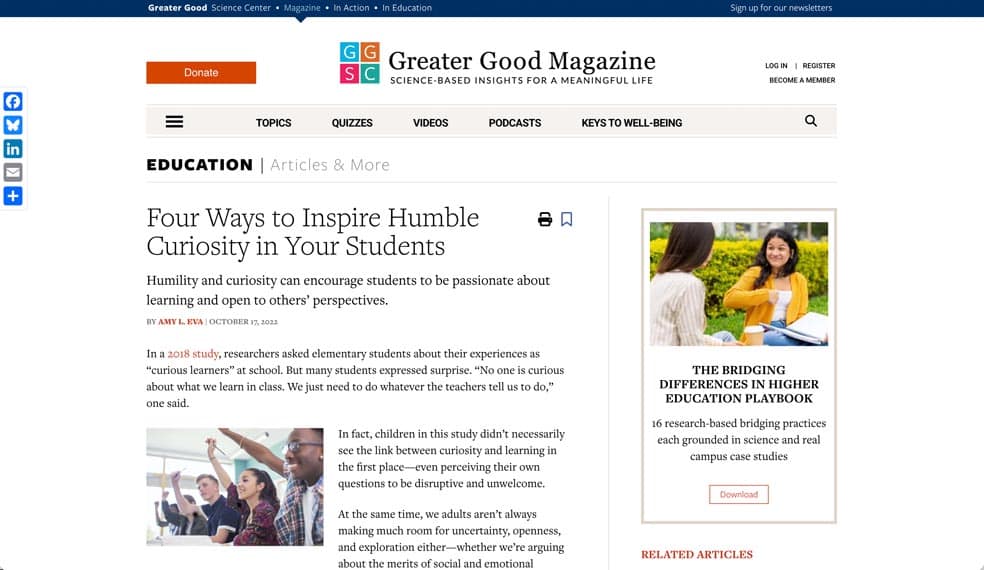
And I think to that end, Derek, when we can do that ourselves with demonstrating through what we say and what we do, that is actually our context. We get curious about things. We try things out to show them a little bit more of the failures we experience or just the wrestling that we experience and not attempting, because it’s the assessment for learning and learning for assessment that we actually do that even when we’re not being graded. Back to your comments earlier, just about the challenges with grading. There is so much more we could say about this. I love what I know you well enough to just be like, hey, this is a great blog post. So I’m going to say in advance, eric, I can’t wait until the next time we get to have conversations. I’m so grateful for your friendship and just getting to be a thought partner. We got to geek out a little bit about podcast. I definitely want people to be listening to your podcast. I get so excited every time I see another one show up in my queue. I’m glad you’ve launched that new aspect of your podcasting life, but right now I’m going to shift us over to the recommendations segment and I have two things I’d like to share quickly. People are going to maybe chuckle because I’m even more curious about curiosity these days because I’m preparing for some upcoming workshops and work with faculty. So I’d like to share two articles that are related to curiosity. The first one, Speaking of Context, is written in a context more focused on K through twelve. But I don’t want higher ed to dismiss it since I just see so many connections. I think there’s so much we can draw from our educators in the K through Twelve context. So this is from the Greater Good magazine at the University of California, Berkeley, and it’s four ways to inspire humble curiosity in your students. And the subtitle Humility and Curiosity can encourage students to be passionate about learning and open to each other’s perspectives. And again, most of the examples here are in K through twelve. But my goodness gracious, do we need this in higher ed. We need that humility. We need that curiosity, not just in our students, but in ourselves. So it’s a really wonderful piece. Lots of art linking to research and other resources that you could use. The Idea of practice, listening with fascination, how we can do that. Emphasize the value of questions, draw on awe to encourage exploration and normalize uncertainty. We’re talking about all these things in today’s conversation. Isn’t that interesting? Derek so, yeah, that living in the not knowing part. And the, the second article is from Noba and it’s the Noba blog, Stimulating Curiosity using Hooks. And Derek will be chuckling because I first learned about this from Derek. The idea of a time for telling. And I love it because I’ve done enough retrieval practice now to be able to say researchers. Now that I say it, I can’t do it. Researchers. Bransford and many times I have been practicing. But the idea that sometimes we do have more dense things we need to do sometimes. Derek the actual practice of writing where we’re going to struggle and like sometimes the small ball, as James Lang would say, in small teaching, we actually need to catch and run the bases. I can’t believe I’m using a sporting. I really, really should not do that thing. But if we have a way of hooking people, getting them curious, getting them to ask questions, from there, they will tolerate and even pursue the more dense and seemingly boring information. Because it’s not boring anymore or not as boring anymore, because now I’m kind of wondering about that. Wait a minute, how did that work? And they talk about attention. James Lang work in his book distracted. Like, we can’t get 100% of even our own attention. How could we expect that of anyone else? But can I get a moment of your attention to get you starting to ask some questions and get you curious about things? And I like this term of the know that thing of the hook, which I think you could also call a time for telling. So those are my two recommendations, I suspect. I’m not done recommending things around curiosity, so bear with me, listeners. And Derek, I’m going to pass it over to you for whatever you’d like to recommend.
Derek Bruff [00:40:37]:
Well, sure. Well, one note on that last one. I’ll mention Ken Bain’s book, what the Best College Teachers Do and how he talks about one of our roles as teachers is to either get students interested in our questions or help them find the connections between the questions they already have and what we’re trying to teach them.
Bonni Stachowiak [00:40:54]:
Oh, so good.
Derek Bruff [00:40:55]:
And that’s another way to get to that authentic space where students are genuinely interested in what they’re learning and then they’re much more likely to engage deeply. My recommendation is an extended version of what I did on my assignment Makeover, where I tried to see how can these AI tools actually replicate the assignment. So the folks at the Planet Money podcast and radio show decided to see if they could use AI tools to make an episode of Planet Money.
Bonni Stachowiak [00:41:22]:
Oh, no. Your kidding me. I did not know this. I’m behind. I’m behind.
Derek Bruff [00:41:26]:
Three part series. It’s very entertaining. And, you know, there’s AI text generators that can write scripts. There are AI voice generators that can sound like fictional people, but also can sound like actual people if you train them the right way. And so they wondered, Mike, basically, is AI going to put us out of a job on our own podcast? And then they tried that experiment to see to what degree can AI tools actually do the things that we do as professionals on a daily basis? So it’s a really interesting exploration of the same kind of idea that I was exploring with my assignment Makeover.
Bonni Stachowiak [00:42:00]:
Oh, my goodness. Literally, I’m about to drive away from home. Not permanently. I’m coming back, don’t worry.
Derek Bruff [00:42:08]:
In your car. And you’re going to listen to Planet Money.
Bonni Stachowiak [00:42:10]:
It’s going to go to the very top of the list. I have used Planet Money episodes more than anything else in my teaching. Talk about getting people curious, right? Oh, my gosh. They are brilliant in getting people curious. So I cannot wait to listen to that. I’ll put something in the show notes for sure to learn a little bit more about that. Derek, it’s so good to talk to you again. Thank you so much for coming back. And I can’t wait till next time.
Derek Bruff [00:42:34]:
Michael is funny. Thanks for having me back on. It’s good to hear your voice. Well, I hear your voice all the time. It’s good to actually talk to you.
Bonni Stachowiak [00:42:40]:
Same back to you as well. Thank you again. Sure thing. Before we start playing the theme music here at the end of today’s episode, I wanted to throw up a cautionary. Not a cautionary. What’s the opposite of caution? A good news. A good news alert. Because you are going to notice as I close the episode that one of the names that I mention at the end of these episodes has changed a bit. Congratulations to Sierra. Used to be Sierra Smith and now Sierra Priest on your wedding and wishing you all of the best in your lives together.
Today’s episode was produced by me, Bonni Stachowiak. It was edited by the ever talented Andrew Kroeger podcast. Production support was provided by the amazing Sierra Priest. If you have yet to sign up for the weekly newsletter from Teaching in Higher Ed, head on over to your web browser. It takes about a minute and you will receive in your inbox the show notes from the most recent episode. But wait, there is more. You will also receive quotable, words, some other related episodes, some other resources that don’t show up on the show, and again, all conveniently once a week in your email. So head over to teachinginhireed.com/subscribe and you’ll be able to receive that information. Thank you so much for listening and I’ll see you next time on Teaching in Higher Ed.
Teaching in Higher Ed transcripts are created using a combination of an automated transcription service and human beings. This text likely will not represent the precise, word-for-word conversation that was had. The accuracy of the transcripts will vary. The authoritative record of the Teaching in Higher Ed podcasts is contained in the audio file.