Follow the Teaching in Higher Ed Podcast
About this Episode
Tatiane Russo-Tait shares about equity and social justice in STEM education on episode 471 of the Teaching in Higher Ed podcast.
My dad told me that I needed to get my education and that education is the only path to liberation for folks like us.
Tatiane Russo-Tait
On episode 471 of Teaching in Higher Ed
Voices on this Episode


Show Notes + Resources
Recommendations from this Episode

Transcript
[00:00:00] Bonni Stachowiak: Today, on episode number 471 of the Teaching In Higher Ed Podcast, Equity and Social Justice in STEM Education, with Dr Tatiane Russo-Tait.
[music]
Welcome to this episode of Teaching In Higher Ed. I’m Bonni Stachowiak, and this is the space where we explore the art and science of being more effective at facilitating learning. We also share ways to improve our productivity approaches so we can have more peace in our lives and be even more present for our students.
[music]
Dr Tatiane Russo-Tait is an assistant professor in the cellular biology department at the University of Georgia, where she leads the access lab, advancing critical consciousness, equity, and social justice in STEM. She has a BA in cell biology from the University of Hawaii at Hilo, and an MS in stem cell biology from San Francisco State University.
Before attaining a PhD in STEM education at the University of Texas at Austin, she was a program director at the Center for Science and Math Education and Instructional Faculty in the College of Science and Engineering, at San Francisco State University. She taught undergraduate courses in biology and health equity, co-developed biology and social justice curricula, and led professional development workshops on student-centered teaching practices and equity issues in STEM.
Her lived experiences as a first generation to college immigrant Latinx biology student in the US, her subsequent work with students from minoritized backgrounds in STEM motivated her to pursue scholarship in the field so that she could contribute to the larger body of knowledge and national conversation on using asset-based and justice-oriented approaches that best support STEM students and prepare STEM educators. Tatiane Russo-Tait, welcome to Teaching In Higher Ed.
[00:02:24] Tatiane Russo-Tait: Thank you for having me, Bonni. Happy to be here.
[00:02:26] Bonni Stachowiak: Would you tell us where you first have some of your earliest memories about why social justice is important in this world?
[00:02:35] Tatiane Russo-Tait: I grew up in Brazil, and my parents split up when I was nine. I was raised by a single dad, and my mom lived in the US and helped us financially, but due to the Brazilian economy, my dad couldn’t find employment and we lived in a very food and shelter insecurity lives. I was always very aware, acutely aware, of class issues when I was a kid.
Being raised by a single dad and being the eldest child who was a woman, I also was the one who took care of the household and took care of my siblings, in conjunction with my sister, who’s a little younger than me. Early on, I always had this idea about gender, class, and equality, that I was very aware. We lived in a middle-class neighborhood so that we could access good schools.
I always had to live this double life, between my friends who were well off, and trying to practice this culture, this politics of respectability, where I could fit in and I knew what they’re talking about, and then go home and deal with some very, starkly different realities, in my household. When I was 11 or 12, I confronted my dad, and I was like, “Why are we doing this? All my friends are fine. What’s going on?”
I was a child. He sat me down and said, “I made some mistakes. I finished high school, your mom had third-grade education, we didn’t get our education, and you need to get your education. That’s the only path to liberation for folks like us.” That really stuck in my mind. I’m going to get a college education, I’m going to get myself out of this life. At the same time, in high school, we were reading Paulo Freire.
Paulo Freire is a educational scholar, a philosopher of education, who really did a lot of social justice work in Brazil, in supporting illiterate adults, learning how to read so that they could vote for their interests, because back in the 60s, they were not allowed to vote if they were illiterate. That book’s called Pedagogy of the Oppressed, really powerful book. That opened up my understanding.
I also was a teen mom, so I had this other layer of experiences based on my social identity and how people perceive me, how I’m treated, that has nothing to do with my abilities or anything else. I was tuned in very early about social injustice, but particularly sexism and classism. I was very much unaware of racism in Brazil. I’m quick to say this, because I’m light-skinned Latina, and I do have indigenous and Afro-Brazilian roots, but that is not something that was emphasized in my upbringing.
My European Italian background was what was emphasized. My racialized experiences were like, “Oh, you look kind of indigenous. You have–” I had this black hair that was super long and straight, and they always compared me to Northern Indian Brazilians. I’m like, “Oh, I’m exotic. They like me.” I was totally in that colonized frame of mind, in terms of race.
I didn’t realize or learn about the extent to which my country was anti-Black and racist until I moved to the United States and then started experiencing some racism and xenophobia myself.
I had some idea of social justice issues, but I think we’re all learning all the time. We’re not very clear in all our understandings of justice and injustice in the world, but I have to say that early on, it was class and gender, and then, eventually, my understandings developed as an adult.
[00:06:20] Bonni Stachowiak: Would you take us forward to your college experience and what you remember, maybe, when that was a new thing for you?
[00:06:27] Tatiane Russo-Tait: As I mentioned, I was a teen mom, so I waited till I enrolled my daughter in kindergarten, then I enrolled myself in community college, and later, transferred to a four-year university at the University of Hawaii. I always knew I wanted to do science. The moment my dad told me I had to get a college education, I started looking for what would I major in, and in 8th grade, I fell in love with cell biology and genetics.
I always knew that was going to be my path, so I was super excited and thankful when I finally– I still remember walking in University of Hawaii and going on campus. Like, “I’m in college, I’m going to get a degree, I’m going to be a biologist,” and I was ecstatic. Within a year or so, as a single mom, navigating first generation to college student immigrant, navigating college, dawned on me, “Wow, I don’t know if I can do this.
I was working two jobs at a time and going to school full-time. It’s like, “Is this how it’s supposed to be in the land of opportunity?” [laughs] I started recognizing, understanding that we socially construct the United States and United States education, in particular, as a place where everybody has equal opportunity and access, but no, it just really depends on the level of privilege with which you walk into the university in the first place.
I almost dropped out, and the only reason I didn’t was because I was waiting tables at the yacht club, two professors are dining there, and they asked me why I hadn’t applied to do research in a lab to get paid, so I didn’t have to wait tables. I didn’t even know that was an option. I always knew I wanted to be a researcher, but I never thought that was an option until they introduced that to me.
Then I applied, I got in, I got a job as a student assistant, and I was there from sophomore to graduation, doing research in fruit fly mating behavior and genetics. Super important experience. Once I moved to California for my master’s in stem cell biology, I started experiencing other facets. In Hawaii, it’s a very diverse university, and I didn’t experience a lot of exclusion. I had financial support once I got that job, and I fit in with a group of students there.
When I moved to California, I started recognizing other aspects of exclusion and barriers, and particularly related to race and ethnicity. I had experienced plenty of exclusionary experiences from regular folks, telling me to go back to Mexico, telling me to learn the language, and all these racist interactions, but I never expected to experience microaggressions and really straight-up, lower expectation of my intellectual ability in a master’s program.
I started feeling very excluded, but I also internalized that as my fault. I’m an immigrant, I need to fit in, I’m not expressing myself properly. I’m not very professional. I just internalized that and tried my best to fit in until I started TAing for courses, and then all of the undergrads who were people of color would come to me, because I was one of the few Latinx TAs, and share their own exclusionary experiences in STEM spaces.
That’s when the light bulb went off and I’m like, “Wait, this is not just a me thing, it’s not my personal, this is a collective experience here.” I went to talk to an advisor who was Latina, and she introduced me to Kimberly Tanner, who was at San Francisco State, and said, “Hey, talk to her. She might be able to help you think about different career paths,” because at that point, I was reconsidering whether I wanted to be a researcher, and thinking about teaching instead, so that I could be a role model and so that I could disrupt classroom spaces to be more welcoming and supportive.
Kimberly introduced me to the equity literature and I was like, “Wow, this is a thing. We can research this.” From that point on, I started engaging in work with undergrads there. I graduated with my stem cell degree, but I stayed in the Center for Science and Math Education. Ever since, I’ve been working in issues of equity and social justice in STEM, and undergraduate STEM, specifically. Eventually, I went to pursue my PhD, so that I could deepen my understanding of inequality, especially because I’m not American.
I wasn’t born and raised in the conditions that folks have been. I wanted to understand the educational system and the history of the United States. I just earned my PhD last year, in STEM education, exploring those issues more formally.
[00:11:06] Bonni Stachowiak: When you first said that someone introduced you to Kimberly Tanner, at first, I assumed you meant her work, not the actual person. [laughs] What an absolute treasure to have had that connection, and just think about the power of relationships and how that can change our trajectories in our lives.
[00:11:24] Tatiane Russo-Tait: She opened a lot of doors for me. She introduced me to the issue, and then welcomed me as a faculty colleague to her lab, to learn more about inclusive teaching and issues of equality and education. She was part of my dissertation committee, eventually, even, the amazing way which faculty can be a gateway instead of a gatekeeper.
[00:11:46] Bonni Stachowiak: I think that for the rest of this part of the interview, it might be interesting for us to explore, maybe, on two levels, the racism and sexism that we might inflict and/or encounter on an individual basis. Then let’s make sure and save some time to talk about some more of the systemic challenges. Is there a good place for us to start? Is there a better place to start and then end? Should we start with the systemic or start with the individual?
[00:12:14] Tatiane Russo-Tait: I think they’re all interconnected. It’s just a different level of inequality, but they all reinforce each other. I’m always grappling with that, because I’m studying faculty beliefs and practices, and the experiences of students in those spaces. That’s very individualized, in a way. I like to see it as a collective understanding, and understanding how we can collectively change faculty and support collective student experience.
[00:12:42] Bonni Stachowiak: Well, let’s start systemically then, because I think understanding that we are part of something broader than ourselves is really important. Both in the ways in which we can build other people up, tear them down, and everything in between. What did you speak a little bit about, early in your research? What you started to notice, maybe some of the hidden ways that we are perpetuating issues of underrepresentation in STEM, specifically?
[00:13:10] Tatiane Russo-Tait: This takes me to my lived experience as a student, and then as a faculty member, supporting students from minoritized backgrounds. What I’ve learned through my research, and then that was fueled by my interest because of these experiences, was that there are these narratives, these discourses that American society, United States Society, uses to explain inequality, or rather, rationalize inequality in a way to justify it.
In my lived experiences working with faculty before I went to get my PhD, had always been like, “Oh, these poor students, they don’t have good education. They don’t have good preparation. They lack motivation. Their cultural is deficient in some way.” These narratives were so striking to me, because they’re the exact same narratives that I heard in Brazil about Afro-Brazilians and indigenous folks. I was really like, “Wow, these are literally the same excuses and very different countries.”
The same rationale to wash your hands off responsibility of doing anything about it, because this is an individual or a cultural problem. That was really interesting to me. How these narratives get in society and then it seeps in everywhere, and it’s so easy for us to pick up, even without wanting to. For example, as I mentioned, I had the idea that this was the place for the American Dream. I understood this to be a meritocratic place. All I needed to do was work hard and I would succeed.
That was not the case. That’s part of what the research that I’m starting to do now, is looking at hegemonic ideologies. Ideologies as these ideas that are used to make sense of the world and explain the world, and that we’re all socialized in, because we are part of this society. Then the hegemonic part is the part that I’m interested in. It’s like it adds power to the idea. Basically, ideologies can become hegemonic and they can mediate our understanding of systems of power in society.
Once people in power start creating these narratives and these discourses, they can control us without exercising fear or violence. We then hear these ideas, these narratives, these explanations, and the people in power, they disseminate these discourses, these narratives, and these discourses usually protect their position of power, explains away inequalities, and normalizes oppression. They’re using half-truths, and often, false information too. As we know, we’ve been listening to a lot of misinformation lately.
Iit’s becoming much more clear how that takes place. It doesn’t matter your political inclination, these hegemonic ideologies are embedded in the United States society, and STEM, in particular. In STEM spaces, specifically, what I find, and what other research has shown, is that meritocratic equal opportunity, and colorblind ideologies are these systemic ideas that they’re pervasive across the system, but are particularly heightened and exacerbated in STEM, because of us, as researchers, believing to be objective, neutral, and apolitical.
This is the space in American society where we are generating knowledge, where our knowledge creation leads to innovation and supposedly always the betterment of society, which is also another discourse that’s problematic, because science can be used as a tool for oppression, militarism, and all that stuff. These discourses then are part of our socialization as scientists. We are objective and neutral in our pursuit of truths, and therefore, objective and neutral in our interactions with people. That is not the case.
We are just as vulnerable, or even more so, because of the ethos that we are embedded in, to take in prejudice and discriminatory ideas. That then informs our understandings and practices, without even recognizing. We can be the most egalitarian person. If we don’t have an understanding of these discourses, the contradictions, the power and privilege systems embedded in these ideas, we are going to be gatekeepers and perpetuate inequality ourselves, even without wanting to do so.
[00:17:38] Bonni Stachowiak: I’d love to hear you talk a little bit more about the ways in which you’ve seen the intersections between science and social justice. Sometimes, I think too naively about– It’s one or the other, [laughs] and the ways in which our curriculum really does need to change, so that we’re shaping the morality as we’re also building expertise and skills, and using that rigorous research mindset.
[00:18:06] Tatiane Russo-Tait: Yes, I absolutely agree. It needs to be modified. I think that it’s an incredibly powerful place to engage in critical consciousness-raising to support future scientists. Undergrads are taught science as a set of facts that we know. Maybe they learn some practices in the lab, but in the end of the day, it’s socially constructed as a space of fairness meritocracy, as I mentioned, but also of good and innovation.
Not necessarily the connection, like you said, between science and social justice, how science has been used as a tool for oppression, or looking at the history of eugenics, that says it all. If we just go back in biology, and we think about that. We think about how science innovation, now– There’s some amazing research being done right now, in K-12, looking at youth’s understandings of STEM, and how they’d rather not be part of the workforce in STEM, even though it would provide them with financial independence and support.
It goes contrary to their moral values. You’re looking at the research in computer science, for example, at Northwestern, has shown how students are very conflicted. Yes, I can code. I can do this, but do I want to? Do I want to be part of Amazon, and do I want to be part of the military? How is my code going to be used to oppress other people across the world, or exploit employees in the United States? There is some understanding now, in a K-12 space.
Not now, for decades, there are research being done, with science students and teachers. For example, there’s another educator who does chemistry education, he looks at the petrol business in Chicago, and how it pollutes a neighborhood and affects the health of these communities that are usually segregated and racialized. How that affects their health. Then we look at health disparities.
We can spend days and days talking about how science has been a part of perpetuating health disparities, and how medical education has done very little to keep folks from racialized backgrounds to having to endure discrimination from doctors who are unintentionally making assumptions about everything from their ability to feel pain to other more complex ideas. Science and social justice are inextricably intertwined.
Another piece that we can look at very clearly is climate change and environmental justice issues, and food justice issues. That’s all connected.
[00:20:38] Bonni Stachowiak: Tati, we’ve talked a little bit about your own lived experience and some of your research with social justice and STEM, the underrepresented populations, and everything in between. There’s so much here. I’m going to ask a completely unfair question to that end, would you share what comes to mind, that each of us might consider doing to raise our critical consciousness, and something that you can think of, that, before we’ve raised it enough, we might start doing, to take action in those areas which we have influence in, and that’s a lot inside of our classrooms.
[00:21:15] Tatiane Russo-Tait: Yes, sure. Just for some context, critical consciousness has been divided in three ways, in three parts. The critical reflection, or this awareness of inequality, this understanding of systemic injustices and how these social-political contradictions are taking place, and understanding of oppression. Then we have critical self-efficacy or political self-efficacy, depending on the literature you read. That’s about– Do you feel empowered? Do you feel like you have agency to do something in your spheres of influence?
Then there’s critical action, which is actually taking action in doing something about this. This involves advocacy, critical activism, or just small disruptions in your own spheres of influence. Like you said, in your own classroom, there are ways in which you can engage in critical action to push back against the status quo and humanize your own classroom, or push for change in your department. Critical consciousness development has been studied a lot in youth.
It was originally studied with adults through Paulo Freire, but there’s not a lot of research in faculty. I’m trying to make sense of that and understand how can we support faculty awareness. I’ve tried in some ways, and what has worked for me, in working within groups of faculty members in workshops or learning communities, the first thing is to be made aware, but before that, you have to critically reflect on your own social positionality and your own understandings. That’s the place where I tend to start with faculty.
I share my own positionality, how I came to my understandings. They have activities that exist for 20 years, I’m not reinventing the wheel, so like an identity wheel, where they think about their own identities and where they have power and privilege, and where there might have been marginalized identities. Then they reflect on those identities in the context of STEM, and then we explore data on folks who are different from them. We have conversations, so that we often have faculty from marginalized backgrounds in different ways.
It could be the first woman in their department, that’s been there for 30 years, and she shares her experiences, and then these faculty members have no idea. They’re like, “What? I didn’t know this. Somebody I care about, somebody I respect, have felt these ways.” That’s the first one, is just– How do we get in, how do we break down the wall and help them see and build empathy? Then we look at the data with students, and we look at student data institutionally.
That’s very important, because we can easily say, “Oh that’s just other institutions, that doesn’t happen in my institution.” Then, eventually, we explore more systemic issues, because they do have understandings that don’t come out of nowhere. There’s an understanding of lack of preparation, there’s understandings of how socioeconomic statics affects these things. We just break it down and look at the data, understand how it’s still racialized, understand how it’s gendered, and understand how this comes to be.
That’s the first thing. Then with this understanding, they are excited to say, “Okay, what can I do about this?” We can never just talk about oppression without talking about solutions. Then we can look at things that have been done in the classroom. What are practices that are equitable? What are things that I can do to humanize my space, because STEM is a dehumanizing space, so how do I humanize myself as a person, how do I humanize science, and how do I help students see that I see them as humans who are learning?
I’m not teaching math, I’m not teaching STEM, I’m teaching students. How do I show them that? We explored that literature base, because it’s been around for decades as well, so it’s just moving it to the STEM space, or to the post-secondary space. I feel like that’s a good start. Once you start changing things in your classroom and your interactions with your mentees in your labs– Those are connected, you can’t separate them.
Once you start seeing that in a classroom, you start seeing that in your lab, maybe you are able to look for more resources. One piece of advice I have for faculty is to find critical mass in their departments. I’m new in my department right now, so I’m still figuring things out and making sense of how things are, but in general, finding folks that are allies, that are co-conspirators, and saying, “Okay, I want this to change. This is a problem.” How do we, as faculty, then vote to change this in our department?
Maybe that will be an example for other departments in that college. How do we change hiring practices or admissions practices, that we have power over, to be more equitable? Not to check a box to say, “Oh we did DEI,” but to truly come in from a socially just perspective, and support the diversification of the folks who are walking into the academy. Then teaching science for social justice, for me, it’s really important. It’s something that I’m working on right now, with some colleagues.
To do that, you need to learn the social justice issue and learn how to connect it to the science. It’s more work, but I can guarantee you, it’s more powerful, because it’s more relevant to students. It’s going to help them be connected to the material better, it’s going to support minoritized students to see how their social identities are not in conflict with science identities, it’s going to help them to see how their communal goals are aligned with science, because right now, we don’t see that connection.
Unless you’re going to be a doctor, maybe, or a nurse, you don’t see how you can help people with science, how you can help communities, and advocate for change with science. I feel that’s a huge individual or interpersonal-level intervention that can support undergraduates from all backgrounds leaving science classrooms with strong understandings of inequality, how science is a tool for oppression, but also a tool for liberation.
Then how they move on to other science careers, with those understandings, may then trickle down, eventually, to the interpersonal relationships between colleagues from different identities, and then for the things that they advocate for change in their spheres of influence, as future professors, future scientists, or future professionals in those fields, because science is a position of power. If you get a degree in science, you tend to end up in a position where you do have some say.
If you’re coming in with an understanding of inequality and critical self-efficacy, you could engage in critical action. That reminds me of a book. You know what, I’ll talk about that in recommendations.
[00:27:37] Bonni Stachowiak: Oh, fun. Fun, fun, fun. Since you mentioned recommendations, this is the time in which we each get to share some things that we have been discovering or would like to recommend with the listeners. I actually have one that came from a listener today. This is from Allison, and she says, “Thanks for the podcast. I’m a graduate teaching assistant and found the podcast over winter break.
I’m learning so much about teaching and being a teacher from you and your guests. You talked a bit about joy in some episodes, and I wanted to share a recent find I think you’ll like,” and Allison, you were correct. She says, “Elyse Meyers, internet funny person, shared a little trick she developed to remind herself of joy. She explains it in this video,” and I’ll link to it in the show notes but the premise is that, “She takes photos of little things that make her happy.
Soon, her camera roll is full of so many things that bring joy, and it helps her adjust her mindset. I hope you like it as much as I do.” This reminded me a little bit of my conversations, over the years, with Alan Levine. Alan Levine attempts to take a picture every day, although he doesn’t necessarily does something that bring him joy, but I mentioned attempts because I find that streaks, for me, can be really motivational, but it feels, sometimes, unhealthy, where I get a little bit–
Maybe I could be a little more gentle with myself on these things, so I love that he says most days, he tries most days, and he’ll just list it off of– This is X photo out of 365, and he’ll see how high he can get that number in any year. Allison’s just recommending this video, just the idea of our camera roll filling up with things that brought us joy, and how that could potentially be self-reinforcing, was really fun for me to consider.
It was also just fun, Allison, to hear from you and know that you’re listening to the show. It’s brought me so much joy, and pain too, good kind of pain, the pain that comes from change and transformation. It was just really fun to hear from you. I’m so glad that you’re listening, and yes, thanks for writing in. It’s always so fun to hear from people that listen. Tatiane, I’m going to pass it over to you, for whatever you would like to recommend.
[00:29:51] Tatiane Russo-Tait: Yes. Regarding what I was speaking before, as far as inequality– Inequities and injustices are multifaceted. They need to be addressed in various levels, from the internalized ideas to the interpersonal interactions. Then, of course, the systemic and institutional levels. I always grapple with this tension in my work, about naming and disrupting inequitable and unjust systems, while also recognizing the roles of individuals, in this case, faculty, in my case, but as any individual.
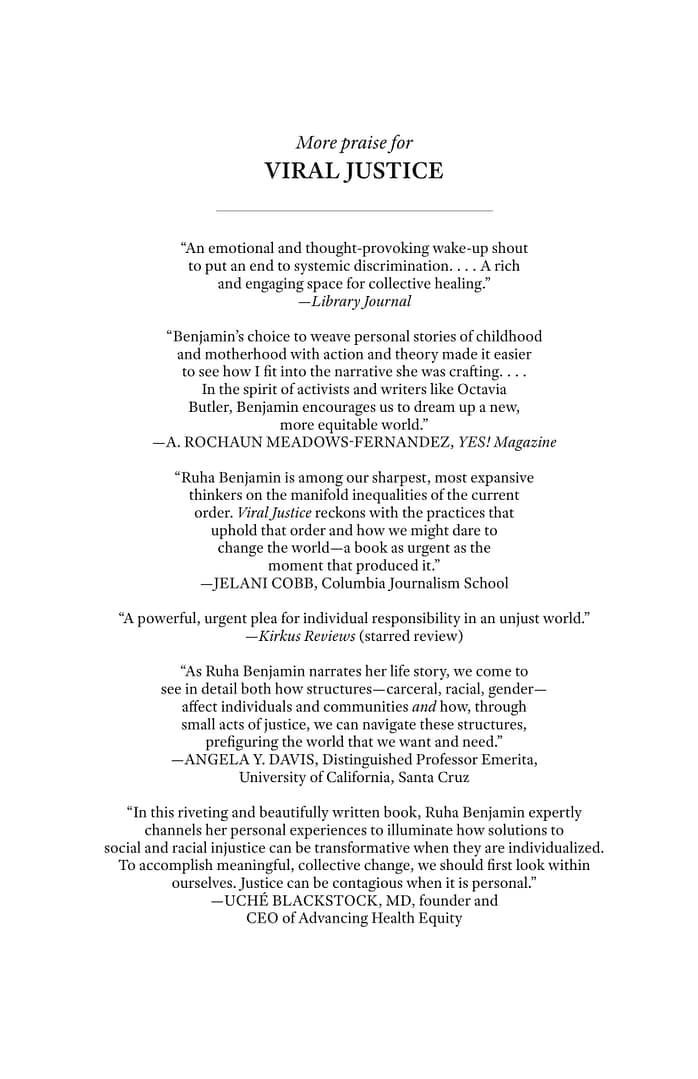
They can be gatekeepers and maintain the status quo, or they can be change agents and challenge it, or disrupt it. A book that I’m just finishing up is called Viral Justice by Ruha Benjamin. She’s really insightful in that regard, again, threading that line between naming the systems of power, but also sharing example of individuals or our collectives, that are engaging in ways to disrupt these inequalities in their spheres of influence. She talks about the housing segregation.
Then, how individuals engage in issues and ways to change that, and then education as well, also how the culture of academia is very exclusionary, and how we can do different things. I found that book was particularly helpful in naming the systemic issue, acknowledging it, but also recognizing that we, as individuals, are change agents, and we can work collectively and individually to disrupt and change this reality as it is right now.
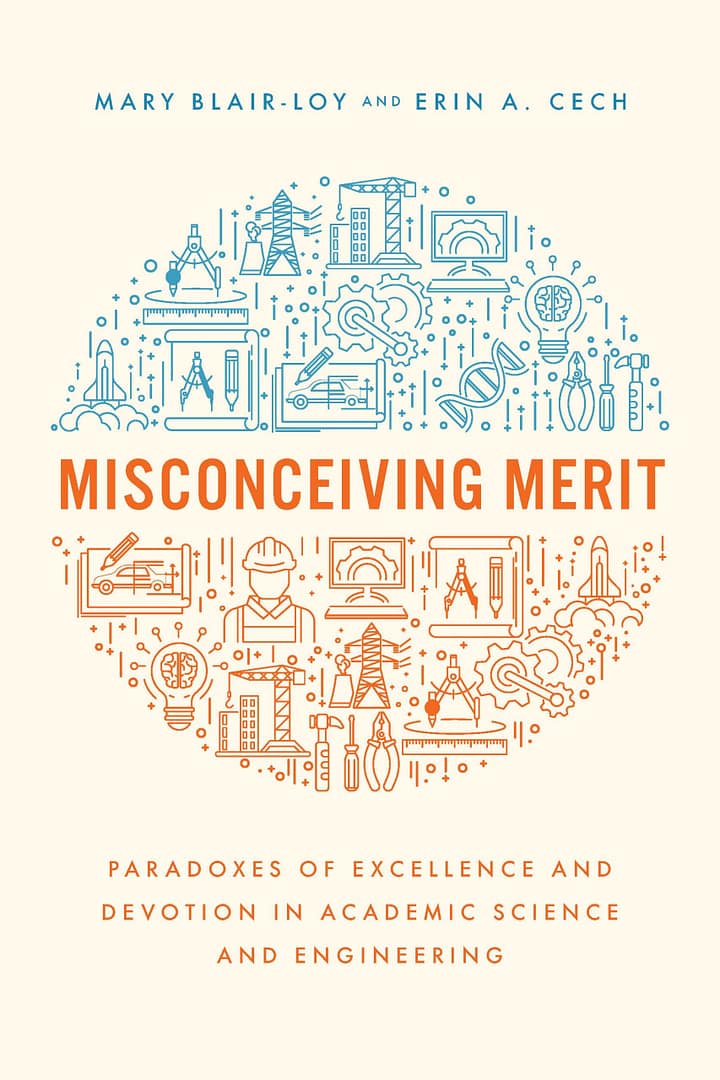
Another book that I read recently, that I’ve cited before, that I find particularly helpful for STEM faculty, it might be particularly helpful for some faculty, is Erin Cech and Mary Blair Loy’s Misconceiving Merit: Paradoxes of Excellence and Devotion in Academic Science and Engineering. They helped us to see how our socialization into this idea that STEM is meritocratic actually works in various ways.
They’re very, very helpful, to see that the little interactions and the judgment calls that we make, that perpetuate inequality in STEM, both for women and people of color in STEM. Those are two resources that I’ve been thinking about lately, because I discovered them reading both books. I highly recommend.
[00:32:08] Bonni Stachowiak: Oh, thank you so much, and Tati, in preparation for today’s interview, sent over a number of articles that she has been a collaborator on, and author on. I’m going to be linking to those in the show notes. Definitely want people to go and check those out for even more. You mentioned Ruha Benjamin’s book Viral Justice. If I can find the link, I listened recently to a podcast episode that she did with someone, on the topics from Viral Justice.
If I can find it I’ll put it in there but I was laughing, because as soon as I heard, I thought, “This sounds like such a good book. I’m going have to go buy it.” It turns out, I already had bought it. It’s just sitting there, waiting for me to read. I’m sure no one listening to this podcast has ever experienced that sort of thing, again. I’m feeling like there’s something speaking to me now, with you recommending it today, then I realize I already own it.
It sounds like such a good, good thing, and especially, even for me, learning more about viruses in general. The whole book, the premise of it, that’s not just a cutesy title, but that it actually– I know that I don’t even have enough of an understanding of how viruses work. It just seemed like a multi-layered learning I might do as a reader, and looking at that work.
[00:33:17] Tatiane Russo-Tait: I know. It’s a really powerful book. She uses data from as recent as COVID pandemic, so it’s really powerful to lay out the issues and help us see how there are already agents of change on the ground, doing the work. These are ways in which we could engage or join, hold hand in solidarity with them, and do this work. It was just helpful for me, because I’m always struggling with that individual versus systemic.
Critical consciousness is right there, so it really helps me to recenter. This is important work. We need to look at systems. We need to take down systems. For sure, we can do it more easily if we have more allies, and work in solidarity. All of our liberation is linked, and we need to work together, but first, some folks need to recognize that they have some work to do on themselves, and then work towards change.
[00:34:12] Bonni Stachowiak: You piqued my curiosity too, when you were talking about merit earlier in the episode, and I was sure I didn’t have a good grasp of that. This Misconceiving Merit book also looks really good for expanding the imagination for some of the ways I’m sure that I completely am unable to perceive in that, though these both sound really, really good. I’m so glad to be connected with you.
Becca was kind enough to connect us, and you were generous with your time and everything. It was funny, because I had to reschedule once, and you had to reschedule once. It was just like, now all of it came together, for us to get to have this conversation today. I’m just so grateful for your time and your expertise. I’m so glad to know you. Thank you again for coming on the show.
[00:34:52] Tatiane Russo-Tait: Thank you. It was great to know you too. I appreciate it. I’ll hope to stay in touch.
[00:34:56] Bonni Stachowiak: Me too. Absolutely. Thanks once again to Tatiane Russo-Tait for coming on Teaching in Higher Ed. Today’s episode was produced by me, Bonni Stachowiak. It was edited by the ever-talented Andrew Kroeger. Podcast production support was provided by the amazing Sierra Smith. Thanks to each one of you, for listening and being a part of the show. If you have yet to sign up for the weekly emails from Teaching in Higher Ed, head over to teachinginhighered.com/subscribe.
That’ll get you the most recent episode’s show notes along with some other resources that don’t show up on the regular show notes pages. Thanks so much for listening, and we’ll see you next time on Teaching in Higher Ed.
[music]
[00:35:59] [END OF AUDIO]
Teaching in Higher Ed transcripts are created using a combination of an automated transcription service and human beings. This text likely will not represent the precise, word-for-word conversation that was had. The accuracy of the transcripts will vary. The authoritative record of the Teaching in Higher Ed podcasts is contained in the audio file.