Follow the Teaching in Higher Ed Podcast
About this Episode
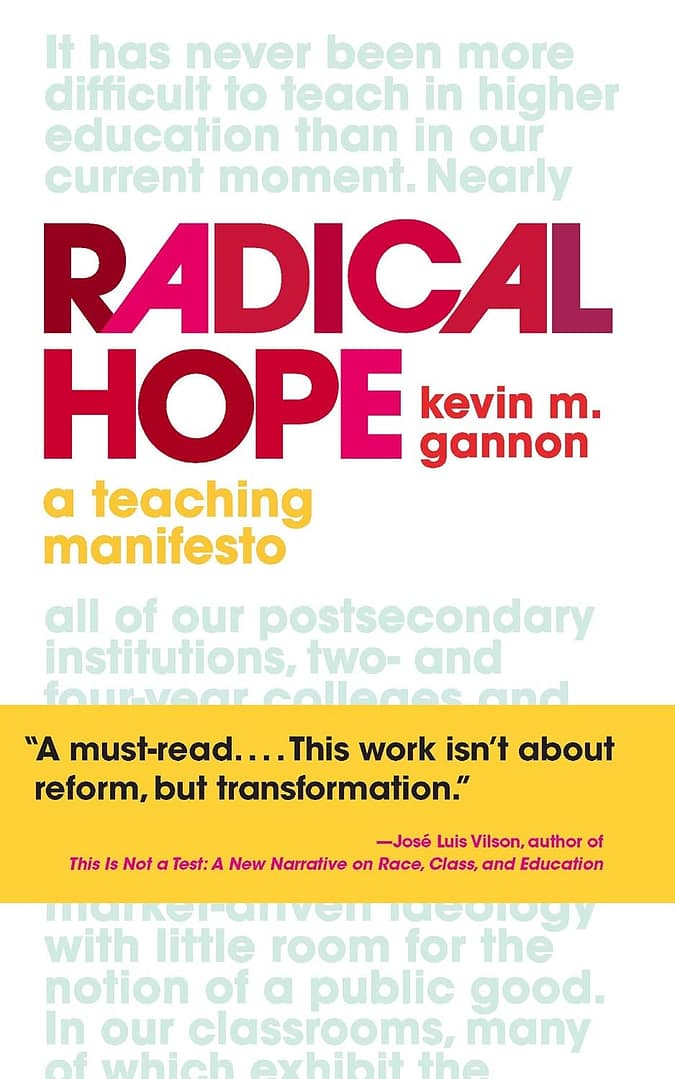
Kevin Gannon shares about his book – Radical Hope: A Teaching Manifesto on episode 304 of the Teaching in Higher Ed podcast.
Free speech is often weaponized against marginalized groups.
Kevin Gannon
On episode 304 of Teaching in Higher Ed
Voices on this Episode


Show Notes + Resources
Recommendations from this Episode
Transcript
Bonni Stachowiak: Today, on episode number 304 of the Teaching in Higher Ed podcast. Kevin Gannon joins us to speak about his new book, Radical Hope: A Teaching Manifesto.
[00:00:13] Speaker: Produced by Innovate Learning, maximizing human potential.
[music]
[00:00:23] Bonni: Hello, and welcome to this episode of teaching in higher ed. I’m Bonni Stachowiak and this is the space where we explore the art and science of being more effective at facilitating learning. We also share ways to improve our personal productivity, so we can have more peace in our lives and be even more present for our students. Kevin Gannon is the director of the center for Excellence in Teaching and Learning and professor of history at Grand View University in Des Moines, Iowa where he’s taught since 2004. His research, teaching and public work, including writing centers on critical and inclusive pedagogy, race, history, and justice, and technology, and teaching.
He writes for Vitae a section of the Chronicle of higher education and his essays on higher education have also been published in VOCs and other media outlets. His book, Radical Hope: A Teaching Manifesto was published by West Virginia University press in spring of 2020 as part of their Teaching and Learning in Higher Education series edited by James M. Lang. He’s currently writing a textbook for the US Civil War and reconstruction eras that’s grounded in settler-colonial theory for Routledge. In 2016 he appeared in the Oscar-nominated documentary 13th which was directed by Ava DuVernay. He’s a speaker and consultant about a range of topics on campuses across North America.
In that work he endeavors to bring passion, humor, and interactivity to his audiences. He’s also delighted to work with smaller groups of students, individual classes or selected groups of faculty and staff on those campus visits. Kevin, welcome back to Teaching in Higher Ed.
[00:02:18] Kevin: Thanks. It’s great to be back with you.
[00:02:20] Bonni: I have got to meet you now twice in person. [laughs] I was saying when we joined each other online today, what a nice thing it is to talk to what I feel like is an old friend.
[00:02:30] Kevin: Yes, exactly.
[00:02:31] Bonni: I also very much enjoyed reading your book. I got a chance to read it before its revised version even. I feel like I have the, what’s that called in music?It’s some deep cut or something. [laughs] I felt like very much your voice, your experience, all those years of teaching, and I especially love the title and just inspiring us to teach with radical hope. When you think about teaching with radical hope what’s the one overarching message that brings us into this conversation?
[00:03:04] Kevin: That’s a great question because these are not exactly times where hope is something that’s been bandied around a lot. I would joke with people, they’d say, “What’s your book about?” I’m writing a book on hope. After the 2016 election and everything that’s going on, I would just get this long silent look from whoever asked me that question and then some embarrassed comment like, “How’s that going?” For a while the answer was really poorly because it was hard to keep in a place of thinking about hope especially in the radical root level since with just everything that we’re swimming in at this current point.
I’ve had to do a lot of thinking about what you just asked about because it can’t just be an empty slogan. It can’t be just, “Hey, things will get better. We haven’t thought about how but we’re just going to comfort ourselves by saying things get better.” I think for me what it comes down to is hope as embodied in practice. Sometimes, we have to think about it in a way that the everyday routine, seemingly routine choices that I make, the ways that I interact with my colleagues, with my students, with my institution, with my community, that that is a practice in which hope has to be embodied.
Because otherwise, the alternative is that it’s a practice in which cynicism is embodied or despaired. I’m not real big on existential crises, and I would not like to go through one. I think even beyond that. It’s like the line from the Rush song Freewill. Even if you choose not to decide, you still have made a choice. I think that not consciously deciding to embody a certain ethic in your practice is defaulting into another ethic. For me, my practice has to be suffused with this, not just hope and the empty platitudes, but a real radical sense of hope. In other words, a root level, fundamental commitment that suffuses every nook and cranny of the work that I do on a daily basis.
[00:04:58] Bonni: I promise I am not going to say too much about this but my dissertation, part of it was on something called the locus of control. There’s lots of different versions of it, but that’s a construct of how we describe what happens to us. I see in a lot of faculty communities we’ve become, and I’m going to use a really judgmental word here, and I’m okay with that, some of us have become really lazy. It ties to what you just said because it’s so easy for me to not have that hope. Then it’s all about an external source. These things are happening because we don’t have the budget we need.
By the way, yes, I know there’s all kinds of things we need to wrestle with around budgets, but I can’t get that because I don’t have the resources or the policy. There’s a lot of just this external look at why we can’t do things differently. It’s hard to look inward. To me, part of what I’m hearing you say around this radical sense of hope is, it’s not radical waiting for someone else to come in and rescue us. Although you are very about things we need to be speaking to, it’s a power. We’ve spoken a lot about that before. I also hear you saying that this has to be looking inward. Am I hearing that or am I projecting that onto you?
[00:06:08] Kevin: No, I think that’s a good way to put it, but I think one of the tensions and I struggle within that is it’s so easy to say, “I’m going to control what I can control and fix what I can fix in my own little sphere.” If we’re all doing that in atomized ways, then we’re not informing one another’s practice. I’m a big structures guy. That’s what I study as a historian, these structures and in particular structures of inequality. What I’m really cautious about is saying, if I’m acting on this ethic of hope, what that means is that I’m disregarding what’s happening outside and only controlling what I can control.
Which is in some ways a really good strategy to use for day-to-day survival and sanity, but by the same token we can’t advocate our responsibility, to advocate for change, and sometimes fiercely, and sometimes vehemently, sometimes angrily. It comes from a place of hope as opposed to that simple condemnation. Because I have hope, I cannot abide the status quo because I know what could be not just what should be in abstract idyllically, but what could be more importantly how we can get there in a concrete sort of way. To lose sight of that, I think, again, it’s back to this idea of what is our practice? How are we embodying our ethic and our practice?
For me, that practice can’t just be what’s immediately surrounding me and my individual community of students. It’s this collective work of higher education in general of education in general, the students, and faculty and staff who are in these spaces trying to make this thing work, knowing that it could work better, knowing how it could work better but getting really tired of screaming into the void about it. How do we move beyond just condemnation into a practice that we can actually model off of and create change starting with what’s in front of us, but always being cognizant of the ways that we might influence systemic change as a result?
[00:08:08] Bonni: I recall all too vividly starting out in higher education and the things that I was told around our students, things I was told around grading, even around proctoring exams, and a lot of it was these are your adversaries. They’re going to try to cheat, they’re going to try to lie. If they’re absent, we better get that doctor’s note or if grandpa dies, we’d better get that funeral announcement. I didn’t question it as well as I would like to say that I did. You have been a real influence for me and for so many others. Share with us about the things that some of us tell our students and how you see that a little bit differently. I say it sarcastically. [laughs]
[00:08:51] Kevin: I think my mantra’s allies is not adversaries. Going back to this idea of we know that there are so many things that are plaguing and troubling us in higher education. Reduced funding, reduced resources, precarious labor, all of these things that we know are so damaging to the enterprise. Students should be the ones that are our allies with this. They are suffering from the effects of those just as we are. Yet all too often we inflict all of that stress on our students. I think a lot of times it’s unknowingly and unthinkingly it’s just these are the people that happen to be around us the most.
If you have a lot of free-flowing stress and angst, it latches onto something eventually and so it’s almost a target of convenience. I think that’s really dangerous and really insidious because our students are listening to us always. All of our campuses, whether it’s a classroom, the registrar’s office, whatever is a teaching and learning space. Our students are always learning. What are we teaching? What are we saying to them? What are we telling them? If my implicit assumption is that given any opening, a student will automatically try to gain the system. If my assumption is, is that when a student misses class that it can’t be a legitimate reason.
It’s nefarious until proven otherwise. My students know that that’s how I feel. I have told them how I feel about them. Anything else I say or do in class when I say, “I expect you to act like an adult, but I don’t trust you as an adult,” that’s cognitive dissonance. If we assume that students are going to do X action if given the opportunity, we’re telling an inaccurate story. From the student perspective, if my instructor is telling me a story about myself that is not who I am, I have no investment in learning from that person because I don’t see that person is invested in anything but inflicting things on me rather than pursuing knowledge and a communal or collegial way.
[00:10:44] Bonni: Sometimes I think it’s easier for us that have experiences in our lives that we can recall where we did not take school seriously at all. Am I remembering right? You have a collection of those yourself that says that you are not always the straight A student.
[00:10:57] Kevin: I was never the straight A student. I was very much an academic late bloomer. It’s interesting because I think I was a punk in high school. There were times where I was, shall we say, escorted home by our friends in law enforcement. In college, I majored in partying for my first three years. I almost dropped out, finally got my act together, took an extra semester to get my grades barely above a 3.0. I know what it’s like to fail a class. I know what it’s like to struggle your first year of college. I know what it’s like to be at the point where you don’t think you’re going to be able to succeed and that you’re about to stop out. I also know that I was given a lot of chances, maybe a lot of chances that other people wouldn’t have gotten.
I’m very cognizant of that. I joke about how I was a high school pong thing. I engaged in petty theft, vandalism, stuff like that. I’m a white kid living in the suburbs. When I went home in the back of a police car, I went home because they wanted to take me home. I don’t have a record. I didn’t spend the night in jail. When I think now about what opportunities students have and who gets the benefit of the doubt and who doesn’t, and when people are struggling academically, what are the stories behind those struggles, and what opportunities if they had to actually have someone in their corner mentoring them as I was mentored? Yes. I think that story is different for a lot of my students.
I think the experiences that I’ve had as acutely shaped the way– It wasn’t always like this. I had to really open my eyes about this and ask some hard questions about my experiences versus some of the experiences of my students. I think that the experiences that I’ve had any perhaps more importantly the counterfactuals to those experiences. What if or what if this hadn’t happened? That’s really been a powerful moment in terms of shaping the way that I work with my students today.
[00:12:45] Bonni: I’m enjoying a lot, there’s been a lot of people that have been saying the statement that- I think it’s around politics a lot. You’ll know what I’m talking about. Two things can be true at the same time. We present something as a false dichotomy, and it doesn’t have to be that way. It reminds me a little bit of what you’re saying where I think if we can look back on our own history, and realize we have unrealistic expectations as compared to how we were, we also have some who are on faculty that don’t have that part of their past. How did they then get more empathy for what it would be like. I like to think though about when I’m teaching that I both take it very seriously.
You mentioned early in our conversation today about the little things. I think very seriously about learning names and about making sure that regardless of whether where we happen to meet, is it online, is it in a classroom, but that they’re great experiences for them and the quality I want to bring to my work. At the same time, I’m finding that I want two things to be true. I also don’t want to take it that seriously. I don’t want to take myself that seriously. I don’t want to think that my class has an outsized proportional importance that it realistically couldn’t and probably shouldn’t. I don’t know if this comes to your mind too. How come both of those things be true for us?
[00:14:05] Kevin: I think certainly we’d all love for what we’re teaching to be the center of our students experience. Early in my career, when I struggled, the one area I did do well in my undergraduate years was history, which appropriate enough for a historian. I have to remember when I teach history now, I’m teaching students who weren’t me. My history classes I was upfront, taking notes, listening, engaged in the material because I found it inherently interesting. Even stuff like tariff debates for example. I ate that stuff up, but I’m teaching classes that are made up mostly that people who were sitting behind me in those classes when I was an undergraduate.
If I had turned around in these classes where I thought the lectures were witty and erudite, and I appreciated all the obscure jokes and references, what was everybody behind me experience in that class. If I’m trying to emulate that class and only thinking about teaching to that front row of idealize students, then I’m not connecting with all of my students. That’s the struggle. It’s like how do we teach students effectively when their pathways are perhaps so far different from our own? I think attention to detail is crucial because like Jim Lang talks about with small teaching. Sometimes it’s those small things that are levers and to exponential change.
While I certainly don’t think that my history 103 ancient world class is at the center of my students’ academic existence right now, I do think it’s important that whatever else may be going on, maybe this is a space for them where those things don’t matter as much and this thing does. For several of my students, the classroom is a refuge. For some of my students, it’s an open door, they’re not sure what’s on the other side, but they’re interested in seeing that. I better make sure that that learning space, whether it’s an on ground or an online learning space, is one that’s appropriate.
It is one that is a welcoming space, a space that my students feel that they belong in. Whatever that space needs to be for them at that point, whether it’s a refuge, just a requirement check, whether it’s something that they’re not majoring in but still interested in, is the learning space one where they can be in that place, and have I done as much as I can especially with the attention of the details, the little things, the learning, the names, the building, the presence, the building the connection community. If I’ve paid enough attention to that, then it can be a space for students where they get what they need.
[00:16:28] Bonni: I have seen you present and I can see you right now, and you have a magnificent presence. You’re a powerful person. I can imagine that sometimes that could get in your way of teaching because it’s hard when you are that magnificent of a presence to make yourself smaller, so that other voices can emerge. How do you go about doing that in your classes?
[00:16:51] Kevin: That’s something I struggle with a lot. I have throughout my career, I like to think that I’ve gotten better at it. I know that there are times where I’m still either forgetful or unskillful in the way that I manage my presence. My wife, she’s like, “You’re just big. You’re a lot.” [laughs] I’m tall, as they say on the internet, I am large, I’m tattooed. I have a loud voice. I can tell you in the past, I really didn’t think very intentionally about how I occupied space and how I presented to others, and how my voice sounded in groups and in communities. I have done my fair share of more than my share, likely of interrupting, of mansplaining, of talking over it. Just unskillful ways of being in community.
I’m very cognizant of the way that I take up space. My voice is one that can be heard easily, not just literally because I’m loud, but also because of who I am and my identity and what privileges are accorded to me that aren’t to others. A lot of the questions that I asked myself as a running monologue in my head, “Do I need to say things right now? Does the world need to hear my opinion on this right now?” A lot of times the answer to that is no. How can I support this conversation in ways that don’t involve either leading it or being a frequent participant in it. There are times where, it’s appropriate to frequently participate and to offer opinion.
I have to be very discerning about that. With students in particular, body language is so important. In one of my early teaching assignments, I had a seminar class. It was with students who I’d had other classes with. They knew me and I knew them. The class was going just so badly after the first few weeks. It was discussion already. It was an upper level history class. We’re supposed to be digging in all these really complex and difficult ideas. I got into the class with this intent to be very intentional, very thoughtful about listening to students, not with the intent to respond, but just to listen. Then to help guide discussion to help model discussion in that way.
Nothing was working, nobody was saying anything. I was ready to tear my hair out. Finally, after class, a few weeks in, I talked to one of the students who I knew well, and we had the relationship where I knew that she would be honest. I said, “What is going on? What can I do? I’m at wit’s end with this.” She said, “Honestly, we’re scared of you.” I was like, “What do you mean?” What had happened was- I’m a little hard of hearing, too many heavy metal concerts. When students were talking, I would lean forward and I would put on my I am listening intently face, this is my serious face, and I would have my arms folded.
What I thought that was conveying was I am deeply interested in what you’re saying and I am listening. What it looked like is when a student would say something I would lean forward, but I’d have the scowl on my face. Because it looked like I was just mad instead of intent. Then when I’m leaning that way, it came across as almost like I was ready to jump in right away, waiting to pounce. I realized that the way that I intended to present to my students was coming out in the completely opposite manner. Being big and loud in that case, it ended up fine. I said, look, “This is what I was trying to do and clearly it was not going across this way to you. We can all laugh at what a dork I am. We’ll start over.
Here’s what I’m intending to do and here’s what I’m hoping we can do going forward. I’m really sorry that I looked like I was about to jump across the table at you.” Since then, that story sticks in my mind because it’s very easy to take up all the oxygen unintentionally. I’m sure that there are recent times where I’ve taken up more than my fair share of oxygen. It’s something I try to do better with. “How can I use a platform that I might occupy because of who I am, and how I look, and how I sound, and how might I give someone that space away or let others climb on that platform with me?” I think those are questions that I’m continually asking myself.
[00:21:09] Bonni: I’m hearing two things from your story. Maybe there’s three things, but I always get risky if you list three things and they can’t remember what they were. I’m hearing you talk about having fostered enough trust with the people that were in your class that when we all are inevitably going to continue. It’s not even like something in our past we can look back on. We are going to continue making mistakes in our teaching. That is just a matter of fact. Without that trust that’s been fostered, we won’t know about it. Then the other theme that I’m hearing you talk about is really a sense of self awareness around one’s presence.
Sometimes that can take place in a moment, and then sometimes that also can take place over many years. I am cracking up at your story because I literally have almost identical story, except that in addition, I have that same crinkled brow, but then if I’m writing notes because I’m getting so much out of what they’re saying, but they perceived it as, “Oh my gosh, look how much she’s writing about how terrible I’m doing it this very moment.” I had to really take a little breather on the, “Don’t try to write it all down.” Literally, know when I sit down and I’m listening to people, whether it’s doing classroom observations for faculty or if I am listening to students share, I will tell myself, “yYou are going to smile right now. The corners of your mouth are going to go up.”
I’m being very conscious of raising my eyebrows up because the more that they’re challenging my thinking in such, “I never thought about it that way. That’s so interesting.” Then I also am hard of hearing too, so I’m leaning. [laughs] The more interested that I am, my facial expressions I know about myself are not matching what the person’s experiencing. That’s such a crackup
[00:22:59] Kevin: It’s fun to tell now, but at the time it was just driving me– Because I’ve tried every tip and trick to start discussion. I know half of these students from previous classes, what the hell is going on. Then the moment, when she said, “You’re scaring them.” Them being the students who weren’t familiar with me, that moment of first confusion. Like, “What does she mean?” The student telling me this. Then the very next moment, just the sinking feeling because then I realized “Oh” %hen all of that coming crashing down like, “This is how you look to these students. Oh my God.” It’s embarrassing. I felt really sheepish and just bad like, here we were a few weeks into the course.
That’s how we can’t get back. It was definitely something I drew a lesson from. People see I’m jokingly all the time. In a conference people will be like, “We know you’re here. We can hear you coming down the hall.” It’s like I’m constantly reminded of how I take up both literal and figurative space. Sometimes it’s a power I could use for good, but it’s also something to be cognizant of that and to ensure that I’m not walking all over everybody else and taking all the oxygen. It’s something that’s an ever-present concern.
[00:24:15] Bonni: I wanted to draw one other lesson from your story, and that is now’s not the time to try to cover all of it. That’s not exactly what you said, but I don’t have to just because something comes up that I might have something to say about it. I don’t have to. I just, this past week, had that where we are in a place, I don’t know what it’s going to be like in April when the show air, but right now the news is covered with the coronavirus. I have had my business ethic students that every week when they come in, they put a sticky note up on a wall. That’s their business news of the week, and about 50% or more of them might not have to do with the coronavirus. We had a guest speaker coming this last Monday. One of them is just like– was it Sesame Street or The Electric Company when we were growing up? There was like one of these kids is doing their own.
One of these is so clearly not true. I just popped out at me of like, “Where did you get that from?” We have a guest speaker coming. I don’t think of it as a big deal if I’m in your class, Kevin, and you asked me to put a sticky note on the wall– If I’m wrong, it’s probably depends on what I’m wrong about, but I’ve been wrong enough to know that I will recover from it. It’s a way bigger risk for a student in one of my classes to have written something down on a sticky note. Their name is on it and it’s on that board. I cannot correct that. I was thinking Mike Caulfield, if he had seen that picture of these sticky notes is going to go, “Have I done nothing.”
I had to choose. This is not that teaching moment for that topic. It just isn’t. That maybe I can save it up because I do think it would be important, but then I don’t have to embarrass that one student who took the risk that I invited them to do that. We can keep it in [laughs] thinking we have to share all of it. I think that’s a really healthy lesson you gave to us with that.
[00:26:13] Kevin: For sure. Is this the battle to fight and if so, is it the battle to fight right now? Those are related, but sometimes the state questions too, I think.
[00:26:23] Bonni: You wrote in the book, “I had to realize that treating all students equally was not the same thing as treating all students equitably.” What comes to mind with you around that?
[00:26:35] Kevin: I think that’s actually something that’s embodied in a lot of our practice that we don’t necessarily think about all the time. Then when we’re confronted with, should certain groups of students or when we talk about under-prepared students, for example, what support do we put around them, and then people will say, “Is that fair? Should everybody in the class have opportunities for supplemental instruction or built in tutoring,” or things like that. That’s where it get to the point is, our students are coming to us from a vacuum. Some of our students come to us from very well resourced school districts and some of them don’t.
When we admit a student to our institution, we are telling them that we are promising them, “We think you can succeed and we will help provide you with the resources and the access to expertise and the learning experiences that will help you succeed in the way that you define success.” If we make that promise to the students, that’s going to look differently for different students. Just by the inherent nature of what a student’s goals are, what their academic story is. If we can say, “I am going to treat all my students equally and that is fair,” I would say, “No, that’s actually not fair.”
Let’s say, we’re going to ignore everything that’s part of these students’ past stories and experiences, and assume everybody’s at one level now. What we’re telling students is that, what happens in terms of your educational journey here now no longer matters. I think that that’s a profoundly damaging thing to tell them. Equally and equitably are related, but they’re also distinct concepts. We do this all the time. The students who come to our office hours for extra help, we’re treating them differently than we are other students by nature of a choice that they’ve made to come and consult with us.
It’s really not that much of a leap I think to think about equitable treatment. It’s not a one size fits all thing. It’s a one size fits one over and over and over again. I think if we approach the work that we do with our students with that mindset, that context specific and story specific, that we do well by our students.
[00:28:34] Bonni: Would you tell the story about the exercise that you have faculty do, where you present them with a challenge and share a number of lessons with them afterward?
[00:28:43] Kevin: Sure. Now, I’ve got to come up with a new one because I gave away the game in the book. One of the favorite things that I like to do in workshops, and I do a lot of workshops on inclusive pedagogy, and equity, and inclusion work. I start out with an exercise or I tell the group that, “We’re going to do a writing prompt. Get out something to write with,” and I’ll even let them use devices, whatever, however you’re going to write. I tell them, “In a minute I’m going to put a prompt up on the screen, and I’m going to let you read it for a few seconds and think about what you might write. Then I’m going to give you two minutes to write your answer to that prompt.
Then once we’re done with that, then we’ll assess each other’s work. Because we believe in rigor and academia, it’ll be a high stakes assessment too.” Then I put up the prompts and it’s usually something very broad, like, “In your assessment, what’s the most important pedagogical principle you use?” Something very open ended, but very complex thinking as well. Then right before we start, I’d say, “By the way, your final instruction for this as you must complete this prompt with your left hand. Then everyone laughs nervously, and then someone always asks, “What if I’m left handed?” I say, “You must complete this prop with your left hand.”
We do it. They write for two minutes, a lot of them get frustrated really easily. I can always tell who the left-handers are in the group because they’re the ones that chuckle to themselves. Then I call time. I say, “Now, we’re going to assess each other’s work, but before you turn to your partner and assess work, I’m going to put the criteria up.” I put the criteria up and there are two areas. They’re each worth 50 points or 100 points total because it’s a big round number and it’s a high stakes assessment. The first one is penmanship. I tell you, we always talk about our students being able to communicate clearly.
Isn’t this a great example of modeling the type of clarity we expect, and of course, it’s funny because as faculty we often complain about students bad handwriting. If this is important, you put your money where your mouth is. Then the second criteria is word jump. I tell them that this is a really complex subject. It needs more than just a sentence to be answered adequately. Then I say, “If there’s not at least 40 word-” or whatever numbers in my head, I make up arbitrarily, “then there’s no credit for this section that there must be at least 40 words.
Then beyond the 40 words you can assign 0 to 50 points based on word count. I said, “Don’t we talk to our students all the time about how it’s really important to communicate complex ideas in a thorough way, under a time limit. All the skills that we say that it’s important for our students to develop.” Then say, “Go ahead and grade.” Of course, no one passes or like two people pass, most of them don’t even make the 40 word count. Then I ask, “What was wrong with the assignment?” It’s funny because some people get really angry or frustrated visibly with this because we’re academics.
Even though it’s completely a joke, some people are, “I didn’t pass,” it ruins their morning. I try to avoid antagonizing any rough feelings about that. What I ask of you is what was the problem? Of course, all sorts of things come up. There are unfair advantages built into this. Like if I’m left-handed, I’m good and 50% of the grade is on penmanship, so I’m pretty much good to go. There’s a structural advantage built in there. If people were using devices, even typing with their left hand is easier to write. Their penmanship is going to be great. All in all, the criteria have nothing to do with the actual prompt. “You didn’t tell us the criteria in advance.”
Other than that, it’s a perfectly designed assignment I think. Once you get past the list of 26 things that are wrong with it– Then I put an image up that asks a question says how many of our students are experiencing college in this way? There’s a sign on the slide, the image that says you are now entering a place of privilege and prejudice. It’s a way for us to think about what structural things are baked into the cake here that are advantaging us. Are our students being asked to navigate an unfamiliar landscape with their non-dominant hand, figuratively speaking, and being judged by criteria that they don’t see the direct connection with the task that they’re being asked to do?
Even the tasks that they’re being asked to do seem to have all sorts of arbitrary things like a two minute time limit for example. Is this experience that I just put you all through, similar to what many of our students are experiencing on a regular basis in higher education? Of course, I think the answer to that is yes. This is a way to bring the point home with a little bit of humor. It’s interesting when I put the criteria up in particular, there are audible gasps and some people yelling like, “Wait a minute.” That’s always amusing. I find that that’s a way for us to think about inequitable structures in ways that we can have a constructive conversation going forward.
[00:33:19] Bonni: Just part of why I love your book so much is just that we’re continuing to wrestle with these questions of– We’ve thought about the hope that we have, we’ve thought about our teaching philosophy, and then just we got to work it into every aspect of our teaching and just be wrestling with these questions and never be done. Speaking of which, [laughs] my last question before we get to the recommendation segment is around that wrestling. I know that after you write a book like this, we keep doing the wrestling. I’m curious if there’s anything that you might have changed your mind about after having read the book or anything that you’re still just going, “Yes, this is really standing out to me as something we all should be wrestling with.”
[00:33:58] Kevin: I don’t think there’s anything that I’ve changed my mind about yet at least. Although I certainly reserve that right. I think some of the things that I write about in the book have been emphasized and I think reaffirmed in terms of the importance that I assign them. The chapter that I write on spaces of power on campus in terms of what I think is largely a manufactured free speech crisis and debates over students civility. We continue to see purported thought leaders painting this picture of student populations is the PC police and woke culture gets used as a pejorative.
Just these wild distortions of college students who are somehow ill equipped to handle any ideas which descent from their own. My current theory is that all of this is psychological projection on the part of these op-ed writers because it certainly makes more sense that way. What I write about in the book is that we need to be asking ourselves on campus like “Who’s getting platforms? Who is asked to in so many words, suck it up and deal with it.” If Richard Spencer gets invited to a university and students of color are told to suck it up and deal with it for free speech, does free speech mean that people who deny the basic humanity of others get a platform?
Certainly, Richard Spencer can say what he wants to say, but does the University of Florida, for example, need to give them a platform in which to do so? I know that the visit got called off, and I think that’s one of those examples of free speech is often weaponized against marginalized groups. Civility discourse is the same way. Look at who is being asked to be civil and who was doing the asking. There are some pretty consistent characteristics for both elements of that debate. I think that that ought to be bothering us a lot more than it is in higher education. For all the caricature of wild eyed, crazy liberal professors, colleges are inherently, I think very conservative institutions.
Conservative in the sense that the established narrative of the powerful and the privileged is what predominates and efforts to push back against it. To use your head, you have the halo. I often assume an outsized menace right off the bat that the knee jerk reaction is, “We need to shut this down.” I wonder why that is. I think that there are some folks certainly in upper administrative levels who need to be asking themselves that question. “Why is this my reaction? Why am I so invested in free speech for a certain type of people? What about the students’ right for free speech. Who gets to be human, who gets to be heard? Who gets free speech and who has to listen to the free speech of others?”
That free speech really means that the institution of which you are a part is giving a platform to someone who is questioning your basic rights and humanity. The expectation is that you are to be civil and you are to tolerate these ideas because we are a marketplace of ideas and this is how the discourse works. I don’t think learning can take place when students are being told either implicitly, explicitly or both that they are not human or fully human, that their humanity is not recognized. I think we cannot expect students to learn or to buy into what we’re selling if we’re not willing to concede their basic humanity.
I think if you went to an administrator and said, “Look, why are you looking at some of our students as subhuman?” They would be horrified and say, but this is the message you’re sending. By creating this space, the marketplace of ideas, just like a genuine free market doesn’t exist. There are structures of any inequality everywhere. There are people who have platforms and people who don’t. It seems like the people who have platforms are given bigger platforms, and then when people push back against that enlargement of platforms, their platforms are taken away. If it was a real marketplace of ideas then ideas would rise or fall on their own merits.
If you have someone coming in and talking about white supremacy based upon what we know are scientifically inaccurate theories about race, that there are biological, genetic, inherent differences that map onto racial categories that we use, we know that that’s not true. We wouldn’t invite a flat-earther to come give our geography lecture. We wouldn’t invite an alchemist’s to teach our chemistry lab. Somehow, a white supremacist gets a platform in a university, and it’s not seen as the equivalent of those things. I think that that’s a really interesting distinction to ask ourselves why that’s the case. Even if people will say they disagree with the Richard Spencers and the Milo Yiannopoulos says in the Charles Murrays of the world, fine, but why so much solicitude paid to giving them a platform to advance what you think of as the discourse because to me that doesn’t all make sense.
[00:38:50] Bonni: This is the time in the show where we each get to give our recommendations and I would like to recommend your book. It’s called Radical Hope: A Teaching Manifesto, and it is representative of decades of your life. Actually Jose Luis Villson, it’s on the very, very front cover. He says, and I don’t think it’s an oversell by any stretch of the imagination. He says, “A must read. This work isn’t about reform but transformation.” I just think he said so much and saw very few words, and that’s why I’d like to recommend that people pick it up. There’ll be a link to it in the show notes, but it’s pretty easy to find in all of your booksellers that you might have access to.
I just want to really recommend that people pick it up. It is just a wonderful read. It’s very personal, but of course well researched too. I got so much out of it, and I just feel like it’s really representative of what you have to offer to help us challenge ourselves to have this radical hope. As you said earlier, to do that in solidarity with one another and not to try to think it’s just all about our little classrooms, but this is a much, much bigger conversation. That gives me big hope too. I’m so glad you were here today, and I get to find out what your recommendations are today for the show.
[00:40:05] Kevin: Thank you for those kind words about my book. I’m glad it resonates in that way and I’m extra glad that the idea of solidarity is what comes out of that because really hope embodied and practice as best as a community as opposed to atomized individuals. I’m really glad that that’s what resonated out of that. You bring up Jose Luis Vilson who’s one of my EDW heroes. I’ve never met him in person. I’m a big fan of his work. We get to meet a Digital Pedagogy Lab this coming summer. I’m totally stoked about that. When he agreed to write something about the book, it was just like I fanboyed everywhere. I think I sent an all caps email to my editor, like “This is great.”
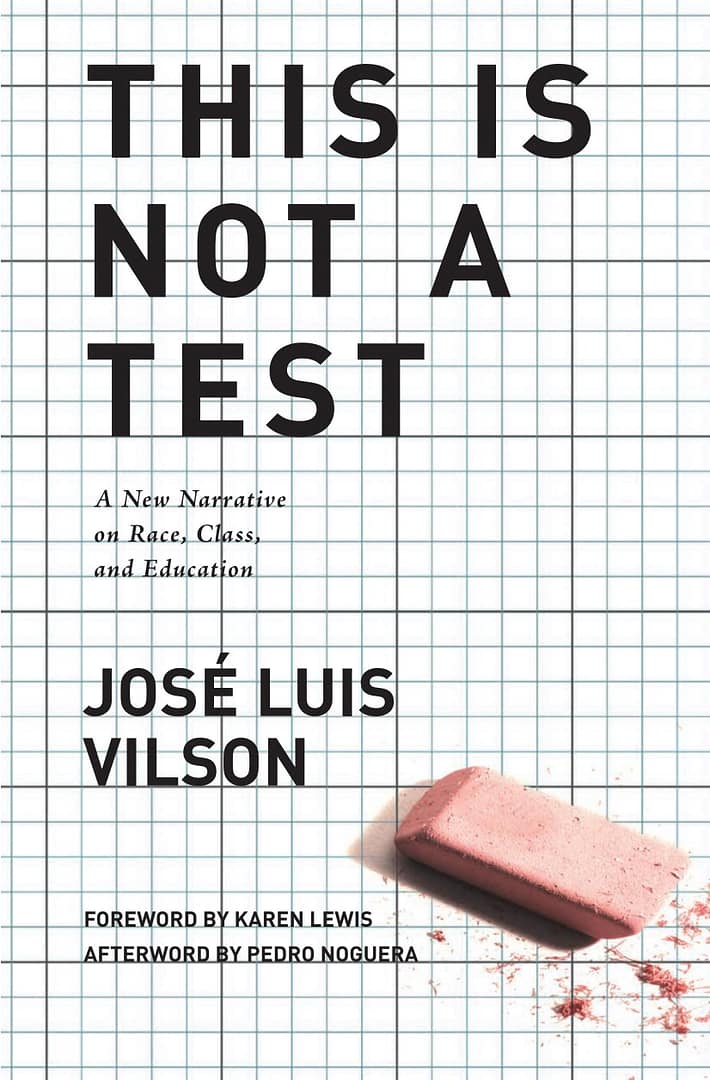
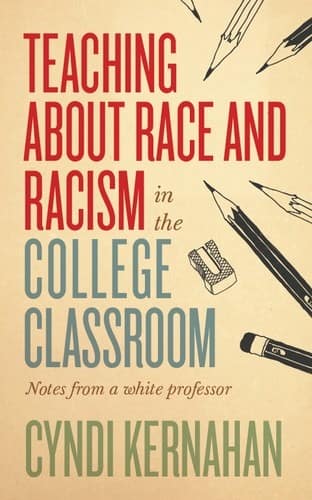
His book, actually, This is Not a Test, Jose Vilson’s book posts through Haymarket press. The collection of his essays, again, deeply personal resonance with his students, his school himself, his world, just one of the best books on teaching and being that I’ve read. If you haven’t read that book, This is Not a Test, it says highly recommend it. It’s a very energizing and inspiring book. Currently, I’m doing a lot of thinking about equity, and inclusion, and working with students– I am a historian of race and racism’s anyway by training. The book that I’ve really enjoyed reading and was happy when it came out and I’ve been using it, a lot of my faculty development is Cindy Kernahan’s book, Teaching about Race and Racism, Notes from a White Professor
Full disclosure, it’s in the same series that my book is in. This may feel a little bit insider trading or something like that. Cindy, she came to our campus actually as the book was in progress and one of my deans swears up and down, it’s the best faculty development experience he’s ever had. She just did wonderful work with us thinking through teaching about race, teaching about racism, and then some of the ways that things like implicit bias and microaggressions really shape a community of teaching and learning. Her book, written in a very humane and personal way, but also based on really solid research. Cindy’s a social psychologist who studies racism. That’s a book I would recommend as well, Teaching about Race and Racism, Notes from a White Professor.
[00:42:19] Bonni: Thank you so much for both of those recommendations. I feel silly telling you this, Kevin, but I knew that Jose was going to be at the Digital Pedagogy Lab, and I have been a fan girl myself of his work. I was so excited that I’ll see him there, but I didn’t realize that I’ll get to see you there. Somehow, I missed that. That you’ll be there.
[00:42:37] Kevin: I’m going to be offering a track on decolonizing education. It’s going to be challenge. I’m acutely aware of my own positionality as a white settler dude talking about decolonization, but I’m hoping that we’re able to do some really good work together, and that it’s a space that you don’t ask a lot of tough questions about the structures in which we’re embedded and often off complicit. Digital Pedagogy Lab is a great place to have those conversations. People who are listening out there, if you’re looking for just a very inspirational and energizing development opportunity, Digital Pedagogy Lab is a wonderful community.
[00:43:16] Bonni: Kevin, thank you so much for coming back on teaching in higher ed and just for the book, and for all the ways in which you do help us all operate more in solidarity and challenge ourselves to just keep getting better at this and having radical hope.
[00:43:28] Kevin: Thanks for having me, Bonni. It’s great to be back with you.
[00:43:33] Bonni: Thanks once again to Kevin Gannon for joining me on today’s episode of Teaching in Higher Ed. I enjoyed our conversation and hope that even more people will have a chance to get their book in your hands. If you want to join Kevin Gannon over on Twitter, he’s @thetattooedprofessor. I’ll actually have it in the show notes because I think I’m saying it wrong. That’s why we have show notes, so you could go over and look at them at teachingainhighered.com/304. You can see his bio there and also have a chance to connect with him on social media. That’s also where you can find more information out about my new book, The Productive Online and Offline Professor. It’s right there on the homepage and you can also subscribe to our weekly update. There are all kinds of things you can do. Thanks so much for listening to this episode and we’ll see you next time on Teaching in Higher Ed.
[music]
[00:44:28] [END OF AUDIO]
The transcript of this episode has been made possible through a financial contribution by the Association of College and University Educators (ACUE). ACUE is on a mission to ensure student success through quality instruction. In partnership with institutions of higher education nationwide, ACUE supports and credentials faculty members in the use of evidence-based teaching practices that drive student engagement, retention, and learning.
Teaching in Higher Ed transcripts are created using a combination of an automated transcription service and human beings. This text likely will not represent the precise, word-for-word conversation that was had. The accuracy of the transcripts will vary. The authoritative record of the Teaching in Higher Ed podcasts is contained in the audio file.