Follow the Teaching in Higher Ed Podcast
About this Episode
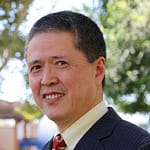
Jianjun Wang describes his Relentless Serving and Learning on episode 265 of the Teaching in Higher Ed podcast.
Online is still relatively new, but new doesn’t mean it’s bad.
Jianjun Wang
On episode 265 of Teaching in Higher Ed
Voices on this Episode

Show Notes + Resources
- SAS Studio
- Dr. Wang’s Table 1
- Dr. Wang’s Table 2 – videos provided by Professors Carl Lee and Felix Famoye of the Central Michigan University
- National Assessment of Educational Progress (NAEP)
- American Statistical Association
- Dr. Wang’s Publications

Transcript
[00:00:00] Bonni: Today on episode number 265 of the teaching and Higher Ed Podcast, Dr. Jianjun Wang describes his relentless serving and learning.
[00:00:13] Production credit: Produced by Innovate Learning, maximizing human potential.
[00:00:22] Bonni: Hello and welcome to this episode of Teaching in Higher Ed. I’m Bonni Stachowiak and this is the space where we explore the art and science of being more effective at facilitating learning. We also share ways to improve our productivity approaches so we can have more peace in our lives and be even more present for our students. Today’s guest is a part of the series that I have been doing with the California State University.
In his special teaching and Higher Ed podcast series, we highlight outstanding faculty that are transforming higher education and supporting student success throughout the California State University. These individuals and today’s guest is no different, have sought to address equity gaps that previously existed in their courses through innovative course redesigns and creative teaching approaches.
Dr. Wang, today’s guest, has regularly taught research design and statistics courses and face-to-face, hybrid and online course formats. These courses are historically challenging for some students. Meanwhile, the course rigor also plays an important role to increase the value of California State University degrees in the employment market. To promote the inquiry-based learning and knowledge acquisition, Dr. Wang incorporated cutting edge technology into the curriculum to break three barriers in student learning.
He talks about these on today’s episode. Number one, make course learning more affordable. Number two, make learning experiences more useful and number three, make instructional support more accessible. JJ welcome to Teaching in Higher Ed.
[00:02:11] Jianjun Wang: Thank you, Bonni. It’s my pleasure to be here. Appreciate your opportunity to have me here and talk to your audience.
[00:02:18] Bonni: I enjoyed going back and looking at your website where you have your publications and you have your degrees and the things you’ve been working on. All I can say is I got a little tired just looking at it. [chuckles] You have been working very hard for many, many decades and it’s just fun to look at all of that. I wonder if you could take us back to your starting, I guess it would be too hard to start from the beginning, but let’s start for you working for the California State University system. Talk to us about that transition in your career and what attracted you to the organization?
[00:02:50] Wang: Well, my feeling about the entire professional career is that it is important for us to engage our students and help them create life-changing opportunities and thus make the world a better place. When we help them to improve their life, we also improve our professional life as well. The reason I choose the CSU Bakersfield was because of a good fit to my research interest.
I used to run a statistics lab for agricultural and the educational research in Kansas in Kearny County, which has the county seat at Bakersfield. Agriculture is a major sector of the economy. CSU Bakersfield is the only regional comprehensive public university within a 100-mile radius. That part really attract me. Also, education demand is increasing because of population growth.
When we are thinking about the California, people normally think of the population size is reducing but not in this Central valley. The Central Valley, the population is still growing so I feel that I can make some impact and we’ll have a better future, more demands tomorrow.
[00:04:06] Bonni: My family when I was growing up was in agriculture, although not any longer. It hasn’t been for a couple of decades, but it actually was in our family for four generations. I guess this will share with you a little bit my bias. I know that the way I grew up can be very different, but I don’t think about agriculture as life-changing opportunities.
I won’t go into my personal story there, but one of the things that comes up so often on the podcast is just this idea of making a difference, helping our students tap into their strengths and the things that they are passionate about. For you, do you find yourself more trying to find what’s life-changing about your research areas or more helping them pursue completely different things than you’ve been interested in because that may be the path for them? How do you see that part of your teaching and research?
[00:04:59] Wang: Well, I see both because we ignore ourselves then we’re not optimizing our strengths but if we ignore the student we are serving, we do not see the potential in their future. For that reason, we have to think about both. It’s hard to portray ourselves. When we portray ourselves, we could call ourselves as, I can do this, I can do that, I can do anything.
All we can portray ourselves as we, in reference to others because it’s not just us, we only deal with egocentric perspective. We also need to position ourselves in the context. Given the students in this institution, they’re not just having me as a professor, they also have others, my colleagues as professor. Then, what would be the best option for them as well?
I also feel the first part is very important too because you ignore I perspective, just focus on me perspective.
We will lose our identity. To do both, I feel that each of us is unique. For instance, when I deal with my background, I deal with statistics and I was in the doctoral program, I passed qualify exam. I also deal with physics because I had my math degree in physics. Also, I had a statistics part, I had a math degree as well, plus the education. When this thing come together, while student probably think, “Well, is it efficient? Why do I have to go such a long way?”
Your reflection, you also see the unique part because if you don’t consider both, there’s sometimes the information could be misleading. I remember that in National Science Foundation Project, for instance, I did some research on. Then they deal with some simple questions that test students’ scientific proficiency. What they did was they said, “There’s a piece of ice inside the water. When the ice melt, what is the change for the water level? Will it go up, will it go down?
Well, that sounds easy question, clear question but then if you think about that’s not statistics, that’s not so much of education either because it deals with physics. Well, I haven’t had math degree in physics if I do not have the competency to answer the question, then I did not really gain much knowledge during my learning experience. For that reason, I check the answer from NSF, even the NSF the answer was there’s no change over the water level.
Because when ice melt, the water level would stay same, but then as a physicist, I feel awkward. Why? Because my answer could be unique. My answer would be lower because it could be low. Why? Because you didn’t tell me under what temperatures the ice is melting. Then it could take hours. I could take days, then we have evaporation.
If I were to answer that question, for international testing, then if I were to represent the United States, I won’t do well.
Because according to the grading rubric, they won’t give you a credit if you say it’s lower, but it’s not because I know less, it’s because I know as much or perhaps even more thoughtful, I know more. Those are good examples, so the math students reflect on themselves, exercise critical thinking to continue that lifelong improvement.
[00:08:44] Bonni: What are some of the benefits that your students get when they take online courses from you?
[00:08:48] Wang: Well, I would say online is still relatively new, but new doesn’t mean it’s bad. I see free advantages for taking online class. The first advantage is unlike the face-to-face instruction. When the classes start, even though you had long day, you have to adjust yourself to face the challenge in the classroom. For online, when you’re tired, then you don’t have to study right away. You can take a nap, you can keep yourself fresh, so you use your best period to do study.
That’s the first advantage. The time is up to you to choose. Secondly, you have more opportunity to learn. When I record the lecture and then the lecture video can be played multiple times, like eight, nine times. If students say, “Well, I don’t get it. Let’s go slow on this part. Let’s go faster on other part.” Well, they can control the pace. If for you deal with face-to-face. You ask instructors to repeat the same thing eight times. It’s not so feasible because there are other classmates there waiting for the opportunity, linear opportunity as well, so that’s the second part, you can control the pace.
The third part is also very important because we not just teach a student in the classroom, we also do advising. When we do advising just like what we do now, we could have zoom technology, as students come to me and we deal with discussions, they do not have to write notes, because zoom can record the notes. That will help them to become more concentrated.
I see these three things as advantages for students taking class in general, not just for me, taking class with me, but to take it with me there are some special advantages because I teach statistics. First, I make the course learning more affordable. You will still take any other statistics classes, instructor tend to make them purchase SPSS student version, they will cost more, but for me we’d use a cloud-based online lab, the students did not need to pay anything.
The second advantage would be, they could make the learning experience more useful because they could replicate what we learned in class and trying to replace number part of the syntax with their own number, they can apply the example for their future jobs. The linear the online settings for future will never expire. That’s something I also feel could be very helpful.
The third piece, I think it’s very helpful is that I make the instruction platform more accessible, because even if we deal with the internet, well, that internet access is only thing they need, they don’t need to worry about software installation. They don’t need to worry about anything was a typo, because we do the point click. In that way, my students, they make it both nutritious and delicious.
[laughter]
[00:12:07] Wang: By nutritious, we do something useful, they can replicate in the future. Delicious, we meet their flavor. We avoid disruption and let them control a face. I told them, they have the veto power. If they don’t get it, I won’t move forward. That’s about a special advantage.
[00:12:25] Bonni: Talk more about these statistics, because anyone listening, we have many people who wouldn’t teach statistics, but somebody at their institution does. There are some significant costs there whether the cost is borne out by the students or at my institution, that cost is borne out by the institution itself and this can be very very expensive. What does this cloud-based online lab look like? Did you build this yourself? Is this something that you have partnered with another company? How does that happen?
[00:12:54] Wang: Yes, that’s a very good question. It takes a commitment because I still remember when I started teaching online was 1999. Then we went through several options, that eventually right now the cloud-based we use in the SAS Studio. I’m not just advertising for the SAS company, but I tell you, we really tried other options, but now all a student need is to register account at a SAS company, then they can submit their problem code to that cloud-based computing facility there after that, then they automatically get the printout, they can print. That way, they don’t need to worry.
I can bring my laptop, how can I do statistical analysis? You have online access, you can do it. It’s just like others. The technology has growing so quickly, and I have to keep learning to stay on path, which is also fun part because for professors nowadays, we also feel that we are a learner. That’s what you also refer to as a lifelong learning.
[00:14:04] Bonni: I’m finishing up a book right now and I can relate to what you just said because the book is about personal productivity specifically for faculty, but I mentioned specific tools that I use in managing my calendar, e-mail, tasks, projects, et cetera, but as soon as you name a tool, then all of a sudden the tool [laughs] there’s going to be a different one.
I know what you’re talking about, but it is always helpful to know what for today, you would recommend and you have found this good solution, but that tomorrow there may be something else and that what I’m hearing you say is just the essential part of our jobs is to be helping to make learning more affordable, and never-ceasing our quest to find additional ways to help our students thrive in their learning. That’s what I’m hearing from you about this.
[00:14:53] Wang: Exactly. I think we both agree on that point because engaging students is very important. There’s no smart students, stupid students, all students almost are created equal, I would say. You be talking about brain structure other things, but the key is, whether the instructor has an effective way, I would be willing to pay attention to find effective way to engage students.
I remember that in statistics context because we deal with probability influence. Probability if you want to talk about chance probability, you got to deal with randomization. When you’re using those terms, especially for non-math majors, those students they feel intimidated. That kind of thing I often tell them, I say, “Randomization is not something abnormal, we all come to the world through randomization because none of us can be choosing to be born in a particular family. Also, we cannot bring any cloth with us. For that reason, we have similar pretest score.”
You said, “Well, why do I have to struggle and study so hard?” Well, that’s what’s going to counted towards your post-test score when you leave the world. If you say, “What a story because I achieved a lot of asset. I bought several houses, mansions. Well, that’s my post-test score?” No. When you leave the world, the mansion would stay. It is what you learnt that will go with you in your brain, then will be accounted as your post-test score.
You say, make life meaningful. Well, there’s a better way, there’s a good way, then there’s a best way, the best way is to optimize yourself, because that’s your life, and it’s under your control. That’s why you need to make sure you make the most of it.
[00:16:49] Bonni: Something else I see in your life and in your teaching is perhaps measuring your post-test score, how much you’re able to have others learn. You have a humility about you that couldn’t possibly have it be that your post score is purely just your learning. [laughs] Though I see you, you want this so much for your students.
[00:17:11] Wang: It’s always like a pleasure when I feel I was mentored by my advisor, like Dr. Charles Steven at Purdue University, and also several professors, wonderful professors at Kansas State, especially in statistics. I can often reflect upon that as trying to figure out since I was taken care of by my professors, I ought to optimize that heritage, and do all I can to benefit my students.
One example, I still remember vividly, a student tend to get confused about some rules like probability, less than point of five or reject my hypothesis sounds so remote to them. I just tell them like, for instance, 10 years ago whatever, then they still remember O.J. Simpson Trial. O.J. Simpson Trial, the glass did not fit, then the chance for it to fit can be very small. That’s what the Johnnie Cochran say, “While the chance slim, it doesn’t fit, you must acquit.” That’s why we reject null hypothesis for same reason because in statistics it’s also common sense. P less than point five, that means the chance slim. That’s the basis for us to reject null hypothesis.
When we approach a student this way, they don’t feel so intimidated, and that’s what we do at CSU because we offer quality and affordable education. A lot of students, they feel it’s not so affordable because they are first-generation college students. They also feel the quality is not quite there because they do not have the support from their family because they’re first generation to engage in learning process.
We, when we offer the higher education, it’s our responsibility to deliver that service, to take care of students. Know where they are, understand their situation, then we can engage. If we just say, “Well, I know my subject, I know my content.” Well, need extra step for us. That’s why we have this faculty innovation and leadership. We don’t have the leadership, faculty control curriculum, who is going to take the leadership? That’s important.
[00:19:31] Bonni: I see in your example in this context, do you put it in a legal context in a story that connects with me in my late 40s, and then also, they just recently came out with a new documentary, it’s like it got another re-life into today’s younger generations [chuckles] where they may have heard of that trial or may have seen it become a new in that, but then I also see you being able to really think in unique ways in terms of this interdisciplinary that you have. You’ve got education and physics and statistics.
To me that probably helps your students better be able to see the things that they are learning, how they take place outside of your classroom, outside of your online class. I think back to my education and where those areas I wish now that I knew, they say that as we get older and older, we just wish we knew more and more. We regret or we become even more fascinated in areas we were never particularly interested in, in our younger years, that you’re just able to do.
I wonder if you would talk a little bit about some more examples of how you’re taking these, whether they’re formulas, or whether they’re procedures like you said, and then how are you showing that lens for, “This really does relate to you.”?
[00:20:49] Wang: Well, that’s very important because when we deal with this kind of situation, we don’t have practical approaches. When we give just ideas where we all want to help our students learn. Then we also have to think hard about how to implement it, how to best achieve that. In my practice, I normally focus on three things when students take my class. I focus on first when to use each method. Second, how to use the methods. Third, would be how to interpret result.
When a student have a data or have a question, they ought to know where to start, which is when to use each method. If they don’t know when to use each method, they’re confused. Even they know which method to use, if they don’t know how to use it, that’s not good, because we’re not prepare them as both the consumer and producer of educational research because when we prepare them as a good producer, they ought to know how to use the method.
Also, the third part is how to interpret result. Even they know the question at the beginning, they know which method you use, how to use it, and how to interpret result. It’s just like a RadioShack advertisement. What RadioShack say, they say you’ve got questions, we’ve got answers. That’s how we handle. I must add one more thing, though. It’s not something come automatically because, for instance, I have a table, it’s not just lip service. What is table? Table listed like the situation, researcher situation, how many variables you deal with. How are the variables measured?
Given a circumstance, students can explain, then the table will guide them regarding which method to use. After student identify a particular sale in that table, regarding the method to choose, there’s a hyperlink, they can click. Once they click the hyperlink, the unit table, there’s a video to show them step by step how to use the method. That’s the second point.
[00:22:59] Bonni: Is this something where if I were looking at your table, I can go at my own pace and choose which things I’m curious about or I have questions about? It’s more of a self-directed?
[00:23:13] Wang: Yes, that’s what a student will use as a treasure after graduation, after finish program. The series of table that’s why I make every effort to make all the hyperlink still working and still current for that table, because I know someone out there in the community no longer in the program, but they graduate from the program are still using that table.
[00:23:35] Bonni: Is this something that the people listening today would be able to view or is it just for your past students?
[00:23:42] Wang: I can provide a link. I must add, though, I’m not the only one who exists. Our colleagues of Central Michigan University, they created a video as well. They are so generous, they allow me to share with my students. UCLA also had the videos. Now, we utilize resources all together because I also go to the annual meetings of American Statistical Association. When I go there, I tried to build a network. It’s always important to make sure you don’t just work on something alone, you work in the real world or trying to utilize the resources from the professional organizations to make sure you’re doing the best.
[00:24:25] Bonni: I see this so often. There’s a big shift in terms of I see it happening in open education, where you see so much more collaboration amongst these experts from different institutions. Then also seen it just in terms of excellent teaching, we tend to use to think of ourselves as, “Well, we’re just here as the providers of information.” Now I see so many people, I’m always encouraging people think of yourself more as a curator.
Yes, you do still need to be very present for your students and have them– that you couldn’t just, “Oh, here’s a bunch of videos, Michigan, UCLA, they’re great, watch them.” You need to have a strong presence in your class but that doesn’t mean you have to have made every video.
[00:25:11] Wang: Right. The share and the teamwork is very important. We’re not just benefit of the work from others. I at least, I feel that I also ought to do my part. I ought to be someone who granted on my own training and trying to enrich the teaching with active research so that I can have something to be shared by other colleagues. I’ll give an example. For instance, I deal with a lot of research, and maybe not so much. I cannot just bragging a lot of them. I’ve just used a couple of examples.
One example is like a multiple-choice test. Well, a multiple-choice test, the score could be contaminated by guessing, you give a choice. Students could guess it because there’s no way you could prohibit them from guessing. Then a question had five possible answers, they could have 30% chance to just guess the correct answer, which is why one of five odds, 20%. If the test has more questions, it is unlikely to guess all answers correctly.
For that reason, the test impact can be controlled, if you have a certain number of questions because if you say, “Well, if I give one question is to risk for students to guess it correctly.” If you make more questions for student to guess each question correctly, well, the chance would be slim. I have a table that was published in educational and a psychological measurement job. That table has been checked used by numerous book authors.
By checking at the table, when they say I want to control the guessing impact. I don’t want a student just to guess and finish my class and pass my test. Well, you can determine how many options you need for each question, and how many questions you need in order to control that guessing impact. That’s the example.
[00:27:10] Bonni: How many options for each question? Then how many questions related to that particular measure of learning? That topic or that thing you’re trying to test for?
[00:27:20] Wang: Either test yourself one or two questions where a student couldn’t just guess it. They get a 20% chance to pass and 25% chance to pass depending on how many options in the question. If a test isn’t too short, then a student could just guess a couple of times and bet on the luck and to finish the test. Another example I also did was about test misgrading because it’s not all multiple-choice. You could have essay test.
Essay test you don’t deal with this kind of guessing anymore because you have to supply answer but the problem is that it needs to be graded by human being. It needs to be graded by a teacher for instance, then they might be tired, they might have a misgrade. How do we control misgrading? We often scheduled break before the first misgrading occur.
The chances for misgrading vary because when you’re fresh, there’s high chance for zero misgrading. If you get high, you’re almost certain to have a misgrading.
Given that circumstance, the distribution if you want to describe that and misgrading pattern, the probability for misgrading will be u-shape because it could be high probability at two ends not so much in the middle. That one I also wrote an article on that because there’s a big name called Rush. Now, you’re talking about college abroad, SAT, ACTs, they all use rush model. Rush model is not just one model. Rush also had another model for typing error, miss typing, in the same book that people use.
Then that mistyping if you also said was scheduled a break before the first mistyping occur. Well, that can be transferred to a test misgrading. Schedule break before the first misgrading occur. If you just simply be loyal to Rush model, where he use a constant as a probability for misgrading, as I just described, it cannot be constant. Actually is a u-shaped probability for misgrading.
[00:29:29] Bonni: Could you talk me through this u-shape, tell me what’s on one end of it and on the other end?
[00:29:35] Wang: One end would be when the creator, when the instructor is fresh, there’s a very high chance on my end with zero probability for mis-grading because they’re fresh, they’re not going to make something wrong. Then if they’re tired, the chances are they always do misgrading. Even you’re tired he said I’m tired, I still do one time right, one time wrong, one time right, one time wrong, it’s not going to happen.
Just close your eyes driving, you’ll hit someone or you’ll hit something. You cannot say, “Today, I hit it, tomorrow I close my eyes, I won’t hit anyone.” That’s not going to happen. A chance on the both end would be very high. Instead of using constant like a simplistic model from Rush, I improved his model. Whatever he can get, I could get it the result like that. How long to wait for the first mis-grading, those kind of index, we can calculate. Except I don’t use that assumption anymore. I make it more realistic because indeed, in reality, the mis-grading opportunity is not constant. It is a u-shaped random model.
[00:30:43] Bonni: What is then the different prescription? Is that the wait time or is it something else? What changed from his recommendation or his findings to yours?
[00:30:53] Wang: His finding would be focused need to schedule a regular break before the first mistyping. They will use his model in testing. We’ll say, “Well, graders need to have a break before first mis-grading.” How do you know when to schedule a break? Break time, according to his model will apply to anyone, whether you’re fresh, you’re tired [unintelligible 00:31:18], he will give you a number. Well, that’s not right because using my model, and we could let it as a variable accommodate his result as a special case, then we can steal a schedule grading period regarding when to take a break.
[00:31:37] Bonni: What’s your advice to me? [laughs]
[00:31:41] Wang: Well, my suggestion for that is to always leave. We want to make it a cost-benefit, then we want to make sure the greatest, not only well prepared, but also well-rested, before we even start the grading session. That way, we’ll do much better. [unintelligible 00:32:04] high, but we have a pressing past, we have to get it done. There’s something attached to it, the cost, because you’ll schedule more frequent break. Then you’re not going to be able to apply the quality control as you originally planned.
[00:32:21] Bonni: Before we go to the recommendations, I just have one quick related question because you’re mentioning one part of the body of research around the fallibility of our grading. Another one that I’m very familiar with more on an anecdotal level, I haven’t done extensive reading but that’s the idea that if I were to go and grade some short answer essay questions, that there’s going to be a lot of bias upfront for the first couple that I do until I get into more of a rhythm.
Then, of course, I’ve sort of almost, I don’t want to do this, but I’m almost grading then exams three through whatever back to as it compares to one or two. What is the advice out there or are you familiar with this part of the research around the bias that shows up when we do that one?
[00:33:04] Wang: Well, what you just said it was a very important. It’s the other side of the coin because when we say grader they become fatigue or those things. Well, student could be fatigue as well. When you give a lengthy test because our curriculum considers a mile wide and an inch deep, if it’s a mile wide, then that wide, we cover a lot of things. No test to can really comprehensively cover all the topics in the curriculum. Now, what can we do?
Well, the thing is that to avoid bias, the test setting is the most important because even you include every questions in the curriculum in a test, then, no one can guarantee that they sometimes to pay attention, sometimes not pay attention. Then when that sloppy answer you see that you’re not going to feel good, which will be impacted, like what you said as a bias. How do we do that? It’s not my idea. It’s already been done in a National Assessment of Educational Progress. It’s a congressionally mandated project.
What they did was they cut the entire test bank, lengthy test into pieces. Each student just take a half a portion of the test, then they didn’t take the other questions, we can impute. There’s a match for imputation procedure. We can guess given the answer you had, then, what would be your overall score? They can guess that, but because the guessing also deal with statistics, because when you deal with that guessing, then imputation you can’t be for sure, if you cannot claim for sure you do multiple imputation.
I also had a recent article published in the American Statistician. In that article, I urge it for more imputations because the national assessment, they only impute five times in the past. More recently, they adapted to 20. If you’re talking about statistical standard of software, they no longer deal with 20. When you deal with the imputation, you guess the score, that can reduce the student fatigue, ensure better quality of the performance. Then that also give the grader a chance to feel better, because it’s not a sloppy answer anymore.
[00:35:32] Bonni: Part of this is bumping up to me the research that just talks about having more lower-stakes assessments, across a semester or a term is going to give you a better measure of learning, then the midterm and final will give you a measure of learning. For the reason that you decided of that, you don’t know what you’re catching them in terms of, it’s just too great of a probability. I’m trying to speak in statistics and that is not my background. You know what I’m saying?
[00:36:00] Wang: Well, you’re very precise on that one though. Well, we all condensed statistics, I guess, because I did not start as a stat major. When I took the qualifying exam at Kansas State, and I automatically got accepted to American Statistical Association as member because the department pay for that. There are always grant that kind of membership to the top performance.
Top performance then my classmate in the field and also typical, because they feel they are mathematician, they had a master’s degree in math, but my master’s Degree was in physics, but when I competing against them in a Ph.D. qualify exam in statistics. We all have to have this confidence. Whatever we are trying to pursuing, it’s a common sense approach that’s more dependable. We feel something so heavy, so difficult, we’re not going to be able to use it.
[00:36:56] Bonni: Well, and that you spoke about that earlier too in terms of just wanting this to be seen as accessible to anyone. Part of that is believing that any of our students are capable of great, magnificent things. You come across to me as someone who thinks perhaps even beyond what you have accomplished that that would be, it’s definitely fits in with an agricultural theme, that the future harvests will, that they can go beyond anything, you would be able to yield just on your own.
[00:37:27] Wang: We want all student to learn. We want them to all be successful, perhaps in different ways, but they can be successful. That’s very important.
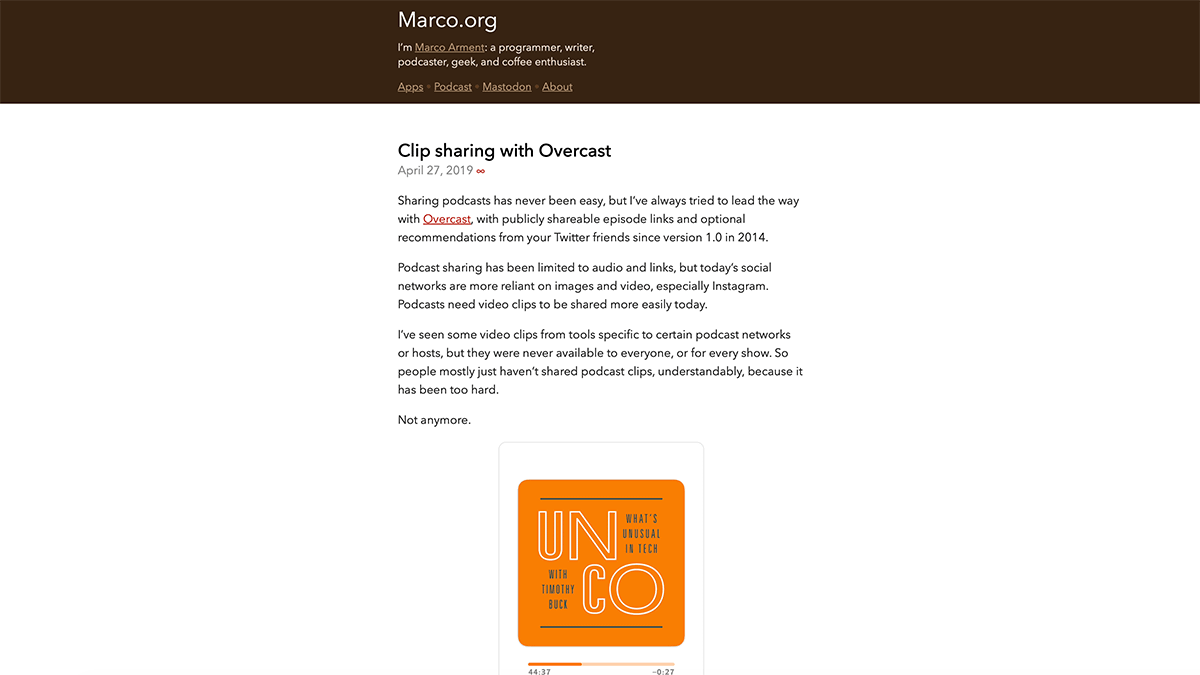
[00:37:36] Bonni: Well, this is the time in the show where we each get to give our recommendations. I just have one today, and that is that I have actually recommended this podcast player before on the show. It’s called Overcast. I know that a number of listeners use it because I get little statistics about where people listen or what services they use to listen to this podcast and Overcast is a big one. It is, by the way, on iOS, meaning on iPhones and other Apple devices.
Those of you listening on a different platform, this is not quite for you but I promise that JJ will have a good thing to recommend in just a moment and I will be over soon. I’ve recommended it before. They just added a feature that I cannot resist sharing today. That is that you can share a clip of a podcast now. When you’re listening in Overcast, if you hear something that you’d like to share, it could be shared over e-mail, it could be shared on Twitter, it could be shared lots of places but you just go and choose the little share button and you say you want to share a clip.
You can choose up to a minute of audio. I shared one actually of an episode that aired recently that had my daughter giving her recommendation, she recommended the Star Wars movies. I thought it was so cute. I shared just that clip of her talking. The people don’t even have to go anywhere but the place I shared it, was in this case on Twitter, they could just play it. The video is housed directly there. It means they don’t have to go somewhere else to hear it. It uploads the video right there.
The article that was written about this new feature talked about that’s one of the limitations of podcasting is it’s very difficult to share the way that you might share something. We’ve talked about annotating tools and past episodes, that’s an easy way to share. Podcasting hasn’t made that very easy in the past. This is a really exciting new way. I hope that other podcast platforms will use this.
Speaking of which, by the way, the person who is the creator of Overcast, his name is Marco Arment, I believe his last name. He talked about you’re allowed to deselect to say that you made this clip with Overcast. He did that intentionally so it’s less about his app, but he really wants to influence the podcasts, in general, to just encourage more of this sharing. I think it’s a really visionary thing that he’s doing there. I’m just excited about doing some more sharing of podcast clips that I enjoy. I’m looking forward to doing that.
I hope that some of you listening will take advantage of that and share some clips of Teaching in Higher Ed or whatever other favorite podcasts you’d like to share. JJ now is your turn to make some recommendations if you would like.
[00:40:05] Wang: My recommendations often change. If yesterday someone asked me to make a recommendation probably it won’t be the same with what I’m making now, maybe tomorrow I will change as well. That’s also part of the learning process, so it also deal with creativity because here’s what I would like to recommend. It’s not just my idea, I believe I read from somewhere. My statement would be, “If you only read the books others read, then you can only think the way the others think.”
What does that mean? Well, my recommendations is, you not just read the books others read because we are all different, we all are trying to digest it in a different way so in that way, we’ll have a unique perspective.
[00:40:57] Bonni: Wonderful.
[00:40:58] Wang: That’s my recommendation, thank you.
[00:41:00] Bonni: JJ, it’s been so good getting to know you today and getting to know and look at your work prior, thank you so much for helping me prepare for this episode. You have just a magnificent body of work, of excellence, and teaching. I have so been honored to have you on today’s episode.
[00:41:15] Wang: Thank you so much, Bonni. It’s really my pleasure to be here, thank you for having me.
[00:41:22] Bonni: What a delight it has been today to have this conversation with JJ Wang, thank you so much for your time. I was trying to take his statement that he made at the end about if you only read the books that others read, then you can only think the way that others think. I was trying to apply that to podcasting. If you only listen to or interview the people that other people interview then you can only– It’s not really working out but you could probably figure it out for me and maybe tweet me or something.
Before this episode ends, I want to remind you if you have not subscribed to the Teaching in Higher Ed update you can get the show notes with the links of the things that we talked about as well as an article written by me plus an eBook on 19 ed-tech tools that I use in my teaching and productivity. You can subscribe @teachinginhighered.com/subscribe, thanks for listening. I’ll see you next time.’
[music]
[00:42:17] [END OF AUDIO]
Teaching in Higher Ed transcripts are sponsored and created by GoTranscript (as of 7/1/2019). The verbiage will not represent the precise, word-for-word conversation that was had. The accuracy of the transcripts will vary. The authoritative record of the Teaching in Higher Ed podcasts is contained in the audio file.