Follow the Teaching in Higher Ed Podcast
About this Episode
Bryan Dewsbury describes teaching as an act of social justice and equity on episode 215 of the Teaching in Higher Ed podcast.
Mistakes are normal, but how you respond to the challenges is what will make you a better intellectual.
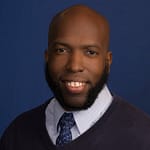
Bryan Dewsbury
On episode 215 of Teaching in Higher Ed
Voices on this Episode

Show Notes + Resources
- The Color of Law: A Forgotten History of How Our Government Segregated America, by Richard Rothstein*
- The History of Higher Education, by John R. Thelin*
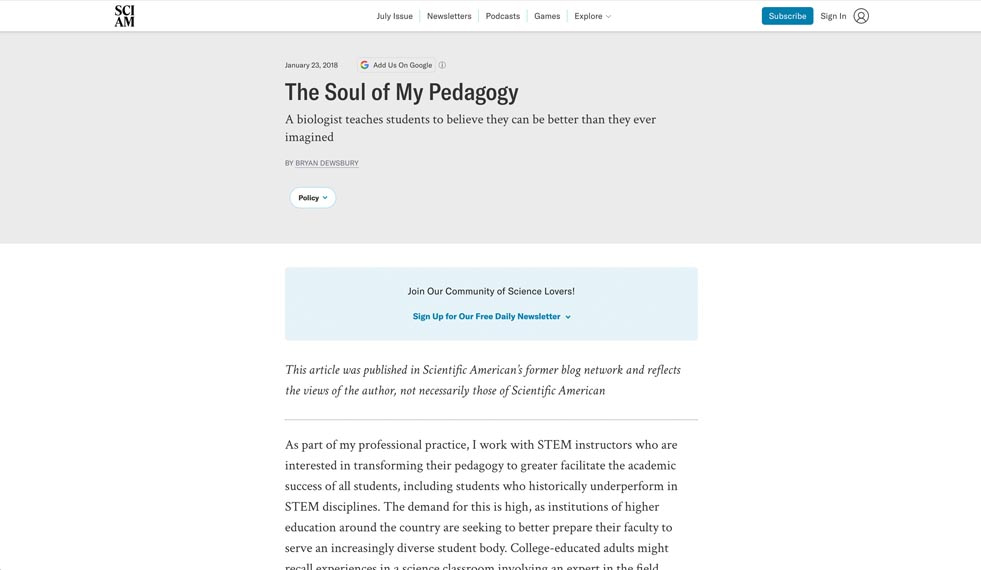
- The Soul of My Pedagogy, by Bryan Dewsbury in Scientific American
- Freshmen “Are Souls that Want to Be Awakened,” by Kelly Field in The Chronicle of Higher Education
- This I Believe from NPR
- This I Believe Educator’s Guide
Recommendations from this Episode


Transcript
Bonni: [00:00:00] Today on episode number 215 of the Teaching in Higher Ed podcast, Bryan Dewsbury describes teaching as an act of social justice and equity.
Production Credit: [00:00:13] Produced by Innovate Learning, maximizing human potential.
Bonni: [00:00:22] Hello and welcome to this episode of Teaching in Higher Ed. I’m Bonni Stachowiak and this is the space where we explore the art and science of being more effective at facilitating learning. We also share ways to improve our productivity approaches so we can have more peace on our lives and be even more present for our students.
Bonni: [00:00:50] Thanks for joining me on today’s episode of Teaching in Higher Ed number 215. Today I have the honor of speaking with Bryan Dewsbury. He was born and raised in Trinidad and Tobago and pursued a bachelor’s degree at Morehouse College and a master’s and Ph.D. from Florida International University. At that institution, he explored a number of interesting questions in marine ecology and ecological economics. And he developed a number of teaching approaches and programs related to social belonging and higher education. He is personally inspired by the possibilities of education as a force for intellectual liberation and as a means to increase critical consumerism. Bryan, welcome to Teaching in Higher Ed.
Bryan: [00:01:43] Thank you.
Bonni: [00:01:45] We know that we can tell students about our pedagogy, but instead you start your classes by showing your students your pedagogy. Could you share with us the exercise that you do in the beginning of your classes that involves shooting baskets?
Bryan: [00:02:00] Well just so you know it is not an actual basket, I don’t want your audience to get confused. So I am not going to take credit for this because I actually found it online. The individual who did it in a key 12 classroom, I think there is a little cartoon about it. So I don’t remember his name but if your listeners do google it, they will find it. And I think it’s great.
Bryan: [00:02:23] So I teach at a semi traditional lecture hall right. So it’s sloping, it goes up. The first day of class, for an intro bio class, he’s talking about 145 freshmen and what they are coming to class with is a real intention to do well. But they’re also coming at a pretty critical transitional period in their lives. And in my short history of teaching this class, I’ve found that the things that trip them up tend to not have anything to do with their ability to actually do the work, it has to do with confidence in themselves. It has to do with trust in the process. It has to do with a specific behavior and how to study and how to manage your time and how to engage in academic behavior that would that would yield success. And then of course, it depends on me, the instructor, designing an experience to make sure that they are able to do those things.
Bryan: [00:03:23] So one of the first things we do in class- this is the exercise, I put our trashcan in front. And I have every student crumple up a piece of paper. And the first couple of rows try to aim that paper into the trashcan. And second rows to the back rows.
Bryan: [00:03:41] And as you can imagine, the rows in front have a much easier time of getting the paper in the basket than the last row. Then I ask if people in the first row are willing to exchange seats for people in the back row. It’s amazing how such a silly game, they refuse to give it up because who knows he might be grading this or whatever. So I use that to make the simple point to them that we have 135 students and they are very diverse in all ways imaginable. And still, statistically, not everyone is going to come in with the same level of preparedness. And because of that, it is my job to figure out with carefully calibrated assessments and ways with her attention to detail to know who may need more assistance from myself, from my learning assistants, etc. on whom might be more prepared and could probably learn other skills like leadership and teaching others.
Bryan: [00:04:38] But it is my job to make sure that in three months everybody has an equal chance to put that paper in into basket. No matter where they are sitting, no matter what a row they are in, what end of the row they are in. By the end of the semester, the probability of getting that into the basket should be the same. And that’s my job. And that’s what equity is.
Bryan: [00:04:59] So in the same way, I’ve explained this to you, I have explained this to them. And I think that’s important because my teaching style is really based on trust, it’s based on a sense of community in the classroom. And I think one of the things that active learning and inclusive teaching in general is without that relationship, without that trust in the process, it just feels like a bunch of tricks. So that for the first day, first couple of days the class is really spent establishing that trust and building that relationship.
Bonni: [00:05:30] In order to build that kind of trust, my experience says we have to break some things down. We can’t build up the trust before we tear down some walls, some barriers that get in the way. Is that your experience as well? And if so, how?
Bryan: [00:05:46] Well when you see barriers, what are you referring to? What barriers did you have to break down?
Bonni: [00:05:50] Well I’m thinking of you. I saw a couple of pictures of you. I’ve never seen you in real life, but you look like- I also have spent time in my education being very intimidated by science so I imagine if I sat in your class as a freshman for example in college, I would feel intimidated. I would feel he knows so much more than me, I’ll never be able to do this. I would feel a sense of fear. And also just the power- you mentioned teaching 145 students in this big lecture hall. You’re very articulate. You would bring a sense of confidence that I imagine could help the learning, because it’s helpful if we trust because this person in front of us is competent. But sometimes if we see them as too competent, we think we’ll never be able to get there. Does that make any sense to you?
Bryan: [00:06:41] It makes a lot of sense. So a barrier, any conventional barrier that you might be referring to in this case is the perception that the instructor him or herself maybe a barrier or be seen as a gatekeeper…
Bonni: [00:06:53] Yeah.
Bryan: [00:06:58] …to their own success, right? At The end of the day I do have the grade book, that is practically true. But I think there’s different ways of conveying to the students what the grade book means. If the default perception of the student is that grade book is the key to my life in the future and my career and my economic mobility then they are touching all of these really high stakes of something. And then once that happens, the class is no longer about learning. So part of the challenge in the first two days and the first week is establishing a culture where when you are assessed, you are assessed to ensure that you develop the skills necessary. And it’s not a means to punish you if you didn’t. So that means that if you, for example, didn’t do well in some of the earlier assessments like the surprise quizzes or the first exam, then I spent a lot of time looking at my grade book to figure out why you didn’t do well, what questions you didn’t do well on, and what kind of strategies that myself and my team can enact to ensure that you’re better the next time.
Bryan: [00:08:08] So does it mean that we need to have a revision of your study strategies? Does it mean that you’re doing really well on recall questions but not well on synthesis questions? Does it mean that you don’t work very well in groups? So all of these things we can sort of isolate and very, very fine detail. And I think that helps reduce the barrier because then it’s not- it’s no longer me just giving them a bunch of stuff to do or a bunch of information and they are tasked with just kind of putting it all together. It’s both of us actually engaging in this process to get them. And the fact that I have more experience in this process means that there are skills that I can bring to bear that can help them be more successful.
Bryan: [00:08:49] So yes I am six feet. I am 200 pounds. So maybe just at face value, in the first five seconds of class, I can maybe evoke a particular affect. But I’m also very self-deprecating. I also tell them one story in science which wasn’t stellar. I tell the audience I graduated with a 3.2 GPA, I wasn’t a rockstar. I went through it. There are things I did well in, there are things I didn’t do well in. And I am very honest with them about that. And part of doing that is to show them that mistakes are normal but how you handle it and how you respond to the challenges is what will make you a better intellectual.
Bonni: [00:09:33] I’m hearing two real themes come out. And of course I’ve read your articles and really enjoyed that as well. I’m hearing a sense of humility that this is not a test- and you mentioned the word trick to try to get ya. But that actually your results… Yes they will inform your learning but that you will be looking back at yourself for how you succeeded or failed as a teacher and shaping your own teaching to meet the needs of these learners. And that takes real humility.
Bonni: [00:10:07] I also see that you have just a hope for these students that they can achieve more than they think is even possible. I just really treasure that about your teaching and it just can help us so much when we’re thinking about all the great possibilities of the learners in front of us instead of all the barriers that they may have brought into the classroom with them.
Bryan: [00:10:30] Right. Yeah I mean I guess you are referencing the article and this sort of speaks maybe a bit of my own history. You forget what it is to be 18, right? I know some my students are non-traditional, but I do teach in a pretty traditional university. So most of my students come in directly from high school. And you forget sometimes what it means to be 18. I forget what it meant to be 18. And I went to college with what I thought was a pretty set idea of what I was going to be. And that did change over time.
Bryan: [00:11:07] And I do credit a lot of my journey to people who were willing to take the time and listen to me articulate what I think I wanted, challenge me in those ideas and have me kind of reflect and think about that differently. And to me, when I think about a four year degree, 5 years or 6 years, how ever long it takes, and the length of time a person lives, and is expected to vote and have a job and raise a family or whatever they end up doing in our functional democracy… College is actually a pretty short time.
Bryan: [00:11:44] So the idea that you’re going to really spend this time kind of piling in information is a little bit ludicrous because a) there is so much information out there, b) that information is changing – at least the form of it is changing. And So what you really want to give them something that’s lasting so that when the information does in fact change, they are armed with the skills to learn that new way of thinking or to engage in information differently.
Bryan: [00:12:13] So the classes is Intro Bio but the the the things that guide the class, the learning outcomes that guide class, have less to do with DNA and cell structure and things like that. It has more to do with- these are some of the fundamental principles that guide how we think about how life works, generally. And here though are the ways in which we engage in understanding those principles. Here’s how they were discovered. Here is the social context of those discoveries. Here’s what goes into engaging in the discovery process. Here is how you think about biopsies. Do you think about research questions? And how those biases manifest themselves into actual social outcomes. So that when you go forth and become your own scientists, you take with yourself not just the content but the way in which that content was acquired.
Bryan: [00:13:06] And so that’s sort of the what when we talk about the social context of learning. That part is important too. So we get through a lot of the irregular topics. But what I think makes each semester unique is how we address social context. And I had a colleague say to me a long time ago that they get tired of teaching the same class every three or four years and try to switch.
Bryan: [00:13:34] It’s a concept that I never understood because every semester, every Intro Bio a semester, there is a different 135 students.
Bonni: [00:13:43] Mhm.
Bryan: [00:13:43] And so when I put the work in to figure out their histoies coming in. When I get the spreadsheet of the high school GPA, the courses they took, and when I send them a survey and ask them to articulate to me what they think they want to be when they grow up. When I ask them to write “this I believe” which yes, I stole from NPR. Sorry NPR. When I aske them to write these and I read that, all those things are unique to every student and every semester. And so therefore it’s never the same class. Right. When we’re talking about teaching for liberation and teaching for inclusiveness, you are incorporating new voices, the actual voices of the students in how you design the curriculum.
Bonni: [00:14:27] Tell us a little bit about growing up and how that informs your teaching today.
Bryan: [00:14:32] Yeah that’s a good question because when you think about growing up and how it impacts your life in general when I’ve read maybe other books or seen TV, movies about this kind of stuff. Sometimes the impression is given that like as you’re growing up, there is sort of linear trajectory right like I did this, then I did that, then I did the other thing. And each of these things led you directionally to this thing you ought to be. What I would argue is that sometimes you don’t really understand how things in your life, in your early life, impacts you until you get to a cognitive level that you could articulate what actually happened.
Bryan: [00:15:17] I was having dinner with a friend of mine last night and she’s a fifth generation immigrant and she has been asked by somebody else how that experience impacted her. And she was saying to me that she never had to really articulate that. She knew how profound it was to be poor and second language and all that stuff. But it takes some time, it takes some emotional bandwidth and some energy and some space to really reflect on how things in your early life impact you later on, especially if they are profound.
Bryan: [00:15:52] I think in my case, I grew up in Caribbean – in Trinidad and Tobago, Southern Caribbean closest Caribbean island to Venezuela for those who are geographically challenged. The country was most recently an English colony. And it is very multireligious. My father was, he is a retired Baptist minister. He also served in Methodist church as well. And he served most of his ministry in a small town, about 20 minutes from my house, and he had a very particular style of preaching. I don’t practice anymore. Sorry dad. But I think I really firmly believe that my experience growing up in that community, what our community meant to our family and what our family meant that community impacted the way in which I approach the community that’s my classroom. So just to put it out there, I don’t go in class and preach the Bible. But in terms of the idea that the people that you are called to serve, which in my context is students, there are causes in this world, there are problems to be solved, there are things out there that they can ascribe to, that they can be part of the solution. And for them to do that, they have to believe in a greatness that is bigger than themselves right now. Right.
Bryan: [00:17:21] They have to be willing to take on an identity that they’re not just going to come in here and get an A here, get a B here, get a C there. They’re going to be part of thinking about how to make this society better. And to do that there is a skill set that transcends disciplines. And so your discipline almost becomes the context around which you teach your skills. So that whole idea that I think my father kind of approaches his religious ministry, I approach a classroom in the same way.
Bryan: [00:17:56] It’s almost like a cloud that guides the thing we aspire to. I heard articulated one time, a good friend of mine maybe six or seven years ago, I was doing an assessment residency at the American Society for Microbiology scholars program and the leader had said – we were basically doing course design. And so the point of that is backward design and you are writing outcomes and making sure you can measure it, etc. But what she started by saying was write the thing you hope your students will be in like 10, 15 years. Not that you can measure it now. But if you had to project these 135 kids, the kind of society you hope to live in or you hope they live in. Write that. And start with that as sort of the lofty goal. And then go from that to what are the thing you can do today to prepare them for that kind of life. And I thought that was some of the best advice that I’ve ever gotten on course design. And that sort of connects the question about how growing up connects to the way I teach now.
Bonni: [00:19:09] You have said, and I think this reflects what you just spoke of that your role is to awaken souls. Can you talk about how you do that in an introduction to biology class a bit?
Bryan: [00:19:21] So I think that question actually comes back a little bit to one of your earlier questions about barriers. And in that there’s a perception, there’s definitely a perception and there are things that feed into the perception of what a college science class should look like, what it should feel like, what they expect to happen, what kind of gatekeeping may take place. There are perceptions of depending on the histories of what their own abilities may or may not be in terms of if they can do well.
Bryan: [00:19:56] So these are real world perceived barriers that I have to diffuse. The process of a awakening the soul, it’s really the process of diffusing those barriers is really teaching them and having them believe that regardless of the background they’ve brought into the classroom, there is a potential to do very, very well. That is not my job to give them some information. It is my job to extract potential they already have. And the degree to which I can get them to engage in that belief, that is the awakening of the soul. That’s the student who comes in not being sure if they are an A student or a B student and then realizes 2, 3, 4, 5, 6 weeks in, “oh I could really do this. I can explain transcription to anybody and have them ask me questions about it.”
Bonni: [00:20:56] You do still measure your progress in quantitative ways. So you have this wonderful writing and you’re so centered in your sense of purpose in your teaching, yet you still do have quantitative measures that you use. Could you speak a little bit about those measurements and how they have informed your own sense of progress toward more inclusive teaching?
Bryan: [00:21:18] So we measure deals and withdrawals as gifts is called unproductive grades meaning that those grades allow you to move on to the next iteration of the introductory biology course if want to make it clear that people Woodroffe are a number of reasons so I’m never really fully comfortable with a W as a sign of failure, but you know the assumption that a student within a classroom for three months and did all the assignments and did everything but wasn’t able to get 70 or above is considered an unproductive grade. So that that was the percentage of students who were doing unproductive grades. You know historically we’re in the 20s and 30s percent and somebody with cases over time at least in my particular class we were able to get down to 5 percent 6 percent one semester. Unfortunately some of the world’s most you oriented probably know that in STEM in particular the failure rates in STEM or the attrition rate tends to be higher for first generation students and students of color. And that was similar to my institution.
Bryan: [00:22:30] So we’re very happy for one semester where that was zero percent for students of color which tend to be about 25 percent of my classroom 20 to 25 percent. And so I want to be clear that as much as I want to to close equity gaps and things like that. My vision of inclusion is – everyone’s included. You know white, black, hispanic – identity. It’s not a colorblind ideology but it certainly is everyone stands to benefit from a pedagogy that is inclusive.
Bryan: [00:23:06] There are things that you will learn if you didn’t – weren’t exposed to these things before. They’re things that you will learn from engaging with diverse students and people who didn’t have your background your ideology. And we model that. We message that. And we encourage that.
Bryan: [00:23:22] So the overall DFW rate has fallen. The DFW rate for historically minority students has fallen. And we hope to keep it that way.
Bonni: [00:23:34] What are some of the practical things that we can do to improve our success in these areas that you’ve just described?
Bryan: [00:23:40] So you know I have to confess, Bonni, I’ve struggled with that question because I do get it a lot because I don’t know that there are practical strategies. I think there are but I think that there’s work that has to take place before people engage in a strategy. And I’m saying this I’m saying this from a place of of experience because as you may or may not know I do a lot of faculty development about inclusive teaching around the country and I get I get that question although I get people who want me to provide you know a list of things that he can do tomorrow that they could do.
Bryan: [00:24:22] I don’t want to I don’t want to knock it it’s a bad thing that they are in fact very good behaviors that if done in the right context can really really inclusive classrooms. But I prefer and I really really try to encourage my audiences to be prepared to do the hard work. There’s a long long long history of race on education in higher ed. There are a lot of social inequity in broader wider society that has informed the reasons why this inequity happens in the classroom in the first place and I really really would like STEM faculty in particular to put in new work to read about that history.
Bryan: [00:25:08] You know read things like (I know we’re not in the recommendations section) [laughing] but read things like Color of Law by Richard Rothstein that talks about housing failures and read things like The History of Higher Education that talk about the formation of these universities and the history of exclusion of certain groups. You know read about the Tuskegee study. Read about the sterilize the Latinos in California. Like read about these things and you know don’t just assume the science itself to be sin-free. And don’t assume that you can take a list of suggestions and just implement them and assume that inclusion will happen.
Bryan: [00:25:47] This is something that really comes from the soul. One of the reasons why I wrote that piece The Soul of My Pedagogy was I wanted to example what it meant to really look critically back on your own life and see why – what motivated me to do what I do – and why it’s important and why it matters. And I think I have have even said it in there to sort of encourage the audience to do that for themselves.
Bryan: [00:26:12] And that means that the reasons the motivation your own understanding and your own reckoning with history will be unique to your understanding. And it is from that and the way in which you know your students and get to know them every semester. That is what will determine strategies that you will end up using.
Bryan: [00:26:31] So it may be some of the tips. It may be all of the tips. And maybe none of it. It may be things… It has to be unique to your circumstance. That’s why I try to get away from practical because sometimes the implication is you know well, “Dr. Dewsbury said such and such and it didn’t work. So therefore I don’t know what. He doesn’t know what he’s talking about.” And that was like, not really quite how it works. You know I’ll kind of maybe talk about it when we get the recommendations section. But it’s a journey very much just a journey I’m still on and I’m not perfect I make mistakes and I still criticize every class I provide and seek to make it better. But it’s a commitment to the journey.
Bonni: [00:27:10] I so appreciate you saying that one of the ways in which I’ve been truly convicted in recent years is I know I subscribe to this myth that if we just gave the students the tools at least I’m glad I had a service orientation toward it. But you know oh you just need this set of tools you know. I alone (not I alone) but you know we alone collectively in higher ed can offer you and as you have alluded to they’re going to graduate. We can hope and we can do everything we can and they’re going to live in a society of racism and systemic racism that all the learning in the world cannot cure or they can you know if they had all of the knowledge and skills and everything still would and wouldn’t cure and I just wrestle with that so much today. It is hard work.
Bryan: [00:27:58] It is. It is but it’s rewarding. I have to say you know it really really is rewarding.
Bonni: [00:28:04] This is the point in the show where we will give recommendations. And to this and I would encourage and recommend that people go read your article The Soul of my Pedagogy in Scientific American. I’ll have a link to that in the show notes of course.
Bonni: [00:28:18] And as you were speaking earlier, I was very motivated and inspired as you talked about teaching as an act of social justice and equity. One of the books that has stayed with me all this time that I think does that very well is one that was written a fairly long time ago, let’s say it was in 2010. So many people will have already heard of this book, but if anyone hasn’t read it yet I would highly encourage it. And that is The Immortal Life of Henrietta Lacks by Rebecca Skloot.
Bryan: [00:28:52] It’s a very good book.
Bonni: [00:28:52] Oh sounds like you’re familiar with it. Yeah.
Bryan: [00:28:55] Yeah. In fact when we do the cancer unit in class in Intro Bio, I introduce the class by referencing that story.
Bonni: [00:29:02] Would you speak a little bit about it then? I’d love to hear you share it and then I’m certainly recommending people go read it.
Bryan: [00:29:09] Well as you know, the book talks about the use of what was eventually called HeLa cells. And Dr. Auto Ghibli I believe was his name who was trying to make a line of human cells replicate and how those cells were then used to discover things like the polio vaccine, etc. And so it became famous because of it’s youth and it’s persistence. The backstory is Henrietta Lacks need to go to John Hopkins because that was the only hospital that would accept African-American patients.
Bryan: [00:29:43] I think one of the things that sort of stuck out to me in that story was this- and correct me if I’m wrong- but I seem to remember the taking of her cells – at least when it happened, it wasn’t really even seen as an issue.
Bonni: [00:29:56] Correct.
Bryan: [00:29:57] It didn’t occur to anybody that maybe you should check in to see if that’s OK kind of thing. It was a means to an end.
Bonni: [00:30:02] Yes.
Bryan: [00:30:06] And I use that example when I start talking about cancer, to talk about lack of agency that particular identities had at certain times in society. Right? So in the same way when we talk about the double helix, we talk Rosalind Franklin and the fact that they used her data without her permission is another example of a time when science was done with people who didn’t have agency to advocate for their involvement in the process.
Bryan: [00:30:35] And so there’s a social lesson in not just to tell you this happened, and this is cancer, and this is a DNA double helix, but the acquisition of knowledge involves social processes that bring to bear… Etc. So It’s a wonderful book. I do co-recommend that with you.
Bonni: [00:30:55] I feel like before anyone ever would learn about research practices and some of the ethical things, I mean what a powerful and compelling story to share. And then that much more to want to make sure as researchers we were never a part of anything as horrific as that. The other thing that we haven’t shared about is just how wealthy so many physicians have become from the use of these cells, and the family wasn’t even able to get medical care that they desperately needed for themselves. So I believe there has been some monetary things but nothing that would even justify it.
Bryan: [00:31:34] It’s interesting. I feel like every six months I read in the news that there is a new [lawsuit]. It’s kind of lost track of it. But.
Bonni: [00:31:42] Yeah. So what do you have to recommend for us today Bryan?
Bryan: [00:31:45] So I would recommend- I’ve thought about this and man there is so much good stuff out there and so many wonderful people doing good work on race and education. But I would probably put out one thing that really, really stuck with me recently and that’s actually another podcast.
Bryan: [00:32:05] The podcast is called Scene on Radio. One particular season, the entire season was called Seeing White. And he was basically exploring the concept of whiteness, basically from the founding of the United States, maybe even before that. In 14 episodes, he just goes through a number of really really great examples of supporting the thesis that racism was really about power and the justification of power structures and not the other way around.
Bryan: [00:32:46] So I don’t want to kind of kill the punchline but he has Ibram Kendi on there. He interviews Michelle Alexander, quite a number of people who’ve kind of written and thought about this for some time. And I think if people want to really understand the idea of generational effects of racism and inequity, and who want to understand a history of racism like an authentic fact-based history of racism that actually doesn’t go that far back, it’s really really powerful and well done and accessible, because sometimes when you read books on these things they’re a bit dense.
Bryan: [00:33:27] I recommend it to anybody who would listen. It’s really really marvelous. And even if you didn’t agree with everything he says, he makes such a compelling argument that you have to at least take it seriously and think about what he’s saying.
Bonni: [00:33:43] Bryan, it looks like a wonderful podcast thank you so much for that gift, I’m looking forward to [listening to] it. I’ll probably load ut up on my queue on my way to my next appiontment.
Bryan: [00:33:50] I hope so.
Bonni: [00:33:51] It’s going right to the top. Seriously. And I listen to a lot of podcasts so thank you for that. And thank you so much for coming on the show. I forgot to mention earlier that it was Susannah McGowan that recommended you come on. And as soon as I saw your articles, I just knew it would be an honor to get to talk to you. I’ve just so enjoyed our conversation. Thank you so much.
Bryan: [00:34:10] My pleasure. Absolute pleasure.
Bonni: [00:34:15] Thanks once again to Susannah McGowen for recommending that I get in touch with Bryan to have today’s conversation. I appreciate Bryan just awakening our hearts and our minds to the importance of teaching as an act of social justice.
Bonni: [00:34:32] Thank you Bryan Dewsbury for being on today’s episode of Teaching in Higher Ed number 215. If you’d like to see the show notes for today’s episode with the links to many of the resources that Bryan and I shared about that is at teachinginhighered.com/215. And if you’ve been listening for a while and want to have some colleagues to talk to about the show the biggest thing that usually holds people back is not knowing how easy it is to subscribe to a podcast. Show them how easy it is and look forward to a conversation about a future episode. Thanks for listening and I’ll see you next time.
Teaching in Higher Ed transcripts are created using a combination of an automated transcription service and human beings. This text likely will not represent the precise, word-for-word conversation that was had. The accuracy of the transcripts will vary. The authoritative record of the Teaching in Higher Ed podcasts is contained in the audio file.