Learn About Learning
Before attempting to modify how you teach, it is well worth spending time discovering what the research says about how we learn. When Saundra McGuire was on the show to share about her book: Teach Students How to Learn, she reminded us that “Learning is a process, not an activity.” Episode #132 with Saundra McGuire: Teach Students How to Learn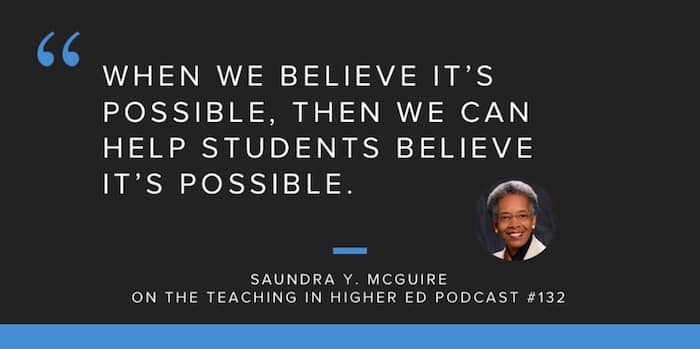
Make It Stick: The Science of Successful Learning, by Peter C. Brown, Henry L. Roediger III, and Mark A. McDaniel
Get Started
It can be overwhelming to think about completely altering how we teach. Instead, think small and start with a few approaches that can yield big results. In James Lang’s Small Teaching, he provides ample techniques we can use. One of his many approaches that keeps rattling around in my brain involves prediction. I try to regularly ask in my classes now, “…and what do you think happened next?” – “…what do you think would happen if…” – “…when this company did that, what results do you think they saw?” and so on… Episode #92 with James Lang: Small Teaching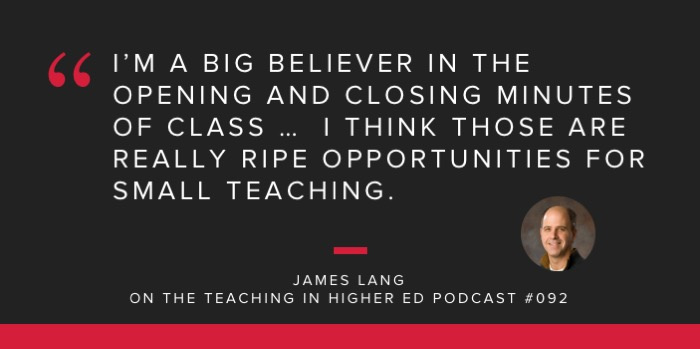
What I Wish I Knew When I Started Doing Active Learning
Gather Your Tools
You don't have to use technology to get learning more active in your classroom. Even something as simple as a sticky note offers plenty of opportunities to engage. One approach often used in STEM classes (but one that works in any kind of class) is called peer instruction. Peter Newbury shares about peer instruction on episode #53. Another method is known as retrieval practice. Pooja Agarwal recently came on Teaching in Higher Ed to share about the science behind retrieval practice. Here are some tools I use for both peer instruction and retrieval practice in my teaching:- Quizlet (including Quizlet live)
- PollEverywhere
- Glisser
- Sli.do
- Kahoot
- Ellen's Heads Up game
Build a Structure
Making a shift from more passive to active learning can be challenging. After you have worked through a few “small teaching” approaches, it helps to build a structure into your course. Paul Blowers described his environmental science class structure in vivid detail on episode #179. Chrissy Spencer also has great advice for how to structure large classes to make them interactive on episode #25. A structure might look something like:- 00-05 – Activate learning from prior class, create “time for telling” and/or current news related to concept
- 05-10 – Retrieval practice for current module
- 10-15 – Mini lecture
- 15-25 – Mini case or game/puzzle
- 25-35 -Debrief case or game/puzzle
- 35-45 – Mini lecture
- 45-50 – Next steps
Break the Structure
The reason for the structure is to get accustomed to talking less in our classes. Once we have made that shift, we don't necessarily have to structure each class session the same. In fact, it is in the unexpected where opportunities for learning can emerge. Ainissa Ramirez provided such inspiration on making challenging subjects fun in episode 66. When we attempt to do that, things are likely to get pretty messy. But, Ainissa reminds us: “It's the messy stuff where you learn.”
Be Patient
Some have accused me of making all of this messy teaching stuff look too easy. Teaching requires celebrating the small steps that might one day lead toward greater learning. It means vulnerability is essential and failure is inevitable. When Yale’s Professor of Physics and Astronomy, Meg Urry, visited Teaching in Higher Ed, she shared just how challenging it can be to correct mental models. Episode #69 with Meg Urry: Correcting mental models As she says on the episode, “Real learning takes time.” This is true when we are talking about our students, but especially so when describing our own learning.
Another resource to help you with active learning comes from Vanderbilt's Center for Teaching.