Follow the Teaching in Higher Ed Podcast
About this Episode
James Wilson on episode 194 of the Teaching in Higher Ed podcast shares about Interactive Theatre in the classroom.
I haven’t come across a medium of teaching which attaches a higher state of emotion to learning experiences.
James Wilson
On episode 194 of Teaching in Higher Ed
Voices on this Episode


Show Notes + Resources
- Dementia Reconsidered: the Person Comes First by Tom Kitwood*
- Choose Your Own Adventure Posts and Podcasts on Teaching in Higher Ed
- Episode 163 with Stacy Jacob
- Being Mortal: Medicine and What Matters in the End by Atul Gawande*
- Episode 117 with Kerry Moore
- Games for actors and non-actors by Augusto Boal
- Article about our experience using Forum Theatre
- Meetoo
- Turning Technologies
- Three filmed projects
- Turning a crisis into an interactive drama: An introductory paper of a ‘clickers theatre’ in nurse education
Recommendations from this Episode

Transcript
Bonni: [00:00:00] Today on episode number 194 of the Teaching in Higher Ed podcast, James Wilson shares about interactive theater as it enters the higher ed classroom.
Production Credit: [00:00:14] Produced by Innovate Learning, maximizing human potential.
Bonni: [00:00:22] Welcome to this episode of Teaching in Higher Ed. I’m Bonni Stachowiak and this is the space where we explore the art and science of being more effective at facilitating and learning. We also share ways to improve our personal productivity so we can have more peace in our lives and be even more present for our students.
Bonni: [00:00:51] James Wilson is a lecturer in mental health nursing at the University of Southampton. Since 2005, he has designed and deployed an innovative toolkit of interactive theater techniques with the aim of bringing learning about healthcare alive for the learners. And for the rest of James’s bio, I’m going to welcome him on into the show. Welcome to Teaching in Higher Ed.
James: [00:01:17] It’s a great pleasure to be with you Bonni, hi.
Bonni: [00:01:20] I told you in advance that since your bio is so much shorter than the ones we normally get, I thought well just tell us your story in 30 seconds or less. I kid cause I know you have a lot of experience, why don’t you walk us through a little bit of your experience in higher ed, but also what happened before because that’s really interesting to our stories as well.
James: [00:01:41] Yeah I think definitely to know where you come from as a teacher, it’s useful to know the background of someone. Before I joined the University of Southampton, where I am a lecturer, I was a qualified mental health nurse for over 11 years. Prior to that, I also have experience working in the police service, I was a police constable for quite some time.
James: [00:02:09] So it really was a public sector background that I have had very much engaging with them of care in the community and looking after the people that work and live in and around communities. I joined the University of Southhampton in 2004 within the Faculty of Health Sciences. And I can then take this story very much from there in relation to the influences that went from my teaching and what we’re going to talk about today as well in relation to interactive theater.
Bonni: [00:02:46] I am super excited to learn all about how these pieces came together. Can you start by telling me about your first experience being introduced to interactive theater techniques in Nursing Education?
James: [00:03:00] When I arrived to the University, one of the challenges that I came across was trying to bring the complexities of clinical practice and somehow bringing these complexities into the classroom. And it was- I mean many other methods, it was like walking into a candy shop as a kid as well. You know, what sorts of methods can I actually sort of pick from, from creating a game to an online methods.
James: [00:03:37] But what struck me, quite early on, joining the University, was the power of theater in relation to the history of humans. It was prior to the Greeks humanity had no codified language to discuss theater. And so therefore, they would have these sort of reenactments. And I just saw how humans were kind of hardwired for learning by doing. So the very first time myself and a colleague stepped into a classroom to do an interactive theater, I donned an old man’s outfit, wrote a story about an old man who had dementia being admitted into our care home. And my colleague, who played almost the villain of the piece, was the nurse who unloaded all of these social malignant acts which were really evidenced by Tom Kitwood who is a writer in the realm of dementia who looks at these social malignant acts.
James: [00:04:49] And so we sort of bring them to life. We showed the nurse character unloading all of these characteristics onto old man in story form. And naturally, you expect sort of good practice, best practice to be performed in a classroom setting, when actually we turned it on its head, we were showing abysmal practice, awful practice and showing it to the students and actually saying “well is this the sort of health care worker that you want to be?” and people recognized the behaviors.
James: [00:05:28] But what we then did was we then started on our Technical Forum Theater which is basically an opportunity for an audience member to show – stop a part of a play that’s being performed to them and take over one of the actors on the stage to enact their solution. And once their solution has come to a natural end, they can sit back down again. So it’s ensuring that passion isn’t actually on a stage as it were for a long period of time.
Bonni: [00:06:05] Now did you get inspiration from other colleagues who were doing similar things in their classrooms? Or were you learning about what people are doing at other institutions? Or just taking what came more intuitively to you?
James: [00:06:19] Actually, it was a conversation at a conference I had with a chap who was an actor. And I got chatting with him and he literally turned around and just described this Forum Theater technique to me and it was like the moons aligning because it was like well here we have a technique which within our classroom environment, you can combine an atmosphere where audiences can witness observable action, they can immerse themselves in a story that’s being presented to them and makes their own sense of it as well as combining what actually is the story rich realm of health care with its challenges of everyday life.
James: [00:07:11] We’ve got an endless supply of scenarios to reduce and play in front of an audience. So it really brought that sort of alignment together of this story rich realm of health care and the ability for the audience to make changes to a scenario, ultimately, hopefully to make it better and practice in the classroom.
Bonni: [00:07:36] If someone listening doesn’t necessarily consider themselves an actor, is this an area that they may still benefit from in some way? I don’t know if this is a proper analogy, but I think of it like people that don’t think of themselves as artists but yet there’s sort of this belief that we are all artists. So how do you come down on whether or not a non-actor could benefit from this approach?
James: [00:08:02] Declaration of honesty here, Bonni. As I mentioned in my own introduction, I have no drama background. And therefore everything I have learned has been through fingertips and through experience. And actually, I would argue that everybody in everyday life is an actor. It shouldn’t be deemed an untouchable sort of art form because it’s something that everybody can do.
James: [00:08:31] For example, every single day when the person that you are when you don’t see a uniform, as either a national police officer, a doctor, or anybody like that, you’re becoming a character and that person changes as soon as that uniform comes off and that person comes home all of a sudden you become a father, a son, you become a different character in the household.
James: [00:08:57] And so it’s something which can be replicated with the right sort of encouragement. I think putting it together, there is the whole package. There’s a certain architecture that is quite useful when considering taking on an interactive theater approach. A toolkit of different techniques but also working with individuals to put together an interactive theater I think is something which, yes anyone can do but it shouldn’t be entered into lightly.
Bonni: [00:09:35] You’ve introduced a couple of terms to us, one is the interactive theater. And then you also mentioned discovering actually after the fact that what you were doing already was called Forum Theater. So that might be something that other scholarship around the scholarship of learning and teaching might mention.
Bonni: [00:09:55] But there is one other term I want to introduce and then I’ll probably back up a little bit and have you describe some other examples of it. But tell us a little bit about clickers theater.
James: [00:10:06] Clickers theater is a combination of different processes that was influenced actually by the Choose Your Own Adventure. Originally I liked episode 163 by Stacy Jacob and her games in higher ed classrooms and it was because of that episode that kind of spurned me over to make contact as well.
James: [00:10:30] But it starts with creating a story which is like say a Choose Your Own Adventure and that in itself is written down. When then is done is usually base those stories on real patient narratives. So I’ve actually had patients come and tell me their story. And then I’ve playwrighted it in such a way as using as a Choose Your Own Adventure.
James: [00:10:57] Following that, now that we have the story, then I would recruit the actors. And the actors themselves have been a student nurses, so senior students or any partners – National Health Service guys partners joining in as the actors. We then have a rehearsal where we put the story on it’s feet as it were in live theatrical form. So that will mean rehearsing for probably two days and that is to actually have the actors understand the component parts that they will be playing and also the different directions that the audience will be choosing because the audience rule in amongst this is to take on a electronic audience response system such as either Turning Technologies, the zappers or Meetoo, which could explain more about it as well.
James: [00:11:52] But the idea is the audience watch the play and at different points, one of the actors will turn around to the audience because they’re faced with a dilemma and turn to the audience and say “hey what do you think I should do?”.
James: [00:12:08] Options will then appear for the audience to vote on and depending on the will of the majority- and it will be a democratic vote, everybody in the audience will get a chance to vote on one of a number of different outcomes, and they will determine what happens next. Whichever decision gets the most votes, the actors immediately then show the audience the cause and effect of their decision.
James: [00:12:37] And we do that again until we get to the next choice point in the play. Now I’ve played nasty tricks on audiences before, we have sent them around in circles. So if they potentially choose the wrong decision, then they will go around in circles and see the same scene again and again and again.
James: [00:12:55] But also, we’ll be able to play very emotive pieces to an audience. We’re in health care. It’s very much about clinical decision making. And even sometimes small decisions can make big impacts in patient and carer’s lives and it allows us the opportunity for audiences to see the impact that their decisions can actually make and show the consequences of them in a safe environment of the classroom.
Bonni: [00:13:27] About how many actors are involved in most of your productions? And how many people should we envision sitting there watching the scene and making their choices on their clickers?
James: [00:13:36] Well actors, we’ve had anything from 6 to about 10. What I’ve actually done in the past is almost like a casting call to the senior students to say “well if we want to be involved, then come on in and get involved” and that in itself has proven really beneficial as well because what that has allowed is the whole students teaching students scenario to occur where the students themselves are the actors and they’re performing to their own peers.
James: [00:14:11] There’s a lovely element there as well where the student audience can watch their colleagues on stage and it’s almost like people like us, hey those are just those are people like us, they’re acting but I recognize the characters they’re playing. And that’s again got a certain and gravity to replace themselves.
James: [00:14:37] But the audiences… Yeah we played to audiences of around 350 before and captivated them without any problem.
Bonni: [00:14:47] One of the things I would imagine you’re doing is creating such a memory for the people that participated that if given the opportunity to make the same kind of memory for other students that aren’t quite as far along, I would imagine that’s very motivating for people to want to engage as an actor or some other way to just be involved for future students.
James: [00:15:11] Definitely. I mean and personally, I haven’t come across a medium of teaching which attaches a higher stake of emotion to learning experiences both for the student, or colleague, or service user actors, or audience members who have emotions with really good memories and they know how you make them feel and you’re able to recreate memories from emotions very readily long after the teaching session has finished. And I think that’s one of the strengths of this interactive theater methods and certainly it’s a real benefit.
Bonni: [00:16:15] I haven’t done anything even remotely close to what you’re doing, but I have done role playing in my classes. And one of the things I have found helpful, just actually like in any class, is to set up some ground rules for people. I wonder if you have ground rules for either the actors or the people that are students who step into the scenes when they shout out to stop the scene and they take over their role. Do you have any ground rules that you establish around when we are in the scene, if you will?
James: [00:16:43] Very much, very much. If I could just take a little sideline.
Bonni: [00:16:45] Oh please, those are always so much fun.
James: [00:16:46] Well it’s this term role play. I don’t know if many of your. Listeners, colleagues have come across this term. And once you’ve actually announced it in a classroom, the genuine terror in the eyes of so many of the students at the mere utterance of the word. “Hey guys we’re going to do some role play today,” you have people almost escaping out of windows.
Bonni: [00:17:04] Yeah.
James: [00:17:05] And I’m so interested as to why this is the case, Bonni, because there’s a dearth of any literature that tackles the subject of certainly why do people hate role play? And I do wonder really and I’m so interested to know what listeners and yourself thinks about this. Two thoughts really occur. First of all it’s this word “play”. It’s become a bad word in some quarters because it’s something that young children do and therefore does it have no place in higher education because that’s where serious stuff happens. And therefore, play is not something that we should be doing. Of course, thatt’s nonsense, but it’s the word. And I think that as a result, we’ve had to try and create a whole language to ensure that role play is not mentioned. So yeah, we have role training, we have simulation, we have participatory theater, interactive theater, anything but the role play word. It’s just an interesting view.
Bonni: [00:18:09] Oh absolutely. I wonder if avoiding it would help make things somewhat better. I think part of I hear the aversion people have toward it is actually feeling like it’s not going to be very real. And as you were talking about some of this Choose Your Own Adventure and the ways that you try to make these real life situations come into the classroom, I was reminded so much of the writer who is also a surgeon named Atul Gawande.
Bonni: [00:18:39] He’s written all sorts of publications, but the book that I read that I am most thinking of right now is his book called Being Mortal: Medicine and What Matters in the End. And for anyone who’s not read it, it is really about his father’s end of life and as a physician what that was like for him to experience it and thinking about what do the last final chapters of our life look like and then what could they look like?How could we make that better for our societies?
Bonni: [00:19:12] And, at any rate, he speaks so eloquently just about how most of our medical education just doesn’t prepare people for the raw, gut wrenching decisions and hard questions that have to be asked. So I’m so inspired and so full of hope as I hear you describing this because I really could see this preparing people to be more effective at just such hard conversations, I could only imagine.
James: [00:19:39] Absolutely Bonni. And I think it goes slightly further as well because we mentioned emotion earlier. And one of the things I feel quite strongly about as well is that these sort of theater pieces can actually provide a kind of a low dose exposure to some of the more unpleasant emotion that you’ll face in the maelstrom of clinical practice.
James: [00:20:02] And I think that’s something that really benefits- especially as I see this with the kindest of words is more younger people coming into the professions of health care. So it gives them that exposure to some of the more uglier areas that you do really think about when you’re writing your application to come and care for people.
James: [00:20:29] So, yeah, when people are not happy with the care that you’ve received or they’re in so much distress that you really can’t alleviate them or they’re seeing some real sort of bizarre things to your face that you struggle with them not laughing at some of the things, you know you have to be professional.
James: [00:20:47] So I think theater allows this exploration in a classroom so that you can get a lot of these experiences distilled within a classroom space. I say the word safe space as well a lot so that we can explore that safely together. And I together because it’s a two way process, a theater is lovely in a sense that we’re never didactic in a way, the theater tells you how to think. That is up to the learner, very constructivist that way.
Bonni: [00:21:19] I had a friend on an episode, which I will link to in the show notes, Kerry Moore. And in that episode, she got to draw from her background in social work as I shared about a family member with dementia. And this has just been quite the adventure, let me tell you, as a family and that’s my mom and my husband and myself they’re kind of all hands on board on this project that none of us expected.
Bonni: [00:21:43] And during that season talking with Kerry on that episode, everything was new. I was seeing the situations for the first time and it all felt very hard and one of the things she shared about the research in these kinds of situations is about the benefits of building resilience. And I chuckled because this is not the kind of resilience that most of us want to build.
Bonni: [00:22:05] But as we have gone through multiple iterations and different care scenarios, it has really built up my resilience and the most recent tough decision that we needed to make, I felt like we were all really able to come together better because we had seen some of these patterns before.
Bonni: [00:22:22] And I think what you’re describing seems so helpful, if I were a nursing student to be able to see it in advance. And if I felt like laughing, far better to laugh in a class because that’s often our reaction to just something so foreign to us. And quite frankly, I imagine sometimes it really is silly.
Bonni: [00:22:40] But you wouldn’t want to laugh in front of a person but just to have like you did describe it as a safe space that that there would be a place where I could be confronted with this for the first time and build up that resilience in a better way before I was actually doing it completely on my own, without coaching and the benefits being able to choose a different adventure, a different clicker.
James: [00:23:07] Well we’ve certainly tackled a number of classes with very difficult to teach subjects. Our very first clickers theater experience was a service user came forward with their experience of being sectioned under the Mental Health Act. In the UK, that’s one of the most powerful pieces of legislation that we have to take people’s liberty away and put them in a hospital, in a safe space from themselves or others.
James: [00:23:38] And that in itself, it was a hugely emotive experience for both the service user to explain. And also when we staged, it showed actually how the health care professionals involved different stages of this person’s journey impacted hugely on the inevitability of that person ending up in the hospital. And it was because of the health care workers actions that actually triggered the person’s level of distress, which then unfortunately led to them being sanctioned.
James: [00:24:20] And yet, the lesson that lovely service user who provided the story was trying to say is that being sectioned under the Mental Health Act shouldn’t be seen as failure. It was the best thing I needed that, that’s what she was saying.
James: [00:24:36] And so therefore there was a dual number of outcomes there for students watching which is yeah be careful what you say and how you say it, because these decisions, your actions really do impact on patients lives, even the small ones. Secondly as well that this sort of outcomes of a journey when someone enters hospital again shouldn’t be seen as “we failed you.” It’s the place that someone may need to be at a particular point in their life. Stop the world, I’m getting off.
Bonni: [00:25:09] I’m going to have such fun putting together the show notes for this episode. Which for people listening are going to be teachinginhighered.com/194. Could you tell us a little bit about the resource. I’ll be looking into about the games for actors and non actors and my people should go click on that link.
James: [00:25:32] Games for Actors and Non-Actors was one of the first books that I was pointed towards and read cover to cover. It is by Augusta Boal, who himself was conceived this of arsenal of techniques known as theater of the oppressed. And within the arsenal, one of the techniques is known as Forum Theater. I’ll come back to that in a second but just as an overview of the Games for Actors and Non-Actors book is jam packed with very straightforward, easy to pull out games and also techniques in order to help people unlock their kind of creativity in acting situations either in the rehearsal space or even in classrooms.
James: [00:26:28] Boal turned around and said that he’s borrowed them from his travels around the world, he’s taken them and put them into and categorized them in this book. Boal himself is a Brazilian theater activist and back in the 1970s, he was looking at putting on plays for people in slums and the like in Brazil. And one of the techniques he was using was called simultaneous dramaturgy.
James: [00:27:03] And what happens in simultaneous dramaturgy is the audience watches a play about a subject or a topic that resonates with them and then at different points during the play, the play will stop, the director will stop the play and say to the audience “hey what should our actor do?”
James: [00:27:25] Now, this particular play, I might add, was about adultery. And it was the point of the play where one of the actors, the male actor, had been caught by his wife in the act of adultery. She’d found letters to his lover. So the police stopped and said to the audience “hey what should we do?”
James: [00:27:47] And one of the ladies in the audience turned around and said “you need to give him a damn good talking to.” So the actress then turned around and obviously started giving the male husband aood talking to. This went backwards and forwards a few times because the audience member just kept on saying “no no no you’re doing it wrong. Give him a damn good talking to.” Until really the profanity on the stage was just an unannounceable on your podcast Bonni. At which point, the member of the audience turned around and said “look, do you want me to show you what I mean? Do you want me just to come up and show you on stage?”.
James: [00:28:24] And of course, in traditional theater pieces, where we go to watch the theater, the unwritten rule is that the stage is the domain of the actors and the audience don’t get up onto the stage. Well the 500 strong crowd were now all clapping and hollering and actually Boal had no choice because this woman was actually making her way up to the stage. It became a bit of a fishing story because every time Boal told a story, this woman got larger and larger.
James: [00:29:01] And so eventually she got up onto the stage and somehow on the way up to the stage, she managed to pick up a broom handle and as she got onto the stage, didn’t actually utter a word but proceeded to beat the actor on the stage. And as soon as she finished she then sat down on a chair on the stage and went “right, I’m exhausted after that. Now make my tea. And by the way don’t do it again.”
James: [00:29:28] And the whole audience went insane with this. They thought it was brilliant. But one of the things that was really interesting to Boal here is that the women in the stage who eventually got up wwasere saying give him a good talking to. And yet, the action that she then demonstrated was actually not about giving him a good talking to, but a broom handle and a sound beating.
James: [00:29:54] And therefore, what goes on in someone’s head and what the verbal estate is then translated very differently to how they then action, what they then show and demonstrate as action. So Boal then took that and that very scene was the birth of forum theater.
James: [00:30:15] And if I can just explain that technique just for a second. So forum theater is a deceptively simple technique where our story is presented by actors to an audience. And again, it’s something of resonance. And the play goes through, there is a protagonist, a main character who tries really hard to doing the plea to overcome the barriers. But ultimately, by the end of the play, they will fail. The play never ends well usually in a forum theater. It leaves the sort of sense of conflict and unresolved problems to an audience.
James: [00:30:58] Then up will pop, in Boal’s language, a joker. And the joker is the person who will explain the rules of the game, they will be attempting where possible to lower the stakes for the audience involvement. They’re the glue of the session as it were because the joker is the person who will talk to the audience, gather all of the issues that they think is really important about this play. They will then explain the rules of the game, which is that in a second they’re going to replay the play once again, and then if there’s a point where the audience member feels that if the main character had done something slightly differently, the outcome of the play would be different. Then at that point, shout “stop!”.
James: [00:31:55] Then that audience member is invited from their space and the audience up onto the stage and they can take over the character on the stage. But only for the amount of time where their solution has run its course. At that point, the person on the stage has the opportunity, at any time, the power to sit back down in their seat again.
James: [00:32:20] It is just an opportunity to show the solution. At that point, we will then move the story on and have an interplay where lots of members of the audience who get up on stage do to sit back down again. Boal refers to this method of the audience instead of becoming a spectator, a passive observer. Then he becomes a spect-actor which is the lovely neologism. Again it’s about the audience getting involved in some way on the stage. And that is again for me where the basis of everything about interactive theater comes from.
Bonni: [00:33:04] You have been so generous, not just with the conversation but also have sent along other items I’ll be linking to in the show notes including three filmed projects which people will just get such a kick out of being able to see this happening in their own computer screen so they might envision how they could use it in their own teaching.
Bonni: [00:33:25] Also an article about clickers theater with your experience turning a crisis into an interactive drama. And oh there’s one more. And an article about your experience using forum theater as well. So you’ve just woven some experts in with lots of examples from what you are doing at your institution. So thank you so much for that.
Bonni: [00:33:48] This is the time in the show where we each get to give some recommendations and mine continues a little bit on a theme I have been talking about on recent episodes and that is more on renewable versus disposable assignments. So the disposable assignments are the ones where we just turn in a paper or we take a test and nothing happens after that there’s no value that gets brought to our own learning.
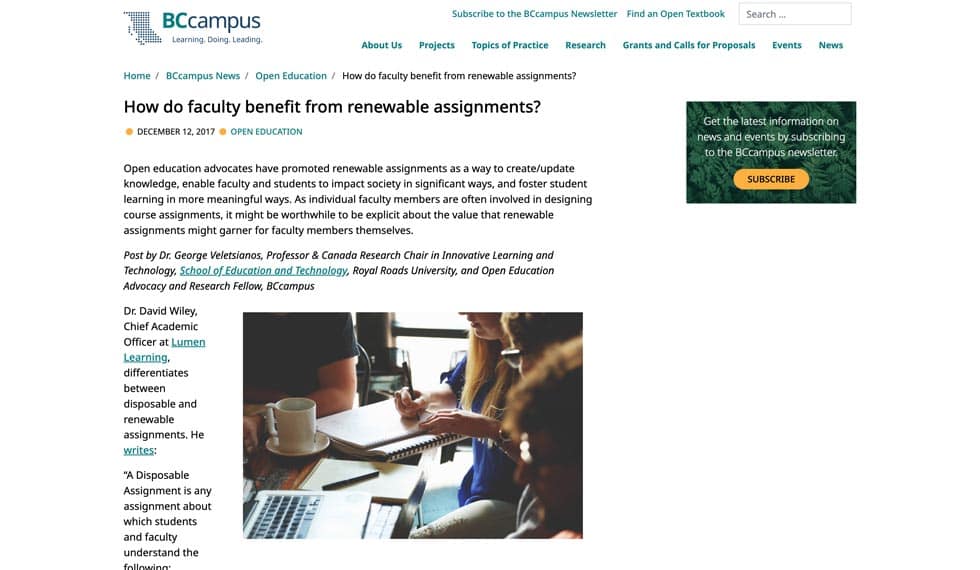
Bonni: [00:34:13] After we’ve submitted it and there’s no value that goes out really to the world to benefit it. And so the contrast to disposable assignments are renewable ones. And there was a lovely article written by George Veletsianos, How do faculty benefit from renewable assignments? You could learn more about how you would benefit by coming up with more of them.
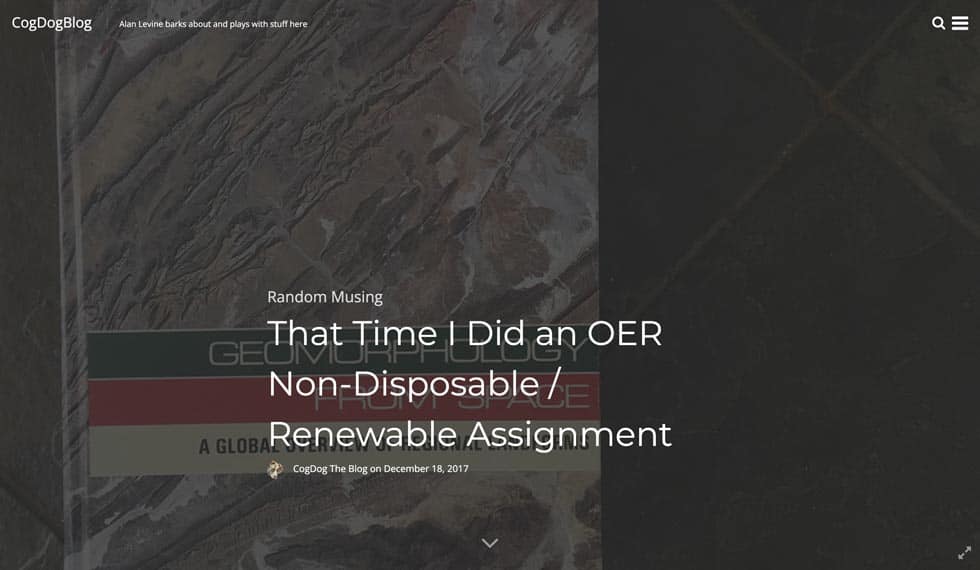
Bonni: [00:34:37] And then Alan Levine wrote a wonderful piece called That Time I Did an OER. That would be an open educational resource non disposable renewable assignment and it is just a great look at him as a student and something that he did to contribute to something that lived on and some of the acknowledgement that he got even well after the course was through.
Bonni: [00:35:00] So I would recommend that you come over to the show notes at teachinginhighered.com/194 and check out all James resources of course. And then a couple of these articles about renewable assignments. And James, I’m going to pass it over to you for your recommendations.
James: [00:35:17] Wonderful. Thank you, Bonni. Well my first recommendation is to be a real time polling cloud based app called MeeToo. It’s something that we’ve used a number of times within our classroom for the clickers theater. It has both the ability to use real time polling but also has a discussion board facility as well. And it’s all cloud based. Audience members can either download an app or use a web browser. Again, it reports feedback, uninhibited feedback, it can asess learning. It’s an excellent addition to the electronic audience response systems. So there is something that some people would really like to check out.
Bonni: [00:36:08] Oh absolutely. And James I know you’ve got one more to suggest for us.
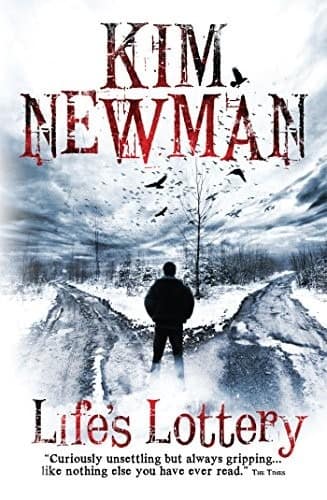
James: [00:36:12] Yes. My other one is back to the good ol’ book. It’s a book that I had never seen anything like this before. And it’s by an author called Kim Newman and it’s called Life’s Lottery. And I was just given it by a friend. It is described as an adult role playing nove, where small decisions have monumental consequences and it’s just that. It’s not a book like one of the the old fighting fantasies that we have come across when we were younger where you actually role yourself a character, no, all it is is you read the book, it’s a lovely thick book, and small decisions really take off in different directions. So it actually gives you a number of the page that you need to go read on.
James: [00:36:56] And there’s multiple different directions, it’s a brunching story line that you can take. So emersive and well written for someone like myself who’s interested in and choose your own adventure stuff and where decisions are important in life. I was really gripped by it.
Bonni: [00:37:12] Oh it sounds like such a wonderful book. And MeToo looks like a great service for us to go and check out. And James, thank you so much for getting in touch and introducing all of us to these truly innovative ways of transforming your classroom. I am inspired and I know so many of our listeners will be too.
James: [00:37:31] As always with these sorts of things, they always just touch the tip of the iceberg.
Bonni: [00:37:35] Oh I’m sure. That’s just an excuse for us to have you back because I think you’re not done.
James: [00:37:39] That would be so lovely Bonni, so lovely.
Bonni: [00:37:46] Thanks so much again to James Wilson for joining me for this episode of Teaching in Higher Ed and talking about interactive theater as it enters the higher ed classroom. Thanks to all of you for listening. If you have yet to give the show a review or a rating on whatever services you use to listen to the show I would be so grateful if you would do so.
Bonni: [00:38:09] Thanks to all of you that has been sharing your experience listening to the show and making it possible for others to discover it. You can do that using whatever service it is you use to listen. And it only takes a couple of minutes.
Bonni: [00:38:24] Thanks so much for listening. And I look forward to seeing you next time. Lots of great episodes in the queue. Take care and I’ll see you next time.
Teaching in Higher Ed transcripts are created using a combination of an automated transcription service and human beings. This text likely will not represent the precise, word-for-word conversation that was had. The accuracy of the transcripts will vary. The authoritative record of the Teaching in Higher Ed podcasts is contained in the audio file.