Follow the Teaching in Higher Ed Podcast
About this Episode
Bonni shares teaching lessons she learned from mom (Jan Frazee) on episode 462 of the Teaching in Higher Ed podcast.
When having hard conversations, they are not going to be perfect.
Jan Frazee
On episode 462 of Teaching in Higher Ed
Voices on this Episode


Show Notes + Resources
- Teaching Lessons I Learned from Mom, by Bonni Stachowiak for EdSurge
- Dr. Frank Leon Robert’s tweet about his office hours and books he gives away to students who visit
- Dr. Frank Leon Robert’s Amazon wish list for his office
- Twitter thread re Aunt Judy’s death
Affiliate income disclosure: Books that are recommended on the podcast link to the Teaching in Higher Ed bookstore on Bookshop.org. All affiliate income gets donated to the LibroMobile Arts Cooperative (LMAC), established in 2016 by Sara Rafael Garcia.”
Recommendations from this Episode




Transcript
[00:00:00] Bonni Stachowiak: Today on episode number 462 of the Teaching in Higher Ed Podcast, Teaching Lessons I Learned from my Mom.
[music]
Welcome to this episode of Teaching in Higher Ed. I’m Bonni Stachowiak and this is the space where we explore the art and science of being more effective at facilitating learning. We also share ways to improve our productivity approaches so we can have more peace in our lives and be even more present for our students.
[music]
Today, I have sitting with me, Jan Frazee. She is my mom. Would you introduce yourself a little bit so they can know who they’re talking to today?
[00:00:52] Jan Frazee: Hello. I am Bonni’s mom. I am a happy aging person. I’ve had lots of fun life experiences. Sometimes I feel like I’ve been incredibly fortunate with how many of them are good.
[00:01:06] Bonni: Thank you. One thing I think maybe would come up possibly in this conversation is my mom’s decades-long work in search and rescue, so she does K9 search and rescue. I can’t even remember because Dave, my husband, also has a podcast, so I know you’ve been on his, I know you’ve been on mine, so who knows. You’ve talked about that, [laughs] somewhere the transcripts are out there. In case that were to come up today, people should know that dogs are a big part of your life, and so is the teaching and learning as it relates to sometimes some behavioral things and positive reinforcement and all of that just in case that comes up.
[00:01:46] Jan: Got it.
[00:01:47] Bonni: All right, I am going to be reading a column from a somewhat regular column I write for EdSurge, emphasis on the word somewhat, but I recently wrote a column for them called Teaching Lessons I Learned from Mom. My mom, Jan, has not heard this yet, so as you are hearing, dear listener, she is also hearing these words. Though I usually use this space, as in the column on EdSurge, to offer answers to teaching advice questions from professors, I wanted to try something different. For my next few installments, I’m writing letters to people who have exemplified what it means to be an effective teacher.
The first letter, listeners, if you’ve been listening for a while, you might remember that I visited my friend Elizabeth Powell’s class, her hybrid class, and this is my second column.
This letter is to my mom. Dear, Mom, my friend and colleague, Jeff Hittenberger, worked with us to launch a new faculty learning community last year. Together we explored how to engage in civic life with love and wisdom. We didn’t have to go further than the daily news to hear of school board meetings, classrooms, grocery stores, and libraries being impacted by political polarization in our country.
What really struck me throughout the experience was that so many people in this faculty learning community shared how they find it hardest to show up with love and wisdom with their families. My colleagues described how they cannot talk to their parents or other family members about anything even remotely political without sparking tension that feels impossible to diffuse. A few stressed that the only way their marriages keep going is to avoid any topics outside of the “safe ones”, such as what’s for dinner or what’s the weather? This was not the way you raised me though, Mom.
I remember my childhood as a time of mutual exploration where you encouraged us to discuss any manner of potentially controversial topics. You were cautious not to speak in dichotomous ways about more challenging subjects, but you did give me a general overview of the broad strokes of how different people perceived tough issues. You would describe various perspectives people might have on an issue and only then share your own viewpoint. Regardless of my age, my sense was always that you found me to be a person worthy of having opinions about important matters in this world.
I recently spoke at a conference back home in San Diego and I ended up driving right past the shopping center where you used to take me to ballet classes several times a week. The familiar clock tower architecture on the building’s facade drew me back to those years of practice. You made it possible for my life to be shaped by dance, yet not in a way that put me directly in the center the way it is for so many children today. Yes, you were sure to have me there on time, but you pursued your own interests. You would drop me off and sit in the car for a few hours each week reading voraciously.
While I always felt important in your life, you also showed me a commitment to your own lifelong learning that demonstrated the importance of self-care and growth. You took me to your sign language classes at the local community college and allowed me to learn by your side. I was not spoken of by you or the others as a bother. Instead, I was a partner in the learning process. The professor gave me a name sign in American sign language as the others in the class came up with their own. She signed the letter B as she moved her hand down the side of her face to represent my long hair.
I did not realize it at the time, but this experience of joining you in class formed a foundation that would serve me years later as I went to college and never questioned whether I belonged there. A trip to a bookstore or library as a younger person was always a delight. Each member of the family could pick up as many books as we could carry, allowing us to go on adventures and our ever expanding imaginations and acquisitions of knowledge. You did not try to control what we read, but you allowed my brother and I to pursue our own interests and characters who would draw us into their stories.
The way you modeled how to avoid binary thinking has stayed with me into my adult years, and I’ve done my best to incorporate this discipline into my teaching. My goal is to treat each student as someone with a unique perspective about the topics we’re exploring together. It is vital to ground students with a shared vocabulary necessary to understand the issues. I also ask plenty of questions along the way so my students realize that their views matter to me. Frank Leon Roberts, English professor at Amherst College, remembers one way that books shaped his life and his relationship with a professor in his college days.
His former professor gave books away to students who visited during office hours. Roberts continues that tradition for his students at Amherst today. As Roberts shared in a 2022 tweet, “My rule, any student who comes to my office hours can keep any book on my shelf that they like. All they need to do is ask.” I have a prof who used to do this back in college and I’ve always remembered how special it made the student-teacher relationship. Let’s continue this tradition. Roberts shared an Amazon wish list with books he would like to give his students. Supporters can then purchase the books and have them delivered to his office at Amherst.
Our family sent Roberts multiple copies of the books on his list so he would have plenty to give away to his students. This was all done in honor of you and the impact you have made on our lives and learning. Thank you, Mom, for all you have done throughout my life to set me up to continue learning and engaging with people who have different perspectives than me. I’m thankful that you continue to be a person in my life who I can talk with about any issue. The columns always go through lots of editing, Mom. [laughs] The editor’s name is Jeff Young.
One of the things he asked me about in reading it, I don’t know if you remember early in the column I say something about you reading voraciously while I’m in the ballet lesson. He said, “Could you please clarify what kinds of things that she would read?” You don’t have to do that. The piece stands on its own, but I’d really be interested as a reader, [laughs] and I tried and I tried and I tried. I was like, “That’s 14 columns right there,” so I’m here to ask you the ever-hard question, Mom, what did you read growing up? Maybe some of that still carries through today.
[00:09:27] Jan: [laughs] When you were growing up, I think, for one thing, I was hooked on some of those series that I love. Some of them were historical. I consider them historical mystery books, but they also had probably some romance thrown in there also. I bought them all and they’re still on the shelves at home and I’m going to have to give them up because I don’t think I’m going to reread them, but I’ll try first to see if I want to. We’ll see what happens.
[00:09:54] Bonni: This is embarrassing because I mentioned in there that Dave and the kids and I, we bought these books to send in your honor to this professor. That was supposed to be one of your Christmas presents and that was Christmas of 2022. Let’s just say we are well into 2023, so Merry Christmas?
[laughter]
[00:10:16] Jan: Still greatly appreciated, though. That’s the best. That’s the best you could do. I love that.
[00:10:21] Bonni: The funny thing is that then also Dave, I think unbeknownst, we were like ships crossing in the night because he also bought books in my honor [laughs] for them. Professor is getting boxes of books like, “Who are these people?”
[laughter]
[00:10:36] Jan: Book nuts. We love them.
[00:10:39] Bonni: One thing that we see throughout the column is just you regularly in all these different contexts, whether it was ballet class, I’m not the center of attention where you want to see my every footstep. You modeled for me that richness of autonomy and agency, and then even with the real controversial topics, you really modeled a lot of things for me. I’m curious how much was intentional as a parent, and ergo, a teacher and how much of it do you think came naturally to you?
[00:11:17] Jan: That’s a really hard question. I think some of it came naturally to me, but I also remember thinking at the time that some of the things that we used to make sure little girls got to do and we didn’t care if little boys got to do it, like ballet, for example, were things that one also had to be careful of because there were dangers inherent also in pushing your child to do something maybe they didn’t really want to do or to wreck your feet. [laughs] Which was another issue I felt really bad that maybe because of the foot injuries you ended up with, but you had a joy and you knew your own mind very early. Yes, I want to do this. No, I don’t want to do this. If you didn’t want to do it, we weren’t doing it.
[00:12:03] Bonni: I’m not entirely sure you can keep chastising yourself from the ballet [laughter] because it feels like I got more good than bad and I might have had foot issues even without all of that.
[00:12:16] Jan: That’s true, but I do still think that it’s something to think about in a way something that has changed about the world because I don’t think every family is making those sorts of mistakes anymore. I’m not saying no child should ever take dance, but I think it’s more open now. At the time, I think your brother wanted to take dance and I said, “Let’s think about that” because I didn’t know how that was going to fit into his life and so on and so forth. “How about basketball?” Do you know what I mean? It was a sexist thing on my part.
That’s something that I would want to change if I could, but I also know that you knew your own mind and your brother knew his own mind. You were very different people, but I think you both seized the opportunity to do what you really wanted to do and that was good.
[00:13:06] Bonni: This might be a little bit of an awkward transition for listeners because I’m going to share a little bit about the sponsor for today’s episode, but our recommendation segment is going to be a little bit longer than it often is because we have some sad, happy, relieving, all of the mixed up feelings, at least for me, news to share, and then some things to recommend. I’m going to just briefly share about today’s sponsor. Today’s sponsor is TextExpander. Listeners who have heard this show for a while know that they have sponsored for longer than anyone else and it is often the very first or close to the first things I install on a new computer or new device.
Without TextExpander, I would feel like it wasn’t a normal working computer. What TextExpander does is you type in a few characters that are super easy to remember because you set them up, and then they expand to a longer series of texts or something that’s harder for you to remember like a phone number. These days, my goodness gracious. Or, for me, the show notes. I can type in the variables like the episode number and the guest, but it has all the other static test that it’ll put in there. I’ve had some fun email exchanges with John E Wagner. I, on a recent show, talked about something he did and he wrote back and said, “Oh my gosh, I want to share one more thing that TextExpander does for me.”
It helps him learn names at the start of his semester. He writes, like many, “I have a single file that has all the student’s names and pictures. I assign this to a TextExpander snippet like ZCHE224. At the beginning of the semester when the students are taking a quiz or they’re otherwise engaged with something else, I can pull up the pictures quickly and compare the pictures to the students in front of me. This extra step of connecting the student to the picture helps a lot and TextExpander makes it so I don’t have to dig through my computer files to find the picture file.”
One more comment on the Greek letters, because if anybody’s been listening for a while, he talked about how you could set up Greek letters or other mathematical symbols. He says, “Because you can set up Word to have shortcuts, but they don’t work on other online programs and other apps like TextExpander does, so TextExpander, no matter where your cursor is floating, it works.” If you set up something like that in Word, it’s only going to work in Word, but TextExpander is wherever you can type in text, it’s going to allow you to use anything that you’ve programmed in there.
I just want to thank you, John Wagner, for sharing this because you actually helped me reimagine even more how I can use TextExpander.
I’m co-writing a book chapter with Maha Bali and I started to realize that we’re having our weekly calls right now that every time it would take me a while to get set up, I’d go to Google Docs, and then where was that folder again, and then where’s the actual document within the folder that we’re writing in. I just set up TextExpander snippets that I can easily open up the folder for our conversation in case I need to access any of the articles or resources.
I can quickly open up the page that we actually are going to be co-authoring on. John, once again, thank you for these additional ways that I can make use of TextExpander and thanks to TextExpander, once again, for this longtime sponsorship. If you head over to textexpander.com/podcast, you can get a great deal for listeners from TextExpander and try it out for yourself. I highly recommend it. Thanks, once again, to TextExpander for sponsoring today’s episode. Mom, this is the time in the show where we each get to share our recommendations. My first recommendation is to have the conversations, have the hard conversations.
I’d like to read a Twitter thread that I wrote on March 22nd, 2023. I found out this morning that my aunt, Judy, died last night. It’s always been hard for me to talk about since she has had advanced Alzheimer’s for so many years and it’s been hard for me to wrestle with the meaning of the last parts of her life. My mom would tell me that it would be just like Aunt Judy to want to be of use even in those final years, to provide a job to the people who worked in the care home where she lived. It was hard for me to reconcile all of that in my mind and still is.
This morning, Dan Green shared a poem here on Twitter that I had never read until just a few moments ago. Marge Piercy’s To be of Use. Mom, I’m going to read the poem now from Marge Piercy, To be of Use.
The people I love the best
jump into work head first
without dallying in the shallows
and swim off with sure strokes almost out of sight.
They seem to become natives of that element,
the black sleek heads of seals
bouncing like half-submerged balls.
I love people who harness themselves, an ox to a heavy cart,
who pull like water buffalo with massive patience,
who strain in the mud and the muck to move things forward,
who do what has to be done again and again.
I want to be with people who submerge in the task,
who go into the fields to harvest
and work in a row and pass the bags along,
who are not parlor generals and field deserters,
but move in a common rhythm
when the food must come in or the fire be put out.
The work of the world is common as mud.
Botched, it smears the hands, crumbles to dust,
but the thing worth doing well done
has a shape that satisfies, clean, and evident.
Greek amphoras for wine or oil,
Hopi vases that held corn are put in museums,
but you know they were made to be used.
The pitcher cries for water to carry
and a person for work that is real.
That, again, was a poem by Marge Piercy. I’m going to continue reading the thread about Aunt Judy. I’ll be darned if that doesn’t fit Aunt Judy perfectly, including “Hopi vases that held corn, are put in museums, but you know they were made to be used. The pitcher cries for water to carry and a person for work that is real.” As I reflect on each season of her life, Judy was continually of use. She died peacefully and without pain and will be remembered well by those who knew her. Mom, what I want to recommend [laughs] is the poem and also to reflect on what it means to be of use and more so to have the conversations. When she passed away, we didn’t have to wonder.
[00:20:33] Jan: Right.
[00:20:34] Bonni: That all the choices, there’s all these things that I didn’t really realize. For anyone out there who this helps, there’s things called a DNR, do not resuscitate that seemed so clean. [laughter] Like, “Oh, that’s going to answer. My goodness gracious, will that answer all the questions?” No, in this case, it didn’t. I feel so naive to not have realized that that’s, speaking of dichotomous things, that felt like a very safe thing to have had her sign a form and all of those things. There was the choice to whether to have a blood transfusion because of iron deficiency.
There were a few, not a ridiculous amount but a few decisions that you and Dave, but it didn’t feel hard because we had had those hard conversations over many years. She was also the kind of person who would tell you exactly what-
[00:21:22] Jan: Yes, she was.
[00:21:23] Bonni: -she wanted and thought, but I just love that you and I have had the hard conversations and it just feels like such a better way to go through life, even though they feel, especially at first, they feel scary and “Oh my gosh, we’re not supposed to talk about this stuff.” I’m just so glad that we have and I’m glad that we had the gift that it was to have had those conversations with her. I don’t know if there’s anything else you want to tell people during my section about having those conversations. If there’s anything that you would recommend.
[00:21:53] Jan: No, but you’re absolutely correct. You do want to have the conversations, but also, they’re not going to be perfect. You are going to feel sad in the middle of when you’re talking about it. That doesn’t mean that you can’t continue and have the conversation. It just means you’re an actual person, [chuckles] you exist. Aunt Judy would love that because she could have had the conversation and not even had a lump in her throat, but that doesn’t mean that it’s the right thing for everybody.
[00:22:20] Bonni: Yes. I thought that the fact that the poem mentions Hopi, the indigenous people. She loved to learn about different indigenous people throughout and would travel a lot and I don’t know if you would’ve call it an archeological dig or things like that.
[00:22:38] Jan: She did do some archeological work for a group that was working on Native American lands to do things. She learned how to do it properly and only did what they wanted done. She was just thrilled to be able to be part of that.
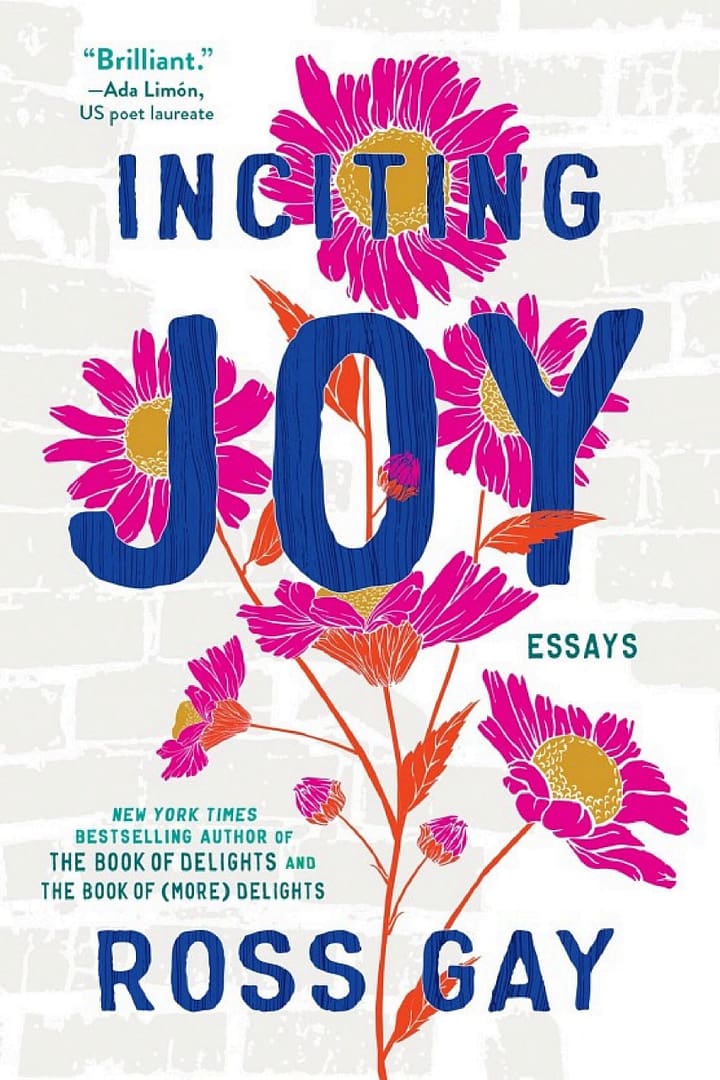
[00:22:52] Bonni: Yes. The second thing I wanted to recommend is a book and I’m going to recommend it in two forms. I’m going to recommend the book Inciting Joy by Ross Gay. The book-book that you can either hold in your hand or hold in your digital gadget that you could read it off the page, but also the audiobook. The audiobook is great. He reads it aloud. He’s the narrator of his own book. It’s an absolute moving, sometimes funny, sometimes tear-jerking raw book. I’m just going to recommend both. I mostly listened to the audiobook just because I got so captivated by his voice and the way he would read his own words, but I also did enjoy that I had his words to go read more.
I’m just going to read two quotes from Ross Gay’s Inciting Joy essays, and then I’m going to pass it over to you to recommend whatever you want to share. The first quote, what would happen if we acknowledged that none of this is privilege, but rather it is as it should and could be? What if we figured out together in a million different ways how to make it so, or to say it another way, rather than cursing the darkness? What if we planted some seeds? Then the second quote from Ross Gay’s Inciting Joy. What if joy instead of refuge or relief from heartbreak is what fluoresces from us as we help each other carry our heartbreaks?
Yes, listeners, if you’re a close, close listener, you know that I read those quotes [laughs] on a past episode when I was recommending an interview with Ross Gay about his book, but they are nourishing for my soul. Especially this last time you were just talking about, Mom, we’re getting all teary-eyed about Aunt Judy and yet there’s a joy in it, a piece, a way of nature and that I know she wouldn’t want us to be in agony. I’m sure she would be telling us to– [laughs]
[00:25:00] Jan: Lighten up.
[00:25:01] Bonni: Yes, but she also would not want us to show up with artificial joy.
[00:25:10] Jan: Very true.
[00:25:11] Bonni: I’m going to pass it over to you to whatever you’d like to recommend.
[00:25:15] Jan: Oh, that’s really hard.
[00:25:16] Bonni: I know. I know you don’t get to listen to every episode. Oh, people will literally obsess about it [laughter] for weeks or months after this, so you are not alone in the hardness of all of this, please understand
[00:25:29] Jan: [laughs] I just have to jump on the things that you brought up because that’s what’s gotten me through losing my sister because it just was very recent and she was a very intentional person who chose to do the good things she did. How wonderful is that instead of just reacting to things that fall into your life. Because of all that, in a sense, I believe she chose how she left this world and she allowed for people to care for her when she was really in a vegetative state. No one would ever know if they were taking good care of her or not, but she knew that she was willing to put herself out there for that.
I knew that those people were taking good care of her because they knew her for the short time that they had been around her before she really went into a state where she didn’t know what was going on around her. That I knew that she chose that, so I didn’t have to worry that she was unhappy in some way or feeling left out. No, that’s the person she was. If it were a sacrifice, that’s what she was going to do. I think in a way, it was instead a triumph for her.
[00:26:40] Bonni: Yes. I also think about the ways in which we can process this on individuals and should process this as individuals. I get so much of it is toward a common good and toward the sacrifices that we might make to the end of a greater good, greater than ourselves and the ways in which she was emblematic of that and that you were emblematic of that. As I was growing up, you taught me that, yes, you cared about me. I hardly ever use the word never, but if I use it, I mean it. I just felt like you cared about what I thought, but not in a narcissistic way, but to an end of becoming a part of a–
I was mentioning the guy, Jeff Hittenberger, that started this faculty learning community, civic life with love and wisdom, and ultimately, that being about things that are greater than ourselves to me being a teacher as not being a narcissist. We all can certainly have ego in it and that’s what gets us hurt sometimes and angry sometimes [laughter] and not at our best, but when we’re able to subjugate those parts of ourselves to that greater good to the gifts that can be given. Also in terms of like I was thinking about her healthcare.
It’s been a long time, but the ways in which my friend Carrie Moore, she actually came on the podcast previously to talk about a whole body of research around the ways in which trials make you stronger, and of course, no one likes that.
[laughter]
[00:28:12] Jan: Can I not have that, please?
[00:28:14] Bonni: Yes, but it is true the ways in which those things are. I think you might have had something to recommend too about reading voraciously. Is there anything that you wanted to share about that before we close the episode?
[00:28:27] Jan: Yes, I do. I do like reading voraciously. The problem is I don’t remember it all always, but nobody can. There’s so much if you want to read a lot, but I want to read a lot anyway, [laughs] so yes. Take it all in, and then the parts that are valuable to you will stick with you. Even if it’s just the feeling that they gave you, that’s okay.
[00:28:47] Bonni: Yes, I was reading this thread this morning about just some kind of a reading method where you find all of the books that are about a topic, and then you look at the table of contents for each book, and then you skim each book. [laughs] I was like, “I wrote a dissertation and [laughter] that was enough.” I know that that’s not what you’re describing here, but the worry to think that we have to retain it all gets in the way of the pure unadulterated joy and pleasure that it is.
It is toward an end of ultimately the story of our lives and the ways in which books are woven into the stories of our lives. Thank you for coming on Teaching in Higher Ed, I think, again. [laughs] Again, I’m confused whose podcast have you been on.
[00:29:34] Jan: So am I. [laughs]
[00:29:36] Bonni: Thank you for sharing these stories about your life or for allowing me to share the way that I saw those growing up and for sharing about Aunt Judy.
[music]
This episode was produced by me, Bonni Stachowiak and it was edited by the ever-talented Andrew Kroeger. Andrew, thank you particularly for this episode since I stumbled over some of those words. [laughter] He had to work extra hard on this one, friends. Thanks also to Sierra Smith for the amazing podcast production support and thanks to all of you for listening. If you have yet to sign up for the weekly emails from Teaching in Higher Ed, I highly suggest it. This one will have the link to the article that I read today, and it also will have other good links including our recommendations. Head on over to teachinginhighered.com/subscribe. Thanks once again for listening and we’ll see you next time.
[music]
The transcript of this episode has been made possible through a financial contribution by the Association of College and University Educators (ACUE). ACUE is on a mission to ensure student success through quality instruction. In partnership with institutions of higher education nationwide, ACUE supports and credentials faculty members in the use of evidence-based teaching practices that drive student engagement, retention, and learning.
Teaching in Higher Ed transcripts are created using a combination of an automated transcription service and human beings. This text likely will not represent the precise, word-for-word conversation that was had. The accuracy of the transcripts will vary. The authoritative record of the Teaching in Higher Ed podcasts is contained in the audio file.