Follow the Teaching in Higher Ed Podcast
About this Episode
Shawna Rodabaugh and Ian Wolf talk about reducing fear in learning context on episode 379 of the Teaching in Higher Ed podcast.
You have absolutely no idea what people are capable of until you put them in a situation where they can flourish.
Shawna Rodabaugh
On episode 379 of Teaching in Higher Ed
Voices on this Episode



Show Notes + Resources
Recommendations from this Episode




Transcript
[00:00:00] Bonni Stachowiak: Today in episode number 379, Shawna Rodabaugh and Ian Wolf join me to talk about how to reduce fear in learning contexts.
[music]
[00:00:11] Production Credit: Produced by Innovate Learning, maximizing human potential.
[music]
[00:00:20] Bonni: Welcome to this episode of Teaching in Higher Ed, I’m Bonni Stachowiak. This is the space where we explore the art and science of being more effective at facilitating learning. We also share ways to improve our productivity approaches so we can have more peace in our lives and be even more present for our students. Shawna Rodabaugh has been teaching in higher education for over 10 years, with the past four at Fayetteville Technical Community College as the program coordinator of anatomy and embalming.
Within the program, Shawna oversees the science portions of the curriculum, and recently finished a revision on the nationally adopted embalming textbook as well as revising the national embalming curriculum with a committee nominated by the American Board of Funeral Service Education. Shawna is also the president of Rodabaugh Mortuary Education and Consulting, which offers online Con-Ed courses on the science of embalming as well as offering expert witness and consulting services.
She’s currently working on her PhD from Walden University in higher education policy. Her prior degrees are an associate in lab sciences, bachelor in mortuary science, bachelor in technical management, with a minor in operations and a master’s in project management.
Ian Wolf is a prior guest of Teaching in Higher Ed, in fact, recommended today’s guest, Shawna, after serving as an assistant professor of English co-director of the quality enhancement plan, Center for Engaged Teaching and Learning co-director, and several other roles at Louisburg College for over seven years, he made the transition to instructional coach with Fayetteville Technical Community College’s brand new center for faculty development. He’s still fanatical about science fiction and British literature, but good teaching has grown to be his chief professional interest. Ian, welcome back to Teaching in Higher Ed, and Shawna, welcome to the podcast.
[00:02:35] Shawna Rodabaugh: Thank you.
[00:02:36] Ian Wolf: Pleasure to be here.
[00:02:38] Bonni: Ian, tell us about how you first met Shawna.
[00:02:41] Ian: The Fayetteville Technical Community College Center for Faculty Development was under some interim directorship and so this dean that took us over is also Shawna’s dean. She was taking us around and showing us the folks, and we were having a conversation with a totally different department and Linda, the dean, says, “Oh, you need to meet Shawna,” and off we go.
I being absolutely clueless, I came on board at Fay Tech in October, so I don’t know what programs are which and I see the sign on the door, it says, “Funeral Services,” and I’m getting a little uncomfortable because in we walk and floor to ceiling there are coffins used for display purposes and instruction. We started having this conversation. If you had asked me that morning, “Hey Ian, you’re going to be in a room by the end of the day with multiple dead people,” I would’ve laughed you out of the room, but by the end of it, Shawna was inviting and we were just talking shop.
We were talking about teaching strategies and engagement tools and things like that, and she’s just moving us closer and closer and closer to the lab, and by the time we were in there, she was pointing at these individuals. I don’t know if they were donations or.
[00:04:01] Shawna: They’re donors.
[00:04:03] Ian: Excuse me. Donors. Apologies. These donors were there, they were in the bags, so they were at least covered, and we were having, matter-of-fact, conversations about this individual or that individual and how fluids are going to be drained and replaced. It was not an experience I was familiar with but it was made infinitely more accessible through much of the work that Shawna did just leading us into that space.
[00:04:34] Bonni: Shawna one of the things that you are very good at is helping us figuratively move into spaces we’re uncomfortable to be in, but also quite literally. I understand that some of that came through failures. Would you tell us about a time when you didn’t get this aspect of teaching right in your mind?
[00:04:55] Shawna: Of course. I’ll start off with a little bit of background, a little bit of a story. The community college mission, the two-year college mission is near and dear to my heart because I was raised by an incredible scientist. He is my best friend and my dad, and he graduated from high school with a 1.6. With a 1.6 trying to get into college at that point, he wasn’t going to get into a university or a four-year school, so he utilized open enrollment in a community college to get that access and he eventually made his way to a PhD and became a professor himself.
I go on that little bit of a tangent to demonstrate that the things that he instilled in me were you need to learn to relate to everyone because you have absolutely no idea what people are capable of until you put them in a situation where they can flourish and so it doesn’t matter if you’re talking to a gravedigger or if you’re talking to a funeral director, you have no idea what they’re capable of, and being a typical teenager I’m like, “Sure, dad, whatever.”
I did what I thought was right for the longest part of my career and then I got into funeral service and I realized that I have to deal with everybody. I have to work with everyone and I have to make these people comfortable in the situation that they’re in. People don’t come to see me on the best day of their life. People don’t want to meet me. People are coming in the worst time of their lives and it’s my job to make it a little less terrifying and a little less horrible.
Through the first couple of years of my career, I was frankly pretty terrible at it. I wanted to get right to business, “Okay here’s my contract. Here’s what I do,” because I was still in learning mode, but once I stopped trying to pay attention to the minute details, looked up from what I was doing and looked people in the eye, you can start to tell what they need from you.
You can look at their body language, you can look at their facial expressions. If they want to know more, you’ll know. If they want you to stop talking, you’ll know. You just need to look them in the eye and figure it out. That is part of being able to make people comfortable in any environment is being able to look someone in the eye, and whether it is verbal or nonverbal, listening to those cues as far as how far they’re willing to go, stop when they’re uncomfortable, and then find a way to continue to edge them forward if that’s where they need to go.
[00:08:29] Bonni: I’m really interested in this analogy that you’re using of the pacing because you did use the word stop but you don’t literally mean stop, you mean pause.
[00:08:41] Shawna: Yes.
[00:08:41] Bonni: We often don’t pause very well. If we’re going to get good at helping people learn, part of that learning is going to be uncomfortable. In most situations I can think of it isn’t about that we stop because stopping would mean that we don’t get to actually achieve that messiness, that opportunity to learn. How have you learned not to stop but to take those pauses? What does that look like to help regain enough of a comfort level to enter into that new very uncomfortable space?
[00:09:16] Shawna: It is 100% communication. If I could I’ll use an example. I have a young student who desperately wanted to be an embalmer but had never been around a deceased individual. Everything about it academically, she loved, but when it came down to actually walking into the room, she had what is called the vasovagal reaction. That is a very normal biological reaction to something that we’re supposed to, biologically speaking, be wired to stay away from dead stuff. That is your body telling you, “Whoa, you’re not supposed to be in here. Back up, walk away.” In spite of her interest, she was having physical reactions trying to walk into the classroom.
Like you said, it’s never the stop. You pause, you walk out of the room with that student and you talk to them, “Tell me what’s going to make you comfortable. Do you want me to stand next to you? Do you want me to hold your arm?” With this particular student, she was like, “Yes, if you would hold my arm walking into the room, I would appreciate it.” Then it is step by step from there. We learn as funeral professionals that there are two things that people pay the utmost attention to, and that is your face and your hands because this is where most of the communication comes from. This is what we always see and so–
[00:11:06] Bonni: She’s gesturing toward her face right now, by the way.
[laughter]
[crosstalk]
[00:11:12] Bonni: Yes. Face. Face is what we–
[00:11:15] Shawna: This means that as I’m introducing her to a deceased individual, the first thing that I will do I’m not going to just open up the bag and, “Whoa, there everything is.” I slightly open the bag and I bring out that individual’s hand, something that she can connect with, something that she can feel comfortable with. This is normal. This is this individual’s hand, yet it’s still an identifying mark, an identifying feature.
When she gets comfortable with that, let’s look at a foot. When she’s comfortable with that, slowly we start to open things up a little bit more until she’s able to get past that biological reaction and become comfortable in that environment. I think that translates not only to what I do for a living, which, granted, is a bit off for most people, but I think it translates with education too. There are so many students, especially with the community college and an open enrollment policy that have just as much fear walking into a classroom as that young lady had walking into my laboratory.
Education is terrifying if (a) you’ve never connected with it before, or if you’ve never had the opportunity to have someone who believes in you, someone who wants you to succeed. If everything that you’ve known up to that point is that, “I’m no good at this,” walking into a classroom is one of the most terrifying things that you could possibly do. My job is to be like, “Hey, I’m normal. I screw up all the time too. Join the club, walk in the room, and let’s screw up together.” [laughs]
[00:13:19] Bonni: Yes. Because we’re so rarely in our lives walking into classrooms for the first time. When we walk through those doors, be they figurative doors or literal doors, we’re walking in with an identity that has been shaped and formed by our educational experiences. Ian, I want to go back just a moment because we’re recording this interview via video, even though people won’t be able to see the video when they’re listening. I was watching you when Shawna said to the student, “What would be helpful to you?”
I saw just your head start nodding. What do you remember for yourself as you were entering into a space in which you felt uncomfortable? What do you remember happening? What did Shawna say? What did she not say? Did she pause? What did you notice now as you reflect back on your own discomfort and her helping you enter that space?
[00:14:20] Ian: Forgive me, Shawna, if I’m ascribing more agency to something that just happened. When you talk about theater, they talk about blocking and positionality of where people are standing. We walked into the classroom and there’s all the equipment and paraphernalia, there are some cases that are on the board, so we are very clearly coming into a living location that is in medias res. We are jumping in into the progression of a lesson. You immediately know. Everything’s funneling to this back room. The classroom has a door in the back that goes to a supply closet, which then goes on to the lab. When we walked in–
[00:15:06] Bonni: Is this like Chronicles of Narnia? Are you going into a wardrobe? I’m going to need to see a …
[00:15:12] Ian: It’s like Chronicles of Narnia meets Tim Burton.
[laughter]
[00:15:16] Shawna: We want to make sure no one walks in there on accident, so there are several doors before you actually get to where you need to be.
[00:15:24] Ian: That could be unsettling, yes, if you thought you were going to the bathroom. When we walked in, you feel the flow of the space going to that room. If you are not ready– The way the conversation is oriented was that Shawna started out being between me and that room. We moved slowly from just inside the classroom door by the desks and the whiteboard and the very familiar trappings of a classroom to “Here’s a table,” where someone would be working on classroom materials. It was pristine, it was sterile, it was clean, and we’re having conversations about what happens if you put formaldehyde in someone who had jaundice, which I don’t know if Shawna you want me to give a spoiler alert.
[00:16:24] Shawna: Go right ahead.
[00:16:26] Ian: They turn green. On top of that, bilirubin counteract the formaldehyde, which means you have to put in more formaldehyde to preserve the body, which makes them even more green. Having these sorts of conversations that are grounded in the real and while we’re doing that she’s physically between me and the lab. As we move closer, she started moving a little bit more out of the way but orienting so we were standing in a circle that rotated.
When we would get a little bit closer to the lab, she’d be between us in the lab, and then as we would talk, she would move, and then we’d take another step in. It’s a very subtle blocking to indicate like, “I’m between you and the thing that’s making you uncomfortable and I’m not going to move until you’re ready.” Also, exactly what Shawna was talking about, looking somebody in the eye and having that empathy to know when they’re ready.
My fellow instructional coach was also with us. I think she was more nervous about it than I was, or at least certainly more vocal. Checking with both of us to make sure, “Are you guys ready for this?” but also engaging us on the things that we were comfortable talking about. Interdisciplinary instructional methods, engagement, authentic assessments, these sorts of things that are my bread and butter that I could talk shop on for days all the while moving closer and closer to dead people.
[00:18:04] Bonni: That analogy of blocking in theater is fascinating to me as someone who in my much younger days did a bit of theater and also recognizing that we do this in other ways. It’s not literally to prepare someone to enter a space literally but in mental ways. One of the things that I was taught to do, Shawna, was for someone who may be as hesitant to speak up and it’s something that’s pretty vulnerable for them to share, we might think, “Oh, get closer to them.”
Actually, the professor who modeled this for me that made me change how I might have normally done it, I don’t know, I might have wanted to get closer but actually to get further away so I’m not invading your space but also to encourage you to speak up just subtly without saying, “Hey, could you make sure that you are super, super vulnerable loud enough that everybody can hear you?” Just as a subtle thing that I back away and I’m as far away so that this is a conversation we are having together, but yes, it is an intimate moment of someone being very vulnerable and admitting something.
How else do you see this idea of the theater blocking our moves? We walk over here; we maintain our distance. When do you get close? When does the arm come in? Would it be helpful if I touched your arm, all of that? How does that strike a chord with you as you think about your own teaching?
[00:19:35] Shawna: Part of it is natural to me, and part of it is learned. The natural portion of it is that I was raised by people who were very protective of me. That was their way of making sure they protected me is there was always a physical barrier between myself and whatever the perceived threat may be. Something as simple as my dad taking me to go get ice cream and he’s walking on the outside of the sidewalk, I’m on the inside of the sidewalk. He is between the traffic and the noise and everything else and his little girl.
I saw that growing up and I modeled it. Part of it is also in funeral service you want to be the first person to walk into the room because if something, heaven forbid, is incorrect, you will be the first person to see it and you can pause those people who are about to enter the room and mitigate the situation before it becomes a situation. It’s a matter of almost having control of the situation.
Going back and talking about the student that is hesitant to speak and giving them their personal space is so important, and that’s one of the things that we also learn in a career like what we have is that some people walk in the door and the first thing they want to do is just hug you. That’s what’s comforting to them. Some people walk in the door and they’re like, “Please stay as far away from me as possible. Let’s just talk professionally. Everything is good.” It’s a matter of being able to just read what people need, to read what they require.
I’m not psychic, I can’t read everybody just by looking at them, but if I see a student that’s struggling and I can’t quite figure out how to engage them, I simply say, “Hey, can you come here for a second?” We walk out of the room and I say, “All right, this is what I’m noticing. How can I help you become more engaged? How can I help you understand this lesson? What things would be helpful to you?” It all 100% comes down to, heaven forbid, talking to the student and figuring out what they need personally.
Ian and I were talking about instructional inclusion quite a bit yesterday. It’s one of my passions, is I’m not here to pontificate to my students. I’m not here to stand in front of them and say, “I know everything. Here is my knowledge, soak it up.” That’s not how this works. My job is to figure out precisely how each one of these students is going to absorb the material, not just to memorize it, not just to regurgitate it, but to be able to apply it, to be able to critically think through it, which is why in my classes I take a variety of approaches so that we can address multiple different types of learning styles, whether it’s through case studies, recorded lectures and some of the typical things, readings and quizzes.
I want these students to be able to take what they’re learning, critically apply it, and solve these puzzles on their own because when they get out into the real world and they’re starting to practice, I’m not going to be there to guide them through it. They have to be able to reason their way through it. That’s what I’m teaching them. I’m not teaching them a + b = c. I’m teaching them, this is how you set up the equation. You figure out how to manipulate it so that it can be solved.
[00:24:15] Bonni: Many, many years ago, a book that I read called Let’s Get Real or Let’s Not Play that I actually ended up doing quite a lot of work with when I was back in my franchising days, this is well before I even thought that higher education was going to be any part of my life, the author introduces a strategy or an approach called addressing yellow lights. He talks about that anytime we get yellow lights, then we tend to just speed up and so, “Oh, I notice you’re uncomfortable, so I’m going to quickly talk over you and keep going.”
He says when we get those yellow lights, and it’s back to what you said earlier, we need to pause, and then he would say, “We need to name whatever it is that’s happening.” I noticed that you looked at your watch and then he would tell us, his readers, to pass that yellow light over to the person and let them turn it red or green rather than us try to jam it forward and get out of that discomfort and what you said about taking the person outside when we’re able to do that.
It doesn’t have to ever enter into anything that might be humiliating for that person because inadvertently, which I have done. Talk about mistakes that we’ve made. I’ve done it. Boy, it is really hard to get out of that. It’s not impossible, by the way, because I’ve done it, but I’ve gotten myself into the mess and managed to get myself out, but I’d rather not ever get in it, so, “Today I noticed that something’s going on. You seem a little different today. Is there anything that you want to share with me?”
Those are the times when we found out, “Oh gosh, grandma just died and my mind really is wandering,” or “I just feel so uncomfortable.” You could offer, “Tell me more. Where is that fear? Where is that discomfort? Where is it coming from?” Maybe it’s not even the thing that’s been fearful for the last 90% of the people and it’s something that could so easily be resolved.
Is it a trigger thing that you’re not expecting or is it one that you’ve seen so many times that you have that confidence to know how you might explore that together? Handing those yellow lights over to the people and engaging them in the process of what that might look like. You did it earlier so well in terms of saying, “Would it be helpful if I put my arm while we walk together or?” Just let them think about that. Maybe it’s not something that they thought about before too.
[00:26:46] Shawna: A lot of the time they don’t. Sometimes it’s hard to verbalize exactly what it is you’re feeling uncomfortable about. I’ve sat with a student before– I think we’ve all been in this situation where you’re so overwhelmed and you’re so lost that you’ve come to your professor for help but you don’t have a clue what to even ask because everything is just a flurry. It’s always making sure you take that student who is walking in flustered, it’s almost like you can see the cloud of dust around them. They’re just like, “Whoa.”
Get that student grounded. Find one thing that that student gets. Find one thing that that student understands. That gives you a base, that gives you something to start with. Once you figure out what that base is, “Okay, you know this step, can we move to this step? What is it between this step and this step that seems missing to you?” “Okay. Sometimes I figure out it’s my fault. I’ve been doing it for so long that I just whip through an explanation.”
Obviously, when we’re going from step A to step B all of these things are happening and I just run right through it and then I turn around and look at my students and it’s vacant stairs, I’m like, “Oh, okay, I messed up. Let’s back up.” We’ve got to go back and figure out that it’s not just a straight line from A to B, sometimes it can have a lot of curves and there’s A sub-1 and A sub-2 and A sub-3 and we’ve got to go back and make sure that the students understand.
It comes down to the fact that I may have multiple degrees and I can speak with people in my field, just as well as anyone else, but the true measure of whether or not I can teach is, “Can I bring that down to a level of someone who’s never seen it before and explain it to them?” Because I can explain it to people that know what I’m talking about all day long, but can I bring it to the level where someone who has never seen it before will understand it? Heck, now I’ve got Ian talking about … over here.
[00:29:25] Bonni: I had exactly the same thought. It’s pretty remarkable to me, just thinking back to how much he remembers from that day.
[00:29:35] Shawna: He even got the bilirubin correct. I’m proud of him.
[00:29:39] Ian: I can be taught
[00:29:42] Bonni: Before Shawna, Ian and I get to the recommendation segment, I just wanted to take a moment to thank today’s sponsor, and that is SaneBox. SaneBox is one of the ways in which I can reduce the amount of time it takes me to process email. We get so much email, most of us have that in common with each other, but what some of us have is the ability to not have to process through which ones are more important or less important than others. What SaneBox does is it uses artificial intelligence to make sure that only the important emails stay in our inboxes, and it’s really good at that.
What happens is SaneBox folders get added everywhere that you check your email. You don’t have to download anything or install anything, and then your inbox gets sorted. The most important emails arrive and stay in your inbox and then the distracting ones potentially arrive and are moved into your SaneLater folder or other types of folders that you can easily set up. They have been doing this work since 2010 and they analyze email history only based on the headers and the to/from, not the body of any emails.
You can easily teach any misplaced email to go to the correct folder just by dragging it into the right folder where it should go. I have hardly ever had to do that, even though it is very easy because SaneBox is just that smart about where to put things. In fact, I most recently renewed my annual SaneBox membership and feel really good about the contributions that it makes to my productivity. Thanks once again to SaneBox for sponsoring today’s episode, everyone should head on over to sanebox.com/tihe, and you can get a 25% credit toward a SaneBox subscription and a free 14 day trial with no credit card required.
This is the time in the show where we each get to share our recommendations. I wanted to share a website that I just found out about recently, it’s called Professors at Play, and it is designed to provide resources for us just to bring more play into learning experiences. The example that currently is on the home page, but you also could navigate it through the menus is how to create virtual escape rooms, and my friend, Julie, who teaches in our nursing department at my institution is great at this.
She’s taught workshops for us and built resources for us and I can’t wait to share this with her because I know there’s a lot of other iterations that you can experiment with that’s really fun. Then they also are putting together a Professors at Play playbook, and they have a call for proposals where we can add to that content. I had not come across it before. They’ve got a blog and lots of great resources too. I’d highly encourage people to visit the link which will be in the show notes, and the link is professorsatplay.org. Again, that’ll come through your podcast player and all that good stuff. I’m going to pass it over to Shawna for your recommendation today.
[00:32:48] Shawna: My recommendation is an app that you can get on Google Play or the App Store for Apple. It’s called Lucid. Lucid is a learning device where you can take a book and turn it into a visual learning experience. The Lucid app takes an entire text, breaks it down into key concepts with interactive visual workings through the entire thing to address visual learning styles.
For example, one of the books that’s on this app is How to Win Friends and Influence People. You don’t go through and read the entire book, what you do is you start the chapter, you go forward, and it starts off with just a little tidbit about what the first chapter is about and visual cues that help you understand the main points. When you get to the end of the chapter, it checks in with you and says, this is what you were supposed to get out of this chapter in bullet points, A, B, and C, and makes sure that it addresses the learning styles for those individuals that have a hard time just sitting down and reading a text.
[00:34:16] Bonni: Looks great. First of hearing about it. Ian, how about you, what do you have to recommend for us today?
[00:34:22] Ian: The first one is to correct an error. When I spoke with you way back on episode 222, I talked about Brenau University and I should have done my research first because I mispronounced the name [laughs] and I have not lived it down.
[00:34:45] Bonni: You’re back, just to set the record straight.
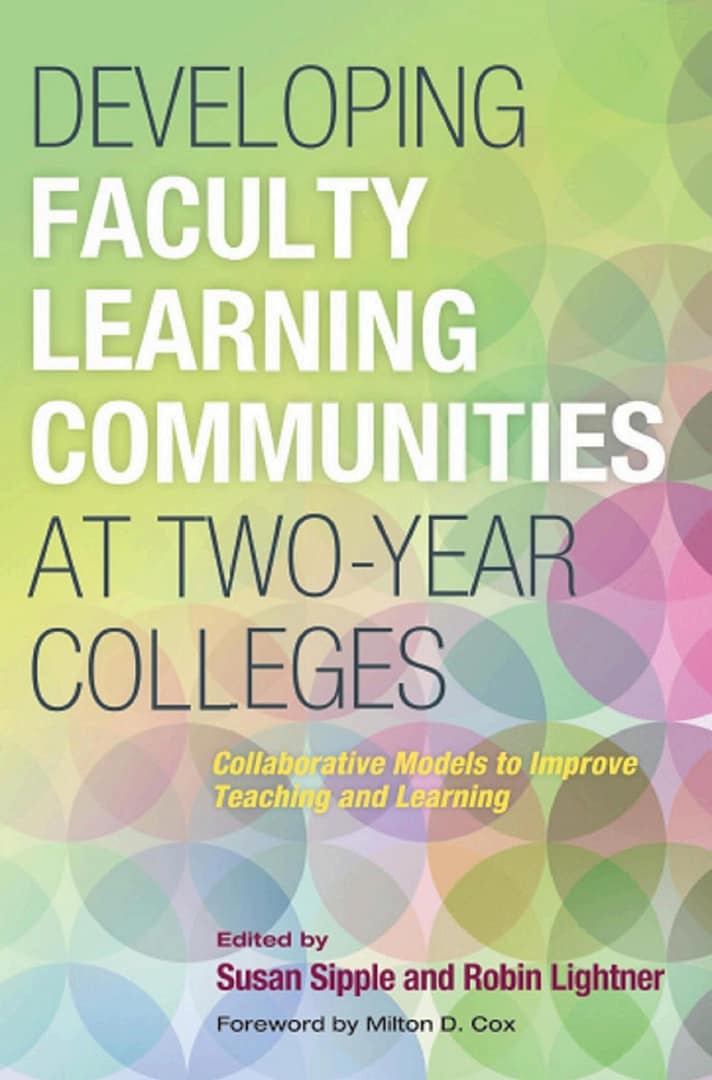
[00:34:48] Ian: Yes. Of course, now, this is awful because I’ve gotten so far into my own head about it, I don’t know if it’s Brenau or Brenau. I’m thinking it’s Brenau, but my friends, Emily and Jim, are still there, and they are doing amazing work, whether their friend Ian is a dunce about names or not. He still thinks the world of them. Putting my own shame aside, I’d also like to talk about– I’ve been reading Developing Faculty Learning Communities at Two-Year Colleges, which has been edited by Susan Sipple and Robin Lightner, and that has been out since 2013.
It’s not a new text but is forwarded by Milton Cox of Lilly Conference fame among other things as well. It’s been especially fascinating for me to see some of the models that they’ve got presented and think very critically about the role of our peers in our own learning. Teaching and learning are very much mirror images of one another and so we get better at teaching by collaborating and working with our peers. Sometimes that’s better in a structure, and sometimes it’s just wandering around talking to them.
I guess my broad-spectrum suggestion is talk to your peers, be vulnerable, share some ideas, talk to them about what are some of the things that you’re trying, ask them some of the things they’re trying, and workshops and stuff. If you’ve got a center for faculty development or engagement or excellence or whatever the acronym may be, talk to those folks too because, gosh, they just love those opportunities.
[00:36:33] Bonni: I’m thinking even that’s really how today’s episode came about. My impression that I took away from you, Ian, from your gushing, glowing email was that you had actually attended a workshop and then come to find out today that actually, it was much more informal. It’s so true that that’s where so much of our learning takes place. Then when we can be more intentional about it and foster those relationships, it just absolutely can be incredible because it’s almost–
We sometimes forget about it in our own learning, just that we need that support, thinking about all the challenging things people are facing with regard to COVID and everything else that’s going on in the world, and sometimes we just need that, to know that there’s people there who will support us and understand the challenges in ways that maybe others who don’t have quite as much of an edge. It’s the passion for the jobs that it is that we do, but then also just to be able to get really into the context, that’s very specific to a given challenge and not try to give blanket answers so that sounds really powerful. I love you both have modeled that for us today too.
[00:37:42] Ian: Absolutely. One of the things that I find most telling about it is one of the major contributing factors to burnout, is the sense of isolation. A lot of other factors of burnout aren’t necessarily within faculty control. They can be systemic or institutional, but gosh, getting out and talking to folks, we can do that. We can push back against that. It’s infinitely more effective and supportive than like, “Oh, just to do some yoga. That’ll solve all of your mental health issues. Go stretch for a while.”
Thanks for that, but climbing out of whatever cave we might have put our own selves in and understanding that teaching is communal, can be a great boon for our mental and emotional health, but also our professional health too.
[00:38:32] Shawna: Never underestimate the power of just walking up to a student and saying, “How are you doing?” Being available to your students, talking to your students. They’re not a bunch of faces in the crowd, they’re individuals that all got their own things going on, and it is absolutely invaluable to just make a human connection with them every once in a while.
[00:38:59] Bonni: Shawna and Ian, thank you so much for joining me today for Teaching in Higher Ed.
[00:39:04] Shawna: Thank you, Bonni.
[00:39:05] Ian: Thank you.
[music]
[00:39:11] Bonni: Thanks once again to Ian Wolf for recommending Shawna Rodabaugh for today’s episode and for your continual support of Teaching in Higher Ed. Thanks to all of you for listening. If you’ve been listening for a while and have yet to recommend or review Teaching in Higher Ed in whatever service it is you use to listen, I would surely appreciate you doing that to help others discover the show.
If you’d like to stay in touch and, once a week, get an email with the most recent show notes, you can head on over to teachinginhighered.com/subscribe, which lets you sign up for the Teaching in Higher Edupdate, which comes into your inbox with those show notes and also with some recommendations that don’t come up on the podcast. Thanks once again for listening in. I’ll see you next time on Teaching in Higher Ed.
[music]
[00:40:12] [END OF AUDIO]
The transcript of this episode has been made possible through a financial contribution by the Association of College and University Educators (ACUE). ACUE is on a mission to ensure student success through quality instruction. In partnership with institutions of higher education nationwide, ACUE supports and credentials faculty members in the use of evidence-based teaching practices that drive student engagement, retention, and learning.
Teaching in Higher Ed transcripts are created using a combination of an automated transcription service and human beings. This text likely will not represent the precise, word-for-word conversation that was had. The accuracy of the transcripts will vary. The authoritative record of the Teaching in Higher Ed podcasts is contained in the audio file.