• Skip to primary navigation
  • Skip to main content
  • Skip to footer

Teaching in Higher Ed

  • Podcast
  • Blog
  • SPEAKING
  • Media
  • Recommendations
  • About
  • Contact
EPISODE 615

Being Kind to Our Future Selves with Matthew Mahavongtrakul

with Matthew Mahavongtrakul

| March 26, 2026 | XFacebookLinkedInEmail

https://media.blubrry.com/teaching_in_higher_ed_faculty/content.blubrry.com/teaching_in_higher_ed_faculty/TIHE615.mp3

Podcast (tihe_podcast):

Play in new window | Download | Transcript

Subscribe: Apple Podcasts | Spotify | RSS | How do I listen to a podcast?

Matthew Mahavongtrakul and Bonni Stachowiak have a conversation about being kind to our future selves on episode 615 of the Teaching in Higher Ed podcast.

Quotes from the episode
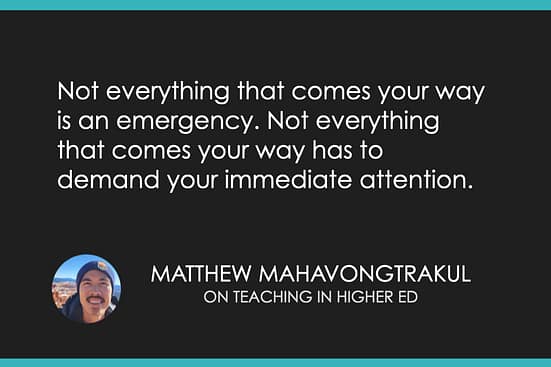
Not everything that comes your way is an emergency. Not everything that comes your way has to demand your immediate attention.

Not everything that comes your way is an emergency. Not everything that comes your way has to demand your immediate attention.
-Matthew Mahavongtrakul

Once you are comfortable with your system and you're iterating, it actually starts to become second nature, not only to professional life, but to personal life as well.
-Matthew Mahavongtrakul

An exercise that I did with my supervisor once was to actually go through each of these tasks and to see what I thought was high priority, was it actually high priority for the job that I was in?
-Matthew Mahavongtrakul

 

Resources

  • Karen Costa’s LinkedIn Post About the Ink & Volt Planning Dashboard
  • Notsu
  • Eisenhower Matrix
  • Episode 407: Unpacking Resilience and Grief with Chinasa Elue, Laura Howard, and Este Jordan (they share about each of their “pandemic dirty words” on this episode)
  • Goblin Tools – Magic ToDo
  • Ink and Volt Dashboard Deskpad
  • Gettin’ Air: The Open Education Network with Robin DeRosa and David Ernst, by Terry Greene
  • Asana

ARE YOU ENJOYING THE SHOW?

REVIEW THE SHOW
SEND FEEDBACK

ON THIS EPISODE

Matthew Mahavongtrakul

Program Director of Faculty Educational Development

Matt is a first-generation multilingual lifelong learner who earned his PhD at UC Irvine in the Department of Neurobiology and Behavior studying epigenetics and cognitive impairment. In his role as the Program Director of Faculty Educational Development, he leads numerous workshops and faculty professional development offerings such as the Active Learning Institute. He enjoys teaching very much and continues to facilitate the undergraduate Bio Sci 99 course at UC Irvine. In addition to his academic appointment, he continues to be involved in STEM as a freelance science writer for Biofluent Communications. In his spare time, he loves teaching and performing Thai classical music, shooting film photography, traveling, and developing healthy baking recipes. He also has 2 rambunctious boys who keep him very busy!

Bonni Stachowiak

Bonni Stachowiak is dean of teaching and learning and professor of business and management at Vanguard University. She hosts Teaching in Higher Ed, a weekly podcast on the art and science of teaching with over five million downloads. Bonni holds a doctorate in Organizational Leadership and speaks widely on teaching, curiosity, digital pedagogy, and leadership. She often joins her husband, Dave, on his Coaching for Leaders podcast.

RECOMMENDATIONS

Gettin’ Air: The Open Education Network

Gettin’ Air: The Open Education Network

RECOMMENDED BY:Bonni Stachowiak
Ink and Volt Dashboard Deskpad

Ink and Volt Dashboard Deskpad

RECOMMENDED BY:Bonni Stachowiak
Asana

Asana

RECOMMENDED BY:Matthew Mahavongtrakul
Woman sits at a desk, holding a sign that reads: "Show up for the work."

GET CONNECTED

JOIN OVER 4,000 EDUCATORS

Subscribe to the weekly email update and receive the most recent episode's show notes, as well as some other bonus resources.

Please enter your name.
Please enter a valid email address.
JOIN
Something went wrong. Please check your entries and try again.

Related Episodes

  • EPISODE 603Active Learning That Engages All Learners with Matthew Mahavongtrakul

    with Matthew Mahavongtrakul

  • EPISODE 407Unpacking Resilience & Grief

    with , Chinasa Elue, Laura Howard, Este Jordan

  • EPISODE 368Defining Our Future

    with Kelvin Bentley

  • EPISODE 535Interactive Experiences: Shaping the Future of Teaching

    with , Alyshahn Kara-Virani, Andrew Cross


EPISODE 615

Being Kind to Our Future Selves with Matthew Mahavongtrakul

DOWNLOAD TRANSCRIPT

EPISODE 615: Being Kind to Our Future Selves with Matthew Mahavongtrakul

Bonni Stachowiak [00:00:00]:

Today on episode number 615 of the Teaching in Higher Ed podcast, Matthew Mahavongtrakul is back. This time, we have a conversation about being kind to our future selves. 

Bonni Stachowiak [00:00:15]:

Production Credit: Produced by Innovate Learning, Maximizing Human Potential. 

Bonni Stachowiak [00:00:25]:

Welcome to this episode of Teaching in Higher Ed. I’m Bonni Stachowiak, and this is the space where we explore the art and science of being more effective at facilitating learning. We also share ways to improve our productivity approaches, so we can have more peace in our lives and be even more present for our students. Today on episode 615, Matthew Mahavontrakul is back, and he is joining me for a conversation where we share our ideas, experiences, and approaches related to being kind to our future selves. Matt is a first-generation multilingual lifelong learner whose work bridges neuroscience, faculty development, and the deeply human side of teaching.

Bonni Stachowiak [00:01:21]:

Matt earned his PhD at UC Irvine studying epigenetics and cognitive impairment, and now he serves as program director of Faculty Educational Development, where he leads initiatives like the Active Learning Institute, and supports faculty across disciplines in designing more engaging learning experiences. I’m excited for you to hear this conversation and the ways in which Matt and I clearly love geeking out about these things, and sharing our stories and things that have worked, and things that have not worked for us in terms of being kind to our future selves. Matt Mahavontrakul, welcome back to Teaching in Higher Ed.

Matthew Mahavongtrakul [00:02:06]:

Thank you for having me. It’s a pleasure to be back.

Bonni Stachowiak [00:02:09]:

It’s great having you back so soon. And also, we got to spend some time together on your, the beautiful campus of the University of California, Irvine. What a treat that was. So thank you to you and your colleagues for hosting me and for today’s conversation, I’m looking forward to it. I want to warn listeners, I’ve already warned Matt, this story is going to sound like, real bad. And we are just weeks past this story, and already this story has an uplifting ending. So I just don’t want to scare anyone.

Bonni Stachowiak [00:02:41]:

And again, I warned Matt in advance, it’s going to sound bad. I had seen on LinkedIn that Karen Costa had recommended this paper-based planner. It— I like it. I do tend to get intrigued by analog things, and so I kind of like that, because it’s designed to sit on your desk. There’s different varieties that they have. It can be like a notepad, or it can be almost bound and everything. But I kind of like that idea of being a little bit more intentional, and then having something that’s visible to me in my workspace. So, Matt, I have to read to you what was on the top of my dashboard.

Bonni Stachowiak [00:03:18]:

So this would have been in the middle of February. So I had written for the week of 2026-02-16, says dashboard, weekly theme and highlights. This week will be peaceful. Matt, this week was not peaceful, spoiler alert. And then there’s a little because, dot, dot, dot. And then I had written in there, Dave and the kids are gone. So my husband Dave and the kids had gone out to visit his family out in Chicago. I had this place to myself for less than 24 hours, and I got a phone call early the next morning after they had left that my dad was in the ICU.

Bonni Stachowiak [00:04:01]:

I’m gonna fast forward ’cause I don’t wanna milk this story any more than is necessary here, but almost died. And I had another family member without going into extreme detail, who I best I can describe as a layperson, probably was experiencing a lot of trauma, and got confused and told me that he had died. So, I go into the hospital to collect his belongings, because I thought he had died. And Matt, spoiler alert, here we are today, very much alive, is staying in a short-term care facility and is already, I was so shocked to hear, already walking without a walker and just making tremendous progress against all the doctors, all the doctors’ predictions and things like that. So that’s my, my story sort of to set the stage for Matt and I today, to be talking about kind of when things don’t go like we planned, how can we, in advance, be kind to our future self? So I warned Matt in advance that A, I was going to tell this story, and B, that it has a happy ending. But it’s just so indicative of how things can just turn on a dime. And if we recognize that in our lives, there’s a lot that we can do that can help be kind to ourselves in the moments, because they’re always going to come in our life that things go like we don’t plan. And I’m just going to ask you, Matt, are there any times in your life where you can reflect back and think, oh, I know that feeling when just like, like the car is just like, like as I was telling that story, what’s coming up for you as like, how important it is for us to think about that stuff is going to happen, that we did not plan?

Matthew Mahavongtrakul [00:05:43]:

Yeah, well, first, thank you for sharing that story, and I’m so glad that the ending is one of recovery. One thing that comes to mind is actually something that happened in our family last November. We lost my grandfather. He lived to be the ripe old age of 105, and he did get to meet a lot of his grandkids for the first time. But I remember getting the news, actually while I was at the POD conference. It was actually during the session where I was facilitating with you in the room.

Bonni Stachowiak [00:06:10]:

Oh my gosh.

Matthew Mahavongtrakul [00:06:11]:

And I left the next day to fly to Thailand, I couldn’t finish the conference. But during that time, I remember just like, wow, I have— like, there’s no question I’m going to go, and I’m going to support my family. I’m going to be out for 10 days or so, plus travel days. And so what could I do? Like, how are the systems that I have set up allowing me to pivot as necessary? And I’ll say that, not only does that have to do with the topics, and the tools that we’re going to talk about today, but also having a support structure at work, and also with the family who are there to really support me and, and everything that our family is going through, is just so critical to be able to pivot in times like these. So yes, this is a very timely topic for me, and I’m happy to, to dive into it with you.

Bonni Stachowiak [00:06:59]:

Oh, I— and, and for listeners, not whether this is of interest to you or not, I did not know that story that Matt just shared until -in this moment, and he did not know the story that I just shared other than I told him it wasn’t going to sound as sad as it might have began, but wow! You know, I’m thinking about an interview that I did, and I’ll find a link to it, but it was a group of researchers who were looking at grief in higher education. And they started the podcast, it was so delightful, talking about, what are the quote-unquote dirty words in higher ed for them. What were— what did they experience that— and pivot was one. So I started laughing because I, I’m just thinking, oh, you just said one of those higher ed dirty words. But, but for you, what does that evoke? Because obviously it evokes something different for you in the spirit with which you shared it, than I think if I could best share, I’m not going to do it justice, but they were kind of like when other people put pivoting on it, and it was during the peak times of COVID you know, could you just learn how to teach all your classes online? And could you just take care of all your family members? And could you not ever become ill yourself? I mean, it’s always just kind of like piling on, and then expecting individuals to pivot. But I can tell with the way that you shared this story, and shared about this experience that to you, the word pivot is a much more uplifting, empowering word. So what does it evoke for you?

Matthew Mahavongtrakul [00:08:23]:

Yeah, thank you for that. And one of the things that I always like to remind myself is that there are hardly any educational emergencies in our field of faculty development, in our field of education. We are serving our students, we’re serving our faculty, our graduate students, our postdocs, and we want to do that in a timely way, and to the best of our abilities. But every once in a while, something like this happens, and I keep on reminding myself that there, like, while things might seem very urgent, and perhaps out of hand at the time, there are rarely any true emergencies that have to happen this instant, otherwise, you know, the world is going to blow up or something like that. And I think that with that sort of a frame of reference, that it really puts the ability to triage certain tasks, certain projects, to prioritize certain things in a different light than what I see some faculty, or even staff doing, where everything that comes in, they say, oh, I have to get this done now, I have to get this done now, I have to put all of my effort into this, and then that’s just a recipe for burnout. And so in the spirit of being kind to our future selves, I think that pivoting for me just simply means that things are gonna come, things are gonna happen, good or bad, and we just have to adjust accordingly. And one of the things that I wanna talk about later on is this act of reflecting and reacting to whatever current circumstances we’re currently dealing with. 

Bonni Stachowiak [00:09:46]:

One of the frameworks that’s going to be really important to us, I know, especially with all that you have to share, is something that some listeners may be familiar with, but I’m sure not all of them. Tell us about the Eisenhower Matrix.

Matthew Mahavongtrakul [00:09:59]:

Sure. And so the Eisenhower Matrix, and I’ll just preface this by saying that I don’t use the full matrix. I use a light version because the full one to me is a little bit intense, although I do know that it works for certain people. But the way that the Eisenhower Matrix works is  that,you have essentially 4 quadrants. And you have these quadrants divided by urgency on one axis and then importance on the other one. So things that are very highly urgent and they are important that you need to get done now, do them. If they are urgent but not important, then maybe you can either delegate to somebody else or delegate to a different time in your schedule. Things that are not urgent that are important, then you can decide what you wanna do with them,

Matthew Mahavongtrakul [00:10:44]:

or when you want to do them. And if they’re not important and they’re not urgent, then maybe you don’t need to do them, and you could just cross them off your list. And that’s in a nutshell what the Eisenhower Matrix is. The way that I use it is a little bit more freeform, where I just put things in terms of high priority, I can get things done now, low priority, I can get things done now, or I can wait for later. And so in my calendar, I’ll have specific boxes. This is another technique called time blocking, where I can do things that are, for example, very urgent but doesn’t take a lot of time. Like, I need to answer 10 different emails, or I need to maybe create a Google Form or organize something, right? Those are all things that I could do within like an hour time block that can be done maybe first thing in the morning when I wake up, and I haven’t had my cup of tea yet versus something that’s a little bit more urgent and would take more time, like creating an FLC, writing a research proposal, designing a syllabus that I can save that for later. And that’s, that’s kind of how I use the Eisenhower Matrix in my daily life and in my work life.

Bonni Stachowiak [00:11:53]:

I have taught it both to students in undergraduate programs, and also, have worked with faculty and academic professionals as well. And so when I share this example, I hope it won’t sound like I’m poking any fun at anyone. A common thing that I’ve noticed is that we tend to get confused between even importance and urgency. I think so much I have noticed that the idea of something being urgent is kind of like that, well, everything then feels urgent, and so that the guilt that I see some people have to say that something’s not urgent, but it is important, it’s hard for them even to conceive of that. And part of what I struggle with as an as an educator too is, I mean, it’s a worthy struggle, it’s something I celebrate that I’ve chosen to do, is that as I’m teaching this to people, I don’t create any sort of interactive games or that sort of thing that would require a right or wrong answer, because what for one person is urgent or not important, or any of those combinations that you mentioned, for another person, it really just depends on their perception. So it is a more challenging thing to teach, and I think especially because today’s attention economy is really trying to teach us that everything is urgent, and everything demands our immediate attention and all the things. So when I have taught it, it’s in the concept of the broad, I guess, category of productivity. Then, it just is kind of a struggle to get people to think about what, what really actually is urgent. Have you found similar struggles with yourself or with people that you’ve worked closely with on this? 

Matthew Mahavongtrakul [00:13:40]:

Yeah, this actually comes up a lot for me in teaching. So for example, I teach an undergraduate molecular biology class, and the students who take that class oftentimes will have very different goals. I teach over the summer, so I get a very different population of students. To give you an idea, over the summer at UC Irvine, it’s 5 weeks instead of 10. We meet Tuesdays and Thursdays for 3 hours at a time. There’s no discussion sections. I’m lucky to have a TA, no other instructional support. And sometimes I’ll get students where they’re coming in— oh, and the last piece of contextual information is that prerequisites are very loose over the summer at UC Irvine, so we have a lot of first years taking this course, which is normally taken by second and third years. And so I have students who, they’re coming back and they’re taking this class not to get an A, but as a refresher because they might be applying for nursing school.

Matthew Mahavongtrakul [00:14:29]:

Sometimes I’ll get students that come in, they are, you know, first years, they’re like, I need to get a 4.0 for everything, otherwise I cannot go to medical school. And so when I have, when I teach this class with these very different populations, one of the activities that I have my students do is something called the course success plan, where I give them a prompt, I’ll give them a template, and I’ll say, what are your specific goals for yourself in this course? What does this course mean to you in both your academic success, as well as your professional goals? And maybe that might inform how you approach this class, because if you are just here to get a refresher, then you might not have the same needs out of this course than somebody who really wants to get 100% on every single little assignment. And so I see that oftentimes as I’m teaching, and then a lot of times when I do advising, I can see some people saying, oh, I just got this email, I have to address it right away. And when I talk to them about productivity and productivity approaches, I always have to remind them, like, not everything that comes your way is an emergency. Not everything that comes your way has to demand your immediate attention. And if we even think about the language around attention, right, in English, we say that we’re paying attention, right? It’s a very transactional thing. We’re paying something. And that normally implies that we either might be losing something or might expect to get something back.

Matthew Mahavongtrakul [00:15:52]:

And so we have all these competing demands for our attention. And is it, is it really doing it justice to treat everything as urgent? Or can we triage and then really approach things in a very mindful and intentional way to better tackle the things that we have to right now? And then we can leave more time for other things later on down the road.

Bonni Stachowiak [00:16:15]:

You mentioned the word triage, which of course, evokes for many of us sort of a real negative context when those, when life happens, in air quotes, what kinds of strategies come to mind for you as you think about using the principle of the Eisenhower Matrix, and other approaches in terms of when those difficult things happen and you need to triage?

Matthew Mahavongtrakul [00:16:38]:

Yeah, that’s a great question. I’m also very curious to hear what your strategies are afterwards, because I’m always looking to tweak my system a little bit. For me, it starts with allowing yourself to be flexible with your time. And so what I mean by that, it’s flexibility, but also setting boundaries. So, for example, there is a technique called timeboxing where you’re setting a maximum time limit for a specific group of tasks. So, for example, if I have an hour between meetings, I might set 30 minutes to say, okay, I’m gonna do all of my low urgency, but low time required tasks right now, like firing off a few emails and maybe updating a webpage, something like that doesn’t really require a lot of my energy. And then later on, if I have like a 3, 4 hour gap between events, then I’ll say, okay, I could really sit down and focus on creating a brand new program with intention, considering all of these aspects that are really important for a successful program or institute or whatever it is. And so when something comes my way, and let’s say I get an email, I’ll triage it, meaning like I’ll take a look at it, I’ll analyze it, and I’ll say, okay, is this something that I can, like, if it’s within my low priority or my low urgency time box right now, can I just respond to it right away, and just get it off my plate? And it’s just quick, done, don’t even need to worry about it anymore.

Matthew Mahavongtrakul [00:17:58]:

Good example, right before we started recording, I got an email that said, oh, could you update my title on the Inclusive Excellence website to my new title? I’m like, sure, that’ll take me 2 minutes, and I just did it right away. But if it’s something that requires more time, or if it’s like, oh, here’s a document on, I don’t know, on event planning or on a program that we’re starting up, and it might take, you know, 1 or 2 hours of my time, I have a time box later on in the week that is maybe a 2 or 3 hour block where I can say, okay, I can either try to get my inbox to zero during this time, which will take, you know, a couple hours. Or I could spend that time really getting into the weeds of providing meaningful feedback on whatever it is that I’m asked to do. So you can slot these different tasks in different priority boxes. So low priority, high priority, and then that also allows me to have flexibility throughout the week. So if I don’t get to all of my low-priority tasks now, I’ll have another low-priority task time box later on in the week that I can just shift things over. And that way, I don’t feel like I have failed myself in any way.

Matthew Mahavongtrakul [00:19:07]:

And the last thing that I’ll say is that, oftentimes when I wake up in the morning, I will create a list of 3 goals for myself, and I’ll write them down. I think my recommendation from the last episode was the Notsu system, which I still very much use. And I’ll just write down, you know, the 3 goals that I want to get done today. And they have to be concrete. It can’t just be: look at a grant. It has to be like write the introduction, or it has to be complete feedback for this program, very concrete. And I’ll just write these 3 things down. I’ll say these are my 3 goals for the day, and whatever comes my way, if I can add to it, then that’s fine.

Matthew Mahavongtrakul [00:19:42]:

But if not, I’ll triage it, and then I’ll put it in wherever it fits in my, my time box throughout the week. So that’s kind of how I approach triaging new tasks that come my way, and this really helps because I always try not to overwhelm myself, and I always try to leave room to do the things that I like to do. If I complete all of my tasks within a given block, then I can, I don’t know, maybe I’ll go grab a coffee or a tea, or I’ll read a chapter of a book or something as kind of a little mini reward before starting a next meeting or next event. But I’m curious to know if you have any tricks or tips for triaging as well.

Bonni Stachowiak [00:20:22]:

I love how many things that you brought up that I just would absolutely echo with. I heard you talk about really starting with intentionality. So rather than immediately starting in, especially when things get chaotic, I mean, yes, when you found out the news about your grandfather, there’s certainly like, okay, we’ve got to make flights, and get in touch with family. I mean, I imagine that your mind was filled with a lot of logistics to get yourself and any family members to be together for that time. And same thing with me, I’m actually relatively calm in emergencies and things like that. Cause it’s just, I’m actually at my calmest. I’m kind of an excited, passionate person, but when it’s those times, I’m really more subdued and kind of trying to calm myself down, regulate myself, you know, breathe. And I guess one thing that’s coming to mind for me, which I don’t know how much it’s going to fall under productivity, but since you’ve mentioned so many of the things that I would have mentioned, um, that anyway, this is just coming to mind that was so helpful.

Bonni Stachowiak [00:21:25]:

Maybe specific only to a medical context, but I imagine maybe it’s not. So anyway, I’ll share what the story is, and then you can tell me what you think. So I mentioned this story where the family member had gotten confused, thought that my dad was gone. And so, I mean, I just don’t spend a lot of time in hospitals. I walk in, we’re talking to the security guard, got his belongings, all the things. And I remember thinking, it seems weird to just leave. Like, it’s— now that I have his stuff, I was just like, I’m not sure what— like, where’s the instruction book for this thing? I, I just don’t— I don’t know what I’m supposed to do. And I remembered a guy I knew decades ago, and his wife had so many health problems, and essentially, he became a caretaker for her.

Bonni Stachowiak [00:22:13]:

She had had a lot of seizures and strokes and things, so it was essentially like taking care of a child full-time for him in her life. And he spent a lot of time with doctors. And I remember him telling me, you know, doctors will be very reluctant to ever give advice. That’s not something that they’ll do. But he had found that if you flip it around and say, gosh, I’m, I’m new to this, how would you handle this if you were me? That he found it engendered trust such that I was like, well, it’s not a doctor, it’s a security guard. But I was like, hey, My dad just died, so just, we don’t know what happened, I don’t, I mean, I’m confused as to, it seems like, what would you do if you were me? And he said, I would want to talk to the operations manager for the whole hospital. And I basically need you to tell me that that’s what you would like me to do.

Bonni Stachowiak [00:23:08]:

And I went, yes, I would like you to call over, and so that’s how it ended up. But I’m thinking, Matt, maybe there’s applications of this idea of maybe asking for help or reaching out and kind of flipping that script, that maybe apply in other contexts besides just medical context, when we have no idea what on earth we’re doing? Is there anything coming to mind for you with that story?

Matthew Mahavongtrakul [00:23:30]:

Yeah. So one of the things that comes to mind in that is just the ability and the willingness to seek help. I think that a lot of times people think that they’re kind of in their own little bubble. And I know that in the academy, we’re trained to think that way, right? We do our dissertation largely in isolation. When we create courses, it’s largely in isolation. Sometimes we’re in a team. Sometimes you get a syllabus from somebody else who taught the class, but who knows if they taught it effectively, and who knows what time management skills they had, or if they just taught it the same way for 20 years. And so I think that just that vulnerability of asking for help and saying, what, what are, like, let’s say you’re approaching designing a course for the first time, or let’s say you’re approaching designing a program, or learning experience.

Matthew Mahavongtrakul [00:24:14]:

How do you, as somebody who does this, you know, on a regular basis, how do you normally approach this? I think those conversations can really help, because just what me and you are doing right now, exchanging ideas, exchanging stories, we can either learn something new or we can modify existing systems that we currently have to incorporate some aspect of some ideas that we are sharing. And I think that just simply asking the question can lead to so many different insights. And the one example that I’ll give is just a faculty consultation, right? Like, sometimes we get requests for consultations, and a faculty member just says, I don’t know how to approach designing a syllabus with the new digital accessibility guidelines, for example. Can you help me? And then we’ll just start a conversation, and we’ll say, look, this is kind of how I would approach it. And sometimes just that one conversation is like, you know what, that wasn’t, that wasn’t so bad. Like, all I needed to do was ask and then we’re laying out some concrete steps. I can do this, I got this. And it’s really instilling that confidence into that other person, I think it’s a very powerful thing that we can do.

Bonni Stachowiak [00:25:21]:

One other thing I was going to mention, you talked about just not having these generic, you know, broad, get this thing done, but, but really being very precise with that. I have— this has been mentioned before on the show, but it’s been long enough that I want to bring it up again. I’ve really come to understand that for some of us, that’s very natural. I’ve just always been able to see the far-off, out into the future goal, and my brain can’t, can’t kind of can’t help itself, but to start just like breaking, breaking it down is just something that, that is a gift that I, I know that I have as a strength. Many people do not have those strengths, and sometimes, for certain types of disabilities or neurodiversity may make that a little bit more problematic for people. So there is an artificial intelligence tool that I have found very helpful for, for students and fellow colleagues alike. It’s called goblin.tools. I’ll put a link in the show notes, and specifically, the one that I’m talking about is called The Magic To-Do: Breaking Things Down So You Don’t.

Bonni Stachowiak [00:26:27]:

And even though I mentioned that I do tend to be pretty good at, at doing those sorts of breakdown, because of this recent thing that happened with my dad, when I get into the super unfamiliar context, then it becomes incredibly stressful because I think, wait a minute, I’m supposed to be able to do this. But since my imagination is not expansive enough to understand this context, well, guess what? That does tend to be what these predictive text tools, in this particular case, an algorithm that’s been specifically programmed to break things down, if it’s an unfamiliar context, or even for students. One example that I’ve— it’s actually on my— I must have cookies saved on my instance of Goblin Tools right now, and the magic to do, because for students, get a job when I graduate. So if they have yet to get that professional job, if that’s not the type of search that they’ve already undergone, then it breaks it down. I’ll just read off a few that are here from the last time I must have been up here. So identify your career interests and goals. Identify the skills and qualifications needed for your desired job. Obtain or enhance relevant skills through courses, internships, or certifications.

Bonni Stachowiak [00:27:37]:

You get the idea. But as soon as you come up with one that maybe is unfamiliar to you. Or if it’s just hard for you to break down, it lets you click and expand one. So in this example, the next step was, create a professional resume and cover letter. That one got expanded in the example I used with students, and then it says research the industry and job roles you’re interested in, gather your personal and professional information, including education. You get the idea here, but I like it because it works like an accordion, where you can shrink down the steps if it’s a relatively familiar context to you, or really ratchet them up on a step-by-step basis to really help. And I’m imagining now, had I used this through some of these very big stressors that I’ve been having this last month, probably would have been helpful for me, because I think even all of us, when we get under that tremendous stress and especially coupled with a context that’s very unfamiliar to us, it can be really, really challenging to try to break things in. So I’ll put a link to Goblin Tools. I know not everybody makes use of artificial intelligence, and there’s lots of controversy around it.

Bonni Stachowiak [00:28:46]:

It came up on an episode having to do with supporting students with disabilities, and how important things like this can be, so I just thought, since we had talked about really breaking those things down and that that’s not always easy for everyone to do, I thought I would make mention of it. And I’m curious, before we close this part of the episode, if there’s anything else you want to say about timeboxing, or just any other last tips that you want to think about before we transition over to the recommendations.

Matthew Mahavongtrakul [00:29:15]:

Yeah, thank you for that, and I will definitely check that out. What I really like about that approach is that it is couched in backward design, scaffolding, all of the things pedagogically that it just kind of makes my— it tickles my brain in such a good way. So thank you for sharing that. I’ll share just the last couple of thoughts are one, when I think about timeboxing and some reflections on it, when I think about it, it has to be an iterative process. So I often will recommend students, so that I do talk to students a lot in the classroom about time management and prioritization, about reflecting and reacting, being flexible. And once you are comfortable with your system and you’re iterating, you’re kind of putting your own tweaks to things, like I call mine the Eisenhower Matrix Lite, since I don’t have the 4 quadrants and I don’t stick to them as strictly. But once you get into that, it actually starts to become second nature almost, not only to the professional life, but I feel like to personal life as well. And I was talking to one of my faculty fellows the other day, who he was talking about his productivity, and he had done something, and he was so excited to go and check it off his list because he has a different system, only to find out that when he went to the list, it wasn’t on the list to begin with.

Matthew Mahavongtrakul [00:30:30]:

And so he said, oh, this is such a bummer. So he just wrote it on the list just to check it off right away. And so I think the point of that story is just that the more you do this, the more that you can commit yourself to a system, and the more intentional you are about this, not only can you be kinder to your future self, but also this is going to become second nature. And how wonderful is it if we could just turn that into second nature, just being more kind to ourselves and allowing ourselves that flexibility to, to handle things as they come, but also to enjoy the victories and the wins that we have by just getting those goals done in a specific block of time. It’s just- I don’t know, there’s nothing like it, but I’m also an analog person. So when I check things off the list, it is just, it’s just so gratifying.

Bonni Stachowiak [00:31:15]:

Oh, there is, there is such satisfaction in checking things off the list. I wanted to just share before we get to the recommendations that, because I think because I’ve written a book about productivity, and certainly a lot of episodes in the past, there’s a whole category as part of the taxonomy for the show. People think that people like you or me, that means we’re, we’ve achieved some nirvana or perfection around it. And I think this most recent set of stressors is just such a reminder that I think it’s quite the opposite. I’m not aiming for perfection in this, but I have had instilled in me over all this time that even if you get off base, when you come back to it, if you’ve had the kind of consistency that you’ve described for us so well today, Matt, if you have a system set up where you’re not putting deadlines in that aren’t actual deadlines, they’re just, it’d be nice if I had it done by then. So we’re not tricking ourselves, or trying to create urgency when really what we need is the space for the important. That’s really what we need, but we just, because it can pull at our attention. The thing that I love about it is that, yeah, I mean, I brought this paper planner dashboard thing that Karen Costa had recommended.

Bonni Stachowiak [00:32:35]:

I brought it downstairs just to have in front of me while Matt and I were talking. And guess what? It’s still on that page. And that, as I mentioned, as of our conversation today, more than a month ago. And yet when I come back to systems, whether my— most of my task-based things are digital in nature, when I come back to them, I have the discipline instilled to be able to get back in. I haven’t been perfect at it, but it’s enough that it can offer up to me things that really do need my attention, and hide from me through what this particular tool calls defer dates. So it kind of just tucks those away. You don’t really need to worry about that until next month, or until 2 weeks from now. And I just think having those systems where we build them so we can trust them, so we’re not going to lie to ourselves and say this is due by Friday, just because we’d like it to be done by then.

Bonni Stachowiak [00:33:31]:

Those are 2 very different things. They’re important information for you, but they’re not the same thing. If the deadline’s not Friday, find another way to get it to surface for you that you’d like to do it Friday, but without just creating all this urgency in a system, that then is just filling you with stress every single time you open it because it’s lying to you about all of these things. And I’ll say one, one last thing. You could tell Matt and I are like so excited about these topics, but I was just recently told as I was navigating some other stressors as well, stuff going on at work, and I had a friend tell me that she really suggested to me that I look back at this last month of my life. She goes, “I think you’d really benefit from a captain’s log. There’s these things that you’ve been doing that are really fueling some great success for you, but because—” and I’m not going to get her words right, but you know, “Because you tend to be such a future-oriented person, you could be kind to your future self by doing a reflection on this last month, and have that little captain’s log to use so that you can fuel to keep doing those things that have benefited you. And I thought, because I tend to focus on the future, I was like, oh, I’m really gonna, I’m really gonna enjoy doing that, to go back and look at my task list, to go back and look at my calendar, and think about the things that I have been doing this last month.

Bonni Stachowiak [00:34:55]:

Because it’s hard, I can’t, I can’t show much for it because it has been so chaotic. So I’m really looking forward to doing that. And the other thing I’m looking forward to doing, what have I said no to in this very busy season? And how have I been kind to myself by setting up those boundaries? And because I’m not going into detail on the boundary setting aspect of family stuff, but that’s been really, really important too, is saying no, being kind to myself, and really what is mine to do, and what is not mine to do, both in the professional and the personal contexts.

Matthew Mahavongtrakul [00:35:28]:

Can I share two things that- What you just said, it kind of reminded me of a couple of things. The captain’s log sounds very similar to some practice that I do, which is for my emails, I actually have a tag for positivity. And so whenever I get a positive note from either a student or a faculty member, somebody who just has the nicest things to say about, for example, a program that I ran, or the structure of my course or how I I was there for them. Last time we talked about the token system, and it allowed my student to go and enjoy her wedding. And getting these notes from them, I file it away into this positivity tag, and I will either go back to it every once in a while to see that, you know what, what I’m doing is making a difference in other people’s lives. Or sometimes I will have it set to automatically remind me at random intervals during the year of like, oh, this is something that something somebody has said that really affected them in a positive way. Those things, they tend to fuel me and keep me going because I know that I’m making such a difference in a good way in people’s lives. And then the other thing that I’ll mention, I swear this is it, is this other rule that I heard about called the 10-10-10 rule.

Matthew Mahavongtrakul [00:36:44]:

And the 10s can have whatever units you want. So for example, 10 minutes, 10 hours, 10 days, 10 days, 10 weeks, 10 months, whatever it is. And when you are thinking about some tasks that come in, and you’re thinking about triaging, one thing that might also help people is thinking about this 10-10-10 rule where the question you ask yourself is, if I do this, who is going to remember this in 10 minutes, in 10 hours, in 10 weeks? And if you can break that down and say, with honesty to yourself, who will actually care and remember during whatever time period you decide for this 10-10-10 rule, it’ll really put things into perspective. Because if it’s like, well, nobody’s really gonna care in the next 10 minutes, maybe I don’t have to do them in a way. But if somebody is gonna care in 10 hours or in 10 days, then maybe you can slot that appropriately into your time box in a way that is, again, more intentional. So in terms of the tips I have, I think we can go on for hours and hours, but I will restrain myself. 

Bonni Stachowiak [00:37:48]:

I’m already looking forward to the next conversation., now that I’ve found someone I can totally nerd out with on this stuff, I love it. All right, so I am going to recommend, to no surprise from people, this dashboard that Karen Costa originally shared with many of us on LinkedIn. So it’s the Ink and Volt Dashboard Deskpad, I strongly recommend it. I already mentioned it earlier, certain parts of it. It also helps you identify focus areas for the given week and some tasks, and it also has a daily tracker. And since Matt and I both share the love of checking things off, you can identify for your daily tracker. What is it that you would like to track? And then check off the weeks of the, the days of the week.

Bonni Stachowiak [00:38:28]:

And it’s just a great analog tool if you like analog tools, designed to set out on your desk. But the one that I got is a spiral-bound one, also fits in my backpack so I could take it back and forth because I actually have multiple desks in my life. So, and I’m also going to recommend an episode of the Getting Air podcast that Terry Green hosts. And some of you may be familiar with— I’m sure many of you are familiar with Robin DeRosa’s work. She has been a very big person in the open education movement, and she recently was hired to lead the Open Education Network, after being led and founded by David Ernst. So it’s a conversation between these two people as David is transitioning to do what he says his normal job. I don’t think that’s exactly how he phrased it, but this has been sort of a side thing for him, and it’s just this wonderful conversation between people who respect themselves so much. And of course, Terry, such a great interviewer, has such a funny sense of humor. There is a goat scream in the episode.

Bonni Stachowiak [00:39:28]:

I’m not gonna say where, but I did listen to make sure that I heard the goat scream, and I found myself laughing, I found myself filled with warmth. And I will say that I did start crying at some point, not because it’s so sad, but just it, it’s hard It is hard. Higher education is hard, and Robin is such a person who has given so much and, recently experienced a job loss, and it was a very public job loss, not just for her, but for many of her colleagues, and just really is emblematic of some of the challenges in a higher education context. I just was so moved by what she shared. I’m so filled with hope that she was able to be hired into this position, and I just so look forward to seeing all the possibilities from her. So it’s a very hope-filled kind of tears that came as I listened to their conversation. So I’m going to pass it over now to Matt for whatever he would like to recommend.

Matthew Mahavongtrakul [00:40:24]:

Well, thank you for that, and you know that I love my podcast, so I will definitely be adding that to the queue. The recommendation that I have is, uh, to use a project management system. Uh, so I know that this was— I think it was mentioned, I forget how long ago, but for me, I use one called Asana. So that’s A-S-A-N-A, Asana. And what it does is, it really helps you organize different projects, and this could be either personal, professional projects. And what’s really nice about it is that not only can you make this collaborative, there is an AI tool associated with it if you do the paid version, but I have the free version. You can also set up different productivity timelines. You can set up ways to keep yourself on task with scheduling.

Matthew Mahavongtrakul [00:41:09]:

You can set different projects with different sub-goals, and then you can put in whatever documents in whatever form you want on there. And it’s really a good place not only to see what you have in front of you, but what’s also quite cool about it, is that you can prioritize, and you can say this is high priority, this is middle priority, this is low priority. And an exercise that I did with my supervisor once was to actually go through each of these tasks and to see what I thought was high priority, was it actually high priority for the job that I was in? And so it was a really interesting conversation to see, where there were mismatches and how those mismatches led to some really deep conversations about the value of the work, and what it means not only to me, but also to the organization. And so that is, that’s the recommendation I have. Asana has been so great. I’ve used it for the last couple of years, and it’s, yeah, it, I can’t say enough good things about it.

Bonni Stachowiak [00:42:01]:

Matt, this has been such a delightful conversation. I’m so glad that we get to reconnect so soon after getting to see each other on your gorgeous campus, and have all sorts of revisiting of my own memories, including getting married on the campus. So you all were so— I, I was careful, but you were also kind to like walk. We got to walk by the place where Dave and I had gotten married, it was so much fun. So what a delight to get to connect with you today and think through these ways that we can be kind to our future selves. Thank you so much for being back on the show. I can’t wait till next time.

Matthew Mahavongtrakul [00:42:33]:

Thank you. And I can’t wait till we can have the opportunity to go for tea together.

Bonni Stachowiak [00:42:38]:

Thanks once again to Matthew Mahavongtrakul for joining me for this conversation about being kind to our future selves. Today’s episode was produced by me, Bonni Stachowiak. It was edited by the ever-talented Andrew Kroeger. I want to invite you to sign up for the weekly update from Teaching in Higher Ed. All you need to do is head over to teachinginhighered.com/subscribe, put your email in, and once a week, you will get an email with the most recent episode’s show notes, as well as some other resources that go above and beyond that. Thank you so much for listening, and I’ll see you next time on Teaching in Higher Ed.

Expand Transcript Text

TOOLS

  • Blog
  • Podcast
  • Community
  • Weekly Update

RESOURCES

  • Recommendations
  • EdTech Essentials Guide
  • The Productive Online Professor
  • How to Listen to Podcasts

Subscribe to Podcast

Apple PodcastsSpotifyAndroidby EmailRSSMore Subscribe Options

ABOUT

  • Bonni Stachowiak
  • Speaking + Workshops
  • Podcast FAQs
  • Media Kit
  • Lilly Conferences Partnership

CONTACT

  • Get in Touch
  • Support the Podcast
  • Sponsorship
  • Privacy Policy

CONNECT

  • LinkedIn
  • Instagram
  • RSS

CC BY-NC-SA 4.0 Teaching in Higher Ed | Designed by Anchored Design