Follow the Teaching in Higher Ed Podcast
About this Episode
Peter Felten and Leo Lambert talk about their new book Relationship-Rich Education on episode 331 of the Teaching in Higher Ed podcast.
Relationships are high stakes for students both in college and after college.
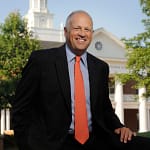
Leo Lambert
On episode 331 of Teaching in Higher Ed
Voices on this Episode


Show Notes + Resources
- Relationship-Rich Education: How Human Connections Drive Success in College, by Peter Felten and Leo M. Lambert
- The Undergraduate Experience: Focusing Institutions on What Matters Most, by Peter Felten and Leo M. Lambert
- Elon 101: The First-Year Advising Seminar
- What’s in a Name? The Importance of Students Perceiving That an Instructor Knows Their Names in a High-Enrollment Biology Classroom, by Katelyn M. Cooper, Brian Haney, Anna Krieg, and Sara E. Brownell
- Caution, Student Experience May Vary: Social Identities Impact a Student’s Experience in Peer Discussions, by Sarah L. Eddy, Sara E. Brownell, Phonraphee Thummaphan, Ming-Chih Lan, and Mary Pat Wenderoth
- Faculty Leadership and Student Persistence–A Story From Oakton Community College, by Elisabeth Barnett
- Whose culture has capital? A critical race theory discussion of community cultural wealth, by Tara Yosso doi:10.1080/1361332052000341006
Recommendations from this Episode


Transcript
[00:00:00] Bonni Stachowiak: Today on episode number 330, one of the Teaching in Higher Edpodcast, Peter Felton and Leo Lambert are here to talk about their new book Relationship-Rich Education: How Human Connections Drive Success in College.
[00:00:20] Production Credit: Produced by Innovate Learning, maximizing human potential.
[music]
[00:00:29] Bonni: Hello, and welcome to this episode of Teaching in Higher Ed. I’m Bonni Stachowiak and this is the space where we explore the art and science of being more effective at facilitating learning. We also share ways to improve our productivity approaches so we can have more peace in our lives and be even more present for our students. Speaking of the art and science of teaching, today’s guests certainly fit into that category. Joining me today are Peter Felton and Leo M. Lambert.
Peter Felton is the executive director of the Center for Engaged Learning, associate provost and professor of history at Elon University. His books include the coauthored volumes, The Undergraduate Experience: Focusing Institutions on What Matters Most, Transforming Students: Fulfilling the Promise of Higher Education, Engaging Students as Partners in Learning and Teaching, Transformative Conversations and the co-edited book, Intersectionality in Action. He has served as president of the International Society for the Scholarship of Teaching and Learning and also of the POD Network. He is co editor of the International Journal for Academic Development and a fellow of the John N. Gardner Institute for Excellence in Undergraduate Education.
Leo M. Lambert is a professor of education and President Emeritus of Elon University, where he served as president from 1999 until 2018. During his tenure as president, Lambert led to 10 year strategic plans for the campus that propelled Elon to a place of national distinction. Today, Elon is recognized widely throughout the US for excellence in undergraduate teaching and experiential learning. Including its programs and study abroad, undergraduate research, civic engagement, and community service and interfaith cooperation.
More than a hundred buildings were added to Elon’s campus during Lambert’s presidency. Lambert is the coauthor of The Undergraduate Experience: Focusing Institutions on What Matters Most and a forthcoming book, which you’ll be hearing about today, coauthored with Peter Felton, the other guest for today’s episode, titled Relationship-Rich Education: How Human Connections Drive Success in College.
Leo and Peter, welcome to Teaching In Higher Ed.
[00:03:09] Guest Speakers: Thanks, Bonni.
[00:03:10] Bonni: We start out every show, in fact, since June of 2014, this is one thing that’s never changed, we started out talking about the art and science of facilitating learning. I know you have so much to share with us today about the science as in something that’s been tested, not just what we imagine anecdotally helps, but I want to start with the art with each of you. Could you tell me about a memory you have, where you could so clearly see in your own life or in someone else’s life? How important relationships are in college and let’s start with Peter.
[00:03:46] Peter Felten: Thanks, Bonni. This question takes me immediately back to my first year as an undergraduate and I had a philosophy class and that fall semester, and it was great. Lots of things were good about it. It was a different course than I’d ever taken before and the professor was wonderful. We used to go, it was a late afternoon class and on Fridays, sometimes we’d go get pizza and she would buy us pizza if we keep talking about philosophy.
We would just hang out and talk about philosophy and all this. At the end of this semester, I wrote a paper. I could tell you about the paper, but I won’t. I thought it was a pretty good paper and I go home for winter break and a 10 days, two weeks later, I get an envelope mailed to me and it’s my paper. On the paper Dr. … had written an A and she wrote, and I remember this very vividly, “This was the best paper in the class, but you could have written a better paper. Could you come talk to me in the spring about that?” My head basically exploded because I thought the point of school was getting good grades and the idea that the point was more than that and that she saw something in me that I didn’t need to recognize. It changed my whole college experience.
[00:04:57] Bonni: Incredible. Imagine that. Of course, would she ever have known that difference, that effort was going to make?
[00:05:05] Peter: No, I also now as an old professor laugh like, did she write that on every student’s paper? Well, but for me, it was the right words at the right time and then she was there in the spring and she was so happy when I walked into her office.
[00:05:21] Bonni: Leo, what does this conjure up for you?
[00:05:23] Leo Lambert: Well, one of the most impressive interviews I had with a first year student as we were conducting interviews for our book was at Nevada State College, right outside of Las Vegas, a Hispanic serving institution, relatively new, less than 20 years old. I met a first year nursing student there who was in his second semester. He was talking to me about how he had been inspired to learn his first semester in undergraduate school by taking a class that he didn’t want to take, introduction to geology.
He’s a nursing student. This is a general education requirement. He has to take a science class outside of his major. He encounters this professor that not only interest in geology, but she turns him on to learning. She makes this class come alive. She has them out in the Nevada desert and in the heat doing active learning exercises. He talks about the process of this class becoming a community. Oftentimes when I listened to people talk about college to students, we use such transactional language to do that.
We don’t use relational language to talk about how to go to college and we need to do that. Jose was one of these very fortunate students that gets it very early on in his undergraduate experience and his relationship with– He thinks of himself as an intellectual very early on in his career because of an interaction with a professor that was truly inspiring. It just makes you think about, we need to design the enterprise so that every student has an experience like Jose’s during their first semester of college.
[00:07:27] Bonni: I had an opportunity the other day to speak to one of the students who’s in my class. It sounds a little strange that I wouldn’t have made this connection, but so many of them have their cameras turned off for various reasons this semester. I really hadn’t made it yet, but she was sharing about having a conversation with one of our faculty members. It was her and another group of students sharing about the difficulties they were facing with having enough money to have food to eat, and to seen a disconnect with some of their other fellow students who were going to Disneyland and the same day going to Chick-fil-A and the same day, I forgot what the last delectable item was. They’re thinking, I don’t have enough food to eat and they described the pangs of hunger and the ways in which that affects them.
What I love about this story, and some of the stories that you just told in terms of, yes, it was that one person. This professor built up enough of a relationship to have these four or five students join her and share in vulnerable ways, but she also then connected them. It wasn’t like she thought does she have to solve the hunger issue in all of higher education or even in our institution. Long story short, this one has such a happy ending because someone who works with me now launched our Living Well Community Resource Center. Those same students got to take the needs and the pain and the grief that they had talked to someone about it, the person connected them.
By the way, if she was listening to me now, the person who I work closely with would say there were like 3,200 people. It just amazing this magnificent way that this, and you said, web of relationships, these ways in which if we take it from the transactional language incredible change can happen in individual’s lives. I know both of you know well, that can just be multiplied and magnified. It’s just incredible to think about the power of what you’re describing. Let’s go now to the science. Talk about how you approached the research for the book and why did you decide on that particular approach? Let’s begin with Peter.
[00:09:43] Peter: Bonni, as you know, Leo and I and a few colleagues wrote a book a few years ago about the undergraduate experience and one of the chapters in that book was titled Relationships Matter. As we heard from people who’d read that book and gave talks about the book, people kept asking about that relationship chapter and keeps on pushing on it. Leo and I had a number of conversations and the research is so clear there’s decades of research, literally decades that demonstrates that relationships with faculty, with staff and with peers are the most powerful forces in almost all of the outcomes that students experience in higher ed positively or negatively. That those relationships are even more important for first generation students and students who’ve been marginalized students of color, for example, on many campuses.
We thought we don’t need to repeat that. The world doesn’t need one more of those studies, but we did think, we were frustrated that not enough people who work in this world know that work and know how important that is. What we decided to do was to try to lift up stories of relationships and so we conducted almost 400 interviews. In about a little more than 200 with students and the rest of the faculty staff from presidents to custodians at, I think it is 27 institutions around the country, as Leo was saying.
Large research universities like Florida International on one edge of the continent or the University of Washington. On the other, Cal State Dominguez Hills, LaGuardia Community College, Haverford and Bryn Mawr Colleges. We’re trying to get a wide range of American higher education, talking to faculty, staff, and students to ask them how they experience relationships and what relationships enable in their education, what the barriers and constraints are and all this. Then we’ll use those as the spine of the book to unpack some of that research that comes from elsewhere too.
[00:11:44] Bonni: Sometimes it just takes that one thing, Leo, you were sharing that earlier, that they could just be that one conversation away from dropping out. Sometimes when you talk about it that way, we can begin to interpret it as if it is happenstance, as if it is accidental. I think you’re trying to say quite the opposite that it’s actually an intentionality that becomes so crucial and being able to cultivate the kinds of relationships that will have the tremendous difference that can mean all the world to our students. Leo, would you reflect for us on how it can feel and seem happenstance, but we don’t want to leave it there. We want to bring this intentionality with us.
[00:12:31] Leo: Well, I think the first thing we have to do, Bonni, is explain the rules of the road to our students. I think they come to college with a set of ideas about what is most important, and we give them our own institutional views about what is most important. Oftentimes, neither of those sets of expectations includes the idea of the fundamental idea that one of the most important things that’s going to happen you in college is that you are going to build a set of relationships.
Maybe seven, might be 10, might be a dozen, might be more, hopefully that are going to be important to you for the rest of your life. Some of them will be long lasting, some of them will be shorter, but still hugely impactful. We need to tell students that they need to go into college with the mindset that building this constellation of mentors, building this web isn’t in very large measure their responsibility, and here’s how you go about doing it.
I’m teaching in Elon 101 freshman seminar at Elon this year, and I have 13 first year students, and we’re really basing the whole class around this idea. Our class this past week was about how do you find mentors among your peers? We’ve got to make this, first of all, very explicit with students and explain why it’s so important that including that those that have significant mentoring relationship in college are not only going to do better in college, they’re going to do better after college and all kinds of different ways.
Relationships are high stakes for students, both in college and after college. We just have to make this much more explicit to students and help them understand that they need to think about college from very early on because Peter and I have a lot of evidence that shows that sometimes, it’s those relationships that students form in their first year that are most meaningful of all. We can’t wait until they’re juniors to tell them explain how all of this works. This has to be something that we begin with literally on day one, two, three, and so forth.
Then the second piece of this is that we need to rethink our institutions to value relationships much more highly. I don’t think there are very many institutions out there that explicitly put mentoring and relationship building on the table when it comes to promotion and tenure time. In fact, I think it has to become an institutional priority at all types of institutions, even research institutions. If we are going to be serious about great undergraduate education, we have to figure out ways to adjust the ways that we approach our work to place a higher premium on relationships.
[00:15:43] Bonni: Peter, we looked at, it’s not just that one thing. It’s not an accident that these are intentional things that we can do. Leo spoke a little bit, even about explaining the, how does this work? We actually just redesigned for this year our freshmen seminar, and we are building it around something called cultural community wealth. This idea, because I was not a first generation student. I came in, I still feel like I didn’t have a clue, but I at least understood, calendars, schedules. I didn’t have any thing that I couldn’t succeed in college. I went in and thought if I’m interested in something, I’ll study it. I didn’t care a lot about grades, but I just I didn’t doubt my own ability to be able to belong there and to acquire a college education.
This model of the community cultural wealth, which I’ll post a link in the show notes to at least the best academic article that I have found that introduces it and helps them begin their college experience with a lens that says, look at all these assets, look at all this cultural wealth that you’re bringing in. Leo, one of them that they point out in this research is look at the relationships, you already brought this in, but to be able to name it.
Then what I hear you saying, I’m still not going to be able to do it in unless I understand what do I do with this thing. I may have had the ability to really foster relationships. Another closely related one to me is the familial capital that gets brought in and part of that is so much relationships and families, but like, I’m not going to know what to do with that in a college context that is so foreign to me, unless someone helps me. Peter, I’m going to get to a question now any minute now. Peter, what does this bring to mind for you?
[00:17:38] Peter: Two things. One is one of the things we heard, especially from some colleagues involved in a program out of the city, University of New York, the ASAP program, which works with low income community college students. They just keep emphasizing building on the community, cultural wealth that so many of our students don’t realize how capable they are, and they know that they’re good at this thing. They’re a good parent or they’re good in their job, but they don’t know how that contributes anything to what they could do in higher education.
One of our tasks is to help our students. As you’re saying, see the assets they bring with them, the capacities they bring with them and remind them of that. Bonni, hearing this conversation, one of the things that’s in my head is as a faculty member, I’m like, but wait, I’ve got a lot of students. There’s only one of me, I already have too much to do, so how on earth am I supposed to build relationships with all my students and have these deep, meaningful connections, like we’ve been talking about?
What we say in the book is you can’t, no one individual can do. But there are things each of us can do in our own classrooms. Just to call out two broad approaches, one, is to recognize that pure relationships in many ways are more powerful than faculty, student, or staff, student relationships. How can everyone’s classroom be a space where students are making meaningful educational connections with their peers? That’s in how we design our courses, but also how we talk about, why I’m asking you to do this collaborative work.
Then secondly, thinking about our own relationships with our students and recognizing to quote a scholar who we interviewed for the book, Brad Johnson, from the US Naval Academy, that some of us are fortunate enough to have long-term mentors. The kinds of things that sometimes some of us get in graduate school, but many people benefit from having what Brad Johnson calls mentors in the moment that a person who is there just at the right time, you may not have a lasting relationship, but they can change how you see yourself, how you see this discipline, how you see the world.
[00:19:54] Bonni: You mentioned the feeling as yourself as a faculty member. Just that challenge. It can be overwhelming both because we feel like we don’t have the time. We also can feel ill-equipped. I don’t know what to do about– I have literally hungry students in my class that I mentioned in my earlier story. I think part of it too, is the reluctance to know how do I incorporate more of these possibilities for students to build these relationships, while I do have this pressure to measure things, to measure learning? To be able to point back that the voting time and attention to fostering relationships within the classroom.
I think you’re really the perfect people to speak into this because you are so research oriented. You’re not writing books that aren’t based on anything. Maybe could give advice to a faculty member, who would like to foster more the peer relationships. How do I do that in a context where there’s the pressure in terms of accrediting agencies but also within the organization that some people might not take that as valuable or take it very seriously?
[00:21:06] Leo: One visit that comes to mind, Bonni, is the time that we spent at Ford International University. Where they went through a gargantuan effort to redesign all their first year classes to employ a learning assistance model. They had very large classes and they still do of general chemistry with 300 or 400 students in them. They noticed their DFWI Rates were around 40%. Meaning that 40% of their students were earning Ds or Fs or withdrawing from the class or taking incompletes.
I think the faculty summoned their courage eventually to come to the conclusion that, “This isn’t just because chemistry is hard. It’s because students are not learning in our classrooms. We need to fundamentally, re-design this experience.” The learning assistance model of course, employs active learning pedagogy a lot of small group work, where expert upper-class men and women who are specially trained can come in and facilitate small group learning and build those relationships in the classroom.
It’s I think a matter of deciding what we’ve been doing hasn’t been working. We need to try something different, shifting strategies. They’re still teaching the same classes but they’re doing it in a radically different way. We have a great colleague there who said, “I used to read standing up there trying to talk my head off teaching chemistry. I found out a much more effective way to help my students learn.” Relationship-based pedagogy, I would say, is where I would start. I think Peter and I are firmly convinced that of all the places on college campuses, where relationships take hold, the classroom is still the most important place.
You might think, “No, it’s the student union. It’s the residence halls.” It’s not. The classroom is a powerful, powerful place. We know as I’ve mentioned earlier, students as early as first semester, are meeting people in those classrooms that are going to be important to them for the rest of their lives. We have to make those first year, first semester classes great. They have to be inspiring. They have to draw students in. We have to put our best faculty and people who are committed to our relationship-based experiences for students because they’re so important in keeping our students in college.
[00:23:57] Peter: I want to add to what Leo said with just a really simple technique that we’ve seen used over and over. There’s actually really powerful research that’s come out of STEM education and Arizona State University about this approach, which is just attempting to use students names. You might say, “Well, I teach a class of 400, 500 students.” There’s this wonderful study out of Arizona State, where in very large classes, students were assigned to make a name tempt and to bring it to class everyday.
The professor then, if the professor could see the student’s name and could read it, could call them by name. If they didn’t, they could say, “I can’t quite see that your name is whatever.” This research demonstrates that students actually did more homework in that class and worked harder. They felt their questions were more valued in that class simply because of name tags. One of the side benefits of this, is that the other students knew each others names. As one of the students said in one of the studies, “It’s nice to not just say, hey, do you want to study together but to say, hey, Bonni, can we study together?”
It can be relatively simple things like using student’s names. What we found and what the research demonstrates, is that students will work harder if they feel we know them and we value them. They’re not asking us to solve all their problems. They just want to be seen as humans.
[00:25:23] Bonni: I did want to find out from either of you though, have you thought about how to guide faculty in terms of the relationship that to your class versus how much time spent? I don’t know if that brings any thoughts to mind for you.
[00:25:38] Leo: Bonni, one idea that comes to mind with regard to getting to know your students better, is inspired by the Persistence Project at Oakton Community College, which is a faculty design, faculty led effort. It’s pretty simple. It’s designed to increase retention at the school. Faculty commit to do several things. One of which is to meet with every student in the class individually for 15 minutes, within the first three weeks of class. It’s time consuming. The faculty have determined that, that is so fundamentally important.
One of our interviewees told the story about interviewing a marine who came in very concerned, that he was going to get type cast as a marine. Through this conversation, his professor who taught philosophy became aware that in the marines, he had read a great deal of philosophy. He wanted to make sure she wasn’t going type cast him as a jarhead. He said, “I’m a Bernie Sanders supporter.” [chuckles] He ended up leaving that 15 minute interview with an honor’s contract for her class.
There are other commitments they make. Again, learning every student’s name and returning some graded assignments early in the semester for students as well. Rather than icebreakers, the time that we can spend individually with students even if it’s just a few minutes, I think reaps enormous long term benefits. It’s simple. Oakton’s goal was for every student to experience at least one class where a professor was involved with the Persistence Project and would have at least one of these conversations during their semester. Very powerful stuff.
[00:27:44] Bonni: You know what? I’m going to be Goggling after today’s episode just as a side note. It sounds incredible. [laughs]
[00:27:49] Peter: Well, and the data they have from the Persistence Project is that, it reads two students persisting in college. The students that benefit the most are men of color. It’s a powerful rather simple intervention. Not all of us teach relatively small classes and can do this. I’m going to give you an example of something I think is so clever by a psychology professor Manda Williamson, who teaches at the University of Nebraska.
She teaches a 700 student fully online, before the pandemic, fully online intro to psychology. Manda, has set the whole course up around helping students understand the concept of efficacy in psychology. I’m not a psychologist, so I’m not going to explain that very much. I’ll probably make mistakes here. The key thing is, is what Manda says, that she wants her students to have educationally, purposeful relationships.
She tells stories in writing and sometimes recording to all her students about how efficacy has affected her own education. Then she’s created in their course management system, there’s a Sandbox area, which is for student. Where they’re supposed to practice efficacy and help each other. One thing Manda does is she has the strings. She pulls the students before the test, 10 days, two weeks before the test asking, “What is the target grade for the class on this test? Where do we want the class average to be on this test?”
They pull. She says, “They always set it relatively high, often … something like this.” She says, “I believe you can do this if you support each other.” She said, “The Sandbox space in the course management system comes alive with some students are just posting memes, they’re encouraging but some are posting study guides, or links to videos or other resources.” Then they celebrate as a class, when they make it or they’re almost make it. She’s not dictating, “Now turn to the student next to you and have this kind of conversation.” She’s creating a space and saying, “Students, do your thing.” I think that so much is so much more powerful and simple icebreaker exercises to create those educationally purposeful. As Leo said long ago, student-driven relationships where they’re bringing themselves into it.
[00:30:17] Bonni: That is such a powerful example because I think the mistake would be for many people, perhaps myself included to over structure it to then I don’t do this, but reply to three people, to have that strong and compelling of a goal because it’s a shared one.
[00:30:38] Peter: She says, “This is your space.” She says, “I’m going to keep an eye to make sure there’s no harm happening. Like someone posts a link to a video that’s misleading about this psychological concept or something like that.” She says, “I don’t comment. I don’t encourage, I don’t point you in directions. I encourage you to use that space and help each other because the goal is all of us to succeed in this class. Not just one of us.”
[00:31:03] Bonni: Sometimes you see the concerns from students where they’re asked to do a group project. I teach in business and management so if they’re going to write a business plan they’d say, “This is not realistic, both because we’re not actually starting this business, but also because of people who aren’t contributing as much.” I had it where, “Okay, if it’s not realistic, if they weren’t performing on your team, well, we’d fire them.”
Then I give the opportunity. I don’t like to use that word fire, but if they’re not producing the kinds of results that you’ve agreed upon. You’ve got this team charter and you’ve agreed what’s your goal. How are you going to work together? What strengths are you bringing and how will you address it, if someone isn’t performing to meet those goals in the ways that you’ve agreed on? It really does help them, I think be able to have conversations that are difficult and that kind of thing.
I will share that I get it. It’s still far removed. You’re not really starting a business here. Most of you aren’t willing to go through the hard conversation to ask someone to no longer be part of your group. By the time you get to that, you got one week left for the project and you know what I mean? This seems very relevant to the class context while also fostering the relationships. I love it. I love it.
[00:32:19] Peter: Bonni, what you’re describing though, is really good pedagogy, of having some structure. It’s not just students work in groups produce this thing, but having the students talk about, “Well, what do we want out of this group and how do we need to behave in this group and what are we going to do if we’re not living up to it? That doesn’t solve all of this, but there’s a wonderful paper I can send to you that observed student groups.
One of the conclusions they said is, it turns out student groups are like other human groups. Some people are jerks, some people dominate. I find saying that to my students too, is like, this is something you’re going to have to learn to manage throughout your life. You can’t just fire people willy-nilly. You’re going to have to figure out how to do this.
[00:33:04] Bonni: Before we get to the recommendations segment. I just wanted to take a moment to thank today’s sponsor and that is SaneBox. I’ve been using SaneBox for quite a while and find it to be such an essential part of my own productivity specifically in managing my email. It’s extremely easy to set up and as soon as you do it, you can set it up on an email address or multiple ones the way I have.
It will go through the headers of your emails and very intelligently sort them. I hardly ever can think of a time when I’ve ever had to correct it. If I did, and it sorted it in a newsletter’s folder or in a later folder. I could easily retrain it by dragging it over to my inbox. If I actually wanted that to show up in my inbox, for example, but it helps for our inbox to become for the messages we actually should be attending to during the prime focus time of our day.
When we’re attending to emails that’s not the greatest time at least in my life to be reading newsletters or to be looking at anything tempting that came through that I may want to purchase, for example. Those things all get tucked away for me and those distractions or potential distractions are hidden so that I can be focused on the most important things I need to be communicating via email anytime I sit down to attend to it.
I want to thank them for their sponsorship. I want to also thank them for their amazing service and all of the time that they’ve saved me. If you head over to sanebox.com/T-I-H-E as in Teaching in Higher Ed, you can receive a free trial and also a $25 credit toward a SaneBox subscription. Thanks once again to today’s sponsor, SaneBox.
This is the time in the show where we each get to share our recommendations. We’ve talked a lot today about context. I’ve been obsessed with that topic well before the pandemic ever hit, but particularly as we start thinking through navigating digital spaces for connections, I just came across a wonderful tweet, which I’m going to have to recreate an audio form, but I’m also going to recommend you head on over to the episode notes. You can click on this and see this thing for yourself. Someone named Gretchen Goldman posted a photo of herself in most interesting contexts. It’s one of those, what was the haircut from the ’70s and ’80s where it’s business on the top and party on the bottom? What was that?
[00:35:32] Peter: …
[00:35:33] Bonni: Yes. It’s the version for Zoom, where she’s wearing a very professional brightly colored, beautiful blazer on the top, and she’s just a very vibrant person and then she’s in what appears to be a playroom. There’s just toys everywhere in this room. I think we are fortunate in that we live in a larger home, so I can be talking to you now and be relatively assured that you’re not going to necessarily get a pretty good sense of the context, but most people don’t have that.
I’ve been seeing on Twitter some people talking about, okay, we’re hitting the six month mark now, and I’m living in 200 square feet and there’s five of us. I go, Oh, so I just love it. She posts that and it goes viral. Then she follows it up. She says, This is going viral because of Comic Relief and side note from Bonni.” We need that right now. I’m soaking up every bit of comedy I can get because it’s just too horrendous without that, but she continues. “But I want to be clear that parents are being put in an impossible situation now, and it will derail entire careers, especially for moms, some thoughts.” Then she says, hashtag sign mom journeys.
I do want to comment that when we say moms, of course, there are dads who are in just as awful as situations. I just want to speak for her, even though she’s not here and never talked to her, but yes, of course men are put in difficult, but I just think about the preponderance of evidence that we have. It came up in another Twitter dialogue about, Oh, well, we could just put promotion and tenure on hold and I’m talking to one of my colleagues.
She’s actually asking for that and I’m thinking, I don’t want our institution to give that to you, because guess what? That will follow you for the rest of your career. You may get your wish to not have to be pursuing this, but that delays any future pay increases for however long and for the rest of her career.
Again, I don’t mean to make it just about a colleague or my institution. This is magnified across all of higher education, those historically marginalized populations, that for any of us that might be feeling pain, just get compounded by it. I offer you this afternoon or morning, or whenever you’re listening to this show, a little bit of humor, because it really is a funny picture, but let’s also take it seriously for the circumstances, which so many people are finding themselves in. Leo, I’m going to pass it over to you for your recommendations.
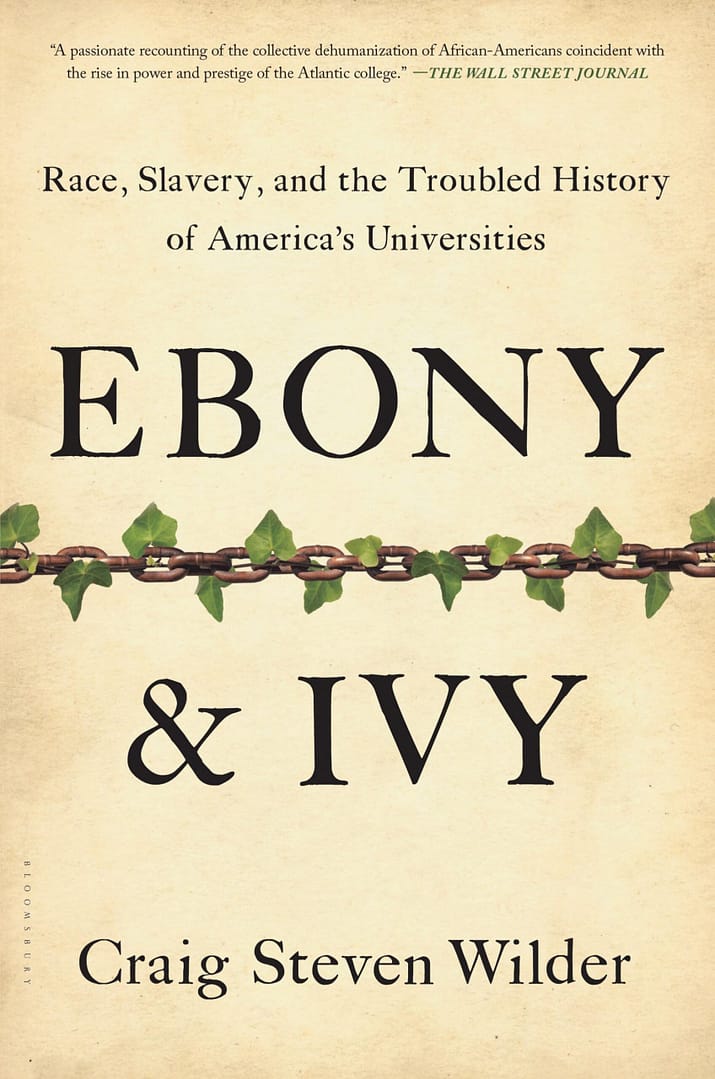
[00:38:10] Leo: Sure. I wanted to recommend a book. It’s not a brand new book. It came out in 2013, but its author is Craig Steven Wilder and its name is Ebony and Ivy: Race, Slavery, and the Troubled History of America’s Universities. I think anybody in a position of leadership in American higher education, including members of boards, of trustees and presidents and provosts need to read this book and consider it its contents very seriously. I’ve been teaching this book for the last two years with Randy Williams, who is vice president for inclusive excellence at Elon University. He and I are co-teaching a graduate seminar called Foundations of Higher Education.
To understand how the structural barriers that have been in place for so long on America’s college campuses in the early days that only privileged elite upper class white men, but in gradually began to admit women and people of color and so on and so forth. These barriers are still with us today in such powerful, powerful ways. I think the American public has so much work to do to adjust our mindset of who the American college student is today.
I think we have in mind, it’s a character out of animal house. Someone going to a Toga party, somebody who is experiencing the best four years of their life, carefree. That’s not who the American college student is today. These almost 40% of our students going to community college, many are working, many have families, many are responsible for older parents, many are first-gen, people of color, and the system that we have built up over the last 300 years, I think it’s not well equipped to serve well the students who are on our campuses today.
I think it is so important to go back and examine the historical roots of this and to understand that we have some very pernicious problems in higher education that have made the playing field a very unleveled place, it’s still is. There are a lot of things that can help money helps, financial aid for students helps, mentoring helps, relationships help, but I think all of us have to go back and take a good look at the entire system and its history.
Wilder’s book has changed my mindset. He’s a professor of history today at MIT. I’m thrilled that in early November, he’ll be joining my class via Skype to interact with our students. He’s been very generous with his time to help us out. Ebony and Ivy will change your view of the American Academy and I highly recommend it.
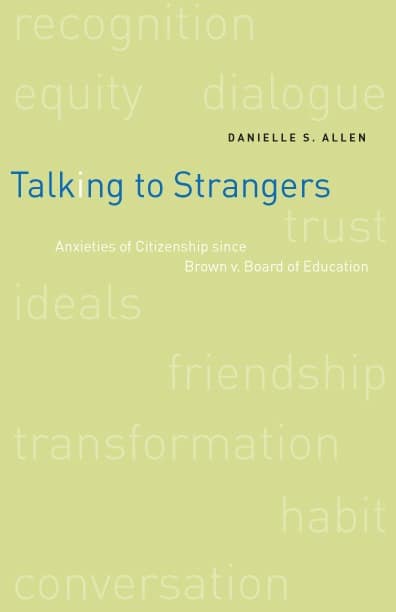
[00:41:33] Peter: I’m last and this is fun because we didn’t plan this at all. Thinking about context and thinking about race and history, my recommendation is a book too. It’s a book by Danielle Allen, who is a professor at Harvard and as far as I can tell the smartest person on the planet. This book, it’s from 2004. It’s called Talking to Strangers: Anxieties of Citizenship Since Brown V. Board of Education.
What Allen says in this book and shows in this book, is that we in this country don’t know how to talk across the difference. White people don’t know how to talk very well with Black people, Black people don’t know how to talk very well with white people, it’s much more sophisticated than I’m making it sound. She broadens this to say, citizens don’t know how to talk with citizens who they disagree with.
This book, in a way, it’s like a philosopher’s argument for what she calls political friendship. She says political friendship doesn’t mean we have to recognize we have this same story or we have the same values, or we have the same goals, but we do have a shared democracy and we need to recognize that shared democracy as the foundation for everything we’re doing.
With what everything that’s been happening in the world, I’ve been thinking about this book and thinking about this book. I’d invite folks to take a look at it because it’s a really powerful call for stretching ourselves and reaching across difference to have meaningful conversations with people. I don’t think we’re doing enough of that right now. I know I’m not.
[00:43:12] Bonni: Peter and Leo, thank you for this book, Relationship-Rich Education: How Human Connections Drive Success in College. Thank you for the ways that you’ve both inspired us, but also given us an invitation to in more purposeful and practical ways play out our roles in this very important function in institutions. Like you said, I really love that are our recommendations all really were intertwined, even though I do try to not find out what someone’s going to recommend.
This was really fun. I just enjoy getting to feel like I’m continuing the conversation with you. Peter and Leo, it’s just been an honor to get to talk to you today. I just appreciate you both so much coming on the show.
[00:43:55] Leo: Thank you, Bonni.
[00:43:56] Peter: Thanks so much, Bonni.
[music]
[00:43:59] Bonni: Thanks, once again to Peter Felton and Leo Lambert for joining me on today’s episode of Teaching in Higher Ed, about your new book, Relationship-Rich Education. Thanks to all of you for listening to Teaching in Higher Ed, whether it’s your first episode you’ve ever heard, or you’ve been listening since all the way back in June of 2014. Thanks so much for being a part of this community. Now more than ever, it just feels so important for us to be working in solidarity and serving our students well.
If you want to head over to the show notes for today’s episode, you can see them at teachinginhighered.com/331. You also can sign up for the Teaching in Higher Ed update at teachinginhighered.com/subscribe. Thanks so much for listening, and I’ll see you next time on Teaching in Higher Ed.
[music]
[00:44:52] [END OF AUDIO]
The transcript of this episode has been made possible through a financial contribution by the Association of College and University Educators (ACUE). ACUE is on a mission to ensure student success through quality instruction. In partnership with institutions of higher education nationwide, ACUE supports and credentials faculty members in the use of evidence-based teaching practices that drive student engagement, retention, and learning.
Teaching in Higher Ed transcripts are created using a combination of an automated transcription service and human beings. This text likely will not represent the precise, word-for-word conversation that was had. The accuracy of the transcripts will vary. The authoritative record of the Teaching in Higher Ed podcasts is contained in the audio file.