Follow the Teaching in Higher Ed Podcast
About this Episode
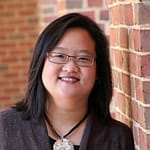
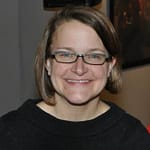
Mimi Benjamin, Karen Kurotsuchi Inkelas, and Jody E. Jessup-Anger Share about living-learning communities on episode 283 of the Teaching in Higher Ed podcast
Creating community is really important, it can help students feel connected to both the institution and their academic pursuits.
Mimi Benjamin
On episode 283 of Teaching in Higher Ed
Voices on this Episode


Show Notes + Resources
- Living-Learning Communities That Work: A Research-Based Model for Design, Delivery, and Assessment (Stylus, 2018)
- High Impact Educational Practices (HIPs)
- Residential Learning Community (RLC), Living-Learning Community (LLC), and Living-Learning Program (LLP)
- https://www.centerforengagedlearning.org/elon-statement-on-residential-learning-communities/
- John Dewey – responsible for the revisiting of living learning communities.
- The experimental college
- Laurie Schreiner – research on thriving
- Elon University Center for Engaged Learning Statement on Residential Learning Communities as a High-Impact Practice
Recommendations from this Episode


Transcript
[00:00:01] Bonni Shachowiak: Today on episode number 283 of the Teaching in Higher Ed Podcast, we talk about living learning communities that work.
[00:00:12] Speaker: Produced by Innovate Learning, maximizing human potential.
[00:00:20] Bonni: Hello, and welcome to this episode of Teaching in Higher Ed. I’m Bonni Stachowiak, and this is the space where we explore the art and science of facilitating learning. We also share ways to improve our productivity approaches, so we can have more peace in our lives and be even more present for our students.
[music]
I’m excited today to be introducing to you to three of the authors of a book, Living-Learning Communities. I’m grateful to Peter Felten to making these introductions to me and for introducing me to this fascinating topic. Let’s start with Mimi Benjamin. Mimi Benjamin is an associate professor of student affairs and higher education at Indiana University of Pennsylvania.
Her research interests include student co-curricular learning outcomes, learning communities and faculty experiences. Mimi earned her Ph.D in educational leadership and policy studies with a focus on higher education from Iowa State University, her M.Ed in college student personnel from Ohio University, Her M.A. in English from Clarion University of Pennsylvania and her BS in secondary education English from Carlton University of Pennsylvania.
The next guest I’d like to introduce you to is Karen Kurotsuchi Inkelas. She has a Ph.D and is an associate professor in the higher education program in the Curry school of education at the University of Virginia. Karen’s scholarship focuses on the impact of college on undergraduate students and she is best know as you’ll hear about today, for her research on living-learning communities.
Today’s third and final guest is Jody E. Jessup-Anger, associate professor of higher education at Marquette University. Prior to joining the faculty, she served as a student affairs administrator for seven years in roles such as resident life assignment coordinator, residence hall director and assistant director and interim director of a women’s center with an academic unit embedded in it.
She received her Ph.D in higher adult and lifelong education from Michigan State University, her M.S. in student affairs and higher education from Colorado State University, and a B.A. in international studies from American University. Welcome to all three of you to Teaching in Higher Ed.
[00:02:58] Mimi Benjamin: Thank you.
[00:02:59] Karen Kurotsuchi Inkelas: Thank you.
[00:03:00] Jody E. Jessup-Anger: Great to be here.
[00:03:01] Bonni: We’re going to start out with some definitions, but I know we won’t spend too much time, but if we don’t frame this conversation with them, at least some of us, myself very specifically, [chuckles] might be left a little bit confused. I know Karen, you have been elected to orient us to a few terms starting with high impact practices and then sharing about what learning community is and then specifically the theme for today’s episode, a living-learning community. We’re ready to learn from you Karen.
[00:03:30] Karen: Sure. No problem. Listeners might be aware that there are 11 college experiences or what are called high impact practices that were identified by the AAC&U, the American Association of Colleges and Universities that the research suggest are the most beneficial for student outcomes. Those are things like conducting under graduate research, studying abroad, doing service learning, conducting a capstone, internships, things like that.
One of those high impact practices is a learning community. Now, learning communities are typically smaller sets of groups who work closer together on a specific topic over time. That can happen in say, a teen talk course or linked courses that are linked together by discipline or a popular form of learning community combines living and learning together, which students who participate in that shared learning community also live together in the same residence hall.
This way, their in and out of class experience is more or less seamlessly combined. Those types of living learning communities can take several forms including say, a residential college which some might- maybe most of them [unintelligible 00:04:37] those are the kinds that basically are derivatives from Oxford and Cambridge, but there’s a lot of other variations of living-learning communities as well.
In fact, my research documents over 17 different types. Over the course of the 20th and 21st century, they’ve blossomed into all different kinds of types and really is context specific. Different universities have different types of living-learning communities.
[00:05:01] Bonni: One of the things that’s happening at my institution, I’ve been here 15 years now and it’s just a really growing commuter population. What has your research showed you about how different institutions are navigating having- even though we’re not alone in that, having more commuters and whether or not– This is the wrong word, but I’m going to use it anyway. Does there tend to be more of that sense of exclusivity around things like this? Do we feel like people then lose out on the access to this kind of learning environment?
[00:05:30] Karen: Living-learning communities definitely are much more popular on traditional four year college and universities where most of the students live on campus or in proximity to the campus. That being said, I think that we’re going to experience a renaissance of this idea again and it might actually turn back more towards the traditional notion of the learning community, and it might use more say technology like online platforms or classroom management systems that tries to bring people together maybe asynchronously, so it might lose the residential piece, but it will still maintain this idea of a smaller and more intimate community of people, who are all interested in the common academic endeavor.
That’s not really the focus of our research because [chuckles] we’re looking at the residential ones, but I do see as Americans go to college in more different and diverse ways, we’re going to have to think of more creative ways to bring them together around the academic topics.
[00:06:24] Mimi: I would also add that certainly community colleges are well known for learning community initiatives. Again, not the residential or living learning ones, but certainly supporting commuter students, community colleges do a great job with learning communities.
[00:06:43] Bonni: I appreciate you saying that Mimi and this actually takes us nicely into another broad theme that I know your research is grounded in and it comes from Dewey all the back in 1938. He encouraged educators to, and I’m quoting here now, “To ground the curriculum in students’ experiences, cultivating students’ individuality, advancing their interests and promoting their construction of knowledge”. Jodi, I know you have a good example for us of just living up to what Dewey lays out here for us in the area of social justice. Would you share that story Jodi?
[00:07:21] Jody: Sure, absolutely. My research has taken me into several social justice living-learning communities, and we saw this notion of what Dewey envisioned in action in one of the communities, and in this community, students were living together on two resident top floors and they were taking two courses together that were grounded in social justice concepts.
How students described their experiences in the community while they were in their first semester, while they were in their second semester, and then one year later, is that they moved from a preconceived understanding of what social justice was and then were exposed to the curriculum and also exposed to deep conversations with their friends and peers that were also in the community.
Those conversations helped them to challenge their misconceptions and they began to integrate new knowledge from their course work and from their peers’ understanding and also from their experiences in the community, and that really helped them to create a new, more nuanced understanding of social justice that incorporated theory and also incorporated real world practice, because these students in addition to living together and taking classes together, were really engaged in their community.
They were going out and doing work in the community, they were attending events together that exposed them to new ideas, and so that’s really where I have seen Dewey’s vision in practice.
[00:08:50] Bonni: There was this lively conversation on Twitter over the last week or so around learning outcomes and I’m sure you’ve all heard of this where there are those that really want precise immovable goals that are completely objective. I’m completely by the way exaggerating here, [chuckles] but then on the other side of that tension is, “Oh we’ll all come together and we’ll decide and nothing could be defined before you get here and before we arrive and see what takes place.”
I think either as you can tell from the way I’m describing this either extreme probably isn’t helpful in the learning process, but one of the themes that was coming out that seemed like most people agreed with was this idea that part of our role as teachers is to help people change their minds, and I would hope that it wouldn’t be to change their minds to always necessarily agree with us, but just this- and it’s part of human development of course, but seeing the world as you said in a more nuanced way and also opening up the possibilities that I don’t know, we might be wrong about things. We might have perceptions that were ill informed and what a wonderful opportunity this is for your people and old people [chuckles] to come together and learn in this way.
[00:09:55] Karen: It was actually John Dewey who was pretty much responsible for a renaissance to returning to living-learning communities in American Higher Education because it was Dewey and other sort of early 20th century reformers who were saying that we’d lost our way in terms of how we’re educating undergraduates, that we’ve become too specialized in our disciplines and we had lost the liberal arts tradition.
It was Dewey and this other fellow named Alexander Meiklejohn had strongly argued we need to return to our liberal arts tradition that is more experiential, that helps the next generations of citizen and scholars to take more charge of themselves in their co-construction of knowledge, and so Meiklejohn took that to the next step and created what was called then the Experimental College, which most credit as being the first 20th century living-learning community.
[00:10:42] Bonni: Another aspect of your research has to do with persistence. From you research, you report about Astin, asserting that student involvement which requires an investment of physical and psychological energy is a critical element of student development. You also share about these learning communities, residential learning communities increase in student involvement between faculty, staff, and peers, thus contributing to a student’s overall development.
Mimi, would you share a little bit about what you have found about persistence, and also this involvement between faculty, staff, and peers in residential learning communities?
[00:11:25] Mimi: Sure. One of the things that is true about residential learning communities is that many of them are for first year students. This idea of creating community is really important and it can help students connected both to the institution and to their academic pursuits. What’s interesting is sometimes students don’t even realize that they’re in a program or that they’ve signed up for one.
This is where faculty who are teaching courses in this programs can really be helpful, because they could remind the students that they actually live together. Ironically, I had a faculty member tell me that he mentioned to students one time in the class that, “You all live together”, and they were looking around and it’s like, “Yes. I do see you in the hall. Isn’t that funny? We all live together.”
I think faculty have a really great opportunity to reinforce the identity of the living-learning community in the courses. There’s research by Laurie Schreiner and her colleagues. They did research on thriving. One of the things about thriving that the research indicates is that degree goals, campus involvement, and psychological sense of community are important for first year students thriving.
One of the benefits of the living-learning communities is that they offer the opportunity to advance all of these. The involvement in the co-curricular elements like programs in the residence hall or attending activities on a campus that are related to the living-learning community really help with a lot of these factors, and these are then elements that impact student persistence on campus.
[00:13:02] Bonni: We’ve been able to look at some examples of living-learning communities and also have gotten down those definitions, but now, we’re going to look at the advances in coming up with a model. Karen, before we get to your answers around specifically living-learning communities, I’d like you to talk a little bit about your intentional use of the phrase “Best Practices.”
Sometimes when we hear best practices, we can start to bristle a little bit and think, “Can we take something that’s messy as learning and actually identify best practices?” I really love what you have to share about this, and why you intentionally decided to go with that phrase.
[00:13:44] Karen: Sure. When we were putting together the model initially as well as when we were writing the book, I hesitated, too, to call it best practices just because it sounds a little arrogant and somewhat presumptuous that we would actually know the the best way to do anything, but it occurred to us is that this model is very aspirational, that most living-learning communities don’t have every element of the model that we’ve proposed. I guess it is aspirational.
For example, I run my own living-learning community here at the University of Virginia and we don’t even have all the elements of the model. In the very community that I run when I am one of the authors of this model. In that way, I thought, “Then it’s all right to call it a best practices model because it’s something that we all aspire to becoming, but we may never get there.” We all hope to in our work over the course of time.
[00:14:33] Bonni: Stephen Brookfield has written about and spoken about that word, “Becoming”, and I just find that so freeing because it’s one of those classic things where the more about something, the less you realize that you know about something. I just think that’s a helpful way for us to frame our work as teachers, as people who really want to serve our students well, we’re never done, we are always becoming– Thank you for that– as an example.
Let’s get back to then the specifics of the research that you’ve done. Would you describe for us the research that led to this best practices model, Karen.
[00:15:07] Karen: I was a principal investigator of a very large national study living-learning communities which was call The National Study of Living-Learning Programs or The NSLLP. It included over 48,000 students of 46 universities and over 600 living-learning communities, so it was a very large study. We collected data from the students who are in those living-learning communities as well as the staff who ran them, who told us a little bit about how they were organized.
Then, we conducted four site visits at universities that we collected data from and their students elicited the strongest outcome data. We thought, “What are they doing that was making them stand out above all the other 46 universities in the study?” We went to those four campuses to find out. Across all that information, the students’ survey data, the staff survey data, and the campus site visits, we started seeing some common threads about what was seem to be working at some of the better models that came out through the course of our study and we started putting together out model.
That model is in the shape of a pyramid. It has four different levels. For those who are familiar with Maslow’s Hierarchy, it operates in a very similar fashion. As you know, Maslow argues that humans can’t attend to their more higher-order needs until they’ve met some of their basic needs, like air, food, water, things like that. Ours is the same in that we believe there are certain types of elements of the infrastructure that needs to be satisfied before we can start thinking about academic co-curricular and other types of events or activities.
I’m to shift things over now to Jody and Mimi we’re going to fill in the model a little bit better.
[00:16:40] Jody: At that base level of the model which we have deemed the infrastructure, there are four elements and the first one is clear goals and objectives. Really, for a living-learning community to be a best practices living-learning community, every one who’s invested in the community needs to have a good sense of what the goals of the community are. That would include the faculty who are teaching in the community, that would include staff who are helping to run the community, and certainly students as well. There’s clear goals and objectives of the cornerstone of that pyramid.
The next piece of the infrastructure is a collaboration between academic affairs and residence life and housing. That collaboration ideally would mean that each of those elements, the academic affairs and the residence life and housing, believe intrinsically that they wouldn’t be able to do their work without the other. Karen’s Co-PI on The National Study of Living-Learning Programs really helped me to understand what this collaboration might look like.
I went to a seminar that he was giving and, basically, he said that the residence life and housing folks are at the table because they understand student development in a way that perhaps the faculty member doesn’t. The faculty or academic affairs who were at the table understand their discipline in a way that perhaps the residence life folks don’t. Then, both are really invested in ensuring that the other one feels valued in the relationship. At its best, that’s what that collaboration looks like.
The final piece of the infrastructure level is adequate resources. Karen’s research on The NSLLP really illustrated that there’s a wide variation in the amount of resources that are provided to living-learning communities. Certainly, when students are living together on a residence hall floor or a number of residence hall floors, that’s a basic resource, but then having spaces for those students to meet, potentially having classroom environments within the community, having other dimensions of community that you might expect in a residence hall, will only be additive to those communities, as well as having funding for students to do the really cool things that often come out of these communities, but like I mentioned before, there’s a lot of variation in the amount of resources that are given to these living-learning community environments.
[00:19:08] Bonni: I know that Mimi has something to add here, Jody, but you just said a word that really struck a chord with me and that was, “There’s some really cool things.” I think you said the word “cool.” Could you just share just a couple that come to mind where you’re like, “This just blows my mind.” What are just a couple of really cool things that they’re doing out there?
[00:19:23] Jody: Yes, absolutely. One of the communities that I researched, students were conducting plays. They would do everything from writing the manuscript to finding a director to direct it, to having the actors and that takes a lot of talent, but it certainly also takes some resources as well getting the props and the costumes and everything. Having the resources to do that within the community or withing the budget of the living-learning community is important.
[00:19:51] Bonni: Do you have another example that something that blew your mind?
[00:19:54] Karen: I have one. One of our case studies did a shark tank competition. They had all the students think of needs in the community that are currently unmet or met less than ideally, come up with a possible intervention or a plan or some sort of a project. Prototype it, come up with a budget on what they’re going to need, and then present it Shark Tank style to a panel of judges. The judges chose the winner, and that winner was given X amount of money, and actually enacted the plan. I think it was a bike ride share program at the campus.
[00:20:27] Bonni: It’s great that they can improve their campus that way. All right, Mimi, it is your turn [chuckles] to share a little bit more about this model in action.
[00:20:38] Jody: Actually, I have to share another one.
[00:20:39] Karen: We have one more piece. Sorry.
[00:20:42] Bonni: Sure.
[laughter]
By all means, Jody, I love this. [crosstalk] This is very energized. Jody has one more to share. Please.
[00:20:51] Jody: Atop the base level is what we call the academic environment. Again, the academic environment has four dimensions to it, and those include courses for credit. We found that in the resource that we’ve done that students getting into courses and taking courses that actually give them academic credit was important to their learning within the living-learning community.
In addition, faculty advising is part of that academic environment that students are engaging with faculty in meaningful ways. Often times the easiest way for students and faculty to engage outside the classroom is through an advising relationship. Then, the other two dimensions of that academic environment are an academically supportive climate and a socially supportive climate.
In that academically supportive climate, students might describe that the environment feeds their academic interests, that their intellectual curiosity is welcomed. A socially supportive environment might be that students feel like others know them and know their concerns, and that students are supportive of everything as it relates to college. Not only their course work, but also their co-curricular activities and their overall college experience as well.
[00:22:10] Bonni: Mimi, before we get to the recommendation segment, I know we have just skimmed the surface here. I warned you all it was going to fly by, but what else should we be sure and share about residential learning communities before we move on to the recommendations?
[00:22:23] Mimi: Well, once the infrastructure in the academic environment are solidly in place, the next level of the pyramid is the co-curricular environment. Some of the co-curricular elements that have been demonstrated to show really positive outcomes for students are things like study groups, which given that students are living together, you can really capitalize on the living environment and the proximity that they have to each other.
K12 outreach programs. Getting out into the school system can also be another co-curricular element. There are certainly some challenges in that area these days especially with regard to clearances and things of that nature, but those are beneficial co-curricular activities. Career workshops and visiting work settings are also beneficial as well as other theme related activities.
Finally, the pinnacle, the top of the pyramid, is the idea of integration, and so thinking about, “How do we, for example, link our courses for credit with our co-curricular activities? How do we take advantage of the academic affairs in residents life and housing collaboration to create that academically and socially supportive climate?” Those are important elements of it as well.
[00:23:36] Bonni: Before we go to the recommendations, Karen, I have one more question for you. [chuckles] You said you had researched something like 17 different kinds of communities. Is that correct?
[00:23:47] Karen: Well, there were over 600 different living-learning communities in our study that we categorized into 17 types.
[00:23:53] Bonni: I can’t believe I actually remember that number. I have a terrible short-term memory for numbers, [chuckles] but good. Have any of them centered around athletic teams or athletics in general?
[00:24:04] Karen: Interesting. No. Not that I can remember. We concluded ROTC because often ROTC lives together and takes classes together, but not in the collegiate athletics, no. Although, it is fairly common for athletes to live together in the same residence hall. That’s an intriguing concept to turn that into a living-learning community as well.
[00:24:25] Bonni: I’m trying to translate it here to our itty bitty campus out here in Southern California of the ways in which we are already doing this and don’t realize it because I’m sure that happens a lot with people that you research, and they don’t even realize what they have.
[00:24:37] Karen: True. Another one. Sorry. Another one that is common is honors colleges. Most people don’t consider that living-learning communities, but all the honor students live together in the same residence hall, have a very specialized curriculum for them. We do include that, honor students.
[00:24:52] Bonni: Thank you so much. This has been such a good primer for us, and I’m excited to hear from any listeners who want to write in. I’m sure all of you would be as well to hear what people are doing and experimenting with it. I’m so glad to have been introduced to your work. This is the time in the show where we each get to share our recommendations, and I just have a quick one that I came across the other day. It is Merriam-Webster’s Time Traveler. I came across it on Twitter where I come across with most of my fun exploratory stuff like this.
It gives you the data on when a word was first used in print. You go to this website and you can type in a given year. For example, you could put in the year that you were born, and then it will tell you what was the first time that those words were actually placed in the dictionary. I’m going to go to the year that I was born, 1971. There’s a ton of them. I’ll just read off a few of them.
HMO, kickboxing, reboot, rest area. Some depressing ones. Sexual assault, sexual harassment, again in 1971. VCR. I’m going to curse for a moment. I apologize to those of you listening. Maybe I’ll just spell it out. W-I-S-E-A-S-S. That was the first time that word was put in the dictionary.
[laughter]
All kinds of interesting words, and I’m hoping that some of you will go explore perhaps the year you were born or perhaps a year of particular interest and see what words were first put in the dictionary. Karen, I’m going to pass it over to you for your recommendation.
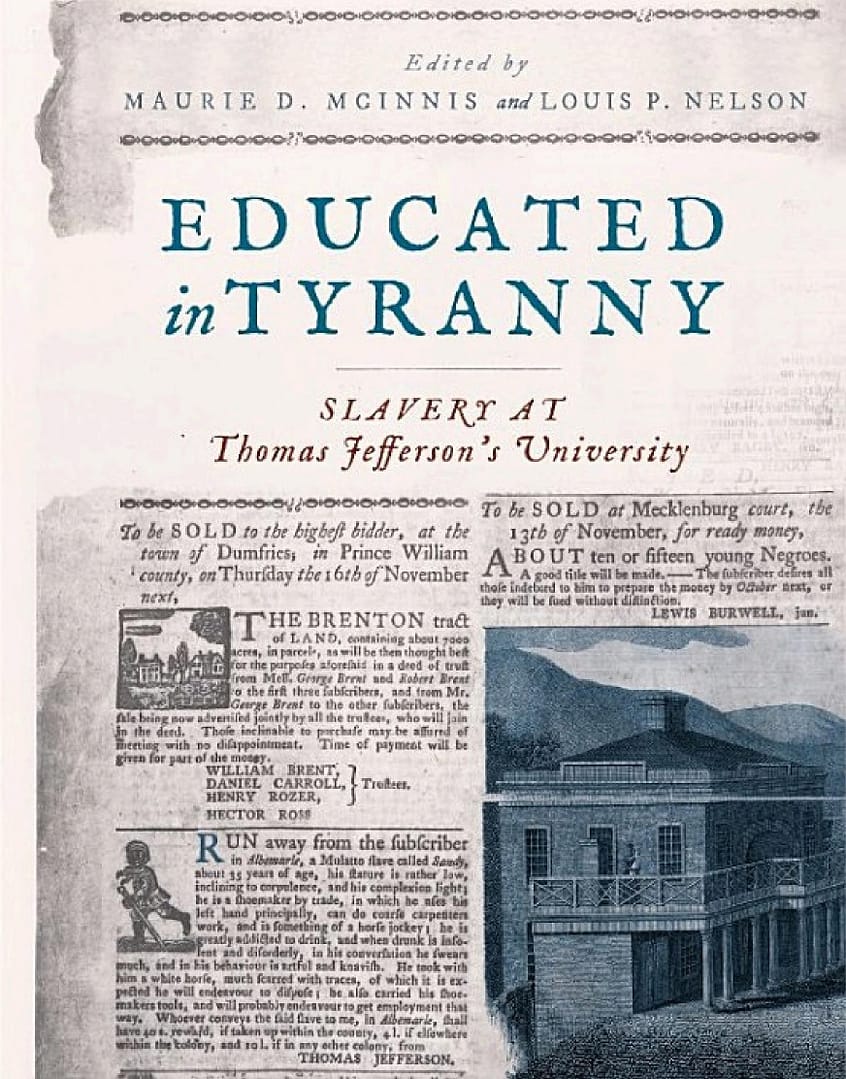
[00:26:21] Karen: Great. First, I really want to go to that website and look up my birth year. I’m going to change topics slightly. My recommendation is a book called Educated in Tyranny: Slavery at Thomas Jefferson’s University. Earlier this fall, I went on a tour of UVA, but it’s not your typical campus tour. It was a tour of the legacy of slavery that’s woven into the architecture and the landscape of our campus.
Many probably know UVA was founded by Thomas Jefferson. We all know Thomas Jefferson has a very complicated history when it comes to slavery. Basically, the hero story about Jefferson at UVA is pretty strong. We all revere him. We call him Mr. Jefferson. We often say WWTJD. What would Thomas Jefferson Do? This is the first time UVA has tried to publicly grapple with its past legacy with slavery.
The two have left such a deep impression on me that I’m still thinking about it over two months after I’ve taken it. This book, for those of you who can’t come to Charlottesville and takes it to Earth, this book tells some of the stories of things that people have found about how slavery and segregation and Jim Crow is indelibly inked in our campus, in our history for all time. For those who can’t make the tour, you can at least read about it in this particular book.
[00:27:40] Bonni: If someone is in the local area, though, it is something available to the public?
[00:27:44] Karen: I don’t know how they’re offered. We were offered it because the author is a member of our faculty. I’m not sure how you link in if you’re just coming in from out of town.
[00:27:53] Bonni: Definitely we should check out the book. It sounds very powerful and an important part of our history to be aware of. Thank you so much, Karen. Jody, it’s your turn to give your recommendation.
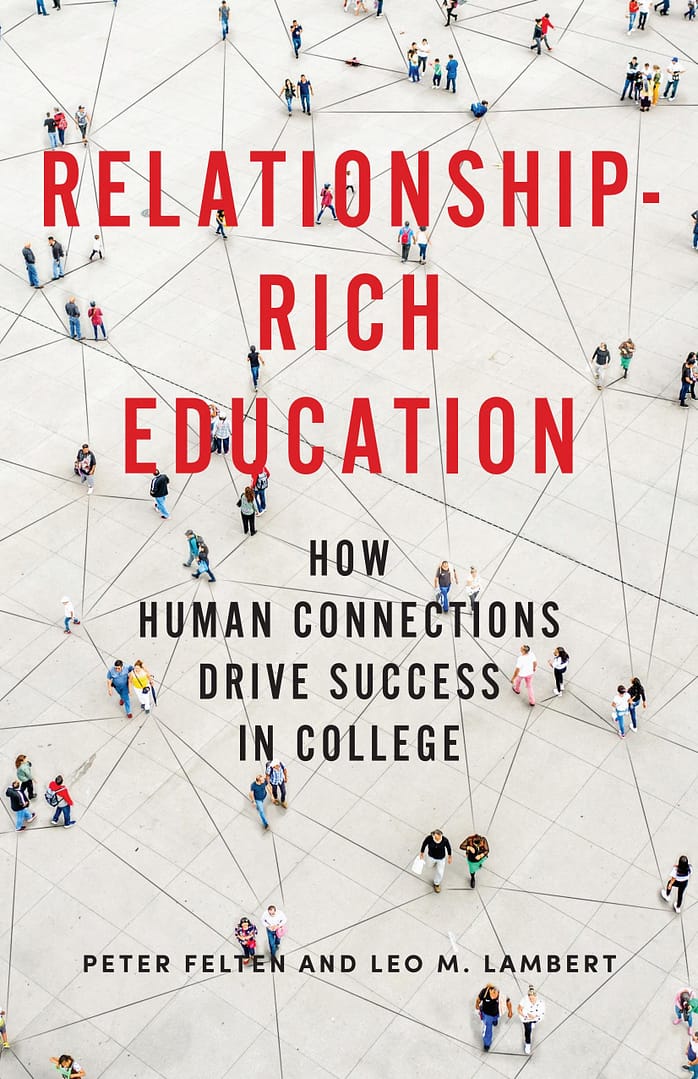
[00:28:03] Jody: Excellent. Well, my recommendation this week is also a book, and it is called The Undergraduate Experience: Focusing Institutions On What Matters Most by Peter Felten, John Gardner, Charles Schroeder, Leo Lambert, and Betsy Barefoot. This book is on my mind a lot lately because I’m using it as a text in one of my courses, Introduction To Higher Ed. I also have mentioned it a lot on campus.
The reason for that is it provides a really strong counter-narrative to some of the negativity that we’re reading about in higher ed lately. I think that I like it especially because it helps us to think about how we might situate ourselves a little bit differently to do really good work. It’s a work smarter not harder type text. It provides a lot of recommendations that are low or no cost. It’s a just a different way of thinking about how our university can work together to educate students in a more meaningful and better way.
[00:29:08] Bonni: That sounds like such a great resource. I’ve had Peter Felten on the show before. Anything I read of his or get my hands on, he just has such a way of making complex topics more accessible to people that need a good frame to hang on to. He did that on the show he was on, and also I suspect probably does it in this book too. I’m going to have to check it out. Thank you so much for sharing that resource with us, Jody. Mimi, it is your time to wrap up our recommendations experience.
[00:29:36] Mimi: Well, my recommendation is a website. It’s the K. Patricia Cross Academy website. The tagline on this is “practical lessons for passionate professors.” They offer a variety of things. Very short videos on teaching techniques. Some of the examples were the Contemporary Issues Journal or the 3-2-1 Technique, the Jigsaw technique. They also have downloadable documents that come along with that. One of the reasons that I was drawn to this is I’m, obviously, interested in always improving and coming up with new ways to do the teaching that I do, but I also coordinate our Preparing Teacher Faculty program here on campus, so I’m always looking for resources for those graduate students. This one seemed to be a good one for them, and I’m enjoying it as well.
[00:30:25] Bonni: I would love to have a conversation with you about your program [chuckles] when we’re not being recorded because that’s such a– For me, recently, in recent years, becoming responsible for ours, it’s so hard because if you try to do too much, it becomes too theoretical, and they can’t really put it into practice. Something like The K. Patricia Cross Academy is really helpful because it’s backed by the research, but it’s very tangible. You can put your hands on it and start experimenting with things and trying them in your class.
What a great recommendation and what a fun challenge that you get to explore in helping those graduate students be more effective teachers. Thank you so much. Thanks to all three of you for joining me on today’s show. I was so glad to be introduced to you and to your work. I’m so inspired. I’m leaving our conversation feeling like, there’s so much we can do. I just really loved hearing about your work. Thanks to all three of you for being here.
[00:31:15] Karen: Thank you.
[music]
[00:31:19] Bonni: Thank you so much to Peter Felten for introducing me to today’s guests, Mimi, Karen, and Jody. Thanks to the three of you for sharing about your research and your book on Living-Learning Communities That Work. I hope people will go and explore your book and get a sense of the kinds of ways that these particular communities have been able to have an impact on higher education.
If you’d like to go visit today’s episode’s show notes, you can do that at www.teachinginhighered.com/283. If you’ve been listening to the podcast for a while and enjoying it, I’d love it if you would pass it on as a recommendation to one of your colleagues or friends. If you’d consider rating or reviewing it using the podcast service that you use to listen. Thanks so much for listening today. I’ll see you next time for Episode 284.
[00:32:13] [END OF AUDIO]
The transcript of this episode has been made possible through a financial contribution by the Association of College and University Educators (ACUE). ACUE is on a mission to ensure student success through quality instruction. In partnership with institutions of higher education nationwide, ACUE supports and credentials faculty members in the use of evidence-based teaching practices that drive student engagement, retention, and learning.
Teaching in Higher Ed transcripts are created using a combination of an automated transcription service and human beings. This text likely will not represent the precise, word-for-word conversation that was had. The accuracy of the transcripts will vary. The authoritative record of the Teaching in Higher Ed podcasts is contained in the audio file.