Follow the Teaching in Higher Ed Podcast
About this Episode
Elizabeth Barkley shares recipes for effective teaching on episode 263 of the Teaching in Higher Ed podcast.
Teaching and learning is a complex process that involves the interaction of human beings.
Elizabeth Barkley
On episode 263 of Teaching in Higher Ed
Voices on this Episode

Show Notes + Resources
- Interactive Lecturing: A Handbook for College Faculty*
- Learning Assessment Techniques: A Handbook for College Faculty*
- Student Engagement Techniques: A Handbook for College Faculty*
- Collaborative Learning: A Handbook for College Faculty (2nd Edition)*
- The Joy of Cooking*
Elizabeth Barkley is an expert consultant for ACUE on the following course modules:
Recommendations from this Episode



Transcript
[00:00:00] Bonni Stachowiak: Today on episode number 263 of the Teaching in Higher Ed podcast, Elizabeth Barkley shares recipes for effective teaching.
[00:00:11] Production credits: Produced by Innovate Learning, maximizing human potential.
[00:00:22] Bonni: Hello, and welcome to this episode of Teaching in Higher Ed. I’m Bonni Stachowiak. This is the space where we explore the art and science of being more effective at facilitating learning. We also share ways to improve our productivity approaches so we can have more peace in our lives and be even more present for our students. Today’s guest, Elizabeth Barkley, was introduced to me through my partnership with the Association of College and University Educators or ACUE. ACUE’s courses and community site feature many of teaching and learning’s top experts, faculty developers and practitioners to showcase evidence-based teaching practices.
If you’ve been listening for a while, you already know that for more than three years ACUE has connected me with great guests for the show. If you’d like to learn more about ACUE, you can visit their website at ACUE, A-C-U-E.org. Back to Elizabeth, though, an innovative educator who has dedicated over four decades to serving students and teachers. Elizabeth Barkley has authored four books on college teaching techniques published by Wiley/Jossey-Bass, as well as several textbooks in music history.
A popular keynote speaker and workshop presenter. She is co-founder with Claire H. Major of Faculty to Faculty, the alliance for research-based teaching and the executive director of the K. Patricia Cross Academy, a non-profit organization that provides free professional development for college teachers. Elizabeth has also received multiple teaching honors including being named California’s higher education professor of the year by The Carnegie Foundation for the advancement of teaching, and being formally recognized for her contributions to undergraduate education by the California state legislator. Elizabeth, welcome to Teaching in Higher Ed.
[00:02:28] Elizabeth Barkley: Well, thank you, Bonni. It’s a privilege and a delight to be here with you.
[00:02:32] Bonni: I want to start with the fact that you have not only written four books, but four books about a certain topic. [chuckles] How did you wind up having written four books about college teaching techniques?
[00:02:44] Elizabeth: Well, that’s a wonderful question, actually. Yes, we’ve written four books on teaching techniques. They were originally inspired by K. Patricia Cross who developed probably the quintessential and certainly the earliest formal teaching technique when she developed Classroom Assessment Techniques when she was at Harvard and was also working with Tom Angelo. Are you familiar with that book at all?
[00:03:12] Bonni: No.
[00:03:12] Elizabeth: What is the Classroom Assessment Techniques?
[00:03:14] Bonni: I’m typing while you’re talking.
[laughter]
[00:03:17] Bonni: That’s a new one, yes.
[00:03:19] Elizabeth: Well, it’s maybe new to you but it is so old. For example, things like the minute paper, muddiest point, they had their formal origin in her book of Classroom Assessment Techniques that she published. At any rate, Cross and I have known each other for decades. It was in working with her that Claire Major and I first started writing our four books of teaching techniques. I think that that was your question, just how did we get started on it.
[00:03:49] Bonni: Yes. When you think about them as a collection, although I know they’re not, it’s not [chuckles] a page-turner where the first book ends and we have to start the next one. How do you think about that in terms of how they evolve? Was it more ideas emerged or you just wanted to clarify things? How do you think about them as four different entities?
[00:04:11] Elizabeth: The four books, one of them is on student engagement, one is on assessment, one is on collaborative learning, and then the most recent one is on interactive lecturing. You can see that each one of them are on broad topics. Then, the way we have all– When I say “we”, I mean Claire, Pat and I, have viewed those techniques or the books of techniques, we’ve viewed them as collections of well-tested recipes. They’re approaches to teaching that have been out in the field, that we have pulled together and included in the book.
Our goal was to make each one so clear and comprehensive that teachers could implement any or improve any aspect of their teaching, whether it’s collaborative learning or assessment, just by following the procedures in the book precisely, and they’d be reasonably guaranteed a good result. We also came to think of those techniques almost like recipes. If you are already a pretty experienced cook, you would come to a recipe, and you would take it, and you’d use it as a launching pad for making your own modifications. If you’re very new to cooking, you usually follow it very precisely.
Our sense was that they’re recipes that teachers could come to regardless of their stage in their professional career or experience with teaching, and then combine, modify, substitute, add elements to meet their unique needs. In answer basically to your question, each collection of techniques addresses a specific broad topic, and then within that broad topic are very precise kinds of activities or approaches to the classroom that you can do to address some aspect of that topic.
[00:06:09] Bonni: When I was earning my doctorate, one of my favorite professors would say that when we’re listening to people– This is such a deep listening experience for me to get to talk to people like you. When we’re listening, we should be listening for what people are saying, but also for what people are not saying. One of the things I’m recognizing that you’re not saying is that you wrote a book of best practices. Some of us in higher ed bristle at that. I came from the franchising industry when I transitioned into academia, so best practices are embraced there. [chuckles] You cook those french fries for two minutes and however many seconds.
I’m hearing you not say “best practices”, but “recipes” really makes for a wonderful analogy really for two reasons. One is because, yes, they’re well-tested, teaching is both an art and a science. Teaching is also teachable. If I follow this recipe, I can be, as you said, reasonably guaranteed I’ll have some success with it. The other thing that’s important about recipes is knowing why, why a particular recipe or the components of it are important in your final product.
I think I may have shared this story before on the show. I’m chuckling at myself. I don’t want to bore people. I once tried to make banana blueberry bread. Because I had made banana bread before and I had made something with blueberries, but this seemed like a really delightful combination. [chuckles] I didn’t understand the importance of baking powder, we didn’t have any in the house, [chuckles] so I tried to make banana blueberry bread without baking powder and also thought I would put it in our blender and mix it that way, which you could imagine what happens with blueberries. [chuckles]
[00:07:40] Elizabeth: Oh, honey.
[00:07:42] Bonni: I did not have a good result on my recipe because I didn’t understand the importance of certain components. I don’t know if any of that resonates with you as you were thinking about that analogy.
[00:07:54] Elizabeth: It absolutely resonates with me. Not only because I am a pretty good cook. I love to cook and one of my earliest favorite cookbooks was The Joy of Cooking. The reason I loved it so much is that, if you’re familiar with that cookbook, they spent quite a bit of time on the science of that particular topic so that you can understand why the different components are important. Putting it all in a blender with no baking soda I think is hilarious.
[00:08:25] Bonni: [laughs]
[00:08:26] Elizabeth: It is also a perfect example of not knowing why different components are there. It’s good as well in applying to the techniques, because we have as part of the core structure of every technique some information on why are you doing this, what is its purpose, what can you expect to accomplish by using this technique.
[00:08:53] Bonni: There was a– I don’t remember if it was a tweet or an article. You know how when you take in as much as we do [chuckles] it’s hard to keep track of where something came in and then out of your head. Something about calling on students. I believe it’s– I’m reading a book about culturally sense of teaching and the brain, it was actually recommended when I was giving a keynote. They were saying that the things I was describing sounded like they were coming out of that book. I thought, “Oh gosh, well, I haven’t read that book [chuckles] but it sounds like I should.” It’s very, very good. They really talk a lot about those whys.
Anyway, there’s something around calling on students. If you’re listening to someone’s approach, whether it’s accepting late assignments or what your attendance policy is, all these questions that we grapple with, at least we hope people are grappling with as educators, just hearing about someone’s technique will never get us to where we want to go if we aren’t think about, “Well, why is that your technique? What is the purpose, intent and real mission around it?” Then, to me, it’s incorporating it in with my own sense of mission and really, “Is this person’s idea or technique actually going to fit well with what I believe my purpose in teaching is?”
[00:10:06] Elizabeth: Absolutely, Bonni. We go through that in so much depth in the opening material for the learning assessment techniques book, because of course, if you don’t know where you’re going, how will you know when you get there? So, we put in quite a bit of material at the front of the book, talking about how to clarify one’s goals and one’s purposes. Especially with so many of us in our current teaching context, we not only have to be responsible for what we want our students to learn, but we have to also connect up to the department level, the program level, the institution level, sometimes at the state level, with our accreditation agencies.
There are so many levels that we have to attend to if we’re taking our teaching really seriously. In that book, we also, in addition to providing specific techniques, we had quite a bit of material on helping teachers clarify precisely why they were approaching something the way they were and what they could expect to find from it.
[00:11:16] Bonni: One of the books, as you mentioned, is about engaging students. This is so important. How can we expect students to learn if they’re not engaged? The attention is such a vital part of learning. Is there a technique that really has a good promise in promoting student engagement?
[00:11:34] Elizabeth: In response to your question, I would say this, that in my book on student engagement techniques, I propose that student engagement is both a product and a process that results from the synergistic interaction of a whole number of different elements. Some of the elements or components that I focus on in that book are active learning, motivation, making sure that you are assigning tasks that are appropriately challenging, not too easy, not too tough, that you’re fostering a sense of learning community, and that you’re teaching for holistic learning, not just addressing the cognitive domain, but bringing in the effect within the psychomotor domain as well.
That was what I had to grapple with when I was writing the engagement techniques book, is that engagement is a complex interaction of so many components. The short answer to your question, is there a single technique that can be guaranteed to engage your students, I would have to honestly say, “No.” However, what we included or what I included in the book was a number of different techniques that addresses many of those components as possible.
For example, we have digital stories. Digital stories can be very engaging to many students because it addresses a lot of those components, they find it motivating to tell a story, they’re actively learning because they’re constantly having to make connections between the course content and what they already know, they can work at it up to their own level. The longer answer is no, there’s not a single technique, but the expanded answer as well has to include that there are some techniques that are more promising towards engaging students than others.
[00:13:25] Bonni: One of the things that really I hear you both saying and not saying [chuckles] at the same time is that– I’m thinking of all these different variables, and so it can be so helpful when we think of it either as a recipe, a tool kit, or what have you, that we know this grouping of things, but that we’re also in the moment with the very people that were in front of, and addressing the needs as they emerge. Because if it is too much, like a– I was thinking, [chuckles] it’s dangerous when I use cooking analogies, because as you already have discovered, I’m [chuckles] not a very good one, but I think of it as a colorful kitchen with not everything has to be the precise measurement.
There’s some impromptu, I guess, is what I want to mean. I understand baking, you need a lot more preciseness than other forms of cooking. You can be a little bit more improvisational. I see that as, in teaching, that idea of, yes, having these techniques, and also knowing that what worked the last time I taught this class might not work with a different group of students, so there’s an entirely different makeup.
I’ve taught three sections of the same class in semesters before, and they’re all radically [chuckles] different from one another. It’s really remarkable, but yet, you don’t want to just throw everything away, though, and say, “Nothing will ever work,” in terms of either end of that spectrum of either too rigid or just no plans at all, not looking for the effective practices, either one of those is a dangerous place to be.
[00:14:57] Elizabeth: Absolutely, Bonni. That’s what we have to be constantly reminding ourselves, that teaching and learning is a complex process that involves the interaction of human beings. As individuals, we are complex entities, and you start pulling this all together in a cluster, in a group, those complexities just increase. So, yes, we can never go into a classroom with completely rigid script for how the whole course or how that whole class session is going to unfold. We have to be attuned to the very human interaction, not only between ourselves as teachers with the students, but between the students themselves. Let me add one other aspect of techniques that I think is important to clarify from my perspective, is that okay?
[00:15:50] Bonni: Please.
[00:15:51] Elizabeth: Well, it’s not just my perspective, but it’s Pat’s and Claire’s and my perspective. It’s that most of us have been trained in our academic disciplines, but few of us have been trained in pedagogy. We haven’t been taught how to teach well, and so we’re very fortunate at this point of time that we have decades of educational research that shows us what works and what doesn’t work in a classroom, but we’re all too busy to plow through all of that research. I put in a small group learning, this is one of my favorite examples into an educational database and came up with over 9,000 articles. Well, we can’t read all of that.
Our techniques and our books are very much research and evidence-based. Our goal is to reduce all of this complex research into consumable chunks that busy content-oriented faculty can digest quickly and implement in their classrooms in ways that can very effectively improve their teaching and learning without their spending so much time on uncovering it.
[00:17:03] Bonni: We’ve explored the idea of engaging students and active learning. One of the big questions people have is, how do those things, or how do they not, change when we start talking about online teaching?
[00:17:19] Elizabeth: I started out teaching very early online because I saw it as a safety net for all of those students who might have difficulties or challenges making it to a face-to-face class. I considered it an alternative venue to provide the materials that they would have otherwise acquired in the class, had they attended. It was written out versions of my lectures, it was the written out assignments, notes, and it was, as we all know, very text-based.
Then, as it evolved to become more of an independent course, not just as a safety net for my on-campus students, I did as I think every early online teacher does, they just try to replicate what they did in the face-to-face classroom in the online environment. In the early days, when that was so text-based, it was just, [chuckles] I think a combination. I was almost going to say “recipe”, Bonni.
[00:18:26] Bonni: [chuckles]
[00:18:26] Elizabeth: A recipe for disaster, in terms of so many levels. On the level of engagement, on the level of actual learning. That continues to be a challenge in online, but I know that in my own teaching, what I have tried to do is to look at what the benefits of online are, rather than the detriments, and then emphasize those in as many ways as I possibly can.
[00:18:56] Bonni: My role back in my franchising days was to write– Well, part of it was to write the manuals for, how do you do this job, how do you do the training, the sales, the marketing, et cetera. Not surprisingly, speaking of recipes for disaster, someone who had bought a franchise in another country with a very different culture, et cetera, they weren’t able to just take these [chuckles] “recipe books,” but this training business, it was corporate training and specifically computer training, they weren’t able to just put that all into practice, and everything went just like they planned.
We backed into– Because I do remember I was involved in the e-learning business very, very early. That’s back when they used to call engagement or interaction clicking on something. Like just clicking the forward button, somehow I’m getting a shot of dopamine, which of course, [chuckles] you’re not. You’re just clicking your mouse. But because it wasn’t transactional, we really wanted to see these businesses succeed, and of course, that helped us too as a franchise. But then you just had to figure out, “Well, this isn’t working.” In the manuals, sometimes there was such grave cultural differences and maybe the whys weren’t expressed as well as they could have been, et cetera.
Then we would get on, back then, synchronous learning. Now, the bandwidth was terrible. I use a lot of Zoom today, the video conferencing tool Zoom. [chuckles] I’m acting like you’re not going to know what I’m talking about, and we’re on it right now. [laughs] That’s cracking me up. To be on a Zoom session today and then to think about it back then, just night and day. It is when we can stop thinking about it as just that, “They’re going to do a certain number of steps, and then they are going to get a grade.”
If we can move ourselves away from that to that kind of care that you just described for your students, Care for your students as an option for them in really complex lives. That’s a wonderful place to start from as a faculty member. I wonder, before we go over to the recommendation segment, if with your time teaching online, if there are specific mistakes that you see people making that you want to give some advice on?
[00:21:03] Elizabeth: Well, I think my advice would be to balance being productive and efficient in teaching online, because early on I developed all sorts of repetitive stress issues because I was spending so much time on the computer. You have to guard against that, but on the other hand, you also have to guard against automating so much that students are not really being challenged to think at any deep level. They take this automatic quiz, many of the answers can be found very quickly just by going to Google. We can so simplify and automate everything that it completely destroys the complexity of the learning that we know truly has to happen in order for it to be sustained learning, that it’s going to stay with the learner throughout their lives. Does that make sense?
[00:22:09] Bonni: It really does, you’re reminding me a little bit of the FERPA training that’s now required at most, if not all, institutions. For people outside of the United States, that’s the privacy-oriented things that faculty need to know what they can and cannot share about student data. Then the sexual harassment training that we take online. I’ve actually taken some good ones over the years, and I’ve taken a lot of really, really bad ones. [chuckles] Balance is so key, so we want to care about our students, we want to be present for them. It’s a big thing in online classes, the presence. At the same time, to the extent that we can automate some of it [chuckles] will help those of us with RSI. Repetitive stress injuries, for people who don’t know what that abbreviation is. I know I can tell from the sound of your voice that we both–
[00:22:57] Elizabeth: Well, I know that one well. Bonni, you’re writing a book on productivity in the online environment. Are you going to be addressing– It sounds to me like that is going to be one of the main topics that you are going to be wanting to address.
[00:23:12] Bonni: Yes, a topic near and dear to my heart. [chuckles] It’s just this idea, exactly what you’re talking about, this balance is so key. I think about that not just with teaching online, but even in correspondence with students, whether we’re talking about e-mails, or meeting with them, or whatever it is. If there’s things that we can automate so that we can allow ourselves to be more fully present for our students, and even on a broader level, just people that are important to us, those are the things we should automate so that we don’t automate a second past that. We don’t want to automate our authentic connections that you can have as teachers. That’s not possible, nor would I even want to attempt it.
[00:23:54] Elizabeth: Very well put, and I agree with you completely.
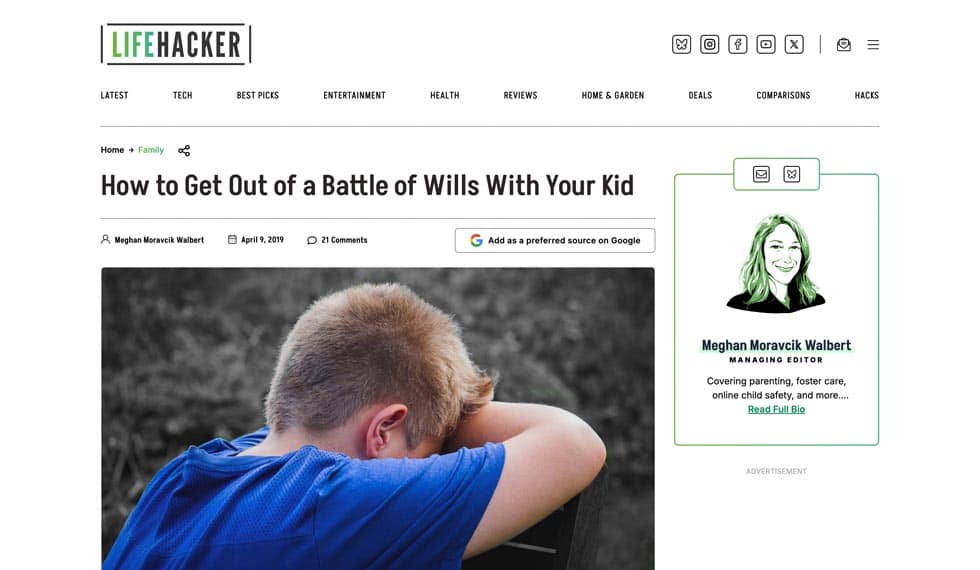
[00:23:58] Bonni: This is the point in the show where we each get to give our recommendations. I’m very careful anytime of comparing our students to children ever, or thinking of ourselves as parents, so just let me get that out of the way. I did read a short article which I’ll post, of course, as always, in the recommendations part of the show notes. How to Get Out of a Battle of Wills With Your Kid. Like I said, it’s just a real short article. I’d love for you to read, those of you who are parents, but I’d love those of you even if you’re not, who are teachers, I think there’s some helpful things here.
Why am I deciding to use this comparison right now? Well, this author talks about that sometimes she gets sucked into almost like a battle of the wills with her eight-year-old son over the simplest of things. What he’s going to wear on a particular day, or where a certain toy should be stored. As a parent of a now five and seven-year-old, I can certainly relate [chuckles] to those times where it’s really more about this power dynamic. Of course, [chuckles] any of us in relationships can feel ourselves when it’s more about being right or about winning. These are the times where we really need to be self-aware enough and step back.
She advised that we should ask, in this case her eight-year-old, or in our case we could even ask our students this, “Why is this important to you?” She writes, “Something about the word ‘important’ signals to him,” her son, “that one, I figured out that it is important to him. Most of the conversation up to this point has probably been him trying to relay this fact, and that two, I’m listening and I want to know why.” I was really inspired when I read this, to try this more in my classroom and also to try it in my meeting with colleagues.
I wonder if I asked that question more in meetings around our campus, what additional opportunities might emerge so that we can really understand each other better. Actually, I’m just realizing this now as I’m saying it, Elizabeth, is that it does go back to the whys, which we started out our conversation around. “Why is this important to you?” I guess this is kind of– I didn’t realize that it would relate to this episode as much as it’s turning out to. I’d suggest, my recommendation is, people, go read this article, How to Get Out of a Battle of Wills With Your Kid, and to ask more of the question, “Why is this important to you?” I’m going pass it over to you for your recommendations.
[00:26:28] Elizabeth: I think that that is an excellent recommendation. I guess my recommendation would come in two-fold. The first part of it is to assure faculty, assure college teachers, that if they’re struggling in the classroom, that they not feel alone. I speak all over the country and I’m almost always surprised at how faculty, regardless of the institution, regardless of how long they’ve been teaching, how many of them struggle with teaching effectively. I want to recommend that people not feel alone, and I would hope that we would be able to create safer places on our campuses that teachers can share the issues that they’re facing and get help.
I know that many teachers are concerned if they’re very new, it makes them very vulnerable politically, especially if they’re on a tenure track. Even very senior faculty who might be known as experts in their particular content area, it’s very awkward and embarrassing for them to admit that they’re having problems. The core of the recommendation is, know that you’re not alone. Teaching college today is very tough, and almost everyone who takes it seriously is struggling. That’s the first part of the recommendation.
The second part of the recommendation, Bonni, I don’t know if you’re aware that we founded a non-profit organization called The K. Patricia Cross Academy, founded and named after that person at Harvard that I told you was really the great originator of the official college teaching technique as we see it. It is available 24/7, totally free, with examples of our techniques, so that teachers can search for them whether they’re looking for something new for discussion or for writing, whether they’re looking to attend to a specific kind of learning taxonomic level, like critical thinking or establishing foundational knowledge.
Each of the videos comes with a downloadable document that provides all the information that they need on that particular technique. We’re very excited about it and just encourage people to use it to help them in their struggles in being more effective teachers and improving their student learning. Completely free, completely online, you can do it anonymously. The feedback that we’ve heard so far is that it’s been extremely helpful.
[00:29:13] Bonni: It is a wonderful set of resources, the videos are so powerful and so helpful to us, it’s very practical. I didn’t know the story about K. Patricia Cross. It’s so fun just to have this opportunity to have spoke with you today and just to have this as you’re honoring her legacy in that way, and that’s so fun. Thank you also for this reminder that we’re not alone. I don’t think we can hear that enough.
It’s so fun when we do have the vulnerability to ask questions, whether our questions lead us to a resource like The K. Patricia Cross Academy or to Twitter or to have coffee with a colleague, [chuckles] it is such a nice thing to hear from you and just to think about all of your experience. It’s just been delightful to talk to you. Thank you so much for carving out a part of your day today to do this.
[00:30:02] Elizabeth: Well, as I said, Bonni, at the beginning, it’s truly been a delight and a privilege to talk with you. We clearly have so much in common, share so many values, and so I thank you for the opportunity.
[music]
[00:30:18] Bonni: What a delight it was to have this conversation with Elizabeth Barkley. I appreciate her bringing her decades of experience and both sharing such practical ways we can think about engaging our students and helping their learning come alive, but also the practical resource of the K. Patricia Cross Academy. I hope you go to the show notes at teachinginhighered.com/263 and have a look at the links there and the resources section. If you don’t want to have to remember to do that, you’re always welcome to subscribe to the email update that comes once a week at teaching in teachinginhighered.com/update. Thanks so much for listening to this episode. We’ll see you next time for number 264.
[00:31:16] [END OF AUDIO]
Teaching in Higher Ed transcripts are created using a combination of an automated transcription service and human beings. This text likely will not represent the precise, word-for-word conversation that was had. The accuracy of the transcripts will vary. The authoritative record of the Teaching in Higher Ed podcasts is contained in the audio file.