Follow the Teaching in Higher Ed Podcast
About this Episode
Christian Friedrich discusses equity in learning design on episode 182 of the Teaching in Higher Ed podcast.
I always try to work with the learners themselves.
Christian Friedrich
On episode 182 of Teaching in Higher Ed
Voices on this Episode


Show Notes + Resources
- Episode 130 – Digital Redlining and Privacy with Chris Gilliard
- OpenCon2017
- OpenCon Resources
- Do-a-thon at OpenCon
- Why I’m No Longer Talking to White People about Race by Reni Eddo-Lodge
- Re-thinking Design for the Inclusion of Marginalised Learners – a Provocational Learning Café
- Web Safe Colors
- The Family Book by Todd Parr*
- Virtually Connecting
Recommendations from this Episode

Transcript
Bonni: [00:00:00] On today’s episode of Teaching in Higher Ed number 182, Christian Friedrich discusses equity in learning design.
Production Credit: [00:00:11] Produced by Innovate Learning, maximizing human potential.
Bonni: [00:00:20] Welcome to this episode of Teaching in Higher Ed. I’m Bonni Stachowiak and this is the space where we explore the art and science of being more effective at facilitating learning. We also share ways to improve our personal productivity so we can have more peace in our lives and be even more present for our students.
Bonni: [00:00:47] I have been familiar with today’s guest’s work for quite some time now and especially enjoy getting to engage with him on Twitter and in other places. I actually got to meet him in person at the Digital Media and Learning Conference earlier this year.
Bonni: [00:01:02] Christian’s work has always centered on open teaching and learning practices among faculty and staff. Over the last few years, his work has focused even more on openness, safety, and inclusively in education. Christian is the co-host of a German podcast on open education and a freelance consultant in online learning. He’s a member of #TowardsOpenness where he and many others aim to provoke conversations around open and connected learning and of virtually connecting, a community that provides space for virtual participation and representation at conferences. Christian, welcome to Teaching in Higher Ed.
Christian: [00:01:47] Hi Bonni, I’m glad to be here. Thanks for inviting me.
Bonni: [00:01:50] It’s wonderful to be talking to you today, especially after the great thing it was to get to meet you in person. And now here we are back to connecting virtually.
Christian: [00:02:00] Yes, yes. I’m really enjoying it. Thank you for inviting me. It is quite an honor, especially looking at the list of people who have been on before me.
Bonni: [00:02:08] Well it’s an honor to talk to you today. I really regarded the work that you do for advocating for greater equity in learning design. I’m just excited to get to have a conversation with you about it today. Let’s start going back in your history, can you tell me about a time when you went through a learning experience that wasn’t necessarily designed with equity in mind?
Christian: [00:02:32] So I think I have a couple of stories to share with that regard. And I’m not sure- as I said in the pre-conversation we had, I’m pretty sure not many people are aware of it, but I used to sell cars for a living in my first career. At that time, Web based learning or digital learning was stall like somebody would send you a CD-ROM, you would plug it in somewhere, you take a test, and then you get to go to an onsite facility of some sort and do a workshop. And that did not have that in mind at all. And I’m also not sure how much people would value that and should value that compared to public education for example. And the other thing is to- how would you say that?- To be kind of self-critical to some extent. I’m pretty sure I’m guilty to smaller or larger extents of designing learning experiences and learning formats, learning environments without equity or marginalized communities or marginalized learners in mind.
Christian: [00:03:40] So that then more relates to my later career, if you want to call it that, in the last five or six years when we started Leuphana Digital School to design larger scale online courses where we were thinking much more about access than about who gets affected by that in what way. Which is something that is really hard if you think about large scale courses that address and invite thousands of learners.
Bonni: [00:04:10] Can you talk a bit more about what it means to emphasize access? We talk about this a lot in the OpenEd movement, but I like to define our terms. And what does that mean to you if I am not expanding my access enough? Or what are some of the challenges that come up there? And what does that mean to you to think about access?
Christian: [00:04:31] My thinking on that is still progressing as well. But the way I see it at this moment is that when we talk about open pedagogy or any kind of open learning format, lots of people tend to think in restrictions or in copyright and rights that then are granted to others to do something. And that’s just the access to content then.
Christian: [00:04:54] So that’s what I have in mind when I think about like strictly speaking about access. And I like to think more in terms of- to be honest the content is important and should be valued and should be accessible by anyone regardless of technology and all of that. But I think it’s much more interesting to think about what happens once somebody has access. And in order to foster a learning environment that actually enables that pedagogical learning environment, you need to think more about accessibility and to be less abstract.
Christian: [00:05:34] I think you had Chris Gilliard on just about a year ago, I think.
Bonni: [00:05:37] Right. Yeah.
Christian: [00:05:39] And to think about how how students, how learners get access with what kinds of devices, what hoops they have to jump through in order to to make that happen on the one hand. But also what happens once they are in that large online course, and how their opinion is valued, and how their own context is valued, and all that is something that comes after the actual access to content, right.
Bonni: [00:06:03] So as learning designers, we absolutely need to think about access. But you’re sharing a bit that part of your own evolution in thinking was yes, think about access but ALSO think about accessibility. Could you talk about a course or a learning experience that you think exemplifies someone thinking critically about accessibility? Whether that’s you or someone that you admire.
Christian: [00:06:30] Mhm. The most recent example is basically about me as a learner, I think. And it was just just a couple of weeks ago. I had a bike accident. And in that bike accident, I fractured a bone in my leg which is not as bad as it sounds, but it kept me from going to the OpenCon conference that was held in November in Berlin this year.
Christian: [00:06:52] And I was really happy to have been accepted there and I was really looking forward to it. And then I couldn’t go. But they did manage to provide great access to a conference because lots of times when you speak about conferences or when you look at conferences, you’ll see key notes that are live streamed and you might have a Twitter stream, and that will just be it.
Christian: [00:07:15] But the the OpenCon people really thought hard about this in terms of who’s going to get access to what. So they had the actual live stream. They also had collaborative notes. They had block posts that they tried to incorporate into that conference.
Christian: [00:07:31] And they had one full day devoted to what they called the The Do-a-thon where they did collaborative projects and they basically kind of like a hack-a-thon on Open. And they invited people from outside the conference venue to participate in that using technology. They thoughtfully crafted that experience. That was really worth pointing to I think for anyone who visits a conference every once in a while.
Bonni: [00:07:59] Do you spend more of your time these days sitting down to design a course for starting from your own expertise and your own interest? Or do you spend more of your time today coaching others who want to design learning experiences?
Christian: [00:08:17] It depends. Most of my time these days goes to coaching and working with faculty and staff to develop those courses and to consult with faculty on how they design their learning or their teaching. But to some extent, I always try and work with the learners themselves somehow. Or at least I try to keep some part of my week to that and make that happen somehow. So I generally always try and have not just my job and that’s it. But also a couple of projects or ideas on the side basically, which is enabled by the fact that I don’t have a full position.
Christian: [00:08:57] And what I usually try to do is to either open up like a conference workshop or anything like that that I’m participating in or work with faculty onsite in their teaching, in their everyday experiences with students and learners. So I try to balance that out a bit.
Bonni: [00:09:20] What have you found that faculty tend to neglect when designing learning as it relates to equity? What are some inadvertent mistakes that we make because we’re just not thinking about as we design courses?
Christian: [00:09:34] I think there are lots of things. But I think very much on different levels. There’s one technology infrastructure level, right. That’s basically what Chris Gilliard was talking about when he talked about digital redlining on your podcast. So things like access to technology, access to a laptop or a smartphone, the bandwidth and all that.
Christian: [00:10:00] But I think lots of faculty also fall in the trap of judging other people’s context by looking at their own. And they will do that without either acknowledging it or even being aware of it. And that I fall into that trap plenty of times and I think we need to be aware of that that that’s how we work basically as humans. But to imagine someone living in a nice flat somewhere where neighbors are not loud but like the settled academic life, right?
Christian: [00:10:34] If there is such a thing. So you are kind of middle class, well-off. You will probably have access to technology. You won’t have to worry about money at all. But that’s not the life of the everyday learner. And especially like in the North American context maybe even more than in Germany, might be the case. I’m not even sure.
Christian: [00:10:56] But I think what this extrapolation of my context is this, so for students it should be like this as well. Or my kids will do this this way and will have access to it and will have a calm room to work on this problem in. That kind of thing is something that I think most of us will do at some point, but also pedagogy and how you set up a learning environment.
Christian: [00:11:24] I remember lots of people before what happened on the political horizon one or two years ago with you have a new president and Great Britain will no longer be part of the EU. And with that came a different awareness among educators I think of what social media does not only to us to, to some extent. And how what we get exposed to.And by we I mean people who are somehow more or less self-confident in their identity and in their way of going about things online. And I think you can extrapolate that experience and transfer that experience to your students as well. And there’s a trap there. I think that that people will assume that their online experience, for example and in a forum or somewhere, might be the same for others as it is for them with a fancy academic title, for example. So I think there are lots of traps that you can walk into.
Christian: [00:12:34] And I think there’s no avoiding all of them at all times. Because there comes a cost in terms of headspace, for example, and what your institution provides you with. I don’t think this should be left only to educators, but this is an institutional problem and should be addressed on that level as well.
Bonni: [00:12:54] I have become completely obsessed with context. And it’s interesting to me that you would bring it up because when I think about my early teaching, probably my mid teaching, probably even my current teaching, I do see this failure of mine of judging other people’s context by looking at my own.
Bonni: [00:13:13] I’m better at it today in some areas than I used to be. And I hope that a year from now I’ll be able to say I’m better at it a year from now than I am today. It has just become an obsession for me because I see it happening all the time to me and I see it happening to others. It really just does seem to be a failing.
Bonni: [00:13:35] And once I guess you catch wind of that failing, at least for me, I become very interested in doing everything I can to fight against it. Because it does hold people back from being able to learn well. And one of the things that we were discussing before we started recording was a little bit about you. You are white. You are a straight male. You are in your mid 30s. So the difference that you and I would have would be in age and also in terms of male and female. But we have much in common in terms of what you spoke about with socio economic. But I think you have even a bit more of it from being male.
Bonni: [00:14:12] So can you talk a little bit about your experience of being woken up to some of the ways in which being a white, straight male in your mid 30s that it did show you that you weren’t always able to see that context very clearly and how today it’s perhaps a bit more clear to you?
Christian: [00:14:30] I’ll start a little abstract and I hope I’ll get there. If not, please kick me towards the answer. So for me, I think what I like about my job right now is that I get to be curious somehow. So that’s something that not lots of car salesman experience.
Christian: [00:14:51] So to learn new things and engage with new, interesting people in academia who do quote on quote “nothing but thing all day.” And I try to stay that way. I try to learn new things every day- not every day necessarily, but on an ideal day, I will learn new things. And I think part of that comes from exposure to different contexts and to different people and different networks and bubbled so to speak if you want to talk about social media, for example.
Christian: [00:15:26] And I always found it interesting, but it was hard for me to- not to grasp, but to transfer to my own practice when I realized that this or that specific issue in the learning environment or this or that specific feature of a platform would actually provide others with the capability of bullying others for example.
Christian: [00:15:52] I think, again from what I was trying to say earlier in terms of you transferring your own experiences to others assuming that they must have the same, especially for someone who looks and acts like me. That can be quite a problem. So for me, it helped to to work with people who are not like me and to co-design learning experiences and teaching together with them.
Christian: [00:16:22] And if you are a bit curious about what they then- you might have a good friend or a good colleague who you can speak to about that, but I would just suggest to go and read and search about that kind of experience from others and where they share that and try and take that and think about that and reflect that and go back to it.
Christian: [00:16:48] I just recently stumbled upon a tweet and I apologize because I can’t really remember who it was from. But it was somebody who was speaking from her position from an “ethnic minority” quote on quote.
Christian: [00:17:04] And she basically said stop approaching me if you’ve never met me and asked me about the most basic stuff of what it is like to be Asian or female or whatever it is in that context. Because you might as well go ahead and just search for that online and you’ll find plenty of people and block posts and research on what that is like and what you can do in order to prevent marginalization for example from not totally from happening, but maybe to offer that to some extent.
Bonni: [00:17:38] Could you share about the writing “Why I’m No Longer Talking to White People about Race” and how that had an impact on you.
Christian: [00:17:48] So anybody who knows me knows that I’m not really a book reader. So I like to read, but usually it’s blog posts, papers, and stuff like that. And I recently stumbled upon the book “Why I’m No Longer Talking to White PRople about race” by Reni Eddo-Lodge.
Christian: [00:18:07] And the book is based and has its origins in a blog post she wrote in 2014 with that exact same title where she basically goes into an argument that she makes why she no longer has the capacity or power maybe to engage white people in talks about race.
Christian: [00:18:25] And that’s usually because that transfer doesn’t happen. That white people would not acknowledge that they have a privilege and that they might even get defensive and feel that that privilege is at stake if they are questioned by others so to speak.
Christian: [00:18:44] And I found it interesting especially reading the preface of that book. I only made it to page I think 60 or 65 of that book. But reading the preface, where she actually goes into some context on that blog post, she publishes that blog post and she talks about how it was received. And I think just by reading those 10 or 12 pages, you’ll get a great idea- at least for me it was like another fragment that I felt like I had unlocked to understanding what I’m talking about really when it comes to for example equity and marginalization in education because I think the mechanisms that she was exposed to and still is exposed to are kind of the same to some extent in education, for example.
Bonni: [00:19:36] You spoke earlier about your transition of not only emphasizing access, but also thinking critically about accessibility. And one of the ways that I presume many/most of learning designers think about yes there’s some things up front I need to do before I even begin designing a course thinking about to ensure a greater possibility for equity.
Bonni: [00:20:02] And then there would be some things I would do after a course was designed almost like a double check. Go back and reanalyze this course with equity in mind and find any mistakes or you said so eloquently, lack of context that I have inadvertently produced in this course.
Bonni: [00:20:24] I’m wondering if you have any thoughts about- I’m forcing you to make a false choice and you don’t have to fall for it if you don’t want to. But if I had to emphasize one, if I could only emphasize one, would there be the stuff that happens before I start designing or that double check after I am done that you would say to either takes more importance or that we just tend to forget more?
Christian: [00:20:46] In an ideal world, I think there would be perfect answer to this. I don’t think there is. But I think this should hppen and can happen on many different levels. So a classic conversation when it comes to accessibility is to use web safe colors that enable colorblind people to find that button on the top right of your website.
Christian: [00:21:08] So that’s a very almost binary thing where you can either be right or be wrong. But then there are so many other layers where you cannot really be right in your course design and where you have to make tough choices. Because you at some point you will have to get comfortable with the fact that whatever you are working on will be as good as it gets on one hand. And you just have to try. And of course there’s a huge value in evaluation. If you had made me to opt for one, I think I would have chosen the first. But I would have also wanted to add that. And again, in an ideal world, you would have yourself access to people who you get to work with who have different plans.
Christian: [00:21:57] So this is like one of the biggest critiques that people have about the Silicon Valley, that there are lots of engineers and lots of companies who are not diverse at all and who then design flawed systems and flawed environments because they will not care about those communities and users are learners on the margins. And in an ideal world, as a learning designer, you would have access to people and co-design with people who are not like you in order to make the best work for the best possible outcome for your learners.
Bonni: [00:22:42] The other day we had a chance to go volunteer in the library at our kids school. And it was when our son’s class was spending some time in the library and they read the book called The Family Book by Todd Parr.
Bonni: [00:22:55] It’s a wonderful book that speaking of context just shows a lot of different families that a family isn’t only like some of the children will have experienced that’s got a mom and a dad and two kids and a dog. Right. Two point two kids and a dog.
Bonni: [00:23:11] I think they had 30 minutes in the library maybe. But there were lots of things that they were doing. We got to record some of the kids with this app called Seesaw and capture another book award they had nominated and all this stuff.
Bonni: [00:23:24] So this was a very short reading of a book that for some of the children that have never spent any time with families that looked drastically different than theirs caused some confusion. At one point- because the book talks about- it brought up in this context some single parent families or do some families have two daddies or two mommies and all this. And one of the kids in the class said “well you have to have a mommy because if you don’t, you can’t have babies.” And she brought up that you know adoption is a possibility and then I’m sitting there thinking in my head “yeah and so is surrogacy,” because we have family members who have been able to have children through a surrogate.
Bonni: [00:24:11] And it just cracked me up though because the reason I’m bringing this up is that you sort of brought to my mind that it is a never ending process. There was not that time in the library that day to discuss surrogacy and all of the possibilities involved, but it was a part of a broader appreciation for diverse families. And that was just one part- the librarian was doing her part of the work to introduce them to some of the ways that families look different. And that then as they get families together, then that’s another part of the work where they get to actually see some of the children’s families and how they look different from their theirs and then talk about that, but it’s a never ending work. We will never have a beginning and an ending of equity and learning design. By its very nature, it is ever ever present or it should be I guess ever present ideally that we’re always thinking with those lenses and trying to find the gaps.
Christian: [00:25:14] It is. And I think I’ve come- I’m pretty new to this whole online learning thing. So I’ve only been with this for like five or six years now, but it feels like it’s almost like playing a jump and run where as soon as you learn something, you unlock a new complete world. And then you’re like in the underwater world and you have to struggle and find new ways and always knowing that you’re working towards something that you want to achieve. But I think it’s also healthy to know that in the end you’re not going to make it to 100 percent. You will always lack some. And I think like I get perfectionism and all, but to to some extent here you will have to make compromises. Also and that is tough I think.
Bonni: [00:26:13] One of the things I know I wanted to have you share about before we get to the recommendations segment is the significance of this episode airing on December 7th. It will be available of course any day after December 7th. But why is it significant about it happening on December 7th?
Christian: [00:26:32] When you sent that date it made smile because that day- I just hope the program won’t change- but that day I will be co-facilitating a workshop in Berlin, Germany together with Hoda Mostafa and virtually joined by Maha Bali.
Christian: [00:26:53] And we will be doing a workshop. And let me just look that title up again because I’m really not good at this.
Bonni: [00:26:59] Oh I’ve got if you want.
Christian: [00:27:01] We were thinking the design for the inclusion of marginalized learners vocational workshop. And this will be also available online which is why I wanted to mention it. We basically plugged it into the towards openness network, I guess I would call it, that that I’ve been working on with Kate Green and [?] And lots of others.
Christian: [00:27:25] And we will have provocations around marginalization of learners and design for inclusion of them. And we also will try to add some resources on the workshop as well as a conversation on virtually connecting afterwards. So thank you for letting me plug that in here. But I think might be something worth taking a look ahead if you’re interested in this.
Bonni: [00:27:46] And if people want to see what is presently on the show notes, you can go to teachinginhighered.com/182. And as the possible recording of any virtually connecting sessions come available, I’ll update the show notes so you can always have access and it sounds like they won’t be recording the actual session but that there will be time to talk after that that will be recorded on Virtually Connecting.
Christian: [00:28:11] Yes that’s right. And we’ll have resources online as well. And we’ll try to make some some kind of online version of this, but this is still being designed and I hope we make it.
Bonni: [00:28:23] This is the point in the show where we each get to share some recommendations. And I wanted to mention that I sent out a blog post, and also it went out in the weekly email, about my end of 2017 Reading. I have a goal of reading 20 books in 2017 which depending on how much you read sounds like a lot or a little. It’s kind of funny the reactions I get sometimes. At any rate, I also have a bunch of books that I’ve been wanting to read for a while, many of which have been recommended on the Teaching in Higher Ed podcast. And I opened it up that if people wanted to just do an informal book club, I don’t necessarily have something I can do every month. But I thought hey end of December, beginning of January, I do have some time to do some reading. And I’ve got a lot of books I want to check out.
Bonni: [00:29:08] And I committed that if more than 10 people responded to that survey, I would follow through and see if we can’t pull together an informal book club. And I’ve put a link in the show notes to that post that includes a survey where you could indicate which of the books you might like to have a discussion about and then the method by which you might like to have said dialogue about the book.
Bonni: [00:29:28] And again, I’ve already received more than the necessary amount to do that follow through and I’m looking forward to having some important conversations and doing some reading with some members of the Teaching in Higher Ed community. If you want to join us go to teachinginhighered.com/182 and see that post under recommendations End of 2017 Reading with a survey in it. And now I’m going to pass it over to you Christian for your recommendations.
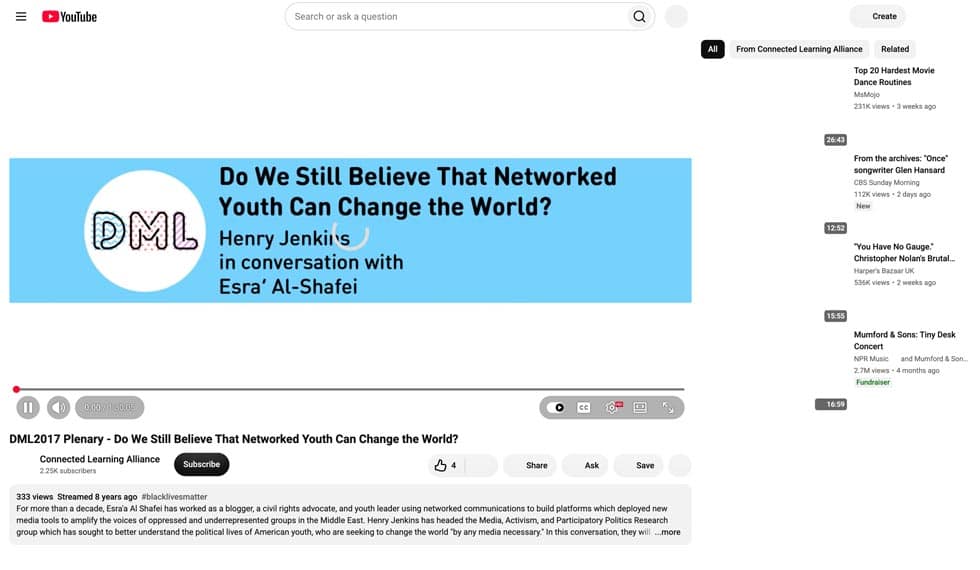
Christian: [00:29:54] All right. So I was going to go with the DML 2017 Plenary that we both sat in the same room to watch. And it’s called “Do Se Still Believe That Networked Youth Can Change the World?”
Christian: [00:30:09] And it’s basically a conversation. And the YouTube recording between Esra’a Al Shafei and Henry Jenkins. What I like about that and why I was going to stick it in here is that this change of perspective is really- this is like a great example of that change of perspective of how you approach online for example. And I really highly recommend anyone to watch that.
Christian: [00:30:39] But as soon as I was on the virtual participating side of OpenCon, the last panel that they had on their Sunday afternoon before they went to the Do-a-Thon period of the conference, they had a great panel on diversity, equity, and inclusion and open research in education.
Christian: [00:31:00] And this panel struck me in many ways and the people and the selection of topics and provocations that they delivered are just awesome. So I highly encourage anyone to take a look at that. There is a YouTube link with a hopefully correct timestep. And there’s also a collaborative google talk that they and virtual participants use for notetaking where you can find lots of resources around this topic. So a huge recommendation.
Bonni: [00:31:33] Christian, thank you so much for coming on this episode of Teaching in Higher Ed. And not only do we get to hear you today, but you’re going to be back for Episode 185. I so appreciate your contributions to this community.
Christian: [00:31:46] Well thank you. And thank you as well for your contribution. It’s really a valuable resource to go back to and listen to. And I’m sure you hear this quite a lot, but I don’t think one could say it enough, so thank you for that.
Bonni: [00:32:00] Oh thank you very much. Thanks to Christian for joining me on this episode of Teaching in Higher Ed number 182. And to all of you for listening if you’d like to access the show notes for this episode, they are available at teachinginhighered.com/182.
Bonni: [00:32:19] We are coming up to the time where some of us celebrate holidays. And if you would like to celebrate a holiday with Teaching in Higher Ed, a small gift you could give would be to rate or review the show on whatever service it is you use to listen to it. That is one of the ways that you can help spread the word about the show and expand the Teaching in Higher Ed community. And another way is just to tell your colleagues about the show and episodes that have been particularly impactful to you.
Bonni: [00:32:47] Thanks so much for listening. You are all such a gift to me and I really enjoy the community and what has it has become since June of 2014. Thanks so much for listening and I’ll see you next time.
Teaching in Higher Ed transcripts are created using a combination of an automated transcription service and human beings. This text likely will not represent the precise, word-for-word conversation that was had. The accuracy of the transcripts will vary. The authoritative record of the Teaching in Higher Ed podcasts is contained in the audio file.