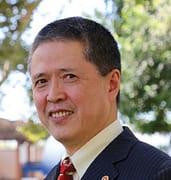
Dr. Wang has regularly taught research design and statistics courses in face-to-face, hybrid, and online course formats. These courses are historically challenging for some students. Meanwhile, the course rigor also plays an important role to increase the value of California State University degrees in the employment market. To promote the inquiry-based learning and knowledge acquisition, Dr. Wang incorporated cutting-edge technology into the curriculum to break three barriers in student learning:
(1) Make course taking more affordable- One strategy of Graduation Initiative 2025 is to expand the number of online courses and expand program availability. While online teaching has offered a convenient learning environment for students, licensed statistical software packages are physically installed at the university computer labs. To make the learning more affordable, Dr. Wang established an online computing lab that does not require the software purchase.
(2) Make learning experiences more useful - Statistical software in a university lab is subjected to annual license renewal. Dr. Wang’s computing setting is perpetual, breaking the barrier on time dimension to support student replication of what they learned from his class in the future job market.
(3) Make instructional support more accessible - Financial support is a typical obstacle for most first-generation college students with limited family resources. Without the need for using a licensed software in Dr. Wang’s class, student anxiety is reduced significantly from the software installation. Dr. Wang’s instructional support has made the Internet access as the only preparation for generating statistical printout for the course assignments.
Dr. Wang’s innovation is built on his scholarly inquiries to enhance teaching effectiveness for student success.