Follow the Teaching in Higher Ed Podcast
About this Episode
Shaina Rowell on episode 414 of the Teaching in Higher Ed podcast.
We can all help to create an environment where students can flourish, where their well-being and learning is important.
Shaina Rowell
On episode 414 of Teaching in Higher Ed
Voices on this Episode


Show Notes + Resources
Recommendations from this Episode


Transcript
[00:00:00] Bonnie Stachowiak: Today on episode number 414 of the Teaching In Higher Ed Podcast, Shaina Rowell joins me to talk about promoting student wellbeing in learning environments.
[00:00:14] Production Credit: Produced by Innovate Learning. Maximizing human potential.
[00:00:23] Bonnie Stachowiak: Welcome to this episode of Teaching In Higher Ed. I’m, Bonnie Stachowiak. This is the space where we explore the art and science of being more effective at facilitating learning. We also share ways to improve our productivity approaches so we can have more peace in our lives and be even more present for our students.
[music]
Shaina Rowell is assistant director of educational development in the Center For Teaching and Learning at Washington University in Saint Louis, where she works with faculty, postdocs, and graduate students. She’s particularly interested in helping instructors consider ways they can promote student wellbeing and has enjoyed collaborating with staff at the student health center.
She’s also affiliated with the department of psychology and brain sciences, where she’s taught undergraduate courses in research methods and lifespan development. Prior to joining the center for teaching and learning, Shaina worked for the Center for Integrative Research on Cognition, Learning, and Education on projects to implement active learning in large courses and to help students improve their study habits. She earned her Ph.D. in developmental psychology from the University of Virginia. Shaina, welcome to Teaching In Higher Ed.
[00:01:52] Shaina Rowell: Hi, thank you for having me here.
[00:01:54] Bonnie Stachowiak: Today is an important conversation about promoting student wellbeing and learning environments. Before you start giving us some possible ways we might consider approaching this challenge, could you tell us a little bit about what we know from the data?
[00:02:11] Shaina Rowell: Yes, I’m happy to. In the US in 2019, 40% of students at colleges and universities reported having a significant mental health problem. Over the seven years prior to that, the percent of students with positive mental health and wellbeing actually dropped from 57% to 40%, and so it’s not just about students having increases in more negative aspects of mental health, but also experiencing less of the positives.
[00:02:43] Bonnie Stachowiak: I know there’s a lot we could explore about the whys, but I think even before we start to look at some of the approaches that you’re going to suggest we might play a role in addressing some of these challenges. Could you talk a little bit about what we know between the connections having to do with these challenges, and then academics and what shows up in the classroom?
[00:03:10] Shaina Rowell: Yes. Students with poor mental health and well-being, it does have an influence for them in the classroom, and whether they have a diagnosed mental illness or not, they’re more likely to experience academic difficulties. For us on our campus, we see students, they report in those health surveys that we do with them, that stress, anxiety, depression, sleep difficulties, all of these are among the top factors for them of things that negatively impact their academics. These factors are really playing a big role for them in their experiences in the classroom and their learning.
[00:03:50] Bonnie Stachowiak: We’re going to be looking at four broad recommendations that your research and your report have to share, but before we do that exploration, would you talk a little bit more about why you personally think we should care about these issues?
[00:04:06] Shaina Rowell: Yes, I think it’s just really important, from being an instructor and from being someone who works with a lot of other instructors, just seeing how important it is to acknowledge that students’ mental health and wellbeing isn’t just someone else’s job. It’s not just the job of staff at the student health center. They certainly play an important role, but everyone on campus, we all have roles that we can play. They’re different. We don’t do exactly the same things, but we can all help to create an environment where students can really flourish and that their well-being and their learning is so important.
[00:04:49] Bonnie Stachowiak: I have a friend, her name is Sandy Morgan. She’s been on the show a number of times in all of these years. Part of her research, part of her work, is in ending human trafficking. It’s a common thing similar to the challenges you’re here to talk to us about today, where it just feels so big. I can remember when I first met her and started to become familiar with some of both the data and the stories and just feeling that– At least I want to tell myself it’s a natural human reaction to feel. This is just way too big. This feels way too big. I can certainly remember early in my teaching having similar feelings about, “I can’t do anything about this. This is just too big.” Then we then allow ourselves to just sit there and do nothing.
If we can try to take a sliver of good news out of it, these are real challenges. This is our students are hurting and those of us who care so deeply, which I don’t know anybody who listens to this podcast who doesn’t, it can feel overwhelming, but I truly feel like what your research has shown is that while, yes, it’s an overwhelming problem as a whole, there are some really small, practical, very tangible things that we can do that–
No, we’re not going going to solve all of these issues, but that can really contribute to making it better for– It’s that whole classic story about the starfish, [chuckles] if we can just get some of those starfish back. Do you have a similar feeling like that either in this area or in other areas of your life where at first it felt way too big, and then now you feel like maybe have some footholds.
[00:06:32] Shaina Rowell: Yes. I completely agree with what you’re saying there, that it does. I think for me as an individual instructor and for, again, those that I work with, it does feel like this huge problem and brings up this question of, “Well, what can I really do to solve that? Is it worth my the limited time that I have, and I’m already so overwhelmed with everything else?” As you say, a big aim of our project here and the information we have in the guidebook is to distill down small things that we can do, small changes we can make in our classes, and little things that we can implement over time to just be continuously improving our teaching the way many of us hope to, but to do that in a way that is keeping students’ wellbeing really in the forefront.
[00:07:15] Bonnie Stachowiak: You’re going to help us explore four areas that we might do that in, and we’re going to skim the surface. Again, in the show notes, and on the episode page, are going to be a link to your guidebook. I really encourage everyone to download it, but we’re going to touch on four areas. We’re going to look at social connections, compassion and stress reduction, belonging and growth mindset, and gratitude and purpose. I know you have some ideas to share for us in each of these areas. Let’s begin with social connection. How can faculty use this broad theme in order to make these issues perhaps a little bit lessened?
[00:08:01] Shaina Rowell: Yes, I think a couple of the suggestions that we have and the guidebook related to social connection have to do with office hours. That’s one really great example of an opportunity to form connections between yourself and students. We have some suggestions there about thinking about how to frame things in the syllabus and during the first few weeks of class to really create invitational office hours, to really invite students in, and help them understand more clearly what they can do in office hours and what kinds of things they can come to talk to you about so that students can really take advantage of that opportunity to connect with you because they often don’t know what to expect or can feel overwhelmed by that.
That’s one of the concrete suggestions that we have in there. As I mentioned, many of these suggestions are smaller things, but some are larger in the guidebook. We also talk about creating more opportunities for collaborative learning so that students are not just having connection with you, but also with their classmates. That’s another area that we touch on in the guidebook.
[00:09:12] Bonnie Stachowiak: You’re reminding me so much of the broad theme of the hidden curriculum. I was not a first-generation college student, but I can still vividly recall how terrifying it was to go to a professor’s office hours. The only reason I did was because I was failing macroeconomics and that just didn’t seem like a good idea. [chuckles] It was certainly not something I wanted to retake. Grades were not much of a priority, but failing the class seemed again, like not a good idea, but it was literally that had to compel me to go there, but it was not any sense, anything resembling an invitation. You just felt absolutely terrifying. Again, I feel like I’m not even at all this similar situation as some of the students that we serve, that it’s a whole different dynamic than when they don’t have access to that hidden curriculum to even know. Giving people ideas about what this could look like, and trying to find ways that we ourselves can seem welcoming and those office hours, what kinds of things might you come and talk to me about. We’re really helpful to people. I feel like I can use that in certain circumstances myself. I’ve other contexts where I need a little help there too. That’s wonderful. How about compassion and stress reduction? We have talked about this prior on the show, but it feels like we can’t enough. What I love about this one, too, is not only can we help this with our students, but really can help ourselves as well.
[00:10:36] Shaina Rowell: Yes. It’s such an important topic. In the guidebook, we focus in on what I like to think of as structure and flexibility in our suggestions, the idea being that building into a course, a certain amount of structure is important and helpful for students, having deadlines. We all know that if we don’t have deadlines, sometimes nothing gets done. Having that structure in place is really important, but then having some flexibility built into that structure to allow for you to show that compassion to students when they’re going through difficulties.
We encourage some specific suggestions, are things like allowing students to turn in a certain number of assignments late by a couple of days, or being able to drop a certain number of assignments or quizzes during a semester so that students are really given more agency in that. They’re able to decide when they need to use something like that. It’s really giving them the agency to make those decisions, but having that flexibility built into the course so that it’s not a hard thing for them to get.
[00:11:48] Bonni Stachowiak: Yes. So much of those things, I’m hearing a lot of conversation from faculty developers, that really COVID and the implications therein, have. We want to be flexible, but complete flexibility, I’m hearing many people say, without the structure that you’re stressing here and what you’re sharing, is not going to be helpful for different types of learners. Wanting to be purposeful in how we think about this. The other thing you’re reminding me too is that this can, yes, help with compassion, it can help with stress reduction. I’m also reminded of the reading I’ve done on academic integrity.
It also can help a little bit with that, where we can have assignments that, yes, we want authentic assignments, which also contributes to not having as many issues around academic integrity, but taking that pressure off such that I don’t feel like I– It’s a natural human feeling, when that pressure is really on, to want to take those shortcuts sometimes. That can be something that can help people get more out of the learning and also be less likely to not show up with the greatest of integrity. What are you learning and discovering and recommending around belonging and growth mindset?
[00:13:02] Shaina Rowell: That, I feel like was the hardest part of the guide to work on in the sense that there was so much that we wanted to put in there. We only wanted to distill down a few things, so, we didn’t want to overwhelm everyone. That section was just so hard to work on. A few of the suggestions that we put into there were things that help students focus more on mastery. When you’re thinking about the structure of your course, to be thinking about that in the back of your mind, and have that influence a lot of your decision-making.
Just a couple of examples would be having more low-stakes formative assessments, having opportunities where students can go back and make corrections on something. That’s, something I’ve been trying this semester, for the first time, and I’ve really felt like the students got a lot out of it, being able to go back and make corrections on their exams. Similarly, revising other types of assignments. Building that intentionally into the course so that students see their learning growing over time, and they can place more emphasis on that.
We put growth mindset and belonging together in this section because, from our perspective, those two things work so well together, that oftentimes, our students are losing their sense of belonging, in part because they’re getting messages from the environment that they’re in, that they can’t grow in that environment. Linking that together for our faculty and helping them see the importance of the intentional or unintentional messages that get sent related to that.
[00:14:50] Bonni Stachowiak: You’re touching on so many themes that we’ve talked about over all these years. I could imagine as you’re sitting down trying to put this guidebook together, there’s so much that could go in this area, something that for me in my own learning, has been tremendously important. You just touched on it, and for anybody who may have missed it, I just want to stress it again. It isn’t only about being encouraging in what we say, “You’re doing great,” giving good feedback. That is an important aspect of this, but it is actually then providing them with tangible ways to show themselves.
Instead of just saying things that help promote a growth mindset, it’s actually assigning things. In order to do that, we need to give people opportunities to fail, try again, get feedback, and have more of an iterative process. I do want to just quickly mention that, when this airs, this is episode 414. I’m going back to 410. If you’re not a regular listener, and you’re just here for Shaina, and the great guide, I’m so glad you’re here. I just listened to that episode a couple of days ago, and I told a story about a student in the class I’m teaching right now, who said he can’t see ever using some of the skills that we were talking about in class, ever outside the class.
He wasn’t being rude at all, but it was one of those things of like, “Oh, shucks.” Bummer, when you can’t read 100% of them, and literally, by the time the episode aired, he already had. Not that much time. I think sometimes we give up, and part of this is, I think the system, because so many classes, you touch on a skill, you turn in the paper and you never see it again. We’re not necessarily always good at doing this in a more iterative process across multiple classes to both build up students’ confidence in their own skills but also, confidence in us that we know what we’re doing, and that these skills actually, and the knowledge really does matter, and it’s going to be relevant to them in their lives.
I just wanted to quickly report back in that I already had a success story. I didn’t even have to wait until the episode aired before that change. I think sometimes we can give up because it’s hard sometimes to see the fruits of what it is that we’re doing both individually, but also collectively in higher education. I just had a happy story to share as a quick update on that one. Thank you so much for talking about, again, just the encouragement that we provide, but also the opportunities for people not just to hear about an opportunity to truly master something, but to actually experience, that’s so powerful.
I don’t know if you have any other examples or things you want to add around this before we look at gratitude and purpose. Please do if you’ve got something.
[00:17:33] Shaina Rowell: Yes, there’s another thing that we talk about in this section, is helping students move away from a feeling of needing to be perfect, and this sense of perfectionism towards more healthy striving. It’s okay to have high goals and to be trying to achieve those, but to be setting those goals as something that you can really do, and working towards them in a healthy way, instead of being stuck on all the little details of something. That’s part of this idea of growth mindset and helping students think about how to grow in a healthy and effective way in their classes. I think that’s also an important one to highlight.
[00:18:16] Bonni Stachowiak: Oh, so important. So critical. Also, I think we could collectively, as faculty, use a lesson on this ourselves.
[00:18:24] Shaina Rowell: I certainly could, yes.
[00:18:26] Bonni Stachowiak: Yes, for sure. Sometimes it’s hard to pick that mirror up and examine ourselves, but such a good reminder for us. What are you hearing and learning about how gratitude and purpose plays a role?
[00:18:41] Shaina Rowell: This section of the guidebook about gratitude and purpose is really about helping students to really appreciate the positive experiences that they have. Also, this is an important time in their lives, where they’re really thinking a lot about their purpose in life and developing that sense of purpose. Giving them opportunities in their coursework to celebrate little successes, is really important because these are the things that, day-to-day, help contribute to having more of those positive emotional experiences.
So much of our students’ lives have to do with things that are going on in the classroom or out of the classroom, but they could be celebrated a little bit in class. For example, we have one suggestion in the guidebook, about taking a moment during the semester just to pause and have students savor a success that they had. That might be something specific to your course, you might have just finished up a project in the class and give everyone a moment to really feel good about that, or it could be something outside the course.
Just creating that space in class to really savor those things. Then in terms of a sense of purpose, this is something that, integrating this into a course, really benefits both the students in having this opportunity to continue developing their sense of purpose, so that contributes to their wellbeing in that sense. It also really contributes to their engagement and interest in the course. It has benefits for you as an instructor, for students’ learning, and for their well-being to really have opportunities where that’s integrated.
Just a couple of examples with that, instructors might consider reflective writing assignments where students might connect course material with other parts of their lives that they’re thinking about, or in a bigger context, some instructors that we’ve worked with work on creating more authentic assessments or civic engagement courses where students are really engaging with the community. Those are bigger things, but as I said, there are also smaller ways that we can integrate this into any course.
[00:21:00] Bonni Stachowiak: Yes. I have to do a lot of thinking because I talked to so many amazing people for the podcast, so I have to do a lot of thinking of how do you shrink things down because, otherwise, it would be way too overwhelming. Even if we can’t incorporate data into a course in the way that our dreams might lend themselves to, even just finding examples. Is it an example that might come from something current that’s emerging in scholarship within your discipline or is it showing up in the headlines of the news or some combination they’re in or is it a work from a prior student or a scholar that is in a discipline that can be celebrated? Though sometimes just rather than think we have to be able to figure out these amazing ways.
Then it’s cool though to see how it can grow from there once we allow ourselves to take the pressure off of feeling like it has to be perfect and all that, try some things out and then see where it goes from there. Part of what you’re talking about too, in terms of purpose, I tend to think a lot about the idealism around purpose, and it can really put a lot of pressure because if you’re teaching in a discipline, which I think maybe all of our disciplines feel so broad and wide.
It’s a lot of pressure to feel like, “How could I make this relevant in terms of a purpose that–” because individuals are so unique, and then so are all of the aspects of our discipline. For me, sometimes I can shrink that down in my mind just to help people be curious about things, and you said that word which is what reminded me of the importance of curiosity. I think often about Josh Eyler’s book, How Humans Learn. He says in there, in order to learn something, we must first wonder about it.
Rather than me putting so much pressure on myself that I somehow have to find this deep purpose that’s going to, oftentimes for me, tied to their careers and their research and whatever’s going to be next for them, it can be, “Can I just get them to be curious about something and wonder about it?” Maybe it feels small today but then those little tiny doses of curiosity over time can add up to a really pretty magnificent thing, so I don’t know.
You can tell our theme in this episode, but I feel like it’s trying to take pressure off because these issues are so important and they’re so big and when we care so deeply, we sometimes can forget that little thing. It reminds me so much of when people interview someone about who was the teacher who had the biggest impact on you, and so many times it’s not a teacher that necessarily did anything that any of us couldn’t do, it was a set of words, it was encouragement and all of that, so I think that brings me a lot of hope. I don’t know about you. [laughs]
[00:23:33] Shaina Rowell: Yes, it definitely does.
[00:23:34] Bonni Stachowiak: All right. The last area you’re going to help us explore has to do with supporting students who are in distress.
[00:23:43] Shaina Rowell: Yes. The last section of the guidebook we created in partnership with our student health center, and this is about helping instructors to think about what their role might be with students who are experiencing some psychological distress and so really focusing in on the fact that we’re not mental health counselors, and so not asking anyone to be that, but to think about what can we be aware of, and what things can we do to help support students, and really think about our campus as an integrated network of trying to support students’ wellbeing.
In the guidebook, we really focus in on helping instructors think about how they can recognize different warning signs with students, how they can approach conversations with students, and where they can express their concerns with the student and really listen to them. That’s actually one of the biggest components of this section, is suggestions about how to really actively listen to students and open up a chance for the students to let you know what might be going on with them or to choose not to open up with you about that.
Just to create those opportunities for the students. We provide some specific phrases and things to use with students to give instructors an idea of how to approach those conversations because I think it can feel overwhelming and like you don’t know what to say. Just ways of validating students and saying things like, “Well, yes, that does sound hard. It sounds like you have a lot going on.” Just trying to help give people school kits to feel more comfortable. Then, of course, a big focus of this is that if instructors are concerned that a student, maybe their distress seems to be increasing or has been going on for a few weeks that knowing how to refer students to student health and knowing what resources are available to students.
I think that’s such an important thing that, even as instructors, just being aware of what’s out there, what resources are available for students is so important because even though students might be told from many different places that, “Hey, you could go do this or that counseling on campus,” it’s hard for them to keep track of it all and I think it means a lot to them when an instructor says to them, “Hey there’s this program where you can just go for a 20-minute Zoom appointment.” That might be a resource of interest. I think that can be really powerful. Just being aware of what resources are available on your campus.
[00:26:21] Bonni Stachowiak: Yes, so much of my learning here is stressing the importance of reducing the stigma of help-seeking behaviors can be a huge one. We had a mental health workshop on our campus in the last six months or so and one thing that’s still resonating from what that individual shared is, yes, please, and I do this on a regular basis of encouraging people to seek therapy and talking about what a difference it’s made in my life so that’s part of that, reducing the stigma and yet we also can be encouraging some of the small things.
Have you been outside and gone for a walk– Before you start to study tonight, can I get you outside for a 10-minute walk in the sun?” Again, not wanting to minimize things, and certainly, I mean the importance of therapy and getting the medical help that we need at different seasons in our life. Sometimes a 10-minute walk is incredibly nourishing and healing. If I didn’t have my mom in college regularly reminding me to do that, I don’t know if I would’ve made it through. I think that’s a wonderful thing. You talked about that also earlier in the stress reduction too. Yes, really important.
Well, thank you so much for all of this great advice and people can imagine, of course, I’m going to encourage everyone to download the guide, it’s free and available and a wonderful resource. I have a couple of other recommendations I would like to share on today’s episodes as well. Shaina, earlier you talked about deadlines, and you talked about both structure and flexibility, and this is coming up so often in topics of discussion.
What I love about it is no one’s saying they have the magic answers because these are really not easy. I feel like I’m tweaking a little bit every semester just really trying to adapt to where we find ourselves today and both be a caring individual in the short term with that flexibility, but a caring individual over the long term to have the structure that we as human beings just so often need.
It is really hard to strike that balance and that’s part of the reason why Robert Talbert’s article, he wrote on his blog, called A “Real World” Approach to Deadlines, really resonated with me. He talks a little bit about it from his perspective, and I won’t do it justice, which is why I’m recommending it, so we all go read it, but from his perspective, we really don’t, in higher education, treat deadlines as if it were in the real world. There’s always this condescending thing, “You better get it in by 11:59.” and that’s the real world.
He really pushes back on that assertion by many faculty that we need to have real-world pressure put on students that every single little thing has to be turned in by exactly that time or it’s a pass-fail. If you didn’t get it in by 11:59, you’re out all the points, that thing. He pushes back on that, talks about deadlines. I’m really fascinated by the topic of context because he talks about different types of professions, and which ones really do have pressing deadlines that we really do need to build up people’s resilience to be able to achieve that exact minute, that type of deadline versus the vast majority of professions.
That’s not how real-world deadlines work anyway, so it’s just a really nice piece. It got me thinking a lot and asking questions and still feeling like I don’t have all the answers but I really appreciated it. Then the second thing is a totally different category. If you’ve been listening to this show for any length of time, you probably know that I work to not recommend the same thing more than once. By the way, I love it when guests recommend the same thing because otherwise I never would’ve probably read some of the most amazing books. If a book gets recommended five times on this show I’m like, “Of course, I got to go read that book.” For me, I try not to recommend things that I went over 400 episodes. Never doing it. Then those of you that listen, know that already in the last few weeks, I accidentally recommended the same movie twice. [laughs]. What are you going to do? …That’s the thing that really got to me.
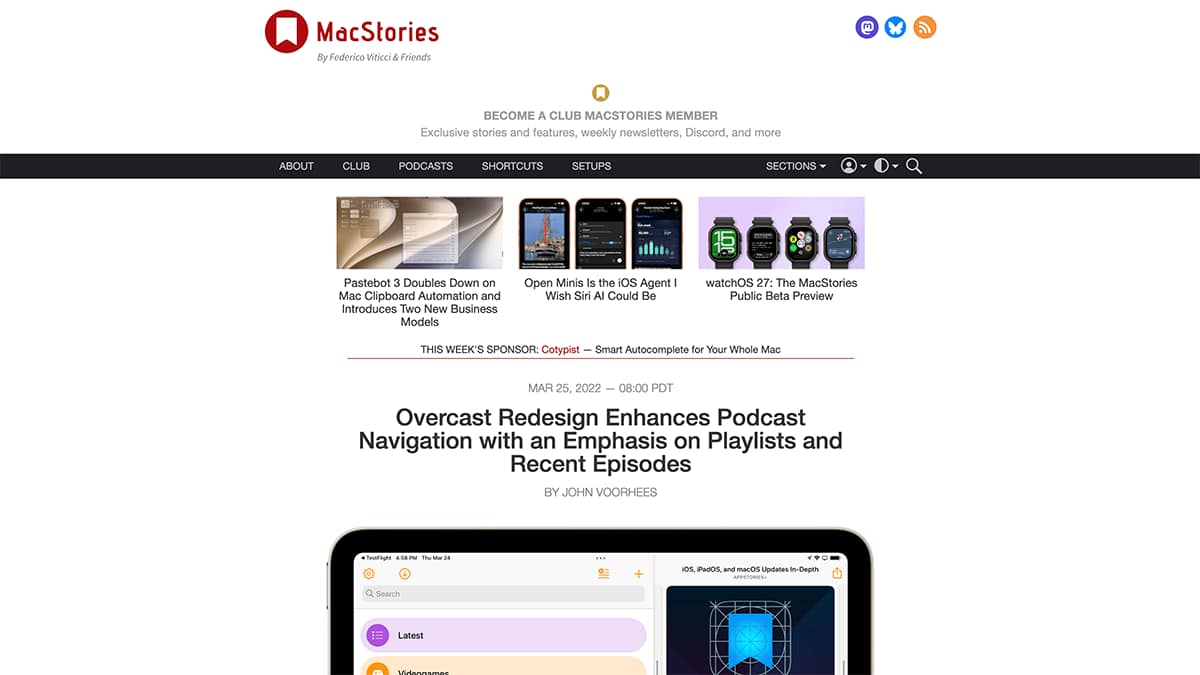
Anyway, I’m going to recommend something, but it’s the updated version of it. I’m cheating a little bit here because years ago, I recommended the podcast catcher that I use, the app on my phone, which is called Overcast. I know I happen to know that 80% of you listening, listen to this podcast on an iOS, as in an iPhone or other type of device like that, so 80% of you might be interested in the redesigned Overcast app.
It’s a little bit less about features, still has a lot of great features, but also just the look of it. It’s got these colorful playlists, and it was really a vibrant redesign. I absolutely love that podcast catcher. I stand by it. I recommended it probably years ago and still stand by it just being– I will sometimes look at different podcast catcher apps and see which ones might be showing up as better. It’s been tried and tuned and it was a really, really nice redesign. That is my recommendation for today. Shaina, I’m going to pass it over to you for whatever you would like to recommend.
[00:31:25] Shaina Rowell: I decided to recommend something related to well-being, but instead of for students, for instructors, because our well-being is important too. I think we can all be a little hard on ourselves with our teaching sometimes. That might be at the end of the semester, it might be over the summer when we’re thinking back on what we had been doing, or at the beginning of the fall when we’re getting ready to teach again. I just wanted to recommend a self-compassionate letter to ourselves. I have tried this, and I find it really helpful. I can provide a link to the Greater Good in Action from UC Berkeley that has an example of how to do this. You just write a letter to yourself as though you were talking to a friend.
You kind of put yourself outside of your own mind here for a minute and treat yourself as you would want a friend to treat you. It helps you to be a little less critical of yourself and remind yourself that you’ve done many good things in your teaching, even if it wasn’t perfect. Getting back to that perfectionism issue that we talked about earlier. That’s my recommendation for today.
[00:32:37] Bonni Stachowiak: This episode is going to air on May the 19th. Although, of course, people could be listening well after that fact. What a nice season after many of us, it depends on of course, how our semester/terms are scheduled, but a lot of us are going to be closing down the season and looking to enter into a new one. What a wonderful opportunity to do some reflection and be kind to ourselves.
That looks like a wonderful template. I’m familiar with the Greater Good at UC Berkeley, but not the Self-Compassionate Letter. That sounds wonderful. Thank you so much for the recommendation and also just for being willing to come on and share about all the research. I know it wasn’t just you but a whole collaboration of people at your institution. Just thank you so much for your generosity and being on the podcast today.
[00:33:20] Shaina Rowell: Thank you for having me. This has been a really wonderful conversation.
[music]
[00:33:26] Bonni Stachowiak: Today’s episode was produced by me, Bonni Stachowiak, and was edited by the ever-talented Andrew Kroeger. Production support was provided by Sierra Smith, a phenomenal educator who just happens to still have time to engage in this side gig for us at Innovative Learning. These podcast episodes are just one Teaching in Higher Ed Resource. If you’d like to receive the weekly email updates subscribe at teachinginhighered.com/subscribe. You’ll receive the show notes from today’s episode as well as a preview of the following week’s episode and recommendations that don’t even show up here on the episode. Thanks so much for listening. I’ll see you next time.
[00:34:28] [END OF AUDIO]
The transcript of this episode has been made possible through a financial contribution by the Association of College and University Educators (ACUE). ACUE is on a mission to ensure student success through quality instruction. In partnership with institutions of higher education nationwide, ACUE supports and credentials faculty members in the use of evidence-based teaching practices that drive student engagement, retention, and learning.
Teaching in Higher Ed transcripts are created using a combination of an automated transcription service and human beings. This text likely will not represent the precise, word-for-word conversation that was had. The accuracy of the transcripts will vary. The authoritative record of the Teaching in Higher Ed podcasts is contained in the audio file.