Follow the Teaching in Higher Ed Podcast
About this Episode
Angela Jenks on episode 289 of the Teaching in Higher Ed podcast.
Looking for open education resources is always good, no matter what field you are in.
Angela Jenks
On episode 289 of Teaching in Higher Ed
Voices on this Episode

Show Notes + Resources
What information to include in syllabus?
When will your class meet?
Remember the holidays
How much reading should you assign?
How much do the books/course materials cost?
- Open access textbooks
- Suny – open textbooks
- Society for Anthropology in Community Colleges
- University of California Luminos
How many works are written by women, people of color, or other marginalized authors?
Is your syllabus accessible?
Conduct a more detailed self-assessment of inclusion in your syllabus and course design with this survey
Include a statement on access and inclusion
Include a basic needs statement
Give a quiz on your syllabus, or make it interactive
Recommendations from this Episode

Transcript
[00:00:00] Bonni Stachowiak: Today on Episode Number 289 of the Teaching in Higher Ed podcast, I get to welcome friend and former guest back to the show, Angela Jenks. This time to share some syllabus resources.
[00:00:14] Production credit: Produced by Innovate Learning, Maximizing Human Potential
[music]
[00:00:23] Bonni: Hello and welcome to this episode of Teaching in Higher Ed. I’m Bonni Stachowiak and this is the space where we explore the art and science of facilitating learning. We also share ways to improve our productivity approaches so we can have more peace in our lives and be even more present for our students.
[music]
[00:00:52] Bonni: Today’s guest, Angela Jenks, is back on the show, this time to share with us some wonderful resources she initially posted on Twitter and is back to share with us in person. Let me share a little bit about her in case you didn’t listen to the former episode. I think it’s been a while now.
Angela is a medical anthropologist and associate professor of teaching in the Department of Anthropology at the University of California Irvine, where she also directs the undergraduate program. Angela is the editor-in-chief of the Teaching and Learning Anthropology Journal. Angela, welcome back to Teaching in Higher Ed.
[00:01:26] Angela Jenks: Thank you so much for having me. It’s wonderful to be back on.
[00:01:29] Bonni: We were reminiscing before we pressed “Record” and apparently your life has gone on since last time I saw you. There’s been a lot going on on a personal front and then also I saw that you recently won an award. Would you tell us a little bit about that? It sounded exciting.
[00:01:43] Angela: I did. I won the University of California Irvine’s Academic Senate Early Career Faculty award for teaching. It’s really a fantastic honor to be recognized by a lot of my colleagues here at UCI.
[00:01:56] Bonni: I thought it was wonderful too. Most listeners probably wouldn’t know that, but I used to work at UCI and just have such a fondness for its institution and know what an honor this is and my heart swelled. I was like, “Yay, she deserves that so much.”
[00:02:07] Angela: Thank you so much.
[00:02:08] Bonni: I know you’re doing some teaching of graduate students who are learning how to teach in higher ed and listeners will be affirmed in that too because so often people will get their doctoral degrees and never have any kind of classes about how to teach. I’m so glad you’re doing that.
[00:02:21] Angela: Absolutely, I never had any really formal training about teaching. It’s really nice to be able to put something together. I’m learning so much from putting things together to help students.
[00:02:30] Bonni: I had a class in my doctoral program about teaching, but it was really more on the theoretical side and what I like about today’s episode is that we’re going to be looking at how to create a syllabus, but we’re going to look at it, yes, from a theoretical because it’s an important document or whatever form it takes. It’s an important piece of communication for our students, but you have a lot of really tangible, practical ideas for us too. This is probably a season where many of our listeners are working on their syllabi.
[00:02:58] Angela: Yes. Hopefully, there’s some resources that can solve really some of the day-to-day, practical issues of putting a syllabus together.
[00:03:04] Bonni: One of the things I want to mention to listeners is that you’re going to be sharing, as I just said, a lot of tangible advice and they’re going to be all linked to on the show notes. Those will be at teachinginhighered.com/289. I think for actually every question I’m about to ask you, there’s at least one, if not more than one, resources for people to go have a look at, starting with this first one. What information should we include in our syllabus?
[00:03:28] Angela: Well, it’s a great question. It’s the best place to start. One of the best things to do is actually check and see if your institution has a template. Here at UCI, the Teaching and Learning Center has a formal template with a list of what they want included. Nearly every institution has one of those. There’s a couple of general checklists that do exist that can be helpful so that you can run through and make sure that all of the basic information that should be on the syllabus is on the syllabus.
[00:03:54] Bonni: Some institutions are very strict about that. You don’t really have a ton of latitude, and some you have a ton of latitude but in my experience, it may not be articulated very well to you, so you really do want to talk to your Chair or whoever the appropriate person is there. I know you have a link to a University of Michigan site about how to create your syllabus and it has some great information about what to include in the syllabus as well.
[00:04:16] Angela: That’s a great general one if your institution doesn’t have anything directly.
[00:04:19] Bonni: Yes. I always like to look them too because sometimes they’ll word things differently. I went through this whole thing. I feel like I’ve gone through this multiple times actually where I read through my syllabus and go, “Wow. I sound like a jerk.” [laughs] What was I thinking when I wrote that and actually one of the things that has helped me is to reframe or rearticulate my syllabi in first-person language. I sound a lot less like a jerk when I use “I” and “you” language and a lot more passive sentences and also passive-aggressive sentences. [laughs] I tend to write third person, so I like to read what other people [crosstalk]
[00:04:55] Angela: Yes, so I can take those are like commandments, “Thou shalt not [unintelligible 00:04:58] anything in late” and “Thou shalt not use a device in class.” When you really put it in the first person, I think it makes it much more human.
[00:05:06] Bonni: Yes, and it helps me, at least from a writer’s standpoint to be able to say “Why?” on some of these things. Why do we talk about deadlines for assignments and actually on the last time you were on the show, that’s what we talked about was we’re not advocating don’t ever have deadlines that we have each found as professors that that’s an important skill to instill, but how to set those expectations well and then also not be a jerk and also not discriminate against people that have issues that might prevent them from having gotten something in on time. What should we say about when our classes might meet?
[00:05:41] Angela: Two important things or two really helpful things. There’s a great calendar tool by Caleb McDaniel where you can just enter in the year of your course, the first day, the last day, and the days of the week. You can check off if it’s a Tuesday/Thursday course. It will generate a still list of all of the dates, the Tuesday/Thursdays during that semester or quarter. It’s enormously helpful when you’re– so you don’t have to pull up– I always have a paper calendar next to me or I’m pulling up my Google calendar to click through and back and forth to syllabus.
This just generates the list automatically. I’ve used it to cut and pasted it into my syllabus then and then fill in the information. What it doesn’t include are any sort of holidays that you want to be aware of. There’s a tool developed from the University of Iowa’s IT Services that’s called the Be Mindful Holy Days calendar. It’s a tool where you can subscribe to this in Google calendar or iCal or whatever system you use. It will mark many of the religious holidays for a wide range of religions, so you know that if you’re teaching a class in October, for example, Rosh Hashanah and Yom Kippur this year are both in October.
You might not want to have an exam on a day where you know a lot of students may not be able to meet or to come to campus. The same thing if you’re planning for the spring, Ramadan this year is going to be from late April to late May. It’s good to know that if your students are observing, they’re fasting, they may be a little low energy. They may be tired in ways you have to accommodate. I think it’s really important to make sure that exams and major events aren’t scheduled for the end of Ramadan where people have a lot of family obligations. The calendar can be really helpful to map out the course around obligations that we all have.
[00:07:23] Bonni: One of the ways that I’ve changed in terms of communicating when my class will meet, I’m going to do a little before and after. We use the Canvas Learning Management System, but this applied when I used Moodle. It also applies I sometimes teach on Blackboard as well. I would tend to how I used to do things was that I’d put in an assignment, if there’s going to be a test on a given day, or if there’s a paper that’s due, then those were things in the learning management system that had dates associated with them, but I would never put my classes in there because it would be like, “We know when we’re meeting and it’s in the syllabus.”
If it’s in the Word document, for example, or the PDF, but now on campus what I’ll do, it allows for repeating events.
I just go to the calendar itself and if my class meets on Mondays from 2:30 to 5:30, I’ll put it on there and say, “Repeat for 15 or 16 weeks.” Then it lets you go back in and that’s where I do my class planning. From this time to this time we’re going to do this. Here’s our learning goals for the day and here’s a link if they miss class, they know where to go to look. There’s all the handouts that I gave, there’s all the videos I showed, or any exercises or that kind of thing. There’s a few beautiful things. One is it carries over to the next semester and it will adjust the dates, relatively speaking.
If I flip over to teach the same class a year later, or even a semester later, all those class planning notes come forward.
[00:08:41] Angela: That’s fantastic because-
[00:08:41] Bonni: It really works good. [crosstalk]
[00:08:43] Angela: -you continue to see them and so students can see them. It’s great that students know what’s going to be happening every day in class or can look back at it, but then you have it too. I’ve spent a lot of time recreating the same thing and it seems like that would save a lot of that time.
[00:08:56] Bonni: It really has. It was one of my colleagues, Alicia Jackson who– It was funny when she came down to our house and went, “We’re teaching Canvas here” as we’re just rolling over to it. She said, “How do I do this? How do I put my–?” I’m thinking, “Why would you want to do that? I don’t understand. No, no, no, no. You put your assignments in.” I realized like, “Genius.” That’s just totally changed it ever since it’s really worked well. Of course, a class meeting whether you’re meeting online via Zoom or some other kind of video conferencing, that should be in there, but so should the in-person classes too. It really helps with the communication. You can put a location and really helpful.
[00:09:29] Angela: That’s fantastic. We use Canvas. I’m going to look into trying to do that with the calendar, which it hadn’t occurred to me.
[00:09:34] Bonni: I’m glad because I didn’t have it in my notes, but while you were talking I was thinking, “I think this might be helpful to some people too. Speaking of things that are helpful, this has been a tool that’s been really helpful for me and I know for you too, how do we determine how much reading we should assign?
[00:09:48] Angela: I love the Rice Center for Teaching coursework load estimator. This is probably one of the teaching tools I recommend the most often and because I often get asked, “What’s an appropriate number of pages to assign for a lower-division class, an upper-division one, a graduate class and with this tool, you can enter in the number of pages. So say I have a 50-page reading, you can enter how dense the reading is. Reading a novel is very different than reading an academic article. You can put in how closely you want students to read it. Is this something you just want them to survey, have a general idea of or do you want them really closely engaging with it? The tool will calculate an estimated number of hours that it will take a student to read.
You can use that to think about how many hours of out of class time do you plan to have students working on the class and then is the reading in line with that considering other assignments, other things that you’re having them do. It’s been fantastically helpful because the farther you get in a field, the more and more differently you read.
I know that I read anthropology work much faster than a student who’s never done any anthropology before but I don’t really know how much faster and I don’t know how long. It’s very, very hard for me to estimate how long it will take a new student to read something that might take me an hour to read so this tool has been really helpful I think.
[00:11:07] Bonni: Every time I’ve ever used it, I’ve been assigning too much reading, every time. [laughs]
[00:11:12] Angela: A lot of students were telling me that for years on my course evaluations, there’s too much reading and yes, there was.
[00:11:18] Bonni: Mine weren’t but I suspect and I can’t go back in time to truly gauge this, but I really have a sense that when you set the bar that high, that it is so unrealistic that they’re just, “Okay, I give up. I give up.”
There actually was some research around this that Harvard did around motivation. If I find a link to it I’ll paste a link in the show notes but I just picture this. It’s not a bell curve, it’s gauging how much confidence I have on whether or not I can do something and then– I can’t remember. Oh, how much effort it’ll take, something like that and if it gets where it’s going to be too hard or I just don’t have the confidence I can do it, my motivation is going to go really down, but if I think it’s super easy, my motivation might go down too so that’s that desirable difficulty that’ll help us. If it’s just a ridiculous amount of expectations for the reading, they’re just not going to do it.
[00:12:09] Angela: Yes, and you know what? It’s probably one of the major complaints that faculty have, that students don’t do the reading and a really important step is to look at what exactly are you assigning, how much are you assigning? Are they checking out because they see this overwhelming amount of pages they have to read and just don’t even feel it’s worth it to start.
[00:12:26] Bonni: The last time you were on the show, I distinctly remember you sharing very humbly about a teaching mistake you had made very early in your teaching and that was not even realizing how much the books cost for your own class and I could relate to that too. It’s not something that people often give us training on then either so how much do the books cost and what should we do about that as faculty?
[00:12:48] Angela: Yes, I think a student asked it the first day of one of the first classes I taught independently and it occurred to me that I had no idea how much the book cost. I hadn’t really thought about it and now is probably one of the major things that I think about when choosing whether to use books and then the books that I use. I think these days it’s really good to look at open access resources and there’s a growing collection of open-access textbooks.
Some of these run through state programs. SUNY, for example, has a great open textbook project where they’ve been supporting a lot of their faculty in writing textbooks and there’s a great website where they playlist them and they’re open so they’re available to anybody. In anthropology, the Society for Anthropology and Community Colleges, one of our professional organizations has had groups of people who have been developing introductory textbooks for our introductory fields.
There’s a cultural one and the biological one is being released right now. They’re doing a chapter at a time and the whole thing will be available very soon, I think within a month or so. The academic presses also have open-access area. The University of California Press I know has Luminos which is their open-access series. There’s a variety of places to find it but looking for OER, Open Educational Resources is always good whatever field that you’re in.
[00:14:02] Bonni: One of the other things I know you warned us about is to have a look at our reading list, what should we be looking for there?
[00:14:08] Angela: I think looking for whose voices are represented on it and whose voices are not represented. Some of these things are really cross-disciplinary. Is your reading list mostly men? Are there people from a variety of racial or ethnic backgrounds? People from a variety of places around the world represented in the reading list? Some of it will vary by discipline. Is there a set cannon that’s been reproduced over and over and over again that perhaps could be disrupted in useful ways by including more recent work or just different perspective?
[00:14:40] Bonni: This is so much harder than it looks and once we’re committed to it. I mean, it is for me, some of the classes I teach I just realized. As an example, I’m teaching a class called personal leadership and productivity, the topic of productivity, not diverse. I could try to fight that and one of the things I remember early on as people were challenging me in this area. They didn’t use this analogy but I sometimes have to simplify it to my childlike brain but like it’s you can’t make this whipped cream that’s in a cherry. That is not the approach.
Although I feel like sometimes we have to start there because we’re going to be clumsy and it’s going to get messy so maybe this is all going to be a good analogy but ultimately we have to go more to the core. This is hard work and some disciplines or some topics just don’t lend themself, but we can often find a critical lens then.
I have along the course of teaching this class for a few years now, certainly found it’ll sound like a little bit of a reach but we talked a lot about the idea of grit and the idea of resilience and that comes up a lot in terms of student retention and things like that. There’s some critical voices there that say– I am not saying this, I’m speaking as the person I read like, “As a woman of color, I have had to have this for generations in my family. Don’t tell me to have grit.”
Even if I can’t find the root things around productivity because it really is a very white male space that’s done a lot of writing and research in that area, I can find critical voices that will say– I mean, that’s one avenue to find if this has been challenging for you, but I’ll just say, I’m not done, I don’t think I’ll ever be done and that we have to recognize this is where our biases come out and so we need to ask others and just be regularly committed to recognizing our weaknesses and trying to get better all the time.
[00:16:30] Angela: I think it takes really a conscious effort that even if we say like, “Of course, yes, I make every effort to include diverse voices and to include different perspectives.” Often if you really look at what you– and this has been for me, when I really sit down and do an inventory of what is being assigned, sometimes I’m assigning things because we all assign them and it’s what one assigns. When you talk about this and if I want to not assign too much reading, how many things can I include and so really making a conscious effort to think about how we’re presenting the fields that were into students and who is being prioritized.
[00:17:02] Bonni: That’s one of the reasons why open educational resources are so exciting because they are so often licensed with Creative Commons licenses that allow us to edit and remix and repurpose them so that if perhaps the authors haven’t taken things as far as we would like to we can then be able to use those great resources as you said that are always assigned because a lot of times it’s expert authors but we can then just make it a little bit more with that perspective we would like to have.
[00:17:31] Angela: Yes, very much.
[00:17:32] Bonni: Another related topic is accessibility of our syllabus and what do you have to share with us about this?
[00:17:39] Angela: One of my favorite resources is accessiblesyllabus.com. It has great resources both for making the actual physical syllabus accessible, thinking about the images you use, whether they have alternative text, thinking about the text, can it be read by screen readers? It also has sections that are great about rhetoric. Much of what you’re saying like not sounding like a jerk. What is the language?
It has great examples of language that you can use around various course policies that’s very helpful for making both the syllabus and the course design I think more accessible. Oh, I was going to highlight too from Anthropology, the anthropologist, Zoë Wool has a great blog post I like that’s about moving beyond what she calls the boilerplate accessibility statements where you have a statement that says, “Here’s the disability office, go to the office if you need anything.”
Really opening it to think about inclusion, on the one hand, more widely than that to think about some of the limits of only working through disability offices. Not everybody has a diagnosis for something that they may need support for it, not everybody can get a doctor’s note. We know there are so many barriers to access to medical care in the US and so if you require a doctor’s note, you assume that they have health insurance, that they can actually go and see a doctor and so trying to have statements that really portray a broader view of accessibility and inclusion and open up a variety of options for students to come and talk about needs that they may have.
[00:19:04] Bonni: This is such a big area and I unfortunately recently had a couple of episodes on the topic, but we can’t ever get enough of it. I know for myself so much of it as I look at it from my own perspective, “When I was in school.” As soon as I find myself doing that I go, all right, let’s shut that down right this second because it’s not going to be helpful. [laughs]
I shouldn’t say it’s never going to be helpful but I would say nine times out of ten my thought process around that is not going to be helpful. Speaking of something that will be helpful for and reducing stigma is including a basic needs statement. I did recently get to have Sara Goldrick-Rab on the show but in case anyone didn’t get a chance to listen to that one, would you talk a little bit about what a basic needs statement is and why you include it anywhere.
[00:19:46] Angela: Sure. She has done a lot of research around basic needs among college students in the US and so that refers to especially food insecurity and housing insecurity and rates are quite high for students. I think in the University of California system is four in ten students or 40% of our students are food insecure. A lot of universities are responding to this by creating basic needs resources.
Here we have a food pantry that has food and toiletries that are available free of charge for anybody who has a UCI ID. I know there’s support. There are several people on campus who are focused on connecting students to like housing resources if they’re having trouble finding safe and affordable housing. Having these resources listed on the syllabus, this is something I started doing after I saw a blog post by Sara Goldrick-Rab that had an example of her basic needs statement. I started including one on my syllabi.
Just this summer, I had a student say that it was the first time– She’d been here for four years and she didn’t even know about this until she had seen it on the syllabus. She had gone, and she’d been connected not just to the UCI resources but then to the California State resources. Then she had a job I think with our food pantry as one of their student workers trying to get information out to other students and work to reduce that stigma.
[00:21:02] Bonni: I’m so energized by all of this. At my institution, we’re very, very young in growing a basic needs program, but it’s just been invigorating seeing the faculty come forward. We’ve already had one of our statistics faculty members help us in terms of not designing the entire survey, but customizing it to have some specific questions for our campus, but also the growing body of research around basic needs across the nation. Rashida Crutchfield, she’s been on the show as well recently and so we used her basic part of her survey and then asked a few questions after that. Anyway, it’s just wonderful.
Then we had some organizations, nonprofits in the area that are already beginning to partner with us. It’s just exciting to see too. We have students who are interning in this program and getting that off the ground. It’s just so fun to see people come forward, and also so fun the idea that we can be reducing that stigma. Even just having the basic needs statement in there, shows those students that they’re not alone. This is something that’s big enough that it’s actually been mentioned here. I’m not alone, and there’s support for me available.
[00:22:04] Angela: Yes, absolutely. The way that their academics is tied into everything else in their life, that you can’t learn if you’re hungry. Recognizing that is, I think, a really important aspect of inclusion.
[00:22:14] Bonni: Yes, absolutely. Then the last thing, I know you gave as a piece of advice, is about making your syllabus a little bit more interactive and talk about being inspiring. Holy cow, you have the most amazing interactive syllabus, and I know you modeled it off. Also, you were inspired by George F. McHendry, I believe too. Talk a little bit about what an interactive syllabus looks like and why you were inspired here.
[00:22:37] Angela: This question of how do you get students to actually read the syllabus is kind of a perennial problem. I have used quizzes in Canvas that are just multiple-choice quizzes. I’ve heard several people talk about having students annotate the syllabus, which I think is a great option. I use Perusall for a lot of my readings in class and I could see putting a syllabus in there. The latest thing I’ve been experimenting with, yes, it’s a template that guy McHendry created focused on using Qualtrix. The components of the syllabus go into this survey management system really. Students can respond to each section of it.
You can present a part of the syllabus and then ask them like do you present it? For example, here’s the book that you need. Do you already have the book? Do you anticipate having trouble accessing the book? Is there anything I can do to help? Here are these assignments, do you have questions right now about the assignment? It was fantastic. It’s like almost a conversation with students, so they can talk back. This quarter, I use his Qualtrix template over the summer. Then this quarter, I tried to adapt it for Canvas because the downside I saw was that I couldn’t respond to students as easily.
They added their information and then I was going into Canvas or somewhere else to try to actually answer their questions. I’ve tried to bring the interactive syllabus then into Canvas so that I can just respond inside the system to any individual questions people have. I found I have a better sense even of things to explain in the future on the syllabus because they were common questions. Certainly, when in class I say, do you have any questions or even what questions do you have? Maybe one person asks something. This time all of them were responding back. Parts of his template too where he asks students to name what their goals are for the class.
That these are the course outcomes that I have designed but then what are your goals? What kinds of steps can we take to help you achieve your goals? In the online class, I have students map out their schedule, because I teach an online summer class. It’s super-fast, and we go through the material at a really rapid pace. I have them lay out for themselves like here’s what I think I’m going to work in this class. Here’s my backup plan if my internet fails. Just have them think ahead of what they need in order to succeed in the class.
[00:24:53] Bonni: What feature are you using on Canvas to bring the interactive syllabus inside of the elements?
[00:24:59] Angela: I was using the quiz feature, but I set it up as a survey, so there’s no right or wrong answers, but they do get credit for completing it.
[00:25:05] Bonni: Do they actually go in then and read your responses? I found sometimes, although it’s been a while since I’ve tried it, but sometimes it’s like tucked away the feedback, and maybe they don’t always see it. Maybe they’ve made that better since I last looked at it.
[00:25:17] Angela: Some of them do. What I found was that when I responded to each individual question, they didn’t see it, but if I left a general comment on the assignment itself, they would see that. I would just respond to each question in that general comment field and then submit it all together.
[00:25:32] Bonni: That’s really smart. From my personal experience for people listening, don’t spend your time doing a lot of question by question. I mean, Canvas does a lot of user testing and I really have confidence in them as an organization that they’re continually getting better. They redesigned their dashboard in recent years around how students actually use Canvas, so I have a lot of respect for them. This is one of those areas where students just start looking, but they really do. I have full conversations with students sometimes on their assignments. You can do it in video or your voice or text, and they love that. Being able to go back and forth.
[00:26:07] Angela: Yes, that is great. I responded only in text, but actually, that makes me think it might be nice to respond in video, especially in the online classes where we don’t get as much face to face contact.
[00:26:17] Bonni: That’s wonderful. Thank you so much for sharing all these resources. Is there anything else you want to share about us having an effective syllabus before we go into the recommendation segment?
[00:26:26] Angela: I think the most important thing is really thinking about the syllabus from a student perspective. I know there’s been a lot of concern that syllabi grow and grow so much. That you have these much, much longer syllabi, but I think it’s really important to be able to just lay out information for students. I work with a lot of first-generation students who don’t know the things that one might take for granted about how courses work, how the university works. Having all of that laid out in the syllabus, I think is especially helpful for helping them begin to navigate this experience that might be very new to them.
[00:26:58] Bonni: We’ve talked about this on a recent episode, but I don’t think we can say it enough. This reminds me of our response to students asking us a question that is clearly in the syllabus and that we can choose an unkind route and unhelpful route and start student shaming on Twitter about how our students asked questions that are in the syllabus and have a coffee mug that we bring to class that says it’s in the syllabus. Or perhaps we could be a little bit more empathetic, which is harder if we aren’t first-generation students, but a little bit more empathetic for what it’s like to be in a place that you’re not familiar with. That’s different words that you’re not used to being used and different norms, and we can be helpful. That’s another idea.
[00:27:37] Angela: I’ve been teaching several courses a semester or a quarter for 10 years now, but the student who’s asking that question that might be the first course they have ever taken in college. What I assume is just common knowledge or take for granted that everyone should know is never going to be the experience that my students are having.
[00:27:53] Bonni: Someone was commenting on Twitter. I’m not going to get it right because I read a lot of Twitter, but they were talking about how so often the question being asked isn’t the real question. Maybe the question being asked is actually like, I’m afraid. I’m not sure I can do this. I’m not sure I belong, so let me ask a question that’s a factual question, but just to test who is this person?
[00:28:15] Angela: Yes, I think that’s very true, and how you respond says a lot or it will structure future interactions you have. That if you respond kindly to people, they will be more willing anyway to raise those other concerns later on in the course.
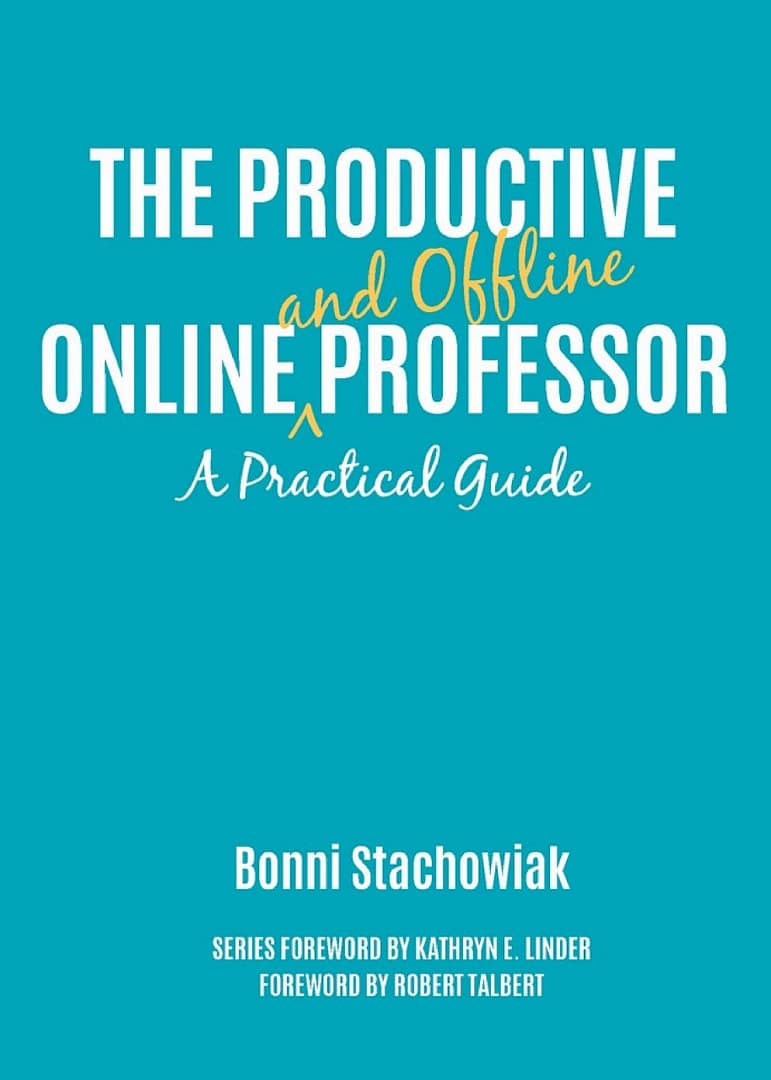
[00:28:29] Bonni: This is the point in the show where we each get to share recommendations. Mine is I’ve never done this before, but I’d like to recommend something that I have written. We’re pre-recording this episode, so it feels weird, Angela, to be recording this all these months or weeks in advance, but I’m going to recommend my new book that will be coming out in January of 2020. I wish I could give you a more exact date than that because you’re probably looking at your calendar going isn’t that like just a week from now or a few days from now. Bear with me, we can’t always get these dates exactly right. Anyway, the book is called The Productive Online and Offline Professor.
It started out just as a book that was just for specifically online professors, but the editors at Stylist said wait a second, we’re 80% of the way through, can we make this for everyone? I chuckled to myself because I thought, “Yes, that’s actually the book that I wanted to write in the first place.” It really freed me up as an author. Productivity is one of those topics that I know people think critically about sometimes because I think about the adjunctification of our workforce in higher education.
I think about the pressures of bigger class sizes, and especially with online education. That churn and burn and it can seem so mechanistic. That’s not at all my heart for teaching. That’s not at all my heart for what I really believe we should be doing for our students. Yet, I really think that for us to be fully present for our students and for people who are special in our lives, we have to stop using our brains to try to track everything and remember everything, and we need good systems. Sometimes, those systems can take the form of automation, the TextExpander is one example of a company that’s been a sponsor for two years now for teaching in higher ed. It’s just a tool that I can automate some portions of writing a recommendation letter, but that’s in order to make the sentences that aren’t automated that much richer, and also to make me be able to respond faster to that student and to have accuracy because I can take the data from the form they filled out with the address of who it should be addressed to et cetera, et cetera.
I really do hope people will go out and read this book. I hope you’ll share it with people, and I hope that you’ll all know that my heart is really not for us to be mechanistic, for us to be just teachers that are able to be fully present for our students. I have a lot of ideas, and I’ll just share one more thing before I pass it over to Angela.
The editors, when they were going through, I’m not sure if I’m supposed to share this so don’t tell anyone that I said this. They wrote in and said why did you write a chapter or a section of a chapter about backups for your computer, for your hard drive? Why did you write a chapter about that? That doesn’t seem to have anything to do with productivity.
I’m thinking like, “Well, I guess you haven’t had anyone who lost–” I have a colleague, who has worked at my institution for about the same time as me. Five years ago, she lost everything. She lost every syllabus she’d ever written, every student paper, every PowerPoint, every single thing that she has ever worked on in her teaching career gone, gone. I don’t stick to traditionally what people might always think of as what does that even mean to be productive? I just have for me the more devastating things like losing your hard drive, and the less devastating but they do build up over time of just wasting our time doing repetitive tasks that computers do better than we do, or planners do better than we do. That’s my recommendation, and it’s my self-serving one. I don’t do this often, but I’m going to pass it over to you, Angela.
[00:31:58] Angela: That’s fantastic. Congratulations. I cannot wait to read this book. I have learned so many, including TextExpander, actually from you and from listening to the show and so many things that have made my life easier.
[00:32:07] Bonni: Thank you.
[00:32:08] Angela: Definitely the backup is a good thing to emphasize to everybody. That’s fantastic. Congratulations.
[00:32:17] Bonni: Thank you. What’s your recommendation today?
[00:32:19] Angela: Mine is, this is a small productivity tool that’s my recent favorite thing. This is where my parenting life and my academic work-life come together. It’s around visual timers. I have a physical time timer, but they also have an app that you can put this on your phone, and it visualizes the time. It creates a red half-circle. If you do 30 minutes, and then as the time goes away, the red disappears. I discovered this with my toddlers and preschoolers. I have an almost two-year-old and almost five-year-old. It was really helpful for trying to explain transitions.
Like I’ll set the timer for 10 minutes, and when the red is gone, it’s when it’s time to wash hands for dinner. Or set it for 15 minutes and you know if we’re all ready to go before the red is gone, then we get to do whatever fun awesome thing would be fun to do for a couple of minutes before we get in the car. Then I found that it’s actually really useful for myself as well. As on the one hand, a way to make use of those little chunks of time that happened in between class and meetings and other things that I have a habit of just frittering away because I feel like what can you really do in that time.
Something about the visual timer and just seeing how much time there is, I’m like, all right, I’m going to spend these 10 minutes just responding to this message, or editing this thing, or working on this letter that I’m writing. It’s also really helped me with things that I’m anxious about. That email I have to send, that I’ve been worrying about for two days and haven’t sent. I can just set the timer and before the red is gone, I’m going to have finished this message and email it, just send it off. The visual aspect of it has been really helpful for me. I’ve done Pomodoros and that kind of thing in the past, but I really liked doing them with the visual timer.
[00:34:01] Bonni: That sounds amazing. You were talking about the parenting thing, and we’ve never used a visual timer, although you can bet that the second we’re on this thing I’m going to be googling a way to look for it. Not just for the show notes and the recommendations links, but they really do well if they’re given some kind of a warning before something’s over. You can avoid so many meltdowns. Like you said, I’m so glad you compared it to us too as adults that works with our students well. They are adults, but just that we’re going to do a little bit of a writing exercise, you’re going to have five minutes. I’ll let you know when you–
In terms of not having to interrupt them because it is visual, I can imagine if you were wanting to set some kind of a timer during an exam or something like that. It might also be helpful. I read somewhere about that if we struggle with worry, sometimes we can set a timer and be like, okay, we’re going to worry, we’re going to let it all out. [laughs] I don’t know what the right time for me, you have 30 minutes to worry. You’re going to worry like crazy. Anyway, I just like that idea. No, you actually meant like I’m feeling anxious about this particular thing, I’m going to finish it by the time that timer is up so you don’t spend too much time.
[00:35:05] Angela: I very often have tasks that I worry about for a week. Then I sit down to do them, and it took like 15 minutes to get it done.
[00:35:12] Bonni: So bad.
[00:35:12] Angela: Yes, because I’ve been thinking about it for so long, but sometimes just setting the timer. This is the time, by the time this timer is done, I will just have this off my plate, and will stop thinking about it so much. It will stop occupying so much space in my head.
[00:35:25] Bonni: I love that both of our recommendations are so related. Then the other fun thing is that there’s a website that Katie Linder, who’s our series editor has created. I’ll be able to put visual timers on there, so it’s an ever-growing list of additional productivity resources. Thank you for that. [laughs] That’s fabulous. Angela, I was so glad to be able to connect with you again. I’m still trying to process that you have a two-year-old and a five-year-old because last time I saw you, you had one child, so clearly a math on this.
[00:35:53] Angela: Yours was so little.
[00:35:54] Bonni: I know. I’m excited about the next time we get to connect in person. I’m just so glad to connect with you again on the podcast. You’re such a great resource, not just for your students at UCI, but for all of us.
[00:36:04] Angela: Thank you so much for all of the episodes of the podcast. I learned so much. I’m always recommending them to others.
[00:36:09] Bonni: Thank you so much. I’m so glad to connect today.
[music]
[00:36:14] Bonni: Angela Jenks, thank you so much for once again, being a guest on today’s episode of Teaching in Higher Ed. These resources you’ve given us for our syllabi are so helpful, and I’m just looking forward to using many of them myself in many semesters to come. I know that so many of our listeners will be doing the same. Thanks to all of you for listening.
This is one of those episodes, it’s worth it to go look at the show notes because there’s a lot in there that she’s provided for us. Please head on over to teachinginhighered.com/289 and check out those links. You also may want to subscribe to the weekly email and you’ll get these show notes most weeks in your inbox along with an article written about teaching or productivity. Thanks so much for listening, and we’ll see you next time.
[00:37:08] [END OF AUDIO]
The transcript of this episode has been made possible through a financial contribution by the Association of College and University Educators (ACUE). ACUE is on a mission to ensure student success through quality instruction. In partnership with institutions of higher education nationwide, ACUE supports and credentials faculty members in the use of evidence-based teaching practices that drive student engagement, retention, and learning.
Teaching in Higher Ed transcripts are created using a combination of an automated transcription service and human beings. This text likely will not represent the precise, word-for-word conversation that was had. The accuracy of the transcripts will vary. The authoritative record of the Teaching in Higher Ed podcasts is contained in the audio file.