Follow the Teaching in Higher Ed Podcast
About this Episode
Peter Kaufman discusses teaching with compassion on episode 230 of the Teaching in Higher Ed podcast.
Social interaction is the foundation of our society.
Peter Kaufman
On episode 230 of Teaching in Higher Ed
Voices on this Episode


Show Notes + Resources
Recommendations from this Episode

Transcript
Bonni: [00:00:00] Today on episode number 230 of the Teaching in Higher Ed podcast, Peter Kaufman shares about Teaching with Compassion: An Educators Oath to Teaching from the Heart.
Production Credit: [00:00:16] Produced by Innovate Learning, maximizing human potential.
Bonni: [00:00:24] Hello and welcome to this episode of Teaching in Higher Ed. I’m Bonni Stachowiak and this is the space where we explore the art and science of being more effective at facilitating learning. We also share ways to improve our productivity approaches so we can have more peace in our lives and be even more present for our students.
Bonni: [00:00:53] Today I welcome to the show Peter Kaufman. He’s a professor of sociology at the State University of New York at New Paltz since 1999. He regularly teaches Introduction to Sociology, Sociology Theory, Social Interaction, Education and Society, and Senior Seminar. Peter’s work has appeared in journals such as Research in Higher Education, The Sociological Quarterly, Symbolic Interaction, Sociological Forum, Teaching Sociology and The Journal of Sport and Social Issues. Recently, Peter coauthored his first book Teaching with Compassion: An Educators Oath to Teach from the Heart, Rowman and Littlefield. Since 2011, Peter has been a regular contributor to the Everyday Sociology Blog writing posts on a wide range of contemporary topics. In his spare time, Peter enjoys cycling, swimming, and walking is greyhound, Billy. Pete,r welcome to Teaching in Higher Ed.
Peter: [00:02:02] Oh thank you for having me. It’s a real pleasure.
Bonni: [00:02:04] I saved the last line of your bio to read with you here on your show. He also plays the drums for questionable authorities and all faculty punk rock cover band that has been together longer than the Beatles.
Peter: [00:02:22] Yeah we’ve been rocking out in the Hudson Valley for for many years now, I guess about 13 or 14 years I think. Right now our main core is two sociologists, a microbiologist, and a psychologist- or he’s an evolutionary psychologist. And we’ve been playing together for I guess since I think 2003.
Bonni: [00:02:47] Stephen Brookfield, who’s been on the show before, has a punk band. And I didn’t actually think that we’d now have two guests who are in punk bands, that is a fun thing, we will have to connect you to his music and see if you like it as well.
Peter: [00:03:01] I didn’t even know that because Stephen Brookfield’s books are some of the most influential books for my own thinking and life as an educator so that’s an interesting connection. I didn’t realize that.
Bonni: [00:03:12] On one of the episodes I actually played a little bit, I asked his permission and played a little bit. So it’s fun.
Bonni: [00:03:17] Well I shared with you this story, but I want to share with listeners how we got connected. You are followed me on Twitter and as I often do I will go and look at a person’s profile and then see if I think that they will be providing me with something of value in terms of my own feed. I ran into my friend the other day she was talking about she had gotten off Twitter she said for her own mental health reasons, she thought like if that was number one on her list to talk to her therapist about it probably was time to sign off for a little bit. But she said oh you’ve curated really well where it’s bringing you a lot of life. And of course it brings me a lot of not good parts too, but it brings me not good parts of things that I really should be more aware of.
[00:03:58] So anyway, I went and instantly was just- I risk sounding like a scary person to you right now- I was enthralled with you. Just starting with your book, you have a wonderful book called Teaching with Compassion: An Educators Oath to Teaching from the Heart. And I wonder if you would talk to us for a few minutes about why did you decide to write a book about compassion, and specifically about teaching from your heart?
Peter: [00:04:26] Well I mean this book was in the works for a long time, for me at least. I was teaching a class I teach a class regularly called Social Interaction a sociology class. And all my classes are a little bit alternative and how I approach them and whatnot. And so in this class we were using a book on a Tibetan Buddhist teaching called Lojong. And Lojong is the 7 points of training the mind. And within those 7 points are 59 principles. These little pithy little slogans, like almost fortune cookie slogans. And they’re all geared towards trying to be more compassionate to yourself and towards others. And I would use this book in a class Social Interaction because we would spend a semester talking about many of the ways that we don’t interact well or that a lot of the problems that we have societally in terms of our interactions.
Peter: [00:05:20] And yet social interaction is the foundation of our society. And if we can’t interact well, then we can’t have a strong society, we can’t have a strong foundation. So I use this book in that context and at some point it dawned on me I thought wow these 59 slogans, I should write a little explanation for each one about how they apply to teaching and learning and then it would be a book about teaching and learning with compassion. Anyway, so the Lojong book didn’t pan out in terms of getting a publisher. But I eventually came back to it a couple of years later, brought on my co-author Janine and then we jumped on the idea of the Hippocratic Oath that doctors have. And we thought hey, teachers should do no harm too, we should have a Hippocratic oath. And so we created an 8 point oath, it was 10 points and we brought it down to eight. And then we started writing the chapters.
Bonni: [00:06:19] One of the things that I heard that I’d love to have you share a little bit more about and that is just the idea of the part of it that has us being kind to ourselves. And I wonder if you’ve reflected on just how are we as teachers sometimes not kind to ourselves and therefore that blocks us being able to be as compassionate as we might otherwise be to our student?.
Peter: [00:06:41] Yeah that’s a great point because even in Lojang, there’s a very famous meditation technique and Lojang that applies to me as something that we’ll talk about I’m sure later on. But where you breathe in the pain and suffering of others and then you breathe out goodness and equanimity, goodness and balance to them. But in the Lojang book it says you have to begin this practice with yourself first, you have to be able to breathe then your own pain and suffering and breathe out goodness and equanimity to yourself.
Peter: [00:07:14] So I think your point is really a point well taken and something we take seriously in the book. We have a section in the book about self-compassion. We cite Kristin Neff, social psychologist at University of Texas at Austin who has written a lot about self compassion, recognizing that teaching is hard and the the worlds that we teach in and that students that we teach and all of these aspects that we engage in as educators it’s really difficult. And if we’re not going to be compassionate to our selves, we’re really not going to be in the right frame of mind. To be able to offer compassion to our students.
Peter: [00:07:53] We talk a lot in the book about having the beginner’s mind, like don’t be an expert, don’t think you know everything. But you also have to situate yourself to have a compassionate mind for yourself. Not that you have to get rid of all the pain and suffering that you’re experiencing, but at least do some practices or do some reflective exercises so that you’re able to take care of your own needs before you necessarily try to save the world of all your students. So it’s really important. I’m glad you brought that up.
Bonni: [00:08:30] One of the quotes from a past episode, it’s been a long time actually, is from Kevin Gannon and-.
Peter: [00:08:36] I know him from twitter.
Bonni: [00:08:37] Yeah it’s funny that you say that because even though I would consider Kevin a friend now, my mind first has a map of knowledge that starts with him being the tattooed professor and then I can get myself to Kevin Gannon because I also know him so well from Twitter.
[00:08:52] But he talked about students are not our adversaries. And you said when you were describing your book, who wouldn’t want a book like that? And I imagine that probably someone wouldn’t want a book like that if they have just built up these walls over time of trying to self-protection. One of the big ways I talk about my own teaching changing is I used to take things personally, like a student texting in class or a student not “paying attention” which I now know the difference between civil attention and true attention although I think there’s probably a better word for attention but I haven’t gotten there yet in my vocabulary. But just I used to take those things as a personal affront.
Bonni: [00:09:33] Or even with plagiarism, James Lang when he came on early back in episode 19 talking about his book Cheating Lessons, that same thing with plagiarism like “you cheated ON ME.” Like you is somehow about me. And now I just feel so much more freeing and so much more peaceful to get over myself and realize that I am actually not as big in my students lives as I might have used to like to think of myself and that feels really freeing. Not that I don’t yearn to be some small part of us all being more present for each other in this world. And I do really feel that these digital devices can sometimes really prevent us from the real authentic raw connections we can have with other human beings. But yet, it doesn’t have to be about me. It can be about way more complexity than that.
Bonni: [00:10:24] And then a recognition that I can build that community not out of control and anger, but build it through a sense of invitation, inviting them to be a part of some interactions that they haven’t had before. So I am wondering if you ever had similar shifts in your own thinking about your teaching? Or have you always been able to teach with compassion without having any of the anger or taking things personally?
Peter: [00:10:48] Well I don’t know if I would go that far. But I mean I my own teaching came out of the earliest focus for me was Pedagogy of the Oppressed by Paulo Freire. And that’s basically been the foundation for my teaching. So not seeing students as antithetical to me or not seeing students as trying to break down that student teacher contradiction. I mean that was something I was trying to do from the very very beginning. So I guess I feel like I never really approached students as adversaries because I- and again this sort of gets to what we will talk about later, but I just absolutely love being in the classroom. I love engaging in the process of exploring ideas, thinking critically, challenging ourselves, and I just see that as a cooperative endeavor. I don’t go into the classroom to be mean or to be to be a jerk and I tell that to students. I say look I’m here because I want to learn with you. And I’ve said this from I think from the very beginning of when I first started teaching because that’s where I went to you know try to get myPh.D. because I wanted to be an educator like that. And I’m not there to to make their lives difficult. I mean I want to challenge them. I want them to think critically, I want them to learn how to write and how to speak. But that doesn’t mean that we can enjoy each other’s company in the process. We don’t have to love, we don’t have to agree with each other. Like there’s a chapter in my book called emphasized classroom chemistry. I mean I I still struggle with that.
Peter: [00:12:19] You know for 20 years I’ve been in the classroom at least at New Paltz and every classroom you have to figure out the chemical equation differently. You know and that’s a challenge but it’s a challenge that I kind of relish and and one that I miss right now. But again, just very quickly going back to the beginning of the book. There was also an article I wrote because it’s funny you mentioned Kevin Gannon, you mentioned that students are not our adversaries. I wrote an article which I the title I wanted for the article was “students don’t suck.”
Peter: [00:12:50] And I think I shopped it around to a few places but the one I ended up using was much more yucky. But still the article is still I think a good article, it’s called A Zero Sum Game of Denigrating Students. And the article actually started out with maybe like five or six quotes that I gathered from my colleagues that sort of suggested that students suck. You know like really these denigrating comments and then I kind of make these three different arguments about why it’s problematic to denigrate students.
Peter: [00:13:21] And one of them is very similar to the one you said about cheating. You know like why are students cheating? Well like why are we creating classrooms and educational structures that would encourage them to cheat? Right. I mean they don’t have any stake in the game, so of course they’re going to cheat. So anyway it’s looking at sort of the bigger issue as sociologists want to do.
Bonni: [00:13:43] Yeah. So we talked a little bit about how I first found you on Twitter. And I mean right in the header of your Twitter is Teaching with Compassion. So I quickly went to Amazon, read the description and then I came back and I already knew- I maybe even already clicked to follow you. But then I came to that tweet that’s at the very top of your Twitter, it’s- I don’t know if you’re on Twitter right now because I’d rather you read the words than me but are you?
Peter: [00:14:08] I can go on it, yeah.
Bonni: [00:14:10] Yeah they’re be great. So this is Peter’s pinned tweet at the top of Twitter.
Peter: [00:14:15] Yeah. It says: There is no easy way to process and share information like this so I did what I’m often most comfortable doing: I wrote about it. I hope you will take the time to read this essay. And then the essay is titled A Sociology of my Death.
Bonni: [00:14:33] And would you mind just reading the first little bit of the article just so people get a sense of what you share?
Peter: [00:14:40] Yeah so it’s called A Sociology of my Death.
Peter: [00:14:43] I’m dying. I don’t mean this figuratively like I’m dying of thirst or dying to visit Hawaii. I mean it quite literally. I have incurable stage 4 lung cancer. I was diagnosed in June 2017, a few months after my 50th birthday. My only symptom was a nagging dry cough. But by the time the disease was detected, the cancer had metastasized throughout my body. Since then, I’ve had numerous treatments and interventions. Some of these worked quite well allowing me to resume most of my normal activities. Others were not as effective resulting in adverse side effects, extreme discomfort, and in one instance a week long stay in the hospital.
Peter: [00:15:25] My current treatment plan showed great initial promise, but now after just a few weeks the tumor started growing again. For me to have lung cancer, indeed any form of cancer, is the epitome of a tragic irony. I’ve never smoked or tried illegal drugs and I’ve never even been drunk. I’ve pursued clean living, good nutrition, and regular exercise in part to avoid the sort of medical misfortune that I am now experiencing.
Peter: [00:15:53] As a kid, I played sports all day long. At 16, I swore of junk food. At 18, I became a vegetarian. In my 20s, I ran marathons and did triathlons. And in my 30s and 40s, when my aching knees no longer let me run, I swam or biked most days. About six months before my diagnosis I completed a one day workout that simulated two thirds of an Ironman triathlon, swimming 2.4 Miles and biking 120 miles with 5000 feet of climbing. A few weeks later, I recorded my fastest one mile swim time ever. I was incredibly healthy until I wasn’t.
Bonni: [00:16:32] So it’s a beautiful post and you go through and talk about so many of your lenses as a sociologist and how this has impacted your work. I wonder if you could talk first about how it’s impacted your teaching? And I know you had some real crucial decisions to make as to whether to share with your students last semester and I wonder if you would talk just a little bit about your decision specifically around teaching and disclosure or not to your students?
Peter: [00:17:02] Yeah I didn’t really think much about that until that question popped up on Twitter in anticipation of this event that I’m doing on campus next week where somebody is going to interview me about living with a terminal illness, an event that I actually kind of proposed and planned. And so I did some crowdsourcing I guess on Twitter to ask people what are some teachable moment type of questions that could be asked. And one came up about disclosing to students. And I hadn’t thought much about that for a while maybe because I’m teaching right now, but when I was teaching- so last fall I got my diagnosis in summer of 2017, in the fall of 2017, I only taught one class because I was kind of shell shocked from what just happened to my life, it just got turned upside down. And I just wasn’t sure, physically where I was going to be at.
Peter: [00:17:59] So I taught one class and my university allows me to do reassigned to work for the other two classes. And my plan was to walk into that class and tell the students right away, to be completely honest and upfront. And it didn’t happen. I mean I walk in there and I just didn’t say anything. We went around the room, I do these exercises to create the classroom chemistry and I just you know I told a different story about myself.
Peter: [00:18:26] And then in the spring I taught three classes. I was feeling a lot better, one of the medications I was taking was working well, at least for part of the semester. And so I was back to teaching three classes and I was totally back in my groove. I felt the flow of what I was doing unlike a little bit in the first semester are still not totally there. And I didn’t tell anybody again either and when my colleagues were covering my classes, I told them please don’t tell the students, they don’t know.
[00:18:53] In the middle of that semester, in February, I got I got news back that the cancer started growing again. And that was in February. And so I had to miss some classes, I was getting some some radiology treatments. I was going down to the New York City for different things. And so I had to have my class covered. And honestly I don’t even know what my colleagues told the students. But they didn’t tell them what was going on with me. And students you know they did not know. When I wrote that essay, I knew that essay was going to sort of be my coming out.
Peter: [00:19:29] Yeah I mean there’s no- there’s not an easy way to do this. I mean I felt like I mean I have a public presence on the campus and I just I guess I felt like eventually people had to know. Students had to know. And I guess the irony is people know now but I’m not on campus. I mean I’m on campus. I’ll be there in an hour or two but I’m not teaching. And the only reason why I’m not teachin- I mean I was scheduled to teach three classes this semester, but I ended up in the hospital in the summer and I just thought at that point, the second medicine that I was taking stopped working. And at that point, it was just a lot of uncertainty. So I just didn’t know if I’d be back in the fall or not. So I thought it’s just out of respect to my colleagues to let those classes get covered now and for the students of course then start the semester and not be able to finish it.
Peter: [00:20:24] So yeah, the thing about telling people are not telling people… I guess I would say that’s kind of an organic process, as it has to be.
Bonni: [00:20:35] What have been some of the reactions from your in this case they would be students?
Peter: [00:20:40] Yeah. So I I posted this on Facebook, the essay. Again, as a way for me to come out. So I posted it on my personal page which I do have some former students that I’m friends with. And then we have a sociology page and the reaction was nothing what I expected. I mean I felt like I was maybe I was naive but it was the most- not that I didn’t expect this. I just it was the most beautiful outpouring of support and appreciation. And it was just, it was so beautiful. And I guess the part that I didn’t expect was it felt like I was being eulogized.
Bonni: [00:21:21] What sorts of feelings to that evoke for you?
Peter: [00:21:23] Well it was interesting because- so the essay came out on September 14th, the week of September 14th was a horrible week for me, just in terms of the medically, I was just in really bad shape. So this essay comes out, I get this tremendous outpouring of support and appreciation not just from students on Facebook but even on Twitter like people from around the world talking about this essay.
Peter: [00:21:54] You know I honestly read that essay at least 30 times that week. And the reason why I re-read it 30 times was because every time somebody would write something, I would be like how did they see this in the essay? Or where did they get this from? I just I felt like I wrote it in my head and then I didn’t realize that readers read it in their head. And that was a huge realization for me. I felt kind of naive. And even more specifically that I wrote it in kind of an intellectual head. And people read it in a deeply emotional head, that just created very different reactions, not bad reactions but just different.
Peter: [00:22:33] And that was that was illuminating for me. So the reactions to the essay were sort of intellectually fulfilling for me at the time, but incredibly emotionally sustaining at a time when I really needed them because I was just in such bad shape that week. And I have to say both my parents are alive thank goodness and they’ve been tremendous support to me. For my parents to be able to read these things that students wrote about me and how much human impact I have in their lives.
Peter: [00:23:02] And just the stuff that you would expect or want to hear from your students about how much they appreciate you. And my parents got to read that and that was just huge for me for them to be able to read that. I gave them access to my Facebook accounts and everything so they could see all that stuff. And I think for them dealing with their incredibly healthy son going through this ordeal, that was just an unexpected gift.
Bonni: [00:23:30] One of the things- and I believe you wrote about this on Twitter, but I apologize if I don’t have my source correct. But you talked a little bit, this is my word of attention, because you were describing so powerfully about this sense of leaving a legacy. But then I just, and again I love your use of the word “reading it in our own head,” so I’m reading this in my own head. And I just it was so wrenching and powerful for me to read. Like no, I want to be tweeting right now. Like I don’t want to leave a legacy I want to be in that classroom teaching right now. And yet, as I hear you even talking today and as I go back and reread the post and reflect on it more, I do have a sense like you’re leaving us with a legacy. I mean just documenting that as an educator I felt this as a sociologist to teach me about death and the process that we as a society are good at that and then also not so good at that.
Peter: [00:24:30] Yeah. I was sitting with my my younger brother. I have an older brother and a younger brother and I was sitting with my younger brother one night and we’re sort of talking about some of these issues. And I was saying something to him to that effect and he started to laught to me and said “well you know when you’re dead, you’re not going to be able to decide what people think.” And I recognize that. And I’ve been meaning to write that- I think that was a Twitter feed that I purposely wrote just as a way to get things down on paper and hoping that I would return to it. I mean I have actually filed forward to write an essay about that that I started a bunch of times. But I realized that people are going to remember me in any way that they want and hopefully a positive way. And I don’t want to sound like ungracious but I don’t want that right now. I want to be in the classroom. You know I just I love being in the moment and I don’t teach so I can get the applause and I don’t teach so I can get these beautiful eulogies when I’m still alive. And that’s hard. I mean it’s hard for me to be on campus right now.
Peter: [00:25:38] And I walk around campus I just see students I talk to my colleagues like you know I am a part of this contemplative group or we meet once every two weeks and do meditation and stuff. And we shared this poem and somebody is like oh this is a great poem I’m going to bring it to my class meeting right after our contemplative group. And I thought to myself, I don’t have a class right now. Like I can’t do something like that. And sure, I even thought about this today and because it’s the fall here in New York and I always for years and years in my intro to sociology class I give the students this E.E. Cummings poem or the three of them.
Peter: [00:26:16] There’s this beautiful one called a leaf falls and that’s that’s like what the poem is. It’s just- and it’s written in such a way that it looks like a leaf falling. And one of the students on Facebook in response to my essay said every time I see a leaf fall, the only class I took with you was intro and I think of that poem and every time I see a leaf fall I think that poem. So that’s a great memory and that’s a great legacy, but I want to be doing that with students right now. It’s fall. And this is the perfect time to read that poem and to go outside and to experience it and so that’s what are sort of trying to articulate in that pos.
Bonni: [00:26:55] The leaves are still falling.
Peter: [00:26:57] Yeah well they always fall, right. They just keep falling.
Bonni: [00:27:02] I took a class in my undergrad that’s one of my most memorable called Sociology of Death. And it was so memorable. The professor had a man come in whose son had been killed in a car accident.
Peter: [00:27:14] Wow.
Bonni: [00:27:15] And he described many people’s reactions to to him and his own grief as translating into wanting to fix him. And there’s the whole religious aspect of trying to fix someone you know don’t feel bad, they’re with God now. Just ever so comforting to someone religious or not, super comforting. And all about just how other people’s grief makes us uncomfortable. And I wonder if you could talk a little bit about what your experience has been like. You’ve shared about that some on the post and also on Twitter but just not certainly I know that it’s not your nature to do it out of a angry place, but to do it really from an educator standpoint so that we might better be able to hold other people who are walking a similar path as you.
Peter: [00:28:03] That’s a huge question. And I’m sure I expect to talk about that question next Tuesday night. But that is, that’s a burning question like OK so great Peter, we know your story. So what do you want us- How do you want us to deal with you? How do you want us to interact with you? And what I would say to people is two things. One is, there’s not a one size fits all approach. So OK so that’s the first thing we have to understand. So then my approach- and can I just preface it by saying I don’t have a lot of knowledge about this issue. Right. I’ve never studied death and dying. Right. That’s not my area of sociological expertise. I just unfortunately have stumbled into this position and now I’m gaining wisdom about it. And after this interview, I’m going to have more wisdom. And after the interview on Tuesday, I’m going to have more wisdom. And I’m going to keep having more wisdom and so we should come back and keep learning more from me because I’ll just know more and more of course until my last breath. That’s when I’ll know the most. Right.
Peter: [00:29:09] So I don’t want to pretend that I’m an expert on any of these issues. And so in terms of how people deal with it, I would I would go back to my sociological lens and maybe that’s just me intellectualizing it. But I would say, treat people like their human beings. And then the question is well what does that mean? What does it mean to be human? And I’d say Yeah exactly. I think we’ve lost a good understanding of what it means to treat each other like humans. I think I wrote a Twitter post a little bit about this because I was saying I wrote an essay years ago on learning to become human from my dog.
Bonni: [00:29:42] I missed that one, I have to go find that one.
Peter: [00:29:45] When I walk my dog, I cannot walk my dog down a sidewalk and it could not see another living being on the same sidewalk and at least be attentive to it. You talked about attention before, it would give attention to that. But as human beings, I walk on sidewalks. I do a ton of walking. I walk my dog I walk to school. I walk on sidewalks lots of times and people walk past me and they don’t even acknowledge my existence. And I would say in my situation, what I’m dealing with terminal illness and anyone, else you know treat someone like a human being, acknowledge their existence. Right. Like a dog, sniff them out. Do they want you to hug them? Do they want you to ask them a question? Do they want you to engage with them? Would they rather retreat? If you at least acknowledge their existence, you can scratch the surface of some of that and then start going in. But if you just avoid them like they don’t exist, that to me is not being human. But take baby steps at least start engage them as a human being. Acknowledge their presence, and maybe even take a risk acknowledge the pain and suffering that they might be experiencing.
Bonni: [00:30:49] When Rebecca Hogue was on talking about her experience with cancer she had just a slightly different word choice that I found be more comfortable to to use, although I didn’t use it with you today. When we got on the line, you said how are you? And I responded with the sciologically correct thing which is how are you? And she she suggested that in her case it was helpful if people said How are you today? Because how are you? Just for her, it was just too big of a question. And also could seem inauthentic to say how are you? Fine. How are you? That’s you know- But how are you today? was a question that she felt like she could more authentically answer going through her treatments.
Peter: [00:31:28] Right. Yeah and that little bit of specificity means a lot to her. But to the rest of us, we might not understand why that would matter.
Bonni: [00:31:39] Yeah. And like you said before, certainly we don’t have the five points to make this all perfect and it’s clumsy.
Peter: [00:31:46] Yeah. Well and I think part of it is let’s recognize and call out the elephant in the room and you know allow her to be clumsy and acknowledg that we don’t have the answers, but we’re at least willing to have a conversation about it. I mean I think this relates back to classroom stuff like we don’t have to have all the answers in the classroom, but we can engage in a dialogue to try to get to the point where we might have the questions.
Bonni: [00:32:12] I have two colleagues at school who both lost their spouses in the last year or so. And one of them I see pretty regularly and I really treasure that relationship because it gets to the point where every single time I see her that is not all encompassing of who she is in my mind. And yet there’s the safety and I just love every chance that she has with me to get teary eyed about her husband and share a story. I just I think Oh, thank you that I get to share that with her and that she feels comfortable enough and I just love that.
Bonni: [00:32:44] And it’s a contrast with the other person who I also consider a dear friend, I just don’t see that much. And so every time I see him I just fill the still I wish that there were a way to translate it into to seeing him enough that that doesn’t have to be so encompassing and still I mean I bite my tongue I don’t say that to him and I don’t- Because of course another thing that is not about me, but I guess I just wanted to share those experiences only to say that if you press on through it, if you lean into that discomfort, there’s a beautiful place where you can get together where you offer that person I think a beautiful gift to be their whole self not just that diagnosis or in their case that death was just one part, a big part, but just one part of who they are.
Peter: [00:33:30] Right. But you know I just want to say the point you make I think are just really important for us to keep in mind that- and I always tell students this, that there’s a lot of problems in the world. I mean we talk about this as sociologists. There’s a lot of big problems and it can be really discouraging and overwhelming, but we have to work within our sphere of influence. You know I work within the world that you can work in and for you, it could be these two colleagues. And you like really giving the attention to these two colleagues. And then you spread that out to maybe people in your community. But I think we have to recognize a need to start small.
Peter: [00:34:06] And I think just again gets to this question of like how do we treat people like me? And how do we deal with terminal illness? And will we’re not going to create new societal structures. Right. I mean like institutional structures that could be in place to try have a better way of dealing with either terminal illness or even aging. Right. But that’s not going to change in a radical quick way, but we could certainly work within our sphere of influence. We could work within our families, within our co-workers, within our communities. And we could create different social arrangements, social relations, different opportunities, different webs of connection that might ameliorate or assuage some of these problems that people experience. You know issues of loneliness, issues of grief, issues of stigma, whatever they might be. Things germane to what I’ve maybe I’m dealing with to some extent now all of a sudden.
Bonni: [00:35:06] This seems like a perfect transition into us talking about our recommendations for the episode. And my recommendation is everyone should go read your post and specifically to what you were just saying, Peter is- I mean literally I could go through every paragraph and say oh my gosh. So it’s just a wonderfully written post. But specifically, I haven’t even skim the surface of what you shared about inequality. And there’s some really important points that you make there including some links to some information. You’re even citing your sources in your own blog post.
Bonni: [00:35:39] And so I think that it’s certainly worth a read for a whole bunch of reasons. And I think people should read your post and take away some thoughts about how to just put those little small changes into having conversations with our students. I mean you only have to open up a couple of conversation to students before you realize they’re dealing with a lot of the same things. Yeah.
Peter: [00:36:00] Yeah for sure. It reminds me that Margaret Mead quote, the famous Margaret Mead quote is “never doubt that a small group of committed citizens can change the world. Indeed is the only thing that ever has.”
Bonni: [00:36:11] Yeah. This is the point where I get to invite you to give your recommendations.
Peter: [00:36:17] My recommendation is I just stumbled upon this yesterday and then I guess I got your email about the recommendation.
Bonni: [00:36:24] At the very last minute.
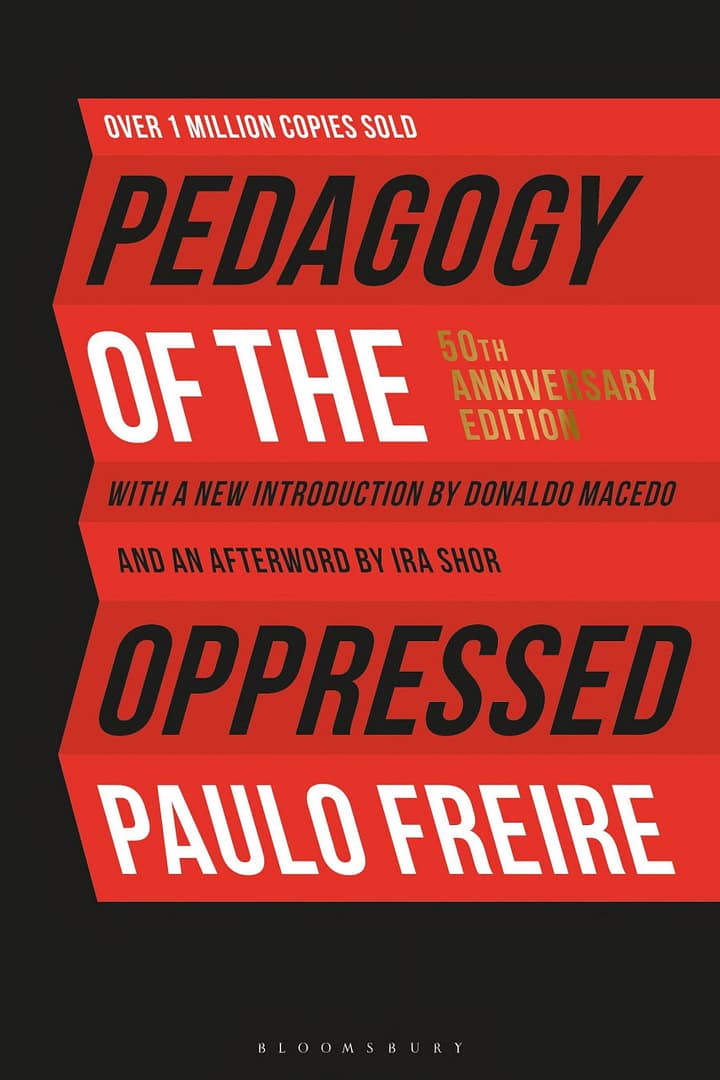
Peter: [00:36:26] I sort of already mentioned it in the podcast today, but far and away the most influential book for me has been the Pedagogy of the Oppressed by Paulo Freire. And I didn’t realize that the book is now out and sort of the 50th Anniversary Edition. Apparently it came out in 1968 in Brazil. So it’s now out. There’s a brand new 50th Anniversary Edition, I think published by Bloomsbury Academic. I feel like that book certainly helped me become both the educator that I am today and I think it also helped me become the person that I am today, not just that book but then other other writings from Freire. And dealing with issues of inequality dealing with issues of dehumanization and he even rights about love. And so I think a lot of the stuff that we’ve been talking about in the interview you know the idea of students as adversaries, the idea of inequality that you just brought up, but even a lot of what I wrote in that essay I think as I talked about at the end sort of just came out of my own intellectual trajectory and Pedagogy of the Oppressed is about much larger things and I would I would definitely put that as my recommendation.
Bonni: [00:37:39] Peter, thank you so much for joining me today on Teaching in Higher Ed. Thank you for your work as a teacher and you’ve already taught me so much and I think I’ve known you for like 12 days. I can just imagine the impact you’ve had on your students and your colleagues and yeah just thank you so much for coming on.
Peter: [00:37:57] Well thank you very much for having me. I really enjoyed it and hopefully it can provide some usefulness for your listeners.
Bonni: [00:38:04] I’m always learning so much through Teaching in Higher Ed and today’s episode is no different with Peter. I’m so grateful for him to coming on the show. And I thought I would end today’s episode by reading A leaf falls by E.E Cummings. And so I went to look it up and it turns out that it’s not really going to be very hopeful for me to try to read it to you, other than to say I suggest you go look it up too because according to wikipedia a leaf falls is a poem by E.E. Cummings. It’s the first poem in his 1958 collection, 95 poems. It’s arranged vertically in groups of one to five letters. When the text is laid out horizontally it either reads as one you have to see but it’s a combination of loneliness and a leaf falls. In other words, a leaf falls inserted between the first two letters of loneliness. In analyzing the poem, Robert DiYanni notes that the image of a single falling leaf is a common symbol for loneliness and that this sense of loneliness is enhanced by the structure of the poem. He writes that the fragmentation of the words quote “illustrates visually the separation that is the primary cause of loneliness.” And I am grateful to Peter for helping us be less separate from those that we care about to have been diagnosed with a terminal illness or are otherwise experiencing some form of grief in their lives. Thank you so much, Peter.
Bonni: [00:39:44] And thanks to all of you for listening to today’s episode. If you’d like to make a comment on the episode please feel free to go to the show notes at teachinginhighered.com/230 and you can make a comment. And if you’d like to not have to remember to go to the show notes to get the links to all the great things that Peter shared today, you can always subscribe to the weekly newsletter and that’s at teachinginhighered.com/subscribe. That’ll get the show notes to the most recent episode and also a blog written by me about either teaching or productivity.
Bonni: [00:40:19] And we’ve got some great guests coming up. Just because we’re getting into some holidays coming up does not mean that episodes stop coming from Teaching in Higher Ed, so I hope you’ll keep listening and tell your friends about the show and make sure that you give a rate or review if you’ve been listening for a awhile and haven’t had a chance to do that. Thanks so much for listening and I’ll see you next time.
Teaching in Higher Ed transcripts are created using a combination of an automated transcription service and human beings. This text likely will not represent the precise, word-for-word conversation that was had. The accuracy of the transcripts will vary. The authoritative record of the Teaching in Higher Ed podcasts is contained in the audio file.