Follow the Teaching in Higher Ed Podcast
About this Episode
Karen Cangialosi on episode 223 of the Teaching in Higher Ed podcast discusses open education in STEM.
I love when my students are surprised at what I’m asking them to do.
Karen Cangialosi
On episode 223 of Teaching in Higher Ed
Voices on this Episode


Show Notes + Resources
- Miranda Dean’s “What an Open Pedagogy class taught me about myself”
- OpenStax Biology OpenTextbook
- University of California Berkley’s – Understanding Evolution OpenTextbook
- University of Utah’s Genetic Science Learning Center
- Digital Pedagogy Lab (where Jesse Stommel offered his writing workshop that Karen mentions)
- But you can’t do that in a STEM course, by Karen Cangialosi
- Karen’s Blog
Recommendations from this Episode
Transcript
Bonni: [00:00:00] Today on episode number 223 of the Teaching in Higher Ed podcast, Karen Cangialosi gives us a peek behind the curtain in her STEM classes and argues against the notion that “you can’t do that in a STEM course.”.
Production Credit: [00:00:20] Produced by Innovate Learning, maximizing human potential.
Bonni: [00:00:29] Hello and welcome to this episode of Teaching in Higher Ed. I’m Bonni Stachowiak and this is the space where we explore the art and science of being more effective at facilitating learning. We also share ways to improve our productivity approaches so we can have more peace in our lives and be even more present for our students.
Bonni: [00:00:56] Hello and welcome to this episode of Teaching in Higher Ed. I was completely enthralled with an article that Karen Cangialosi wrote for Hybrid Pedagogy. It’s entitled But You Can’t Do That in a STEM Course.
Bonni: [00:01:12] And please don’t stop listening even if you don’t teach STEM courses because Karen’s advice for us today goes well beyond those disciplines and can apply to any of us who teach.
Bonni: [00:01:22] Karen Cangialosi is a professor of biology at Keene State College. Her courses include Animal Behavior, Evolution and Human Behavior, Tropical Marine Biology, Invertebrate Zoology, and Ecology and Evolution. She runs a coral reef monitoring program in the Turks and Caicos Islands and a research program on the behavioral ecology of spiders in Keene, New Hampshire. Karen spearheaded a movement to replace traditional textbooks with open educational resources and other freely available resources for almost all Keene State College biology courses and has incorporated methods of open pedagogy in all of her classes since 2016. She serves as the Keene State College Open Education Faculty Fellow where she facilitates an open pedagogy faculty learning and community and is co leader KSC Open, a domain of one’s own campus project. She was recently appointed as the Keene State College Coordinator of Faculty Enrichment.
Bonni: [00:02:37] Karen, welcome to Teaching in Higher Ed.
Karen: [00:02:40] Hi Bonni. It’s really great to be here.
Bonni: [00:02:42] I’m so glad to get to talk with you today for the podcast. And one of the things that was so fun about all the things that you sent over for me to explore about your work is that I felt like I was really getting a peek behind the curtain. And I just love the opportunities I get to do that. And one of the very unique things too is not just a peek behind your curtain as a professor, but a peek behind some of your student’s experiences as they’re coming into your classes.
Bonni: [00:03:09] Would you help us peek a little bit behind the curtain and before your classes even start in a semester, tell us what are some of the surprises that your students experience?
Karen: [00:03:23] That’s such a great question. And I wish my students were here to speak for themselves because I am all about trying to promote student voices. And we do a lot of wonderful things with student panels. And so I’ll try to paraphrase my students a little bit. Now that I’ve been using open pedagogy and these kinds of techniques in my classes is a little bit more, it maybe a little bit surprising to some of my students… But I would say a few semesters ago it was definitely a lot more like “what the hell are we doing?”
Karen: [00:03:56] And one of my students who wrote a blog post about this that you may be familiar with, Miranda Dean, says that she thought she actually enrolled in the wrong class when got into my class. She went into the site and- I use a little bit of Canvas as a- I kind of do a hybrid between Canvas and my own kind of web spaces. And I’m like less and less in the learning system all the time.
Karen: [00:04:19] So she went into there and said “I was sure I enrolled in the wrong course. I don’t know what she wants me to do or why I need to be doing this. And this just seems like crazy.” Which I think is great. I mean I love when my students are surprised by what I’m asking them to do. Or that they feel sort of shocked or “this is different” or “this is new.” And actually one of my worries now is “oh yeah this is this is Cangialosi doing this thing again” instead of it feeling new.
Karen: [00:04:46] One of the big surprises she writes about. And for you, I realize you are so immersed in open education that this is not news to you and it might be less news to your students. But talk about the textbook. What would a textbook normally cost for your class? And then what did she experience?
Karen: [00:05:04] Well maybe for her, but also for our students in her introductory courses, we use only open educational resources in our intro course. We use the OpenStax Biology. So I think our students in those courses are definitely pleasantly surprised when we say “no textbook costs!” That it’s going to cost you zero. And some of them are definitely surprised by that. Like “what am I going to do without having a physical book that I have to read?” But the fact that they’re saving 200-300 dollars, because science textbooks are quite expensive. And so on average, they save about 250 dollars a piece and they’re pretty happy about that. Some of them are surprised they have the read stuff online instead of having a physical book and they’re like “can we print it?” And I’m like well you can, but you might not really want to. So that part of it I think is definitely surprising for students.
Bonni: [00:05:57] I know that at your institution this is becoming more of the norm. But for a lot of people listening, it’s not. So somebody is listening and they do teach an introductory class, whether that be in biology or a different discipline. How difficult is that? How difficult is it to find an open educational resource that one could adopt? And then what do you give up? I mean is there really such a thing as “free?” What’s the hidden cost that we can’t put our arms around? What is it like to do that? How easy? How hard?
Karen: [00:06:28] Well it’s a good question. And I would say it’s not really the norm at my institution as a whole. But it’s definitely become the norm in the biology department.
Karen: [00:06:36] And so we use a range of open educational resources, but a lot of free content that’s on the web. So we try to say we do zero textbook costs for most of our classes up to the first two years in the biology program. And most of our upper level classes after that have no traditional textbook costs associated with them.
Karen: [00:06:55] It’s actually not that hard in the sciences. Like when you think about all the free content that’s available on the web. I use material from like the Berkeley 101 course for evolution. And there’s the Utah Genetic Science Learning Center. The Smithsonian has a ton of content. So these are not openly licensed materials, but they’re free. And they’re easily available on the web. Students can definitely find content. You can find content for them. And it’s really not difficult to find a lot of especially fairly introductory content in the sciences for Biology, Chemistry, and Physics.
Bonni: [00:07:33] And for a lot of these open educational resource providers, like you mentioned OpenStax, just for people listening because this is still very new for me, a lot of times your campus bookstore can actually offer one of these titles where they print it out and it could be available in a print form for students. I’m just again mentioning that there are other ways that universities have that where if this didn’t really feel like they need a printed copy, or sometimes that professors feel like that printed copy as necessary.
Bonni: [00:08:01] But I’m curious before we go on and talk about other aspects- I certainly don’t mean to at all limit your course design or open education to just this tiny sliver of it, but I try to think with beginner’s mind for I’d love to see more professors realize how easy this is. What do you think it is? Is there do they really need a printed textbook? Or is that kind of a learning curve that you as a professor can help them with of using digital resources?
Karen: [00:08:28] So that’s the thing. I don’t think that anybody really needs to have a printed resource. That is not withstanding people that may have certain kinds of visual disabilities where it’s difficult to read on the screen and not as familiar with that as maybe some people are. So for the majority of students, if it’s just a nervousness around “oh I don’t want to have to read on a screen” or “it’s harder to read on screen than a printed textbook.” I don’t think there really are any valid studies that show that students learn better by reading from a printed book. Or people just say “I like to hold a book in my hand.” And often what I’ll say to professors when I’ve done workshops and things is to say well you can weigh that against “I just like to have a book in my hand.” Well you can weigh that against students in your classes that maybe are food insecure and they’re not getting enough to eat and they’re really having trouble because their expenses are so high. And so you’re saying “well I just like to have a book” or “I think my student’s should have a book in their hand” when perhaps there are other things that are more important for that student. And so my students do quite well.
Karen: [00:09:40] We had 93 students in our Introductory Biology class and I actually dodged the bookstore at every turn. Even though they’re like “what book are you using? Even if it’s OER, tell us about it!” Because they do want to print it and they want to sell it to the students. I knew if I told them what it was, they would print it, and they would put it in the bookstore and they would market it to my students. I told my students I told the bookstore we don’t have any book at all. There’s just no book. Then only one of the 93 students chose to actually go on OpenStax and have the book printed for herself, which you can do.
Bonni: [00:10:14] The other thing I have this sense of is that people not really understanding that it isn’t just words written on a page or in this case on a screen. I think I’ve actually looked at the OpenStax Biology specifically because there’s interactive diagrams and like little tiny learning quizzes, not for punitive purposes but for retention purposes and check for understanding. I think when students are able to experience what an engaging open textbook can be, then it’s like “well I wouldn’t want to print this because I couldn’t take those quizzes and see what the answer was right away.”
Karen: [00:10:52] It’s a great book. I’ve taught Biology for 26 years. I have shelves full of Introductory Biology textbooks. The OpenStax Biology textbook is just as good, if not better than any other biology textbook I’ve ever used with my students. And being able to have those interactive kinds of quizzes and links to videos right there definitely makes it even just easier and all in one place. So it’s really nice.
Bonni: [00:11:17] So we’ve looked at before your class starts, already your students are experiencing surprise. “What is an OpenTextbook?” Although maybe not as much these days. But early on as you started to do that. And then opening up this space a little bit, not everything’s locked behind this learning management system, but there’s a whole world out there.
Bonni: [00:11:36] Talk to me about the first day of class, or maybe the first couple of sessions. What element of surprise or what element of trying to get me enveloped in a new way of thinking about this particular discipline?
Karen: [00:11:50] Sure. And I should say there’s a difference between the- for my upper level courses like my Marine Biology class, my Invertebrate Zoology class, my Animal Behavior class, I don’t use a book at all. We don’t use OpenStax, we don’t use any kind of textbook. So the OpenStax are for the intro books.
Karen: [00:12:06] So for my upper level classes, I think the students are more surprised when they go out on the first day and I say “OK we’re going to construct this class together.” I don’t have a syllabus. I don’t have a list of topics. I have some ideas. I have questions I want you to explore. And I say “How do you guys want to approach this class?” And so they’re like “what?!” Like what are the learning outcomes that you would like to see? And they’re mostly scratching their head like “I don’t know how to write a learning outcome.” And then I’ll say well how many of you guys actually pay attention to that laundry list of learning outcomes that you see on your syllabi and are at the end of semester saying “but we did number seven!” They’re mostly like I don’t pay that much attention to them.
Karen: [00:12:46] So they’re surprised that they’re helping to construct the class. And especially I think the biggest surprise that they have and the thing that they’re not really sure what they’re going to do with it I say “I want you guys to tell me how you want to be graded.” I have my students write their own grading proposal. Like what kinds of assignments do you want to do? How much of them do you want to do? How much do you want to do this versus that? And that they’re going to grade themselves and that they do a lot of self-assessment in my classes.
Karen: [00:13:13] So I think a lot of it is sort of shocking to them all the same time because they’re getting all this at once. So I do put a lot of that material out on my core sites for students to peruse at least for a weekend or more ahead before the class starts so they can kind of start to look at it. And some do and some don’t. So they’re sort of like what the heck is this? Why is she making me do this?
Karen: [00:13:40] And most of them really do come around after a while just to see that there are so many advantages to this style of learning. And they really like it. But not not everyone. I had one student in my Invertebrate Zoology class who was trying to do some of the things I asked him to do. And he was just having a difficult time. And he was struggling. He didn’t know what to do. And I knew he was a good student. I knew that he was capable of learning but he’s like “I need to take tests. I want to do this traditionally.” And so I said OK, if you want tests, I got 26 years worth of test on my computer. I have practical exams. I have traditional essay exams. I’ve got multiple choice. You can take all the tests that you want. And that’s when he chose to do. And when I say student agency and that’s what you want to do, then that’s what we did for him.
Bonni: [00:14:30] That actually was in part answering my next question which is: are they doing this collaboratively and the classes coming up with a structure that then they work together on? Or is it each and every student contracting with you this agreement around how their learning will take place?
Karen: [00:14:48] So there’s a little bit of both that goes on because in the first class or two we have a lot of discussion about what’s possible. And so they get ideas from each other, but I have each student sort of craft their own individual grading proposal which includes an attendance policy for themselves. Like write your own attendance policy and put that onto your grading proposal and tell me how much, what percentage of your grade you would like to go to these different kinds of activities.
Karen: [00:15:17] So each individual student will submit their own grading proposal, but they kind of get ideas from each other in sort of talking about what what are you going? How did you do this before? So there is some collaborative aspect to trying to figure it out.
Bonni: [00:15:34] And how many students are we talking about here for for this kind of structure?
Karen: [00:15:39] So my upper level classes have a maximum of 16, which is nice size. So they tend to have somewhere between 13 to 16 in those courses.
Bonni: [00:15:51] And then, because I can’t resist… So walk me along then the pathway of we’re about three quarters of the way through a term- is it a semester that you’re teaching or?
Karen: [00:16:03] Yes we have semesters.
Bonni: [00:16:04] OK. And then how are we checking in? Are you putting anything down in a spreadsheet somewhere in the learning management system for how grades are [earned] or is it all on them?
Karen: [00:16:14] Yes. And I realize that this comes from the place of a privileged full professor who’s tenured. Right. So I’m like I’m just done with a lot of that crap. Like I’m done with spreadsheets and keeping points. And believe me, I used to be really good at that like “you have a maximum of 600 points and 120 of those points are going to be for this and 90 for that” and then you know periodically I’ll tell you exactly what the percentages of your grade. Like I’m just done with that so I don’t do that anymore.
Karen: [00:16:45] So maybe some people think I went way far on the other side. So my students do self assessments and they do a total of four. So there’s three self assessments during the semester and then they do a final self assessment at the very end. And so they fill out a self-assessment form and I ask them a lot of questions like how do you feel like this is going? What do you think you contributed? How would you describe what success you’ve had here? And so they have to answer the question and then I say what grade would you give yourself for this?
Karen: [00:17:20] So it’s interesting. I love the whole process of self assessment and we could probably spend the rest of the show just talking about that. But one of the things that became clear to me is that a student would say something like “Oh I haven’t done this at all” for one of the questions and then they give themselves a C and I’m like huh… Explain to me how that’s average, like if you haven’t done this at all, why wouldn’t it be an F for that category? And so they go “Huh. Yeah I guess maybe you’re right.”.
Karen: [00:17:50] So by kind of taking that fear away a little bit to say don’t be afraid to give yourself an F for something if you didn’t do it. And ask yourself why? Is it because you want to do something else? Is it because you didn’t think this was valuable? That F is not going to stick with you. Like you could end up on your self-assessment having lots of C’s and D’s and F’s. And then by the end of the semester you still might have an A in this class. You’re not doomed. You haven’t just earned 17 points that will be calculated into an average that will never go away. Like those grades can completely change and you just have to convince yourselve and as you’re convincing yourself it will convince me that yeah now that’s what you’ve been able to accomplish. And I just think it’s a really powerful thing for learning.
Bonni: [00:18:38] There’s so much that you’re talking about here. One that I want to acknowledge again- you and I both are in relative positions of privilege in terms of being tenured faculty. At my institution, I’m able to experiment with a lot of stuff and never get any kind of pushback because of the credibility that I’m able to bring to the podcast and other reasons like noone comes and says “what’s the thing you are experimenting with?”
Bonni: [00:19:02] But those people listening who are in your first couple of years and maybe on tenure track, but not there yet, you might not want to swing this far. I did also want to acknowledge too that you’re really drawing on a thread that has come up a number of times in the podcast and just challenges me in such good healthy ways. We constantly need to be reflecting on our teaching philosophy.
Bonni: [00:19:30] And every single thing that we do and how it aligns back with that because I can’t, I’ve tried and I’m sure I still will sometimes on accident, but to go “Oh that sounds great. Let me try that.” But it’s completely misaligned with other aspects. We got to kind of bring it all down to the baseline and build it back up again if we’re going to really be thinking about what we believe as teachers.
Karen: [00:19:57] Absolutely. And I think that those of us that are in positions of privilege actually have the responsibility to take those kinds of risks and do different things. And so if you’re if you’re not brand new or an adjunct and fearing for your position then it’s like how else is anything ever going to change if we don’t really shake up all of these structures? And we talk about how there’s so much in education, higher education, and probably education in general that needs to shift. So what or who is going to actually make those shifts happen if it is not those of us that sit in these positions where we don’t really have to fear anything in terms of those kinds of ramifications in your tenure process? Like having somebody make fun of you. Or having a student think that you’re completely crazy. Or having your colleagues think you’re off the wall. Those are not really risks not like some people face. So I would say that we have such an opportunity to use our classrooms as experimental places where we can really affect change.
Karen: [00:21:05] And I don’t mean that our students are going to be the guinea pigs and they’re going to suffer immensely. We have to be very conscious about the safeguards that we build in for our students so that they do have the ability to say hey if you want to take traditional tests, you can take them or whatever. It’s that they feel like they’re learning.
Bonni: [00:21:22] I do have a whole another area I want to explore with you but before I do I just- one of the big objections that comes up with the kind of work that you’re describing is that it makes it too easy. That’s too easy. You know, people won’t fail the class. Or that won’t create the kind of “rigor.” Rigor is often used in those objections. Would you respond to those concerns?
Karen: [00:21:50] Sure. Yeah. I think it’s really interesting. I mean some of it kind of assumes that our students are so lazy and uninterested in learning that they’re going to do the least amount of work so that they can just get an A. And that’s just not in my experience at all. I have students that are working two jobs and just trying to hold it together. And they’re still putting as much effort into their classes as they can possibly put because they earnestly want to do as well as they can, to get as much out of the experience as they can.
Karen: [00:22:23] So I feel that the rigor comes from the students themselves. That the more you’re giving power and energy over to them to say what do you want? What do you want to learn? What can you get out of this? The more and more they actually put into it and the kinds of work that they’re doing, and the the blog posts that they’re writing for my class, and the research they’re doing, and the connections that they’re making, and the hyperlinking that they’re constructing is incredibly rich with different kinds of ideas. And I don’t think anybody could look at a lot of the work that they’re producing and say “that’s not rigorous.”
Karen: [00:22:59] And that’s not to say that maybe their grammar isn’t always perfect. Or maybe they didn’t quite get this reference right. So they may still be struggling, but that’s part of the learning process that’s there. So I haven’t seen students that are just trying to slide through for an easy A. And because they have to actually justify their A to me, it doesn’t happen. When I keep saying “well explain to me how that’s an A.” All they have to do is justify it. And they can decide well I decided to write these posts on this topic instead of that one. Or I wanted to do a project about this. Or I drew this thing.
Karen: [00:23:41] I had a student who designed these beautiful comics in Animal Behavior and that was her choice of what she wanted to do. And it illustrated these ideas. That’s great. So just tell me about what you learned from this and why you think you should get an A. So I think it’s incredibly rigorous work.
Bonni: [00:24:00] Yeah. I think that’s sometimes not the part that we hear. And I love the way you’re helping us peel back the onion, no peek behind the curtain is what I was going for. It’s just so fun to just to be able to sort of picture what it would be like to have you as a teacher. Before we go onto the recommendation segment, I just wanted to explore one more area with you.
Karen: [00:24:22] As I read your bio and just as I told you I had admired your work for a long time. I didn’t have science teachers like you who could help me see how learning about this discipline can make us make the world better. Talk about your teaching as an act of social justice and how you help students be able to see those connections.
Karen: [00:24:51] Sure. Well I think in many ways I feel like the sciences are so naturally situated to have us address issues that are of social concern, especially when you think about environmental issues. We talk about global warming and in marine biology there is so much about ocean conservation. So there are so much that is naturally there. When I teach Invertebrate Zoology, we talk about diseases like malaria. Why are there certain groups of people in the world that suffer from these diseases more than others? So I think a lot of that content is already naturally situated to deal with social justice.
Karen: [00:25:27] The extent to which an instructor decides to emphasize that in their class can be very different too. You can say learn the life cycle of the plasmodium organism and memorize that. Or you can say huh why are these people actually getting malaria? Those questions could be answered by a biologist too, not just the memorize the lifecycle part.
Karen: [00:25:49] And I think for me, like I’ve been an activist for as long as I can remember and a lot of sort of social justice activism in like lesbian and gay rights, in the environmental movement, in the feminist movement, I always felt a little bit sort of schizophrenia around that. Like that was the stuff that I did over here and then I would go to school and now I’m the biology professor in the classroom and we’re just talking about like memorizing terms and doing life cycle stuff.
Karen: [00:26:18] So it was sort of divided. And I think that later in my life I’m like huh, I should be integrating these things better. And for me, open education really allows for that even to a greater extent to say how do we look at our students as a group of people that are an oppressed population in some ways? They’re the underprivileged in this context. And so if we look at what is it we need? How do we need to empower them? How do we bring those principles of social justice into our classrooms in ways that can help us be better teachers and could really improve the lives of our students? Not just while they’re in my class, but what’s going to happen to them after they graduate as I think about them as people?
Karen: [00:27:06] Maybe it was Robin DeRosa or some other brilliant person that said something like the students already have real lives. We about “when you get out into real life,” well no actually, they do have a real life right now.
Bonni: [00:27:19] Yeah.
Karen: [00:27:20] When we think about it that way we definitely are just better professors our students are learning more so it’s absolutely not just a thing that you can do, but absolutely essential for being a good professors is to have a social justice context to whatever you’re teaching.
Bonni: [00:27:43] Well I’m so grateful for the work that you do. And I just wish I could go back and have you as a professor because our son is 6, he is in first grade and I am just barely able to hang on to the things that he’s already learning about space. He is really intrested in space and he has interest in all kinds of science. And I am fortunate that I do like technology so the robot stuff I can kind of understand programming and boolean logic just enough to be somewhat helpful. But it’s just so fun to think about all the possibilities but especially integrating what our students really care about and what they’re passionate about and that’s just been such a theme that’s been coming up especially as of late on the podcast. It’s like I don’t know stop and ask them what their goals are for learning how to write better. Like stop trying to shove APA down their throats.
Karen: [00:28:34] What a novel idea.
Bonni: [00:28:35] This was such an idea like oh you never want to ever go on beyond college? And never want to write any journal articles? Then maybe I would be better served as your coach to help you actually pursue those writing goals you might actually have. Imagine that.
Karen: [00:28:49] It is crazy what we consider like these “revolutionary ideas” that are actually not that amazingly different than what people have been saying for a long time. We’re just deciding OK instead of moving at the usual glacial speed that academia moves at, we can actually say let’s really try to enact these methods and these principles that will get us in a very different place than where we are right now.
Bonni: [00:29:19] Karen, this is the point in the show where we each get to give our recommendations and I have one that is the most ridiculous one I’ve given in a while. It’s a quick story.
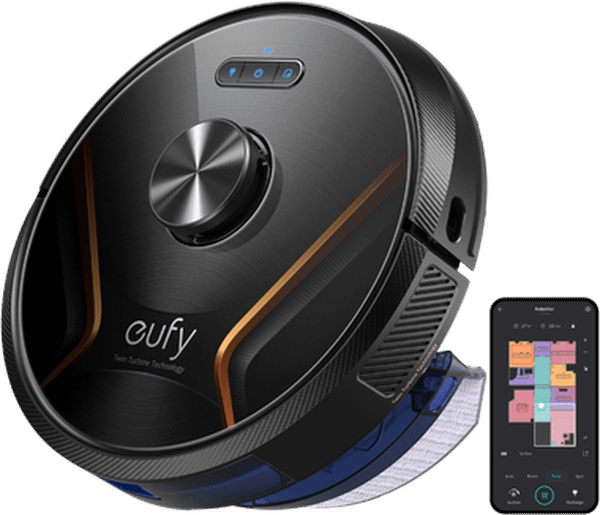
Bonni: [00:29:29] This is not my actual recommendation, but I found out that my husband and I both had coveted this robot vacuum called the Roomba which people may have heard of before. And Roombas are something like 600 to 800 dollars and that was just like that would be nice, but we’d rather buy the forthcoming rumored Apple Watch rather than spend that much on that kind of a luxury.
Bonni: [00:29:55] And it was something like 6am and I’m sitting there flipping through on my iPad a couple of weeks ago. And they have a review from I think the Wire Cutter for the best one of these that’s under three hundred dollars and it was on sale for $170. And it’s the I think it’s UFY, boost IQ RoboVac 115, which I will be linking to in the show notes. And it was one of those things where I do try to think a lot about frictionless systems. And neither are my husband and I is ever inclined to pick up a vacuum cleaner. We do outsource and have a team that comes in once a month that get’s us by.
Bonni: [00:30:38] But this is just kind of one of those fun things. I had no idea A. How dirty our floors are. It just doesn’t show. They look lovely. If you came over you would never know it, but I mean this thing is picking up every time it goes up a full vacuum.
Karen: [00:30:54] All the dirt and dust you didn’t know existed.
Bonni: [00:30:57] My gosh. And then how easy it is. It comes with a little remote and you just can send it up on its way. You can have a little barrier so it won’t get caught up in electrical cords if you have issues like that. But I mean it’s the smartest thing. But my kids are just enamored with it. And so you can actually drive it around with a remote. So my son is like driving…
Karen: [00:31:23] Now they want to vaccum the house.
Bonni: [00:31:24] Exactly. They’re both like “let me push the button!! Let me push the button!” OK we can only push the button if we take everything off the floor that’s on it. And they run around with more motivation than they’ve ever had in their lives for any sort of household chore. It’s been a delight. So that is my ridiculous recommendation. I will say that I only recommend things that completely delight me. And this is one where I just thought it just keeps paying off in spades. We’ve had it for about two weeks now and it is a welcome member of our home now.
Bonni: [00:31:58] Karen, what do you have to recommend today?
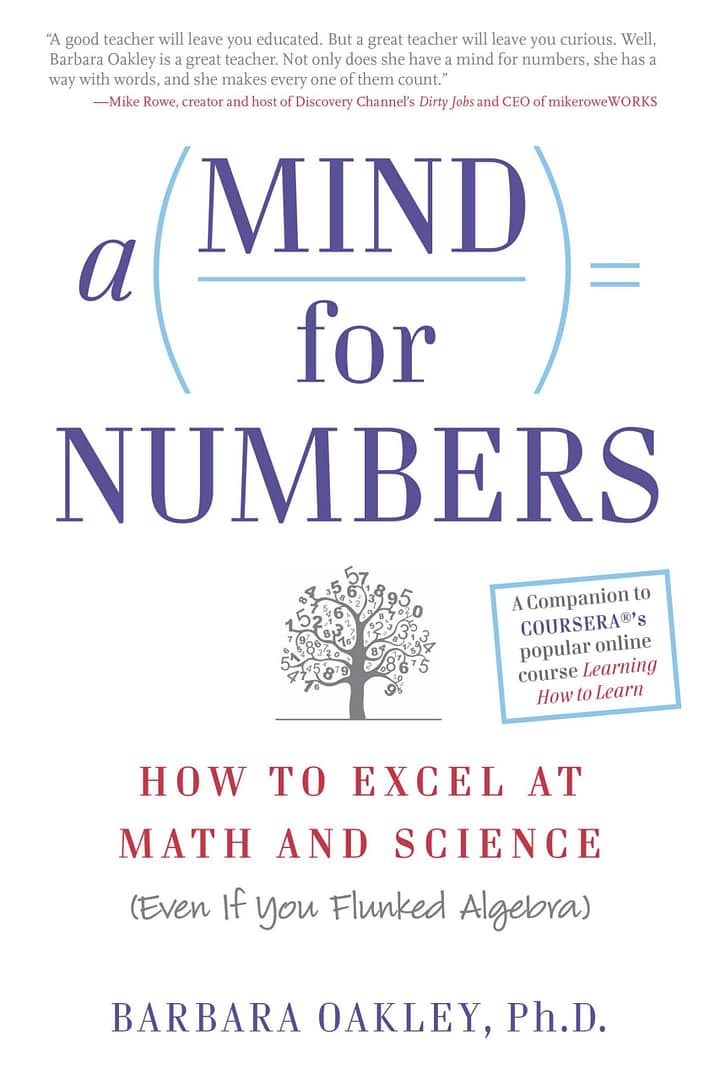
Karen: [00:32:00] Now my recommendation is going to seem really boring in comparison to that. Well I had a couple of things to recommend. One is a book that is called A Mind for Numbers which is written by Barbara Oakley. The subtitle is How to Excel at Math and Science Even if You Flunked Algebra. I don’t know if you’ve heard of it before or not.
Bonni: [00:32:25] No.
Karen: [00:32:25] It’s pretty cool. I love this book because it’s about creativity. It’s not about like “oh this book is going to teach me how to do math.” It’s really about how our minds go into different modes. She talks a lot about like a focussed mode of thinking versus a diffuse mode. And she talked about how really creative people like artists but also like Thomas Edison invent things by getting his mind to go into this diffuse mode. Sort of like how much work we do when we’re not concentrating on something. Like when you’re really focused on “I can’t solve this equation” but if you take a walk, or take a break, or fall partly asleep that your mind is actually doing all this work in the background. And it’s really really amazing. Then you come back from that break and you’re like “AHA!Now I have the answer.”. And so there’s ways that we can actually intentionally bring our minds into diffuse states to be more creative and more problem solving.
Karen: [00:33:21] And so I’ve often said that I’ll write something- like that article I think I wrote it in my head for about five months until I put it down on paper. And I was really glad to hear Jesse Stommel, I took his writing workshop this summer and he talked about how he writes stuff in his head and then finally it just all comes down. Like that’s what I do!
Bonni: [00:33:44] Oh wonderful.
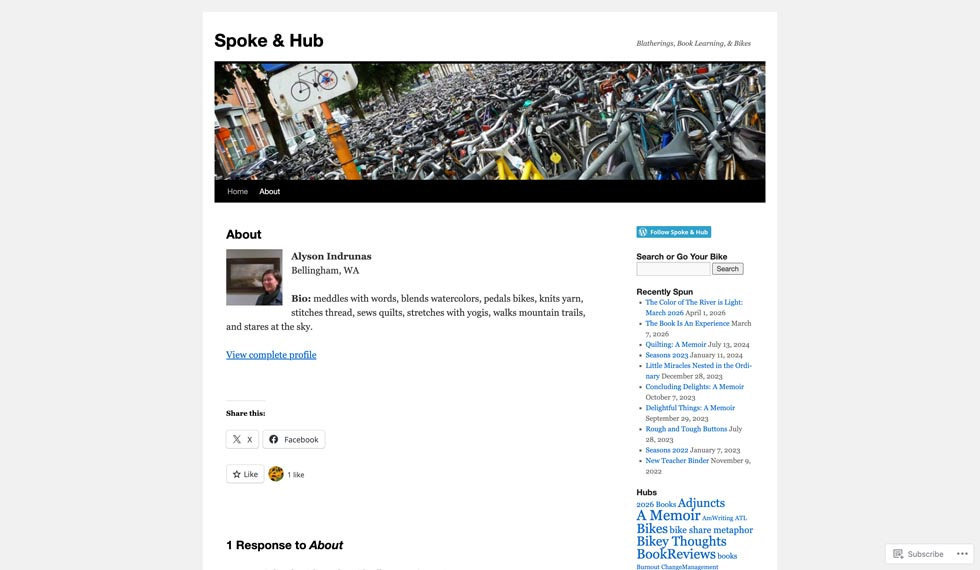
Karen: [00:33:48] The other recommendation is the Spoken Hog Blog by Alison Indrunas. She is a person who does faculty development stuff. And so I have this new gig as our Coordinator of Faculty Enrichment, which is kind of what we call faculty development here at Keene State. She wrote a post on July 13, 2018 called Reflecting on Some Things: A Memoir. I love this post for so many reasons. She’s so creative. But I love how she kind of takes these recommendations that were written for somebody for filmmakers and they’re great recommendations like “there’s nothing wrong with spending a night in jail if it means getting the shot you need.”
Karen: [00:34:33] Like learn to live with your mistakes like these kinds of things like that are about shaking it all up. Like just don’t do things the way that people have always done them before. Don’t be afraid to take risks. Don’t just feel like you have to do what everybody else does. And I love the piece about not wallowing in your despair. Just like keep your despair private and brief. I really kind of like that too because you’re getting out there and you’re doing crazy stuff. You’re going to screw up and it’s OK to make mistakes and then you have to kind of get beyond it. So there’s other really great things in her post and I’ll let people read them first for themselves.
Bonni: [00:35:12] Both of these recommendations are resonating with me so much. It’s the first time I have ever- I’m sure it exists, because everything always exists when I think it doesn’t. But just this connection between being better at math and then what you’re talking about. I think in my head I can’t reconcile them going together but yet I see…
Karen: [00:35:29] They do.
Bonni: [00:35:30] That they totally do. But in my head they don’t you. Know what I mean? Like clearly this would be something that would benefit me to read because they both do and don’t go together all at once. It’s hard to explain.
Karen: [00:35:42] And whenever I hear people say “I can’t do math” or “I can’t do science.” I’m always like well there is there is no “you can’t do.” There’s no genetic pre-determined thing where people certainly know how to do math. Everybody had to learn Math. Even Einstein had to learn math. Just being able to access the creative arts of your brain allow you to do it. And the good news is that anybody can do that, anybody.
Bonni: [00:36:09] I always suggest that we shift our language to say “I am working on getting better at..” whatever that is. So a big shift. And then the memoir, the post that you were talking about reflecting on some things, that sounds amazing.
Bonni: [00:36:22] And I am not new in faculty development, but my role got expanded at my institution, so I’m feeling very new at a lot of things. And I think I need to go read the post as soon as we get off the line because that just sounds like it would be a really healthy time for me to read it and reflect on it. Maybe do some writing of my own to kind of challenge myself to be thinking about some of these things that she has recommend. It sounds amazing. So thank you so much for both of these and for all your contributions today.
Karen: [00:36:50] Thank you. I really appreciated having the opportunity to be on your podcast. It’s such an honor.
Bonni: [00:36:59] It was so invigorating to get to have this conversation with Karen Cangialosi. Thank you Karen for coming on Teaching in Higher Ed. And secret surprise, she’s already agreed to come back because there’s so much more I wanted to ask her and so much more she can offer to our community.
Bonni: [00:37:16] Thanks to all of you for listening. If you’ve been listening for a while and want to contribute in some way, you can share the show with your colleagues. It’s one of the best ways of spreading the word about the podcast. Consider showing them how easy it is to listen to podcasts. A lot of them are not aware that they probably already have an app on their phone that allows them to do that or it’s just one tap away. So thanks for spreading the word about Teaching in Higher Ed and for spreading the word about podcast as a means for lifelong learning. Thanks so much to you for listening. And I’ll see you next time.
Teaching in Higher Ed transcripts are created using a combination of an automated transcription service and human beings. This text likely will not represent the precise, word-for-word conversation that was had. The accuracy of the transcripts will vary. The authoritative record of the Teaching in Higher Ed podcasts is contained in the audio file.