Follow the Teaching in Higher Ed Podcast
About this Episode
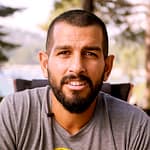
Andrew Ishak talks about Learn, Teach… and Satirize with Video on episode 334 of the Teaching in Higher Ed podcast.
You’re aware of the audience; you’re aware of the students.
Andrew Ishak
On episode 334 of Teaching in Higher Ed
Voices on this Episode

Show Notes + Resources
- Using Video to Learn New Skills, Engage Students … and Satirize (ACUE Community)
- Making Your Zoom Look More Professorial (Vimeo)
- Andrew Ishak Video Channel (Vimeo)
- Video clips from ACUE Q&A
- Making Your Zoom Look More Professional
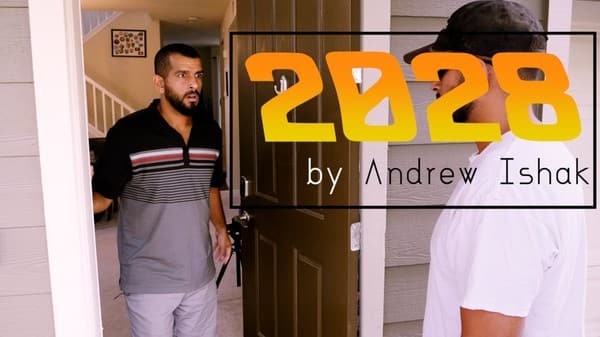
- 2028: In Which a Time Traveller Answers 2020’s Big Questions
Recommendations from this Episode
Video
Andrew Ishak’s Vimeo Page

Idea
Get a Creative Hobby
Video
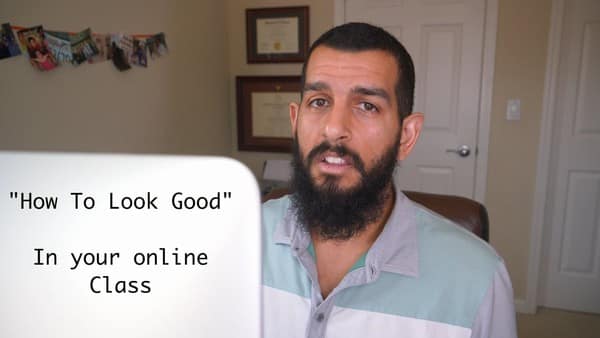
How to Look Good in your Online Class

Technology
Quizizz

Technology
Trello
Transcript
[00:00:00] Bonni Stachowiak: Today, on episode number 334 of the Teaching in Higher Ed podcast, Andrew Ishak talks about how to learn, teach, and satirize with video.
[00:00:15] Production Credit: Produced by Innovate Learning, maximizing human potential.
[music]
Hello, and welcome to this episode of Teaching in Higher Ed, I’m Bonni Stachowiak. This is the space where we explore the art and science of being more effective at facilitating learning. We also share ways to improve our productivity approaches so we can have more peace in our lives and be even more present for our students.
[music]
A couple of notes before I officially begin today’s episode, I wanted to mention that today’s conversation was had prior to the election day in the United States. Today’s guest has, among many, many, many other things, made a video of him in 2025, coming back to talk to him in 2020. I find myself, right now, wishing that I could have me from the time when this episode is going to air talking to me now about how to open this episode.
In fact, some of us on Twitter were talking about maybe making this episode a Choose Your Own Adventure kind of deal, where you could hear an intro based on whatever may have happened, but that’s not possible, so I’m going to leave this all here for now. Today’s guest was introduced to me by the Association of College and University Educators or ACUE.
ACUE’s courses and community site feature many of teaching and learning’s top experts, faculty developers, and practitioners to showcase evidence-based teaching practices. For many years now, ACUE has connected me with great guests for the show, including today’s guest, who I actually knew about well before they ever contacted me about him, and I’m so glad for you to hear our conversation. Andrew Ishak is a faculty member in the Communication Department at Santa Clara University.
He studies communication in high-pressure situations, including firefighting, team sports, and public speaking. He also provides evidence-based communication coaching for professionals in areas such as presentational speaking and meeting effectiveness. Andrew, welcome to Teaching in Higher Ed.
[00:02:36] Andrew Ishak: Hey Bonni, thanks for having me.
[00:02:38] Bonni: You have one of those presences, can you make presence plural?
[00:02:43] Andrew: Yes, do it.
[00:02:42] Bonni: You have a presence where I just instantly felt like I knew you and I feel like people all over the internet feel like they know you because you created this video where I feel like so many faculty members felt seen. Can you take us back in time to the article that prompted whatever feeling that was that you had that got you to pull out the video camera and tell a story around it?
[00:03:09] Andrew: Sure. Yes, it was a Thursday. I was teaching summer school, and somebody had sent around this article. They were not happy with the article, but basically, the title of the article was when students log on they should see something professorial. I think that word really set people off because, actually, the content of the article was relatively reasonable.
It’s basically saying that, yes, you should curate your background and make sure things look nice, and I’m in favor of that. If you can do it, I think it’s really good to do it, but I also think I’d say it was not respecting the moment. We’re in a really difficult time right now. People, they’re trying to do this however they can, I’m lucky to have a spare bedroom, but people are sharing space with their kids, who are in school who they have to take care of all the time, or their kids are not in school, which is probably even worse at this point if they’re two or three years old.
It’d be great if we could all look professorial, but how about we just show up and make sure that students have a class right now? That’s how I felt about it. Immediately, I felt like this is going to be misunderstood and people are going to be frustrated about this. I shouldn’t say misunderstood, it’s just the interpretation of something that’s telling me to look more professorial. I don’t look professorial normally.
What does it mean to look professorial? By the way, I think they actually changed that word in the title. I think they actually went back and edited it. I think they realized that that was not the right way to frame what they were doing, so that was a mistake probably, but yes, I quickly decided to make a video. I was inspired that morning, somebody else had said, “Hey, I’m using Andrew’s Office Hours video.”
I felt like, “Oh, this is good. People are actually using something that I made a couple of years ago.” I was feeling very inspired that day by positive energy to make another video, and I just did it. It’s very easy for me because I didn’t have to go anywhere. Obviously, right now, I can’t have people act with me. It’s challenging to do, so I just set up my camera right here in the same room I’m talking to you now, and I recorded it, I cut it together in five hours.
I posted it as a response to that Chronicle’s tweet and it just took off. I think … Healy, I think, is how you pronounce his name, retweeted it, and that really helped, and then I wasn’t expecting a lot of people to love it, but I was just shocked that a hundred thousand people in a day watched it, which for me is a lot, probably not for a YouTuber, but you know what I mean.
[00:05:31] Bonni: It sure seems like a lot to me, and I certainly heard about it so much in my circles and I think you identified, already, two of the reasons why. One is just let’s question the premise, what does it mean to look like a professor? A lot of people, depending on your gender, your race, ethnicity, you’re already getting left out of when you google “What does a professor look like?” and we want to say a professor looks like me in a lot of different ways and a lot of different contexts. Then the second thing is this is hard. What we’re doing, we’re just barely able to make it on some days.
[00:06:07] Andrew: Absolutely. That is a tough thing. Again, I’m very fortunate. I have an 8 and 11-year-old. They are very self-sufficient. We have a spare bedroom. I don’t think this is the standard. What is the standard right now? People don’t go into academia so they can make a lot of money, right? That’s not what they’re doing. It’s not like people are sitting in their beautiful homes with an extra study that has wood paneling and lots of bookshelves. It just doesn’t work that way. I don’t know. I just think, what does it mean to look professorial? I don’t know what that means. It’s great to have your background look nice, but I don’t know.
[00:06:39] Bonni: I got really intrigued by one part of your bio, and that is that you study communication in crisis contexts of firefighting, team sports, high-pressure situations. I’m curious, what could you share with us today that you’re able to take from studying communication in high-pressure situations into teaching in COVID times?
[00:07:00] Andrew: Yes. My research, for the most part, has been on emergency response teams, firefighting teams, SWAT teams, emergency medical teams, things like that, and then when I was initially hired at Santa Clara University to teach there, this is eight years ago, I was hired to head up the public speaking program. Those two things may seem different, but they’re actually quite similar.
We’re talking about people trying to communicate in situations in which they can’t really redo their work. It feels like life or death when you’re doing public speaking although it’s not actually life or death. They’re quite similar. To be prepared and to practice and to get experience, those are the things that matter the most. If you can do those things ahead of time, I’m constantly telling myself that whatever I do today in my classroom is actually practice for tomorrow, for the next class I teach.
I frame it that way to say, look, I have to learn something so that next time I can do a better job, and that’s what it comes down to when teaching. I’ve had times when I’m teaching and my internet goes out, and I think, “Okay, now what is my response going to be?” The answer is that I always have my email window open, and I’m ready to send an email to my students very quickly if something like that were to happen.
Communicating in high-pressure situations or time-limited, time-sensitive moments, it involves this pre-planning, it involves experience, it involves speaking about “Okay, what will I do if something goes wrong?” All those things are things I’ve learned from my research, but they are pretty applicable to teaching, too. It’s not just online, things go wrong all the time when we’re in person in the classroom. We have to think on our feet, “Okay, what are we going to do now to make the rest of this time valuable?” I think it’s just a good strategy for teaching.
[00:08:38] Bonni: I want to talk a lot more with you about that, and you have a whole project that you undertook that I’m so excited for us to explore a little bit, but I want to ask. I’m not someone who enjoys debating, so I don’t at all mean this to sound like a debate, but you don’t seem like someone who overemphasizes preparation and to be clear about what I’m saying–
[00:08:58] Andrew: How dare you, Bonni?
[00:08:59] Bonni: I know, “How dare you insult me in this way? [crosstalk] I love it.
[00:09:04] Andrew: I appreciate that. Thank you.
[00:09:05] Bonni: Well, because I work with a lot of faculty especially new ones, they think that they will be better teachers if they literally have over-prepared to an extent that I couldn’t even sustain it when it was my first year in teaching, let alone now. Thinking through things of actually scripting out or the PowerPoint that has 17 bullets, and they actually never get past slide one because …
I want to learn more from you in terms of, I think you’re talking about a different kind of preparation than what might broadly be thought of as “I have to script everything I’m going to say. I have to know, in advance, every question they might ask me because what would that look like? If I were to get a question I couldn’t answer, that would be so mortifying.” I think we’re maybe talking about different kinds of preparation. Maybe you could help because, again, you’re not reading from a script right now, you didn’t ask me for questions in advance, I didn’t have them to give you, so that was easy. You seem like you’re able to have a combination of in the moment, what’s emerging, but there’s, obviously, planning that happens, too.
[00:10:17] Andrew: Yes. Well, thanks for saying that, Bonni, I appreciate that. I would say, basically, I’m trying to game-plan every time that I am in a situation … be teaching or a challenging situation or going on a trip, for example, traveling somewhere. When you travel somewhere, you say, “Hey, we want to make sure we see this, this, and this.”
If you planned literally everything you would do, it wouldn’t work out because you’re going to have delays, you’re going to have things that are closed, you’re going to have things that don’t work out the way you want them to. What you want to do is you want to make sure you hit the highlights, right? Here are the three things we want to make sure we do, absolutely. We’ve made this dinner reservation, we have a reservation for this museum, and we’re going to spend this evening cruising on this river, right?
Those are the things we have to do. If nothing else happens, we’re going to do those things. Then you’re aware of the time, and then you’re aware of the people that you’re traveling with or in this case, now taking the analogy here to teaching, you’re aware of your audience, you’re aware of the students. That’s really the three-part thing that I’m doing. It’s, what are the key points I need to hit, what is the time right now? Be aware of the time and be aware of your audience.
If you see them just losing it, they’re not picking it, they’re not focused on what we’re doing, it’s like when you coach little kids, you say, “All right, water break, let’s get a water break and regroup” because you just have to be aware of how they’re experiencing that moment. For me, I don’t script things out when I teach, I also don’t go into a class not having prepared anything, I actually have a loose–
I didn’t want to call it an outline, I have three or four main points I want to hit with some notes underneath each. If I don’t get to some of the notes on some of them, that’s fine. I will sometimes take those notes and send them to my class later. It’s all about hitting the key points and being aware of the time. If you can do those things, I think that’s the way to prepare for teaching.
[00:12:03] Bonni: I have a lot of experience playing soccer, which is to say approximately three months when I think I was six years old, I have a picture of it too, but I do like this analogy of a game plan because you can’t plan out what the game is going to look like exactly, but you can, in most sports that I can think of right now, have a rough estimate of time-frames.
Now, some games can go a lot longer than you might plan, they can go shorter, but I mean some way of gauging time, some way of gauging different scenarios that could happen within a game. I don’t know. Is there a particular sport that you like to have analogies from a lot or something that you’re most familiar with because I could do them all right now I say rather sarcastically?
[00:12:50] Andrew: Frankly, this is actually part of the reason I study what I study is because I was interested in sports, and my advisor pushed me to a similar direction but not sports. Think about firefighting teams, think about a surgical team, they don’t panic, right? They don’t say, “Oh, I’ve never seen this before, what’s going on?” They have experience, and they go, “Okay, what’s the goal here? What are we trying to do? What’s the important thing? We got to remove this, we got to take care of this, we got to not do this. Whatever the situation is, we still have our focus on those things.”
I know there are times I’ve played sports and I get lost in the moment of the adrenaline or when I’ve given a talk and I get lost in the moment of– They call it being lost in the fog. It’s like, “What’s going on what’s happening? Somebody asked a question … my presentation, what am I supposed to do?” Then you get thrown off your game plan. When I teach, especially now that I’m teaching, I have a screen in front of me, I have my game plan, so to speak, on the screen right next to me.
I actually have time markers, I teach 45-minute classes, I don’t really go longer than that because I try to use the modules more because I don’t think students can pay attention on Zoom that much longer. I have like, “This will take 15 minutes, this will take 10 minutes.” If I’m going way over, I go, “All right, I’ll write you more about that later. Let’s move on to the next thing.” It’s all about being flexible, being able to improvise, but having that structure in place.
[00:14:13] Bonni: I love that you brought up surgery, one of the most memorable books that I’ve read in the last 10 or so years was by Atul Gawande, The Checklist Manifesto, and all the lives that have been saved over something as simple as “Today, we’re here to operate on this individual’s right leg” and that “Everyone has an opportunity to introduce themselves, talk about the purpose of why we’re here.”
That can really make class planning go such a long way so that in the moment if something went a little bit long and you have to juggle things on your own, you have enveloped the students in some way in “Why are we here today? What is the main purpose of it?” Then, of course, you have that plan. Sometimes people will share those plans, and their classes are a little bit more structured, I think in terms of people who teach in STEM, and they’ve got a specific “It’s going to be seven minutes for this and five minutes for that.”
I sometimes have to do that for myself, especially using Breakout Rooms on Zoom. Man, that’s something that I think is not going to take that long. I need to explain it, I need to have a title slide on there that also explains what we’re doing, and it always takes longer than I think, it’s wild.
[00:15:24] Andrew: Yes, you brought up a good point about The Checklist Manifesto, the idea of being structured beforehand and having an idea of “Okay, here are the things I have to do to get ready as well.” That’s also another good way to prepare and knowing, like what you said, that the Breakout Rooms are going to take longer than you think. They’re not going to be as active as you think, right?
Have a backup plan. For me, I use the chat a lot, chat feature to say, “Okay, I’m asking questions. I know you all don’t want to speak up, I’m going to call on somebody first, but by the time I’m done talking with them, I do want to see two or three questions in the chat.” It’s a backup, right? I’m giving another outlet to get that. I just think it’s good to have that knowing the structure coming in, but being able to be flexible.
[00:16:07] Bonni: I want to talk more about this project that you undertook because you really mean it when you say it, practicing something, getting better at it over time, and that’s not just something you say, that’s something that you lived for 52 weeks. Would you tell us about your project of creating 52 videos in 52 weeks? Maybe you were off by … I don’t even know…
[00:16:29] Andrew: At the end of 2017, I was feeling like I enjoyed academic publishing, I don’t know, 1% maybe. I did it because I had to do it. I just didn’t love it. I saw that around my department, there are people who are using film, and these are people who are in the film, they’re in the film area. I asked, and I found out that I could use film as a way to do my scholarly output.
I thought, “Why am I not doing this? I’ve always loved working with video, why am I not doing the thing that I love doing, as opposed to doing the thing that I don’t love doing?” just a very simple thought. My worry was that I wasn’t going to be good enough, and I didn’t want to put stuff out that wasn’t going to be good. I was actually inspired by a guy who writes an online webcomic, he released one comic a day for 365 days, and I thought that’s amazing.
I love the idea of just doing something because you tell yourself, you have to do it, and you put a deadline on it. I said, “Okay, I’m going to do 52 videos in 2018. I’m going to release one every Wednesday.” I started doing it. Some of them were duds, total duds, I put them out like, “I don’t like this.” It didn’t really matter. I wasn’t doing it for other people’s approval.
It was more like I did it, I’m like, “I got a lot of things wrong on that one. I wish I could redo this and redo this and redo the lighting and redo the script. I should get a better direction, a lot of things I screwed up on.” Some of them, I didn’t and I thought, “Wow, that was fantastic, and I felt like I barely even plan for that one.” They were all over the map, but the key thing was that I was doing them.
I was just doing the things because if you do them, then you’re eventually going to get better, assuming you do it with intent. I did one every week for 27 weeks. I tore my ACL in the middle of summer, playing basketball. It’s hard to work on videos when you’re– I couldn’t hold a camera and squat, I couldn’t walk backwards or anything like that. I took a month off and then finished the other 25 over the next 20 weeks or so, and most certainly–
[00:18:28] Bonni: You did catch up? Oh, wow.
[00:18:30] Andrew: I did. I did 52. One of the videos, this is my least effort I put in one, was a slow-motion video of my son reacting in disgust to a disgusting thing that he saw. His face is contorting. I cheated, but a couple of videos I put in probably like two or three hours of effort total on them on editing, but yes, I got them all done. At the end, I knew way more about lighting, audio, things I didn’t really have an understanding of because I never had used lights.
I had never used a microphone. I had never used an external microphone for videos, I’d always done just the camera. I learned so much about writing stories. I learned so much about, how do you prepare when you’re going to have a shoot, how do you get all your stuff together? I just learned all these little things in different ways, and it’s been so helpful for me because I actually got over this fear of showing people things and being judged by it.
I don’t care if people want to judge what I see, truly this project has changed how I feel. I put things out. If you don’t like it, all right, don’t like it, I have 52 other videos you might like, it doesn’t really matter to me because I’m not making this just for you, I’m making it for me, and if you like it, that’s awesome. That’s great. If you don’t like it, I’m not going to worry about it too much.
It’s given me a lot more confidence as well. I strongly recommend taking on a project like that. It doesn’t have to be video, it could be something like singing, it could be something like writing short stories, anything, but doing something creative. It just felt really good and gave me a lot of confidence.
[00:20:06] Bonni: It’s fun to hear your example of doing the disgust video because you could see, perhaps, your general audience that you think about. I suspect you’ve probably refined that over time and now, with this viral sensation, probably even thinking about other opportunities for you with video in higher education. Instantly, when you said that, I went to that there are people in psychology who study disgust, and you could bet that they would love to have a video like that to be able to show in their classes, just to introduce a topic.
It’d be perfect for that. That’s how I thought about podcasting too, where, like you, I had a real commitment to, when we started back in June of 2014, “I am going to produce an episode every single week.” It’s funny, I don’t remember if it was the Chronicle or Inside Higher Ed, and it doesn’t matter which one it was, but I was literally offended when they said, “Most weeks, she airs.”
I just wanted to go, “Most weeks?” They’re profiling my podcast, and that’s the thing I want to get hung up on and want to go, “No, every single week” because I didn’t tear my ACL. [laughs] Also, you can still podcast even if I had. Just no, if it was good, if it was bad, and there was one that I didn’t think was going to be that good about course evaluations, where someone wasn’t able to do the interview at the last minute, so I said to my husband, “Could we talk about course evaluations?”
I ended up getting pretty emotional on that episode as we were reading through one specific qualitative comment. I had people writing to me from all around the world. Like you, when you strike a chord and people go, “He sees me, he understands the pressure that I’m in, and you want me to be professional here? [laughs] I’m giving you the best that I can,” it really does resonate with people. There would, definitely, be episodes that aren’t going to resonate, but it’s that commitment to continue to create, to continue to be vulnerable, and some are going to resonate with the masses, and some are not. [laughs] That’s not something I think we cultivate very well in higher education.
[00:22:13] Andrew: I agree with you. I don’t think we do that, I think we think everything has to be a hit, and you have to do it right the first time. This video that I made about the professor’s office, if I had not been working on videos for the last couple of years, I would not have known immediately which mic, which lens, how I want to set my camera up, I would not have known how I want to approach the camera.
I wouldn’t have been able to edit it in an hour and a half, which was one of the quickest edit jobs I ever did on a video, just because when I was recording, I knew what to do to make my editing easier. I give myself some hand signals and things like that so I can look through the timeline, “Oh, I know exactly where I’m cutting, I’m cutting there. That was my best take,” and I cut it together really easily. That’s just because I worked on it, the last couple of years. The one video you do or the one podcast you do may not be great, but then it helps you do something better in the future, which is the point of doing it every week.
[00:23:06] Bonni: If someone doesn’t have the time or inclination right now to spend a year getting to be really good at doing videos, what would you say are some of the most important lessons that you learned along the way that actually someone who doesn’t already have the microphone, external, and the lighting– I know those things are important but are there other things that people could do today that would actually make a huge difference in what they’re doing?
[00:23:32] Andrew: You’re talking specifically about video, right [crosstalk]
[00:23:34] Bonni: Yes, video, if I want to make a video for my class. Maybe you could approach it at, what mistakes would I be most likely to make, thinking that time spent here is better than time spent here?
[00:23:45] Andrew: Sure. I would say the most important things you have to do, from a technical standpoint, the most important thing is audio, make sure that your audio is good. You know that, Bonni, as a podcaster.
[00:23:54] Bonni: [laughs] I do.
[00:23:55] Andrew: If your video doesn’t look great or if your video’s glitchy, it’s okay; if your audio’s glitchy, students will not want to listen to what you’re doing. You don’t have to have a fantastic mic to do this stuff in the classroom. It does help. I have some videos online that are about, okay, maybe you want to speak in a room that’s carpeted, maybe you want to speak in a room that doesn’t have totally bare walls because it can actually be helpful for the sound, but what I would say is spend–
If you’re looking, “I want to spend a little bit of money on something,” don’t spend money on a camera, spend money on a slightly nicer mic that’s in the $70 to $150 range. I’m using a Lavalier mic that is $80. The reason I’m using it is because I’ve used cheaper ones, and they just don’t really work that well. You get the scratchiness, you get things like that. If you’re looking for a little place to spend a little bit of money, spend it on a mic, get good audio. That’ll make all the difference for your videos, from a technical standpoint.
From a composition standpoint, two things. One thing is, keep in mind the story. I mean that not that you have to tell a story, but what is it that you’re trying to say throughout the course of the video? Sometimes it’s good to start up front. I’m even thinking about math teachers. It’s like, “Okay, here’s what we’re trying to get out of this,” I don’t know anything about math, “that this equals this in any single case.”
You want to say that early on and get them to understand, “Here’s the story we’re trying to get to, and here’s why it matters. This is how it’ll affect you in the future,” focus on that one thing, don’t go in a lot of different directions. Then, related to that, I think short videos work really well for students right now. I think they’re watching most of the stuff on their phones, I don’t even think they’re on their computers when they’re watching our lectures and our videos.
I can tell you that about 70% of the people who watched the video that I made, which was not a class video but this Zoom video, were on phones, at least according to Vimeo’s stats. You want to make your videos pretty brief. I think it’s better to break things up. You hear about micro-lectures a lot. I think micro-lectures is a good concept. I also think things like introductory videos or doing encouragement videos is really good.
I’m not saying they have to all be under five minutes, but just keep in mind, would you watch a 15 or 20-minute video about something that you weren’t super excited about? Probably not. I don’t think a lot of students are always as excited as we are. From a technical standpoint, get the audio right, invest in a mic, I think it’s helpful. From a composition point, think about the story, think about the focus, and then keep it pretty brief.
If you have to cut things out that aren’t necessary, just cut them out, just cut them out. I’m not talking about ums and uhs, I’m talking about a tangent you went on about something else. Maybe it’s not that important and you can probably cut it out. Students, they’re never going to notice that you cut it out, but they’ll appreciate it being shorter. I know it seems very unacademic to say that “Keep it brief, don’t go on a tangent,” and things like that, but I do think it helps.
[00:26:49] Bonni: I really think that mindset of less is more is so vital. In fact, the very first question I asked you, which, of course, I can’t remember the question, what I remember is your answer, you took me immediately to a place, you got rid of all the superfluous stuff, and it was like, “I’m taking you to a place.” That’s something I’ve really learned a lot from my husband, Dave, get rid of the “Oh, so nice to see you today. I’m really glad. I’m glad that we’re spending time–”
No. Think of a tiny, tiny thing and just start, dive right in, and make some of your more, “Oh, it’s great to see you,” you can have that in text, you can have some of the stuff that maybe is a little bit more dense, you can break it up. “Here’s a two-minute video about this, and a paragraph about this, and a little quiz. It’s not even graded, it’s just to test, did you understand what we just said?” and breaking it up a little bit more and thinking in terms of the arc overall versus this one thing. That’s where you get to the 20 minutes, 30 minutes, 50 minutes. Whew, it’s got to be good if you’re going to keep attention for 50 minutes. [laughs]
[00:27:55] Andrew: Absolutely. Bonni, I think you’re exactly right. We’re not filmmakers. If you want to say, “Hi, hello, how are you?” and all that stuff, that stuff, actually, it can be useful. I would make it a separate video sometimes. That’s what I do week by week, I say, “Hey, class, really excited for this week. Here’s what we’re going to be working on. It’s going to be a lot of fun.” Okay, that’s my one-and-a-half-minute video that I do.
Then, the next video, a separate video, is, “All right. In 1963, this person gave a speech to say dah, dah, dah, and that’s why it’s important that we do this.” You segment it, you make things modular for students. By the way, this is really helpful if you’re going to be teaching multiple quarters or multiple semesters. If you have a really long video and you have to fix one thing, it’s kind of frustrating, but if you have a bunch of shorter videos that you can post for your students and you have to remove one thing because maybe it’s out of date now, much easier.
[00:28:43] Bonni: Yes. I’ve been thinking about this a lot in terms of the coronavirus, that I definitely want to be naming things that are happening and we do. My class have Zoom sessions, and that’s where the conversations happen, and then I can do quick videos that I don’t really spend any time on at all. I’m spending a ton of time on building the course. I don’t want it to be entirely wrapped up in where we are right now because where we are going to be even a year from now, even if we’re still very wrapped up in this crisis, it’s still going to look different because it will have been a year and a half instead of six months.
I think about that a lot. You want to bring that current, in the moment, and speaking specifically to you because I know you, I know your names. That’s the kind of stuff we’re separating out this “my relationship with you, specifically, this class, this term from” the content I’m trying to really get you curious about and engaged in.
[00:29:40] Andrew: Yes. It’s a good point where you can differentiate. In the Zoom classes, yes, connect to the students on what’s happening right now, whereas maybe in the videos, you don’t do that as much, but you can reuse those videos quarter after quarter or semester after semester. What I do, actually, the first time in the spring, I was putting things like “Week five” in my videos, week six. I’d put that and then when I taught in the summer, I’m like, “Wait a second. Oh, yes, five weeks. I got to change all these videos. It doesn’t make any sense to say week six in this video.” What I did was I replaced it with the title of the video. I replaced it with Organization. This is a public speaking class, and that’s what I try to do in all my videos now, I try to make them–
I don’t want to say timelines because there’s nothing that’s timeless, but I try to make it so that I can use it throughout the rest of the school year, this year. I hate to be pessimistic about it. It’s possible. Many of us will be online. We’re online now, probably online in the winter. I want to be able to use these things again, without having to totally reinvent the class.
[00:30:42] Bonni: I love hearing about your experience with these 52 videos and just like you said, whatever it is to allow ourselves to be vulnerable enough to know that it’s not possible to be perfect so “Why try?” versus the kind of ways we can be shaped, it’s really powerful when you commit to something like that, and there’s lots of different ways we might experience that.
I think it would be fun, before we get to the recommendation segment, just to have you take us all the way back to your first time teaching or early in your teaching and what you remember about those experiences because when you were talking earlier, we can see you now, we can go see your videos. Probably, I’m guessing, I’ve looked at your Vimeo page, the most popular ones are the ones that you want to curate or like higher up on the list. Some of those failures might be heading to us, and I think it might be encouraging to hear about some of the challenges you remember experiencing early on.
[00:31:35] Andrew: Yes, my first time teaching my own class was a public speaking class at the University of Texas. I was a second-year grad student, and it was right before Labor Day, and I taught the class, taught two classes back to back, and I was so nervous. I was so sweaty, I’m a very sweaty person. You can’t tell over the podcast, never mind. It didn’t go as well as I wanted to, but it didn’t go terribly.
I remember writing down all these things, “Okay, here’s what I’m going to do differently on Tuesday” because it was a Thursday, a Tuesday, Thursday class. I had that first Thursday class, I wrote and said, “Okay, Tuesday, here’s what I’m going to change. I’m going to change this, I’m going to change this, I’m going to change this, I’m going to change this.” I had a sense of relief after that because I wrote these things down that I was going to work on.
I guess that was my … first experience with the growth mindset, of thinking about “If I’m thinking about getting better, then it’s okay if I don’t do well this time.” Since then, to be clear, that was 2008. To be clear, I still get nervous when I teach sometimes. I’ve been teaching for 12 years. There are times I do something or say something and I’m like, “Oh God, that’s going to be interpreted wrong,” or “They didn’t like that,” or “They didn’t think it was funny.”
I use Britney Spears as an example of something three or four years ago, I’m like, “Britney Spears is the oldest person in the world to my students,” and I thought that was a cool example. I don’t know why. I know at a time I used George Clooney and I’m like, “Look, Andrew, you got to update your references here.” I still get nervous. I still have those experiences, but just thinking about, “Yes, that’s okay. I’m going to get better next time,” that’s what it’s all about. That really helped me get over that first nerve-wracking experience of teaching.
[00:33:21] Bonni: Before we get to the recommendations segment for today’s show, I just want to take a moment to thank today’s sponsor, and that is TextExpander. TextExpander, I’ve been using it for many, many years, and they also are the longest-running sponsor here on Teaching in Higher Ed. Anyone who does what we do, especially in the context we’re doing it in today, really understands the power of being able to take back some of our time, and we can do that through text expansion services and specifically, TextExpander.
If you think about the repetitive typing that we do, those little mistakes, trying to search for answers, “What link was it that I send people to, to register for whatever that is?” with TextExpander, we can take back our time and use the tool to be that part of our brain so we don’t have to remember where links are, we don’t have to remember our standard verbiage for things. I use it for my work phone number that I could never remember.
I just type in “the VU phone” and instantly, it just expands to show me the phone number that I don’t think I’ll ever remember because it’s so easy to do with TextExpander. You can use it for letters of recommendation for students. You can even use it across teams so that your team could be more consistent and accurate and current, updates would cascade across your entire team.
I love being able to go and look at other ways that people are using TextExpander, the kinds of snippet collections that they have. A snippet is one of those little shortcuts where you type in a few letters, press the space bar, and all of a sudden, it expands into something that’s either hard for you to remember or something that’s a lot of text that you wouldn’t want to have to go try to copy and paste every single time.
I like to go see how other people are using it. You can actually download shared snippets. They have samples up on their website, and it’s so fun to go see how other people are using it and to discover other ways that I can get even more power out of TextExpander. If you head over to TextExpander.com/podcast, you can get 20% off your first year. Please let them know that you heard about TextExpander from Teaching in Higher Ed.
When you visit that link, you’ll get 20% off your order and also can acknowledge that we’re sharing a bit about them over here on Teaching in Higher Ed. Again, thanks to the TextExpander for sponsoring Teaching in Higher Ed and to everyone listening, head on over to TextExpander.com/podcast. I’m excited about our next segment for the show, and this is maybe going to be a little predictable to people because you can tell how excited I am about Andrew’s work.
The first thing I wanted to recommend is that everyone, everyone, everyone, go watch his How to Look Good in Your Online Class video that we started out the show speaking about. I just think it’s such a way of feeling seen, and you are hysterical in that it’s just like you hit every note. Your comedic timing is so perfect in that video, and I’d love for that to be a road that people could take to my second recommendation, and that is to head over to your Vimeo page.
There’s so much there that we can learn from and glean and get better at our own videos. The last recommendation I have has nothing to do with Andrew or his work that I know of, but you never know. Maybe there’s a connection here. I don’t know. Liz Mosher had written to me, and a former guest had recommended Kahoot, K-A-H-O-O-T, and I made a comment about that Kahoot’s free plan had gotten a little bit less generous in recent months.
She said that Quizizz is something that she likes to use that has a little bit more of a generous free plan. It’s Q-U-I-Z-I-Z-Z, and I’ll have that in the show notes, of course, and over on the recommendations page. I only like to recommend things that I’ve actually used, and so I can tell you I’ve not used this in a class context yet, although I’m looking forward to it, but my six-year-old daughter is sold.
When her school time is over, she often will come up, and we have a break before I get back to work. She helped me test this out the other day, and it mentioned something about having advertisements, and I thought that’s what we were seeing, but they actually have a thing you can turn on or off where it’s just different kinds of memes that it’ll show in between questions.
It’s got a lot of gamification, you can level up, which I don’t even know what that means in the context of this particular thing, but it just looks like a lot of fun. I like using Quizlet, that’s generally where my flashcard decks are, but I think this is one worth checking out, and my daughter would say the same thing if she was here too. Again, I’m going to pass it over to you, Andrew, for your recommendations.
[00:38:00] Andrew: All right. The first recommendation I have is a website called Trello, which I’m sure many people have heard of, but Trello is a way-
[00:38:08] [END OF AUDIO]
The transcript of this episode has been made possible through a financial contribution by the Association of College and University Educators (ACUE). ACUE is on a mission to ensure student success through quality instruction. In partnership with institutions of higher education nationwide, ACUE supports and credentials faculty members in the use of evidence-based teaching practices that drive student engagement, retention, and learning.
Teaching in Higher Ed transcripts are created using a combination of an automated transcription service and human beings. This text likely will not represent the precise, word-for-word conversation that was had. The accuracy of the transcripts will vary. The authoritative record of the Teaching in Higher Ed podcasts is contained in the audio file.