Follow the Teaching in Higher Ed Podcast
About this Episode
Sarah Cavanagh shares about her new book, HIVEMIND, on episode 274 of the Teaching in Higher Ed podcast.
Our ideas about the world are collectively sourced almost as much as they are individual.
Sarah Cavanagh
On episode 274 of Teaching in Higher Ed
Voices on this Episode


Show Notes + Resources
- The Spark of Learning: Energizing the College Classroom with the Science of Emotion*, by Sarah Rose Cavanagh
- HIVEMIND: The New Science of Tribalism in Our Divided World*, by Sarah Rose Cavanagh
- Tressie McMillan Cottom
Recommendations from this Episode


Transcript
[00:00:00] Bonni Stachowiak: Today, on episode number 274 of the Teaching in Higher Ed podcast, Sarah Cavanagh describes her new book, HIVEMIND.
[00:00:12] Speaker 1: Produced by Innovate Learning, maximizing human potential.
[music]
[00:00:21] Bonni: Hello, and welcome to this episode of Teaching in Higher Ed. I’m Bonni Stachowiak, and this is the space where we explore the art and science of being more effective at facilitating learning. We also share ways to improve our productivity approaches, so we can have more peace in our lives and be even more present for our students.
[music]
Today, I’m so excited to be welcoming back to the show, Sarah Rose Cavanagh. She is currently on faculty at Assumption College, where she directs the Laboratory for Cognitive and Affective Science and serves as Associate Director for Grants and Research in the Center for Teaching Excellence. Her teaching focuses on emotion, motivation, and neuroscience. Her research considers whether the strategies people choose to regulate their emotions and the degree to which they successfully accomplish this regulation can predict trajectories of psychological functioning over time. She’s here today to talk about her new book, HIVEMIND. Sarah, welcome back to Teaching in Higher Ed.
[00:01:32] Sarah Cavanagh: Thanks for having me.
[00:01:34] Bonni: You have been busy since you were on the show last?
[00:01:37] Sarah: Yes, life is busy.
[00:01:41] Bonni: I am so excited about this particular project we’re going to be talking about today, your new book, HIVEMIND. I know that it would be good for us to start just with a little bit of an overview of what the book is all about.
[00:01:53] Sarah: Sure. Well, I think about the book as having three layers. The first layer, it’s an overview of contemporary social neuroscience, so some of the most exciting coolest research that I can find about how we are so social as a species. That is one part that informs the title of the book, HIVEMIND. I see the HIVEMIND as having, itself, a couple of different levels, one being the fact that we can enter the state of mind in which we join with our social partners, almost in a collective sort of consciousness, and that you can see in things like dancing together at weddings or marches, ecstatic group ritual.
You can see it a lot in really strongly bonded groups, like cults, where you just join with your social others. I think it also can either have my means, the sense that by which our sense of reality, our consensus reality, our ideas about the world, our thoughts and emotions, are collectively sourced, almost as much as they are individual. I think we don’t notice. We like to think that we’re all originals and individuals, but how much of our understanding of the world was collectively sourced? That’s one layer of the book, just an overview of contemporary social neuroscience, things that have always been true.
The second layer is how smartphones and social media have come on the scene, and I see as amplifying all of those tendencies, both the pro-social and the anti-social tendencies of our collective selves, are both good to know. Then, the third layer is about our current political moment, so political polarization and some of the things that are happening on both the national and a global scale.
[00:03:41] Bonni: This is a different book than you have done previously. I was trying to explain to my husband the other day, and I can’t remember the name for it– Was it public press, or what is this type of book called?
[00:03:51] Sarah: I’m still new to this world, too, but what they seem to call it is trade, so a trade publisher, rather than an academic publisher.
[00:04:00] Bonni: I was going to say, it’s the real deal, but it’s not like the other ones weren’t the real deal. As you started to imply, lots of new things for you to learn. Can you give us a little bit of a background of why you decided to go this route, both in terms of this kind of a book, the trade publisher, and then also, where did this start? Maybe it’s hard to decide how your ideas start, because aren’t they all just swarming around?
[00:04:21] Sarah: Yes. I’ve always been more of a teacher than I am a researcher. I say this in the preface of the book. From the very beginning of my academic career, I sought to spend more time in the classroom than outside the classroom. Writing Spark of Learning, my first book, which is an academic book– It was an academic book, but it was for teachers. It was for a James Lange series in teaching in higher ed. He was really encouraging the writers to write in an accessible way.
I found writing that, that I really enjoyed doing that, rather than academic [inaudible 00:04:55] and manuscript writing. I found that that writing voice had a lot in common with my teaching voice. It felt like teaching, but writing. I enjoyed it so much that I decided to try my hand at reaching the public audience, more popular audience, and sharing some of the most exciting research going on in psychology, with not just my students, but also with a wider group.
[00:05:23] Bonni: You decided that you really wanted to embrace the style of writing, which by the way, you’re so good at it. I’m so glad. I read your book, The Spark of Learning, literally, in just a plane ride, and that was a gripping story, it felt like, and I learned so much. Definitely, that resonated. Talk a little bit more about– I keep really trying not to make bee references. How do these ideas swarm around in your mind? Where did these things start to culminate?
[00:05:52] Sarah: Love it. Well, really, with writing Spark of Learning— That book was on emotions in the classroom. Some of the research that I found most compelling and most interesting was about how the instructor’s passion and enthusiasm for the material could infect the students, and how the classroom is really a collective social setting, and the students are influencing us and we’re influencing them, and all of these ideas about swarming thoughts influencing each other.
Those pieces were some of my favorite parts of researching Spark. That got me thinking about, “How does this apply more broadly, and what are other ways in the world and human experience that this is true, besides just the classroom?” That led me to the HIVEMIND ideas, which started before the 2016 election and before Brexit. My original conception of the book was going to be very playful and fun and positive. It took a turn as events in the world unfolded. I hope that it’s still a hopeful book, but there’s a lot of dark stuff in it.
[00:07:01] Bonni: One of the elements of being a hive, having this hive mind, is around group polarization. Could you tell us more about what you discovered as you started to research this particular aspect?
[00:07:12] Sarah: Right. Group polarization refers to the fact that I encourage us to think, in the book, that we are one giant human hive. I think we should have more of that. That’s one of the kinds of solutions, I think, out of the mess that we’re in. We also form in-groups, and very easily and automatically, and that seems to be part of our nature.
When we form these in-groups and we start talking to people who agree with us only, we start syncing up around common ideas. When you hear your opinions being echoed back to you by social others and you don’t hear dissenting opinions, then you tend to – we know from a lot of research – move more extreme in our opinions, so not just become more entrenched in our opinion, but our actual opinion becomes more extreme.
Over time, this can cause some problems, because if you’re only talking to people who agree with you, then you are not having a cross-fertilization of ideas, and you’re also becoming more extreme. I think that this is not an original idea. A lot of people have been talking about echo chambers and conformity and all of these things about how we’re dividing into different camps. I think that that’s dangerous.
[00:08:27] Bonni: When you consider that, one of the things that concern me is– Well, I’m sure it’s because I’m so susceptible myself, but just this idea of hearing both sides, when one– That doesn’t seem a very thoughtful way of considering these things. Someone on the show, Harold [unintelligible 00:08:49] had talked about– just to give an example– I think this might have been the example he gave, but if it isn’t, forgive me. I suspect he probably would give the same one, but climate change. 97%, 98% of scientists believe that this is a partially man-made caused issue.
We don’t go and read one story about the 97%, and then one story about the 1% to 3%. Do you understand what I’m asking? I don’t know if I’m making any sense. I get concerned, because people say that we should be looking at both sides, but then it’s a disproportionate, and more into like, “Well, let’s look at some of the solutions. Let’s just agree on this base of research that exists, that is overwhelmingly scientifically-based.” Then, we’ll see richness in the diversity of ideas on how you might address it.
[00:09:35] Sarah: Right, absolutely. I think that both sides-ism is another danger of one of our hive mind tendencies and our hive mind narratives, which is these false dichotomies, and that there are always two opposing sides of equal value, and you have to agree with one or agree with the other. I think that we need to make space for complexity, and that we need to make space for– There’s a lot of people doing great work in journalism trying to open up those ideas.
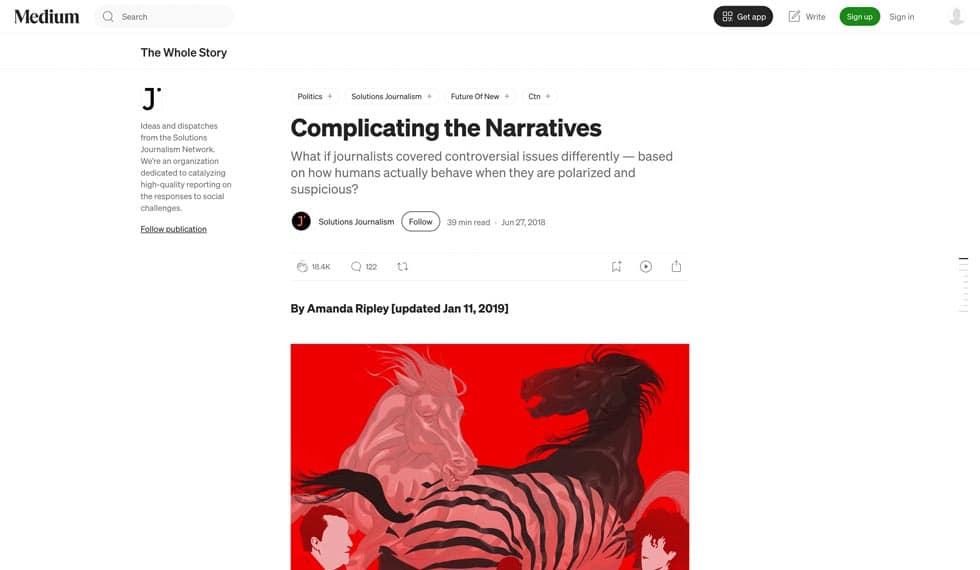
My students this week are reading a piece– I don’t have the author on hand, but I’ll add it to the recommendations. I’ll send you an e-mail– called Complicating The Narratives. It went viral a year or two ago. It’s a wonderful piece about how journalists can avoid those kinds of problems of just bringing two people, when one side has a huge weight of evidence, by embracing complexity and the different ways that we can widen the lens, that we can talk about things without introducing, “Okay, here are two sides.”
I love the phrase of “wicked problems,” and I think a lot of these are wicked problems. They’re tangled, and, I quote, Tressie McMillan Cottom in a book about smart people needing to avoid certainty, and that these wicked problems are tangled, but they’re really urgent. Having those conversations in ways that avoid both sides-isms is really important.
I think that there are other issues that have more complexity than– Climate change clearly has a huge weight of evidence on one side, but there are other issues that we could have a multitude of opinions, not just for and against, or yes or no. It’s really dangerous to engage in those kinds of false dichotomies.
[00:11:23] Bonni: I’m thinking as you’re describing that, how powerful, then, our role as teachers can be. First, we have to get ourselves out of the habit of adopting that, which I can see can be a challenge, but then also asking the right kinds of questions that help get people engaged in those broader discussions. How do you teach a group of people to discuss these complicated narratives? I’m excited about the article. It sounds really good.
[00:11:49] Sarah: Yes, it’s really good. It has all different sorts of suggested solutions.
[00:11:54] Bonni: One of the areas I know you’ve seen this in is in the scholarship of teaching and learning. How have you seen HIVEMIND and these false dichotomies entering into that space?
[00:12:04] Sarah: Well, one really interesting thing that I have been just keeping my eye on because it fascinates me is I see is good polarization happening a little bit surrounding how teachers should best improve our craft in the classroom. It seems like there’s a cluster of ideas and people and researchers who are– I see them as very cognitively focused. They’re drawing from cognitive neuroscience. They are drawing looking at learning strategies. They’re trying to break down and operationalize learning and how best to help students learn, how their brains work, what are the techniques that we know from cognitive neuroscience, and to improve those strategies. That’s one side.
Then, I see this other camp growing around more emotion-focused, intuitive, progressive, inclusive teaching practices that resist the codification of learning. I’m sensing that some have done some keynotes and workshops to groups that are more one or the other flavor. Sometimes, this other camp puts scare quotes around science. What is science, and also, what is learning?
I had someone say that to me in a workshop, they said that they didn’t think that learning was about facts and learning new skills at all. That’s really fascinating, and both of these groups are deeply passionate about pedagogy and about learning and about helping our students, but it seems to me just sitting back and watching the Twitter conversations, that people are moving out, echoing each other, not talking to each other very much.
Once in a while– I think the field of the scholarship of teaching and learning is so filled with lovely people. I think that teachers are just such a naturally kind and generous group– maybe that’s a biased opinion, I don’t know. I don’t see a lot of animosity in these polarizations, but just a lot of not talking to each other more and not accepting each other’s evidence as evidence, and things like that.
James Lange and I put together a grant proposal for NSF, and we decided to go a different route. One of my ideas was to take a bunch of people from these two camps and put them in a room, and you’ll have that debate. You talk about, what is learning? Is there a role for empirically studying some of these things? Is it more about relationships? How can we be both inclusive and any strategies that we know that will help students learn?
I see learning as both. Some of learning is about facts. I teach neuroscience, and I need my students to know what parts of the brains are. Strategies and some of learning is all relational and growing as people. I think it could be a really great synergy to cross that bridge.
[00:15:04] Bonni: We had something similar like that come up at our institution. We did a workshop on culturally responsive teaching. We are a Hispanic-serving institution, and so it came up around that population and what are some of the needs that are unique. People were really resisting that. I treat all my students as if they’re individuals. My comment was that, I think that’s wonderful that we really could weaken our teaching if we just started applying labels to people and not being careful.
Yet, at the same time, one of the practices within the Hispanic-serving institutions is to do a DFW audit and see if there’s a disproportionate number of Hispanic or other students of color who received those grades. The,n we can look at– We’ve done past episodes with faculty talking about these change in their practices and starting to see there be less disparity.
I think that could possibly be another example where we could get really stuck in that either or, and how wonderful if we could both treat each student as individuals, but also be doing these checks for our own implicit biases that they exist. Another HIVEMIND tendency that you talked about is our tendency to see knowledge as fitting in these distinct and separate boxes. What did you discover in your research about this tendency?
[00:16:29] Sarah: Well, I mean they’re related to each other, I think, because it’s again, back to that dichotomy and extreme opinions on things. This is just a human tendency, in general, that we see information and knowledge as existing in these boxes. I would love to do is to really break those down. There’s so many different people who are studying in the phenomenon of groups of people working together trying to advance knowledge or to learn skills.
Certainly, we’re doing that in higher ed, but people are also doing that in business. I had a couple of friends in industry, and I’m Chair of the IRB at my institution, and I can’t believe the research that they get away without any ethical approval. They are putting sensors in people’s bedrooms that eavesdrop– It’s wild. They are very focused on how can teams, working together, develop products, which is a lot like students working on projects together in classrooms.
There’s psychologists studying people going on space missions, and how does a team dynamics work in those settings. There is all the work in social neuroscience on how we synchronize and share knowledge. I get really excited about the idea of taking information from all of these different places to inform our work of the classroom. I was lucky enough– He proposed a session, and they invited me to do it as the anchor session, so any people attending that conference could stay until Sunday. We’re going to talk about honey bees and outer space missions and business, and how we can take knowledge from all of these other areas and bring it into the classroom.
[00:18:14] Bonni: We have just a couple minutes left before we go over to the recommendations segment, and since you brought up honey bees– I’ve been watching on Twitter– You’re just so fun to follow on Twitter. If you could just share a few random things that we may not know about honey bees that you uncovered, I think that would be a fun way to transition us over to the recommendations.
[00:18:36] Sarah: Well, in the first chapter of the book, I interviewed a beekeeper. I went out to western Mass. I was hoping he’d let me play with the bees, but his research assistant didn’t show up, and so I didn’t get to play with the bees. He told me lots of interesting things about his bees. One of the things he said that I loved was that the healthiest hives are the most diverse, in his opinion– that he sees bees as–I don’t know how scientific this part is.
He’s not a biologist, he’s a beekeeper. They have little personalities, and that some are more aggressive, some are more communal. He sees certain hives as having those personalities, or there are certain hives he says, they’re low on honey. You don’t want to go anywhere near them, because it’ll be a bad news.
He saw the hives that thrived the most, he thought, were the ones that were most diverse, which I loved that quote. Then, how much they also operate using pheromones and having a clear leader in their queen releasing this hormone that communicated that everything was all well in the hive. I see that as the instructor, to say, all as well, being the master of the ship.
[00:19:47] Bonni: It’s funny, because I do read Twitter later at night than I should. Did I also see something from you the other night about a spider, that’s the big huge spider and it keeps a little tiny– Was it a frog?
[00:20:00] Sarah: Yes, I don’t know if this is true. My joke on Twitter was that I literally had spent the day talking to my interest classes about media literacy and make sure to fact-check everything. Then, someone put on Facebook this thing about spiders keeping teeny tiny frogs as pets to kill bugs that are too small for them to see. The fact that these little frogs are actually cats, spider cats. I said, “I don’t care if it’s true, I’m just going to believe it.”
[00:20:28] Bonni: You’re just going to believe it? [chuckles] I think that entered into my dream in some way, but–
[laughter]
[00:20:32] Sarah: Oh, no. I gave you a spider dreams.
[00:20:35] Bonni: Yes, it could be. I don’t remember me having my sleep disrupted, but it’s so funny. Just that image really stays with me. Now, I’m going be so curious if it ends up being true.
[00:20:44] Sarah: Yes, I shouldn’t have faith.
[00:20:45] Bonni: I’m the one who brought it up without untested, [laughs] but I’d like to believe it’s true, it would be nice. All right, this is the point in the show where we each get to give recommendations, and I have a couple of them. The first one is from Maria Anderson. Her Twitter handle is businessgirl, and she’s got a wonderful blog. She recently put out some basic HTML tips for when your learning management system is making you nuts. I think sometimes, people think that that’s really inaccessible, like, I couldn’t learn that. I’m not a programmer.
I think her article is a really nice way to start small and just learn a few things that could go a long way and not make it as intimidating. She’s so good about breaking things down, so that’s my first recommendation. The second one is an article from Fast Company, and it’s called I create Videos for a Living. These tools make it easy and affordable. It’s just a wonderful way of looking at sound for video, and looking at screens and clutter. How do you make a higher quality video from an expert? It really makes it accessible, and there’s a lot of different links to resources.
If you are working on improving your creating video game, this would be a great, great place to start. I’ve got those two recommendations, and now, I get to pass it over to you for yours, Sarah.
[00:22:01] Sarah: I think the first would be Complicating the Narratives article that I will send you. I think that that’s both great from a teaching perspective, anyone who wants students to start thinking about, how can we have better debates in the classroom? How can we think past polarization, but also is a wonderful set of solutions to some of these themes of dark sides of the hive mind.
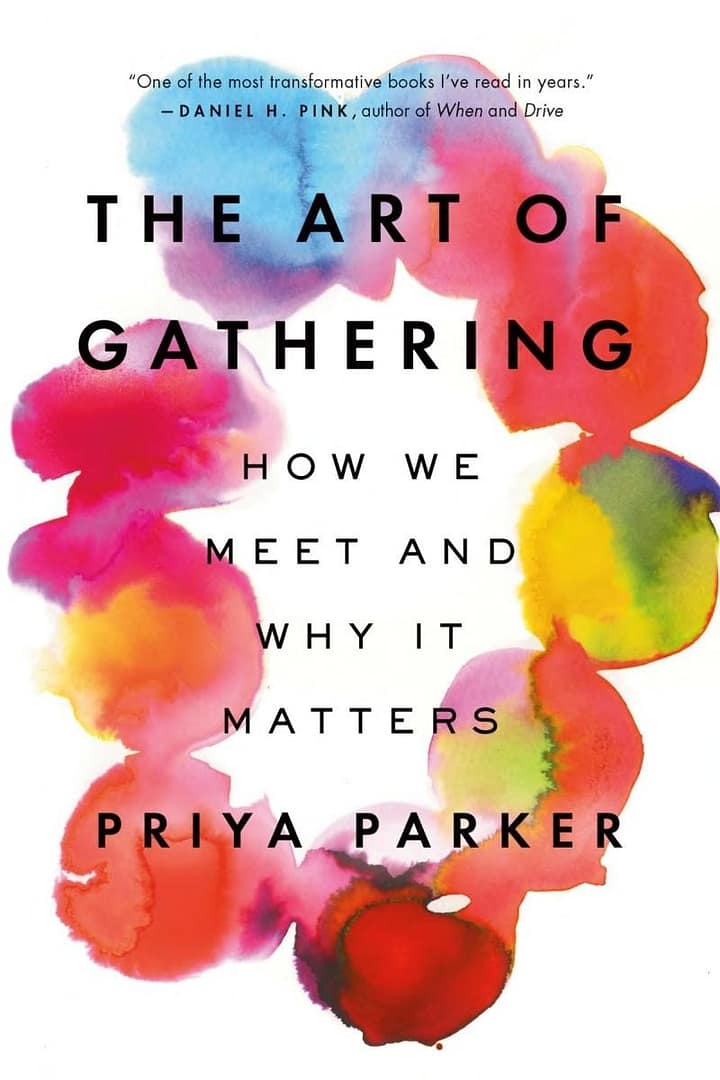
My second is– I recently had a speaking engagement at East Tennessee State University that was lovely. The folks there and their planning team all read the book The Art of Gathering by Priya Parker. It’s interesting, because it’s not a teaching book. It’s a book about gathering, about how to throw a party or a conference or a work meeting, and how to gather better.
I read it on the plane on the ride over, and I just love the principles. It’s filled with– I turned it in to a blog post, in fact, I loved it so much. Tips about openings and how you shouldn’t start with logistics. Any gathering, you should start with purpose, and you should start with meaning, and just ways to gather more meaningfully and connect more meaningfully. I think it’s full of rich recommendations, both for the classroom and just for life.
[00:23:21] Bonni: Dave, my husband, had her on his podcast, and so she– He read the book, too, and he said that there was a lot in terms of– because we do some event planning in my departments as well, but also, just for teaching, starting with that purpose, some really good reminders. Sometimes, I think, for me, gatherings seem to be a little bit more superficial than I would prefer. If we really do start with that purpose and the deeper ways we want to engage, we can really design great experiences. I’m reluctant to say I haven’t read it yet, but you’re making me want to read it even more for sure. [laughs] It’s hard to keep up with all these great books we come across.
[00:23:56] Sarah: It is.
[00:23:57] Bonni: Sarah, it’s been so wonderful to get to talk to you again. I’m just so excited about your work. I enjoy everything I’ve ever gotten my hands on that you’ve written. I love the way that you just resonate so much with our lives and make it accessible for us to understand this stuff, including HIVEMIND. Thank you so much for coming back on the show.
[00:24:15] Sarah: Thank you.
[00:24:17] Bonni: Thanks so much to Sarah Cavanagh for coming back on today’s Teaching in Higher Ed. It was great to learn more about HIVEMINDS. Of course, we should all go out and purchase it and get some of these ideas into our minds to improve our teaching and just lives in general. Thanks to all of you for listening to this episode of Teaching in Higher Ed.
If you’d like to go to the show notes, you can always get there by going to teachinginhighered.com/274. You also have an option to subscribe to them to come into your inbox, along with an article about teaching or productivity written by me. You can subscribe at teachinginhighered.com/subscribe. Thanks so much for listening, and we’ll see you next time.
[00:25:13] [END OF AUDIO]
Teaching in Higher Ed transcripts are created using a combination of an automated transcription service and human beings. This text likely will not represent the precise, word-for-word conversation that was had. The accuracy of the transcripts will vary. The authoritative record of the Teaching in Higher Ed podcasts is contained in the audio file.